
Average food truck startup costs often land between $40,000 and $200,000 in the U.S. That range alone should change how you evaluate this business.
A food truck is a capital allocation decision with tight margins, uneven daily sales, and very little room for sloppy execution. Owners who last treat the truck, buildout, permits, inventory, and working capital as one operating system, not a passion project with wheels. If financing is part of the plan, the structure matters as much as the amount. Short-term debt tied to long-lived equipment can squeeze cash before the truck has stable routes, which is why many operators review options like restaurant equipment financing for commercial kitchen assets before they commit.
The operators who perform well over time usually make boring decisions early. They keep the menu tight, know their food cost targets, price for labor and waste, and protect cash for the first slow months. They also understand a hard truth. Sales can look strong and the business can still fail if repairs, commissary fees, event terms, and debt payments were underestimated.
If you want to start a food truck, start with the numbers and let the concept follow. The truck is only the visible part of the business. Profit comes from disciplined planning, controlled spending, and daily operating habits that hold up under pressure.
Table of Contents
- Laying the Foundation From Idea to Business Plan
- Securing the Capital Food Truck Costs and Funding
- Becoming Official Navigating Permits Licenses and Regulations
- Building Your Mobile Kitchen Truck Menu and Supply Chain
- Hitting the Streets Location Marketing and Launch
- Running the Numbers Early Stage Financials and Growth
Laying the Foundation From Idea to Business Plan
Start with demand, not equipment
Restaurant failure rates get plenty of attention, but food truck failures usually come from a simpler problem. Owners buy the truck first and test demand later. That order ties up cash before the business has proven it can generate steady sales.
The first job is to confirm repeatable demand. A food truck is a small-footprint business with thin room for error. If the concept depends on occasional buzz, inconsistent events, or a customer base that only buys once, the numbers usually break fast.
Study buying behavior before you price a truck or sketch a wrap. Look at lunch corridors, school and sports traffic, brewery partnerships, office clusters, nightlife pockets, and recurring community events. Then get specific about what people already buy, how long they are willing to wait, and what they complain about with current options. The goal is not to find a clever idea. The goal is to find a pattern of demand you can serve profitably.
Three questions usually expose whether the idea is real:
- Who is the primary buyer? Office workers, parents at weekend events, brewery customers, late-night crowds, or commuters.
- When does that buyer purchase? Weekday lunch, dinner service, weekends, festivals, or catering blocks.
- Why will they choose this truck repeatedly? Speed, portability, price point, dietary fit, or one item they cannot get nearby without hassle.
If those answers are fuzzy, the concept is still expensive guesswork.
Practical rule: Do not commit to a truck purchase until you can describe the customer, the buying occasion, and the lead menu item in one clear sentence.
Make three decisions before writing the plan
A workable business plan starts with discipline, not formatting. Lenders may want a document. Operators need a model they can run.
The first decision is the offer. Food trucks that try to serve five different cravings usually create slower ticket times, higher prep complexity, more waste, and weaker margins. Tight concepts win because they are easier to execute in a cramped kitchen and easier to explain to customers.
The second decision is the customer. “People who like good food” is not a customer segment. A real customer definition affects portion size, price ceiling, service window, and where the truck can earn enough revenue per hour to justify showing up.
The third decision is the competitive set. That includes more than other trucks. Your real competitors are every fast, nearby option that solves the same meal occasion. That might be a deli, a convenience store hot bar, a sandwich chain, a grocery prepared-food counter, or an event vendor with shorter lines.
As noted in Epos Now's discussion of food truck success rates and failure patterns, operators often get into trouble with broad menus and weak location variety. Both problems show up in the planning stage first. If the concept needs too many ingredients or only works in one type of spot, it carries more risk than many first-time owners realize.
Write a plan that protects cash
A food truck business plan should answer one core question. Can this operation produce enough gross profit, often enough, to cover fixed costs and still leave the owner with acceptable income?
That changes what belongs in the plan. Mission statements matter less than operating assumptions. A useful plan should cover these five areas:
Core menu and signature item
Define the few items that will drive most orders. Focus on products that travel well, hold quality during rush periods, and can be produced with limited labor and equipment.Revenue model by service type
Separate weekday stops, private events, breweries, festivals, and catering. Each channel has different average tickets, labor demands, fees, and risk.Location mix
State where the truck is likely to earn repeat business, not just where it is allowed to park. A permitted location with weak traffic is still a bad location.Item-level margin assumptions
Build rough contribution margins for each major item before launch. If a popular item is slow to produce or weak on margin, it can hurt the business even when sales look strong.Launch and test plan
Set rules for what you will measure in the first weeks. That includes ticket count, average check, prep bottlenecks, waste, and which items should be cut quickly.
A strong plan helps owners reject bad decisions early. It tells you whether the concept can support debt, whether the menu justifies the equipment list, and whether your likely sales pattern can carry payroll, commissary costs, fuel, insurance, and downtime. If the plan does not answer those questions, it is not a business plan yet. It is a wish list.
Securing the Capital Food Truck Costs and Funding
Food trucks rarely fail because the owner cannot cook. They fail because the business runs out of cash before the model gets stable.
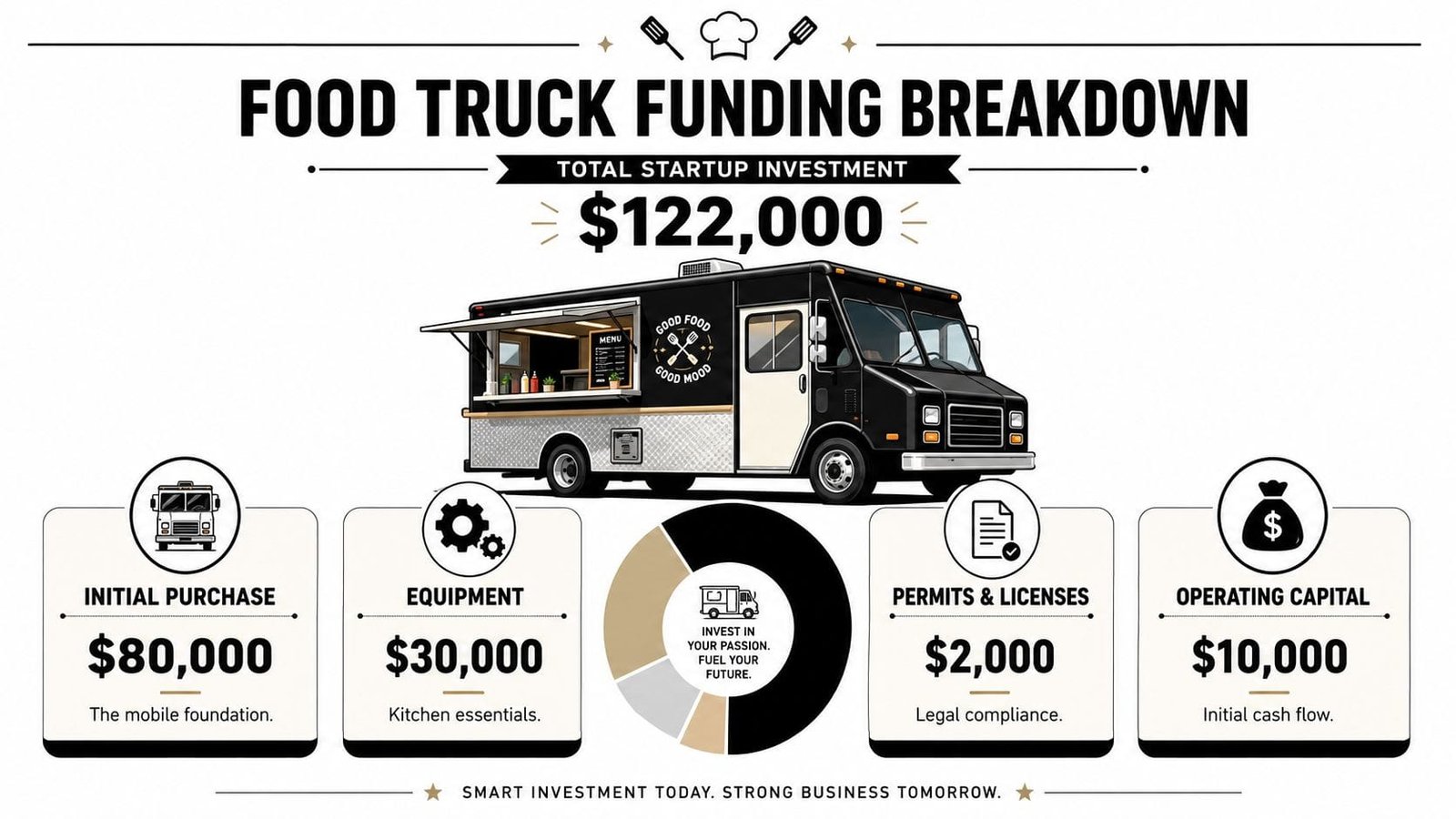
The funding decision is bigger than coming up with a purchase price. Owners need enough capital to buy the truck, outfit it for the menu, clear startup obligations, and survive the first stretch of uneven sales. Underfunding shows up fast. Repairs get postponed, inventory runs thin, insurance deposits hurt more than they should, and every slow week becomes a crisis.
Budget by use of funds, not by a headline number
A single startup estimate is not enough to make a sound financing decision. What matters is where the money goes, which costs can be financed, and which costs must be covered by cash.
Use these funding buckets:
| Cost bucket | What belongs here | Why it matters |
|---|---|---|
| Vehicle and buildout | truck purchase, retrofit, wrap, installed systems | This is the largest fixed investment and usually the hardest to reverse if the concept changes |
| Kitchen equipment | refrigeration, cooking line, prep tools, storage | Equipment has to fit the menu, service speed, and power limits inside the truck |
| Compliance and setup | permits, registrations, inspections, legal setup, insurance deposits | Delays here burn time and money before the truck serves its first customer |
| Opening inventory and supplies | ingredients, disposables, cleaning supplies, uniforms | A weak opening stock position creates service failures and waste problems early |
| Working capital | payroll, fuel, commissary, repairs, slow weeks | This covers the gap between opening day and a reliable operating rhythm |
That last bucket gets ignored more than any other.
I see owners stretch to buy the truck, then assume the business will fund everything else immediately. It usually does not. Revenue ramps unevenly, event payments can lag, and breakdowns never wait for a good month. A truck can be fully built and still be financially fragile.
Later in the same planning process, it helps to see how experienced operators think about the cash stack before opening:
Match the funding tool to the asset
The financing structure should follow the life of the expense. That is one of the clearest differences between a well-built launch and a stressful one.
Equipment financing works best for assets with resale value and a usable life measured in years. The truck, refrigeration, generator, and installed cooking equipment often fit here. If you are comparing structures for those purchases, this guide to restaurant equipment financing gives a useful overview of how asset-based borrowing works.
SBA-backed financing can work well for borrowers with solid credit, stronger documentation, and time to wait through a more formal process. The appeal is usually lower monthly pressure because terms can be longer.
Term loans can cover broader startup needs, but they need discipline. They are often used too broadly. Borrowing long-term money for short-lived items like initial food stock or disposable packaging can leave the business paying for supplies long after they are gone.
Lines of credit fit operating swings better than startup assets. Fuel spikes, repair surprises, catering gaps, and temporary inventory builds are short-cycle problems. Flexible working capital fits those needs better than fixed-installment debt.
The basic rule is simple. Fund long-life assets with longer-term capital. Cover short-cycle operating costs with cash reserves or flexible working capital.
Short repayment schedules on long-life assets put pressure on the truck before the route book is proven.
Build the capital stack before you need it
Food truck owners often ask how much they can borrow. The better question is how much the business can carry without breaking under a mediocre month.
A practical capital stack usually includes three layers:
- Asset financing for the truck and major equipment
- Owner cash for soft costs and opening liquidity
- Reserve capital for repairs, delays, and weak early sales
That structure gives the business room to absorb normal startup friction. It also forces discipline. If there is no reserve after the truck is purchased and equipped, the project is probably too large for the current budget.
What lenders and investors want to see
Credit decisions are rarely based on enthusiasm alone. Lenders want evidence that the truck can generate enough cash to make payments while covering normal operating costs.
Bring these materials into shape before you apply:
- A clear concept summary: what you sell, who buys it, and where the truck is expected to earn repeat business
- A line-by-line startup budget: a real uses-of-funds sheet, not a rounded estimate
- Menu economics: item-level gross profit logic and realistic prep assumptions
- Operating assumptions: service windows, staffing, commissary plan, and expected weekly schedule
- A reserve plan: how the business will handle slow ramp-up, equipment issues, or delayed approvals
Strong applicants show how capital turns into sales capacity, and how sales capacity turns into cash flow. That standard matters even if the owner uses personal funds and never speaks with a lender.
Becoming Official Navigating Permits Licenses and Regulations
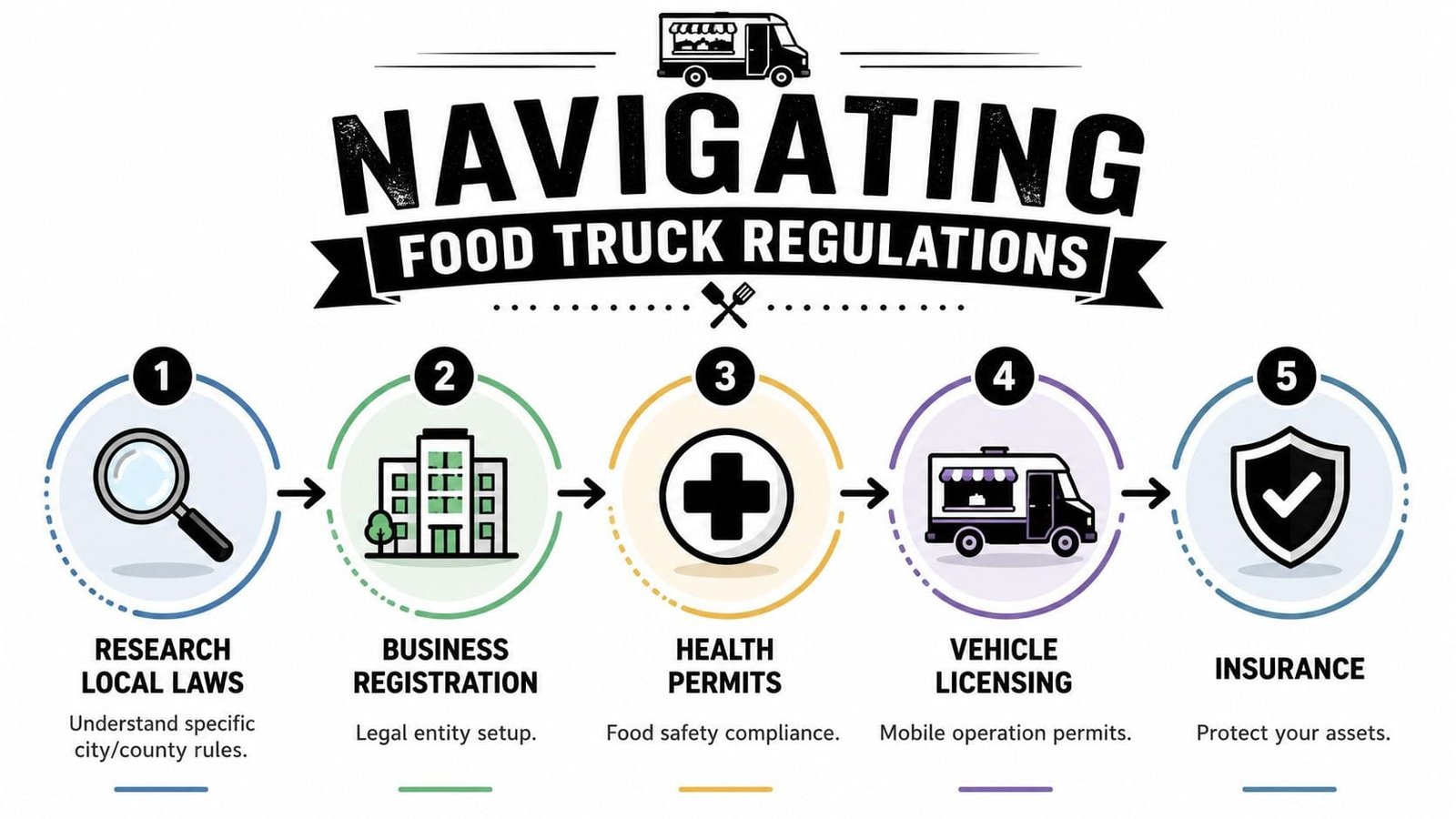
Most first-time owners think permits are a paperwork exercise. They aren't. They're an operating-permission exercise. The central issue isn't “what forms do I need?” It's “where can I legally and profitably sell food often enough to justify this investment?”
The real question is where you can operate
Wolters Kluwer's guidance makes an important point that many startup articles miss. Operators must verify city-specific zoning, approved vending zones, commissary access, and private-property permissions, because these rules are highly local and directly shape revenue potential, as outlined in its article on how to start a successful food truck business.
That changes the order of operations. Don't just ask what your city requires. Ask where your business model is allowed to function. A permit stack that lets you operate only in weak locations is not a win.
Paperwork matters, but operating permission matters more
You'll still need the expected legal and operational approvals. Business registration, health department approvals, food-safety compliance, vehicle-related licensing, and insurance all matter. But those are baseline requirements.
The harder questions are usually these:
- Can you vend in the zones where your target customers are
- Do you need commissary verification before approval
- Will private-property owners allow recurring service
- Are restroom or worker-access rules tied to your parking arrangements
- Do event permits differ from daily street or lot operation
A founder who answers those questions early avoids expensive rework. A founder who ignores them often ends up with a compliant truck and no viable route to revenue.
The wrong location strategy can kill a legally compliant truck just as fast as a permit denial.
What to verify before you spend heavily
Before you commit to a build, wrap, or financing package, validate the operational map. Use this checklist:
| Item to verify | Why it matters |
|---|---|
| Approved vending zones | Tells you whether your target demand areas are even available |
| Commissary requirement | Affects recurring cost, workflow, and daily logistics |
| Private property permissions | Many profitable spots depend on landlord or owner approval |
| Parking and maintenance arrangements | Determines where the truck can be stored, cleaned, and serviced |
| Event-specific rules | Festivals and special events often have separate approval layers |
I advise founders to gather local answers in writing whenever possible. Verbal guidance is useful, but written confirmation protects you when staff changes or interpretations shift. That's not bureaucracy for its own sake. That's risk control.
Building Your Mobile Kitchen Truck Menu and Supply Chain
Margins usually break before demand does. I've seen plenty of trucks attract a crowd and still struggle because the menu was too broad, the prep flow was clumsy, or one supplier miss turned a profitable day into a refund problem.
Design the truck around the menu
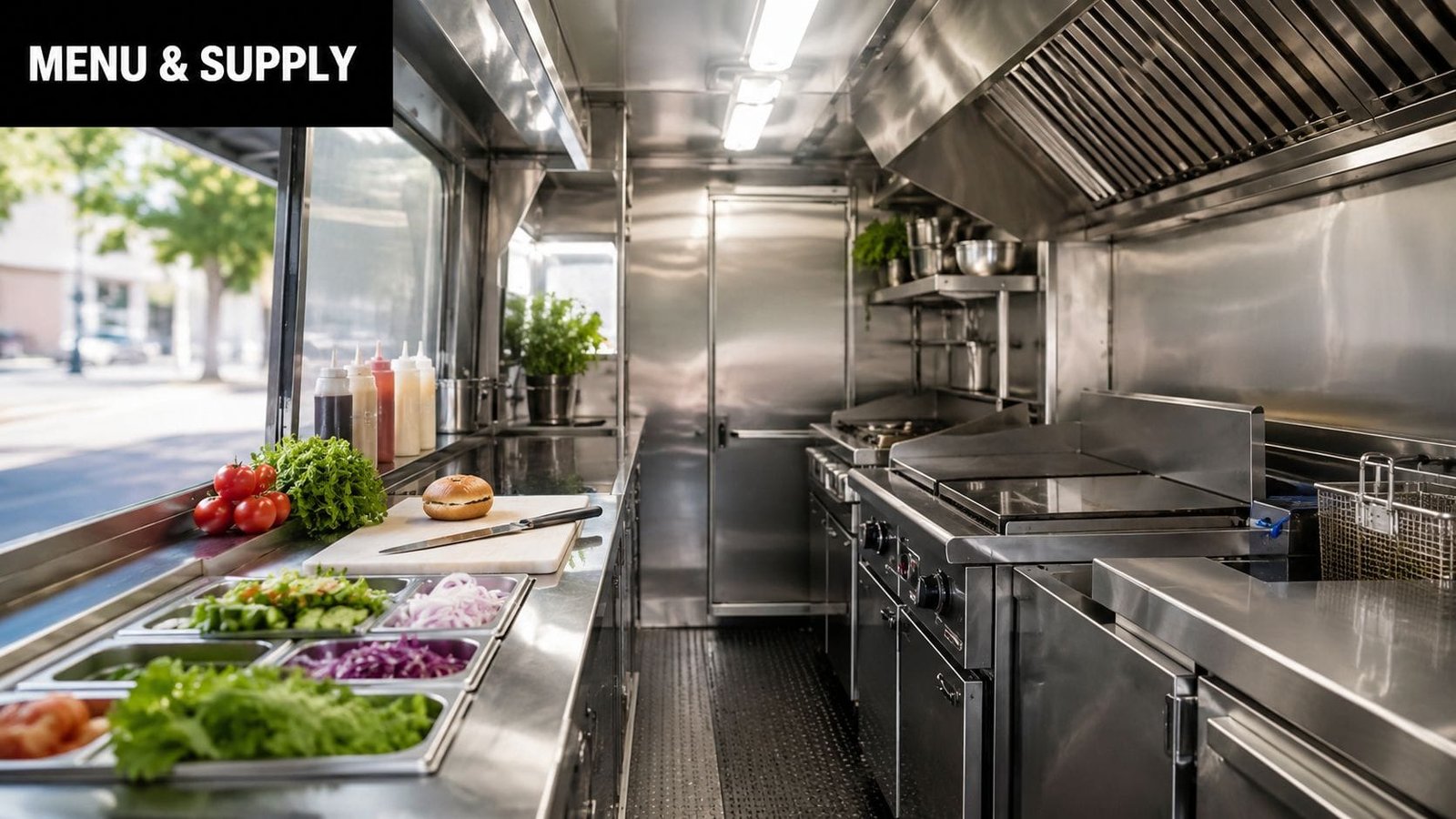
The truck is a production unit with hard limits on space, power, refrigeration, storage, and labor. Menu decisions need to come first because they determine the equipment package, the prep burden, and how fast you can turn a line into cash.
A compact menu usually performs better in a food truck because it reduces inventory complexity and keeps service predictable. Operators who try to serve too many items often pay for that ambition in slower ticket times, higher waste, and expensive build decisions that never earn their keep.
Used versus new matters here, but the financial trade-off is more important than the cosmetic one.
- Used truck: lower upfront cost preserves cash for working capital, marketing, and early repairs. The downside is layout compromise, more maintenance risk, and occasional retrofits to make the kitchen fit the menu.
- New or custom build: better workflow and cleaner equipment integration can improve output, but the higher debt load or larger cash outlay raises your break-even point.
The wrong truck can lock in weak economics for years. A fryer-heavy concept in a truck with poor ventilation, weak electrical capacity, or limited cold storage will cost more to operate than it should, even if sales look strong at first.
Why tight menus outperform broad menus
Strong food truck menus are built for margin and repeatable execution. Customers should be able to order fast. Staff should be able to produce the food the same way during the first rush and the fifth.
A tight menu improves:
- Speed of service because staff repeat the same assembly steps
- Food cost control because more dishes use the same core ingredients
- Training time because the line is easier to learn
- Waste control because fewer slow-moving ingredients expire
- Equipment use because each station supports revenue instead of taking up space
Broad menus usually create hidden costs. You carry more SKUs, tie up cash in inventory, increase spoilage risk, and slow down service during your highest-value selling windows.
Pricing discipline matters just as much as menu discipline. This guide on strategically pricing your menu to boost profits and qualify for restaurant business loans explains how to price for contribution margin, not just customer appeal. Lenders and investors look for a menu that can produce dependable cash flow after food, labor, and operating costs.
A good food truck menu is easy for the customer to choose from and easy for the operator to execute hundreds of times a week.
Build a supply chain that survives real service
Supply chain mistakes rarely show up in the business plan. They show up on a busy Friday when your bread delivery is late, your backup packaging does not fit the hot hold setup, or your prep team runs out of cooler space.
Build around consistency, not optimism.
Use primary vendors for core items
Start with the ingredients that define the concept. Protein, starch, bread, sauces, and packaging should come from suppliers who can support your typical weekly volume.Set backup sources for high-risk inputs
Single-source dependence is dangerous for signature items. If one supplier misses a delivery, you need another approved option fast.Match prep to storage capacity
Every menu item should fit your cold storage, dry storage, and line setup. If an item requires too much prep space or too many containers, it may not belong on the truck.Create par levels by service type
A lunch route, brewery shift, and festival day do not consume inventory the same way. Set purchasing and prep targets based on actual sales patterns, not guesswork.Standardize portions and yields
If portion size changes by employee or by shift, food cost drifts upward. Recipe cards, scoop sizes, and batch prep standards protect margin.
The best operators buy for reliability first, then negotiate cost. Saving a small amount on an ingredient does not help if inconsistency slows the line, hurts quality, or creates stockouts during peak service.
Menu engineering and supply discipline decide whether a truck can scale beyond the opening buzz. Revenue gets attention. Controlled execution produces profit.
Hitting the Streets Location Marketing and Launch
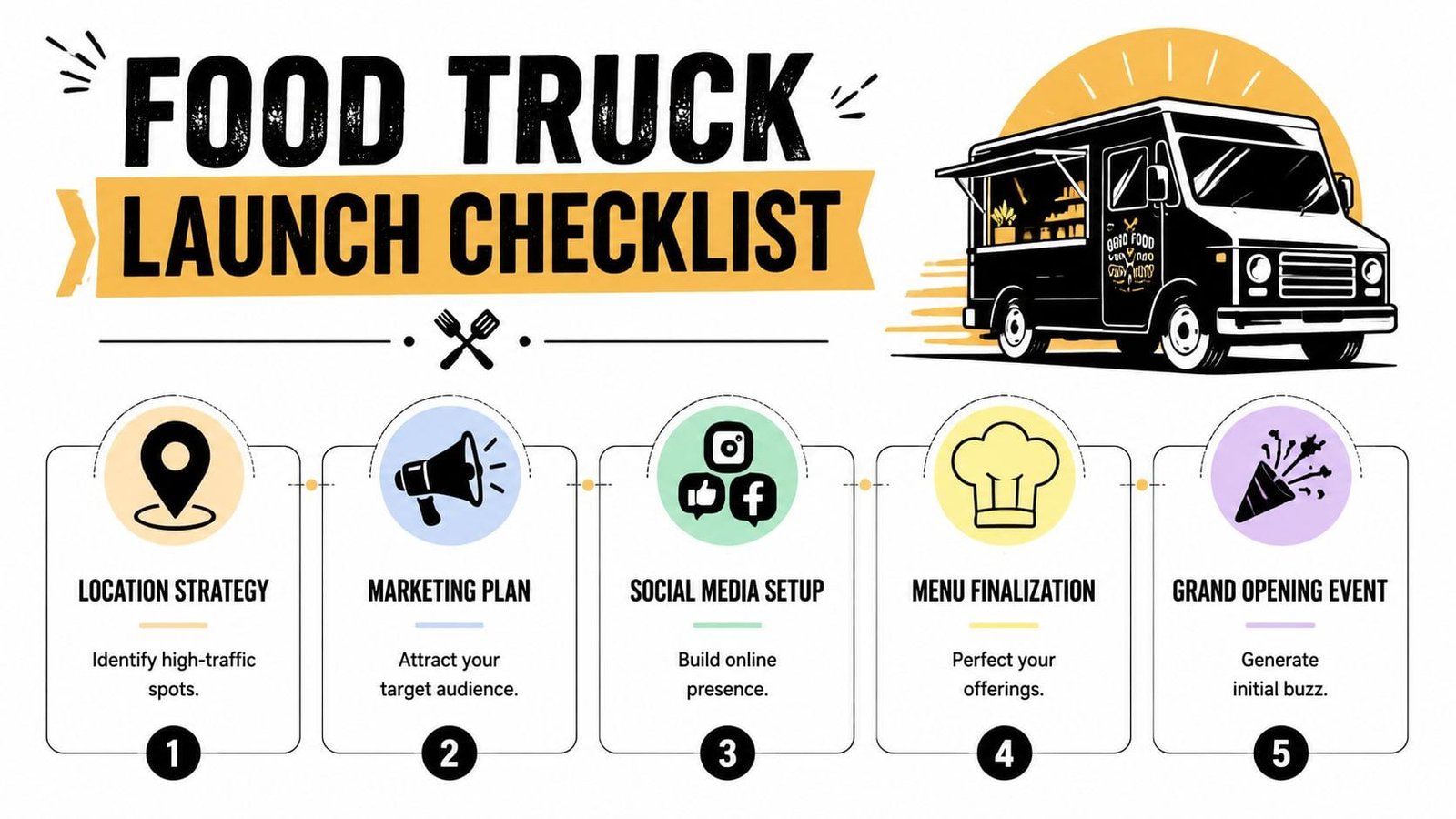
A food truck doesn't have a fixed address to do the selling for you. You have to create demand, signal where you'll be, and place the truck where the concept fits the occasion.
Location is part of the business model
Too many operators think of location as a scheduling decision. It's a core revenue decision. Lunch service near offices, brewery evenings, school or sports events, private catering, and weekend community events each produce different ticket rhythms, staffing stress, and menu demand.
Don't lock yourself into one spot out of convenience. Rotation matters because different locations reveal different strengths. Some locations are best for volume. Some are better for margin. Some are better for exposure and repeat discovery.
Build an opening rotation that includes:
- One dependable recurring stop that helps create habit
- One event-driven channel that can spike awareness
- One test location where you learn quickly whether the concept travels well
Use a two-stage launch
Soft launches are underrated because they don't feel glamorous. They are, however, one of the best forms of operational insurance. Square specifically recommends a soft launch to debug service speed, menu fit, and recurring costs before scaling, as noted earlier in the startup guidance.
Run the launch in two phases.
Phase one is the soft launch. Keep it controlled. Short service window, limited menu, simple staffing, and a clear goal of finding bottlenecks. Watch ticket flow, customer questions, prep timing, payment friction, and cleanup workload.
Phase two is the public opening push. Once the line can move and the menu holds up, promote a bigger debut through social channels, local groups, and partner venues.
A practical launch checklist looks like this:
- Before opening: claim and complete your Google Business Profile, set up social media pages, publish your first route schedule, and make sure your menu board is readable from a distance.
- During soft launch: limit options, watch service times, note what confuses customers, and track what sells first.
- After each service: review inventory depletion, staff fatigue, order bottlenecks, and guest feedback.
- At full launch: pair the opening with a host venue, local event, or community partner so visibility is built in.
Market like a local operator, not a big brand
Food truck marketing works best when it's concrete. Post where you are, what you're serving, when you'll sell out, and what your signature item is. Customers don't need abstract brand storytelling first. They need confidence that you'll be nearby and worth the stop.
Epos Now's discussion of launch basics emphasizes a minimum viable demand-generation stack that includes a Google Business Profile, website, social media, email marketing, and sidewalk signage. That's the right baseline. Simple and consistent beats elaborate and sporadic.
If people have to guess where you are, they usually won't come looking twice.
Running the Numbers Early Stage Financials and Growth
The food truck category is large and growing, but that doesn't make the average operation forgiving. According to GoFoodservice's IBISWorld-based reporting, the U.S. food truck industry included 92,257 businesses in 2025 and grew at a 23.8% compound annual rate from 2020 to 2025, while overall food-service profit margins typically average 3% to 8% and food trucks are often cited around 6.2%, as summarized in its analysis of why food trucks matter in the restaurant economy. That's the clearest reason to stay obsessed with your numbers. The business can grow as a category while individual operators still lose money through sloppy execution.
Track the right numbers from day one
Many owners watch total sales and stop there. Sales matter, but they don't tell you whether the truck is healthy. Track these weekly at minimum:
| KPI | What it tells you |
|---|---|
| Sales by location | Which stops deserve repeat scheduling |
| Sales by menu item | Which items carry the truck and which ones waste space |
| Cost of goods sold | Whether pricing and purchasing are holding up |
| Labor as a share of sales | Whether staffing fits the volume pattern |
| Average transaction value | Whether customers are buying enough per stop |
| Cash on hand | Whether the business can absorb repairs, weather, or weak weeks |
I'd also track voids, discounts, and waste notes. Those are often early warnings that the operation looks busier than it really is.
Use your first months to make hard decisions
Early-stage operators often protect bad ideas too long. They keep weak menu items because they like them. They revisit weak locations because they hope things will change. That drains margin and management attention.
Use real results to make cuts. If an item complicates prep but doesn't pull its weight, remove it. If a location produces traffic without profitable ordering behavior, reduce or replace it. If labor is too high for a service window, redesign the shift or shorten the menu for that slot.
A simple review rhythm helps:
- After every service: note sellouts, waste, and workflow issues.
- At week's end: compare locations and item mix.
- At month's end: decide what to cut, keep, or test next.
Financial discipline is not a personality trait. It's a routine.
Grow only after the truck is financially repeatable
Growth is attractive because food trucks create visible momentum. If the truck is busy, expansion feels close. But growth only works when the current unit is repeatable.
That means:
- the menu performs consistently
- the location mix makes sense
- cash flow isn't fragile
- staffing works without constant heroics
- equipment downtime doesn't derail service
- owner decisions rely on data, not instinct alone
If expansion is on your horizon, build a real forecast first. This practical guide on how to build a cash flow forecast that empowers your loan strategy is worth reviewing because it forces you to model debt capacity, timing gaps, and operating pressure before you borrow for the next move.
The founders who build durable brands from trucks usually master one unit before chasing the second. That patience is not cautious. It's profitable.
If you're ready to fund a truck, refinance equipment, or build a smarter working-capital plan, Business Loan Warrior can help you compare financing options without turning the process into a full-time job. The platform helps business owners check specific funding paths, evaluate terms, and move faster on the capital decisions that matter most when you start a food truck.