

You're probably making a decision right now that costs real money either way.
Maybe you're thinking about adding a service line, raising prices, opening a second location, or buying equipment with borrowed capital. The problem isn't usually ambition. It's uncertainty. You don't want to commit cash, take on debt, or lock in a plan based on a few loud customer comments and your own gut.
That's where market research questionnaires earn their keep. For a small business, they're not academic exercises. They're a fast, low-cost way to pressure-test decisions before you spend money you can't easily get back.
Table of Contents
- Why Guess When You Can Know?
- Defining Your One Core Research Objective
- Designing Questions That Elicit Truth
- Structuring Your Questionnaire for Flow and Completion
- Distributing Your Survey and Maximizing Responses
- Analyzing Results and Translating Data into Action
Why Guess When You Can Know?
A lot of owners call something “market feedback” when what they really mean is a handful of comments from regulars, a sales rep's opinion, and a competitor move they noticed on Facebook. That's better than nothing, but it's still shaky ground for decisions tied to payroll, inventory, pricing, or financing.
A questionnaire gives you a cleaner signal. You ask the same questions, in the same order, to the people who are relevant. Then you look for patterns instead of anecdotes. That changes the quality of the decision.

Modern market research questionnaires didn't appear out of nowhere. The foundational design was established between 1930 and 1960, creating a scientific process that companies like AC Nielsen used to measure entire markets, and that blueprint still underpins how businesses study purchasing behavior and competitive position today, as outlined in this history of survey research from Public Opinion Quarterly.
That history matters for one reason. It reminds you that a questionnaire isn't just a list of questions. It's a system for reducing uncertainty before you act. Small businesses need that kind of system thinking in more places than they usually realize, especially in decisions that affect operations, staffing, and capital planning. If you want a broader view of why repeatable processes matter, this piece on why every business needs a solid system is worth reading.
Practical rule: If the decision is expensive, customer-facing, or hard to reverse, don't rely on instinct alone.
Used well, market research questionnaires help you answer questions like these:
- Pricing risk: Will customers accept a higher price if service improves?
- Expansion risk: Which location, service, or product category has actual demand?
- Investment risk: Will a new machine, hire, or software tool solve a real customer problem?
- Loan risk: If you borrow to grow, are you funding a validated opportunity or just a hope?
That last point gets ignored too often. Before you use outside capital, you want evidence that demand exists and that buyers value what you plan to improve. A good questionnaire won't guarantee success. It will make your next move smarter.
Defining Your One Core Research Objective
Most bad surveys fail before the first question gets written.
The owner starts with something broad like “I want to understand my customers better,” then piles in questions about pricing, service, brand perception, new products, website usability, delivery speed, and demographics. The result is a long form that produces a pile of answers and very little direction.
A useful questionnaire starts with one decision.
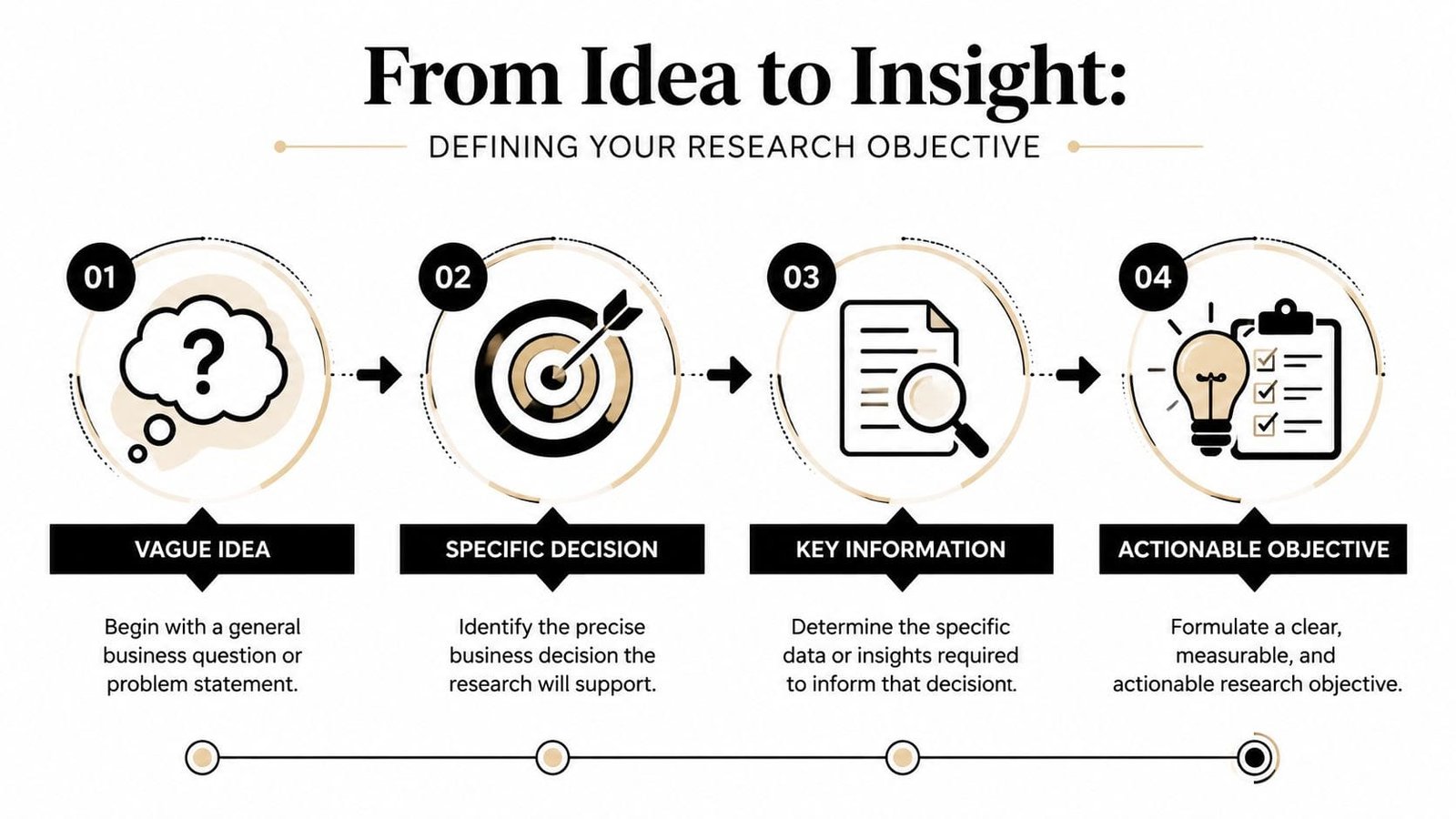
Turn a vague concern into a real decision
Here's the difference:
- Too vague: Understand customer preferences
- Better: Decide whether to extend weekend hours
- Too broad: Learn what people think of our brand
- Better: Find out why first-time buyers don't return
- Too fuzzy: Test demand for growth
- Better: Determine whether existing customers want a maintenance plan enough to justify hiring for it
The sharper the decision, the sharper the questionnaire.
A simple four-part filter works well:
Name the business move
What are you about to do, stop doing, change, buy, launch, or fund?
Define the risk
What could go wrong if you guess wrong? Lost margin, weak demand, wasted ad spend, underused equipment, poor repayment capacity.
Identify the missing information
What do you need customers to tell you that internal reports can't?
Write the objective in one sentence
Example: “We need to determine whether current customers value faster turnaround enough to support a higher-priced service tier.”
That sentence should be plain enough that a manager can read it and immediately know why the survey exists.
A quick visual can help lock that in:
Keep one objective per questionnaire
Owners often resist this because they want to “get the most out of the survey.” That instinct usually backfires. Every extra objective creates extra questions, extra complexity, and extra noise.
If you need to answer three unrelated business questions, run three shorter questionnaires over time or send each one to a different segment. Don't force one form to do everything.
A short survey with a single purpose beats a long survey that tries to settle every debate in the company.
A good objective usually fits one of these categories:
- Decision support for pricing: Can the market absorb a change, and what value matters most?
- Demand validation: Is there enough interest in a new offer to justify investment?
- Customer retention: Why are people leaving, staying, or buying less often?
- Operational improvement: Which friction points hurt the customer experience most?
- Financing readiness: Is the planned use of funds tied to a customer need people describe and prioritize?
Use this test before writing a single question
Ask yourself three blunt questions:
- Would the answer change what we do? If not, cut it.
- Can a respondent reasonably answer it? Customers can report experiences and preferences. They can't diagnose your strategy for you.
- Will this help us choose between options? If the answer only produces “interesting” commentary, it probably doesn't belong.
That discipline protects your time and your respondents' attention. It also protects your budget. If a questionnaire won't improve a decision, it's not research. It's paperwork.
Designing Questions That Elicit Truth
Good questionnaires don't just collect answers. They reduce distortion.
That means your questions need to do three things at once. They need to be easy to understand, neutral in tone, and specific enough to support action. If any one of those breaks, your data gets soft fast.
For optimal results, market research questionnaires should aim for 70–80% closed-ended and 20–30% open-ended questions, while limiting open-ended questions to 3–4 per survey to avoid respondent fatigue and drop-off, according to Formbricks' guidance on market research survey questions.
Use structure to get usable data
Closed-ended questions help you compare responses cleanly. They're the backbone of decision-making because they let you spot patterns quickly in a spreadsheet.
Open-ended questions tell you why people chose what they chose. That context matters, but only in small doses. If you ask too many text-box questions, people either quit or rush through with low-effort replies.
A practical mix looks like this:
- Closed-ended for priorities: Which factor matters most when choosing a provider?
- Closed-ended for behavior: How often have you purchased from us recently?
- Closed-ended for comparison: Which of these service options would you most likely choose?
- Open-ended for nuance: What almost stopped you from buying?
- Open-ended for language: How would you describe the main problem you hired us to solve?
Bad questions waste good respondents
Most survey problems come from wording, not software.
Here are common mistakes I see all the time:
- Leading question: “How much did you enjoy our fast, friendly service?”
- Double-barreled question: “How satisfied are you with our pricing and delivery speed?”
- Jargon-heavy question: “How do you rate our omnichannel fulfillment experience?”
- Hypothetical fluff: “Would you be interested in a premium solution designed to optimize your lifestyle?”
Now compare those with stronger versions:
- Neutral version: “How would you rate your recent service experience?”
- Separated version: “How would you rate our pricing?” and “How would you rate our delivery speed?”
- Plain-English version: “How easy was it to get your order when you wanted it?”
- Decision-ready version: “Which of these upgraded service options would you be most likely to buy?”
What works: Ask about recent behavior, clear preferences, and concrete trade-offs.
What fails: Asking people to flatter you, predict imaginary future behavior, or decode your internal language.
Another fix is to remove assumptions. Don't ask, “Why did you choose our premium plan?” unless you already know they chose it. Ask first whether they did.
Sample question bank for small businesses
You don't need a giant research department to write solid questions. You need a short bank tied to the decision you're making.
| Use Case | Question Type | Sample Question |
|---|---|---|
| Customer satisfaction | Closed-ended | How satisfied were you with your most recent experience with our business? |
| Customer satisfaction | Open-ended | What's one thing we could have done better? |
| Product-market fit | Closed-ended | Which problem were you hoping our product or service would solve? |
| Product-market fit | Closed-ended | How well did our offer solve that problem? |
| Product-market fit | Open-ended | What almost stopped you from buying from us? |
| Pricing strategy | Closed-ended | Which of these pricing options would you be most likely to choose? |
| Pricing strategy | Closed-ended | What mattered more in your decision, lower price or faster service? |
| Retention | Closed-ended | Have you considered switching to another provider in this category? |
| Retention | Open-ended | If yes, what was the main reason? |
| New service demand | Closed-ended | How likely would you be to consider this new service if it were available? |
| New service demand | Closed-ended | Which version of this service would best fit your needs? |
When you draft your own list, read every question and ask, “Can I act on the answers?” If the answer is no, delete it.
Structuring Your Questionnaire for Flow and Completion
A questionnaire can have strong questions and still perform badly because the experience feels clumsy.
Respondents don't experience your survey as a research instrument. They experience it as a conversation. If that conversation starts awkwardly, jumps around, or asks irrelevant questions, they leave. Or worse, they stay and answer carelessly.

Start like a good conversation
The opening needs to do two jobs quickly. It should tell people how long the survey will take and assure them their responses are confidential. Formbricks also notes that screening questions belong at the very beginning so you can filter for qualified respondents who know the product, brand, or category you're asking about.
That sequence matters. If you own a roofing company and want feedback on a maintenance subscription, you shouldn't ask everyone a long series of pricing questions. First ask whether they've used your services recently or are responsible for property maintenance decisions. If not, route them out or to a shorter version.
A strong flow usually follows this order:
- Introduction first: State the purpose plainly, mention estimated completion time, and address confidentiality.
- Screening next: Confirm the person belongs in the sample.
- Core topic after that: Ask the most important decision questions while attention is highest.
- Profile questions last: Save demographics or lower-priority segmentation items for the end.
Skip logic helps a lot here. If someone says they've never used a service, don't force them through detailed satisfaction questions. If a respondent says price is their biggest barrier, route them to a follow-up about pricing trade-offs instead of generic brand items.
A survey should feel tailored, even when it's automated.
Pilot testing catches expensive mistakes
I've seen owners spend time building forms in Typeform, Google Forms, or SurveyMonkey, send them to a list, and only then discover the questions are unclear. At that point, the damage is done. Responses are contaminated, and you don't know which answers to trust.
Pilot testing is the fix. Formbricks warns that skipping a pilot test allows jargon, ambiguity, and logic problems to survive into the full launch. That directly weakens data quality.
Before you send the questionnaire widely, ask a small group of real target respondents to take it while you watch for friction:
- Confusing wording: Where do they pause or reread?
- Broken logic: Did anyone get questions that didn't apply?
- Annoying repetition: Did two items ask nearly the same thing?
- Weak answer choices: Were they forced to pick options that didn't fit?
One of the easiest ways to improve completion is to cut questions that don't pull their weight. Owners often believe one more question can't hurt. It can. Every extra click gives people another chance to leave.
The best questionnaires feel shorter than they are because the sequence makes sense.
Distributing Your Survey and Maximizing Responses
A smart questionnaire with weak distribution is like a strong sales pitch delivered to the wrong room.
Most small businesses don't have the luxury of a giant panel or a research agency. That's fine. You can still get useful input if you put the questionnaire in front of the right people and give them a good reason to answer now, not later.
Pick the channel based on the decision
The channel should match the audience and the business question.
Email works well when you need feedback from existing customers and already have a usable list. A website embed is useful when you want input close to a buying or support experience. Social media can work for broad directional feedback, but it's less reliable when you need responses from a specific customer segment.
If your goal is loyalty or experience measurement, tools built for in-message feedback can reduce friction. For example, teams exploring NPS email surveys often use them because they let recipients respond directly from the email experience instead of bouncing through extra steps.
Your tech stack matters too. If your customer list is scattered across inboxes, a POS system, and a CRM no one updates, distribution gets messy fast. Clean systems make better research possible, which is one reason this guide to small business essential tech tools is useful beyond marketing alone.
A practical way to think about channels:
- Email list: Best for current customers, repeat buyers, and account holders.
- Website or checkout embed: Best for catching feedback close to a transaction.
- Text or QR code in-store: Best when the experience is physical and immediate.
- Social post: Best for lightweight audience input, not high-stakes decisions.
- Sales or account outreach: Best when you need responses from a narrow, valuable segment.
The invitation does most of the work
Owners often obsess over survey software and ignore the invitation. That's backwards. The message determines whether people open, trust, and start.
A good invite is direct. It says why you're asking, who it's for, how long it takes, and what the respondent's feedback will influence. Busy people respond when the request feels relevant and bounded.
Write invitations like this:
- Be specific about purpose: “We're reviewing our service packages and want input from current clients.”
- Set expectations clearly: “This survey takes a few minutes.”
- Explain the payoff: “Your answers will help us decide which option to add.”
- Keep the tone human: Don't sound like legal copy or a corporate memo.
Personalization helps when it's real. Using a first name is fine, but relevance matters more than merge tags. A customer who recently bought from you should get a different invitation than a lead who only requested a quote.
If you want honest responses, ask at a moment when the experience is still fresh and the reason for asking is easy to understand.
Incentives can help, but they're not always necessary. Sometimes a modest thank-you works. Sometimes it attracts people who rush through for the reward. If your audience already has a relationship with you, clarity and timing often matter more than a prize.
The key is simple. Distribution isn't administrative. It's part of the research design.
Analyzing Results and Translating Data into Action
Many survey efforts die at this point. The form closes, the spreadsheet fills up, and nobody turns the responses into a decision.
You don't need advanced statistical software to get value from market research questionnaires. For most small businesses, a spreadsheet and disciplined thinking are enough. The hard part isn't math. It's connecting answers to the business move you were trying to make in the first place.
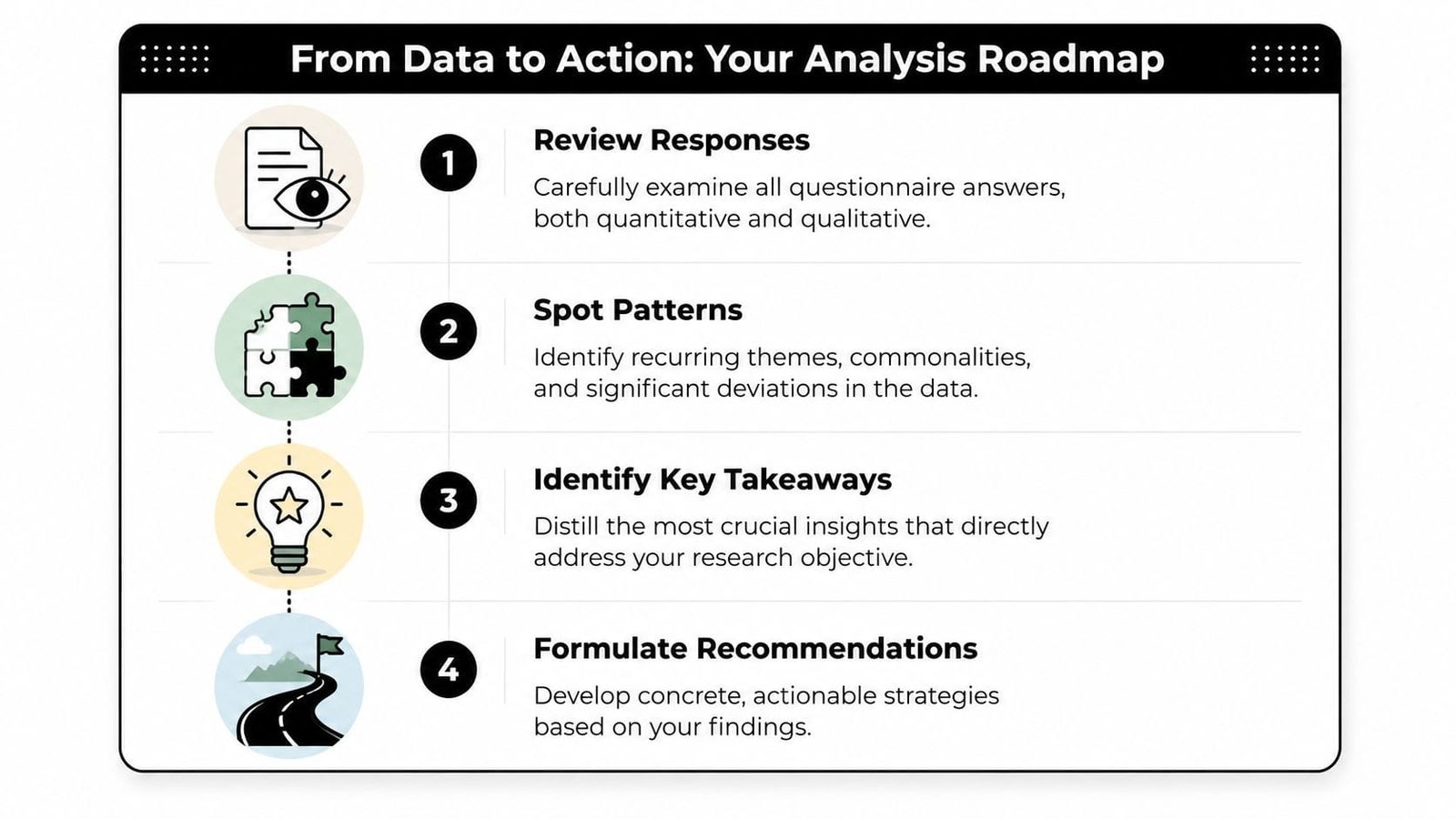
Start with the business question, not the spreadsheet
Before you sort, chart, or tag anything, restate the objective in one sentence. If your question was whether customers would support a premium service tier, every analysis step should help answer that.
Then split your review into two buckets:
- Closed-ended responses: Look for patterns in choices, rankings, and ratings.
- Open-ended responses: Look for repeated words, objections, and motivations.
This doesn't need to get fancy. In Excel or Google Sheets, you can sort by answer, group similar comments, and compare segments manually. What matters is that you separate signal from noise.
A useful review process looks like this:
Clean the file
Remove obvious junk, duplicates, or incomplete responses that don't help the decision.
Group key variables
Put similar respondents together. New customers versus repeat buyers. Higher-spend accounts versus lower-spend ones. Recent buyers versus lapsed customers.
Read comments in batches
Don't read open-ended responses one by one and make emotional judgments. Tag recurring themes such as price confusion, slow response time, limited hours, or feature requests.
Compare answers across segments
You're often looking for differences more than averages. Loyal customers may care about one thing, while new buyers care about another.
If customer satisfaction is part of the analysis, this practical guide for small businesses is a helpful companion because it shows straightforward ways to organize feedback into something managers can act on.
Turn patterns into decisions
A pattern becomes useful only when it changes a choice.
If respondents consistently select speed over price, that points toward operational investment and premium positioning. If comments cluster around confusion, the issue may be messaging, not the offer itself. If one segment shows interest and another doesn't, your next move may be to target the first group instead of rolling a change out broadly.
Here's the discipline I recommend:
- Write the finding plainly: “Existing customers repeatedly mention turnaround time.”
- Name the business implication: “Faster fulfillment may be more valuable than discounting.”
- Assign an action: “Test a priority service option for current customers first.”
- Set an owner: Someone has to make the change, not just agree with it.
That's also where financing decisions become sharper. If you're considering borrowing to hire, buy equipment, or expand capacity, your questionnaire findings should help answer whether the investment addresses a verified customer priority. If the data doesn't support the planned use of funds, rethink the plan before you touch your cash reserves or add debt. The same discipline applies to everyday operations and liquidity planning, especially if you're trying to improve cash flow while growing.
Decision filter: If a survey result doesn't lead to a clear action, either the objective was weak or the questionnaire asked the wrong things.
One more point matters. Share back what you learned with your team. Customer service, sales, operations, and leadership should all hear the same few takeaways in plain language. Not a dense report. Not twenty charts. Just the handful of findings that affect what happens next.
That's how questionnaires stop being “research” and start becoming operating intelligence.
If you're planning a major hire, equipment purchase, expansion, or pricing change, pair customer insight with funding discipline. Business Loan Warrior helps small businesses explore tailored financing options quickly, so you can move on validated opportunities with more confidence and less guesswork.