
You formed the LLC. The bank account is open. The logo is done, the lease is signed, and you're finally ready to invoice, hire, or open the doors.
Then the main problem shows up.
Your entity filing gave you a legal shell. It did not automatically give you permission to operate. That missing step catches owners all the time, especially when they're moving fast, adding locations, or preparing for financing. A lender may like your revenue, your margins, and your plan, but if your licensing file is incomplete, expired, or inconsistent with what the business does, the deal gets harder immediately.
I've seen this happen in ordinary situations. A contractor has the company formed but no local operating permit. A food business has sales coming in but missed a health-related approval. A professional practice is registered with the state but still missing the license that authorizes the work. On paper, the business looks established. In practice, it's exposed.
That's why I treat business licensing as part of business infrastructure, right alongside tax registration, contracts, and insurance. If you're sorting out locations, staffing, and risk, it also helps to review related obligations such as understanding California commercial insurance, because lenders and regulators don't view compliance items in isolation.
A license isn't busywork. It's the ticket that lets you legally sell, hire, expand, and show a lender that your operation is real, stable, and ready for capital.
Table of Contents
- Introduction Why Your Business License Is Your Ticket to Operate
- The Four Layers of Business Licensing
- Is My LLC Enough The Registration vs Licensing Myth
- How to Determine Exactly Which Licenses You Need
- The Licensing Application Playbook Required Documents Costs and Timelines
- Staying Compliant and Preparing for Renewals
- How Licensing Status Impacts Your Business Loan Application
Introduction Why Your Business License Is Your Ticket to Operate
A business owner can do almost everything right and still get stopped by licensing.
That's what makes this issue so frustrating. The owner isn't hiding. They've filed the LLC, obtained an EIN, signed a location, and started building the operation. But the legal right to exist and the legal right to operate are two different things. When those get confused, the business ends up vulnerable at exactly the wrong time, usually when it's about to launch, expand, or apply for funding.
The practical consequence is bigger than a paperwork delay. If you don't hold the right approvals, you may not be able to lawfully provide the service, collect tax where required, display required permits, or satisfy a lender's due diligence review. In lending, that matters because underwriters aren't just asking whether your business is profitable. They're asking whether it's financeable without avoidable compliance risk.
A clean licensing record tells a lender that management pays attention to operational details before those details become losses.
I tell owners to think of licensing as the operating layer of the company. Your entity filing is the frame. Licensing is the permission structure that allows revenue to flow through it. Without that layer, growth gets shaky. Expansion gets messy. Funding gets harder.
The businesses that handle licensing well usually do three things early:
- They separate formation from operation. They know the LLC filing is the beginning, not the finish line.
- They match licenses to real activity. What you sell, where you sell it, and where you physically operate all matter.
- They document everything. Lenders, landlords, agencies, and insurance carriers all ask for proof at different moments.
If you're trying to build a stable, fundable company, business license requirements aren't a side issue. They're part of the foundation.
The Four Layers of Business Licensing
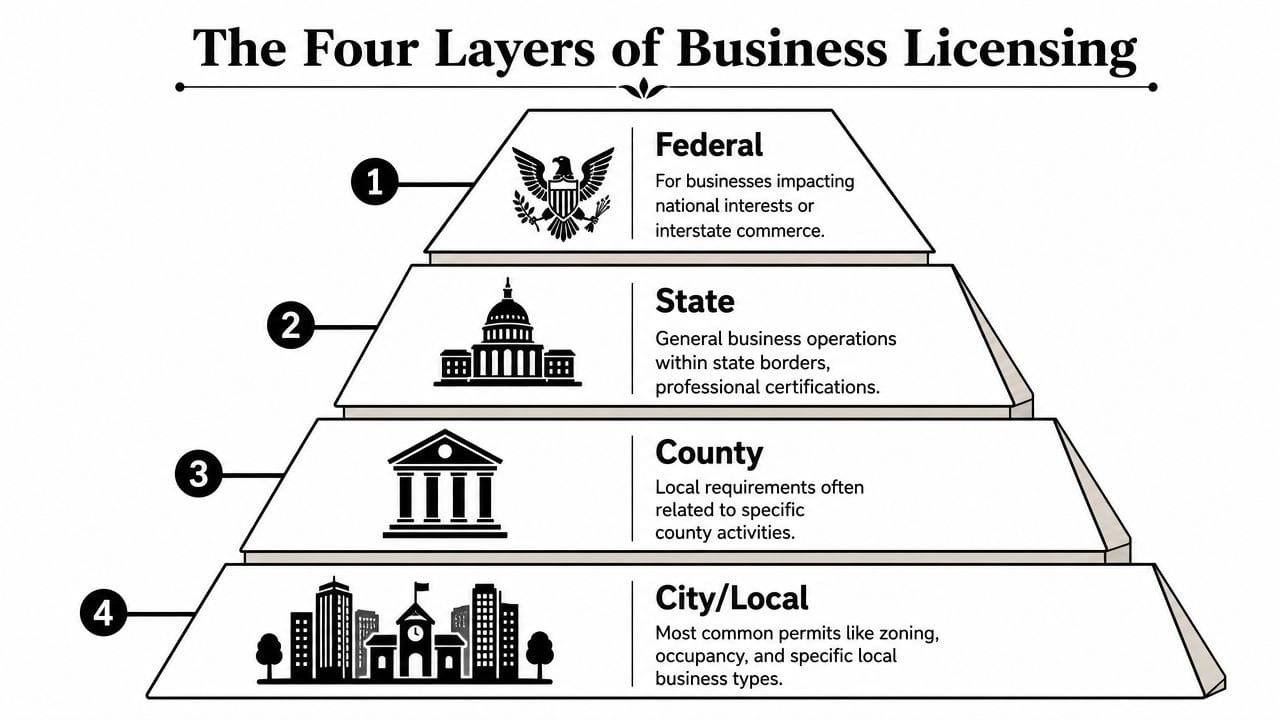
Business license requirements confuse owners because they don't come from one place. They come from multiple government layers, each handling a different part of your operation. The easiest way to understand it is to think like a builder. One house may need separate approvals for land use, structure, utilities, and occupancy. Business licensing works the same way.
According to InCorp's guide to business licensing, the vast majority of businesses in the United States require at least one license or permit to operate legally, and those obligations are fragmented across federal, state, and local levels. The same source notes that only a small fraction of businesses require a federal license, while nearly all need state-level permits and local general business licenses.
Federal oversight is narrow but serious
Most businesses won't deal with a federal business license. But if you're in a federally regulated activity, this layer becomes mandatory.
Common examples include businesses involved in activities like selling alcohol, broadcasting, or operating heavy machinery, as described in the InCorp resource above. When federal licensing applies, it usually applies because the government sees the activity as affecting public safety, interstate commerce, or a national regulatory interest.
That's an important distinction. Owners often waste time looking for a universal federal business license that doesn't exist for most companies.
State county and city rules stack on top of each other
The state level is where many businesses first feel real licensing pressure. States handle tax registrations, regulated occupations, and approvals tied to the services or products you offer. If you sell taxable goods or services in a state with sales tax, state registration often becomes part of the operating baseline.
Then local rules enter the picture. County and city governments may require general business licenses, zoning clearances, occupancy approvals, health permits, signage approvals, or location-specific permits. These are the rules that often block a launch even after the entity is formed.
Here's the practical model:
| Layer | What it usually covers | Why owners miss it |
|---|---|---|
| Federal | Narrow, industry-specific oversight | They assume every business needs it |
| State | Tax permits, regulated professions, operating permissions | They confuse this with entity filing |
| County | Regional local rules tied to activity or property use | They forget county rules exist |
| City | Zoning, occupancy, and local operating permits | They think the state approval is enough |
Practical rule: If your business has a location, a regulated activity, employees, or taxable sales, assume more than one agency has a say.
Owners get into trouble when they search only one layer and stop. Good compliance work means building the full stack, not checking one box.
Is My LLC Enough The Registration vs Licensing Myth
This is the mistake that causes the most preventable damage.
Owners form an LLC or corporation and assume they're cleared to do business. They're not. Formation creates the legal entity. It doesn't automatically authorize the activity the entity wants to perform.
Avalara's discussion of business licenses makes the point directly: many small business owners mistakenly assume that forming an LLC automatically grants legal permission to operate. It also notes that states such as New Jersey, Pennsylvania, and Maryland do not issue a single statewide general business license, and instead require a mix of industry-specific and local permits that are often missed.
Formation creates the entity
Think of formation as birth certificates and organizational records for the company.
It establishes the name, ownership structure, and legal existence of the business. It lets you open accounts, sign contracts in the entity's name, and separate the company from the owner personally. That matters. But it's still only one layer.
A formed entity without the right operating approvals can still be blocked from lawful operations.
Licensing grants permission to operate
Licensing answers a different question. Not “does this business exist?” but “may this business do this work, in this place, under these rules?”
That's why a perfectly valid LLC can still have serious exposure if it opens before local permits are issued, starts a regulated service without the proper credential, or expands into a state where additional approvals are required.
A simple comparison helps:
- Entity registration handles the company's legal structure.
- Licensing handles the company's legal authority to perform specific business activities.
- Tax registration handles collection and reporting obligations where required.
- Local permitting handles place-based approvals such as zoning or occupancy.
If an owner tells me, “We already formed the LLC, so we should be fine,” I assume the file still needs work.
This myth hurts loan readiness because lenders often spot the gap quickly. If your application says you operate in construction, food service, healthcare, real estate, or another regulated field, the underwriter will expect the licensing file to match the activity. When the file doesn't match, the lender starts asking a harder question: what else has this business missed?
How to Determine Exactly Which Licenses You Need
Most owners don't need more advice. They need a method.
The right way to handle business license requirements is to build your list from the ground up, using what the business does, where it does it, and where it has real operational footprint. Guessing creates rework. Generic checklists miss important local requirements.

Start with your actual activities
Begin with four plain-English questions:
- What do you sell
- Where do you physically operate
- Who performs the work
- Do you handle regulated products or services
That sounds basic, but it prevents the most common mismatch. A company may describe itself as “consulting” on one form while performing a regulated field service, warehousing product, or selling taxable goods. Agencies and lenders care about the specific activity, not the broad label.
Use a worksheet and list:
- Core services: What the business does every day
- Side activities: Installations, repairs, food handling, transportation, storage, public-facing retail, or professional services
- People involved: Employees, licensed professionals, remote staff, field crews
- Physical footprint: Office, warehouse, clinic, storefront, shared workspace, inventory locations
Check every place where the business has footprint
For growing companies, the licensing burden gets heavier.
The U.S. Chamber of Commerce guide on business licenses and permits notes that for businesses with sales between $20 million and $50 million, nexus determination for state occupational and sales tax licenses is a primary compliance burden. The same resource explains that a physical presence or significant economic activity in a state, often $100,000 in sales or 200 transactions, can trigger mandatory licensing obligations there, regardless of where customers reside.
That means you should review every state where you have:
- A physical site: Office, warehouse, storefront, or other fixed presence
- People on the ground: Employees working from that state
- Inventory or operational assets: Stock or equipment tied to the jurisdiction
- Meaningful sales activity: Enough economic activity to trigger registration obligations
Don't rely on where your customers are located as the only test. The more useful question is where your business has enough connection to create legal obligations.
The fastest way to create a lending problem is to expand first and research licensing second.
A disciplined process works better than a perfect memory. Pull the official state tax and business agency pages, then check the city and county where each location operates. Match the licenses to the activity list you built earlier. That's how you get from vague concern to a defensible compliance file.
The Licensing Application Playbook Required Documents Costs and Timelines
A strong application process starts before the first form is opened. Owners lose time when they begin applying without a complete file, then get stuck hunting for documents, correcting names, or resubmitting information that doesn't match prior registrations.
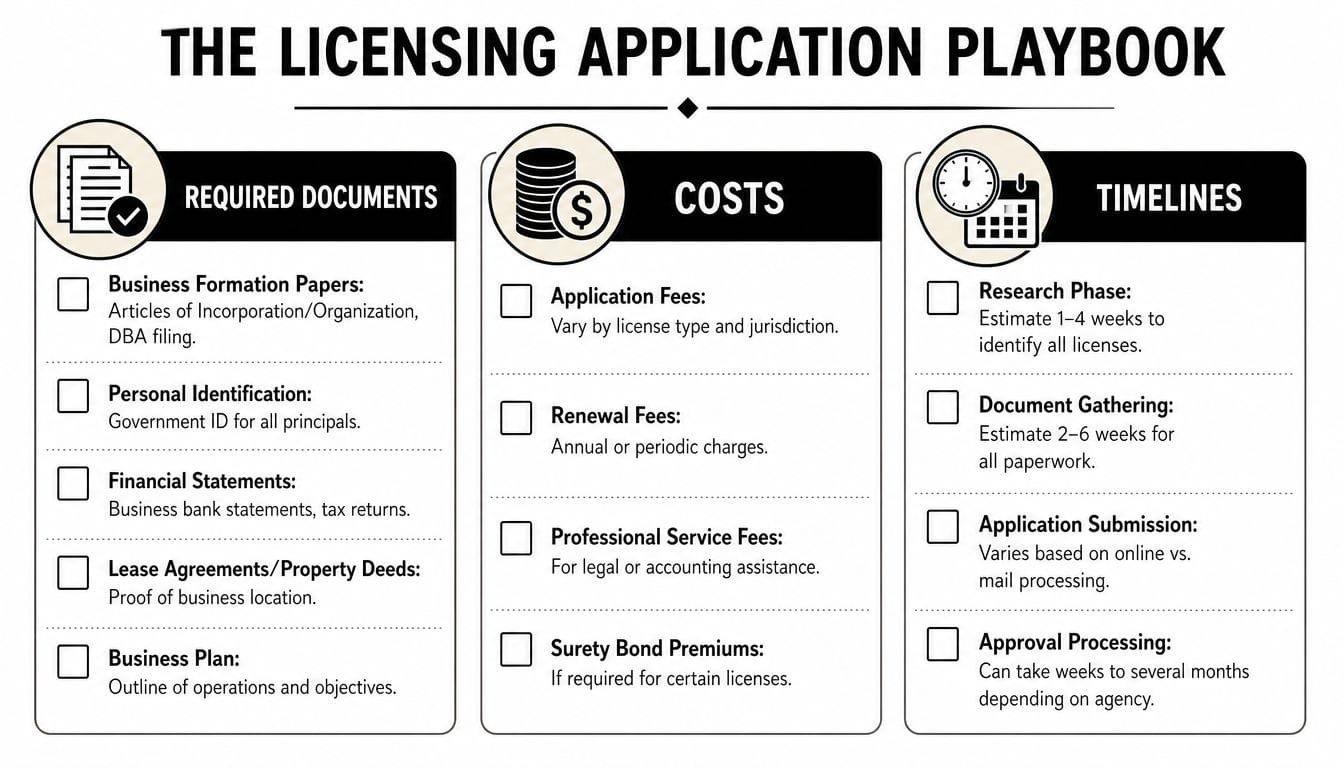
Stripe's overview of U.S. business license requirements identifies the common documentation clearly. The application process may require government-issued ID, Social Security Number, completed forms, fees, and often proof of business name registration, lease agreements, or articles of incorporation. It also notes that some professional licenses require proficiency exams.
Build the file before you start applying
I recommend assembling one licensing folder, digital and clearly labeled, before submitting anything.
Your file should usually include:
- Entity documents: Articles of incorporation or organization, plus any DBA support
- Identity documents: Government-issued ID for owners or responsible parties
- Tax identifiers: EIN details and any tax registration support already issued
- Location proof: Signed lease or property documentation when the permit depends on place
- Application support: Completed forms, payment method, and any activity-specific attachments
If financing is part of your near-term plan, align your compliance calendar with your funding expectations. This is especially important because approvals, corrections, and follow-up requests often take longer than owners expect. A realistic planning reference for the broader financing side is this guide on small business funding timelines from application to cash.
What slows approvals down
Agencies don't usually reject files because owners are careless. They reject or delay them because the file is inconsistent.
The most common friction points are simple:
| Problem | What it looks like in practice |
|---|---|
| Name mismatch | LLC name, DBA, lease, and application don't match exactly |
| Address mismatch | Mailing address appears where physical location is required |
| Wrong activity description | Application says “consulting” but business performs regulated work |
| Missing support | Lease, ID, or formation documents aren't attached |
| Late sequencing | Owner signs contracts or opens before approval is issued |
Get the entity name, business address, and service description identical across every application unless the agency specifically asks for something different.
That discipline helps more than people realize. It doesn't just improve approval odds. It also produces cleaner records for audits, renewals, and future loan underwriting.
Staying Compliant and Preparing for Renewals
A license file doesn't stay healthy on its own. It decays when nobody owns it.
That's why I push clients to treat licensing like accounts payable. Not because the tasks are identical, but because both depend on dates, documentation, and follow-through. You don't wait until after a missed payment to build a process. Licensing deserves the same discipline.
Harbor Compliance's discussion of business licensing questions points out that many guides treat licenses as a one-time cost, even though many licenses require annual renewal, and failing to track those dates is a leading cause of non-compliance penalties. The same source notes that a significant change in services can instantly introduce new licensing requirements.
Treat renewals like debt payments
Renewals should live in a tracked system, not in someone's memory.
At minimum, the business should maintain:
- A master register: Every license, permit, issuing agency, and status
- A date calendar: Renewal dates, filing windows, and internal reminders
- An owner: One person accountable for submission and follow-up
- A document archive: Current copies of approvals, receipts, and correspondence
This gets even more important as the company grows. Multi-location businesses, remote teams, and expanding service lines create the kind of complexity that breaks informal systems. If you're building stronger management processes broadly, this guide on business operations and why every business needs a solid system is worth reviewing.
Business changes trigger licensing changes
Renewal risk isn't just about dates. It's also about change.
A move to a new address, a new product line, a remodel, a staffing shift into another state, or a service expansion can all change the licensing picture. Owners often focus on the commercial upside of the move and forget the regulatory consequence until a lender, landlord, or agency asks for proof.
I also tell leadership teams not to separate compliance from workforce management. When job roles expand, scheduling gets stretched, and multi-state staffing gets more complicated, legal obligations tend to multiply subtly. Broader labor-side context, such as this article on work life balance law, can help teams think more carefully about how growth decisions create downstream compliance work.
Businesses rarely get in trouble because one renewal was hard. They get in trouble because no one built a repeatable system.
Good renewal discipline protects more than operations. It protects credibility. And credibility matters when you need capital quickly.
How Licensing Status Impacts Your Business Loan Application
Lenders don't review licensing because they enjoy paperwork. They review it because licensing status signals whether the business is operating with avoidable legal and operational risk.
If a company is missing required approvals, carrying expired licenses, or describing its business activity in a way that doesn't match public records, the lender sees more than a technical defect. They see execution risk. They see the possibility of interrupted operations, penalties, or contracts tied to work the business wasn't properly authorized to perform.

What underwriters look for
Underwriters usually want consistency.
They compare your application, entity records, tax documents, bank statements, website, and operating story. If those materials point to a regulated business activity, they expect the supporting license file to be current and plausible. If the file is incomplete, they may pause the deal, ask for more documentation, tighten conditions, or decline to proceed.
This is especially relevant for owners seeking financing based on the business rather than personal income alone. If you're applying using the company's federal tax identity, this explanation of how to get a business loan with an EIN gives useful context on how lenders evaluate the business as an operating borrower.
What helps a file move faster
The strongest borrowers make it easy for the lender to believe the story.
That usually means:
- Current records: No expired licenses sitting unresolved
- Operational match: Licenses line up with the service being sold
- Jurisdiction match: Records support the places where the company operates
- Clean documentation: Copies are organized and ready when requested
A compliant licensing file won't rescue a weak business on its own. But it does remove one of the most frustrating avoidable obstacles in underwriting. It tells the lender the company is serious about operating inside the rules, maintaining continuity, and managing details that directly affect repayment risk.
That's the connection between business license requirements and funding. Proper licensing doesn't just keep you legal. It helps keep you lendable.
If you're preparing for expansion, equipment purchases, working capital, or an SBA-backed loan, Business Loan Warrior can help you assess funding options without turning the process into another administrative maze. A strong loan file starts with clean operations, and that includes licensing. When your compliance house is in order, it's easier to move from application to approval with fewer surprises.