

You're probably staring at a lender quote right now, trying to decide whether 6.5% is a good deal or just a clean-looking number with ugly strings attached. That's the trap in commercial real estate. The coupon gets all the attention, then the fees, prepayment terms, recourse, and timing show up later and change the actual cost.
If you've ever compared two offers and felt like one lender was speaking a different language, you're not imagining it. Commercial real estate loan rates are never just about the headline rate, they're about structure, financing, property quality, and how much flexibility you're willing to give up for speed. Borrowers who understand that trade-off save money. Borrowers who don't usually just pick the cheapest-looking mistake.
Table of Contents
- The Rate You Quote Is Rarely the Rate You Pay
- How Commercial Real Estate Loan Rates Are Calculated
- Typical Rate Ranges by Loan Type in 2026
- What Lenders Actually Look At When They Set Your Rate
- Two Sample Loan Calculations You Can Run Today
- The Hidden Cost Drivers Behind Every Quote Sheet
- How to Lower Your Commercial Real Estate Loan Rate
- Putting It All Together With the Right Lending Partner
The Rate You Quote Is Rarely the Rate You Pay
A retail owner I've worked with thought he had a solid deal. The lender quoted 6.5%, which sounded manageable, especially compared with the ugly numbers he'd heard from other borrowers. Then the closing statement landed, and the deal felt a lot less friendly once fees, prepayment exposure, and recourse were priced in. The all-in cost was much closer to what an impatient borrower would call “expensive” than “cheap.”
That's the mistake. People shop commercial real estate loan rates like they're shopping a T-shirt, but the better comparison is a car lease with mileage limits, maintenance obligations, and a buyout clause hiding in the fine print.
Practical rule: if you only compare the coupon, you're not rate-shopping, you're guessing.
The core question is simple. How much cash leaves your pocket over the hold period, and how much flexibility do you lose along the way? A slightly higher rate can be the better deal if it comes with easier prepayment, lighter fees, or less recourse. A lower rate can be a trap if you'll pay dearly to refinance, sell, or break the loan early.
The rest of this guide gives you a cleaner lens. You'll see how CRE pricing works, which structures fit which properties, and where lenders make their money. More important, you'll learn how to compare offers on total cost, not just the shiny number on page one.
How Commercial Real Estate Loan Rates Are Calculated
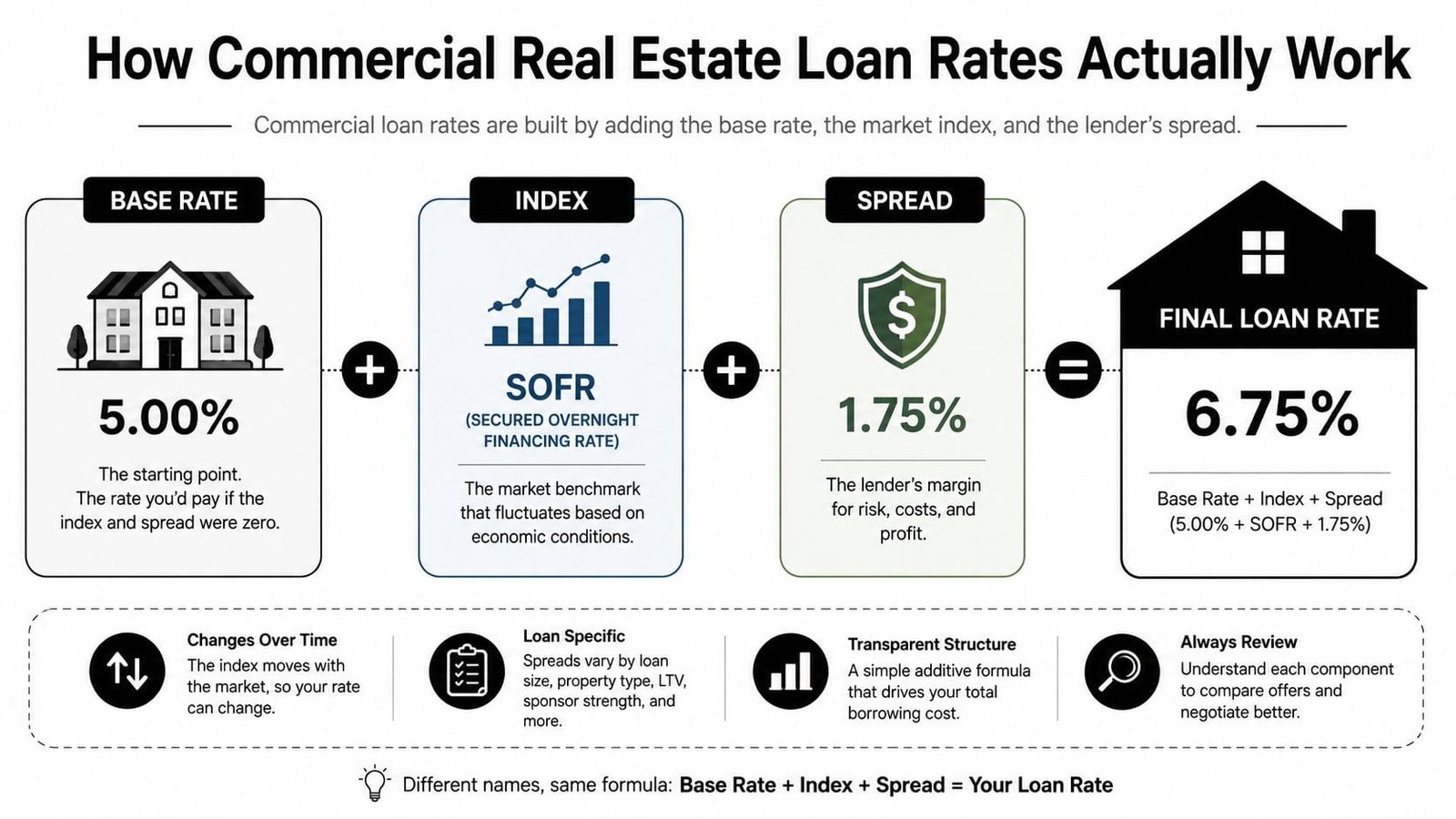
A residential mortgage quote is usually easier to read. CRE pricing is layered. The lender starts with a base index, adds a spread, then adjusts for property type, debt-to-value, recourse, sponsor strength, and market conditions. The quote you see is the starting point, not the full story.
Base index, spread, and what they mean
For floating-rate loans, the price usually begins with an index such as SOFR, then the lender adds a margin. In late April 2026, Term SOFR was about 3.62% to 3.65%, while the 10-year Treasury was about 4.31%. That is why a floating-rate loan can start below a fixed-rate permanent loan, even though the borrower takes more reset risk later.
The market snapshots in 2026 point to floating-rate bridge and value-add debt commonly quoted at SOFR + 275 to +400 bps for multifamily value-add, while stabilized agency debt sits around 150 to 200 bps over the 10-year Treasury and all-in near 5.80% to 6.30%. Bridge loans are typically 9.0% to 14.0% in 2026. Those ranges come from current market pricing in this industry rate overview.
The spread is where lenders protect themselves. A wider spread usually means the lender sees more uncertainty in the collateral, the cash flow, or the exit.
For borrowers who want the mechanics in plain English, bonds vs bond funds explained is a useful frame. Bonds hold a defined coupon path, while bond funds move with the market, and CRE loan pricing behaves the same way once the base rate starts moving.
Fixed versus floating, and why the choice matters
A fixed-rate loan gives you payment certainty. That usually fits a stabilized multifamily property or an industrial asset with durable occupancy and predictable cash flow. A floating-rate loan gives you more initial flexibility, which is why it shows up so often on value-add, bridge, and construction deals where speed matters more than long-term payment stability. For borrowers comparing build-phase debt, construction loan rates are shaped by draw timing, completion risk, and exit timing as much as the headline coupon.
Two lenders can quote the same property and still land 75 basis points apart because one is pricing a safer borrower, a lower debt-to-equity point, or a stronger exit plan. The rate is not just a market number. It is a judgment about risk, certainty, and how much pain the lender expects if the deal goes sideways.
Typical Rate Ranges by Loan Type in 2026
Borrowers waste time when they ask, “What's the rate?” before they ask, “What structure fits the deal?” A 20,000-square-foot retail center with decent tenancy does not belong in the same bucket as a 40-unit value-add apartment building that still needs lease-up and rehab. A restaurant expansion needs a different financing logic again, because speed, recourse, and documentation can matter as much as rate.
| Loan Type | Typical Rate Band | Max LTV | Term Length | Best Fit |
|---|---|---|---|---|
| Bank term loan | Mid-5% to mid-6% | Lower to moderate leverage | Medium to long | Stabilized assets with clean financials |
| CMBS | Mid-5% to high-6% | Moderate leverage | Often longer-term fixed structures | Borrowers who can accept rigid prepayment terms |
| SBA 504 and 7(a) | Mid-6% to upper-9% | Higher leverage for qualified owner-occupiers | Medium to long | Owner-operated businesses buying or expanding facilities |
| Construction | Roughly 7% to 15% | Project dependent | Short-term, tied to build or stabilization | Ground-up builds and major repositioning |
| Bridge | Roughly 9% to 14% | Higher leverage possible | Short-term, exit-driven | Value-add, recapitalization, or time-sensitive acquisitions |
The spread is the story. Stabilized permanent debt is usually the cheapest because the lender sees cash flow, collateral, and exit visibility. Bridge and construction cost more because the lender is funding uncertainty, not just real estate.
If you’re comparing deals for a development or heavy rehab, the structure matters more than the coupon. A deep dive on project financing can help you benchmark the mechanics, and this construction loan rate resource is useful if your deal sits in that lane.
Borrower takeaway: choose the structure that fits your hold period first, then compare rate. Reverse that order and you’ll probably overpay for the wrong kind of certainty.
What Lenders Actually Look At When They Set Your Rate
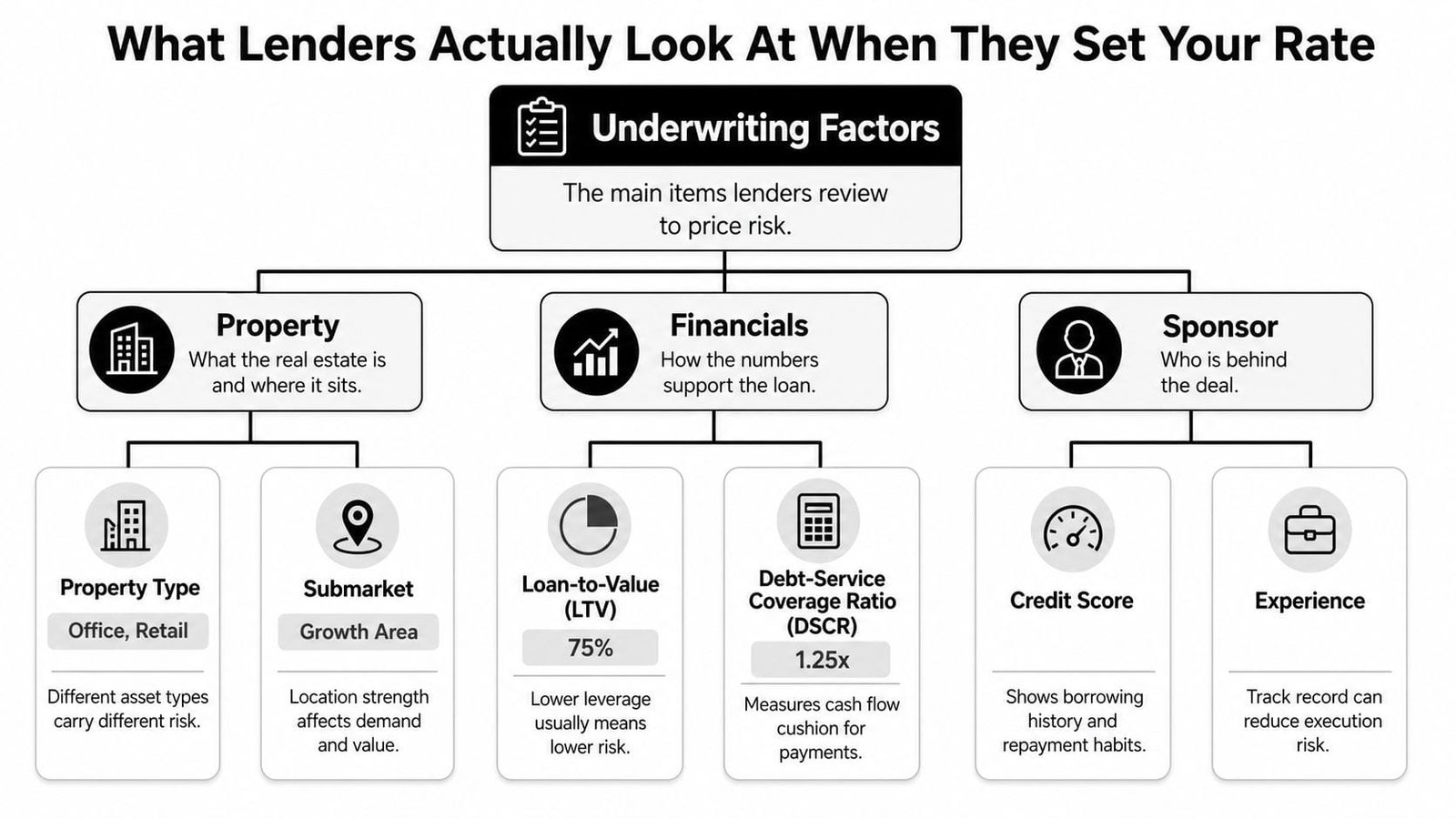
Lenders don’t price the asset in a vacuum. They price the property, the financials, and the sponsor together, then decide how much risk premium to add. If one of those pillars is weak, the quote moves against you fast.
Property and financial strength
A cleaner property type and submarket usually price better than a troubled one. That’s why office carries a wider risk premium than multifamily or industrial in current spread data, and why lender appetite changes so quickly when a market softens. For asset-level valuation questions, the right starting point is often a fresh look at commercial real estate valuation, because the appraised value and underwritten cash flow set the ceiling for financing and pricing.
LTV is one of the quickest levers. A borrower asking for a lower LTV is telling the lender, “I’ve got more equity in the game.” That usually helps the rate. DSCR works the same way. If the property comfortably covers debt service, the lender can justify better pricing because cash flow is doing part of the risk management for them.
Sponsor quality and recourse
The borrower matters too. Liquidity, experience, and track record affect pricing even when the property looks fine on paper. A lender will often quote better when the sponsor has already owned and operated similar assets, because the lender trusts the execution path.
Recourse changes the math as well. A full-recourse loan can price tighter than a non-recourse structure on the same collateral because the lender has more avenues if the deal goes sideways. That doesn’t mean recourse is always bad. It means you should know exactly what you’re giving up before you accept a lower coupon.
Rule I use in live deals: if the lender keeps asking for more protection, expect the rate to reflect that caution somewhere else, even if it doesn’t show up in the headline number.
Two Sample Loan Calculations You Can Run Today
A quote sheet gets real once you turn it into monthly debt service. A lot of borrowers don’t need a perfect amortization model to make a smart decision, they just need a quick way to compare payment burden and hold-period cost. For that, a simple loan payment calculator is enough to expose bad assumptions before they become expensive.
Stabilized retail acquisition
Take a $3 million stabilized retail loan at 6.5% fixed over 10 years. On an amortizing structure, the payment is going to be materially lower than an interest-only bridge loan, and that matters if the asset already throws off steady cash flow. The central question is how long you plan to hold it.
If you expect to sell or refinance early, the prepayment terms matter more than the coupon. A loan with a slightly higher rate but lighter prepay exposure can beat a lower-rate deal if you need to exit sooner. If your hold period runs close to maturity, the fixed structure usually earns its keep through stability.
Value-add multifamily bridge
Now take a $5 million multifamily value-add bridge loan at SOFR + 325. Using the late-April 2026 SOFR range in the market snapshot, you’re roughly in the mid-7% starting area before lender-specific adjustments, and that loan is exposed to index movement over time. That’s the price of speed and flexibility. You’re paying for the ability to close quickly and solve a transitional property problem.
The numbers tell you the whole story. The stabilized loan is usually cheaper in total interest if you hold long enough and avoid a punishing prepay. The bridge loan can be the better move if it lets you close the deal, execute the business plan, and refinance into cheaper permanent debt later. One is paying for certainty. The other is paying for optionality.
The Hidden Cost Drivers Behind Every Quote Sheet
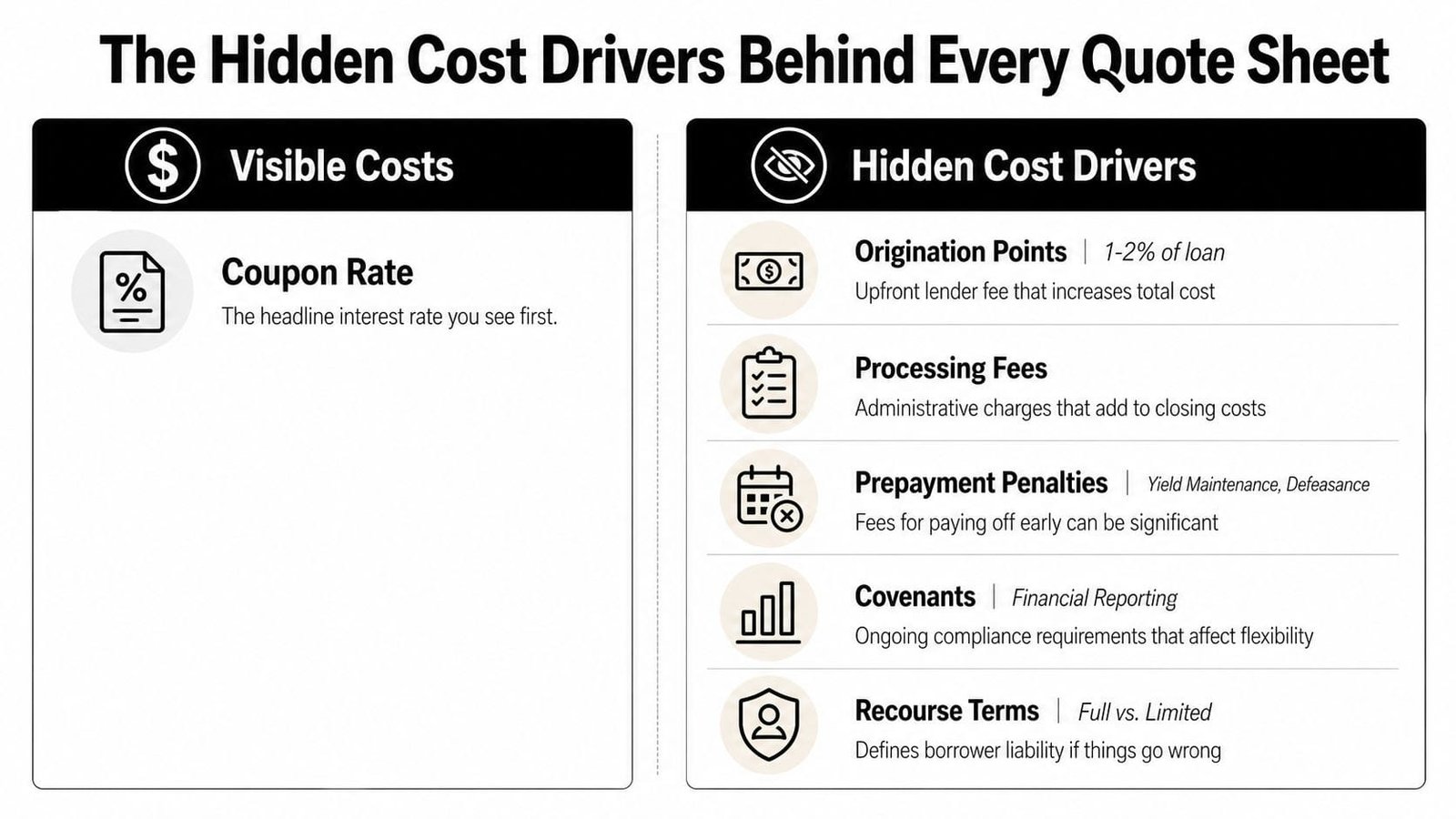
The coupon is the loudest number on the page, not the most important one. I’ve seen borrowers obsess over a lower rate and completely miss that the loan came with heavier origination points, a rigid prepayment regime, and covenants that made the deal harder to manage.
The costs that hide in plain sight
Origination points can distort the economics right away. A lender may show you a tidy rate and collect more upfront than another lender with a slightly higher coupon. Processing fees, underwriting charges, and documentation costs can do the same thing.
Prepayment terms deserve special attention. Yield maintenance, defeasance, and declining penalties all limit your flexibility in different ways, and they can become brutally expensive if you expect to sell or refinance early. A lower rate with a lockout or stiff prepay burden can easily lose to a higher-rate loan that lets you exit cleanly. The same logic appears in broader fee structures, which is why borrowers should also understand commitment fees before they sign anything.
Why flexibility often beats the lowest coupon
The smartest borrowers price optional ity before they price rate. That means they ask, “What happens if I refinance in three years? What happens if I sell? What happens if my tenant rolls?” Those aren’t edge cases. They’re normal CRE risks.
The OCC’s CRE lending guidance focuses on cash flow, collateral, borrower equity, and repayment capacity, not rate alone, which is exactly the right way to think about it. If the deal is structurally strong, a flexible loan can be cheaper even when the coupon is higher, because it preserves your exit options.
If you expect a change in capital structure before maturity, don’t fall in love with the lowest rate. Fall in love with the cheapest exit.
How to Lower Your Commercial Real Estate Loan Rate
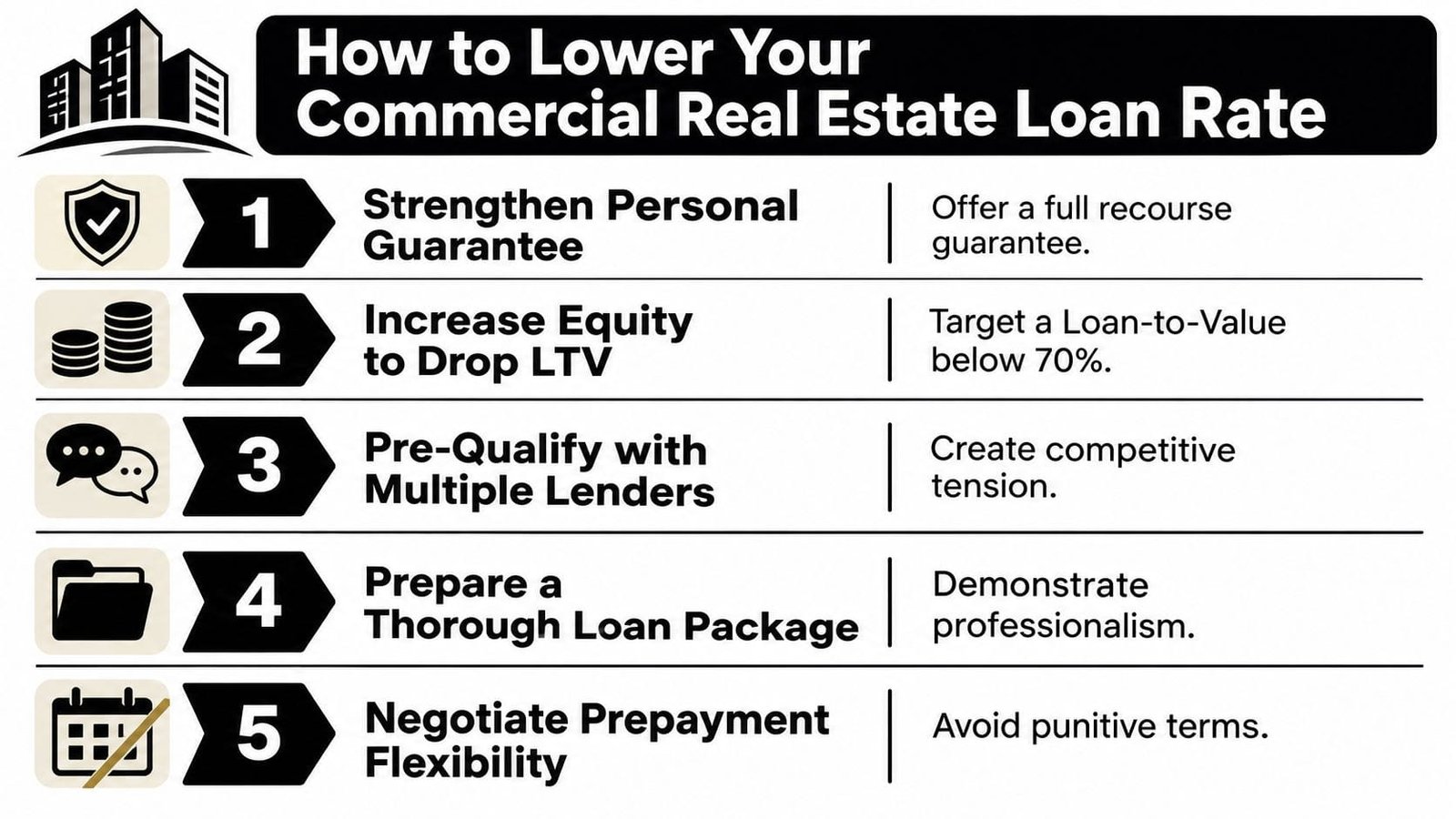
You don’t “negotiate” your way into a great quote from a weak file. You earn better pricing by reducing the lender’s risk before the lender ever sees the deal. That starts with strong equity, documentation, and how clearly you present the exit.
The moves that actually change pricing
- Lower the debt-to-equity ratio. More equity usually gets you a better quote. If you can push LTV down, you’ve already done half the lender’s job.
- Strengthen the guarantee package. More borrower support can tighten pricing because the lender sees a stronger backstop.
- Run multiple lenders at once. Competitive tension matters. A clean, parallel process usually beats one lonely quote from one sleepy banker.
- Bring polished financials. Stale statements, messy rent rolls, and missing tax returns waste time and weaken your position.
- Match the structure to the property. A stabilized asset should not be priced like a construction deal. If your business plan is solid, make it easy for the lender to see that.
Timing matters more than most owners admit
The fastest path is usually prequalification, term sheet review, due diligence, then funding, but the win is avoiding rework. Bad files slow everything down and invite wider pricing because the lender senses friction. A borrower who applies with fresh financials, a clear exit, and multiple offers in motion usually gets better terms than the borrower who waits for a single bank to “come back with something.”
The mistake I see most is chasing the lowest quote instead of the best fit. The second mistake is ignoring DSCR improvements that could have moved the deal into a better pricing band before submission.
Putting It All Together With the Right Lending Partner
A good 30-day plan is simple. Gather current financials, define the deal in plain English, and request quotes from three to five lenders in parallel. Then compare every offer on the full cost stack, not just rate, so you can see origination fees, recourse, prepayment risk, and timeline side by side.
If you want a broader context on how commercial and residential lending differ in process and risk, Restore Heroes’ overview of commercial versus residential financing is a helpful reference point. The difference isn’t academic. It affects underwriting depth, closing speed, and how much room you have to negotiate.
Which lending channel fits which deal
A bank makes sense when the property is stable, the borrower is clean, and you can wait for a tighter quote. A broker makes sense when you need broad market access and want someone to press multiple lenders for structure. A CMBS conduit makes sense when long-term fixed pricing matters more than flexibility. A fintech platform works when you want fast prequalification, a cleaner application flow, and a way to compare offers without turning the process into a spreadsheet nightmare.
The right lender isn’t just the cheapest one. It’s the one whose structure matches your hold period, your balance sheet, and your exit plan. If you’re buying stability, pay for it. If you’re buying speed, admit that’s what you’re doing and price it accordingly.
If you’re ready to compare commercial real estate loan rates without getting buried in quote-sheet tricks, visit Business Loan Warrior and run a single application to see your options side by side. You’ll get a faster read on what you qualify for, and you’ll stop wasting time on offers that look cheap until the fine print shows up.