
Debt consolidation is a refinancing strategy that combines multiple business debts into one simplified loan, aiming to simplify payments and potentially lower interest costs. In recent U.S. lending data, 53.1% of personal-loan borrowers said they used the money to consolidate debt or refinance credit cards, which shows how mainstream the approach has become (LendingTree personal loan statistics).
You're probably staring at a stack of obligations that don't fit neatly together. An equipment loan wants one payment, a merchant cash advance wants another, suppliers want their invoices paid, and the card you leaned on during a slow month is still charging interest. That's where consolidation enters the conversation, not as a rescue fantasy, but as a way to turn scattered debt into one manageable obligation.
Table of Contents
- Introduction Taming Your Business Debt Overwhelm
- The Core Concept Behind Debt Consolidation
- Comparing Common Debt Consolidation Methods
- The Step-by-Step Debt Consolidation Process
- Weighing the Pros and Cons for Your Business
- Signs Consolidation Is the Right Move for Growth
Introduction Taming Your Business Debt Overwhelm
A small business owner rarely gets into trouble with just one bill. More often, the problem is the pile. There is an equipment note to cover, a credit card balance tied to inventory, a short-term advance that lands in your bank account daily, and maybe a supplier account that needs attention before the next shipment goes out.
That is why debt consolidation matters. It gives you one payment schedule instead of several, so you spend less time sorting due dates and more time watching cash flow. For business owners carrying scattered obligations, that kind of reset can matter just as much as the interest rate itself, especially when the structure includes debts such as merchant cash advances or equipment loans.
For a business owner, the value is easier to see than the jargon. Consolidation works like moving from a cluttered back office to a clean ledger, where the goal is to replace a tangle of deadlines, rates, and minimums with one structure you can run the business around. It only helps if the new loan leaves you with clearer payments and a lower or at least manageable total cost, since a rollover can stretch repayment and raise the bill over time.
For owners comparing funding options, an AU founder playbook for funding can help frame the bigger picture before you sign anything.
Practical rule: If the new loan does not improve your total cost or your repayment clarity, consolidation is just a reshuffle, not progress.
The Core Concept Behind Debt Consolidation
A business owner juggling card balances, supplier bills, and short-term financing can feel like the company is being pulled in several directions at once. Debt consolidation brings those obligations into one payment flow, using a new loan or credit product to pay off selected existing balances. The result is a single creditor, one payment date, and one repayment timeline.
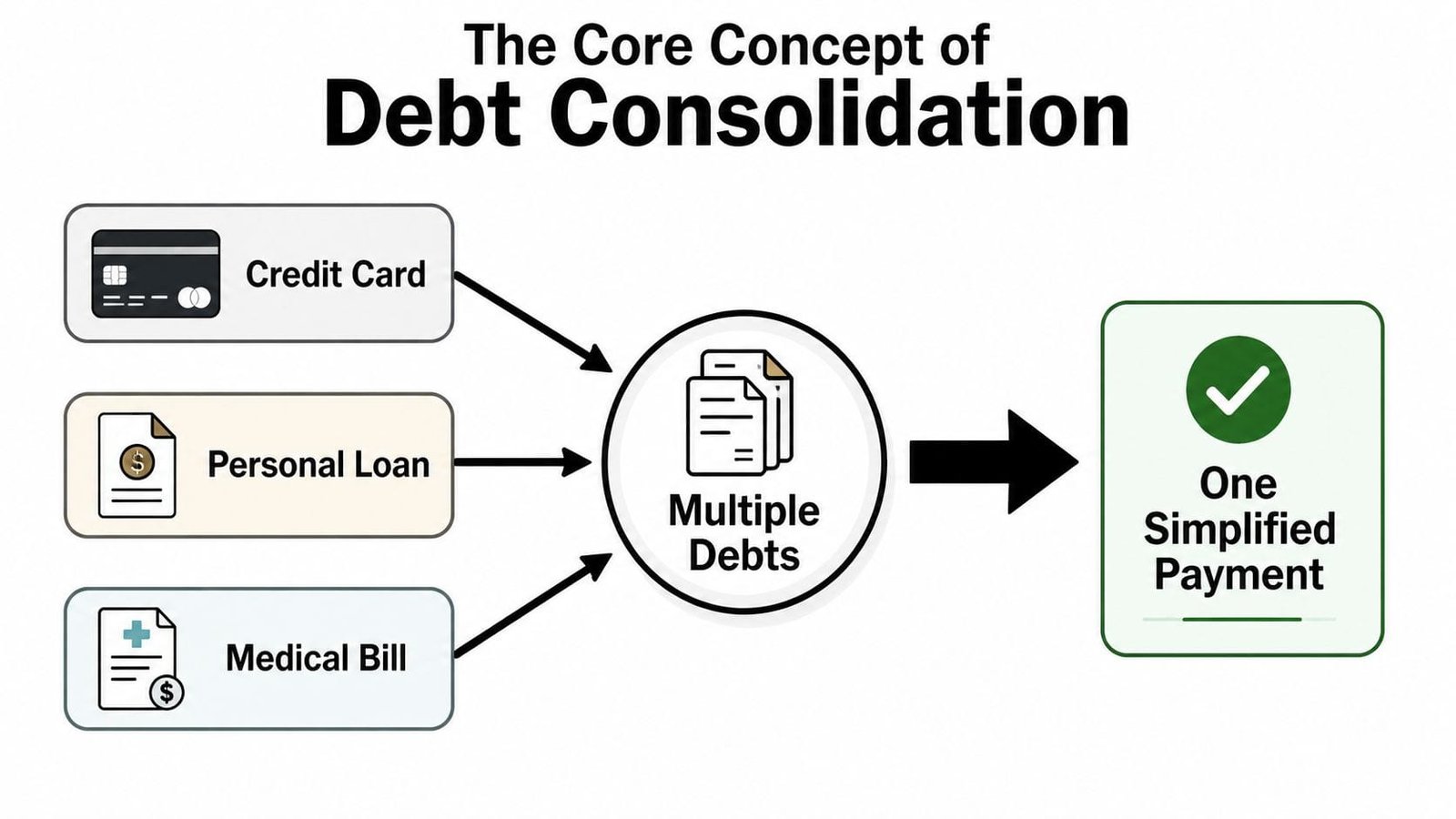
The mechanics are simple, but the financial impact depends on the terms. Principal does not disappear, because consolidation does not erase what you owe. What changes is the borrowing structure. The new loan may come with a different APR and a different term, and those two pieces shape whether the move helps your cash flow or increases your total cost.
A practical way to see it is to compare it with moving loose papers into one folder. You still have every document, but now there is one place to manage them. Debt works the same way. The goal is to replace scattered obligations with a single structure you can plan around, especially when the old balances are spread across cards, supplier credit, or other short-term financing. If the new rate is lower than the weighted average cost of the debts being replaced, the blended borrowing cost can improve. If the term stretches too far, the monthly payment may look easier while the total bill grows.
That trade-off matters most for small business owners, because the structure is often the value. A lower-rate loan can steady payments tied to card balances, equipment loans, or other business obligations. A longer repayment period can also reduce immediate pressure on cash flow, which may help in a tight month. The same longer term can also mean paying more over time, so consolidation should be judged by both the monthly payment and the final amount repaid.
For owners comparing capital options, the AU founder playbook for funding is a useful way to think about how funding choices fit the business plan. If you are weighing whether a line of credit or a loan fits your next move, the guide to choosing a line of credit over a loan can help frame that decision.
Comparing Common Debt Consolidation Methods
Not every consolidation tool fits a business the same way. A restaurant with card balances and supplier invoices faces different trade-offs than a contractor trying to refinance an equipment note or a retail owner trying to tame a merchant cash advance. The right method depends on what kind of debt you're replacing, what assets you're willing to risk, and how strong your qualification profile is.
| Method | How It Works | Best For… | Key Consideration |
|---|---|---|---|
| Business consolidation loan | One new business loan pays off several business debts, then you repay the new loan on a set schedule. | Owners who want business debt kept separate from personal obligations. | Qualification and pricing depend on business strength and credit profile. |
| Balance transfer credit card | You move card balances to a new card, often to get temporary rate relief. | Smaller revolving balances that can be paid down quickly. | Promotional terms can end, so timing matters. The transfer credit card balance guide is helpful if you're comparing card-to-card options. |
| HELOC | You borrow against home equity and use the proceeds to pay off other debts. | Homeowners who need a secured option and can manage repayment discipline. | Your home becomes part of the risk. |
| Debt management plan | A counselor helps structure repayment with creditors into one plan. | Owners who need a guided repayment framework and can't qualify for standard credit. | It's a repayment system, not fresh operating capital. |
For a small business owner, a business loan is usually the cleanest fit when the debts are tied to the company. That keeps the financing aligned with the asset or cash-flow problem you’re trying to solve. A balance transfer card can work for revolving balances, but it’s usually better for personal card debt than for operating liabilities, and it often requires a fast payoff plan.
A HELOC gives you another path, but it uses personal property as collateral, so the downside is sharper. A debt management plan can help if the issue is organization and creditor pressure rather than growth financing, but it doesn’t function like working capital. If you’re deciding between borrowing tools for everyday operations, the internal comparison at when to choose a line of credit over a loan is worth a look.
Business lens: The best method is the one that improves cash flow without creating a worse obligation on the back end.
The Step-by-Step Debt Consolidation Process
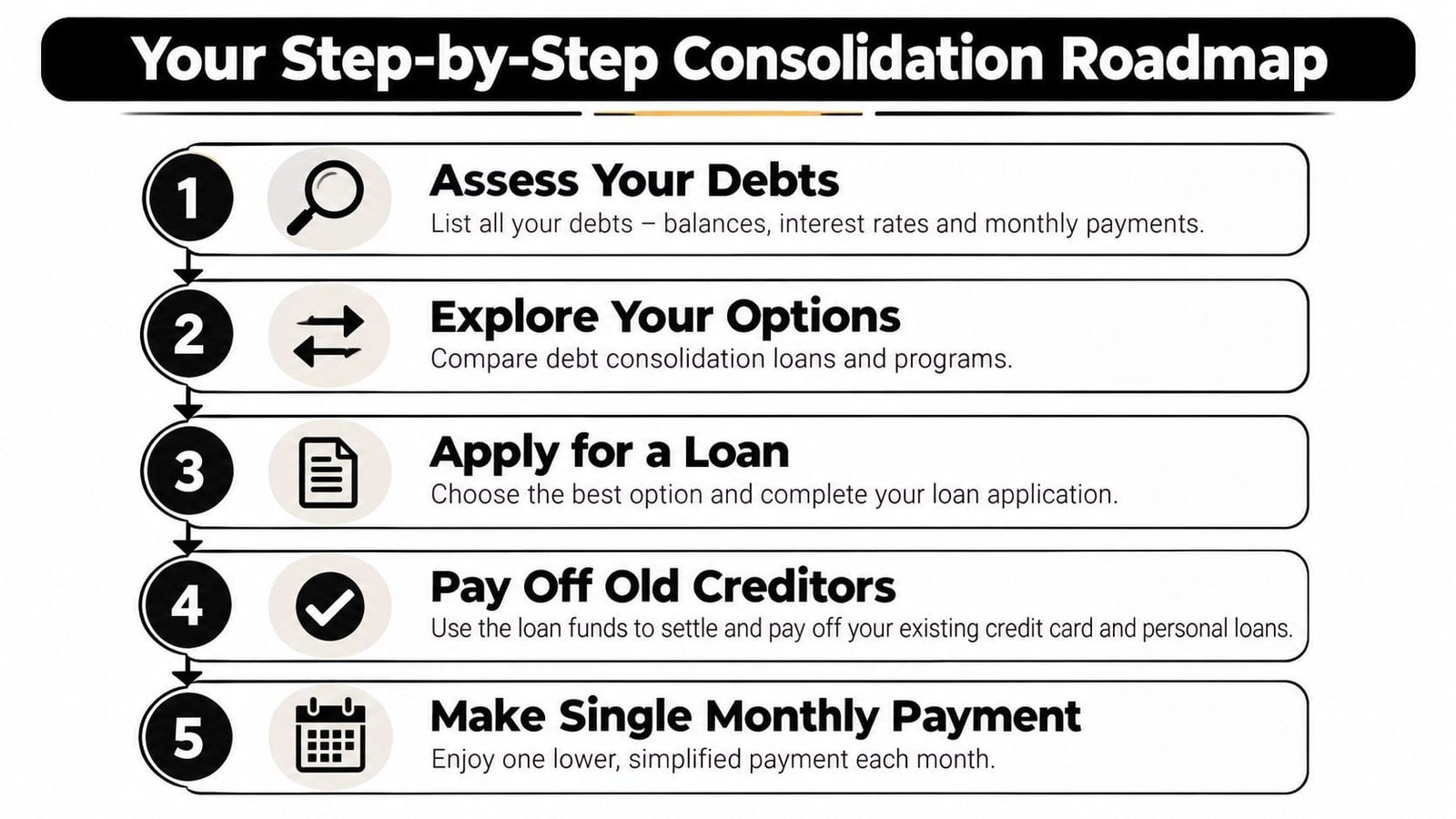
The process starts with a hard look at your books. List every debt, the creditor, the payment frequency, the rate, and whether the debt is tied to your business or your personal guarantee. A lender can’t solve a problem you haven’t mapped clearly, and neither can you.
Step 1 Inventory the balances
Start with a debt schedule so you can see the full picture. The internal guide on what is a debt schedule is useful because it forces you to compare every obligation in one place. That makes hidden drag, like uneven payment dates or short-term expensive balances, easier to spot.
Step 2 Check qualification before you apply
You can’t consolidate if you can’t qualify for the new product. Guidance on the process emphasizes prequalification, soft inquiries, and documentation, which means access isn’t automatic and you need to be ready with records before a lender can give you a real answer (Debt Reduction Services on how consolidation works). If you can’t qualify for a standard unsecured loan, secured options or counseling plans may still exist, but they come with different risks.
Step 3 Compare the structure, not just the payment
A lower payment can hide a longer term. That’s why the comparison has to include APR, term length, and whether the new debt pays off the old balances in full. If the new structure doesn’t improve the total picture, the move can look helpful while costing more over time.
Step 4 Apply and document
Expect to provide business and personal financial documents, especially if the debt touches both sides of your balance sheet. Lenders underwrite consolidation more like a credit decision than a simple transfer. They want proof that the new debt fits your repayment capacity.
Step 5 Close the loop
Once approved, the loan funds should retire the old obligations so you’re left with one payment. That closing step matters because half-done consolidation still leaves you juggling the same mess with a new obligation layered on top.
Weighing the Pros and Cons for Your Business
A small business owner looking at debt consolidation is usually trying to solve a cash flow problem first. Multiple due dates, different interest rates, and separate payment rules can make strong revenue feel less predictable than it really is. One consolidated payment can simplify the month, which frees up attention for sales, hiring, inventory, and the work that brings in money.
The upside is structural
A fixed payment works like a steadier metronome for the business. It can make payroll planning, inventory purchases, and owner draws easier to map out because you are no longer guessing which lender is due next. If the new rate is lower than the rates on cards, merchant advances, or other expensive balances, the payment relief may also improve your operating margin.
For owners considering refinancing, our guide on SBA loan refinancing explains when it can make sense to restructure existing debt. That matters because refinancing is not only about lowering a bill, it is about changing how the debt fits the business’s cash cycle.
The downside is easier to miss
The trap is simple. A smaller monthly payment can come with a longer repayment term, and that can raise the total interest cost even when the monthly number looks better. The test is the total cost of the new structure and the behavior it encourages, not monthly relief alone.
That risk is especially important for small business owners who also face tax debt or mixed personal and business obligations. If you need help sorting out IRS balances alongside other debts, small business IRS debt guidance can help you separate what can be restructured from what needs a different fix.
A lower payment can also create a false sense of breathing room. If the freed-up cash gets spent before the business adjusts its habits, the owner may end up with one new loan plus the old spending pattern, which is the expensive version of the same problem.
Bottom line: If consolidation lowers the payment but raises the lifetime cost, the business has not improved. The timing has changed, not the burden.
The practical question is whether the new loan gives your company room to operate without weakening discipline. For a business owner with a clear plan, that can be a useful reset. For an owner who keeps refilling the credit gap, the same move can stretch the debt out and make it more expensive to carry.
Signs Consolidation Is the Right Move for Growth
Some businesses are profitable enough to carry debt, but the debt structure still creates friction. If revenue is steady and payments are spread across cards, advances, leases, and notes, consolidation can improve cash flow quality without changing the core business model. The signal is operational strain, not panic.
A restaurant owner with a merchant cash advance, an equipment loan, and supplier credit faces this problem in a very direct way. Each obligation pulls cash on a different schedule, like three hoses draining the same tank at different speeds. A single refinancing solution can steady the payment pattern if the new terms are better and the owner stops adding fresh balances on top.
The rate environment matters too. As noted earlier, higher borrowing costs can make a fixed payment structure more appealing when variable obligations are getting harder to carry. For business owners, that means the decision should focus on whether the new structure protects working capital and reduces pressure on the monthly operating cycle.
If tax debt is part of the mix, the small business IRS debt guidance can help separate what belongs in a consolidation plan from what needs a tax-specific response. That distinction matters because an IRS balance follows different rules from a vendor invoice or an equipment note, and treating them the same can distort the fix.
Business Loan Warrior fits into this conversation as one option for owners comparing funding paths, because it offers a single application for business loans, SBA loan processing, lines of credit, short-term financing, equipment and construction loans, merchant cash advances, invoice financing, and business acquisition loans. For a lot of owners, the useful question shifts from whether debt exists to whether the next structure gives the business a cleaner runway.