
Most advice on solar for businesses is upside down. It treats solar like a universal win, when the key question is whether the project fits your roof, your load profile, your tax position, and your access to financing. The companies that do well with solar don't just “go green,” they allocate capital where it directly lowers operating cost and improves control over cash flow.
That's why the first mistake is shopping for panels before you've asked a harder question, does this building and this business model deserve solar capital right now? A right-sized project can be a smart financial asset. A poorly matched one can tie up cash, create maintenance headaches, and underdeliver for years.
Table of Contents
- Why Solar Is Not a One-Size-Fits-All Solution
- How Commercial Solar Systems Work
- Financing Options and Which Fits Your Business
- Your Step-by-Step Solar Adoption Timeline
- Maximizing Tax Incentives and Financial Benefits
- Common Pitfalls That Derail Solar Projects
- How Business Loan Warrior Simplifies Solar Financing
Why Solar Is Not a One-Size-Fits-All Solution
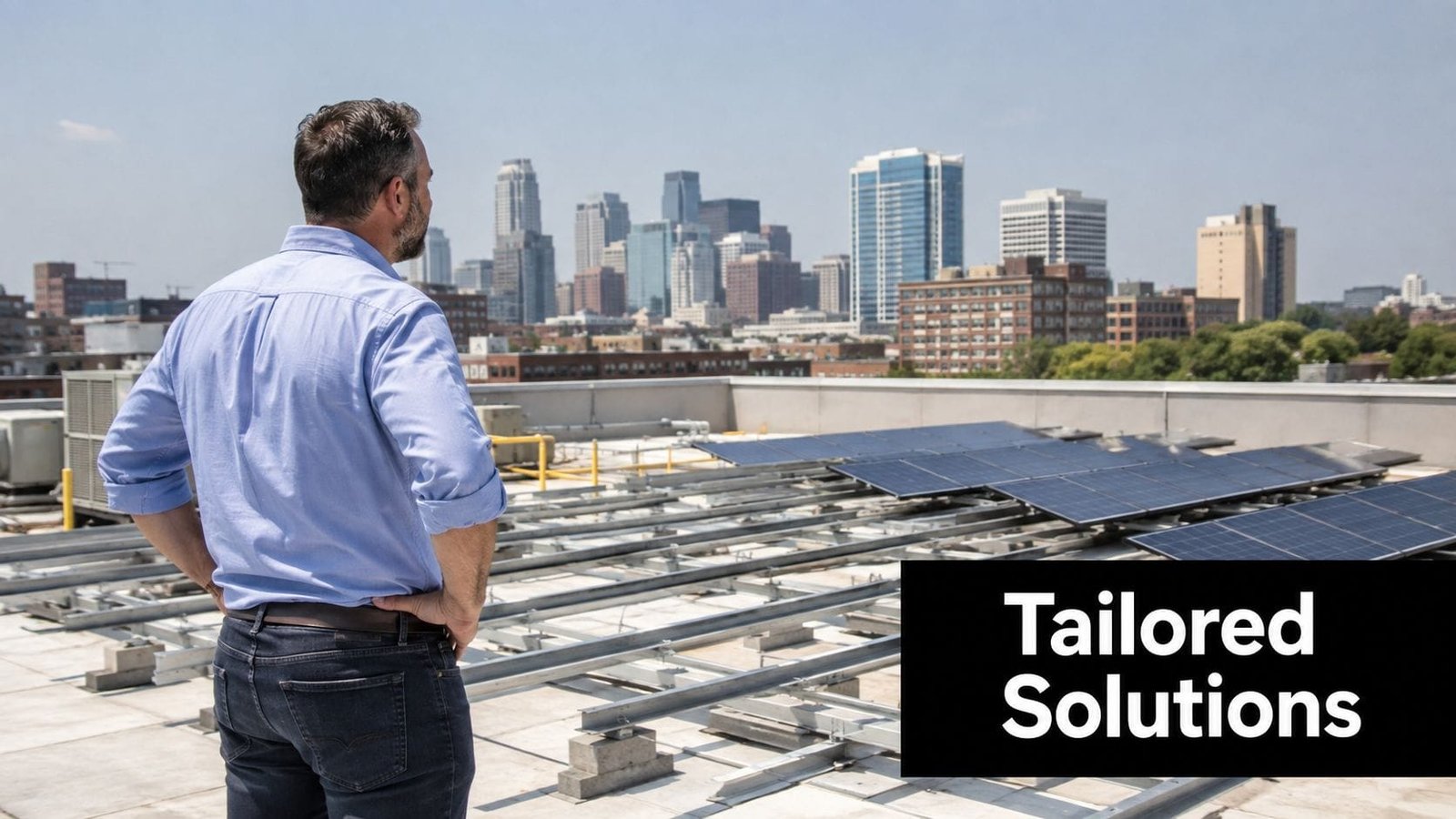
Solar is not a default yes for every company. It's a good deal only when the building, the utility rate, the roof, and the business's own load profile line up. SEIA says corporate procurement now represents over 18% of total U.S. solar capacity, and 20% of all installations in 2023 had a corporate offtaker (SEIA), but that doesn't mean every rooftop is a fit. It means the market has matured enough that serious buyers are being selective.
The first filter is the roof
A warehouse with a broad, structurally sound roof and heavy daytime electricity use is a very different candidate from a small office with shade, aging membrane, or a roof that needs replacement soon. If a roof is near end of life, solar can turn into a costly detour because the array may need to come off for repairs later. A practical roof-and-solar checklist from Arizona Roofers solar and roof guide is a good reminder that roof condition should be checked before anyone quotes a system.
Load profile matters more than panel count
Solar pays best when a business uses most of the power on-site during daylight hours. That's why a right-sized system often beats a larger one that spends too much time pushing power back to the grid. The U.S. DOE national analysis found that small offices, warehouses, and schools had the highest breakeven price tolerance, which tells you building type and consumption pattern drive value as much as hardware cost (DOE analysis).
Practical rule: If the roof is weak, the load is lumpy, or the business expects major expansion soon, slow down. Solar should fit the business plan, not fight it.
Quick self-assessment before you call installers
- Roof readiness: Is the roof in good shape for the full expected life of the array?
- Daytime usage: Does the business consume meaningful electricity during business hours?
- Space limits: Is there enough usable roof area without heavy shading or mechanical obstructions?
- Utility economics: Are electricity costs high enough that offsetting usage will matter?
- Capital discipline: Would this money do more work elsewhere in the business?
If most answers are shaky, solar may still work, but it needs a tighter financial model and a more cautious approach.
How Commercial Solar Systems Work
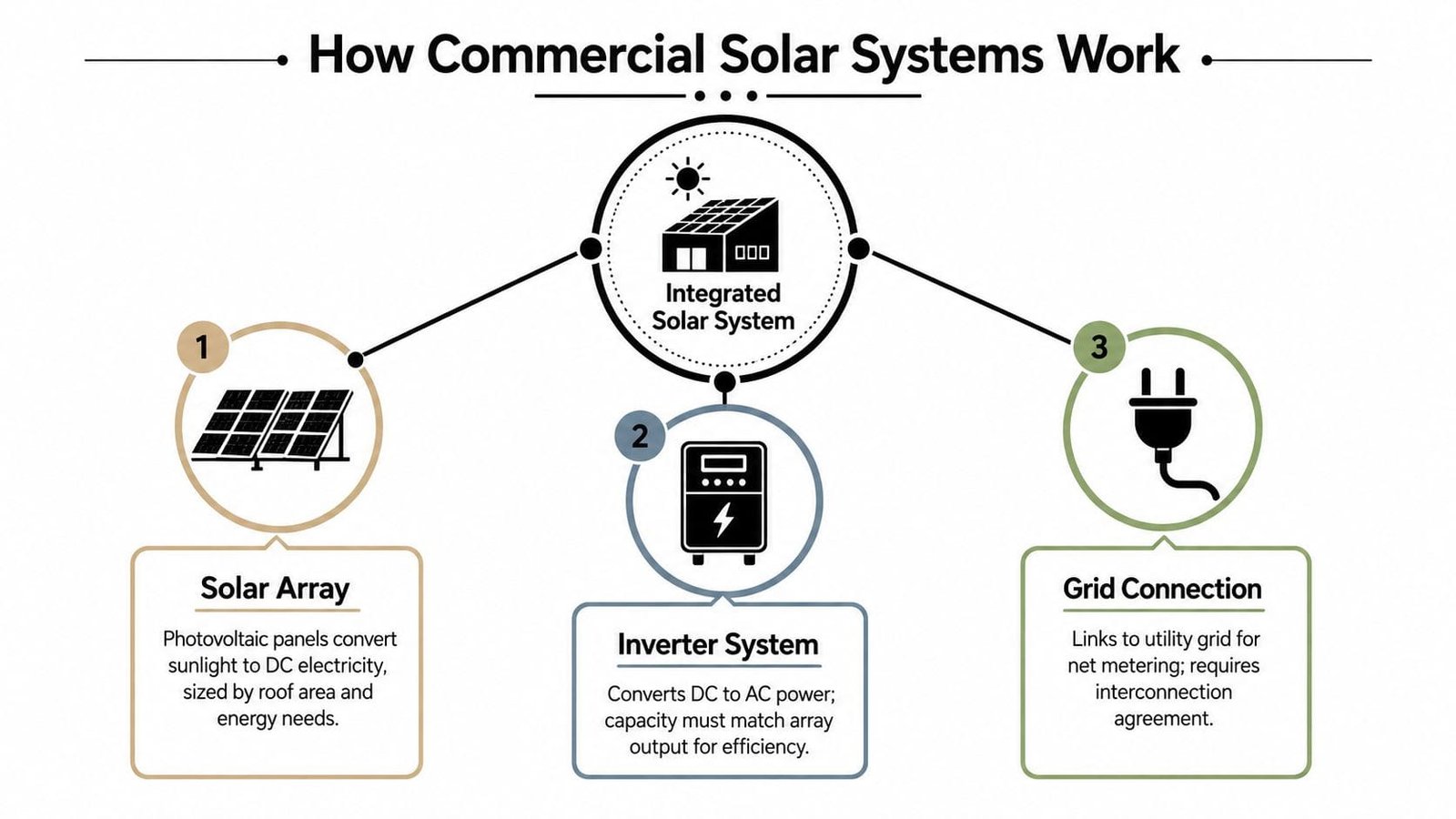
Commercial solar works as an integrated energy system, not a pile of panels. The array captures sunlight, the inverter converts direct current into usable alternating current, and the grid connection handles export, import, and interconnection rules. If any one of those pieces is undersized, poorly matched, or badly maintained, the business gets less usable power than the brochure promised.
Nameplate size is only the starting point
A system's DC size tells you how much panel capacity sits on the roof. It does not tell you how much electricity the business will use or save. That is why the IEA PVPS KPI guide recommends tracking AC energy output, irradiance, module and air temperature, reactive power, alarms, and outage duration so operators can calculate technical and economic KPIs from real site data.
Consider two trucks with identical payload ratings. One sits idle, one runs hot on summer routes, and one spends too much time in the shop. Rated capacity looks the same. Delivered value is not.
Performance depends on more than the panels
Temperature, shading, inverter clipping, and outage time all change the energy a system delivers. A cooler site with better uptime can outperform a hotter site with more nominal capacity. That is why a commercial O&M contract should be tied to measured availability and energy-delivery KPIs, not just an annual visual inspection.
Rule of thumb: If an installer talks only about installed watts and never about monitored output, ask better questions.
What business owners should insist on
The best commercial solar setups give you data you can manage. That means monitoring hardware, site analytics, and a reporting format that lets you compare actual performance against design expectations. It also means the system should be evaluated on the business side, not just the engineering side. Specific yield, performance ratio, and availability are the numbers that tell you whether the asset is working as intended.
Solar equipment is only part of the capital decision. The key question is whether the system can reliably turn sunlight into bill reductions. If you buy hardware without demanding data, you are taking a guess on an asset that should be measured like any other business investment.
Financing Options and Which Fits Your Business
Financing is where many solar deals get stuck. The project can look strong on paper and still fail on underwriting friction, tax complexity, or a mismatch between monthly savings and loan terms. NREL says commercial solar and solar-plus-storage are under-used in low-income and disadvantaged communities because of system cost, complicated financing, and the lack of simple, standardized packages for commercial customers, and many small businesses either can't qualify for attractive loans or do not want more debt even when it is available (NREL).
Compare the structures before you compare the sales pitch
| Financing Type | Upfront Cost | Tax Benefits | Ownership | Best For |
|---|---|---|---|---|
| Cash purchase | Highest | Strongest direct capture if the business has tax appetite | Business owns the system | Buyers with strong reserves and a long holding period |
| Equipment loan | Moderate, often little cash down | Usually preserved by the owner, depending on structure | Business owns the system | Firms that want ownership without draining working capital |
| Lease | Low | Typically captured by the lessor | Usually third party | Businesses that want predictable payments and limited operational burden |
| Power Purchase Agreement | Low or none | Usually captured by the project owner | Third party owns the asset | Businesses prioritizing low entry cost and minimal balance sheet impact |
A manufacturing firm with strong cash reserves and a stable roof can usually justify ownership. A retail chain with thin margins may care more about conserving liquidity and limiting balance-sheet noise. The right answer is not always the lowest headline monthly payment, it is the structure that protects operating flexibility and leaves room for repairs, inventory, and payroll.
Before committing to solar, compare it against tools like Exayard roofing estimating software to evaluate how roof condition affects your total project cost.
Understand the true cost of capital
A low payment is not the better deal if you give away tax value or accept weak contract terms. Compare total project economics after tax treatment, maintenance responsibility, and end-of-term ownership are all included. If a financing offer is hard to understand, it probably deserves a harder look.
Best practice: Price the project as a capital allocation decision. If solar does not beat your next-best use of cash, do not force it.
A business owner who wants to preserve cash for inventory, payroll, or expansion often prefers debt over a cash purchase, but the debt has to fit the asset's savings profile. If the project savings depend on daytime offset and the financing term is too aggressive, the monthly benefit gets squeezed. The payment can look manageable while the actual cash flow benefit shrinks.
Don't ignore underwriting friction
The biggest barrier for many firms is not whether solar works in theory. It is whether the lender, lessor, or tax structure matches the business's documentation, credit profile, and appetite for debt. That is why solar financing should be reviewed alongside broader equipment-financing options, not in a silo. A useful starting point is to compare solar against other asset-backed funding paths, including the options outlined in equipment financing lenders.
Your Step-by-Step Solar Adoption Timeline
A good solar project moves through a narrow set of gates. If you skip one, the timeline slips or the economics get worse. The business owner should control the process with a clear file of utility bills, roof details, equipment lists, and credit information before anyone starts designing a system.
Start with feasibility, not proposals
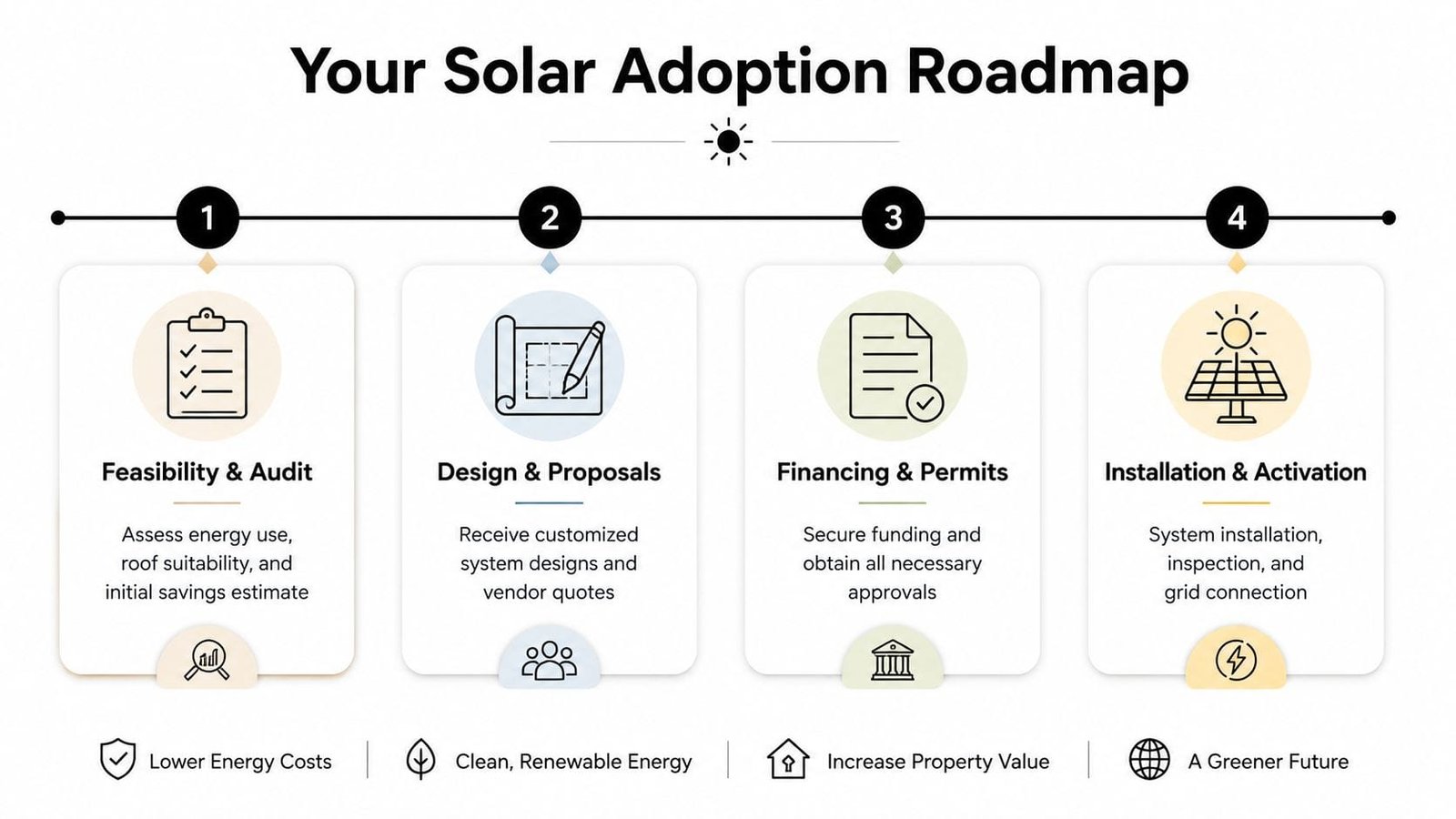
The first step is a feasibility audit. That means reviewing energy use, roof condition, electrical service, and obvious shading or structural issues. If the site can't support the project cleanly, the rest of the work is wasted. A quick video overview can help business owners understand the process before they talk to vendors, and the framing in this short explainer is useful for setting expectations.
Then move through the gatekeepers
After feasibility comes design, proposals, financing, permits, installation, inspection, and grid connection. Each step has a different blocker, and the blocker is rarely the same from one municipality or utility to the next. Utility approval backlogs and permit delays can stretch a project far longer than the sales team initially suggests.
- Feasibility & Audit: Gather utility bills, roof age, service size, and operating hours.
- Design & Proposals: Demand site-specific layouts, equipment specs, and production assumptions.
- Financing & Permits: Line up capital and confirm what documentation the lender or lessor needs.
- Installation & Activation: Coordinate downtime, inspections, and utility interconnection.
For a financing analogy, think in terms of approvals, not promises. The project is only real when the money and the permits are both locked. A useful reference for how funding timelines often move is realistic timelines for small business funding.
The business that prepares documents early usually gets the cleanest quote and the fastest path to activation.
What to have ready before you contact installers
Have the last 12 months of electricity bills, roof information, recent site photos, any planned roof work, and a current picture of how the business uses power during the day. If you're missing those pieces, installers will make assumptions, and assumptions become expensive when the final system is built.
Maximizing Tax Incentives and Financial Benefits
Tax incentives can make solar compelling, but only if the project is structured to capture them. The common mistake is chasing the headline incentive and ignoring entity structure, tax appetite, and whether direct ownership or a third-party model captures more value. Solar economics improve when the incentives, depreciation treatment, and utility savings all line up in one model.
Incentives only matter if your business can use them
A business that does not have enough tax liability may not fully benefit from a tax credit, even if the project is otherwise attractive. That is why ownership structure matters. Some firms should own the asset directly and capture the tax upside. Others should use a third-party model where the economics are handled differently.
The broader market context is strong. SAP's summary of IRENA data notes that the cost of electricity from solar photovoltaics has fallen by 82% since 2010 and that by the end of 2024 solar had become the largest share of global renewable power capacity at 1,865 GW out of 4,448 GW total renewable capacity (SAP summary of IRENA data). The same source also summarizes SEIA's report of 262 GWdc of installed U.S. solar capacity, enough to power 45 million homes. Those milestones matter because they explain why solar is now treated as an operating-cost strategy, not a fringe sustainability project.
Structure determines what you capture
A direct owner can usually align savings, tax treatment, and control more cleanly. A lease or PPA can reduce upfront burden, which is useful when cash is tight, but the economics depend on contract terms and the value of the electricity rate. I would not judge a structure by label alone. I would judge it by who gets the tax value, who carries the maintenance risk, and who keeps the residual asset value.
Use incentives as part of the full return model
The right project evaluation includes the tax credit, depreciation treatment, and utility savings together. If a proposal only shows the incentive and not the pre-incentive economics, it is incomplete. The older and cleaner the roof, the more likely ownership will make sense. The tighter the cash position, the more carefully the business should compare financing structures before choosing the best incentive path.
For business owners who want to compare financing choices against tax strategy, the guidance in tax-savvy business financing is a useful lens for thinking about the full capital stack.
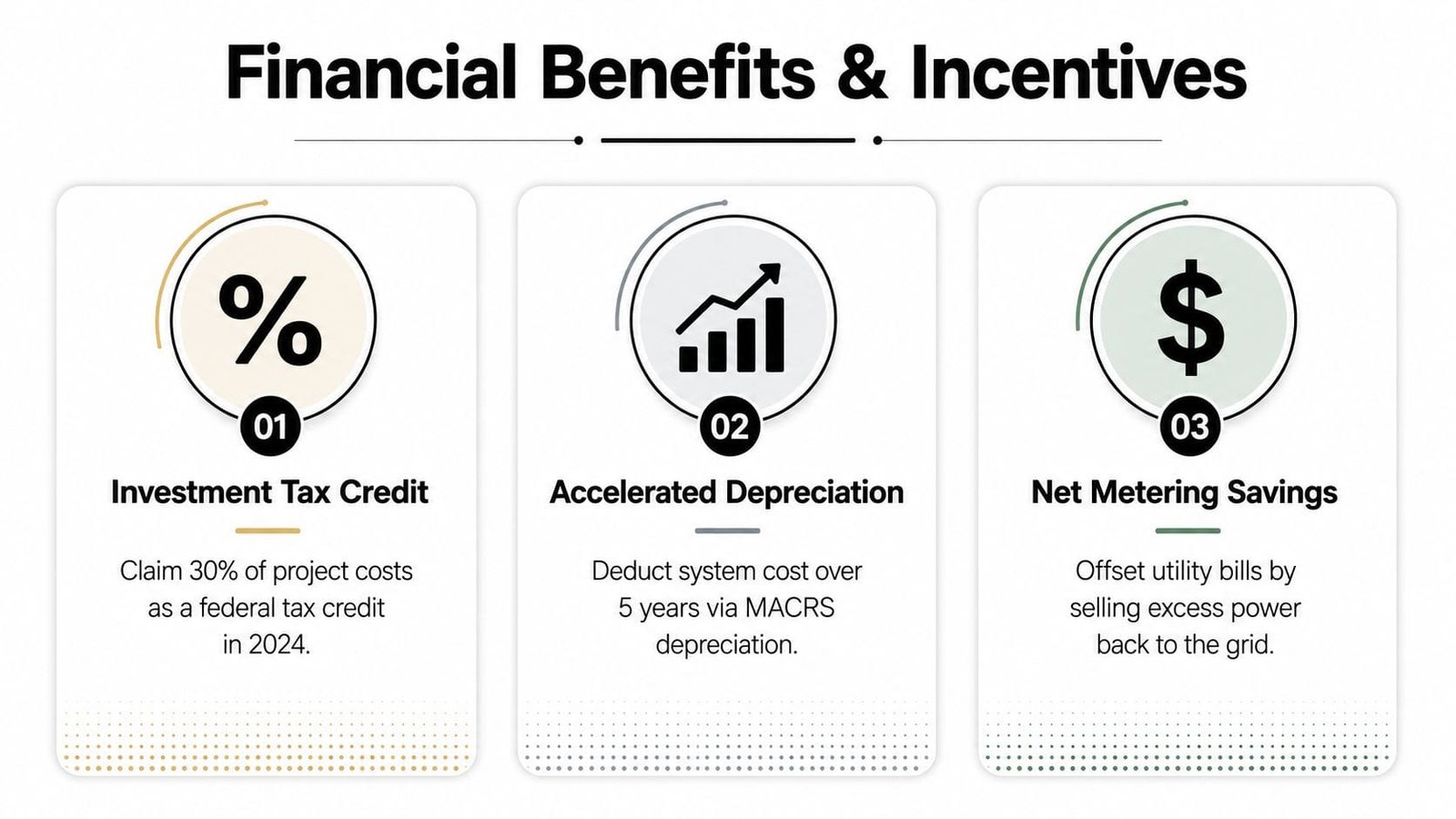
The sharper question is which structure gives your business the best after-tax cash flow over time, and the answer depends on your entity type, tax liability, and holding period.
Common Pitfalls That Derail Solar Projects
The cleanest solar proposal can still fall apart on site. I've seen business owners sign on because the savings looked obvious, then run into roof work, tougher-than-expected electrical service, or a system sized for today's load even though the business was about to grow. The outcome is the same every time, lost cash flow and avoidable frustration.
The roof is often the hidden problem
A restaurant owner may love the projected savings, then learn the roof membrane has too little life left for a multi-decade array. A warehouse owner may discover the roof can support panels only after an expensive structural review. As covered in the feasibility section, roof condition is the most common silent failure point, inspect before you sign.
Site potential can be weaker than people assume
Solar output lives or dies on the site itself. Roof age, shading, layout, and structural limits can cut production before financing even enters the picture, and the gap shows up in the operating numbers, not the sales deck.
The maintenance side matters too. Inverter performance degrades over time, and a system that is not monitored can lose output long before anyone notices. If cleaning and inspection are ignored, dirt, debris, and access problems turn into lower generation and weaker returns.
Installer selection matters more than polished decks
A bad proposal often hides behind payback language that looks tidy but rests on weak assumptions. Watch for sloppy shading estimates, vague maintenance terms, and contracts that leave the business exposed if the system underperforms.
Good contracts tie expectations to measured performance and monitoring, not just the install date. If the proposal does not explain who owns the monitoring data, do not assume you will get it later.
Maintenance is part of the return, not an afterthought
Commercial solar is an operating asset. Someone has to check output, clean the array when conditions call for it, and investigate alarms quickly, or performance drifts below plan for long stretches. That matters most in places with dust, debris, or hard-to-reach rooftops.
The mistake is buying a project that looks fine on paper and then treating the site as an afterthought. A disciplined buyer treats feasibility, monitoring, and contract language as part of the investment decision, because that is what protects cash flow.
How Business Loan Warrior Simplifies Solar Financing
Business owners don't need more solar enthusiasm, they need financing that fits the business. Business Loan Warrior helps by giving owners a single application, no-fee access, and a way to compare funding options without wasting time on mismatched lenders. That matters for solar because the best project is the one you can fund without starving operations.
The advantage is speed with structure. Instead of forcing a solar purchase into one rigid product, the platform can match companies with equipment loans, lines of credit, or other funding types that fit cash flow and growth plans. For a business trying to preserve working capital while funding an energy project, that flexibility is the difference between moving forward and shelving the project for another year.
If you want a maintenance-oriented view of ownership costs, it also helps to understand ongoing panel care. A practical reference on upkeep is Arizona business solar maintenance tips, because solar performance is easier to protect when you plan for cleaning and inspection from day one.
Business owners in the $20M to $50M revenue range usually need fast decisions, clean documentation, and a lender that won't make solar financing feel like a side quest. That's where a secure dashboard, underwriter access, and an approval flow are useful. They reduce the friction that keeps good projects stuck in committee.
If you're evaluating solar for businesses as a capital decision, don't guess at the financing structure or assume every roof deserves panels. Talk to Business Loan Warrior and compare funding options that protect cash flow while still letting the project work on its own numbers.