
You've got a broken walk-in, a landlord asking for the signed lease, or a second location that looks profitable on paper but still needs cash to open the doors. That's the normal restaurant funding moment, not some tidy business-school scenario. The core question isn't whether you need money, it's which restaurant financing option fits this exact problem without draining the place for years.
A lot of operators make the same mistake. They shop for the fastest approval or the lowest headline rate, then discover the cost shows up later in cash flow, collateral, or daily repayment pressure. In restaurants, the wrong capital can do more damage than no capital at all.
Table of Contents
- The Restaurant Funding Moment Most Operators Face
- How the Restaurant Financing Market Actually Works
- Every Restaurant Financing Option Side by Side
- Matching the Right Product to Your Restaurant Scenario
- What Lenders Look for in a Restaurant Application
- How to Improve Your Approval Odds
- A Simple Framework for Choosing the Right Option
The Restaurant Funding Moment Most Operators Face
A chef-owner in a busy neighborhood spots a failing walk-in cooler on a Friday afternoon. A franchisee is ready to sign for a second site but needs money for the buildout, equipment, and opening cash. A casual-dining operator has payroll on Friday and supplier invoices due before the next deposit clears. These aren't abstract financing needs, they're urgent, operational problems.
That's why restaurant financing options have to be judged by the moment, not the brochure. A conventional bank may smile politely and still say no, and industry compilation data says traditional bank approval rates for restaurant borrowers sit around 18% to 25% (Crestmont Capital restaurant loan statistics). Meanwhile, SBA-backed lending keeps showing up because lenders like the government guarantee and the longer repayment structure, especially in a sector with a real failure risk.
The three questions that matter first
Before you apply anywhere, answer these three questions plainly:
- How much money do you need? A roof repair, a new grill line, and a second location are different funding problems.
- How fast do you need it? If you can wait weeks or months, your choices improve. If you need money in days, the price goes up.
- What are you willing to pledge or pay? Collateral, a personal guarantee, and higher effective cost are all forms of payment. One of them is just less obvious.
Practical rule: If you can't explain the use of funds in one sentence, you're not ready to borrow yet.
Restaurants are capital-intensive by nature. Buildouts, kitchen systems, permits, and working capital all hit before revenue stabilizes, which is why the market for restaurant financing options has split into layers instead of one standard loan path (Crestmont Capital restaurant loan statistics). The right move is usually not “find a loan.” It's “match the capital to the job.”
How the Restaurant Financing Market Actually Works
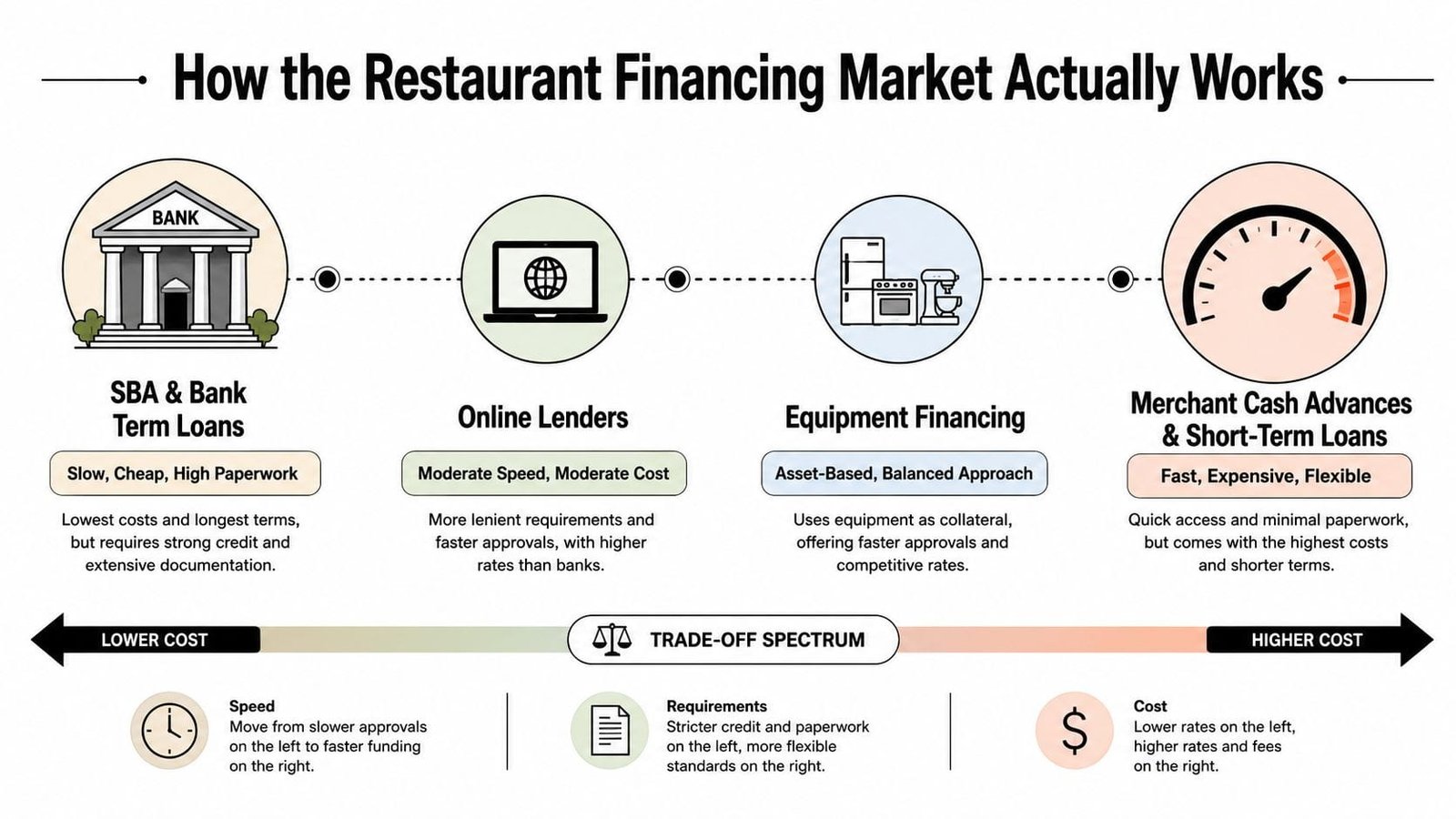
The restaurant lending market runs on a simple trade-off. On one side, you have slow, cheaper capital like SBA and bank term loans. On the other, you have fast, expensive capital like merchant cash advances and short-term working capital products. In the middle sit equipment financing and online lenders, which usually trade some cost for speed or some flexibility for collateral.
Why restaurants get priced differently
Restaurants need money before revenue fully settles in. Buildouts, permits, inventory, kitchen systems, deposits, and payroll all happen early, often before the concept has stabilized. That makes lenders more cautious, so they price for risk and ask for more documentation than they would for a lower-burn business.
That's also why a layered funding plan is normal. A restaurant might use an SBA loan for a renovation, equipment financing for ovens and refrigeration, and a line of credit for short-term payroll swings. One product rarely solves every problem cleanly.
A good lender is underwriting the restaurant, not just the bank balance. They want to know how the revenue behaves, how the operator handles labor, and whether the concept can survive a slow week.
If you want a useful benchmark for how tight cash flow is in your operation, a look at restaurant liquidity ratios from 10Seat can help frame the discussion with an accountant or lender: restaurant liquidity ratios. It's the kind of operational context that makes financing conversations sharper.
The four funding archetypes
Think in four buckets:
- Long-term growth capital for buildouts, expansions, and acquisitions.
- Working capital for payroll, inventory, and short-term gaps.
- Asset-backed financing for equipment or construction tied to a specific purchase.
- Revenue-based or short-term capital for speed when the situation is urgent.
If you want a wider map of how operators use these tools to scale, this breakdown is useful: restaurant loans decoded for scaling faster. The main point is simple. The cheaper money usually comes with more paperwork and more patience. The faster money usually costs more, sometimes a lot more.
Every Restaurant Financing Option Side by Side
The biggest mistake operators make is comparing products by headline rate alone. That's how someone picks a “fast” option that becomes the most expensive decision in the year. You need to compare rate, term, approval time, and the specific use case.
Restaurant Financing Products Compared
| Product | Rate / Cost | Term | Approval Time | Best Restaurant Use |
|---|---|---|---|---|
| SBA 7(a) loan | About 6% to 8% (Doordash restaurant financing) | 10 to 25 years (Crestmont Capital restaurant financing data) | 60 to 90 days (Doordash restaurant financing) | Expansion, renovations, major working capital |
| SBA 504 loan | Best for long-term asset purchases | Long-term | Slower, document-heavy | Real estate and heavy fixed assets |
| Conventional bank term loan | About 5% to 9% (Doordash restaurant financing) | Mid-term | 2 to 6 weeks (Doordash restaurant financing) | Established operators with steady financials |
| Business line of credit | About 7% to 25% (Doordash restaurant financing) | Revolving | 1 to 3 weeks (Doordash restaurant financing) | Payroll gaps, inventory swings, seasonal needs |
| Equipment financing | About 4% to 10% (Doordash restaurant financing) | 2 to 7 years (Doordash restaurant financing) | 5 to 15 days (Doordash restaurant financing) | Ovens, refrigeration, POS, replacement gear |
| Construction loan | Project-based pricing | Project-based | Slower than equipment financing | Buildouts and tenant improvements |
| Merchant cash advance | 15% to 40%+ APR or 40% to 200%+ effective cost (Credibly restaurant funding options, Doordash restaurant financing) | 3 to 12 months (Crestmont Capital restaurant financing data) | 1 to 3 days (Doordash restaurant financing) | Emergency-only, when speed matters more than cost |
| Short-term working capital loan | Higher than bank and SBA money | Short | Fast | Payroll, urgent repairs, short cash squeeze |
| Invoice financing | Cost tied to receivables | Short | Fast | Catering and B2B receivables |
| Acquisition loan | Depends on asset and structure | Medium to long | Moderate | Buying a partner out or acquiring a competitor |
SBA 7(a) loans are the workhorse for restaurants that need a serious amount of capital and can tolerate a slower process. They win when the project is big enough that a longer amortization period matters, which is why the 10 to 25 year structure makes sense for expansions and renovations (Crestmont Capital restaurant financing data). SBA 504 loans belong in the same long-term bucket when the restaurant is buying hard assets or property.
Bank term loans are cleaner if the business is already stable and the operator wants predictable payments. They're not the first stop for a new concept, but they can be a smart option for a seasoned operator with clean books and a clear use of funds.
Equipment financing is the obvious choice when the need is tied to a specific asset. A $60,000 walk-in replacement should usually be financed as equipment, not dressed up as general working capital. The collateral is the equipment itself, and the repayment structure tends to fit the asset's useful life better than a short-term cash product.
Merchant cash advances are where owners get burned. The speed is real, and in a true emergency that can matter, but the cost can be brutal. A $250,000 SBA 7(a) at roughly 6% to 8% over a long term is usually a better business decision than a short-term advance, even if the advance shows up in a few days (Doordash restaurant financing, Crestmont Capital restaurant financing data).
If you're comparing a merchant advance to another fast-turn option, read a product-by-product guide before you sign anything, then sanity-check the repayment schedule. The wrong fast loan doesn't solve a cash problem, it just relocates it.
When MCAs belong at the bottom of the list
Bottom line: Use an MCA only when the alternative is worse and the need is immediate. If you have time, look elsewhere first.
That's especially true because even a well-run restaurant can get trapped by daily or weekly repayment. One slow month turns a temporary bridge into an ongoing burden, and the business starts financing the financing.
Matching the Right Product to Your Restaurant Scenario
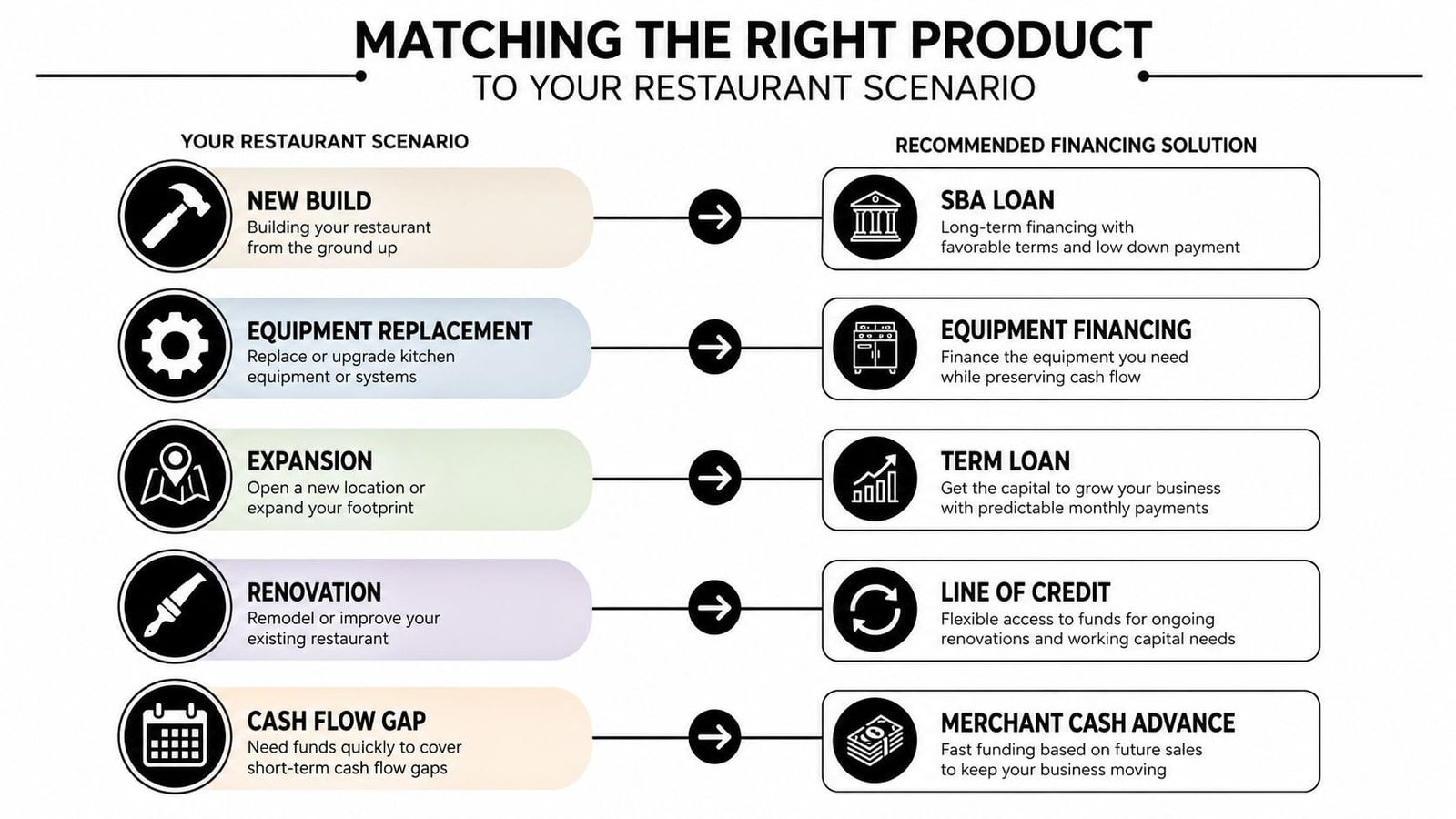
The right answer depends on the job you're funding. A buildout is not a payroll gap. A broken hood system is not a second-location expansion. Treating them the same is how operators overpay.
Five common scenarios and the right fit
- Opening a new casual-dining concept. An SBA 7(a) or SBA 504 is the best call for a serious buildout. You need longer repayment, enough capital for permits and equipment, and a structure that doesn't choke the first year of operations.
- Expanding to a second location. A term loan or SBA-backed loan usually beats a short-term product. This is growth capital, not emergency cash, and it should be priced like a long-term investment.
- Replacing a kitchen system after a breakdown. Equipment financing wins. If the purchase is tied to a specific asset, finance the asset. Don't drag a broken piece of equipment into an expensive cash advance.
- Catching a short payroll or inventory gap. A business line of credit is the cleaner answer. If the gap is short and documented, use revolving capital first. A merchant cash advance only makes sense if the timing is too tight for anything else.
- Buying out a partner or acquiring a competitor. An acquisition loan or a structured term loan fits best because the transaction is strategic, not reactive. You want enough runway to absorb the change without starving operations.
A $400,000 buildout should usually point you toward SBA capital, not a short-term working capital product. A $60,000 walk-in replacement should point you toward equipment financing, not a flashy same-week advance. A 45-day cash squeeze is where a line of credit earns its keep, because it solves a temporary problem without forcing a business into a bad repayment structure.
The mistake isn't needing fast money. The mistake is using fast money for a problem that wasn't fast.
The one time a fast-and-expensive product can be rational is when the restaurant has a real, time-bound opportunity or crisis and the operator already knows exactly how the cash will be repaid. Even then, the math has to be honest. If the payoff doesn't clearly outweigh the cost, don't do it.
What Lenders Look for in a Restaurant Application
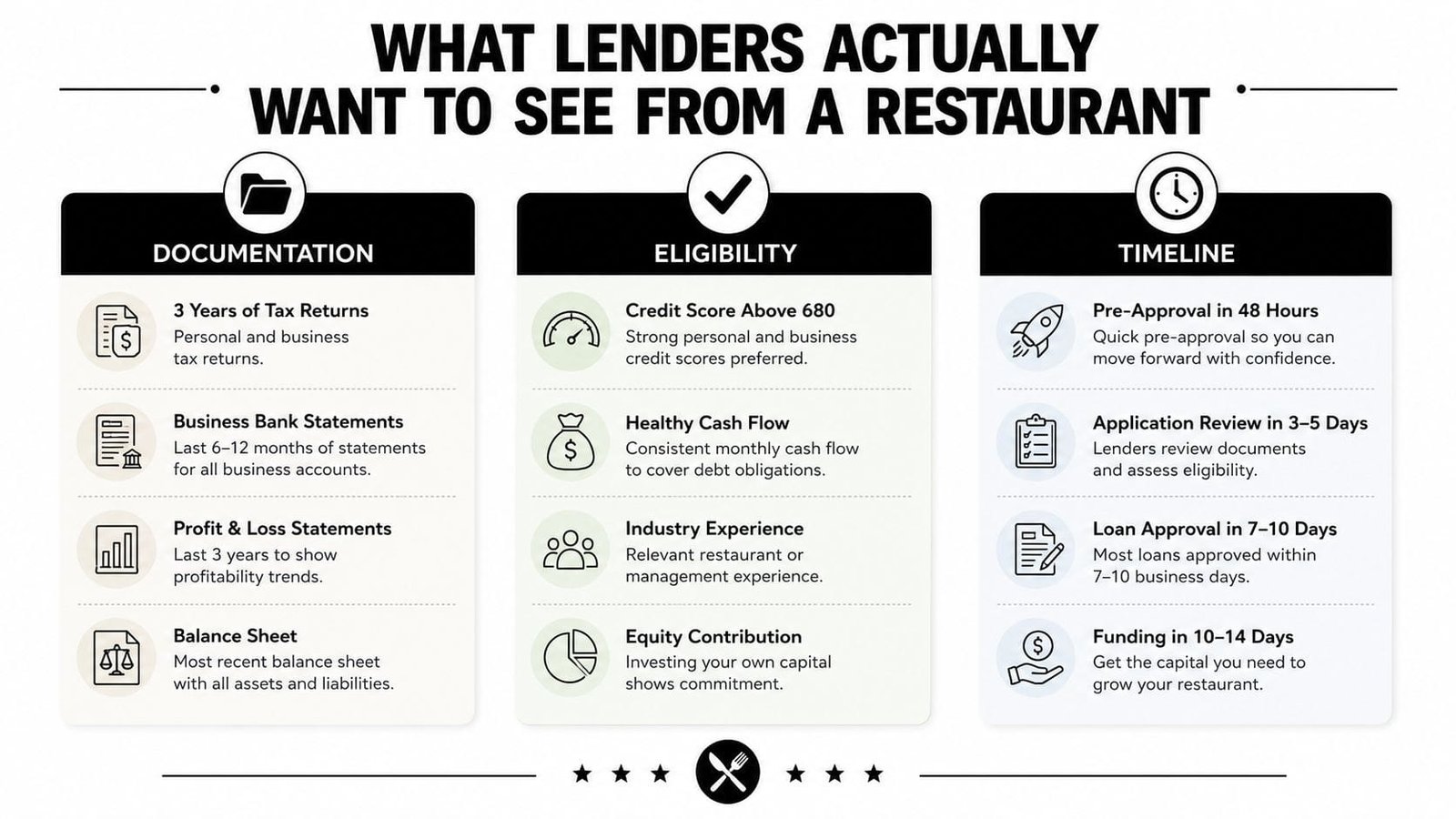
Lenders do not want a polished pitch with vague optimism. They want a file that shows how the restaurant earns cash, where that cash goes, and how the debt gets paid back without straining operations. A stronger file leaves less room for guesswork, and less guesswork usually means a better decision.
The paperwork that changes the conversation
Have these ready before you apply:
- Business financial statements. Profit and loss, balance sheet, and cash flow detail.
- Tax returns. Lenders use them to compare reported revenue against filed numbers.
- Bank statements. They show deposits, withdrawals, and the cash pattern behind the books.
- Ownership structure. Lenders want to know who owns what, who signs, and who carries the guarantee.
- Concept-specific items. Franchise agreements, liquor licenses, lease documents, permits, or letters of intent when they matter.
For a closer look at how lenders read the business plan beyond the financials, use what modern restaurant lenders want in your business plan.
Why restaurant financials get judged differently
Restaurant revenue is uneven by nature. Seasonality, staffing, weather, neighborhood traffic, menu mix, average daily check, and table turns all affect how steady the business looks on paper. Underwriters notice that pattern fast. They are not just measuring top-line sales, they are checking whether the restaurant can produce enough repeatable cash to support another payment.
That is why restaurant-specific details matter. A lender wants to see whether occupancy costs are pressuring the unit, whether liquor sales carry a meaningful share of margin, whether the chef has stayed long enough to stabilize execution, and whether the concept still performs when traffic softens. If those signals are strong, the file looks much safer. If they are weak, the lender will price in more risk or pass.
If the books are messy, fix them before you apply. Separate personal and business expenses, clean up charge accounts, and make sure each location has readable performance data. A lender cannot underwrite confidence from mixed transactions and broken reporting.
What changes approval odds before the file goes in
Owners hurt themselves when they submit a restaurant file that only shows the basics. The stronger approach is to tie the numbers to how the restaurant runs day to day. Show the lender the operating rhythm, not just the accounting output.
A lender will look harder at the story if the financials support it. If sales are strong but labor is out of line, that gets attention. If food cost is drifting, that gets attention. If the menu, manager, or chef changed recently, explain what changed and how the numbers moved. The cleanest applications make it easy to connect the business plan to the actual restaurant.
A practical application file also benefits from clear use of funds. “Working capital” is too vague. Say whether the money covers inventory, payroll, a buildout delay, or a renovation that should improve revenue. If you want a model for how lenders read that narrative, Doordash restaurant financing is useful background on how operators get evaluated.
Practical rule: If the file cannot explain how the restaurant earns and protects cash, the lender will fill in the blanks with caution.
How to Improve Your Approval Odds
Operators hurt their own approval odds by walking in unprepared. A lender reads that as a sign the business may be harder to verify, harder to trust, and more expensive to approve. The fix is straightforward, but it has to happen before the file goes in.
Moves that strengthen the file
- Check pre-approval first. Know what is realistic before you spend time on a full application or start comparing offers.
- Link bank accounts when asked. Direct verification helps an underwriter confirm revenue faster than a stack of PDF statements.
- Separate personal and business spending. Mixed transactions make the business look riskier than it may be.
- Build a sales trend summary. A simple revenue snapshot gives the lender a cleaner read than a giant file dump.
- State the use of funds clearly. “Working capital” is too vague. Say exactly what the money buys and why now.
- Answer margin and labor questions in plain English. If you cannot explain what changed in the business, the lender will fill in the blanks with caution.
A fintech-enabled lending platform can make this process easier by letting owners track approvals, repayments, and credit insights in one place, instead of juggling email threads and uploaded files. That matters because the application itself becomes part of the financing strategy, not just the paperwork.
Pre-approval gives you a clearer path forward
Pre-approval is not a formality. It shows you price, timing, and likely structure before you commit to a full round of applications. That keeps you from grabbing the first mediocre offer that lands in your inbox.
It also changes how you handle lender conversations. When an underwriter asks about labor or margins, answer directly. Do not spin. If the business has a seasonal dip or a one-time repair, name it and explain the fix.
The restaurants that get better terms prepare thoroughly and communicate clearly.
A Simple Framework for Choosing the Right Option
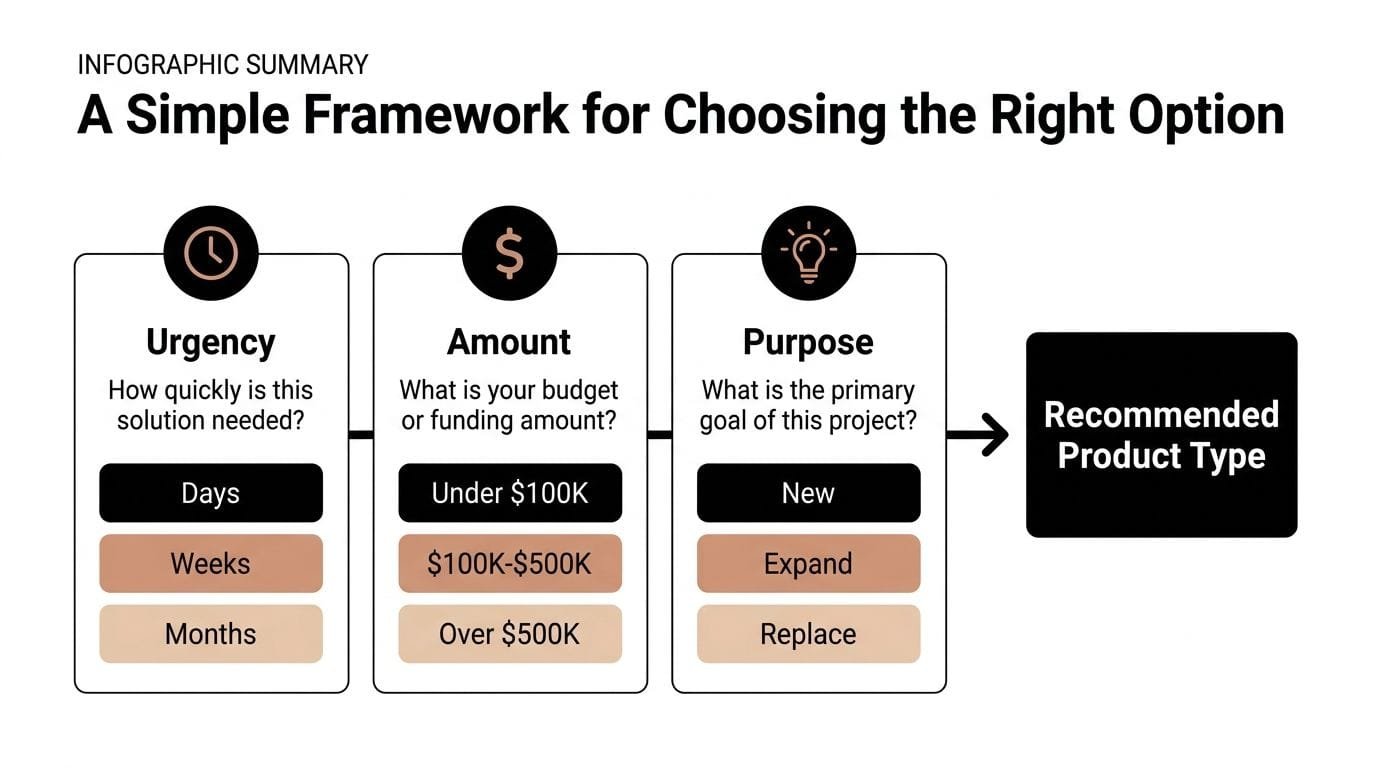
Start with the question operators usually skip, what does speed cost you over time? A faster approval can save a season, keep a buildout on track, or stop a cash squeeze from turning into a shutdown. It can also lock you into higher payments, weaker terms, and less flexibility than the problem deserves.
Use a simple scoring pass before you apply. Give urgency a high score if the money has to land fast, give cost tolerance a high score if you can carry a more expensive product without stress, and give financial strength a high score if your statements look clean enough for lower-cost capital. The product you choose should win on the score that matters most, not on the headline rate.
A restaurant with strong books and a long runway should wait for the cheaper option. A restaurant with a specific asset purchase can pay for that asset directly and avoid borrowing against the whole business. A restaurant with a short cash gap should protect liquidity first, then worry about getting the rate down later. That order matters.
Watch for the traps that distort the choice
The biggest mistake is comparing monthly payment only. A low payment can hide a long payoff, heavy fees, or a structure that keeps eating cash after the original problem is gone. A second mistake is borrowing long-term money for a short-term fix. That is how a temporary problem turns into years of drag.
Use the source of the need as the deciding filter. If the money is tied to a buildout, equipment, or another asset you can point to, the cleaner structure usually wins. If the money is there to bridge payroll, inventory, or a slow stretch, speed matters more, but only if the business can absorb the repayment without choking daily operations.
If you are considering more than one product at once, read how to layer multiple financing tools without over-leveraging. Stacking can work, but only when the combined payments still leave room for rent, food costs, and labor.
Choose the product that matches your timeline and your financial position, and the funding works for your restaurant instead of against it.