
You've built a real business, paid suppliers, and kept customers coming back. Yet a bank declines your business card application because your personal credit history doesn't fit its requirements. That rejection can feel especially unfair when your company's day-to-day finances are healthier than your personal score suggests.
The good news is that business credit cards for bad credit aren't ordinary cards with a lower approval standard. They're a separate group of products with different risk controls, including secured cards, specialty programs, and options that evaluate business cash flow. A denial from one issuer doesn't prove that every path is closed.
The practical question isn't, “Which card will approve me fastest?” It's, “Which account can I manage safely while creating a stronger business credit file?” That shift matters. A card with a deposit may help you establish reporting history, while a high-cost account with poor reporting may leave you paying for access without building much useful credit.
This guide explains how these products work, what issuers examine, and how to compare deposits, fees, limits, and reporting. You'll also learn how to use a card without letting utilization or interest costs work against you, and when vendor accounts, secured financing, or a pre-approval marketplace may be more appropriate than another card application.
Table of Contents
- How Business Credit Cards for Bad Credit Actually Work
- Card Types Fees and Limits You Should Compare
- What Issuers Look at and How to Improve Approval Odds
- A Practical Playbook for Building Business Credit With Cards
- Smarter Alternatives and When to Use Business Loan Warrior
How Business Credit Cards for Bad Credit Actually Work
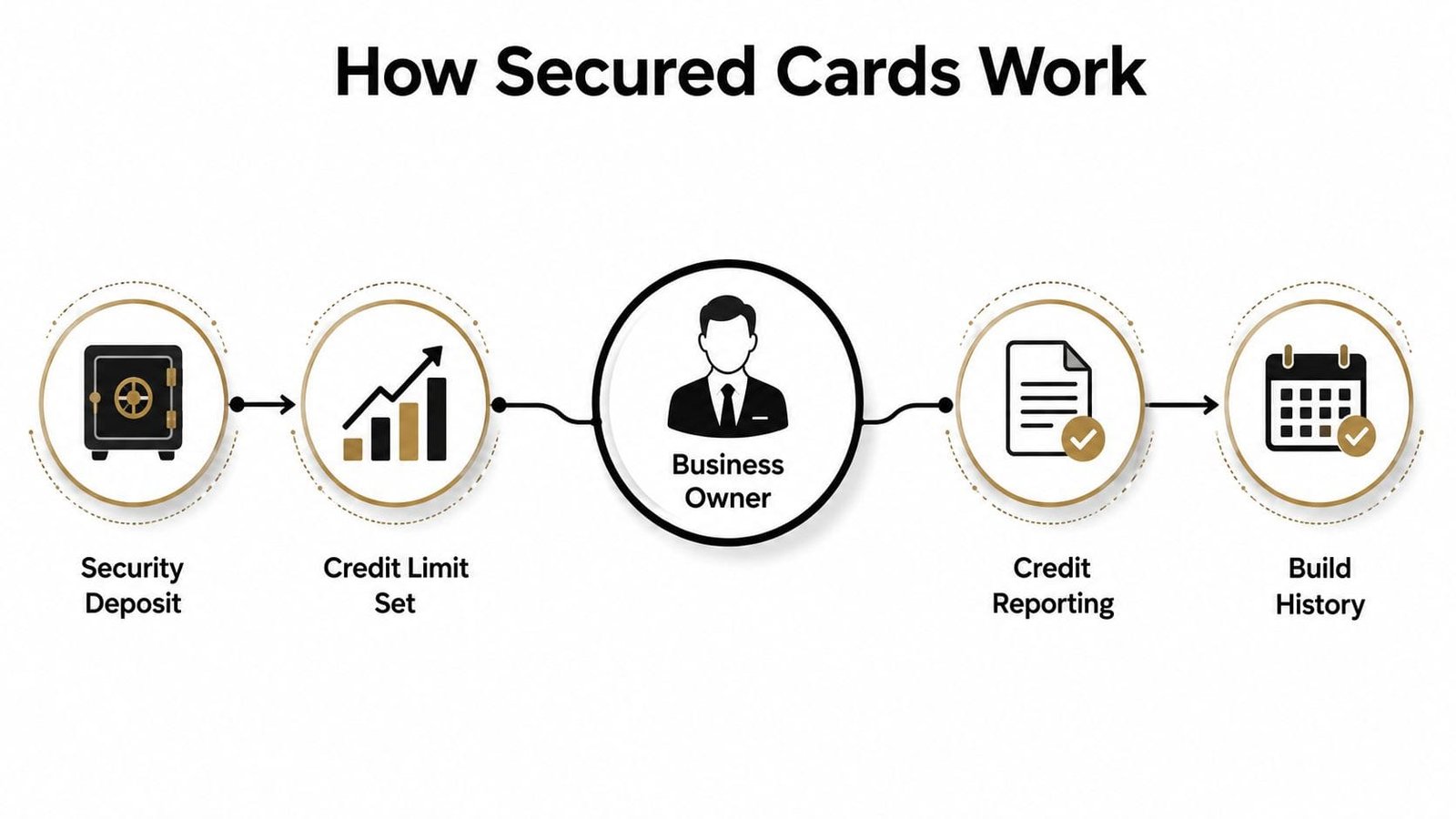
Think of a secured business card like renting an apartment with a security deposit. The deposit gives the issuer protection if the account becomes delinquent, much as a rental deposit protects a landlord from certain losses. You still have to pay the bill, but the issuer takes less risk when approving the account.
A traditional business card often works more like signing a lease with a co-signer. The business applies, but the owner may provide a personal guarantee, meaning the owner can remain responsible if the company doesn't repay. That's why a business application can still involve your personal credit, even when the purchases are for the company.
The deposit changes the underwriting equation
With a secured card, your cash deposit typically sets or supports the credit limit. The issuer holds the deposit as collateral rather than treating it as spending money. You should therefore consider whether tying up that cash will leave enough room for payroll, inventory, taxes, and other operating needs.
Secured cards are the main technical route for applicants with weak personal credit because the deposit reduces default risk. Industry guidance says applicants around 500 or below may still qualify for some secured products, while many standard business cards expect personal credit around 670 or higher, sometimes 690 or higher. That underwriting gap is the reason secured products exist. See the explanation from Bankrate on getting a business card with bad personal credit.
Personal and business files aren't the same
Your personal credit file and business credit file are separate systems, although an issuer may review both during an application. Business bureaus can receive information such as the account's age, credit limit, balance, payment history, and current status. That information becomes useful only when the issuer reports it.
Practical rule: Approval gives you access to credit. Reporting and responsible repayment create the business history that may support future approvals.
Before applying, ask which business bureaus receive payment data. Some issuers report through the Small Business Financial Exchange, while others report directly to Dun & Bradstreet, Experian Business, or Equifax Business. A card that doesn't report may still help with spending management, but it isn't necessarily a strong credit-building tool.
Card Types Fees and Limits You Should Compare
A secured card can be a useful first rung, but it can also tie up cash or create expensive debt. Compare each offer as part of a staged credit-building system: first choose an affordable limit, then confirm the account can support business history, and finally check whether a vendor account or pre-approval marketplace would fit better. Applicants around 500 or lower often find secured products more accessible, with a cash deposit equal to the credit limit, as described in Lendio's guide to business cards for bad credit.
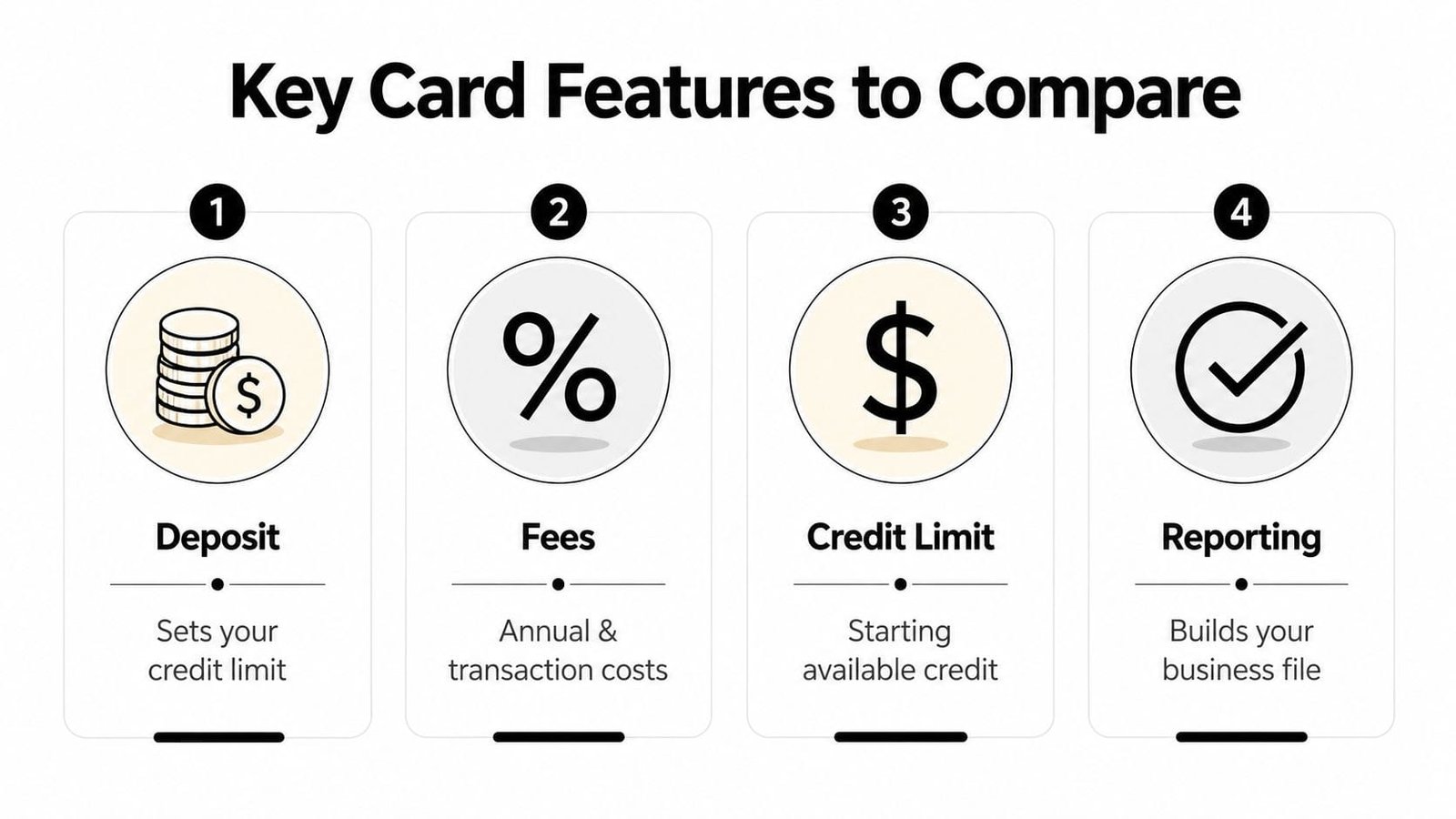
Four features deserve close attention
Start with the deposit and limit together. A $1,000 limit may cover recurring expenses, but a $1,000 deposit also removes that cash from working capital. Ask whether the deposit can be returned and whether the issuer reviews the account for an unsecured upgrade after responsible use. A larger limit helps only if the business can leave the deposit untouched.
Fees become clearer through a first-year comparison. Suppose Secured Card A charges a $49 annual fee and no application fee. With a $500 deposit, its first-year cash commitment is $549, including the deposit. Suppose Secured Card B charges no annual fee but a $25 application fee and a $10 monthly program fee. The same $500 deposit brings its first-year commitment to $645, because the program fees add $120. The deposit may be refundable, so separate that temporary cash requirement from the fees the business cannot recover.
APR matters if the balance carries over. Poor-credit products commonly charge more because the issuer is pricing for greater risk. A card used only for purchases paid in full may keep interest from becoming the main cost. If repayment will take time, compare the card with a vendor account or secured line of credit before applying.
For reporting details, return to Section 1. Here, focus on reporting and graduation terms: ask how positive payments are handled, whether the issuer reviews the account for an unsecured upgrade, and what responsible-use history that review requires. A card that reports well but offers no practical graduation path may still serve as a temporary tool, while a card with a review process can mark the next stage.
| Card Type | Deposit and Limit Logic | Typical Score Range | Reporting and Upgrade Path |
|---|---|---|---|
| Secured business card | Cash deposit generally supports or sets the limit | Designed for weaker credit, including applicants around 500 or below | Confirm reporting, deposit-return rules, and whether responsible use can trigger an unsecured review |
| Specialty issuer program | May assess business cash flow, bank activity, or other company information | Depends on the issuer's underwriting model | Confirm business-bureau reporting and whether a personal guarantee applies |
| Traditional business card | Usually unsecured, with a limit based on the application and underwriting | Many issuers expect about 670 or higher | Reporting and upgrade terms vary, so compare the next product available after stronger repayment history |
The right offer provides an affordable limit, useful reporting, and a realistic next step. If a deposit would strain cash flow, a vendor account or pre-approval marketplace may be the better first move.
What Issuers Look at and How to Improve Approval Odds
An issuer doesn't see only a score. It evaluates whether the applicant appears able to repay, whether the business is real and verifiable, and whether the requested account matches the company's financial activity.
Personal credit remains important for many small-business applications, especially when the card requires a personal guarantee. Recent delinquencies, high balances, collections, and a thin credit file can all make approval harder. The issuer may also review time in business, revenue consistency, business-bank deposits, existing debt, and the accuracy of the legal business information.
A foundational 2010 Federal Reserve report found that 14% of low-score firms used business cards, compared with 10% of high-score firms, even though low-score firms were less likely overall to use them. The same report found that more than 20% of firms applying for a credit card couldn't get one, while 5.6% declined a card because of unfavorable terms. Among firms receiving unfavorable terms, 80% cited inadequate credit limits and 56% cited unfavorable interest rates. These figures are summarized in Nav's discussion of business cards for bad credit.

Focus on the levers you can control
Before applying, review your personal reports for errors and reduce revolving balances where possible. Lower utilization can make the application look less strained, although it can't erase accurate negative history.
Prepare clear business information, including the legal name, business address, tax identification details, revenue, and expected spending. Keep business and personal expenses separate in a dedicated business account. Clean records help you answer underwriting questions consistently.
Choose an issuer whose requirements match your profile rather than submitting applications randomly. Pre-qualification tools can be useful when available because they may help you assess fit before accepting a hard inquiry. You can also use this guide to understand how business credit scores affect funding.
Give yourself time between applications. Multiple hard inquiries, repeated denials, and rushed decisions can make a stressful situation harder. If an issuer declines you, ask for the reason and use it to choose a better-matched product.
A Practical Playbook for Building Business Credit With Cards
A card helps build business credit only when the account reports and you manage the balance consistently. Treat the card as a reporting instrument, not as extra income.
Start with an account that can create a file
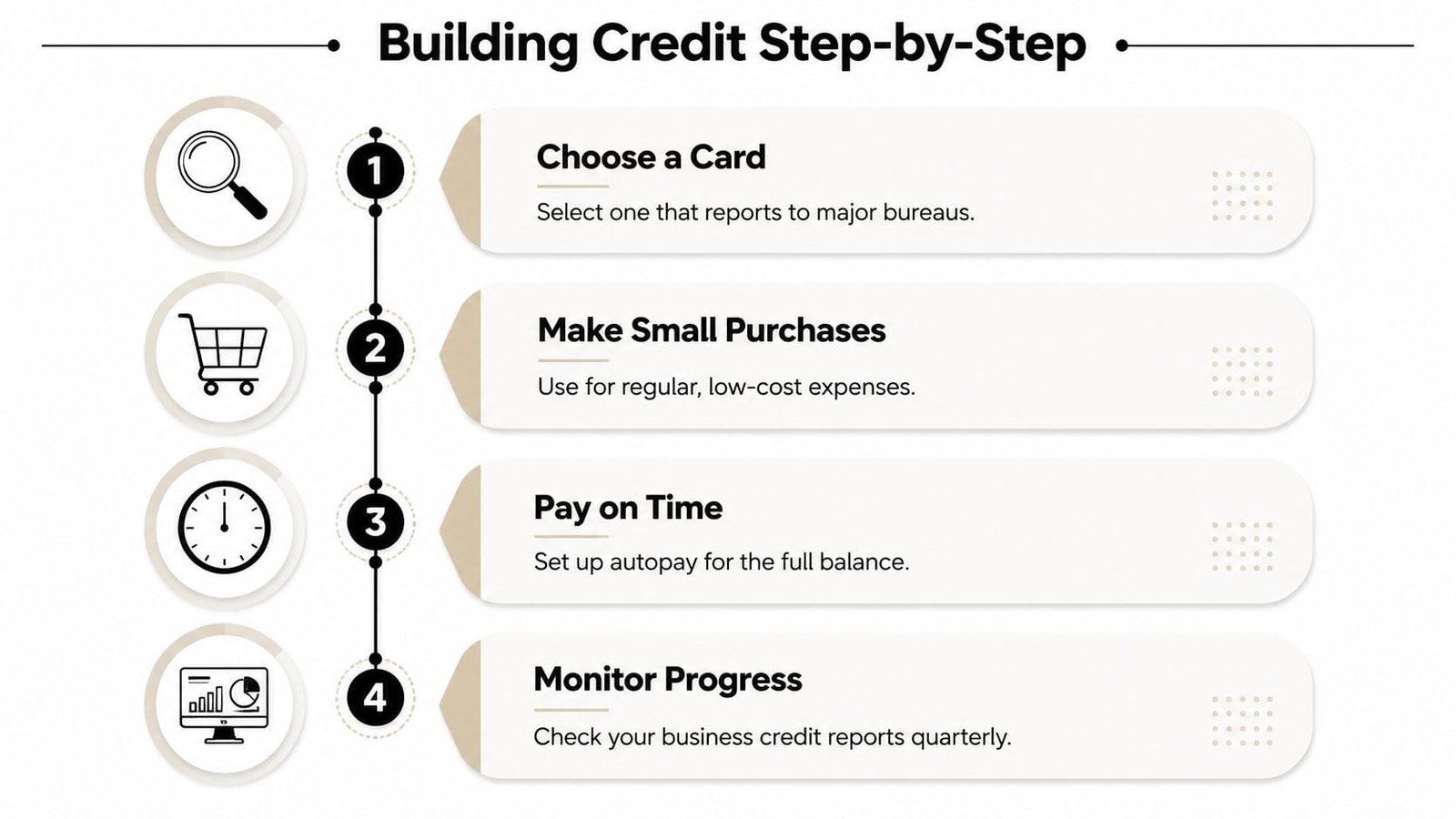
Confirm that the issuer reports payment behavior to the business bureaus. Useful reporting can include account age, credit limit, balance, payment history, and account status. Some issuers send information through SBFE or directly to Dun & Bradstreet, Experian Business, and Equifax Business, according to Payline Data's guidance on secured cards and bureau reporting.
A retailer might use the account for a small recurring inventory purchase. A contractor could route fuel, job-site supplies, or software subscriptions through it. The purchase should already fit the operating budget. Don't buy unnecessary items just to create activity.
Keep the monthly routine simple
Use the card for predictable expenses, then schedule payment of the full statement balance. Expert guidance commonly recommends keeping utilization below 30% of available credit, so a low-limit card may require especially careful timing and smaller purchases. The same guidance explains why balances and payment history can affect credit-building immediately.
A practical monthly cadence looks like this:
- Plan the purchase: Choose a recurring business expense you can repay from existing cash flow.
- Watch the balance: Check the account before the statement closes so utilization doesn't rise unnecessarily.
- Pay automatically: Set autopay for the full balance, then verify that the payment cleared.
- Confirm reporting: Review business credit files periodically to ensure the account appears accurately.
The safest credit-building charge is one you could already afford without the card.
Don't request a higher limit because you're spending more. First check whether the account reports correctly, whether payments are consistently on time, and whether the larger limit supports a genuine business need. For a broader operating routine, review the 90-day business credit blueprint.
A successful sequence may eventually reduce the need for a secured deposit, but graduation isn't automatic. Read the issuer's review policy and keep monitoring every bureau that receives the account's data.
Smarter Alternatives and When to Use Business Loan Warrior
A card isn't always the right tool. If your main need is building a file, a reporting vendor account may be less restrictive than a general-purpose card. If you need inventory before customer invoices are paid, a line of credit may fit better. If you need equipment, equipment financing can align the debt with the asset rather than forcing every expense onto a small revolving limit.
Consider these alternatives based on the problem you're solving:
- Vendor net terms: Useful for supplies and recurring purchases when the vendor reports payment behavior.
- Store or supplier accounts: Appropriate when most spending occurs with one retailer, although usage is less flexible.
- Secured credit lines: A possible fit when you can provide collateral and need access to funds beyond card purchases.
- Secured small-business loans: Better suited to a defined project when predictable repayment matters.
- Revenue-based financing: May fit a business with consistent revenue that needs working capital, but it isn't a credit-building product by itself.
Avoid offers promising guaranteed approval. Review the complete cost, repayment structure, personal guarantee language, collateral requirements, and reporting policy before signing. A product that solves today's cash shortage but creates unaffordable repayment pressure can damage both the business and its owner.
Business Loan Warrior is one marketplace option for owners comparing funding paths. Its process uses a single no-fee application, allows eligible applicants to check pre-approval without a hard credit impact, can connect business-bank data, and provides a secure dashboard for tracking approvals, repayments, and credit insights. Owners can also communicate with underwriters while comparing options. You can review additional approaches in this guide to securing small-business funding with bad credit.
The decision framework is straightforward: start with the lightest product that reports, borrow only for a planned business purpose, and move toward broader financing as your business and bureau history strengthen. If a secured card would consume cash you need for essential operations, pause and consider a reporting vendor account or pre-approval process instead.
Business Loan Warrior can help you compare business funding options through one no-fee application, with pre-approval options designed not to affect your credit and a secure dashboard for tracking next steps. Visit Business Loan Warrior to review funding options that may fit your business while you continue building credit responsibly.