

One podcast can't serve every entrepreneur equally well. A startup founder deciding whether to raise equity needs a different conversation from a restaurant owner protecting working capital, a retailer funding equipment, or an established company planning another location. The popular advice, “just listen to the biggest business show,” confuses recognition with usefulness.
This ranking sorts the best podcasts for entrepreneurs by the business decision each one helps you make. The criteria are practical relevance, depth, financing insight, episode accessibility, and usefulness when you need to choose between preserving cash, borrowing, hiring, launching, or expanding.
Podcast listening also rewards consistency. A widely cited 2026 consumer podcast benchmark reports that 58% of Americans age 12 and older listened in the past month, while 45% listen weekly. That recurring exposure makes serialized learning more useful than random sampling, particularly when you connect each episode to one active business constraint.
Use a simple method. Identify the constraint, choose the matching show, capture one applicable lesson, and translate it into one cash-flow, funding, or expansion action. The best episode isn't the one that inspires you most. It's the one that improves the next decision on your calendar.
Table of Contents
- 1. How I Built This with Guy Raz
- 2. Masters of Scale with Reid Hoffman
- 3. My First Million
- 4. Acquired
- 5. The Tim Ferriss Show
- 6. The Pitch
- 7. Indie Hackers Podcast
- Top 7 Entrepreneur Podcasts Comparison
- Turn Listening Into a Business Move
1. How I Built This with Guy Raz
Best for choosing a business model and learning from founder resilience
A founder story can be more useful than a generic strategy lecture when you're trying to understand how a business developed. How I Built This with Guy Raz examines the origins, pivots, setbacks, and operating choices behind recognizable companies. The format is especially valuable for owners who want to compare business models across retail, food, software, consumer products, and other industries.
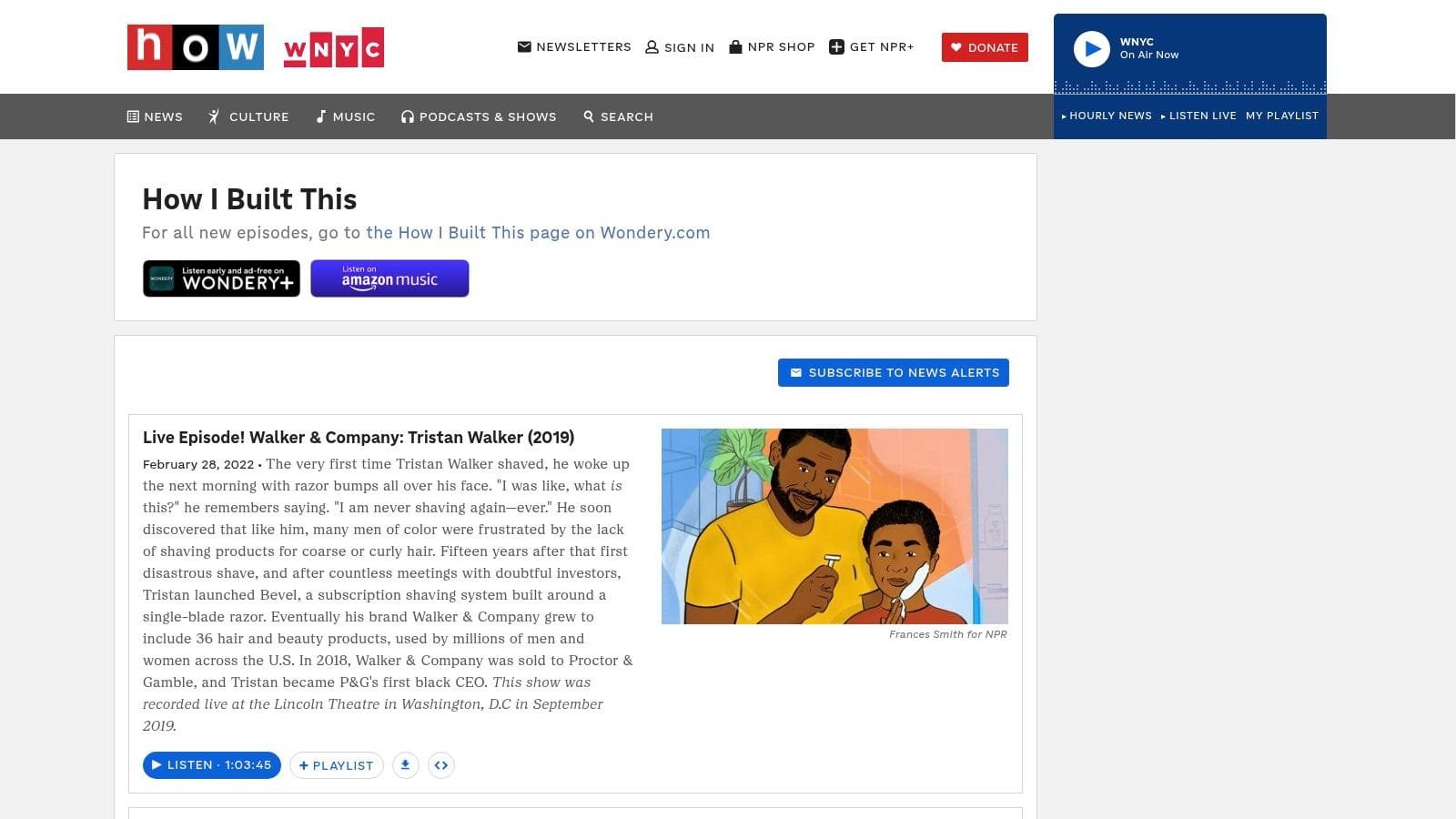
The show's strongest lesson is rarely a single tactic. It's the sequence of decisions. You hear how a founder identified demand, tested a product, handled hiring pressure, adjusted pricing, or responded when the original plan stopped working. For a small-business owner, that context helps separate a temporary cash-flow problem from a flawed model that deserves a deeper reset.
Where the show helps financially
Episodes can inform decisions around product-market fit, pricing, staffing, supply chains, and early financing. A hospitality operator might listen for lessons about purchasing and customer experience. A retailer might study how a consumer brand built distribution before committing to inventory. A software founder might focus on when the business shifted from experimentation toward repeatable sales.
The practical limitation is that the narrative often gives you more context than mechanics. Not every episode explains loan structures, credit lines, repayment schedules, or detailed deal terms. The storytelling pace can also feel slow if you need a five-minute answer before a meeting.
Practical rule: Use founder narratives to identify decision patterns, then verify the financial details against your own statements, forecasts, and lender requirements.
This is a strong starting point when you're choosing a model or rebuilding confidence after a difficult operating period. Listen with a question in mind, such as whether to simplify the offer, protect payroll, delay a purchase, or invest in the channel showing the clearest repeat demand.
2. Masters of Scale with Reid Hoffman
Best for scaling operations and planning expansion
Revenue growth can expose weak systems faster than a slow sales period. Once demand is reliable, owners must decide how quickly to add staff, locations, products, or markets without letting fixed costs outrun cash flow. Masters of Scale examines that transition through pricing, go-to-market execution, network effects, culture, and international expansion.
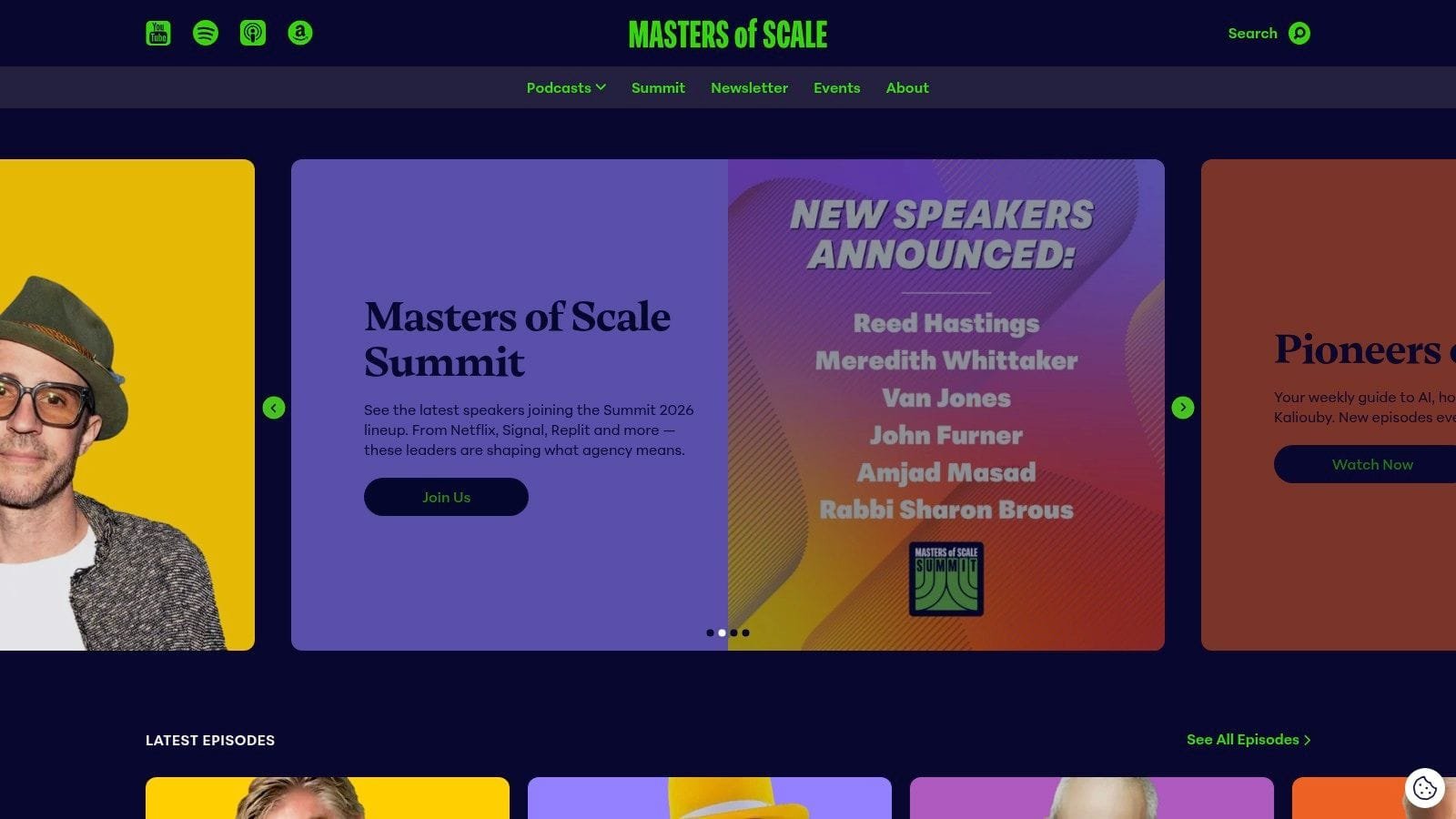
The show suits owners who already have an operating engine and need to make it repeatable. Its frameworks help test whether growth still depends on the founder, whether sales capacity can support a new market, and whether the current team structure can handle expansion. Those answers should come before financing a new location, increasing inventory, or adding a major marketing channel.
Apply the framework, then test the numbers
Translate each episode into an operating decision rather than copying a large company's tactic.
- Pricing discipline: Decide whether higher prices should fund better service, added staff, or stronger margins.
- Team design: Identify which responsibilities need documented processes before adding a manager or department.
- Market expansion: Separate evidence of customer demand from an attractive but untested opportunity.
- Growth funding: Match borrowed capital to an asset or cash-flow event that can reasonably support repayment.
For digital businesses, tools like a ShortGenius AI ad generator can help visualize the growth campaigns discussed on the show before committing a larger advertising budget. The output is a planning aid, not proof that the channel will produce profitable demand.
The show offers less detail on small-business financing. An owner seeking an SBA loan, line of credit, equipment facility, or working-capital structure still needs lender input, repayment estimates, and cash-flow projections. Sponsor segments can also interrupt the discussion when you need a tightly defined operating answer.
For an established company, define the operating requirement before requesting funds. Guidance on growing an established business with smart financing and operational scaling connects expansion ideas to a concrete capital plan. Masters of Scale works best when it clarifies what must become scalable before debt accelerates the plan.
3. My First Million
Best for finding new profit centers and acquisition ideas
Some owners don't need another founder biography. They need a sharper way to discover an adjacent offer, marketing channel, or acquisition opportunity. My First Million takes a fast-moving approach to business ideas, market gaps, acquisitions, media plays, and operator tactics.
The show is particularly useful for owners who can execute but need more options. A service company might hear an idea for a productized offer. A retailer might consider a complementary category or a different distribution route. A digital business might spot a niche audience, content opportunity, or acquisition target that fits its existing capabilities.
Use the ideas as hypotheses
The strength of the show is speed and pattern recognition. The weakness is that brainstorming can make an opportunity sound easier than it is. An idea still needs customer validation, margin analysis, staffing capacity, legal review, and a realistic view of how much cash it will consume before it contributes anything.
A useful listening note has four columns:
- Opportunity: What business or profit center is being discussed?
- Existing advantage: Which customers, systems, relationships, or assets could your company reuse?
- Capital need: Would the idea require inventory, equipment, marketing spend, hiring, or an acquisition loan?
- Kill signal: What evidence would tell you to stop before committing more cash?
That last question keeps enthusiasm from becoming an unfunded expansion plan. A new revenue stream can strain cash flow if the owner buys assets or inventory before confirming demand. It can also distract the team from a profitable core business.
The show's HubSpot connection adds useful marketing context and makes it easier to find entry points for new listeners. Its casual humor and occasional digressions won't suit every operator, and the format doesn't consistently provide step-by-step finance detail.
A compelling business idea is not yet a capital allocation decision.
Listen when you want to widen the opportunity set. Then move quickly to a small, measurable validation step before seeking funding or reallocating operating cash.
4. Acquired
Best for strategic planning, M&A, and capital allocation
Acquired treats company history as a strategic case study. The episodes are long, heavily researched, and focused on how important businesses built moats, made acquisitions, developed pricing power, and allocated capital over time. That depth makes the show a better fit for owners planning a major expansion than for someone searching for a quick productivity tip.
The central benefit is perspective. Before buying a competitor, opening locations, or entering a new market, an owner needs to understand why an advantage lasts. Acquired can help you think through distribution, switching costs, brand strength, operating efficiency, and the difference between a temporary lead and a durable moat.
Why depth matters before borrowing
A financing decision often looks attractive when viewed only through the purchase price or projected revenue. A deeper strategic analysis asks different questions. Does the acquisition improve your position in a market you understand? Can your team integrate the operation? Will the combined company produce stronger cash flow, or will the deal add complexity without enough strategic benefit?
The show's meticulous research and show notes support this kind of work. You can pause, review the source material, and compare the episode's logic with your own assumptions. That's useful when building an expansion memo for partners, lenders, or an internal leadership team.
The trade-off is time. Long-form episodes demand deliberate listening, and the material isn't designed around small-ticket borrowing mechanics. You won't necessarily get a direct explanation of how to structure equipment financing, an operating line, or short-term working capital.
Use the show selectively. Pull one episode when you're evaluating a competitor, studying an industry leader, or deciding whether a growth plan depends on scale that your current operation can't yet support. Then turn the strategic lesson into a financial question:
- Cash flow: What operating cash must remain available during execution?
- Funding: Which asset or transaction would the capital support?
- Expansion: What evidence would justify moving from planning to commitment?
Acquired won't replace due diligence. It can improve the questions you ask before due diligence begins.
5. The Tim Ferriss Show
Best for targeted operator tactics
The Tim Ferriss Show is a broad interview archive covering founders, investors, executives, negotiators, performers, and specialists. Its value comes from searchability and range. Rather than listening sequentially, an owner can select episodes around a specific need, such as negotiation, fundraising, productivity, sales, leadership, or go-to-market execution.
That flexibility makes the show useful during an active decision cycle. If you're negotiating with a supplier, preparing for a financing conversation, redesigning a sales process, or trying to reclaim time from day-to-day operations, the archive may contain a relevant conversation. Detailed episode notes also make it easier to scan before deciding whether an episode deserves your attention.
Extract tactics without copying personalities
The practical risk is overgeneralization. A tactic that works for a venture-backed software company, professional athlete, or high-profile investor may not fit a retailer, contractor, manufacturer, or service business. The show also includes exploratory conversations that are valuable for thinking but less useful as direct operating instructions.
Filter every recommendation through your financial model. Ask:
- Does this tactic affect revenue, margin, capacity, or risk?
- What would implementation cost in cash and management time?
- Can the business test it without taking on new debt?
- If it works, what funding would support the next step?
The show's wide guest mix is its advantage and its constraint. It exposes you to ideas across software, consumer businesses, finance, and personal performance, but relevance varies from episode to episode. Don't confuse an interesting conversation with a validated plan.
Listening filter: Keep the tactic, discard the mythology, and test the mechanism inside your own business.
Choose this podcast when you have a narrow operating problem and want several perspectives quickly. It belongs lower in a funding-specific ranking because many episodes address business performance indirectly. It belongs high on a practical list because a well-chosen conversation can improve the quality of a negotiation, meeting, hiring decision, or operating routine.
6. The Pitch
Best for preparing for equity fundraising
The Pitch puts founders in front of real venture capital investors. Listeners hear the pitch, the questions, the objections, the negotiation, and the discussion around whether an investment makes sense. That makes it one of the clearest options for entrepreneurs who need to understand how equity investors evaluate a company.
The show teaches founders to make their story legible. Investors want to understand the customer, the market, the growth engine, the risks, and the intended use of capital. Hearing real conversations helps you notice where founders create confusion, answer too broadly, or fail to connect funding with a credible operating plan.
Equity lessons aren't debt lessons
This distinction matters for established owners. A venture pitch may emphasize market size and rapid growth, while a lender will focus on repayment capacity, financial statements, collateral, time in business, and cash-flow stability. A strong pitch for equity doesn't automatically become a strong application for an SBA loan, equipment financing, or a working-capital line.
Still, the show has practical value for any capital conversation. It can improve your data-room organization, clarify your use-of-funds explanation, and help you anticipate diligence questions. Owners comparing multiple sources of capital can also use the concept of capital stacking and business funding to think about how different financing tools might serve different needs, without treating every option as interchangeable.
Pay attention to the negotiation, not only the outcome. Consider what the founder gives up, what control the investor receives, how timing affects power dynamics, and whether the proposed capital fits the company's goals. Entertainment can make the process feel simpler than it is, so write down the underlying business lesson after each episode.
The Pitch is the right choice when you're preparing to raise equity or want to understand investor psychology. It's less relevant when your real question is how to finance inventory, equipment, construction, or a predictable working-capital gap.
7. Indie Hackers Podcast
Best for bootstrapped, capital-efficient growth
Indie Hackers Podcast focuses on founders building online businesses with lean teams and limited dependence on outside capital. The conversations are practical, especially around customer acquisition, SEO, communities, content, no-code tools, monetization, and revenue-backed growth.
For a bootstrapped owner, the show's most useful question is simple: can the company grow without spending ahead of proof? Episodes often encourage faster shipping, direct customer feedback, and disciplined attention to the channel that produces revenue. That mindset can protect cash flow when an owner has limited borrowing capacity or wants to avoid dilution.
Translate digital tactics carefully
The advice transfers most directly to software, media, agencies, and other digital businesses. A service company might adapt the customer-acquisition lessons. A brick-and-mortar operator may find the content and community ideas useful, but not every tactic applies to a business that needs vehicles, inventory, construction, or specialized equipment.
Use the show to examine capital efficiency:
- Acquisition: Which channel can you test before committing to a larger marketing budget?
- Revenue: Can you collect cash earlier, improve retention, or package the offer more clearly?
- Capacity: What work should be automated or removed before hiring?
- Financing: Is borrowed money necessary, or would a smaller operating experiment answer the question first?
The format's candid discussions of revenue and monetization make it more concrete than many motivational shows. Cadence and availability can vary, so treat the broader Indie Hackers community as part of the learning environment rather than relying only on new episodes.
Owners who need a funding path before revenue is established should also review startup funding without revenue, while recognizing that eligibility and suitability depend on the business and financing product. Indie Hackers is the best fit when your priority is preserving ownership, improving cash conversion, and proving demand before adding fixed obligations.
Top 7 Entrepreneur Podcasts Comparison
| Podcast | Implementation Complexity 🔄 | Resource Requirements ⚡ | Expected Outcomes 📊 | Ideal Use Cases 💡 | Key Advantages ⭐ |
|---|---|---|---|---|---|
| How I Built This with Guy Raz | Moderate, story-driven, less step-by-step | Low–Moderate, typical episode length; passive listening | Operational lessons, founder resilience; limited deal mechanics | Owners seeking origin stories and practical operational case studies | NPR-quality production and broadly relatable cases ⭐⭐⭐⭐ |
| Masters of Scale with Reid Hoffman | Medium, framework-driven, needs interpretation | Moderate, focused episodes and curated curricula | Repeatable growth frameworks for scaling teams and GTM | Leaders moving from mid-size to large-scale businesses | Actionable playbooks and C-suite insights; strong network ⭐⭐⭐⭐ |
| My First Million | Low, ideation-focused, informal format | Low, fast-paced, trend-driven episodes | Idea generation, marketing plays, acquisition angles | Founders hunting for niches, new profit centers, roll-up ideas | Highly current, marketing-savvy, trend spotting ⭐⭐⭐ |
| Acquired | High, deep research and multi-hour case studies | High, long episodes and extensive notes/time | Strategic context for M&A, moats, unit economics | Owners studying big-company strategy and acquisition analysis | Exceptional depth and sourced research for strategic decisions ⭐⭐⭐⭐ |
| The Tim Ferriss Show | Medium, long-form interviews, variable structure | High, lengthy episodes and large archive | Practical tactics across productivity, negotiation, fundraising | Broad skill-building and operator-level tactics across industries | Diverse guests and a massive, searchable back catalog ⭐⭐⭐⭐ |
| The Pitch | Medium, real-time negotiation walkthroughs | Low–Moderate, focused, demo-style episodes | Clear investor expectations, pitch templates, term-sheet dynamics | Founders preparing for VC pitches or fundraising rounds | Transparent in-room negotiation audio and practical templates ⭐⭐⭐ |
| Indie Hackers Podcast | Low, tactical, bootstrap-oriented interviews | Low, concise, execution-focused episodes | Revenue-focused tactics, capital-efficient growth ideas | Bootstrapped founders and digital/software businesses | Highly tactical, plug-and-play growth and monetization tips ⭐⭐⭐ |
Turn Listening Into a Business Move
The right podcast depends on the decision in front of you, not the size of the show's audience. Choose How I Built This when you need founder resilience, product-market lessons, or small-business case studies that make setbacks easier to interpret. Choose Masters of Scale when the challenge is building repeatable operations, managing a larger team, or preparing for expansion.
Use Acquired for strategic planning, competitive analysis, M&A thinking, and long-range capital allocation. Its depth is valuable when a decision could reshape the company, but it isn't the fastest option for a narrow financing question. My First Million is better when you're searching for new profit centers, acquisition ideas, or adjacent opportunities that could use your existing customers and capabilities.
For capital-efficient growth, Indie Hackers offers the most relevant mindset. It encourages owners to validate demand, improve acquisition, and grow from revenue before committing cash to a large plan. That approach is particularly useful when preserving liquidity matters more than pursuing speed.
Choose The Pitch when equity fundraising is the decision ahead. It can help you explain the business, prepare for diligence, anticipate investor objections, and think more clearly about the trade-off between capital and ownership. It won't replace lender-specific preparation, so don't use venture conversations as a substitute for understanding the requirements of debt financing.
Finally, use The Tim Ferriss Show as a searchable tactics library. Pick episodes around negotiation, hiring, sales, leadership, or fundraising rather than listening without a purpose. The broad archive rewards targeted questions, but you'll need to separate transferable mechanisms from advice designed for a very different type of operator.
A listening session should end with one written decision. That might be whether to preserve cash, seek a line of credit, prepare for an SBA loan, finance equipment, fund construction, pursue an acquisition, or delay expansion until unit economics support it. Write down the action, the cash required, the expected business effect, and the evidence that would make you change course.
Business Loan Warrior is relevant when that decision leads to a real funding comparison. Owners can explore options for cash-flow stabilization, equipment, expansion, construction, acquisitions, SBA-backed financing, lines of credit, and other business capital through a single application process, then compare potential paths with human support.
The goal isn't to consume more business content. It's to make better decisions with less wasted cash and fewer unsupported assumptions. Pick one show, listen for one constraint, and put one tested action on your operating plan.
Business Loan Warrior helps small-business owners compare funding for working capital, equipment, construction, expansion, acquisitions, SBA financing, and more through one no-fee application. Visit Business Loan Warrior to explore funding options and turn your next business decision into a practical capital plan.