

Commercial real estate refinancing has become a balance-sheet event, not a routine paperwork exercise. S&P Global Market Intelligence estimated that roughly $950 billion in CRE mortgages matured in 2024, with about $1.0 trillion set to mature in 2025 and maturities projected to peak around $1.26 trillion in 2027 (S&P Global Market Intelligence's CRE maturity analysis). Owners aren't just replacing an old loan. They're repricing debt, defending appraised value, and finding cash to cover gaps created when today's loan proceeds fall below yesterday's payoff.
The most dangerous assumption is that a performing property will automatically refinance. Lenders underwrite current value and stabilized cash flow, not the original purchase price or the equity you believe exists. A conservative owner models the appraisal first, calculates the worst-case equity requirement, and only then chooses a loan structure.
Table of Contents
- Why Commercial Real Estate Refinancing Is Surging Right Now
- Understanding Your Refinance Options
- The Financial Metrics That Determine Your Approval
- Documentation and Timeline for a Successful Refinance
- Choosing the Right Lender for Your Situation
- Avoiding the Appraisal Gap Trap
- Your Refinance Decision Framework
Why Commercial Real Estate Refinancing Is Surging Right Now
$498 billion in commercial real estate borrowing and lending took place in 2024, up from $429 billion in 2023, according to Mortgage Bankers Association data. That activity reflects more than routine loan replacement. Debt originated in a lower-rate period is reaching maturity while replacement financing costs more, creating immediate pressure on owners who expected their existing equity to carry forward.
The timing problem extends beyond one year. The St. Louis Fed, citing Trepp estimates, reported that approximately $1.7 trillion, nearly 30% of outstanding CRE debt, was expected to mature from 2024 through 2026. That concentration gives lenders more choice and leaves borrowers less room to delay a difficult refinance.
Why the old loan no longer fits
S&P Global reported that CRE loans originated in 2024 carried an average interest rate of 6.2%, compared with 4.3% for mortgages maturing during that period, a difference of nearly 200 basis points (S&P Global Market Intelligence's maturity-wall research). Even with stable property income, a higher payment can reduce DSCR and lower the proceeds a lender will approve.
Value creates a second pressure point. Banks must decide how much collateral support remains when income assumptions change. Office properties face particular scrutiny, while hotels, retail assets, and other operationally sensitive properties can see revenue shift quickly. A property may have performed well historically and still produce insufficient refinance proceeds under current underwriting.
| Year | Maturing loan volume, estimate | Key market condition |
|---|---|---|
| 2024 | Approximately $950 billion | Large volume of loans reached maturity as replacement debt became more expensive |
| 2025 | Approximately $1.0 trillion | Refinancing demand remained strong amid tighter underwriting |
| 2026 | Approximately $875 billion of U.S. commercial and multifamily mortgage debt | Borrowers continued facing appraisal and equity-gap pressure |
| 2027 | Approximately $1.26 trillion at the projected peak | The maturity wall remained a multi-year market issue |
The figures come from the MBA-based 2026 capital reset analysis. Owners comparing loan structures should monitor commercial real estate loan rates instead of relying on the coupon from an older term sheet.
Model the appraisal before approaching lenders. Test the payoff against a lower valuation, revised rent assumptions, higher debt service, and required reserves. The resulting equity gap is the cash the owner may need to bring to closing, even when every scheduled payment has been made.
Delay can turn a manageable refinance into a forced negotiation. A lender may reduce proceeds, require amortization, request a paydown, or offer only a short extension. Early preparation gives owners time to compare banks, credit unions, agency programs, and portfolio lenders, while improving collections, renewing leases, addressing deferred maintenance, or building reserves. Teams handling complex property data and operating workflows can use Loopfour for property finance to organize information before lender discussions begin.
Understanding Your Refinance Options
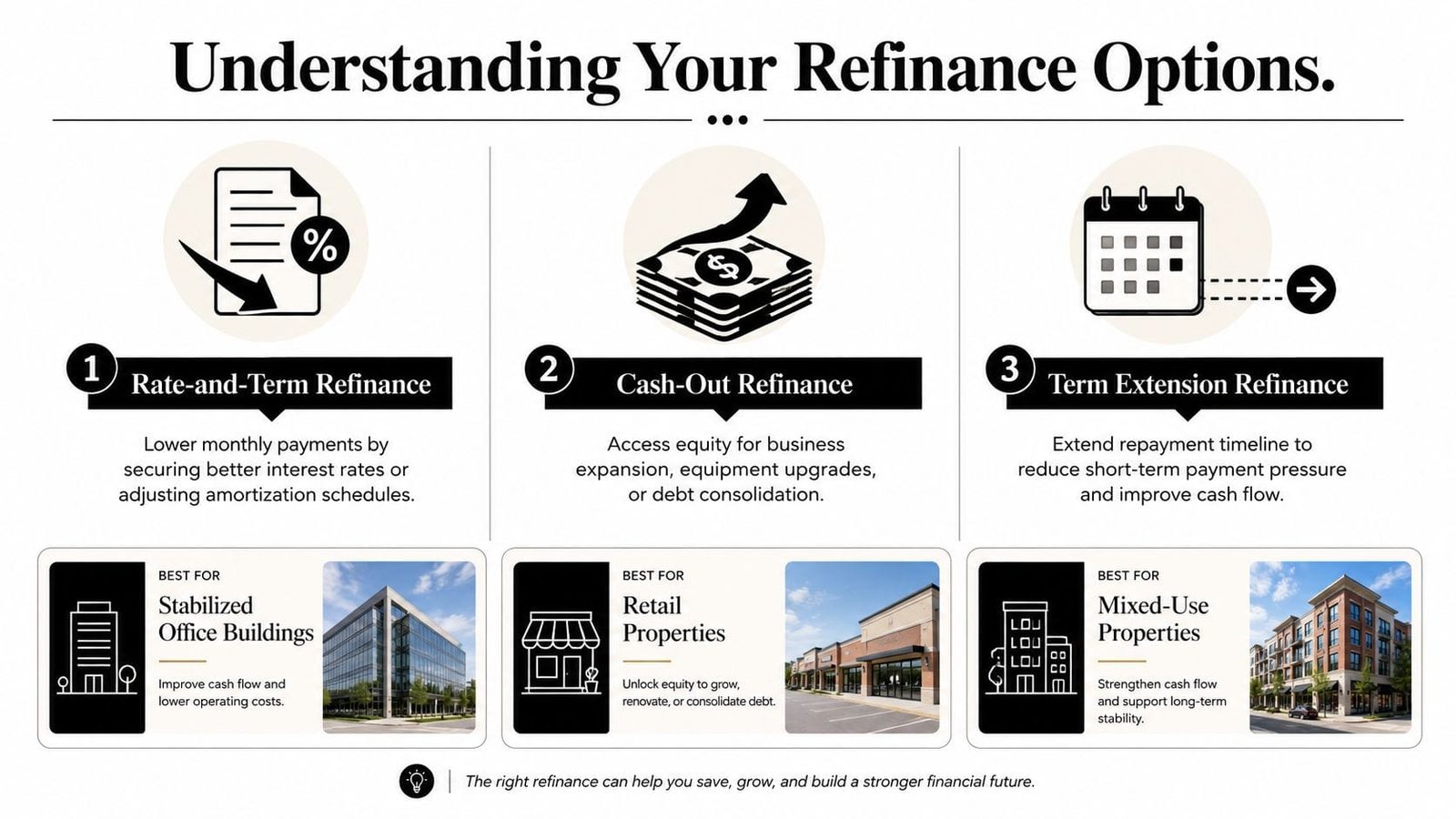
The right refinance structure follows the property's immediate need. Lowering debt service, releasing equity, and postponing a maturity date solve different problems. Treating them as interchangeable can leave an owner with the wrong loan and a larger equity gap at closing.
Rate-and-term refinance
A rate-and-term refinance replaces the existing loan without materially increasing the balance. Owners use it to reduce the payment, change amortization, replace restrictive covenants, or move from floating-rate exposure to a more predictable structure.
The potential benefit is lower debt service and stronger property cash flow. The trade-off is that a new amortization schedule may extend the period of interest payments. Closing costs and prepayment charges can also eliminate the savings if the owner expects to sell soon.
Review the existing note before requesting a payoff. Yield maintenance, defeasance, and other prepayment provisions may make an early refinance expensive. The lowest quoted rate is not always the lowest total cost after legal expenses, appraisal work, closing charges, and the reduced flexibility of a longer commitment.
Cash-out refinance
A cash-out refinance increases the loan balance and releases part of the owner's equity. Typical uses include tenant improvements, equipment purchases, acquisitions, business debt consolidation, and property repairs.
Proceeds depend on the current appraised value, not the original purchase price or the value the owner expects after planned improvements. Commercial refinance underwriting guidance from Murphy Private Capital explains why both property cash flow and collateral value shape the lender's decision.
Before requesting cash out, model a lower appraisal and higher debt service. If the revised proceeds do not cover the payoff, fees, and required reserves, the owner faces an equity contribution even with a perfect payment history.
Cash-out works when the released capital has a defined return or protects operating liquidity. It becomes dangerous when borrowed funds cover recurring losses. Higher debt raises coverage requirements and can create a larger shortfall at the next maturity.
Term extension
A term extension postpones the balloon payment or maturity date. It can provide time to stabilize occupancy, complete improvements, sell the asset, or wait for more workable financing conditions.
An extension may involve a fee, a higher rate, principal reduction, tighter reporting, or a short review period. It buys time, but it may not repair weak value or cash flow.
Compare the cost of buying time with a permanent refinance before choosing this route. A bridge financing overview helps distinguish temporary liquidity from long-term property debt. Owners can also estimate mortgage refinance costs before assuming that a lower coupon creates a meaningful net benefit.
The Financial Metrics That Determine Your Approval
Lenders reduce a complicated property story to a few underwriting tests. Run those tests before applying. A self-underwrite exposes hidden equity gaps, weak coverage, and appraisal risk while you still have time to adjust the request.
Start with NOI and DSCR
Net operating income is the foundation. Use collected property revenue, subtract normal operating expenses, and exclude financing costs. An optimistic pro forma does not help unless leases, collections, and operating history support it.
DSCR = Net operating income ÷ annual debt service
For example, $1,250,000 of NOI against $1,000,000 of annual debt service produces a 1.25x DSCR. As noted in the refinance options section, lenders commonly look for approximately 1.20x to 1.30x, depending on the program and property. Their guidance also considers both property cash flow and collateral value, as described in CRE underwriting guidance from Murphy Private Capital.
Stress the ratio after vacancy changes, expense increases, reserve deductions, and a higher interest rate. If coverage works only in the base case, the loan is fragile. Model the downside case before a lender does it for you.
Calculate LTV from current value
LTV = proposed loan amount ÷ appraised property value
As noted in the refinance options section, commercial cash-out financing commonly caps at 65% to 75%. The applicable limit still depends on property type, lender, sponsorship, and loan structure. A property purchased at a high valuation may have less refinance capacity if comparable sales or income support a lower current appraisal.
Review commercial real estate valuation before requesting proceeds. The practical question is not how much equity appears on your balance sheet. It is how much debt the lender will permit against today's defensible value.
Calculate the payoff gap under a lower appraisal. If proceeds cannot cover the existing balance, closing costs, and required reserves, you may need to contribute equity despite a perfect payment history.
Find the break-even point
Add lender fees, legal work, appraisal, title, recording, and any prepayment charge. Then divide the total by monthly payment savings.
Break-even period = total refinance costs ÷ monthly savings
If the result extends beyond your expected ownership period, a lower payment may not justify the transaction. Cash-out requires a second test. Compare the cost of new capital with the operating return it should produce, and do not count projected gains until the lender accepts the assumptions.
| Metric | Typical threshold | Red flag trigger |
|---|---|---|
| DSCR | Approximately 1.20x to 1.30x | Coverage falls below the lender's minimum after stress testing |
| LTV | Typically 65% to 75% for commercial cash-out | Current appraisal leaves proceeds below the payoff balance |
| Reserves | Frequently 6 to 12 months of payments | No liquidity for vacancy, repairs, or delayed leasing |
| Ownership seasoning | Many lenders expect roughly six months | Cash-out request arrives before the property has operating history |
Reserve and seasoning requirements vary by lender and transaction. Use PropLab's CRE underwriting guide to organize assumptions, then treat the lender's term sheet as the final test.
Documentation and Timeline for a Successful Refinance
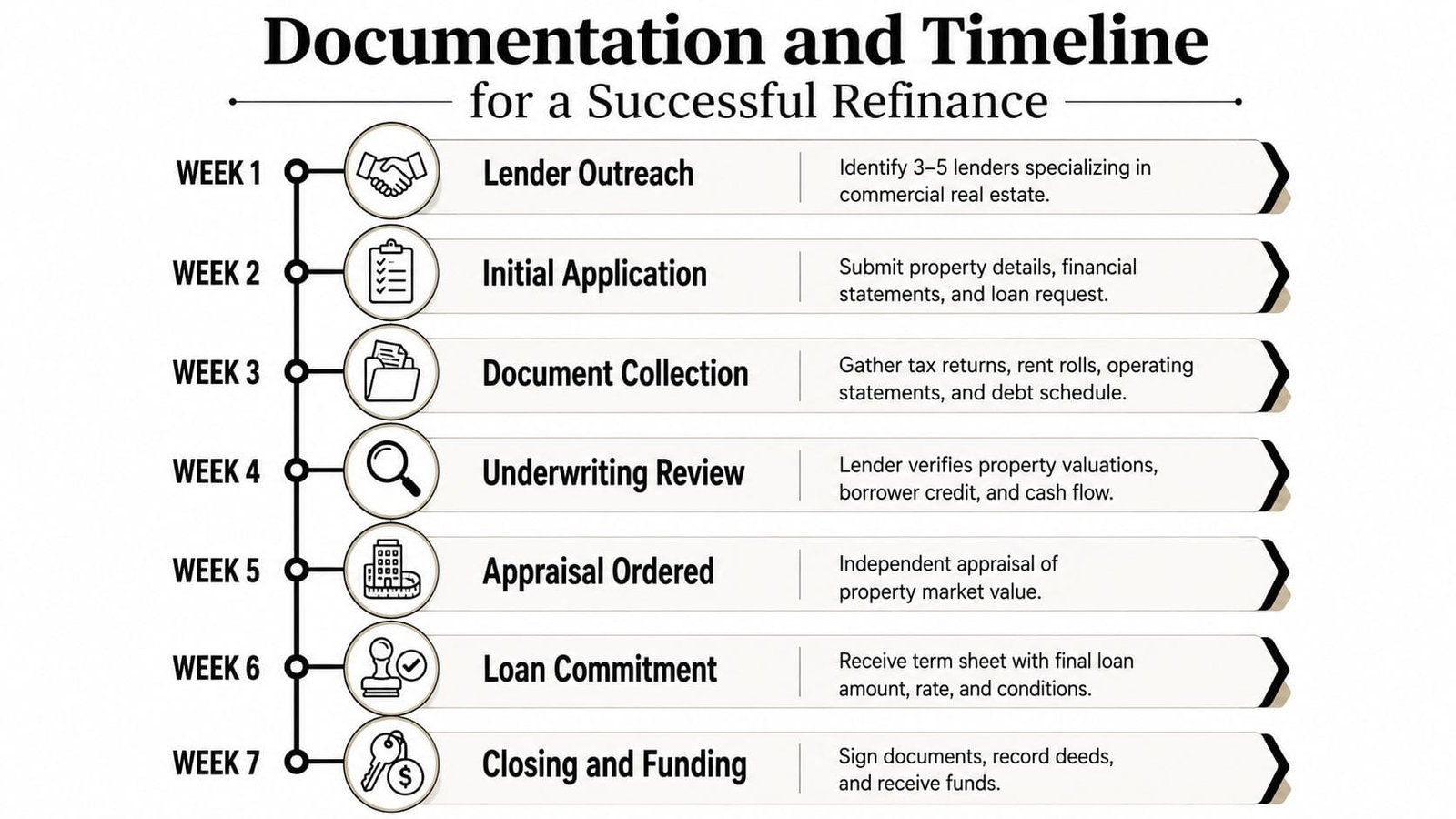
Most refinance delays begin before underwriting. Borrowers submit incomplete rent rolls, inconsistent operating statements, or entity documents that don't match the loan request. The underwriter then pauses the file while the borrower searches for information that should have been assembled first.
Start with three folders:
- Property records: Current rent roll, lease abstracts, operating statements, tax records, insurance, capital improvement history, and the existing loan statement.
- Borrower records: Entity formation documents, ownership chart, operating agreement, personal financial statements, debt schedule, and requested tax returns.
- Third-party materials: Appraisal, title work, Phase I environmental report, property condition report, survey, and any required engineering documents.
Lenders compare the rent roll against deposits, tax returns, leases, and operating statements. Explain discrepancies before they become questions. A vacancy that appears in one document but not another creates more concern than a clearly documented vacancy with a credible leasing plan.
Sequence the work carefully
Contact lenders well before maturity. The practical underwriting guidance in the verified data recommends starting six to 12 months before maturity, while a more conservative owner may begin earlier when the asset has value, occupancy, or documentation issues.
Order third-party reports only after confirming the lender's requirements. Reports can become stale, and ordering them too early may force the borrower to pay twice. At the same time, don't wait until the lender has completed every review if the appraisal or environmental report is likely to control the closing date.
Practical rule: Build a buffer for one disputed appraisal item, one missing entity document, and one unexpected property repair. Those issues are common enough that a schedule with no slack is not a schedule.
Use a single debt schedule showing the current balance, maturity, interest rate, amortization, prepayment terms, and payoff instructions. Give each lender the same package. Consistent information makes competing offers easier to compare and prevents a lender from underwriting one set of assumptions while another uses a different version.
Choosing the Right Lender for Your Situation
The right lender must fit both the property's risk and your exit plan. A lower quoted rate can still produce a poor refinance if the lender requires an equity contribution you cannot fund, cannot close before maturity, or applies prepayment terms that restrict a planned sale.
| Lender type | Typical rate range | Maximum LTV | Prepayment penalty | Recourse | Best for |
|---|---|---|---|---|---|
| Traditional bank | Varies by market and credit profile | Often conservative | May include negotiated penalties | Common for smaller or riskier transactions | Stable properties and established operating relationships |
| Credit union | Varies by institution and relationship | Institution-specific | Often negotiable, but review the note | Frequently relationship-based | Local owners seeking context-sensitive underwriting |
| CMBS or conduit lender | Varies by execution and market | Can support a higher loan amount within program limits | Yield maintenance or defeasance can be significant | Often structured with nonrecourse features, subject to carve-outs | Stabilized assets with a long hold period |
| SBA-approved lender | Program-specific | Depends on eligibility and structure | Review program and lender terms | Depends on guarantees and structure | Owner-occupied businesses meeting program requirements |
Use the table as a screening tool, not a promise of terms. Commercial cash-out financing generally sits around 65% to 75%, while DSCR expectations commonly fall near 1.20x to 1.30x. Lenders still apply their own standards, and a lower appraisal can create an equity gap even when the requested loan appears reasonable.
Match flexibility to the business
A community bank may understand local conditions and handle exceptions thoughtfully, but it may cap proceeds or require recourse. A credit union can provide relationship-based review, although membership and geographic eligibility may apply. A CMBS execution may provide long-term debt with nonrecourse characteristics, yet yield maintenance or defeasance can make an early sale expensive.
SBA financing may suit an owner-occupied operating company more closely than a passive investment property. Confirm eligibility, occupancy, guarantees, and permitted use of proceeds before treating the structure as available.
Before requesting proposals, model the downside. Test a lower property value, a higher equity requirement, and the cash needed to cover closing costs or a payoff shortfall. That exercise shows which lenders remain workable if the appraisal does not support your target loan.
Ask every lender the same questions:
- Payoff flexibility: What happens if you sell, refinance again, or make a principal reduction?
- Recourse exposure: Which obligations survive a default or transfer?
- Cash management: Will rents pass through a lockbox or controlled account?
- Underwriting basis: How will the lender treat vacancy, concessions, reserves, and unusual expenses?
- Closing process: Which reports must be ordered, and who pays if the loan does not close?
Compare written term sheets on proceeds, covenants, fees, reserves, recourse, and exit costs, not only the interest rate. A lender that explains those items clearly is easier to manage and less likely to create a late-stage surprise.
Avoiding the Appraisal Gap Trap
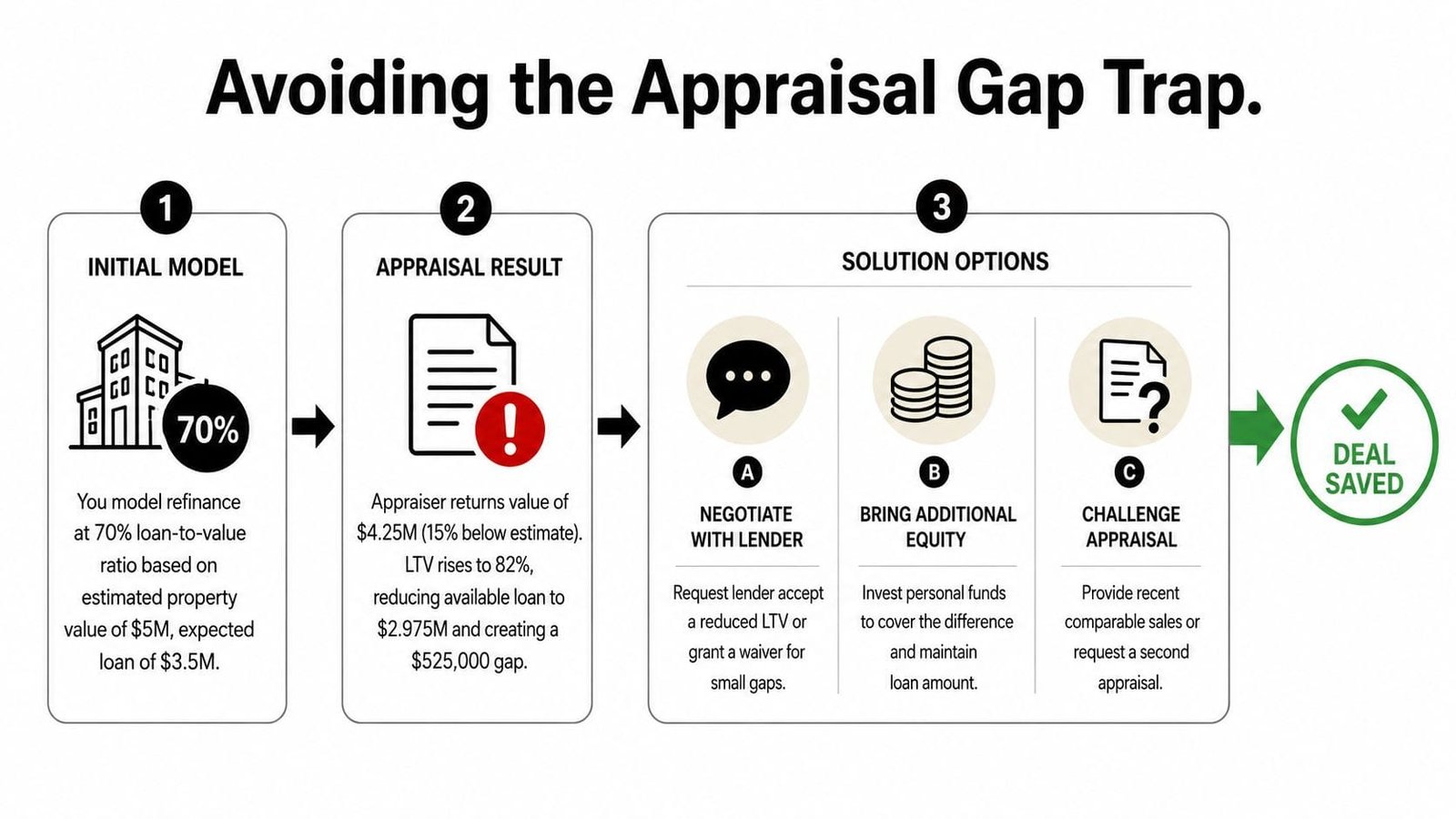
The appraisal gap appears when the requested loan depends on a value the appraiser doesn't support. The borrower may have a strong original basis, recent improvements, and paying tenants, yet still receive loan proceeds below the payoff balance because the lender applies its LTV limit to a lower current value.
Commercial appraisers typically weigh the income, sales comparison, and cost approaches. Income-producing assets usually depend heavily on sustainable NOI, market rent, vacancy, expenses, and the capitalization rate. A recent renovation helps only when the market recognizes it through income, condition, or comparable evidence.
Run a shadow appraisal
Before ordering the formal appraisal, build a conservative model:
- Normalize NOI. Remove one-time income and verify recurring expenses.
- Increase vacancy assumptions. Use a scenario that reflects lease rollover and slower re-leasing.
- Test capitalization rates. Apply a more conservative rate than the one supporting your optimistic valuation.
- Calculate proceeds. Multiply the stressed value by the lender's LTV limit.
- Compare with payoff. The difference is the potential equity requirement.
The appraisal process isn't the time to discover that your refinance requires a cash contribution. If the stressed proceeds don't cover the payoff, consider a lower loan amount, an equity injection, a term extension, or a sale. A formal challenge works only when you can provide relevant, recent comparable evidence or correct a material factual error.
A low appraisal isn't always wrong. Sometimes it is the first honest indication that the existing loan balance no longer fits the property's current economics.
Don't commit to a rate or spend heavily on reports until you understand the lender's appraisal policy. Ask whether a reconsideration process exists, whether a second valuation is permitted, and whether the lender will accept a reduced proceeds structure.
Your Refinance Decision Framework
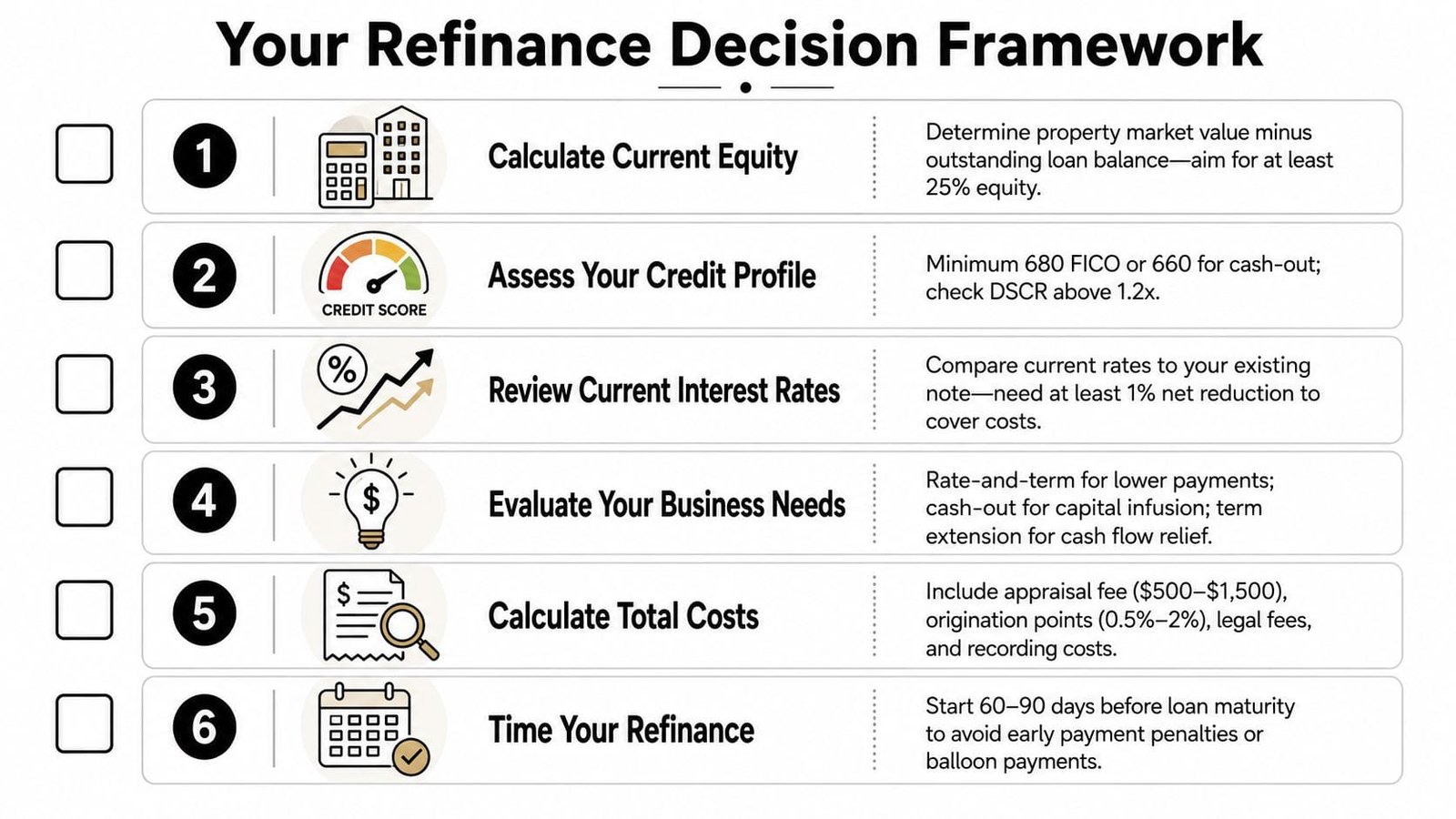
Use the property's current facts, not the hoped-for outcome. A workable decision begins with equity and ends with the maturity date.
- Calculate current equity. Estimate defensible market value, subtract the outstanding balance, and calculate current LTV.
- Stress DSCR. Recalculate coverage after vacancy, expense, reserve, and rate changes.
- Expose the appraisal gap. Run a conservative value using sustainable NOI and a tougher capitalization assumption.
- Choose the purpose. Rate-and-term supports payment or covenant relief. Cash-out funds a defined use. An extension buys time.
- Select the lender tier. Match the property, recourse tolerance, financing requirement, and exit timeline to the capital source.
- Work backward from maturity. Start lender conversations early enough to absorb appraisal, documentation, and closing delays.
Use a simple go or no-go test
Proceed when the stressed DSCR remains acceptable, the conservative LTV leaves room for valuation movement, the break-even period fits your ownership plan, and the documentation package is complete. Pause when the loan only works at an aggressive value, depends on unproven NOI, or requires equity you haven't identified.
Review prepayment language before comparing rates. Yield maintenance, defeasance, and other penalties can change the economics of a refinance or future sale. Also confirm reserve requirements, guarantees, reporting obligations, and whether the new amortization schedule creates a larger balloon later.
The strongest refinance is usually arranged before the maturity deadline becomes the dominant fact in the negotiation. Owners with stable cash flow and manageable debt can compare structures. Owners who wait until the payoff is imminent may be choosing between an expensive refinance, a short extension, and a forced equity contribution.
Business Loan Warrior can help small-business owners explore funding for refinancing an existing loan and compare potential business financing paths through its lending platform. Visit Business Loan Warrior with your current loan statement, property financials, and maturity date ready, then use the comparison process to identify a refinance structure that fits your cash flow and equity position.