
You need capital, but your balance sheet doesn't offer much for a lender to seize. Your distribution company is producing steady revenue, inventory demand is rising, and the next decision is practical: buy more stock now or hire the people who'll help you handle the growth. A business loan without collateral sounds like the clean answer.
It can be. But “no collateral” is only the beginning of the risk discussion.
Lenders still need protection. Without a specific claim on real estate, equipment, inventory, or receivables, they often rely on cash-flow underwriting, stricter terms, higher pricing, and a personal guarantee. The product may be unsecured from the company's balance sheet while remaining personally consequential for the owner.
That tradeoff matters more than the label. This guide will help you identify the right product, prepare an approval-ready application, compare the total cost, and decide when secured funding is the smarter choice.
Table of Contents
- The Promise and Hidden Catch of Collateral-Free Funding
- What an Unsecured Business Loan Actually Means
- The Main Types of Business Loans Without Collateral
- How Lenders Underwrite Loans Without Collateral
- Steps to Qualify and Apply Without Putting Up Assets
- Real-World Examples of No-Collateral Funding in Action
- Advantages, Risks, and When Collateral Still Makes Sense
- Decision Framework and Common Questions
The Promise and Hidden Catch of Collateral-Free Funding
A growing distribution company may need inventory before supplier lead times stretch, payroll coverage while a contract ramps up, or enough liquidity to hire before demand outpaces capacity. If its vehicles are leased, its warehouse is rented, and its inventory moves quickly, the owner may have no attractive hard asset to pledge.
An unsecured loan can address that gap. The application may be more direct because the lender does not need to appraise a building or verify the value and priority of an equipment lien. The company can avoid pledging a particular machine, property, or receivables pool.
The tradeoff is straightforward: lenders replace collateral with other protections.
The lender still needs a repayment story
An unsecured lender will examine deposits, existing debt, credit history, and operating cash. A personal guarantee can make the owner personally responsible if the company defaults. The lender may also set a shorter repayment period or require payments monthly, weekly, or daily, increasing pressure on available cash.
Predictable revenue can make that structure manageable. Annual sales can still hide a serious timing problem, however, if cash arrives after payments are due. Review your cash flow visibility for CEOs before accepting an offer, particularly when the loan will fund recurring expenses rather than a clearly timed return.
For companies in the $20M-$50M revenue band, lenders often assess the business differently from a microbusiness. Strong revenue does not remove the need to explain cash conversion, debt capacity, and repayment timing. Collateral-free funding usually remains personal-guarantee-heavy, cash-flow-underwritten, and priced as a premium product. Ask for the full repayment schedule, not just the approval amount.
Practical rule: Treat “no collateral” as a description of what is not pledged, not as a measure of how little risk you are taking.
The market reflects this tension. An FDIC-linked paper cites estimates that only about 5% of small-business lending is unsecured, leaving roughly 95% backed by collateral or another form of security FDIC-linked paper. Unsecured borrowing is therefore a specialized structure, commonly used for working capital, short-term needs, and asset-light businesses.
My recommendation is direct. Ask what replaces collateral, test repayment against your weakest cash-flow months, and compare the total cost with the business outcome. If the loan funds recurring expenses without a dependable repayment source, do not let a fast approval make the decision for you.
What an Unsecured Business Loan Actually Means
An unsecured business loan is debt approved without requiring the borrower to pledge a specific asset as security. The lender bases its decision on the business's credit profile, revenue, cash flow, operating history, and ability to repay.
A secured loan works differently. The lender takes a defined claim over an asset such as commercial property, equipment, inventory, or receivables. If the borrower defaults, that asset provides a recovery path. An unsecured lender doesn't receive that same asset-specific backstop.
Collateral and personal guarantees are different
This distinction causes more confusion than almost anything else in small-business lending.
- Collateral is a specific asset pledged to secure the debt.
- A personal guarantee is the owner's contractual promise to repay if the business doesn't.
- A blanket business lien may give a lender a broad claim over business assets, even when the marketing says “no collateral.”
A loan can therefore be unsecured in the narrow sense while still exposing the owner to personal liability. If the business can't repay and the owner signed a guarantee, the lender may pursue the guarantor under the agreement and applicable law. The absence of a named asset doesn't erase the obligation.
That structure also separates an unsecured business loan from other forms of credit. A business credit card is revolving credit designed for purchases and short-term flexibility. A business line of credit lets the company draw, repay, and draw again within an approved limit. A term loan delivers a defined amount and follows a scheduled repayment structure. A personal loan is issued to the individual, even if the owner intends to use the proceeds for the company.
Read the documents, not just the headline
Before signing, look for the personal guarantee, default triggers, payment frequency, prepayment language, restrictions on additional debt, and any lien filings. Ask whether the lender can accelerate the full balance after a default and whether the agreement contains a universal-default provision.
The correct baseline is this: unsecured means no specific pledged collateral, not no downside. You're trading an asset pledge for deeper scrutiny of the company and often greater responsibility for the owner.
The Main Types of Business Loans Without Collateral
Product labels can hide major differences in cost and repayment pressure. Match the structure to the cash need, not to the phrase “no collateral.”
Unsecured term loans
An unsecured term loan provides a lump sum that the business repays over a defined schedule. Bank versions tend to demand stronger documentation and a more established operating profile. Online lenders may move faster, but the borrower often pays for that convenience through higher pricing, shorter terms, or more frequent payments.
This structure fits a defined project, such as a hiring push tied to a signed contract or a planned inventory purchase. It's a poor fit for a recurring cash deficit because fixed payments remain due after the original need has passed.
Business lines of credit
A line of credit is better for uneven working capital. You draw only what you need, repay the balance, and preserve access to the remaining limit. The lender will still evaluate cash flow and credit, but the revolving structure can reduce the cost of carrying unused capacity.
A line is useful for timing gaps between receivables and payables. It isn't a substitute for fixing margins, underpricing, or chronically negative operating cash flow.
Merchant cash advances
A merchant cash advance provides capital in exchange for a portion of future sales, often collected through automated remittances. The quoted factor rate isn't the same as an interest rate, so compare the advance amount, total payback, expected repayment pace, and effective annualized cost.
An MCA can solve an urgent, short-duration need when card sales are strong and repayment is highly visible. It can become expensive and restrictive when sales slow or when the business takes another advance before clearing the first.
Invoice financing and factoring
Invoice financing advances money against eligible unpaid invoices. Factoring generally involves selling receivables to a finance company. These products may be described as collateral-free because the borrower isn't pledging property or equipment, but the receivables function as the lender's practical security.
This is often a sensible match for a B2B company with creditworthy customers and slow payment cycles. It's less useful when invoices are disputed, concentrated among risky customers, or already subject to another lender's claim.
SBA exceptions
Some SBA-backed structures can be available without borrower-pledged collateral in particular circumstances. SBA programs involve a government guarantee to the participating lender, but that doesn't eliminate underwriting, repayment responsibility, or the possibility of a personal guarantee. Review the specific lender's requirements rather than assuming every SBA loan follows the same collateral policy.
| Product | Typical Amount | Repayment | Pricing | Underwriting Focus | Collateral |
|---|---|---|---|---|---|
| Unsecured term loan | Varies by lender and borrower | Fixed scheduled payments | Interest, fees, or both | Revenue, credit, cash flow, purpose | No specific asset pledge may be required |
| Business line of credit | Varies by approved limit | Draw-and-repay revolving structure | Interest and possible fees | Liquidity, deposits, utilization, credit | Often no specific asset pledge |
| Merchant cash advance | Varies with sales volume | Percentage of future sales or fixed remittance | Factor rate and fees | Card or sales volume, consistency | No traditional collateral, revenue is central |
| Invoice financing or factoring | Based on eligible receivables | Repaid when customers pay invoices | Discount or financing fee | Customer quality, invoice aging, dilution | Invoices act as practical security |
| SBA-backed financing | Depends on program and lender | Scheduled principal and interest | Lender-set pricing and fees | Repayment ability, credit, business strength | Policy varies by amount and lender |
For a concise comparison of short-term loans, MCAs, and invoice factoring, review this unsecured financing comparison before accepting the first fast-funding offer.
How Lenders Underwrite Loans Without Collateral
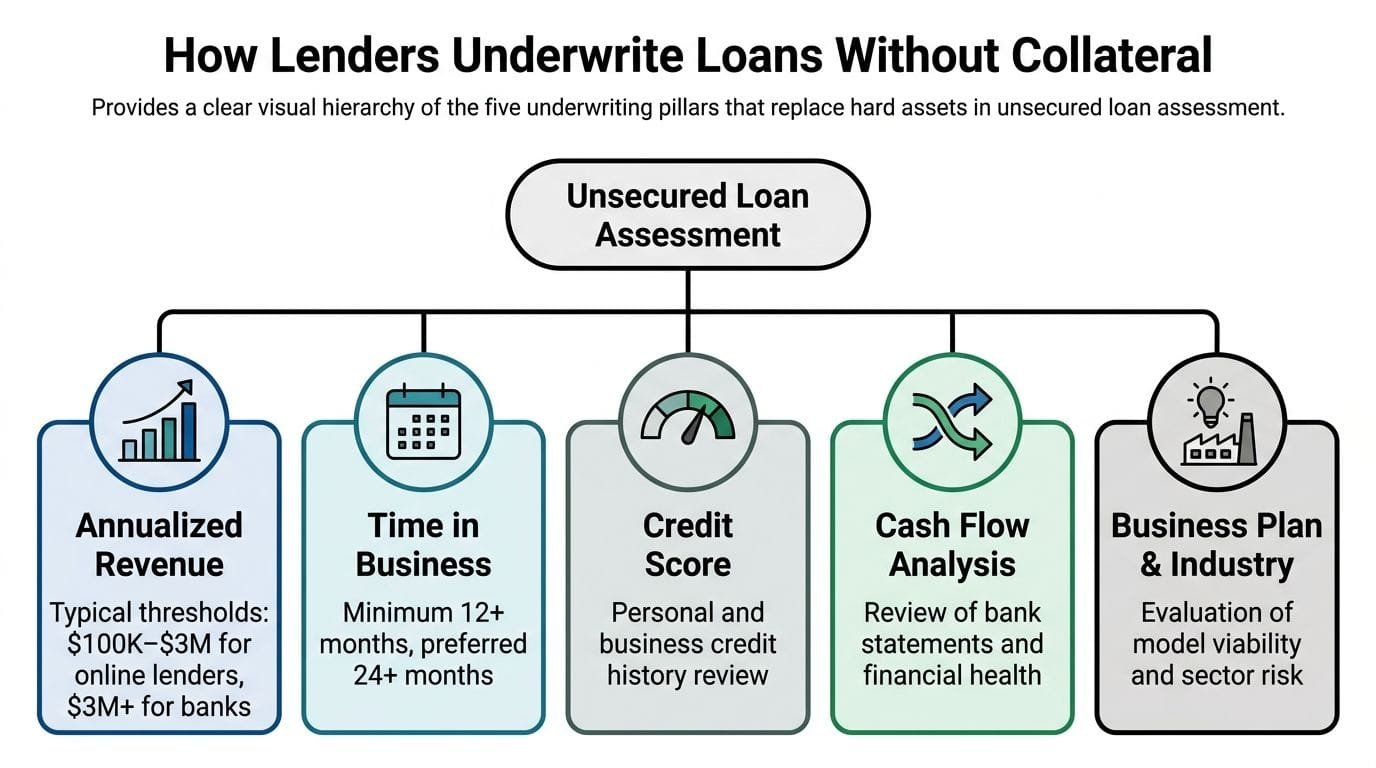
Without hard assets, lenders need other evidence that repayment will happen. They don't evaluate every product the same way, but five underwriting pillars repeatedly shape the decision.
Revenue and operating history
Lenders want revenue that is verifiable and sufficiently consistent to support the proposed payment. Time in business gives them more operating evidence, including seasonality, customer concentration, and the company's response to weaker periods.
A larger borrower doesn't automatically receive approval, but scale can give the lender more financial information to assess. For mid-market companies, lenders often move beyond headline revenue and examine margin quality, recurring contracts, customer concentration, and debt service.
Credit profile
Personal credit remains important, particularly when the company is privately held or the facility includes a personal guarantee. Business credit history, payment performance, existing liens, and prior borrowing behavior add another layer.
A strong score can't rescue a weak cash-flow story, but a damaged profile can make a healthy company more expensive to finance.
Bank-account cash flow
Bank statements reveal what financial statements may conceal. Underwriters review deposit patterns, average balances, overdrafts, returned payments, transfers between accounts, and the timing of existing debt withdrawals.
Merchant cash advance providers may focus on card-processing volume. Invoice financiers examine receivables quality and aging. SBA lenders generally require a more complete view of repayment capacity. For a broader explanation of what banks look at for small business, review the financial information you'll need before approaching a lender.
Personal guarantee and business viability
The guarantee shifts part of the repayment risk to the owner. The lender may also assess the company's industry, business model, management capability, and intended use of funds.
A clean application should explain not only how much you want, but how the capital produces or protects cash that will repay it. For a deeper look at lender evaluation, use this guide to the underwriting process for business loans.
Steps to Qualify and Apply Without Putting Up Assets
A strong application reduces uncertainty before the lender sees it. Follow this sequence instead of submitting incomplete applications to every provider you find.
1. Audit personal and business credit
Pull reports from the major consumer and business bureaus relevant to your borrowing profile. Dispute inaccurate balances, duplicate accounts, outdated statuses, and misreported payment histories before you apply.
Don't assume a lender will catch the error for you. An incorrect delinquency can change the product, price, or approval outcome.
2. Build the financial file
Prepare recent business bank statements, business tax returns, a current year-to-date profit-and-loss statement, a balance sheet, and a schedule of existing debt. Larger facilities may also require receivables aging, customer concentration details, ownership documents, and projections.
If you need records from an account that has been closed, use a documented process to get statements from closed accounts rather than leaving a gap in your submission.
3. Find the real revenue floor
Calculate monthly revenue from deposits and reconcile it to your financial statements. Then identify the weakest recent period, not just the annual average. Lenders care about whether the proposed payment survives a soft month.
Write down the repayment source in plain language. “Growth” isn't a repayment plan. “Existing contract receipts will cover the scheduled obligation while inventory turns” is much stronger.
4. Prequalify selectively
Use lenders that disclose whether prequalification involves a soft inquiry. Compare a small group of suitable providers within a short shopping window, then stop. Multiple formal applications can create unnecessary credit friction and conflicting offers.
The objective is not to collect the largest number of approvals. It's to identify the structure that fits your cash cycle.
5. Compare the term sheets
Review total repayment, annualized cost, payment frequency, origination fees, prepayment treatment, default provisions, guarantee language, and restrictions on other financing. Convert factor-rate offers into a comparable cost before making a decision.
6. Submit one clean final application
Choose the best-fit lender and submit consistent information across every document. Include a brief use-of-funds narrative, repayment source, and explanation for any unusual deposit or recent weakness.
Online decisions can arrive quickly, while bank products may require a longer review. Don't let a fast approval pressure you into accepting an expensive structure without checking the full agreement. For additional qualification preparation, use this guide on how to qualify for a business loan.
Real-World Examples of No-Collateral Funding in Action
The following scenarios illustrate how the product choice changes with the business model. They're decision examples, not promises of approval or pricing.
A restaurant group with 240 seats, $1.8 million in annual revenue, and credit scores above 600 needs to bridge payroll during a five-week gap while opening another location. An unsecured line of credit from an alternative lender could fit because the need is temporary and revolving. The lender would likely focus on deposits, card sales, payroll history, rent obligations, and whether the new location has a credible opening plan.
The line is preferable to a term loan if the owner expects cash to normalize quickly. The risk is payment capacity during the opening period, when expenses can rise before the second location produces steady receipts.
A mid-market services borrower
A managed IT services firm with $28 million in revenue, 22 months of trailing EBITDA growth, and a founder's 720 credit score seeks a $500,000 unsecured term loan for sales-team expansion. A bank or specialized commercial lender may consider the facility based on recurring contracts, margins, customer retention, debt service capacity, and the owner's guarantee.
The stated cost in this scenario is 14.5% APR. That may be rational if the sales investment has a clear payback path, but the borrower should still compare it with an asset-backed or revolving alternative. At this revenue level, the company shouldn't accept small-business boilerplate without asking for commercial underwriting appropriate to its scale.
A direct-to-consumer retailer
A skincare brand generating $3.2 million through Shopify needs inventory for a seasonal launch. A $120,000 merchant cash advance tied to card sales could provide speed, with repayment based on a 14% holdback from card receipts.
That structure matches a retailer with strong, traceable sales, but only if the gross margin supports the total payback and the inventory is likely to convert on schedule. A holdback reduces payment during slower sales days, yet it still diverts cash exactly when the brand may need funds for marketing, fulfillment, and returns.
The product is only “right” when its repayment mechanism follows the way the business actually collects cash.
Advantages, Risks, and When Collateral Still Makes Sense
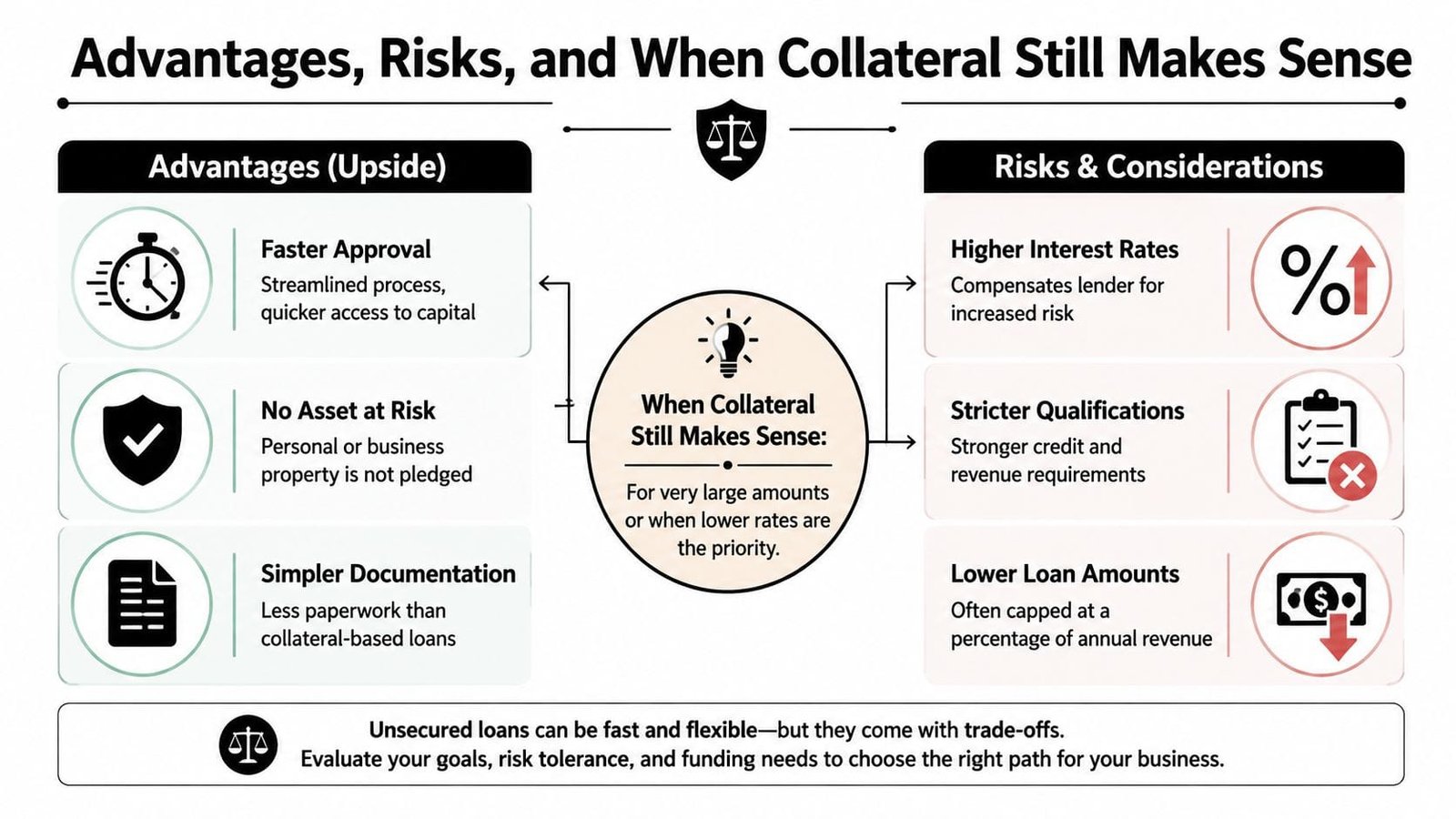
Unsecured financing is not automatically safer. It protects a specific pledged asset, but it can expose the owner to a personal guarantee and the business to aggressive repayment terms.
The genuine upside
- Faster review: No specific asset appraisal or valuation process may be necessary.
- Asset preservation: The company doesn't designate a particular building, vehicle, or machine as the repayment backstop.
- Access for asset-light firms: Professional services, technology, consulting, and other companies can qualify based on operating performance.
- Simpler execution: A clean financial file may be enough to move the application forward without extensive collateral documentation.
The cost that owners underestimate
Higher pricing is only one concern. Short repayment periods can increase the required payment, while daily or weekly automated withdrawals can make a profitable company feel cash-starved. Prepayment penalties, blanket liens, restrictive covenants, and universal-default clauses can also limit future borrowing.
The risk becomes sharper for companies in the $20 million to $50 million revenue band. These firms may be too complex for a basic small-business product but still lack the asset base or borrowing structure expected by a larger commercial lender. They shouldn't assume that a bigger revenue number guarantees flexible unsecured terms.
The FDIC-linked research cited earlier describes unsecured lending as a small part of small-firm debt, while independent market estimates place the global market at $5.55 trillion in 2025 and project $9.43 trillion by 2030, with an 11.2% CAGR from 2025 through 2030 FDIC-linked research and market reference. A growing market doesn't mean every borrower receives low-cost access.
When secured financing wins
Pledging collateral can make sense when the loan funds a long-lived asset, the amount is substantial, or rate savings matter more than speed. Equipment financing can let the equipment secure its own purchase. Real-estate-backed debt may provide a more suitable term for a property investment. SBA-backed options can also offer different collateral outcomes depending on the program and lender.
Australian SME data shows unsecured credit has remained below 5% of SME credit in recent years, while around half of small SME loans are secured with non-residential assets such as vehicles and equipment Mordor Intelligence summary of RBA data. That mix reflects a basic commercial reality: when a borrower has suitable assets and can tolerate the pledge, secured debt may produce a better overall structure.
Decision Framework and Common Questions
Use four questions before you apply.
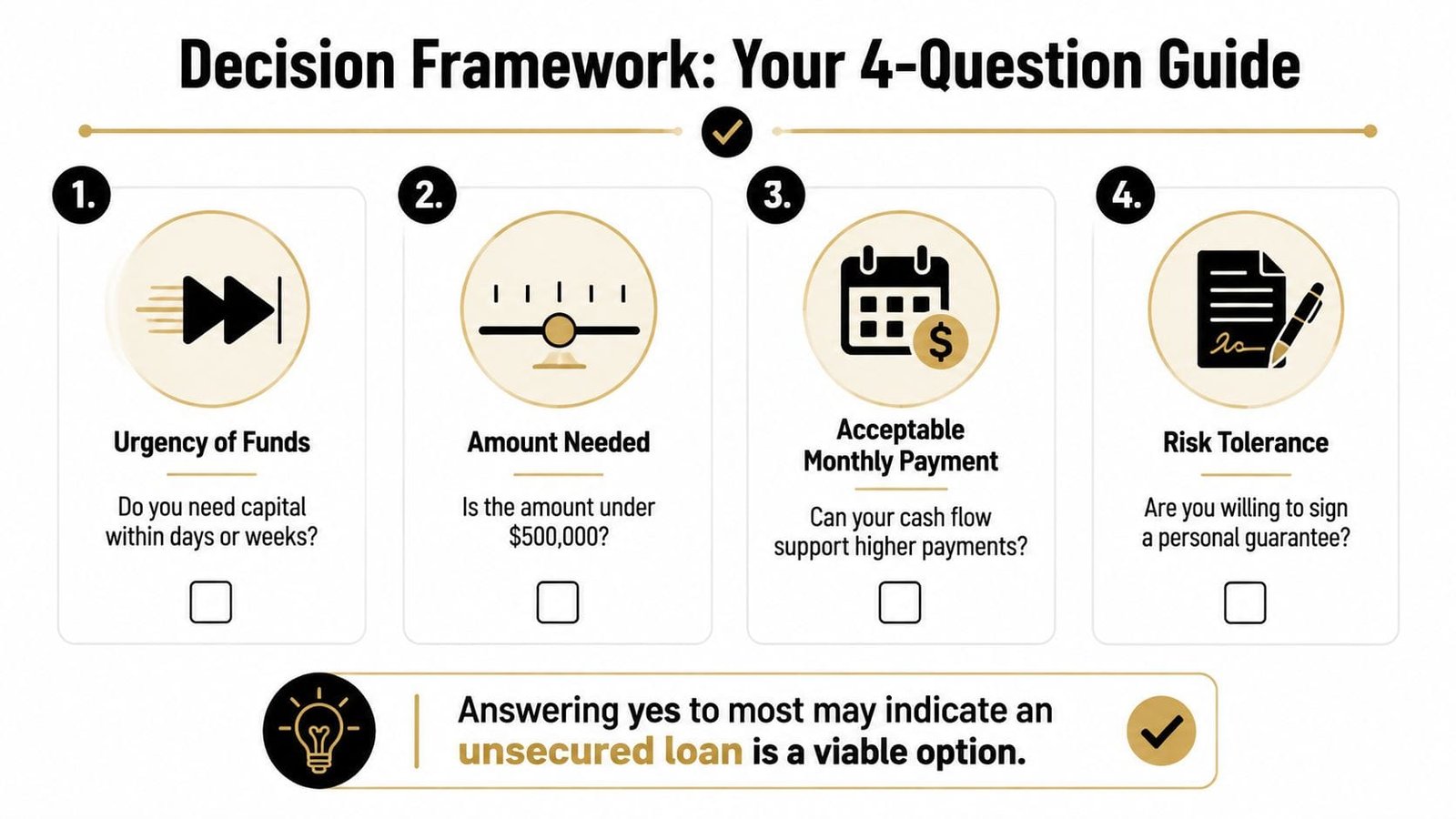
- How urgent is the capital? If the need is immediate, an online working-capital product may fit better than a bank process.
- How much do you need? Smaller, clearly defined needs are easier to match to unsecured structures. Larger facilities may justify commercial or secured underwriting.
- What payment can cash flow support? Model the payment against the weakest recent period, not the best month.
- Will you sign a personal guarantee? If the answer is no, your available options may narrow sharply.
A merchant cash advance can address a short, urgent sales-backed need, while a line of credit is usually more appropriate for recurring working-capital timing. An SBA-backed product may suit a growth project that can tolerate a more involved review. Choose secured debt when lowering the cost and extending the term matters more than preserving assets from a specific pledge.
Common questions
Do startups qualify? They face fewer choices because lenders have less operating history to assess. New businesses may need to build evidence through revenue, owner credit, or specialized programs.
Can I refinance unsecured debt? Sometimes, but the new payment must improve the company's cash position after fees. Replacing one expensive short-term obligation with another doesn't solve the underlying problem.
Is there a universal credit-score threshold? No. Lenders weigh personal credit, business history, revenue, and cash flow differently by product.
Can I avoid a personal guarantee? Some structures may limit it, but borrowers should expect a guarantee to be common in unsecured business lending.
Before contacting lenders, gather three months of business bank statements, a current P&L, and a one-year projection. Add a debt schedule and a written repayment plan if the request is material.
Business Loan Warrior can help you compare business loans, lines of credit, SBA processing, invoice financing, and other funding structures through one application process. Visit Business Loan Warrior to review financing paths and start with the documents lenders will use to assess your request.