
A $50,000 business line of credit can look like a safety net until a slow receivables month arrives, payroll is due, and a supplier demands payment before customers settle their invoices. Many owners respond by drawing the maximum available amount. That move feels decisive, but it often turns flexible working capital into expensive, persistent debt.
The smarter approach is to treat the facility as a timing tool, not as unrestricted growth capital. Recent lending data makes that distinction more important. The Federal Reserve's 2025 employer-firm survey found that 24% of applicants sought a business line of credit, while 45% were fully approved, 31% were partially approved, and 24% were denied (Federal Reserve survey context). You may have access to less capacity than you expected, or face conditions that change how safely you can use it.
Table of Contents
- Why Most Business Owners Misuse Their Line of Credit
- From Application to First Draw Without Getting Stuck
- Smart Cash-Flow Timing for Maximum Impact
- Calculating Costs and Building a Repayment Strategy
- The Utilization Trap That Kills Future Borrowing Power
- Renewals, Covenants, and When to Explore Alternatives
Why Most Business Owners Misuse Their Line of Credit
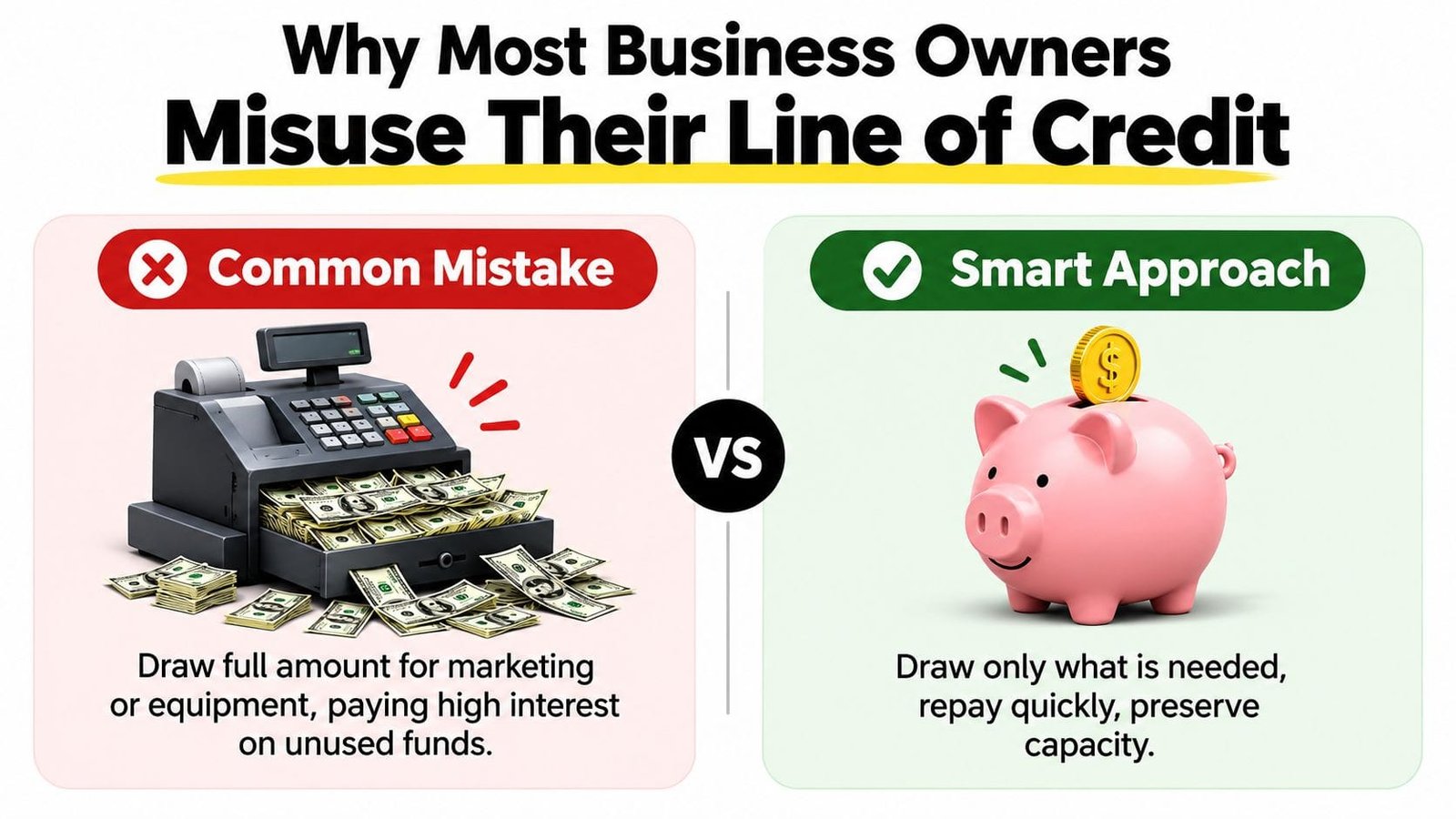
A contractor receives approval for a credit line, then assumes the full amount will remain available whenever needed. The lender may offer only partial capacity, attach tighter draw conditions, or require security that changes the economics. If the owner spends heavily on equipment or expansion, interest starts immediately while the line loses its ability to handle an unexpected cash shortfall.
That approval gap is the hidden trap. A stated limit is not the same as usable capacity, and a funded balance is not the same as productive capital. Recent small-business lending conditions show why owners must plan around the facility they can access, not the amount they requested.
Match the product to the cash cycle
A line of credit works best when funds leave the account and return through a predictable operating cycle. Use it to bridge a receivables delay, buy inventory before a selling season, or cover a short payroll gap. Draw only what the business can repay from a defined inflow.
Equipment, renovations, acquisitions, and other assets with multiyear useful lives usually fit a term loan better. A term loan provides a lump sum and a set repayment schedule. A revolving facility provides repeated access, but that flexibility disappears when a long-term investment consumes the available balance.
Practical rule: If you cannot identify the cash inflow that will repay a draw, do not make the draw.
Approval is not usable capacity
Review the approval for restrictions, not just the headline limit. Confirm the amount available for immediate draws, whether the lender can reduce that amount, and which expenses qualify. Check the personal guarantee, collateral requirements, variable rate, repayment trigger, and renewal conditions before accepting the facility.
The Federal Reserve's 2024 Small Business Credit Survey found that 37% of employer firms applied for a loan, line of credit, or merchant cash advance during the prior 12 months, unchanged from 2023 and near prepandemic levels (Federal Reserve small-business credit context). That level of demand makes disciplined utilization more important. A line of credit is a mainstream working-capital tool, but access can still be limited by lender policy and business performance.
Lender behavior also differs by institution. The FDIC's 2024 small-business lending survey found that lines of credit were the top product for 36% of large banks but 17% of small banks (Kansas City Fed summary of small-business lending conditions). Compare draw rules, repayment mechanics, pricing, and renewal terms. Choose the facility that preserves borrowing room after the first draw, not the offer with the largest printed limit.
From Application to First Draw Without Getting Stuck
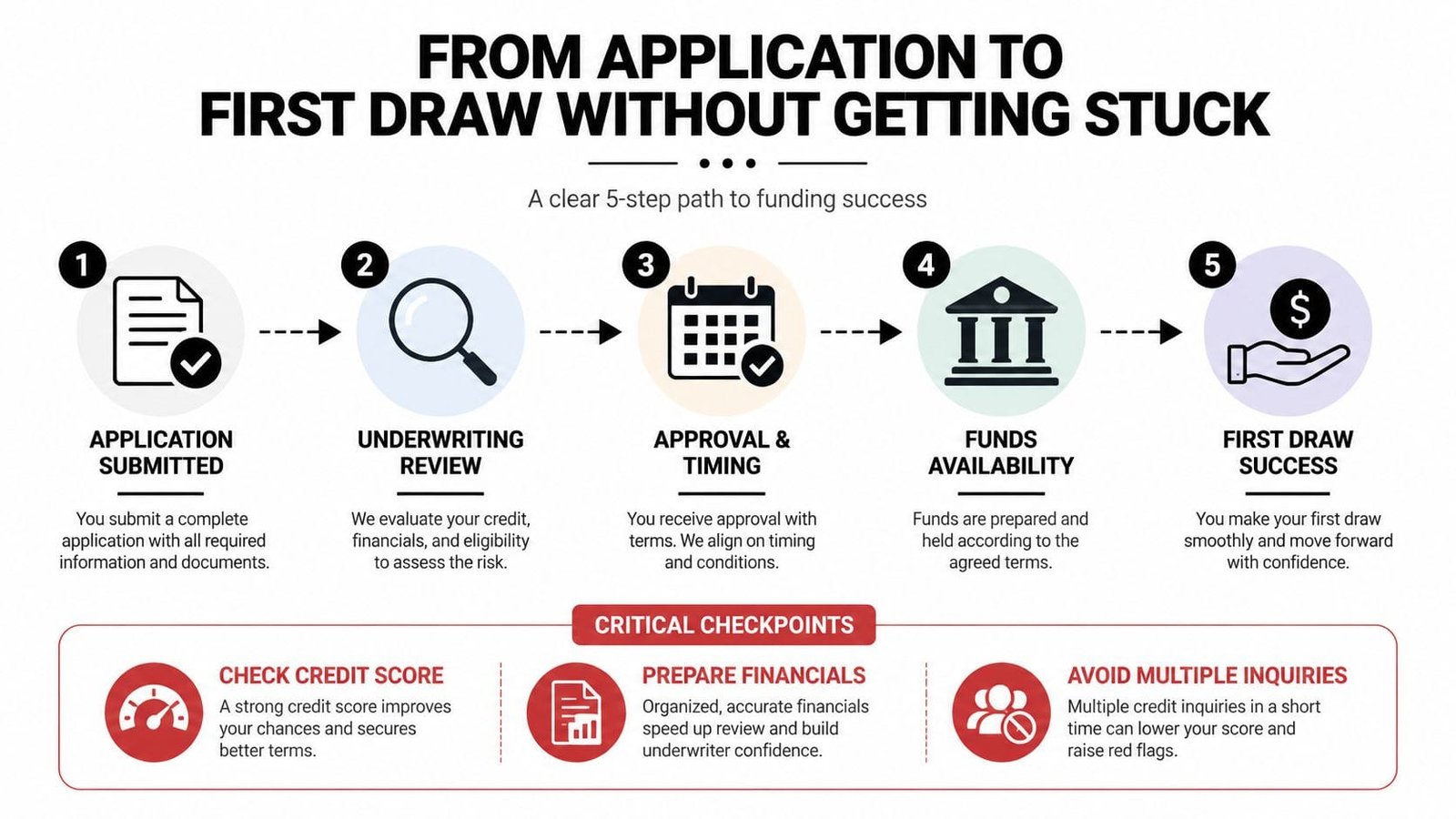
A successful first draw starts before you submit an application. Lenders want evidence that your business can repay borrowed funds, and they typically examine business and personal credit history, revenue consistency, existing obligations, bank-account activity, and the quality of your financial records.
Prepare before the lender asks
Gather your recent business bank statements, tax returns, profit-and-loss statements, balance sheet, accounts receivable aging, and a concise explanation of how you'll use the facility. If the business has seasonal revenue, show the pattern instead of letting a weak month appear unexplained. A clean explanation can prevent an underwriter from interpreting normal seasonality as deteriorating performance.
Use pre-qualification when available to understand likely terms without immediately creating a hard inquiry. Final approval may require a hard credit pull, so ask the lender which inquiry applies at each stage and avoid submitting several full applications at once.
Review the approval, not just the limit
Before accepting an offer, verify:
- Approved capacity: Confirm the amount you can draw, not merely the requested amount.
- Draw conditions: Check whether each advance requires approval, whether eligible uses are limited, and whether draw periods expire.
- Personal exposure: Identify any personal guarantee, collateral requirement, or blanket lien.
- Pricing mechanics: Read how the variable rate is calculated, including any floor, margin, or reset language.
- Repayment terms: Confirm minimum payments, maturity, renewal rights, and what happens if the lender reduces availability.
A partial approval isn't necessarily a bad outcome, but it changes the operating plan. If the approved limit won't cover the full working-capital gap, combine the facility with tighter invoice collection, supplier negotiations, or a better-matched product rather than assuming the lender will increase it later.
For a broader view of expected funding timing, review this guide to how long it takes to get a business line of credit approved.
Once the agreement is active, make a small, clearly documented first draw if the facility permits it. Confirm where funds arrive, how interest is posted, how repayments restore availability, and whether the lender reports activity to business or personal credit bureaus.
Smart Cash-Flow Timing for Maximum Impact
A credit line may look like a ready reserve, but approval does not guarantee full access. Lenders can approve only part of the requested amount or impose tighter conditions. Build your cash plan around the limit you can draw, then protect that availability by timing each advance carefully.
Draw close to the expense it covers and the revenue expected to repay it. Drawing months early creates unnecessary interest and reduces room for a genuine disruption. Waiting until payroll or a supplier payment is overdue creates avoidable pressure.
A seasonal retailer might draw before inventory demand rises, then repay as sales receipts arrive. A contractor can use the facility while an approved invoice converts into cash. A service company may cover a temporary payroll gap caused by delayed client payments, but revolving debt should not fund a recurring operating loss.
Use the draw-and-repay rhythm
Schedule advances around known cash-flow events. Pull funds shortly before the expense, track the related receivable or sales cycle, and pay down principal as soon as cash arrives. The result is a lower average balance than drawing early and leaving the full amount outstanding.
Credit conditions can tighten while businesses still need working capital. That makes utilization management part of approval quality. Keep a portion of the approved line unused, document the repayment source for each draw, and avoid treating the stated limit as guaranteed permanent capacity.
Use a cash-flow forecast for your loan strategy to map expected collections, payroll, taxes, inventory, and supplier payments before you draw. Update it when a customer delays payment or a lender reduces availability.
| Scenario | Draw Timing | Repayment Window | Interest Cost Impact |
|---|---|---|---|
| Seasonal inventory | Shortly before the purchasing cycle | As inventory converts into sales | Lower when sales receipts repay the balance promptly |
| Temporary payroll gap | Only after a specific receivable is scheduled | When the receivable clears | Manageable when the repayment source is documented |
| Emergency equipment repair | At the time of the repair | From near-term operating cash flow | Higher if the repair creates no direct cash inflow |
| Bulk-buy opportunity | Only when the discount exceeds financing cost | According to the resulting sales cycle | Attractive only when inventory turnover is reliable |
| Expansion or permanent hiring | Usually not the right timing tool | Often extends beyond the operating cycle | Costly when the balance remains outstanding |
Before drawing, write down the expense, expected cash inflow, repayment date, and backup source of funds. If the expense should produce or release cash within a short, defined cycle, a line may fit. If repayment depends on distant expansion gains or uncertain demand, choose a term loan, equipment financing, or another structured option.
Calculating Costs and Building a Repayment Strategy
A credit line can look inexpensive until a short-term draw becomes a long-running balance. Interest usually accrues on the amount drawn, not the unused limit, so borrowing only what the business needs protects flexibility. Read the agreement carefully. Confirm whether interest uses a daily balance, a stated billing cycle, or another calculation method.
Consider a $50,000 draw at a 9% annual percentage rate, held for 45 days versus 90 days. Using a basic annual-rate approximation, 45 days creates about $555 in interest, while 90 days creates about $1,110. The longer period therefore adds about $555, before fees. These figures illustrate the arithmetic, not a promise about a lender's pricing or day-count convention.
| Scenario | Draw Duration | Interest Accrued | Fees | Total Cost |
|---|---|---|---|---|
| $50,000 at 9% APR | 45 days | About $555 using a simple annual-rate approximation | Depends on the agreement | Interest plus applicable fees |
| $50,000 at 9% APR | 90 days | About $1,110 using a simple annual-rate approximation | Depends on the agreement | Interest plus applicable fees |
Find the costs outside the interest rate
Request the full fee schedule before signing. Check for draw fees, maintenance fees, inactivity fees, wire charges, annual fees, and renewal costs. A low stated rate can still produce a high financing cost when the account charges for unused access or frequent small draws. Calculate the cost based on your expected draw frequency, balance duration, and repayment pattern. This guide explains how to calculate the actual cost of a small-business loan.
Variable pricing demands tighter repayment control because a rate reset affects every dollar still outstanding. Small businesses often leave part of their approved commitments unused, so approval does not guarantee full access under every condition. A lender may reduce availability or tighten terms, making draw timing and balance control part of the approval-quality strategy.
Avoid the minimum-payment trap
Paying only the required interest can keep the account current while leaving principal unchanged. Set a repayment rule tied to collections instead. Reserve a fixed share of weekly receipts for principal reduction, then make a larger payment during a strong sales period.
Use this checklist:
- Automate the minimum: Prevent missed payments and late reporting.
- Pay principal early: Apply surplus cash to the balance instead of waiting for the due date.
- Track the average balance: Review weekly usage, not only the month-end statement.
- Call before trouble: Contact the lender before a projected shortfall becomes a missed payment.
- Protect available capacity: Do not treat every restored dollar as permission to redraw immediately.
Your target is a facility that remains available when conditions tighten. Price each draw, repay principal aggressively when cash arrives, and keep a documented backup plan for any collection delay.
The Utilization Trap That Kills Future Borrowing Power
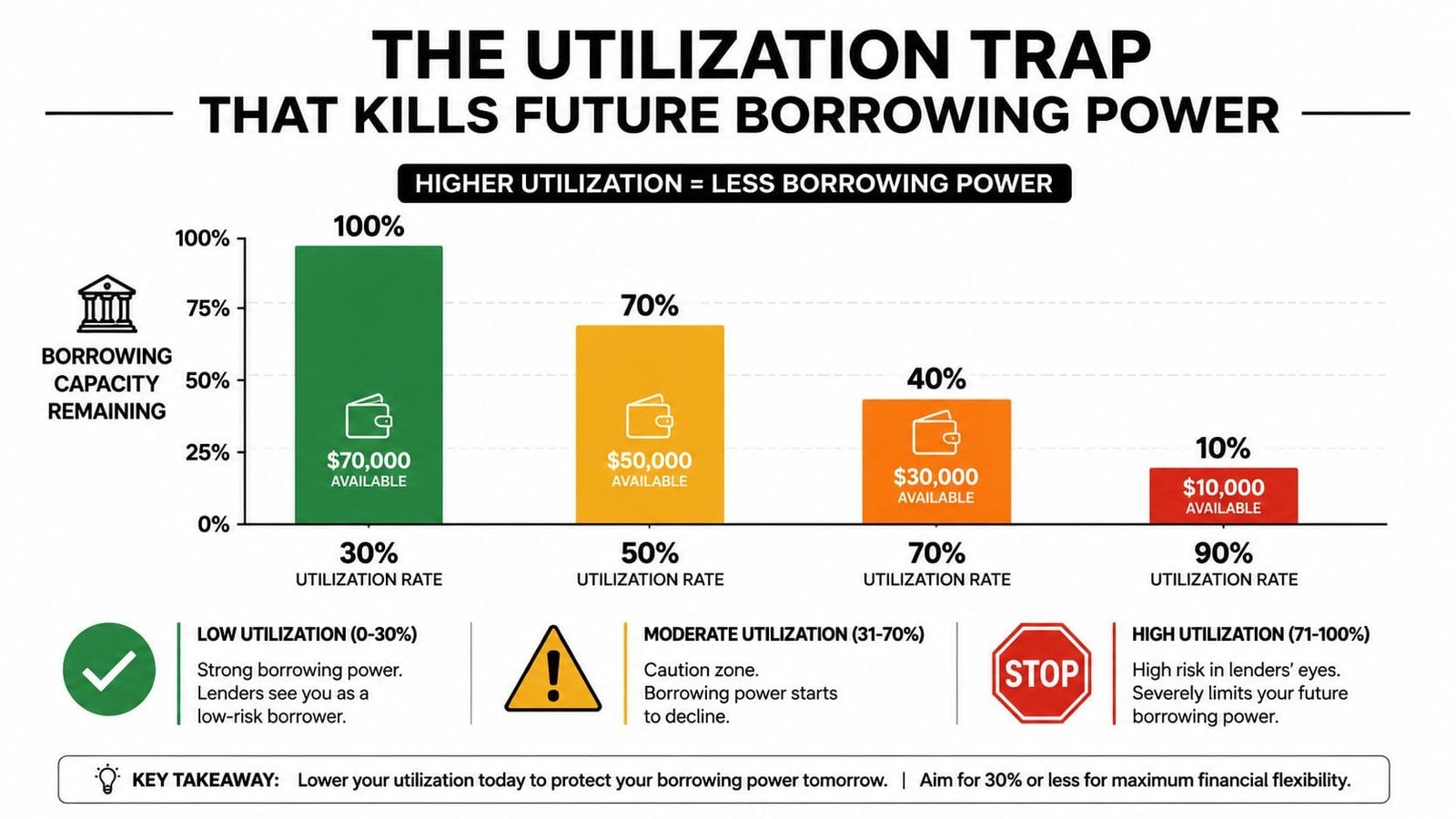
An approved limit isn't the same as healthy borrowing capacity. A line that stays nearly full signals that the business may depend on borrowed funds to maintain ordinary operations. That perception can affect renewal discussions, future applications, and the lender's willingness to preserve the current structure.
Don't rely on unsupported utilization thresholds or invented lender rules. The verified guidance available for this topic recommends keeping utilization below about 30% to help protect the business credit profile and future borrowing power (Lendio guidance on managing a business line of credit). Treat that as a management target, not a guarantee of approval.
Manage the balance before the lender reacts
A business that draws most of its facility and carries the balance for months has lost the main benefit of a revolver, which is flexibility. The owner may still have a credit line on paper, but little room remains for an emergency, a supplier opportunity, or a delayed customer payment.
The danger is greater when the balance funds operating losses. The Kansas City Fed identifies working capital, inventory, and accounts receivable financing as dominant uses for lines of credit, while warning against treating a revolver as long-term capital or an operating-loss plug (Kansas City Fed small-business lending survey).
Use this self-check before making another draw:
- Repayment source: Can you name the specific customer receipts, sales, or other cash inflow that will reduce the balance?
- Operating dependency: Would the business miss ordinary expenses without repeated borrowing?
- Available reserve: Will the draw leave meaningful capacity for an unexpected event?
- Rate sensitivity: Could the business continue repayments if the variable rate rises?
- Renewal position: Would your recent statements show declining balances and on-time payments?
If the answers expose a recurring shortfall, stop increasing the balance. Rework pricing, collections, inventory purchasing, or fixed expenses, then discuss a properly structured refinancing option with a qualified lender.
Renewals, Covenants, and When to Explore Alternatives
Renewal starts well before the maturity date. Assemble updated financial statements, reconcile bank activity, review payment history, and identify every covenant in the agreement. Speak with the relationship manager early if revenue has weakened or the business expects to breach a requirement.
Build a renewal file
Your internal dashboard should track debt payments, cash balances, receivables aging, inventory, revenue trends, and the ratios named in the credit agreement. Common covenants include debt-service coverage, current-ratio, debt-to-equity, and tangible-net-worth requirements. The exact test and calculation can differ by lender, so use the agreement's definitions rather than a generic spreadsheet formula.
A practical renewal file includes:
- Current financial statements and tax filings.
- A rolling cash-flow forecast.
- Covenant calculations with supporting schedules.
- A list of outstanding draws and repayment sources.
- A written explanation for any unusual revenue or expense movement.
- A request for revised terms, increased capacity, or a different product if the current structure no longer fits.
Renewal advice: Give the lender a complete explanation before a covenant problem appears in its monitoring system.
If the business needs help handling strained obligations, review these debt negotiation strategies before entering a difficult lender conversation. Preparation gives you more options than waiting until a renewal deadline or payment failure forces the discussion.
Know when to change products
Use a line for short-term working capital, not as a permanent substitute for equity or long-term financing. A term loan may fit equipment or expansion. SBA financing may suit an eligible long-term investment. Equipment leasing can align payments with the useful life of a machine. Invoice financing may be more appropriate when the central problem is slow-paying commercial customers.
Business Loan Warrior offers a single application flow that can connect small businesses with products including business loans, SBA financing, lines of credit, equipment and construction loans, invoice financing, merchant cash advances, and acquisition loans. Compare the repayment structure, total cost, collateral exposure, and cash-flow fit before choosing.
| Business need | Product to evaluate | Why it may fit |
|---|---|---|
| Receivables timing gap | Line of credit or invoice financing | Matches borrowing to collections |
| Seasonal inventory | Line of credit | Supports a defined purchasing and selling cycle |
| Equipment purchase | Equipment financing or term loan | Spreads repayment across the asset's useful life |
| Expansion or acquisition | Term loan or SBA financing | Provides structured long-term capital |
| Recurring operating loss | Restructuring, equity, or turnaround financing | Addresses the underlying deficit instead of extending revolving debt |
Maintain relationships with more than one credible funding channel, but don't submit indiscriminate applications. Share accurate financial information, repay as agreed, and request capacity increases based on documented cash-flow needs. The strongest renewal conversation shows that the business uses credit selectively, monitors its obligations, and knows when another product is more appropriate.
Business Loan Warrior can help you compare lines of credit, term loans, SBA financing, equipment funding, and invoice financing through a single application and funding dashboard. Visit Business Loan Warrior before your next cash-flow gap, prepare your financials, and evaluate the repayment structure before you draw.