
A direct lender is a nonbank institution that funds loans from its own balance sheet, sets the terms, and makes the credit decision without a broker. A broker routes your application to other funders, while a marketplace sends it into a network where another lender ultimately supplies the money.
You're probably asking because the funding process has become harder to read. You apply on a polished website expecting one lender, then three salespeople call, each asking for the same bank statements and promising to “shop the file.” By the time a funder reviews your application, you may not know who owns the deal, who sets the price, or whether an extra fee has been added.
That confusion matters in 2026. Equifax reported that its Small Business Lending Index fell 9.0% month-over-month in May and was down 13.1% year-over-year, while alternative lenders have expanded as banks pull back, according to the Small Business Lending Index report. Direct lending can fill that gap, but “direct” on a website doesn't prove that the company funds or services your loan.
Table of Contents
- What Is a Direct Lender and Why the Question Matters Now
- Direct Lender vs Broker vs Marketplace
- How a Direct Lending Deal Actually Works
- Real Scenarios Where Direct Lenders Shine
- Pricing, Speed, and Underwriting Compared
- How to Evaluate a Direct Lender Before You Apply
- Red Flags and Borrower Protections to Watch
- When to Choose a Direct Lender and What to Ask First
What Is a Direct Lender and Why the Question Matters Now
A contractor applies for working capital and expects to deal with the company advertising the loan. Instead, a sales rep forwards the application to a broker, the broker sends it to a marketplace, and the marketplace offers it to several funders. Each handoff can create another delay, another explanation of the same financials, and another opportunity for the final cost to become less transparent.
A direct lender makes the loan itself. In consumer finance, the CFPB distinguishes a lender, which makes the loan, from a broker, which connects borrowers with lenders, as explained in its guide to the difference between a mortgage lender and mortgage broker. For a small business borrower, the practical test is simple: the company should identify itself as the funder, approve the application using its own credit process, issue the loan agreement, and explain who will collect your payments.
Why the distinction has become important
Direct lending expanded sharply after the 2008 Global Financial Crisis, as banks reduced lending and regulations tightened after Dodd-Frank was passed in 2010, according to Oaktree Capital's overview of direct lending. One academic estimate found that by 2022, only 2.5% of U.S. middle-market nonfinancial companies borrowed from direct lenders, compared with 41.3% served by banks and 19.9% by finance companies. Direct lending has grown into a structural response to tighter bank underwriting, but it still isn't the only path to capital.
The model is especially relevant to middle-market companies that need financing for growth, acquisitions, or refinancing. Morgan Stanley describes the U.S. middle market as representing more than one-third of private-sector GDP, about $15 trillion in revenue, and roughly 50 million workers, details in its evolution of direct lending analysis.
Practical rule: Don't ask only whether a company is a direct lender. Ask whether it owns the credit decision, supplies the capital, and remains responsible for servicing.
The extra layer isn't always harmful. A broker can help with an unusual transaction or locate a lender you wouldn't find alone. But for a straightforward working capital request, unnecessary intermediation can add cost, delay, and opacity. The alternative lending guide for business owners offers useful context on why borrowers increasingly look beyond traditional banks.
Direct Lender vs Broker vs Marketplace
The label on the homepage doesn't tell you enough. A company may call itself a lender while collecting applications for another institution, or it may show several offers without clearly explaining which party funds each one. Identify the role before you compare rates.
| Dimension | Direct Lender | Loan Broker | Online Marketplace |
|---|---|---|---|
| Who supplies the money | The lender's own balance sheet or disclosed funding structure | A separate funding institution | A lender selected from its network |
| Who makes the credit decision | The direct lender | The funder receiving the file | One or more participating funders |
| Who sets the final price | The lender | The funder, with broker compensation potentially affecting economics | The participating lender, with marketplace fees potentially built into pricing |
| Who services the account | Usually the originating lender or its disclosed servicer | Usually not the broker | The selected lender or a servicing partner |
| What the borrower signs | A contract with the lender | A contract with the funder, plus possible broker disclosures | A contract with the selected lender |
| Main advantage | Fewer handoffs and direct communication | Broader lender access | Convenient offer comparison |
| Main risk | A narrow credit box or expensive product | Unclear compensation and repeated submissions | Confusion about who actually funds the loan |
A broker doesn't lend money. The broker shops your application, introduces you to funders, and may be paid through an origination fee or another compensation arrangement. That can be worthwhile when your equipment, industry, collateral, or ownership structure requires specialist placement. For a practical look at how intermediaries approach equipment transactions, review these equipment financing broker tips before assuming a broker is automatically unnecessary.
A marketplace sits between the two models. You submit one application, and the platform routes it to a pool of lenders. That may save time, but you need to know whether the platform is comparing offers neutrally, selling your information, or receiving a lead fee that affects the economics. The distinction is explained in this guide to online business loan marketplaces.
The questions that expose the real model
Ask four questions before providing sensitive financial information:
- Who will deposit the funds?
- Whose name appears as lender on the agreement?
- Who owns the loan after closing?
- Who receives my payments and handles hardship requests?
If the answers change from one salesperson to the next, stop. A genuine direct lender should be able to explain the capital source, approval authority, servicing arrangement, and compensation structure without evasive language.
How a Direct Lending Deal Actually Works
A direct lending transaction should have a clear chain from application to repayment. The process may be digital, but you still need to know which decisions are automated, which are made by people, and where the lender can adjust terms.
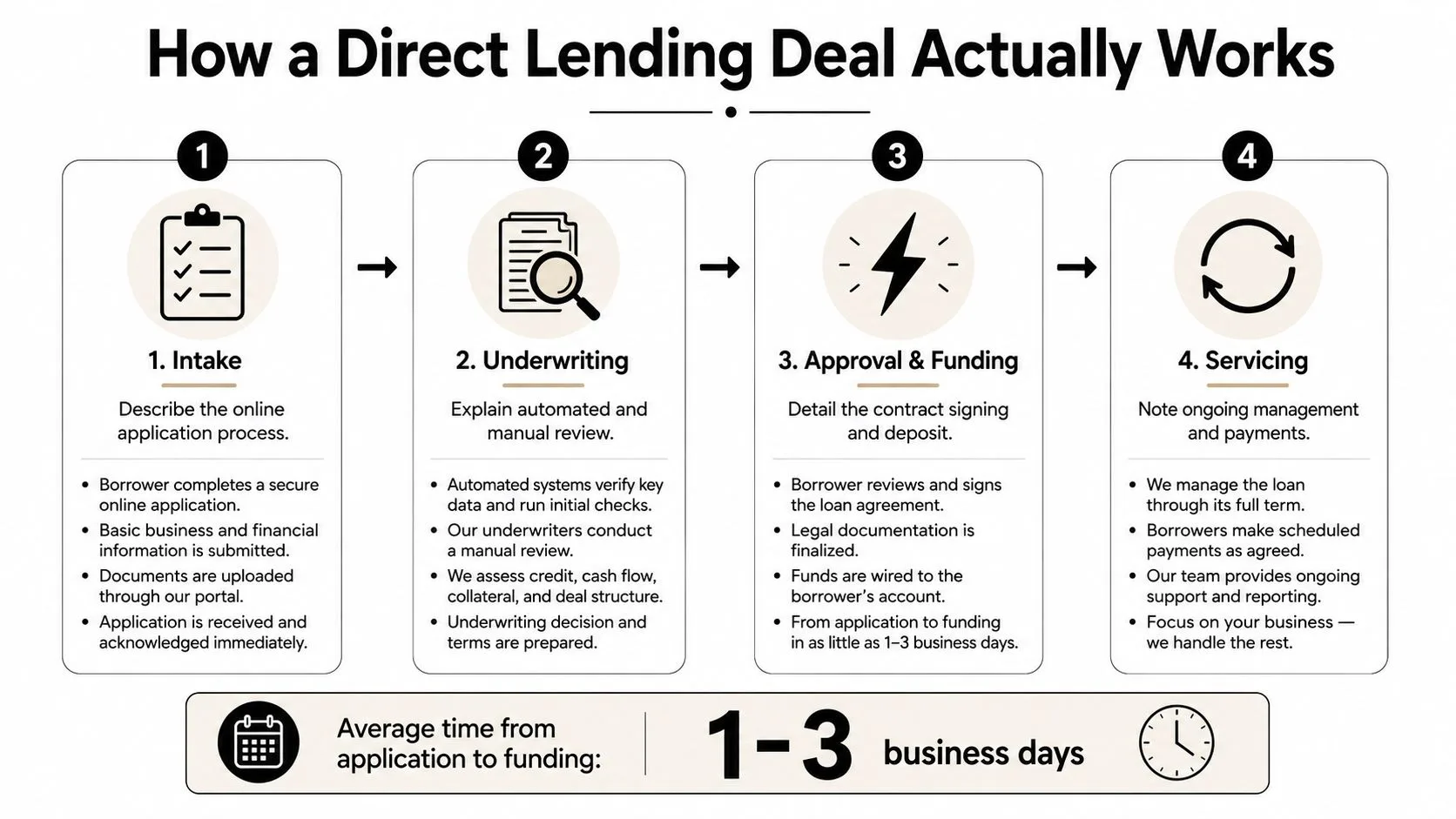
Intake and underwriting
The first stage usually collects an application, business bank data, ownership information, and authorization for credit review. A soft credit inquiry may be used for initial screening without itself damaging the score, but ask whether the lender will later perform a hard inquiry and when that happens.
Underwriting then evaluates cash flow, time in business, industry risk, debt obligations, and guarantor strength. A direct lender's internal team or scoring model reviews the file rather than sending it to an unknown third party. That doesn't guarantee approval, but it gives you a single decision-maker who can explain why the request was approved, declined, or resized.
Terms, documents, and funding
The lender should present the principal amount, interest or factor structure, repayment schedule, collateral position, guarantees, fees, and default terms in writing. Don't compare only the advertised rate. Compare the total repayment obligation and the effect of payment frequency on your cash flow.
After signing, the money is deposited and the lender or named servicer manages collections. Working capital products can move quickly, while SBA-style financing generally requires more documentation and coordination. The direct relationship becomes valuable when revenue changes, a draw is needed, or you want to discuss an early payoff. You can reach the party with authority instead of chasing an intermediary who never owned the loan.
For lenders, strong servicing matters just as much as acquisition and underwriting. This overview of why nearshore BPO improves loan and lease servicing explains why payment management, borrower communication, and account support deserve close attention.
The following video provides a visual walkthrough of the process:
Real Scenarios Where Direct Lenders Shine
Direct lending wins when the borrower needs a decision built around operating reality rather than a rigid checklist. It doesn't win every deal, and speed alone isn't a reason to accept poor economics.
Working capital under a short deadline
A long-established restaurant needs a working capital line before a scheduled expansion. Its tax returns don't present the cleanest picture, but its deposits show consistent operating activity. A direct lender may be willing to examine recent cash flow and industry patterns more closely than a bank's standardized process.
The advantage is not that the lender ignores risk. The advantage is that the person reviewing the file can connect the requested capital to the restaurant's actual payment capacity and structure the facility accordingly. If the business needs funds within days, that flexibility can matter more than a marginally lower headline rate that arrives too late.
Equipment with a clear business purpose
A medical practice wants to acquire an imaging unit. An equipment-focused direct lender can evaluate the machine, its useful business purpose, the practice's cash flow, and the borrower's credit profile in one process. The lender may also offer a purchase option or other end-of-term treatment that differs from a traditional term loan.
Specialization helps. A general-purpose broker may submit the request widely, but a direct equipment lender understands the asset, documentation, and repayment structure before issuing terms. Read the purchase option, maintenance obligations, insurance requirements, and default remedies carefully. The equipment secures the transaction, but it doesn't eliminate the borrower's responsibility to repay.
An SBA transaction that needs certainty
A borrower pursuing an SBA-backed acquisition or expansion may prefer a nonbank lender when the bank route becomes too slow or inflexible. The lender still must follow SBA program requirements, but a focused underwriting team may keep communication and decision-making in one place.
The SBA loan resource explains the program environment borrowers should understand before comparing lenders. A direct lender can be a strong fit when the business has a sound plan but needs an experienced team to coordinate documentation, eligibility, and credit review. It isn't a shortcut around repayment capacity or required disclosures.
Pricing, Speed, and Underwriting Compared
The cheapest funding channel depends on the borrower's credit, financial statements, collateral, industry, and urgency. In 2026, the relevant comparison is not “bank versus alternative lender.” It is the cost of each channel against the flexibility and timing it provides.
| Channel | Typical APR or Factor Rate | Term Length | Time to Fund | Min. FICO | Min. Time in Business | Revenue Threshold |
|---|---|---|---|---|---|---|
| Bank loan | 6.3% to 11.5% | Varies by product | Slower than most digital alternatives | Depends on underwriting | Depends on underwriting | Depends on underwriting |
| SBA loan | 9.75% to 14.75% | Varies by SBA product | Usually slower because of documentation | Depends on lender and program | Depends on lender and program | Depends on lender and program |
| Alternative direct financing | 10% to 40% | Varies by product | Often faster than bank financing | More flexible by lender | More flexible by lender | More flexible by lender |
The rate ranges above come from the 2026 market benchmarks provided in the Equifax report. They show why a direct lender isn't automatically expensive or automatically cheap. A strong borrower may receive competitive pricing, while a short-term product for a stressed business can carry a substantial premium.
What the premium buys
Banks usually offer the strongest economics to borrowers who can document stable cash flow, satisfy conventional underwriting, and wait through a detailed review. SBA financing can widen access, but the application often demands patience and complete records. Direct lenders may rely more heavily on current bank activity, payment performance, collateral, or a guarantor profile when tax returns don't tell the whole story.
That flexibility has a price. Faster funding can help a business capture inventory, cover payroll, complete an acquisition, or prevent a cash-flow interruption. It can also tempt an owner to accept a payment schedule the business can't sustain.
Use the fintech and bank approval comparison to frame the decision around timing, documentation, and total cost rather than approval speed alone. Before signing, convert every fee and repayment obligation into a comparable cost measure. If the lender quotes a factor rate, request the total dollar repayment and don't mistake a low-looking factor for a low APR.
How to Evaluate a Direct Lender Before You Apply
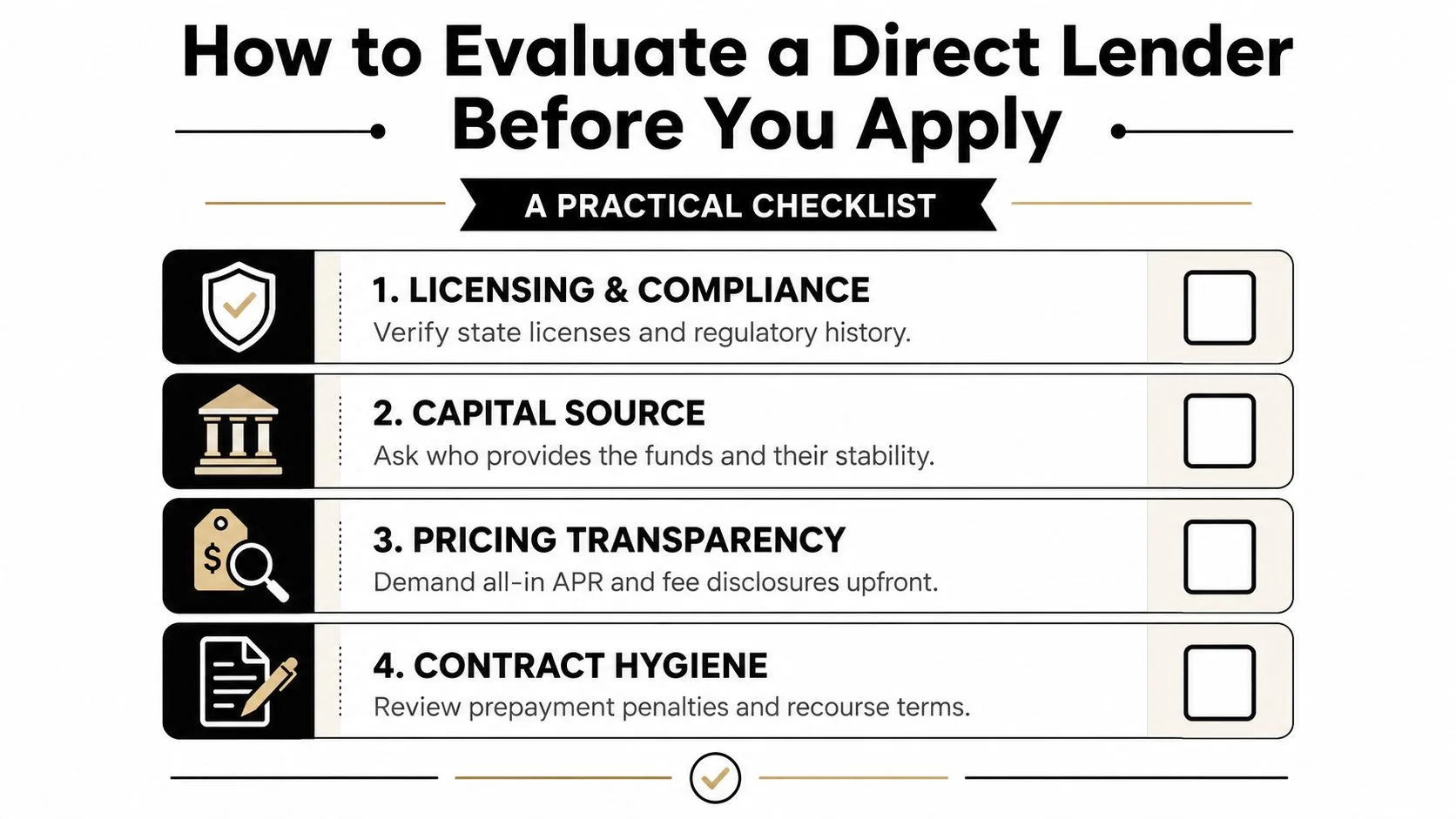
Treat the lender's identity as part of the underwriting. Before you send bank credentials, verify who is asking for your data and who is legally responsible for the loan.
Licensing and compliance
Look up the company's legal name, physical address, state lending license, or applicable exempt status. For mortgage-related or other regulated activity, verify the NMLS number when one applies. A polished brand name isn't enough. The contract should identify the legal entity that originates the loan.
Check complaint and enforcement information through the CFPB database and relevant state regulators. One negative review doesn't prove misconduct, but repeated complaints about undisclosed fees, unauthorized withdrawals, or misleading refinancing deserve a direct explanation.
Capital source
Ask, “Do you fund this loan from your own balance sheet?” If the answer is no, ask who provides the money, whether the lender uses a warehouse line, and whether another entity can refuse or resell the loan.
A lender can still be legitimate without using only permanent balance-sheet capital. The issue is transparency. You need to know whether the person approving the transaction can control funding and whether a change in the lender's capital arrangement could interrupt closing.
Pricing transparency
Request a written term sheet that shows:
- All-in cost: Ask for interest, factor charges, origination fees, administrative fees, and any required products.
- Payment schedule: Confirm the amount, frequency, first payment date, and total repayment.
- Early payoff: Find out whether prepayment reduces the cost or leaves the full charge in place.
- Collateral and guarantees: Identify personal guarantees, blanket liens, and asset-specific security interests.
Contract hygiene
Ask for a redacted sample agreement before you apply. Compare the originator, funder, and servicer names across the application, offer, and final contract. If those entities don't match, ask why.
Don't sign until you understand default triggers, notice procedures, collection rights, dispute resolution, and what happens if you miss a payment. A direct relationship is useful only when the contract gives you enough information to manage it.
Red Flags and Borrower Protections to Watch
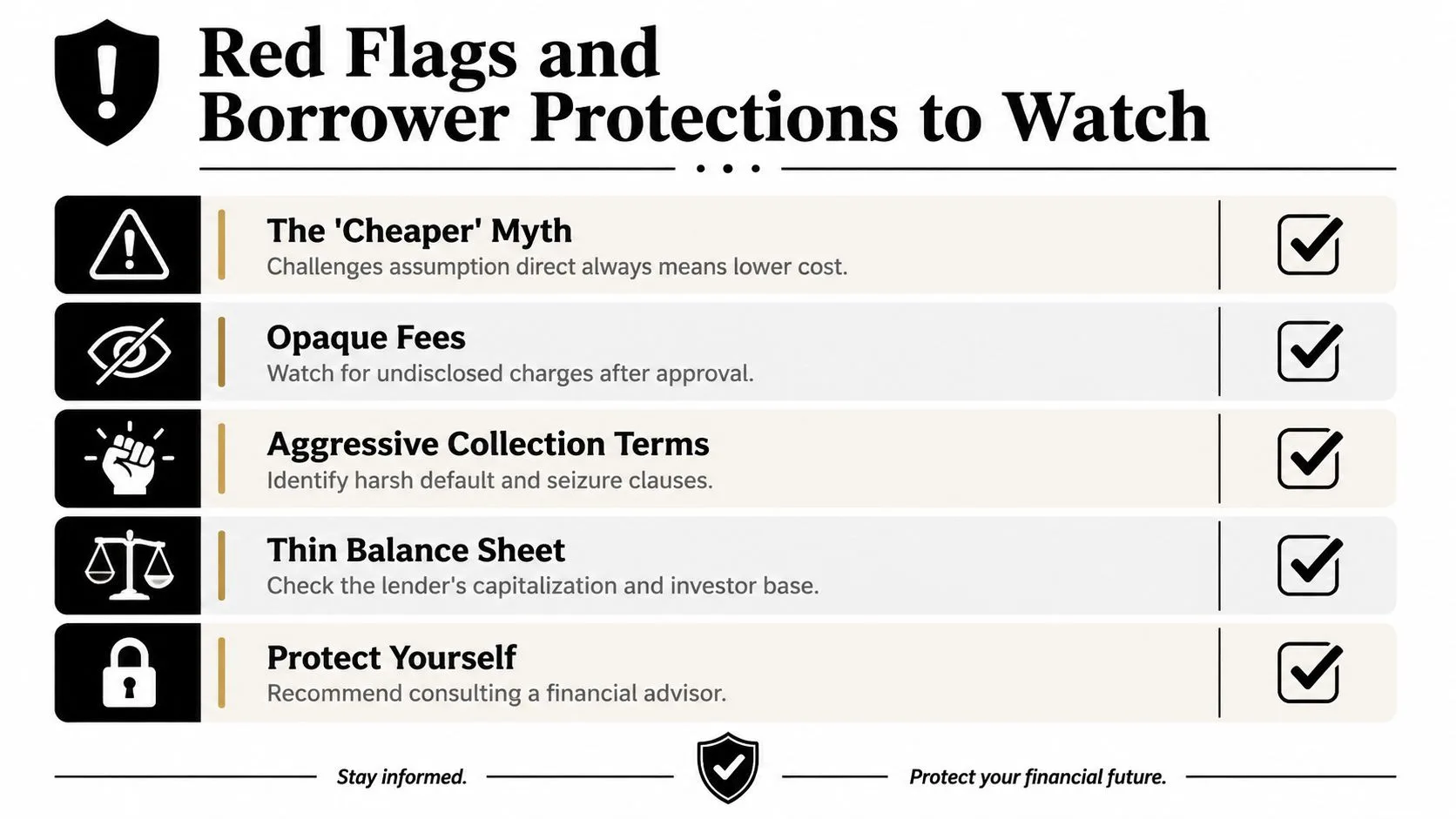
“Direct” describes the funding relationship. It doesn't describe the quality of the deal. A direct lender can offer clean terms, or it can place an expensive, aggressive contract directly in front of you.
Read the economics before the urgency
Be cautious when the lender emphasizes approval but avoids a complete cost disclosure. An origination fee above 5% should trigger a careful comparison, and any pre-authorized ACH arrangement should be clear before funding. Ask whether the lender can debit your account automatically, under what conditions, and how you can dispute an incorrect withdrawal.
A refinancing offer can also hide loan flipping. If the company repeatedly replaces an existing obligation with a new one while charging fresh fees, the business may receive new cash but pay for the same financing cycle again. Compare the new total repayment with the remaining balance on the old debt.
Examine control and recourse
Forced arbitration, broad confession-of-judgment language where permitted, aggressive default remedies, and blanket liens deserve legal review. You should know whether a missed payment can trigger an account sweep, personal liability, equipment seizure, or acceleration of the entire balance.
Federal and state protections vary by product and jurisdiction. Review applicable usury limits, Equal Credit Opportunity Act rights, state commercial-finance disclosures, and any cooling-off provisions that may apply in states such as California or New York. Don't assume a protection applies to every business product. Ask a qualified attorney or regulator when the contract is unclear.
Walk-away test: If the lender won't identify the funder, disclose the total repayment, or provide the contract before signing, don't proceed.
Before closing, verify the lender through the NMLS or the relevant state regulator, confirm the legal entity in the agreement, and ask whether the loan will remain with that entity after funding. A lender's claim that it “services” the loan doesn't necessarily mean it owns the credit risk.
When to Choose a Direct Lender and What to Ask First
Use a bank when your business has strong conventional financials and your priority is the lowest available cost. Consider SBA financing when the transaction needs a government-backed structure and you can tolerate a more involved process. Choose a direct lender when speed, flexible underwriting, specialized collateral, or a nonstandard cash-flow profile matters more than a bank's conventional process.
A broker has a narrower but legitimate role. Use one when the deal is unusually specialized and you can't identify a suitable funder yourself. Don't use a broker because the website hides the lender's identity.
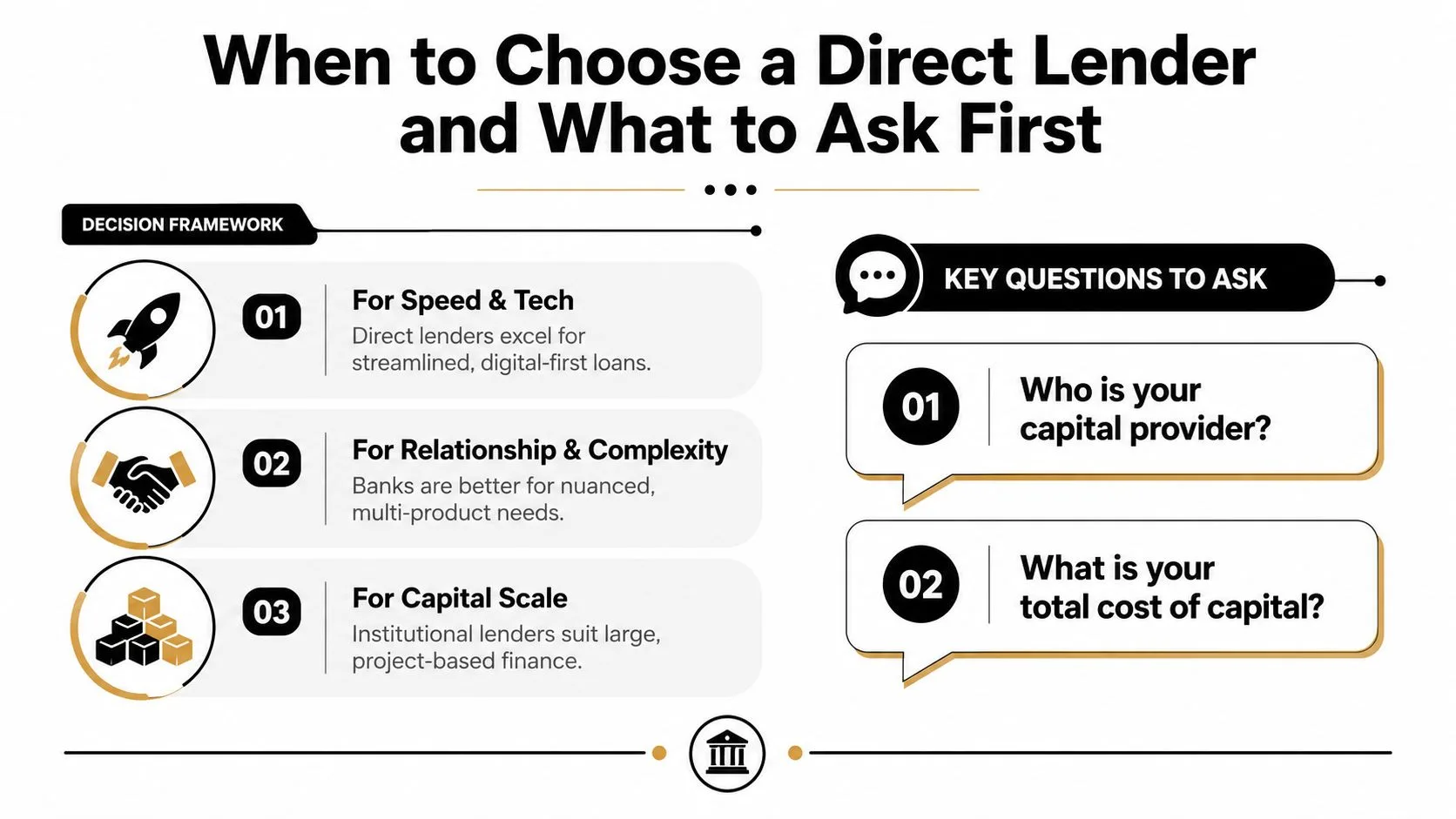
Ask these questions before signing:
- Who supplies the capital?
- Who makes the credit decision?
- Who services the loan?
- What is the total repayment amount?
- What is the all-in APR after fees?
- Does early payoff reduce the cost?
- Are there personal guarantees or blanket liens?
- How do draws and repayments work?
- What happens after a missed payment?
- Can I review a sample agreement before applying?
The 2026 lending squeeze makes direct lenders useful because they can address gaps left by slower or tighter bank processes. It also makes comparison essential. Faster isn't cheaper by definition, and flexible underwriting isn't a substitute for a payment the business can afford.
Business Loan Warrior provides a no-fee application, pre-approval checks that don't affect credit, bank-account connection, approval and repayment tracking, and access to underwriters across products such as business loans, SBA financing, equipment loans, lines of credit, and invoice financing. Visit Business Loan Warrior to compare funding paths and identify whether a direct lender fits your timing, cash flow, and total-cost requirements.