
A busy week can make a healthy business feel short of cash. Sales are coming in, customers are returning, and the income statement looks encouraging, yet payroll, inventory, supplier deposits, and rent all arrive before the next meaningful batch of receipts. That gap can force an owner to seek capital even when the business isn't failing.
Business loans based on revenue are designed for this kind of situation. Instead of relying mainly on collateral or a strong personal credit profile, the funder studies how reliably the business generates cash and structures repayment around sales. That flexibility can help, but it doesn't make the funding inexpensive or automatically safe. The two questions that matter most are often overlooked: How much margin can the business protect while repaying, and how quickly will the balance be collected?
Table of Contents
- The Owner With Strong Sales and Tight Cash
- What Business Loans Based on Revenue Actually Are
- What Lenders Look At Before They Approve
- Revenue-Based Funding vs Traditional Credit-Score Loans
- How Pricing and Repayment Really Work
- When Revenue-Based Funding Makes Sense for Growing Businesses
- How to Prepare Before You Apply
- Putting It All Together and Choosing Your Next Step
The Owner With Strong Sales and Tight Cash
Maya owns a specialty home-goods store. Customers are buying, her annual sales are moving in the right direction, and several commercial buyers have placed repeat orders. On paper, the business looks stronger than it did last year.
Her immediate problem is timing. A supplier requires a deposit before releasing a shipment, payroll is approaching, and some commercial customers won't pay their invoices until later. Maya has acceptable personal credit, but it isn't strong enough to carry the application through a bank's process without additional support. The bank also wants collateral and a substantial operating history documented through statements and financial records.
Maya isn't looking for money to cover a failed business model. She needs working capital to bridge the distance between earning revenue and receiving usable cash. That distinction is why revenue-linked funding has become an alternative to conventional bank credit. One market estimate placed global revenue-based financing at about $3.38 billion in 2023 and $5.78 billion in 2024, a year-over-year increase of roughly 70.9%, and projected the market could reach $41.81 billion by 2028. The estimate is reported in revenue-based financing market statistics.
Before applying, Maya would benefit from clean visibility into which sales have produced cash, which invoices remain outstanding, and how much money leaves the business each day. A tool that helps owners automate cash from sales tracking can make that review easier, especially when sales arrive through multiple channels.
The right question isn't just, “How much revenue do I have?” It's, “Can my margins and cash reserves support the proposed remittance during an ordinary month and a weak one?” The answer determines whether revenue-based funding solves Maya's timing problem or creates a more expensive one.
What Business Loans Based on Revenue Actually Are
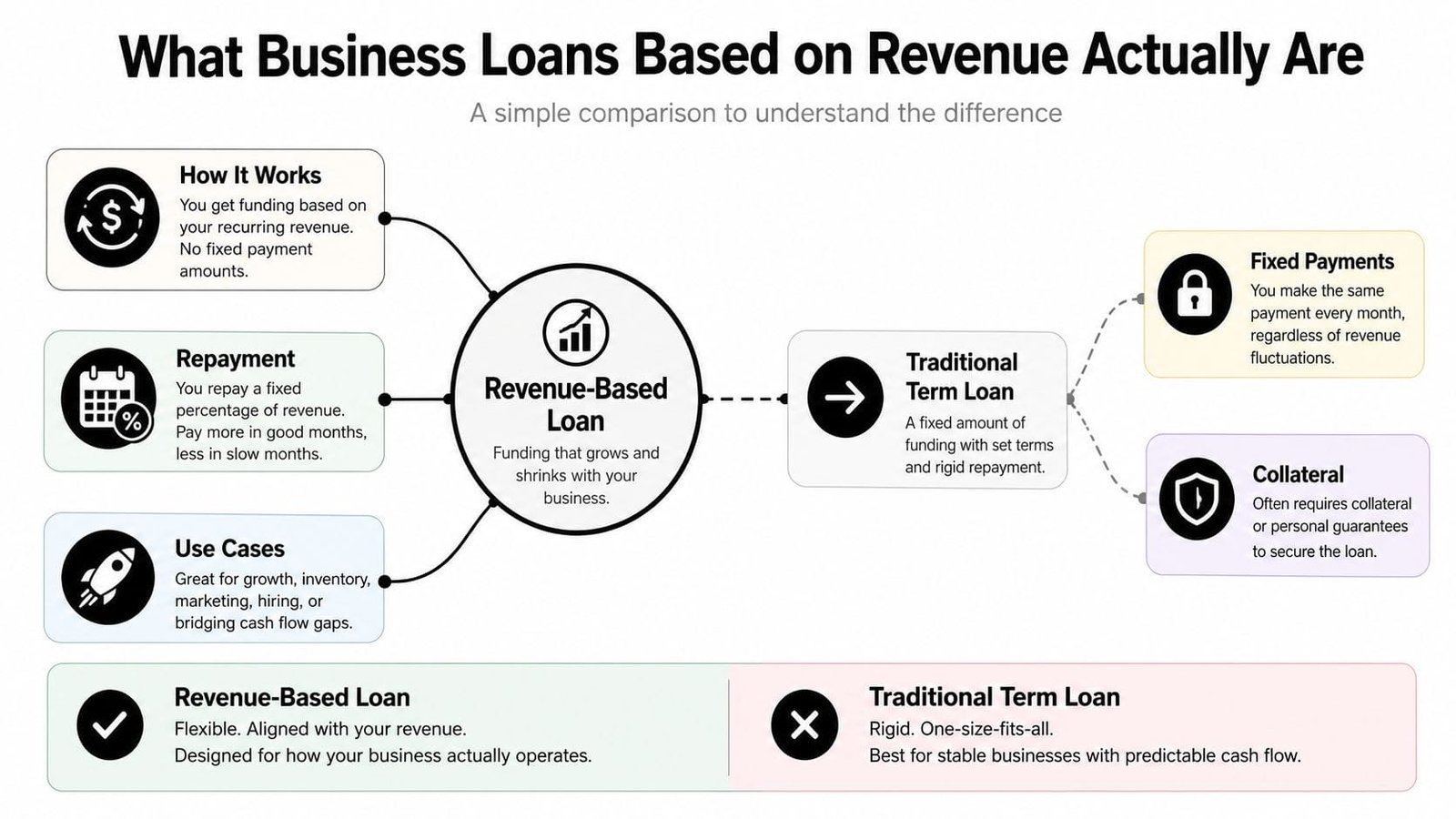
A revenue-based loan gives a business a lump sum and collects repayment through a percentage of future sales. Depending on the agreement, the remittance may be taken daily, weekly, or through a payment processor. When sales are stronger, the payment can rise. When eligible sales decline, the payment may fall if the contract uses a variable percentage rather than a fixed debit.
The simplest analogy is a royalty on sales, not a mortgage payment. A traditional term loan usually requires scheduled principal and interest payments regardless of the day's sales. Revenue-linked funding instead gives the funder a claim on an agreed portion of future receipts until the contract's total repayment amount has been reached.
The structures owners often confuse
The label covers related products, but the documents can work differently:
- Revenue-based financing: The business receives capital and remits an agreed share of revenue until a repayment cap is satisfied. The payment is intended to flex with operating performance.
- Merchant cash advance: The provider purchases a portion of future receivables, often card receipts, for a fixed total payback calculated with a factor rate. Collection may occur through a processor split or scheduled withdrawals.
- Revenue-linked business funding: Some providers describe their product as a loan while still basing repayment on sales volume. The legal classification and exact obligations depend on the agreement.
A merchant cash advance is closely related to revenue-based funding, but owners shouldn't assume the two contracts carry identical protections, payment mechanics, or pricing. Market estimates put the U.S. merchant cash advance market at about $19.65 billion in 2024, with a projection of $32.7 billion by 2032 at a 7.2% CAGR. Another estimate placed the global market at $18.6 billion in 2024 and projected $24.9 billion by 2030 at a 5% CAGR, as summarized in merchant cash advance and revenue-based financing statistics.
What this financing isn't
This product isn't equity. You don't surrender ownership merely because repayment is connected to sales. It also isn't a conventional revolving line that you draw against a balance-sheet facility, and approval isn't based primarily on the owner's personal FICO score.
The funder's central question is whether incoming revenue is durable enough to support repayment. That means the same annual sales figure can produce different offers for two businesses if one has recurring customers and stable margins while the other depends on a few irregular orders.
What Lenders Look At Before They Approve
Underwriters don't treat revenue as a single, decisive number. They examine its shape, its reliability, and what remains after the business pays the costs required to produce each sale.
The underwriting hierarchy
First comes revenue consistency. The lender reviews deposits over time, sales concentration, recurring versus one-time receipts, and seasonal swings. A business that depends on one customer or a short selling season carries more concentration and timing risk than a business with a broader, repeatable customer base.
Next is gross-margin durability. Gross margin shows what remains after direct costs such as inventory, materials, or delivery expenses. A high sales figure won't protect the business if the remittance consumes the cash needed to replenish stock or complete the next job. Lenders also consider revenue growth, margins, churn, and historical cash-flow patterns when judging whether sales can continue supporting payments, as explained in revenue-based financing underwriting.
Cash-flow behavior follows. The review may include average bank balances, returned payments, overdraft or NSF activity, the timing of receivables, and whether payables cluster before customer collections. Existing obligations matter because a new remittance competes with every other scheduled withdrawal.
| Tier | Signal | What the Lender Is Measuring | Relative Weight |
|---|---|---|---|
| 1 | Revenue consistency | Stability, customer concentration, recurring receipts, and seasonality | Highest |
| 2 | Gross-margin durability | Cash left after direct costs and the ability to absorb remittance | Very high |
| 3 | Cash-flow pattern | Bank balances, NSF events, collections, and payable timing | High |
| 4 | Existing debt stack | Current withdrawals, liens, and repayment overlap | Meaningful |
| 5 | Business profile | Time in business, industry, and operating model | Supporting |
| 6 | Owner credit | Personal credit history as a secondary signal or tiebreaker | Usually secondary |
A practical review of ways to pressure-test revenue consistency before approving a loan can help an owner identify weaknesses before a funder does.
Underwriting rule: A revenue threshold can open the conversation, but margin behavior and repayment speed usually determine whether the offer is workable.
That is why a comparison based only on minimum revenue can mislead. A business with uneven receivables and fragile margins may be riskier than a smaller company with predictable deposits and ample gross profit.
Revenue-Based Funding vs Traditional Credit-Score Loans
The two financing paths solve different problems. Revenue-based funding prioritizes current business performance and often accepts more operational uncertainty in exchange for a higher cost. A traditional term loan generally offers cheaper capital when the borrower can satisfy stricter credit, documentation, collateral, and repayment requirements.
| Dimension | Revenue-Based Funding | Credit-Score-Based Loan |
|---|---|---|
| Primary approval signal | Business revenue, deposits, payment volume, and consistency | Personal or business credit, financial statements, collateral, and repayment history |
| Funding speed | Often designed for rapid decisions when data is available | Usually involves a longer review and documentation process |
| Repayment | Daily or weekly remittance, sometimes tied directly to sales | Scheduled monthly principal and interest installments |
| Use of funds | Commonly flexible working capital, inventory, payroll, equipment, or expansion | May be flexible, but the lender can impose purpose restrictions |
| Cost comparison | Often higher when converted into an annualized cost | Usually lower for qualified borrowers |
| Credit profile | A thin file may not automatically prevent approval | Strong credit is often central to the decision |
| Collateral and covenants | Requirements vary by provider and contract | Collateral, guarantees, and covenants are more common |
Consider two owners. The first has strong card sales, a limited personal credit history, and an urgent inventory opportunity. Revenue-based funding may be accessible because the lender can evaluate payment activity rather than relying on a conventional credit profile.
The second owner has a 720 personal credit score, but deposits arrive unevenly because the business completes large projects at irregular intervals. A traditional loan may still be cheaper if the owner can document the business well and wait through the bank's review. The score helps, but it doesn't erase cash-flow risk.
Owners can use business loan credit score guidance to understand how personal credit may affect conventional financing. The decision cue is straightforward: if speed and flexible collection matter more than the lowest possible cost, revenue-linked funding may deserve review. If the business has strong credit, stable documentation, collateral, and time to wait, traditional credit should be priced first.
How Pricing and Repayment Really Work
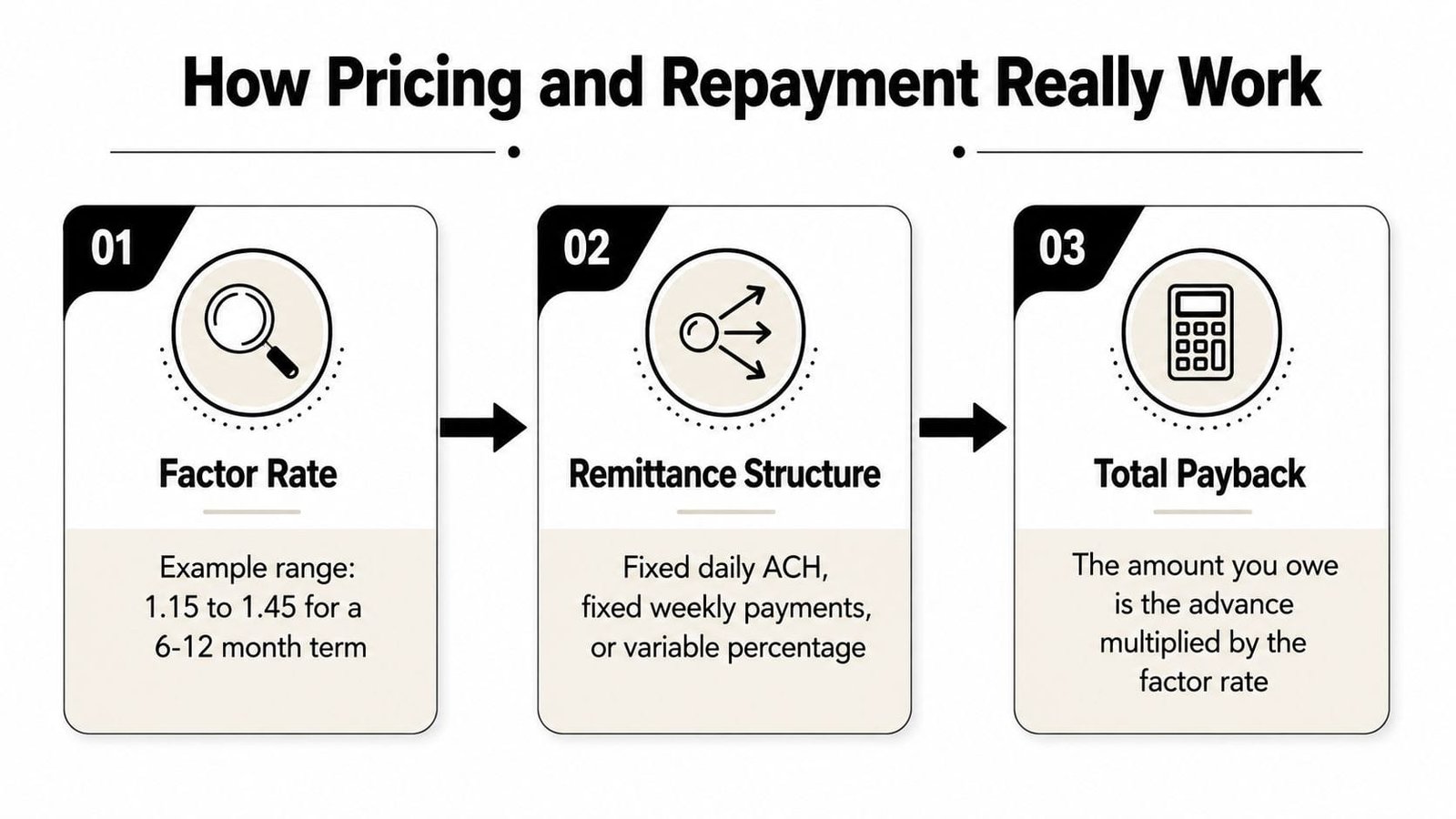
A revenue-based offer has three moving parts: the factor rate, the remittance structure, and the time required to collect the total payback. Owners need all three before they can judge affordability.
Factor rate and total payback
A factor rate multiplies the amount advanced. For example, a $50,000 advance at a 1.30 factor rate requires $65,000 in total repayment. That means the contract fee is $15,000 before considering other charges.
The factor rate isn't an interest rate. It doesn't automatically tell you the annualized cost because the time outstanding changes the calculation. A six-month repayment and a three-month repayment can carry the same total payback but produce very different effective annual costs.
Remittance and collection speed
The contract may use a fixed daily ACH debit, a fixed weekly withdrawal, or a percentage of card sales processed through a split. Those structures aren't interchangeable. A fixed debit can remain difficult during a weak sales period, while a variable remittance may reduce the payment but extend the collection period.
Market data for 2026 places common merchant cash advance factor rates around 1.1x to 1.5x, with effective APRs of roughly 40% to 350%, depending on how quickly repayment occurs, according to merchant cash advance rates in 2026. The mathematics is important: the fee is fixed, but compressing repayment into a shorter period increases its annualized cost.
If the $50,000 advance is repaid over six months, the implied annualized cost may land between roughly 60% and 110%, depending on the precise payment pattern. If sales surge and the balance clears in three months, the dollar fee remains $15,000, while the annualized percentage changes sharply. A faster payoff can therefore look better in percentage terms over a longer comparison period while pulling cash out of the business much more aggressively.
A spreadsheet can help compare scenarios. Owners who want to understand fixed-payment calculations can review using PMT in Excel for loans, then separately model a percentage remittance against conservative and strong sales cases. Also check for origination fees, underwriting fees, administrative charges, and early-payoff provisions. The business loan repayment terms guide offers another framework for testing the effect on operating cash.
When Revenue-Based Funding Makes Sense for Growing Businesses
Margin volatility is the decision test. Top-line revenue can demonstrate demand, but gross margin determines how much cash remains available after each sale. A business with steady 15% to 20% gross margins and predictable sales cycles may be able to absorb a remittance more comfortably than a business with sub-10% margins or a severe seasonal swing. Those illustrative margin bands should be tested against the owner's actual records, not treated as approval rules.
The strongest use cases have three traits: documented demand, a defined payback window, and a clear connection between the capital and future receipts.
- Inventory before a known peak: A retailer may purchase stock ahead of a confirmed seasonal demand period. The plan works only if the expected sales are supported by prior order patterns or documented customer demand, and the owner can fund ordinary expenses before inventory converts back into cash.
- A short payroll or vendor gap: A service company may bridge timing between completed work and customer payment. The funding should cover a specific gap, not become a recurring substitute for insufficient operating margin.
- A contract or purchase order: A contractor can use capital to buy materials or pay labor before a signed project generates receivables. The owner should verify payment terms, customer reliability, and the cost of completing the work.
- A time-sensitive expansion opportunity: A bulk supplier discount, equipment purchase, or location buildout may justify the cost when the return is measurable and the business has enough cash left to operate.
The structure becomes less attractive when repayment would consume money needed for inventory replacement, payroll, taxes, or essential maintenance. A slow quarter can reduce a variable remittance, but it doesn't make a low-margin business profitable, and a fixed debit may not reduce at all.
Cash-flow test: If repayment still works only when sales meet the optimistic forecast, the funding is too aggressive for the business.
An owner should also ask whether the capital creates new revenue or merely postpones a problem. Funding a confirmed, profitable opportunity is materially different from using a new advance to cover a recurring operating deficit.
How to Prepare Before You Apply
A clean application starts with a clean internal review. Gather the records a funder will likely inspect, then challenge the proposed payment against a slower trading period before requesting an offer.
Build the operating file
Collect 3 to 6 months of business bank statements and merchant processing reports. Reconcile deposits to accounting records, and separate actual sales from transfers, owner contributions, refunds, and chargebacks. Gross processing volume can make revenue look stronger than the amount the business ultimately keeps.
Document gross margin by month rather than relying on one annual average. A retailer may have strong margins on one product category and weak margins on another, while a contractor may see material costs rise on specific projects. That pattern helps you determine whether the proposed remittance leaves enough cash for the next cycle.
Review the debt stack in one place. List each existing obligation, its outstanding balance, payment frequency, withdrawal date, and any personal guarantee or lien. Multiple daily or weekly debits can create pressure even when each obligation appears manageable by itself.
Run a slow-quarter test
Use a conservative scenario that reduces expected revenue by 20% to 30%. These are stress-test assumptions, not forecasts or lender requirements. Recalculate the remittance, subtract direct costs, payroll, rent, taxes, existing debt payments, and essential operating expenses, then check whether cash remains positive.
Before signing: Ask the funder whether the payment changes with sales, what happens after a weak month, and whether early payoff changes the total amount owed.
Prepare entity documents, tax returns, current profit and loss statements, bank statements, processing reports, and a short explanation of the funding purpose. State what the capital will purchase, when that use should produce cash, and what evidence supports the expected return.
Putting It All Together and Choosing Your Next Step
Revenue-based funding is one tool in a broader financing set. A term loan may fit a planned equipment purchase. A line of credit may suit recurring working-capital needs. An SBA product may offer a lower-cost path for an established company willing to complete a more demanding application. Equity can make sense when the business needs patient capital and repayment would constrain growth.
Choose based on the business's cash pattern, not on a product's popularity.
Owners with stable margins and a short, high-return need should request offers from multiple revenue-based providers. Compare the total repayable amount, remittance method, collection speed, fees, and default provisions. Don't compare factor rates alone, because the same factor can create different operating pressure depending on how quickly sales are collected.
Owners with thin or highly volatile margins should examine a line of credit or SBA option before accepting a revenue-linked obligation. A slower application can be worthwhile when the business needs lower-cost capital and predictable repayment rather than speed.
Owners who remain uncertain should build a three-month cash forecast. Include expected deposits, direct costs, payroll, taxes, existing debt, and the proposed remittance under strong, ordinary, and weak sales conditions. That forecast often reveals whether the funding supports growth or only moves a cash shortage forward.
Business Loan Warrior can help owners compare funding paths through a no-fee application, bank-account connection, funding dashboard, and access to options including business loans, SBA processing, lines of credit, equipment financing, and merchant cash advances. Visit Business Loan Warrior to review a funding route that matches your revenue pattern, margin capacity, and urgency.