
Unsecured credit is debt issued without collateral, where the lender relies on the borrower's credit profile and cash flow rather than pledged assets. In the United States, consumer debt totaled $4.989 trillion out of $20.195 trillion in household credit at the end of 2024, making unsecured borrowing a central part of household and business finance, not a niche product.
You may be facing the question after a supplier asks for a large deposit, a customer pays late, or an expansion opportunity appears before your cash arrives. Your company may generate substantial revenue, but that doesn't automatically make every lender comfortable extending funds without an asset to fall back on. For an established business, the question isn't whether credit is unsecured. It's whether the business can demonstrate enough reliable cash flow, credit strength, and repayment capacity to justify the lender's risk.
A corporate card used to cover inventory, an operating line drawn between receivable cycles, and a short-term working capital facility can all be unsecured. They may also carry materially different costs and repayment pressures. Understanding those differences helps you choose financing that supports the business instead of creating a cash-flow problem.
Table of Contents
- What Unsecured Credit Really Means
- Unsecured Credit Compared With Secured Lending
- How Lenders Actually Evaluate Unsecured Credit
- Common Examples of Unsecured Credit in Real Life
- Building Stronger Unsecured Business Credit
- When to Choose Unsecured or Secured Financing
- Finding the Right Unsecured Funding Partner
What Unsecured Credit Really Means
A credit card offers the simplest analogy. You can spend against an approved limit without giving the card issuer a vehicle, building, or piece of equipment to hold as collateral. If a company uses a corporate card to pay a supplier deposit, the lender expects repayment because of the company's financial profile and the personal guarantees or credit support attached to the account, not because it can immediately take that shipment or a specific business asset.
That's the core meaning of unsecured credit. The lender makes an advance without a pledged asset securing the obligation. If the borrower stops paying, the lender generally must pursue collection through the terms of the agreement and applicable legal process rather than just repossessing the named collateral. Cornell Law School's explanation of unsecured debt describes the key distinction, the lender has no claim on pledged assets when the borrower defaults.
Why the definition matters to a larger business
For a company generating revenue in the $20 million to $50 million range, unsecured borrowing can appear in several operating decisions:
- Supplier deposits: A business card or revolving facility may cover a deposit while the company waits for customer receipts.
- Seasonal inventory: A line can bridge the period between purchasing stock and collecting sales proceeds.
- Expansion expenses: The company may use unsecured funds for hiring, marketing, software, or site preparation before revenue from the expansion arrives.
- Personal support: A founder may provide a personal guarantee even though the business hasn't pledged a specific asset.
The absence of collateral doesn't mean the lender ignores the business. It shifts attention toward creditworthiness, income stability, financial history, and cash flow. The lender wants evidence that repayment will come from operations.
The scale of this market is substantial. The Federal Reserve data summarized by Discover shows consumer debt at about one-fourth of household debt at the end of 2024, while mortgage debt represented roughly three-fourths, and household credit grew year over year even as consumer debt moved differently within that broader total. Discover's overview of unsecured credit cards places unsecured products such as credit cards, student loans, and many personal loans inside that wider consumer-debt picture.
Practical rule: “Unsecured” describes what protects the lender. It doesn't describe how easy the borrower's approval will be.
Credit cards remain the most common unsecured credit product, and U.S. credit-card balances reached $1.18 trillion across 631.39 million accounts by the end of 2024, according to Debt.org's consumer debt data. A secured loan is backed by a pledged asset. An unsecured loan depends primarily on the borrower's promise and demonstrated ability to repay.
Unsecured Credit Compared With Secured Lending
A $20M-$50M company may have strong sales and still choose between two very different borrowing structures. Secured financing gives the lender a defined recovery path through property, equipment, inventory, or receivables. Unsecured financing leaves that specific asset outside the agreement, so the lender places greater weight on the company's ability to produce cash and meet its obligations.
| Factor | Secured Credit | Unsecured Credit |
|---|---|---|
| Collateral | Requires an asset such as equipment, property, inventory, or receivables | Doesn't require a specific pledged asset |
| Pricing | Often lower because collateral can reduce loss severity | Usually higher because repayment depends more heavily on credit and cash flow |
| Approval focus | Asset value plus business credit and repayment capacity | Business credit, personal credit support, revenue quality, cash flow, and existing debt load |
| Approval process | May take longer because the lender verifies, values, and documents collateral | Can move faster when financial data is readily available |
| Funding ceiling | Can support larger purchases when the asset provides meaningful security | Depends heavily on lender risk appetite and the borrower's financial profile |
| Default consequences | The lender may enforce rights against pledged collateral under the agreement and law | The lender must use collection remedies available under the contract and law |
| Best practical fit | Equipment, real estate, and long-term capital investments | Working capital gaps, flexibility, and expenses without a clear asset to pledge |
The pricing difference is not fixed. It varies with the lender, structure, borrower, and market conditions. A lender with rights to equipment or property may accept less interest because those assets can reduce potential losses. An unsecured lender has fewer recovery options, so pricing may reflect greater repayment risk.
Approval speed also depends on the deal. A secured facility may require appraisals, lien searches, insurance documents, and formal collateral filings. An unsecured lender may rely on financial statements, bank data, and credit reports instead. Fewer asset documents can reduce administrative work, but the lender still needs enough information to assess repayment.
For an established business, the practical question is often whether preserving borrowing capacity and avoiding an asset lien matters more than obtaining the lowest possible rate. A company funding a new production line may prefer secured financing tied to equipment. The same company covering a seasonal receivables gap may value unsecured flexibility, even at a higher cost. This secured versus unsecured business loan guide compares those operating tradeoffs.
Business owners handling personal guarantees, collection rights, or insolvency should also understand the legal distinction between secured and unsecured obligations. A practical guide for Minnesota bankruptcy filers from LifeBack Law Firm, P.A. explains how those categories may be treated in a bankruptcy context.
How Lenders Actually Evaluate Unsecured Credit
Without collateral, underwriting becomes a close examination of repayment capacity. Lenders aren't asking only, “How much does the company sell?” They're asking whether the company turns sales into dependable cash, whether that cash remains available after existing obligations, and whether management has handled credit responsibly.
The underwriting stack
Personal and business credit often provide the first risk signal. A lender may review the owner's personal credit, the company's commercial reports, and scores such as FICO, Paydex, or FICO SBSS where applicable. Payment history, utilization, public records, and recent inquiries can influence the risk tier.
Revenue quality matters more than a headline sales figure. A company with strong annual sales but erratic deposits, concentrated customers, or long collection cycles may present more risk than a smaller company with predictable recurring receipts. Bank-statement analysis helps the lender see deposits, withdrawals, overdrafts, average balances, and the timing of debt payments.
Time in business gives the lender operating history. A longer track record may provide more evidence about seasonality, customer retention, and management's response to difficult periods. It doesn't guarantee approval, especially if debt has risen sharply or margins have weakened.
The cash-flow test
Lenders may calculate debt service coverage by comparing operating cash available for debt payments with scheduled obligations. Existing loans, leases, card balances, tax liabilities, and requested financing all affect the picture. Industry risk also matters because a contractor, distributor, restaurant group, and professional-services firm may have very different working-capital cycles.
Automated lenders can analyze connected bank data alongside credit information. A business should review its own statements before applying, looking for unexplained transfers, frequent overdrafts, irregular payroll patterns, and balances that fall sharply before payment dates.
The three Cs of credit, character, capacity, and capital, offer a useful way to organize that preparation. This business credit guide to the three Cs provides a lender-oriented framework for assessing the same factors from the applicant's side.
A lender prices the risk it sees, not the revenue story the owner tells.
Two businesses with similar sales can receive different offers because one has cleaner bank activity, lower debt, stronger payment history, or more consistent margins. Unsecured credit rewards evidence. Before applying, assemble current financial statements, debt schedules, bank access, ownership information, and a concise explanation of how the funds will be repaid.
Common Examples of Unsecured Credit in Real Life
A company doesn't experience unsecured credit as a legal definition. It experiences it as a payment decision. The finance director needs to pay a vendor, payroll arrives before receivables, or a new contract requires spending before the first invoice clears.
| Product | Typical Use Case | Repayment Structure | Pricing Reality |
|---|---|---|---|
| Business credit card | Supplier purchases, travel, software, and recurring operating expenses | Revolving balance with a required minimum payment | Flexible, but carrying balances can become expensive |
| Personal loan with founder support | A business or owner needs funds when the lender relies on personal credit | Fixed installments over an agreed term | Cost reflects personal credit and unsecured risk |
| Unsecured business line of credit | Bridge receivables, seasonal inventory, or short operating gaps | Draw, repay, and potentially redraw within the approved limit | Cost depends on credit tier, utilization, fees, and structure |
| Short-term working capital loan | Fund a defined need before expected customer receipts | Regular installments or frequent scheduled payments | Faster access may come with a higher total financing cost |
| Merchant cash advance | Obtain funds against expected card or receivable volume | Repayment through a share of future receipts or scheduled withdrawals | Factor-rate terminology can obscure the true cost without careful conversion |
Consider a distributor with strong sales but customers who pay slowly. An unsecured line may help cover a supplier order while invoices remain outstanding. The line's value comes from timing flexibility, but the owner must ensure that projected collections can support both the draw and the company's existing obligations.
A business card serves a different purpose. It may be convenient for recurring software or travel, but using it for a large inventory purchase can create a persistent revolving balance if the company doesn't pay it down quickly. Convenience doesn't equal affordability.
A merchant cash advance also requires close review. The provider may describe the charge using a factor rate rather than an annual percentage rate, and repayment can reduce deposits or bank balances during periods when sales soften. Owners comparing this product with a term loan should calculate the total dollar repayment and examine the timing of every withdrawal.
Personal guarantees can complicate the borrower's exposure even when the business itself pledges no asset. For questions about collection risk and legal remedies, these Wisconsin debt lawsuit answers from Lein Law Offices provide useful general context, though a business should consult qualified counsel about its own agreement and jurisdiction.
Building Stronger Unsecured Business Credit
Unsecured borrowing becomes easier to evaluate when the business maintains a clean, consistent financial record. Credit building isn't a single application event. It's an operating discipline that affects how a lender interprets every statement, payment, and balance.
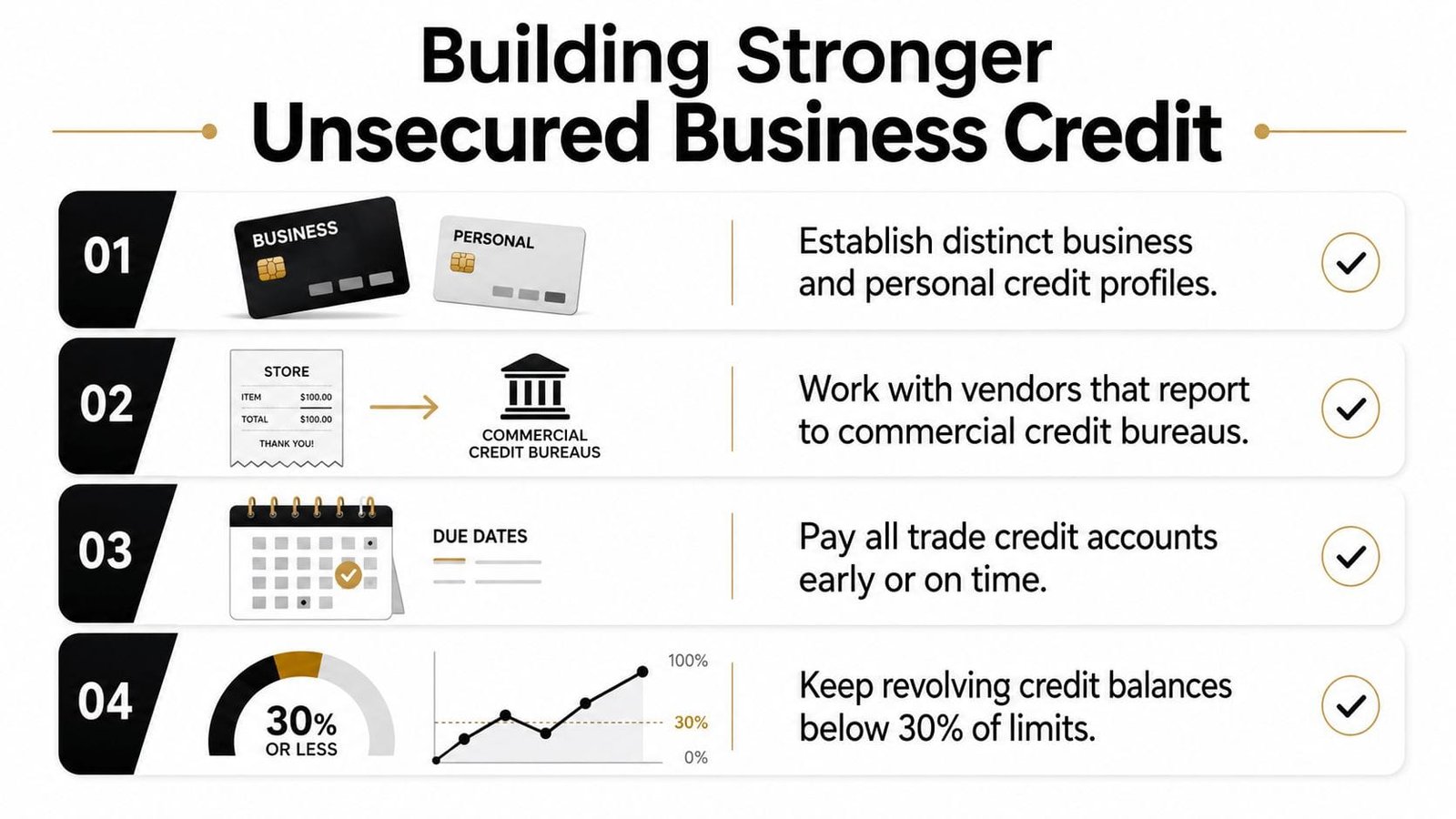
Separate the profiles
Keep business and personal spending distinct. Use the company's legal name, tax identification details, dedicated bank account, and business credit accounts consistently. If a founder regularly pays company expenses from a personal card, the books become harder to interpret and the owner's personal credit may absorb more utilization.
Ask vendors whether they report payment performance to commercial bureaus. A trade account that never reports may still help operations, but it won't necessarily strengthen the company's commercial credit file. Confirm the reporting practice before choosing vendors for the purpose of building credit.
Make payment behavior boring
Early or on-time payments create the record lenders want to see. Set calendar reminders, automate recurring obligations where appropriate, and assign one person responsibility for monitoring due dates. A missed payment can matter more than a polished funding presentation because it directly signals repayment behavior.
Revolving utilization deserves regular review. A company that draws close to its available limits may look dependent on borrowed liquidity even when it pays on time. Lower balances, sensible limits, and documented reasons for temporary increases give the lender a clearer picture of normal operations.
Keep the financial story consistent
Clean bookkeeping should connect invoices, deposits, payroll, taxes, and debt payments. Reconcile accounts regularly and explain unusual transfers before a lender asks about them. The 90-day business credit blueprint can serve as a planning reference for turning these habits into a repeatable preparation process.
For a larger company, add a quarterly credit audit. Review commercial reports, open accounts, guarantees, debt maturities, utilization, and cash reserves. Then compare the company's actual borrowing capacity with the amount management expects to request next. That review gives owners time to correct reporting errors or reduce avoidable balances before a financing application becomes urgent.
When to Choose Unsecured or Secured Financing
The right structure depends on four questions: How much do you need, how quickly do you need it, what assets can you pledge, and how sensitive is the project to financing cost?
Unsecured credit may fit a short working-capital gap when the company expects identifiable receipts and doesn't want to encumber equipment or property. It can also make sense when the use of funds is broad, such as hiring, marketing, launch expenses, or supplier deposits, and there isn't one asset that naturally secures the request.
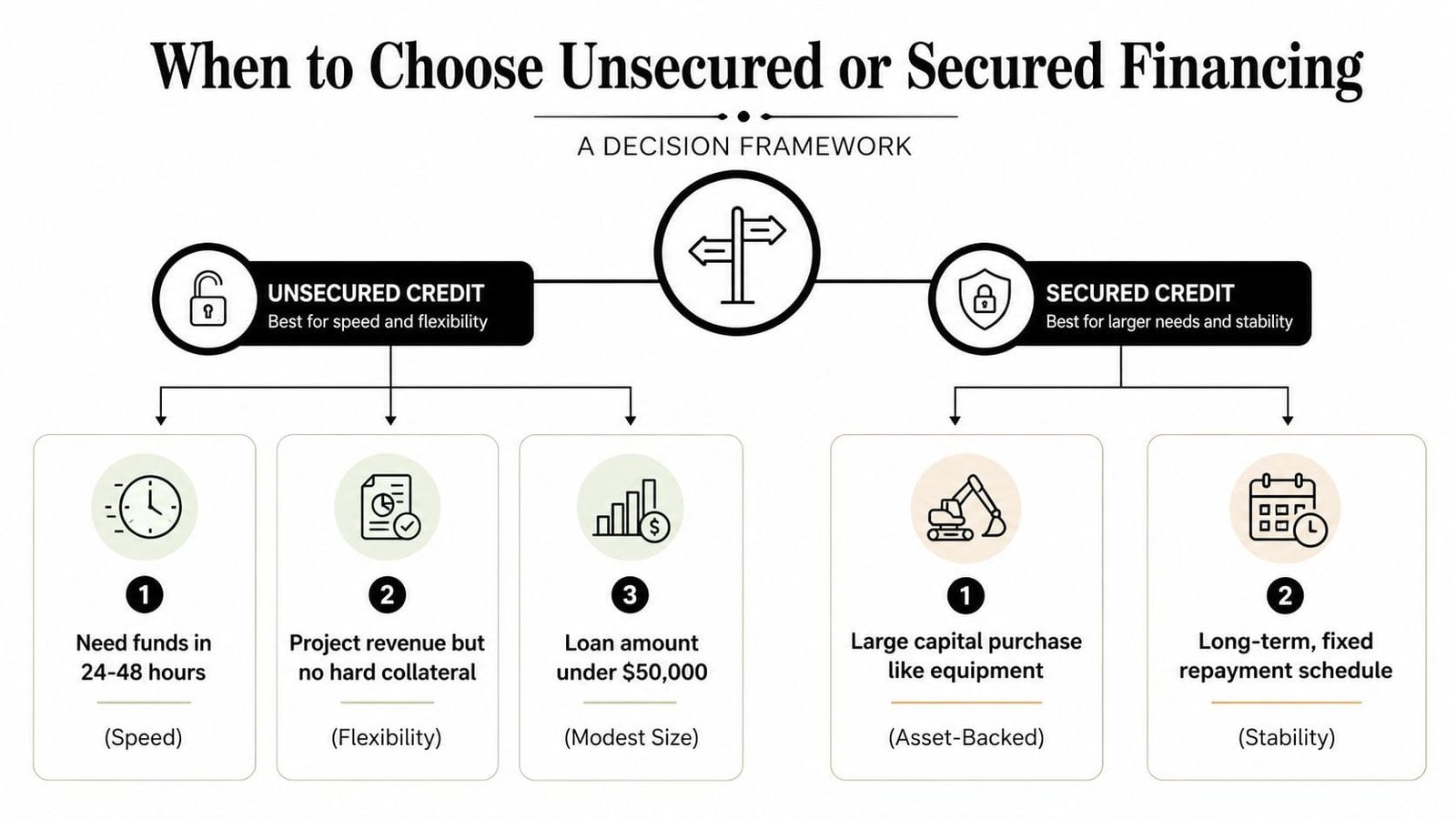
Use this diagnostic:
- Need speed: If a time-sensitive opportunity requires funding quickly, an unsecured option may reduce collateral documentation. Confirm that the repayment schedule matches the expected cash receipts.
- Have useful collateral: If the request funds equipment, real estate, or another identifiable asset, secured financing may offer a more natural structure.
- Need flexibility: If the amount and timing of draws will change, a revolving line may be more useful than a fixed secured loan.
- Care most about total cost: Compare the full repayment amount, fees, and consequences of default. A lower rate doesn't help if the structure doesn't fit the cash cycle.
- Have weaker credit: Collateral may improve the lender's recovery position, but it won't eliminate the need to show repayment capacity.
A company purchasing a production machine may prefer asset-backed financing because the equipment has a clear relationship to the loan. A company covering a temporary gap between payroll and customer collections may prefer an unsecured line, provided the business can repay without relying on new borrowing.
The repayment schedule matters as much as approval. A product that takes daily or frequent withdrawals can strain a business whose customers pay on longer terms. Review the schedule against the company's actual deposit pattern before signing.
For a visual explanation of the decision, watch the following resource.
Finding the Right Unsecured Funding Partner
A lender comparison should begin with the offer's true cost, not the advertised funding speed. Ask whether the provider quotes an APR, a factor rate, or both. If the offer uses a factor rate, convert it into the total repayment amount and map each payment against the company's projected cash flow.
Read the offer beyond the headline
Check these items before accepting:
- Cost disclosure: Identify the principal, total repayment, interest or factor charge, and any recurring servicing fee.
- Origination charges: Determine whether fees come out of the amount funded or get added to the balance.
- Prepayment terms: Confirm whether paying early reduces the cost or leaves the original charge unchanged.
- Credit reporting: Ask whether payments report to commercial bureaus and under what business name.
- Repayment mechanics: Understand whether withdrawals are daily, weekly, monthly, or tied to receivables.
- Guarantees and remedies: Review personal guarantees, confession-of-judgment language where applicable, default triggers, and collection rights with qualified counsel.
An established company should also identify who stands behind the offer. A direct lender makes the credit decision itself. A marketplace may collect information and present options from multiple lenders. A lead aggregator may distribute an application to providers whose identities and terms aren't clear at the beginning.
Be cautious with guaranteed approval, unexplained upfront fees, pressure to sign before underwriting is complete, and offers that avoid stating the total repayment obligation. A legitimate provider should be willing to explain why the business qualifies, what could change the terms, and what happens if revenue falls short.
Owners comparing products for a regional operation can also review educational material on working capital term loans in Texas, particularly when weighing a fixed repayment structure against a flexible line. The point isn't to choose a product because of its label. It's to match the payment design to the company's collections and operating margin.
How market conditions affect the decision
Unsecured borrowing is accessible, but accessibility doesn't mean affordability. The IMF has shown how sensitive unsecured lending can be to income and interest-rate shocks. In one stress analysis, about 26% of unsecured debt could become at risk after a 20% income shock, while about 23% could become at risk after a 300-basis-point rate increase, with the analysis estimating potential default losses of about 5% and 4.5% of GDP, respectively. The IMF analysis illustrates why lenders scrutinize cash flow when no collateral cushions losses.
Recent consumer lending data also shows the tension between access and risk. TransUnion reported $281 billion in outstanding personal loan balances and 30.1 million unsecured personal loans in Q2 2026, while borrower-level delinquency stood at 3.37%. LendingTree reported 26.4 million Americans held a personal loan in Q1 2026 and a 60-plus-day delinquency rate of 3.98%. TransUnion's Q2 2026 report and the cited LendingTree data show why lenders may continue offering unsecured products while tightening decisions for weaker borrowers.
One practical path is a platform that lets an owner pre-qualify, connect financial data, compare available structures, and review alternatives without treating one product as the automatic answer. Business Loan Warrior offers that type of application and comparison process, including business loans, lines of credit, SBA processing, equipment financing, invoice financing, and other funding categories. Treat the platform as a starting point for comparing realistic offers, then examine each agreement independently.
Business Loan Warrior can help you review unsecured business funding alongside lines of credit, SBA financing, equipment loans, and other working-capital options through a single application process. Visit Business Loan Warrior to pre-qualify, compare potential funding paths, and prepare your company's financial profile before you commit to a repayment structure.