
Working capital is the cash buffer a business has to fund daily operations and short-term obligations, calculated as current assets minus current liabilities. In practical terms, it tells you whether today's cash, customer invoices, and inventory can support today's payroll, supplier bills, rent, and other near-term payments.
That definition sounds simple until a profitable business can't make payroll. A contractor may sign a lucrative project, order materials, and schedule labor, yet wait weeks for the customer's payment while expenses leave the bank account every day. The income statement may show revenue and profit, but the owner still faces a cash gap.
That gap is why business working capital deserves more attention than a single balance-sheet number. You need to know how quickly customers pay, how long inventory or work-in-progress sits in the business, and how supplier terms affect the timing of cash. You also need to know whether an operational fix can release cash before you borrow.
Table of Contents
- The Cash Gap Most Owners Underestimate
- What Working Capital Actually Means
- The Formulas That Reveal Your Real Position
- Why Working Capital Looks Different in Every Industry
- Common Working Capital Problems Owners Face
- Operational Strategies to Free Up Cash
- Financing Options When Operations Are Not Enough
- Your Working Capital Action Plan
The Cash Gap Most Owners Underestimate
A contractor wins a six-figure project and feels relief. The signed agreement promises strong revenue, but the customer pays only after work milestones are approved. Meanwhile, the contractor pays workers each week, purchases materials, covers insurance and rent, and keeps other jobs moving.
After several weeks, the business can look healthy on paper and still have an uncomfortable bank balance. The problem isn't necessarily weak demand or poor margins. The problem is timing. Cash leaves before revenue arrives.
The same pattern appears in other businesses. A wholesaler may buy stock before a retailer pays for it. A professional-services firm may complete work before sending an invoice. A growing company may add staff and software costs before new customer receipts become regular.
Practical rule: Profit measures what the business earns. Working capital measures whether the business can keep paying while it waits to collect.
Owners often discover the problem when a supplier calls, payroll is approaching, or a tax payment is due. By then, the available choices may be more expensive because urgency limits negotiation. A simple cash flow forecast for your loan strategy can expose the timing mismatch earlier, while the business still has time to collect invoices, adjust purchasing, or arrange a suitable facility.
Working capital acts as the bridge between outgoing operating cash and incoming customer cash. A business can have valuable receivables and profitable contracts but still need enough liquidity to cross that bridge. The useful question isn't only, “Did we make money?” It's, “Can we fund the period between paying for the work and getting paid for it?”
What Working Capital Actually Means
Start with the basic equation:
Working capital = Current assets − Current liabilities
Current assets are resources expected to become cash, be sold, or be used during the short operating period. They commonly include cash, accounts receivable, inventory, and certain prepaid expenses. Current liabilities are obligations due during that same short period, such as accounts payable, accrued payroll, short-term debt, and upcoming taxes. This definition and formula are outlined in JPMorgan's working capital guide.
Consider this simplified balance sheet:
Sample Working Capital Calculation
| Line Item | Amount | Category |
|---|---|---|
| Cash | $25,000 | Current asset |
| Accounts receivable | $55,000 | Current asset |
| Inventory | $30,000 | Current asset |
| Prepaid expenses | $10,000 | Current asset |
| Total current assets | $120,000 | Current assets |
| Accounts payable | $35,000 | Current liability |
| Accrued payroll | $15,000 | Current liability |
| Short-term debt | $15,000 | Current liability |
| Upcoming taxes | $10,000 | Current liability |
| Total current liabilities | $75,000 | Current liabilities |
| Working capital | $45,000 | Assets minus liabilities |
This business has $45,000 of net working capital at the measurement date. That doesn't mean the owner has $45,000 sitting in cash. Much of the amount may be tied up in invoices that customers haven't paid, inventory waiting to sell, or prepaid costs that can't immediately fund payroll.
Positive working capital generally means current assets exceed current liabilities. Zero working capital means the two totals match. Negative working capital means near-term obligations exceed near-term assets, which can create pressure unless the business collects cash unusually fast or has dependable financing.
A positive result isn't automatically safe. Receivables may be overdue, inventory may be obsolete, or liabilities may mature before expected customer cash arrives. Conversely, a negative result isn't automatically unhealthy. A business that collects customer cash upfront and pays suppliers later may operate successfully with negative working capital.
The formula is a stock measure, meaning it captures a position at a point in time. It doesn't show the movement of cash during the month. To understand movement, owners need ratios and the cash conversion cycle.
The Formulas That Reveal Your Real Position
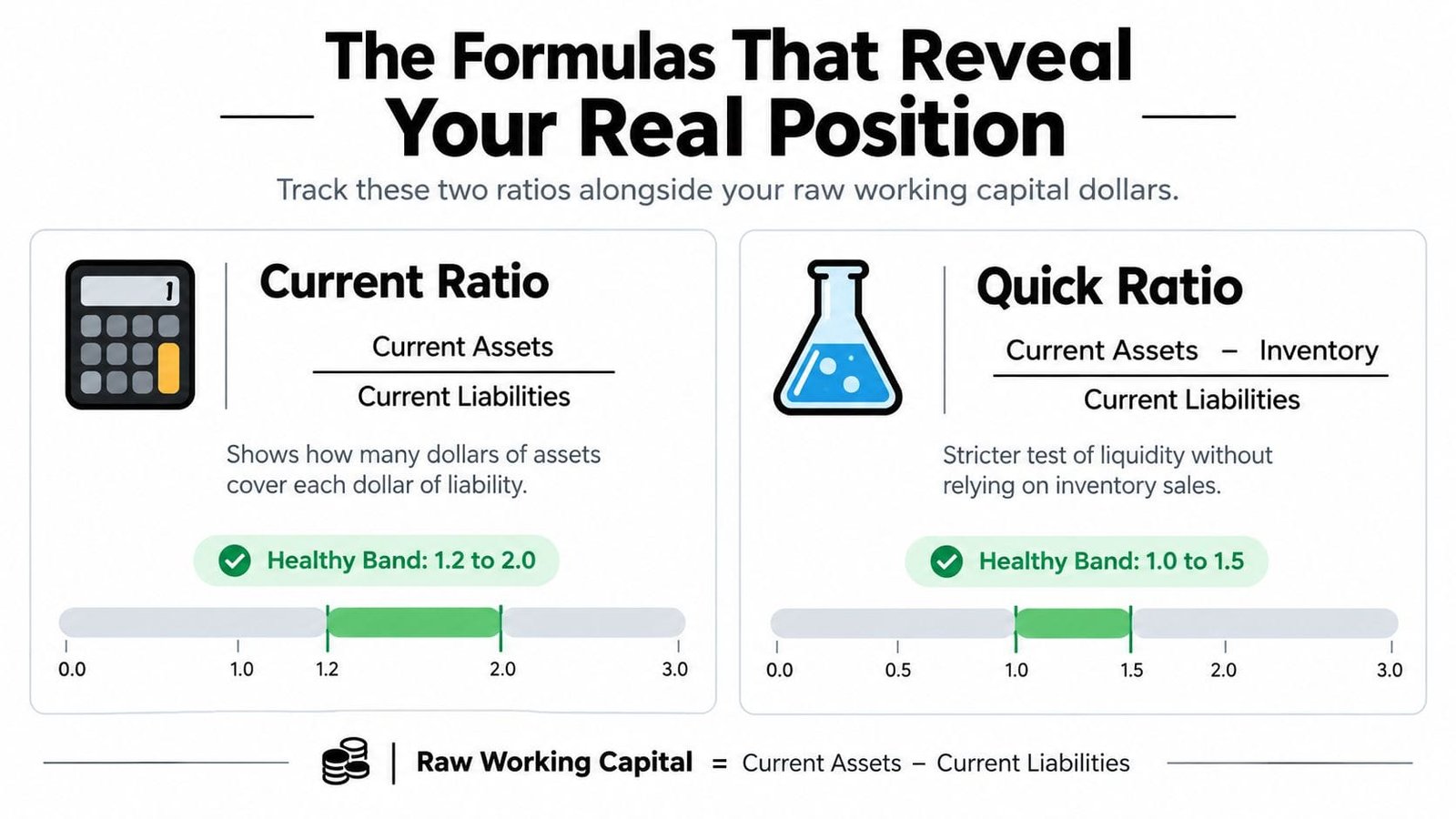
The raw dollar figure gives you a starting point, but ratios make comparisons easier. Two useful measures are the current ratio and the quick ratio.
Current ratio
Current ratio = Current assets ÷ Current liabilities
Using the sample balance sheet, the calculation is:
$120,000 ÷ $75,000 = 1.6
A current ratio of 1.6 means the business has $1.60 of current assets for each dollar of current liabilities. Broad benchmark guidance often places a current ratio around 1.2 to 2.0 as broadly sufficient, although working capital research and ratio guidance emphasize that sector norms can differ.
A ratio below 1.0 can signal that the business lacks enough current assets to cover current liabilities. A much higher ratio may reflect a deliberate liquidity reserve, but it can also point to slow-moving inventory, weak collections, or cash that isn't being used productively. Don't treat the range as a universal pass-or-fail test.
Quick ratio
The quick ratio removes inventory from the calculation because inventory usually has to be sold before it becomes cash:
Quick ratio = (Current assets − Inventory) ÷ Current liabilities
If you also exclude prepaid expenses for a stricter test, the sample produces:
($120,000 − $30,000 − $10,000) ÷ $75,000 = 1.07
That result says the business has about $1.07 in more immediately usable assets for each dollar of current liabilities, without relying on an inventory sale. The quick ratio often matters more to a service firm, where inventory contributes little, or to a product company whose stock turns slowly.
Ratios should be read alongside collection speed, inventory movement, and payment terms. A product business may accept a lower quick ratio if its inventory sells predictably. A consulting firm with little inventory may focus more heavily on receivables. Both measures become more useful when connected to the cash conversion cycle.
Why Working Capital Looks Different in Every Industry
A working capital level that looks conservative for one business may be excessive for another. The right comparison depends on inventory intensity, billing practices, customer payment timing, supplier terms, and cash-conversion speed.
January 2026 sector data for U.S. listed companies excluding financials show median non-cash working capital at 11.62% of revenue, but homebuilding stood at 61.65% of revenue, while seven sectors had negative working capital. The sector working capital data from NYU Stern illustrates why owners should benchmark against businesses with similar operating models, not against a broad market average.
| Industry | Typical Working Capital (% of Revenue) | Cash Position Characteristic |
|---|---|---|
| U.S. listed companies excluding financials | 11.62% | Median non-cash working capital position |
| Homebuilding | 61.65% | Cash tied up in long projects, work in progress, and receivables |
| Negative-working-capital sectors | Negative | Customers or suppliers help finance operations |
A homebuilder may carry substantial work in progress and wait for progress payments. A contractor faces a similar issue when labor and materials are paid before the customer approves a billing milestone. The business may need a larger operating buffer because cash remains trapped for longer.
A grocery retailer operates differently. It may collect customer cash at the register before paying suppliers under agreed terms. Some subscription-style businesses also receive customer payments before delivering the full service. In those models, negative working capital can be an operating advantage, not immediate evidence of distress.
Restaurants sit somewhere else. They purchase perishable inputs, pay staff regularly, and depend on steady daily sales. Excess inventory can spoil, while a sales dip leaves fixed obligations in place. A restaurant owner should study waste, purchasing frequency, and sales volatility rather than copy a homebuilder's balance-sheet target.
Calculate the cash conversion cycle
The cash conversion cycle estimates how long operating cash remains tied up before returning through customer collections:
Cash conversion cycle = DSO + DIO − DPO
- DSO, or days sales outstanding, measures how long customers take to pay.
- DIO, or days inventory outstanding, measures how long inventory or job costs remain tied up before sale or billing.
- DPO, or days payable outstanding, measures how long the business takes to pay suppliers.
Suppose a contractor has:
- DSO of 45 days
- DIO of 60 days
- DPO of 30 days
The calculation is:
45 + 60 − 30 = 75 days
A 75-day cycle means operating cash is tied up for roughly that period before the business recovers it through collections, using the simplified inputs above. Shortening DSO through faster billing, reducing DIO through better purchasing, or extending DPO through negotiated terms can release cash without adding debt.
Seasonality can distort the result. A retailer preparing for a peak selling period may temporarily carry more inventory, while a contractor may show a longer cycle during a heavy project phase. Compare the same period across years and inspect the individual components, rather than reacting to one monthly figure.
Common Working Capital Problems Owners Face
Owners usually don't lose liquidity because of one dramatic decision. The pressure builds through small timing mistakes that affect receivables, inventory, payables, and visibility.
Rising receivables
A customer who pays after agreed terms increases DSO and pushes the cash conversion cycle outward. If several customers make the same choice, revenue can keep rising while the bank balance weakens. Owners should review aging reports by customer, not just the total accounts receivable balance.
Inventory bloat
Overordering before a sales campaign ties up cash in products that may move slowly. Inventory increases current assets on paper, but it doesn't help pay payroll until it sells. DIO rises, storage costs can increase, and markdowns may reduce the eventual cash recovery.
Payables pile-up
Delaying supplier payments can preserve cash temporarily, but it may damage trust, remove favorable terms, or interrupt deliveries. Paying every vendor immediately can create the opposite problem, especially when suppliers would accept reasonable scheduled terms. The useful measure is whether payment timing supports the operating cycle without creating avoidable cost.
Concentration and visibility problems
A single large client can dominate receivables. If that client delays payment, the business may face a liquidity shock even though total sales look strong. Mixing personal and business accounts makes the position harder to read, while ignored accrued expenses cause current liabilities to appear smaller than they really are.
Diagnostic question: Which component changed first, customer payment days, inventory days, or supplier payment days?
Seasonality creates another squeeze. Revenue may dip while rent, payroll, subscriptions, and other fixed commitments continue. A rolling forecast and clean aging reports help separate a temporary timing issue from an operating model that consistently consumes more cash than it releases.
Operational Strategies to Free Up Cash
Borrowing shouldn't be the first response to a problem that better processes can solve. Start with the operating levers that shorten the cash conversion cycle or prevent cash from becoming trapped.
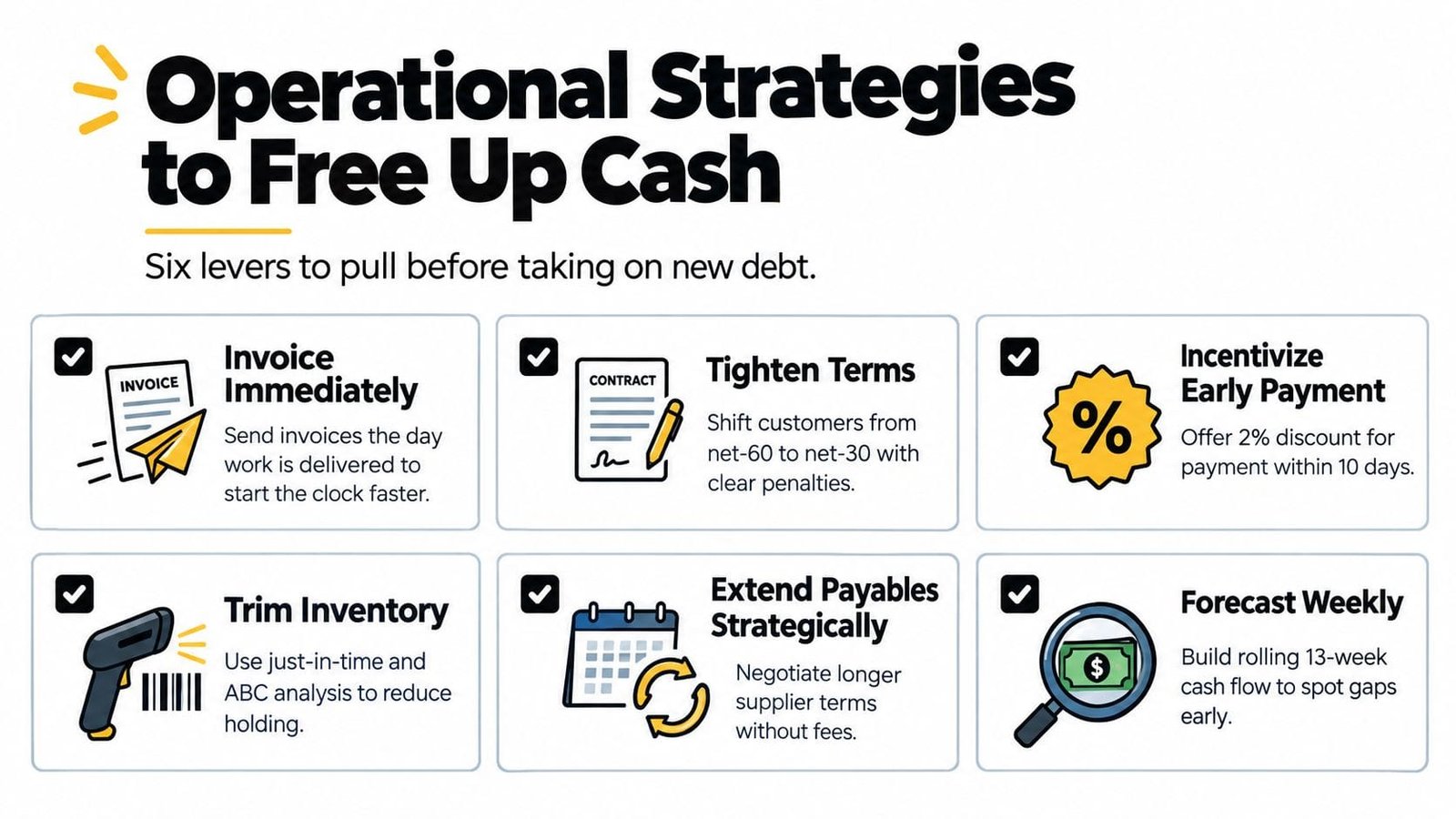
Invoice immediately. Send a complete invoice when the work or delivery is accepted. Clear purchase-order references, delivery records, and payment instructions reduce avoidable disputes.
Tighten customer terms. Move customers from net-60 to net-30 where the relationship and market allow it. Put late-payment consequences in the contract, then apply them consistently.
Create a collection routine. Schedule reminders before and after the due date. A documented process prevents collection from becoming an uncomfortable task owners postpone.
Trim inventory by SKU. Review products monthly using ABC analysis. Stop replenishing dead stock, negotiate smaller minimum orders, and consider consignment or drop-shipping for slow-moving, low-margin items.
Extend payables strategically. Ask suppliers for terms that match your customer collection cycle. Don't surrender an early-payment benefit or damage a key relationship merely to postpone one bill.
Forecast weekly. Update a rolling 13-week cash forecast each Friday, separating committed payments from expected receipts. Align staffing, non-urgent capital purchases, and vendor orders with actual sales velocity.
For companies handling many invoices, an end-to-end AP automation playbook can help organize approvals, payment scheduling, and invoice records. The objective isn't automation for its own sake. It's better visibility into which obligations are due, which can be scheduled, and where manual delays are slowing the process.
Use the cash flow improvement guide to connect these actions to your broader operating plan. Measure each change against DSO, DIO, DPO, and the cash conversion cycle, rather than judging success by one isolated improvement.
Financing Options When Operations Are Not Enough
Sometimes the business has already tightened collections, reduced excess inventory, and negotiated workable supplier terms, yet a timing gap remains. Financing can make sense when the need is identifiable, repayment matches future cash receipts, and the cost is lower than the operational value created.
| Option | Best For | Typical Speed | Cost Range | Repayment |
|---|---|---|---|---|
| Working capital loan | A defined shortfall or seasonal build-up | Depends on lender and underwriting | Interest and fees vary | Scheduled installments |
| Business line of credit | Repeating cash-flow swings | Depends on lender and approval process | Interest and account fees vary | Draw, repay, and reuse within the limit |
| Invoice financing or factoring | B2B receivables with delayed payment | Often faster than traditional term financing | Discount, factor fees, or interest vary | Repaid when invoices are collected |
| Short-term online loan | Genuine urgent liquidity needs | May fund quickly | Often higher cost than longer-term options | Frequent fixed or scheduled payments |
A working capital loan suits a specific amount with a clear use and repayment path. A line of credit fits recurring fluctuations because you draw only when needed, but the available limit can encourage habitual borrowing. Invoice financing addresses a receivables problem directly, while factoring may transfer collection work to a third party and reduce the amount ultimately received.
Compare APR, factor fees, origination charges, collateral, personal guarantees, payment frequency, and early-repayment terms. A fast facility can solve today's payroll problem but create tomorrow's payment burden if the cash conversion cycle remains unchanged.
For a broader overview of funding structures, review this guide to financing working capital. Business Loan Warrior is one platform that helps owners compare funding pathways through a single application and connect financial information for review. Treat any approval as a tool for a defined gap, not as proof that the underlying operating process is healthy.
Your Working Capital Action Plan
Turn the concept into a weekly management routine. Start by pulling the last 12 months of balance sheets, accounts receivable aging, accounts payable aging, inventory reports, and bank activity. Calculate:
- Current ratio, current assets divided by current liabilities.
- Quick ratio, current assets less inventory and prepaid expenses, divided by current liabilities.
- Cash conversion cycle, DSO plus DIO minus DPO.
- Working capital as a percentage of revenue, then compare it with businesses that use a similar model.
Don't set a target from another industry without checking how your business bills, collects, stocks products, and pays suppliers. The sector evidence above shows that working capital needs can vary sharply, so the right benchmark is a starting point for investigation, not a universal answer.
Next, identify the first point where cash becomes trapped. If receivables are aging, improve invoicing and collections. If inventory is growing faster than sales, reduce purchasing and clear slow stock. If supplier payments are too early, negotiate terms that preserve relationships and liquidity.
A simple decision sequence
- Measure the position. Record the ratios and cycle components monthly.
- Diagnose the cause. Name the specific process responsible for the cash gap.
- Test operational fixes. Assign an owner, deadline, and expected cash effect to each action.
- Finance only the remaining gap. Match a loan, line, or receivables facility to the timing and certainty of repayment.
- Review on a set cadence. Recheck the plan after 30, 60, and 90 days, then adjust targets as the business changes.
If financing is necessary, prepare recent bank statements, current receivables and payables aging reports, financial statements, and tax documentation before approaching lenders. A clean package helps the lender understand whether you're financing a temporary bridge or covering a recurring operating deficit.
The most important habit is to return to the operating diagnosis whenever the cycle lengthens, collections weaken, or inventory starts accumulating. Borrowing can bridge timing. It can't repair a business model that continually locks up cash.
Business Loan Warrior helps small-business owners compare funding options for working capital, including business loans, lines of credit, invoice financing, and SBA-related solutions. Review your cash gap, connect the numbers to the right financing structure, and visit Business Loan Warrior to explore your options.