
You're reviewing a quote for a replacement excavator, production line, commercial oven, or server rack. The lender's estimate looks manageable, but the number on the screen only answers one question: what might the scheduled payment be? It doesn't tell you what the asset will cost to install, operate, maintain, insure, finance, and eventually replace.
That distinction matters. An equipment financing calculator is useful, but only when you treat it as a scenario-planning tool, not a funding decision. The right analysis measures cash flow, ownership economics, financing risk, and the asset's cost per year of useful service.
Table of Contents
- Why Basic Payment Estimates Fall Short
- How Equipment Financing Calculators Compute Payments
- Key Inputs for Accurate Financial Estimates
- Comparing Common Equipment Financing Structures
- Real-World Scenarios for Different Business Profiles
- Hidden Costs Most Calculators Miss
- Next Steps to Secure Your Equipment Funding
Why Basic Payment Estimates Fall Short
A business owner recently described a familiar process. The company had chosen a piece of production equipment, received a vendor quote, and entered the purchase price into an online calculator. The result produced a monthly payment that fit the current budget. The owner nearly approved the acquisition until the finance team added installation, operator training, insurance, maintenance, and the expected downtime during the transition.
The payment hadn't changed. The business decision had.
A basic calculator generally uses a few inputs, such as equipment price, down payment, rate, and term. It then estimates principal, interest, and perhaps the total amount repaid. Those figures are useful for comparing financing offers, but they don't describe the asset's full economic effect. A low monthly payment can still accompany a long repayment period, expensive borrowing, weak resale economics, or operating costs that overwhelm the apparent savings.
Practical rule: Never approve equipment because the payment fits. Approve it because the equipment's expected contribution exceeds its complete annual cost.
The broader context explains why this distinction matters. U.S. businesses, nonprofits, and government agencies invested $2.3 trillion in plant, equipment, and software in 2023, and about 57.7%, approximately $1.34 trillion, was financed. Banks represented 59% of financed acquisitions, while captives accounted for 17%, independents 15%, and fintechs 7%, according to the Equipment Leasing and Finance Association industry overview. Financing is normal. Blind financing isn't.
The payment is only one layer
Your first calculator pass should answer practical cash-flow questions:
- Can the business make the payment during a weak sales period?
- Does the repayment schedule match the asset's useful working life?
- What happens if installation takes longer than expected?
- Will the equipment generate enough additional capacity, revenue, or savings to justify the obligation?
- Does the quote include fees that aren't obvious in the headline rate?
You also need to distinguish APR from the interest rate. Those terms can produce different comparisons when fees are included, so review the difference before treating two offers as equivalent. This APR versus interest rate guide is useful when you're normalizing competing quotes.
The calculator should therefore become the starting point for a decision file. Run the base case, then stress the rate, term, down payment, utilization, operating costs, and exit value. If the acquisition only works under optimistic assumptions, it doesn't work yet.
How Equipment Financing Calculators Compute Payments
The interface may look simple, but the result depends on the financing structure behind it. An equipment loan and an equipment lease can show similar monthly obligations while producing different ownership rights, balance-sheet treatment, residual exposure, and end-of-term choices.
Amortizing loan mechanics
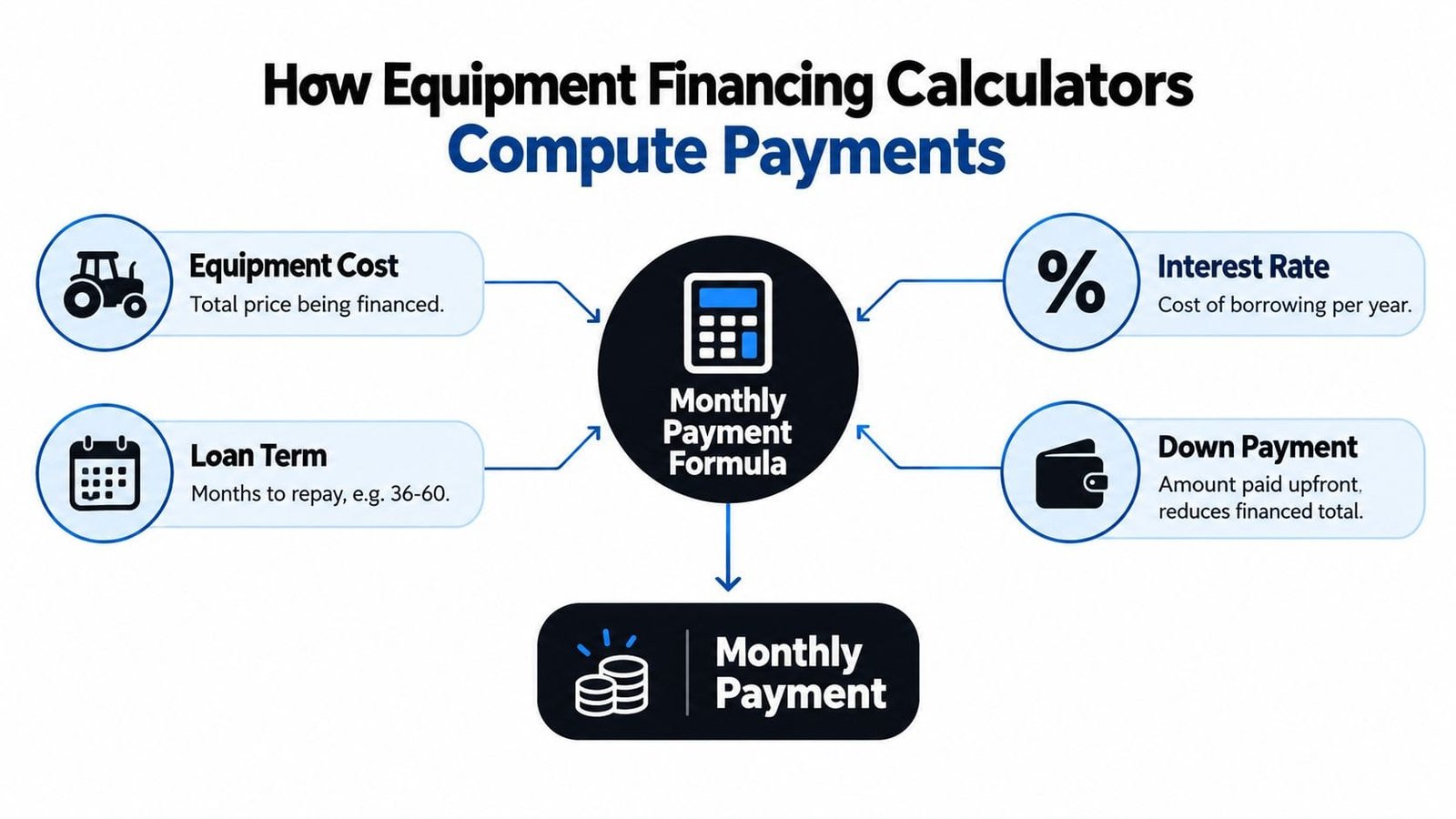
For a conventional equipment loan, start with the amount financed. That usually means the equipment price plus eligible financed costs, less any down payment. The calculator then applies the annual interest rate over the repayment term and produces a scheduled payment.
The payment usually combines principal and interest. Interest is calculated against the outstanding balance, so the interest portion declines as the principal is repaid. Early payments therefore contain a larger interest component, while later payments direct more cash toward reducing the balance.
The standard calculation uses:
- Equipment cost, which establishes the purchase amount.
- Down payment, which reduces the amount borrowed.
- Interest rate or APR, which determines the borrowing cost.
- Term, which determines how long the balance remains outstanding.
- Fees, if the lender adds them to the financed balance.
A longer term generally lowers the scheduled payment because repayment is spread across more periods. It also keeps the business indebted for longer and can increase the total financing cost. A shorter term usually creates more payment pressure but reduces the time during which interest accrues.
For a fuller explanation of how principal and interest shift over time, review this guide to what an amortization period means. The important operating question is whether the equipment will remain productive throughout the repayment schedule.
Lease calculation mechanics
Lease calculations work differently. A lease payment may reflect the equipment's cost, the expected residual value, the lease rate factor or money factor, fees, and the agreement's end-of-term conditions. Instead of paying down the entire purchase price in the same way as a loan, the lessee may be paying for use and for the portion of value consumed during the lease period.
That residual assumption matters. A higher residual can reduce the scheduled payment, but it can also leave the business with an end-of-term obligation or a purchase decision. You need to know whether the agreement provides a purchase option, requires a return, includes a balloon amount, or imposes conditions on equipment wear and use.
Why identical payments can mislead
A 60-month loan and a 60-month lease may produce similar monthly cash outflow, but they aren't economically identical. The loan may leave the business with an owned asset and a remaining balance that declines over time. The lease may preserve flexibility while transferring some residual risk, or it may create a later purchase obligation.
The market's scale reinforces the need to compare structures carefully. In 2023, financed plant, equipment, and software acquisitions represented approximately $1.34 trillion of investment, with banks, captives, independents, and fintechs supplying different forms of capital, as reported by ELFA. Use the calculator to normalize the offers, then read the contract to understand what the payment buys.
Key Inputs for Accurate Financial Estimates
A calculator is only as reliable as its inputs. The most common mistake is accepting the default rate, default term, or equipment price before verifying the commercial quote and the lender's actual assumptions.
Start with the total acquisition cost, not just the sticker price. Ask the vendor for a written quote that separates the equipment, freight, installation, configuration, training, taxes, warranties, and service commitments. Decide which of those costs belong in the financing request and which should remain in working capital.
Build a defensible input set
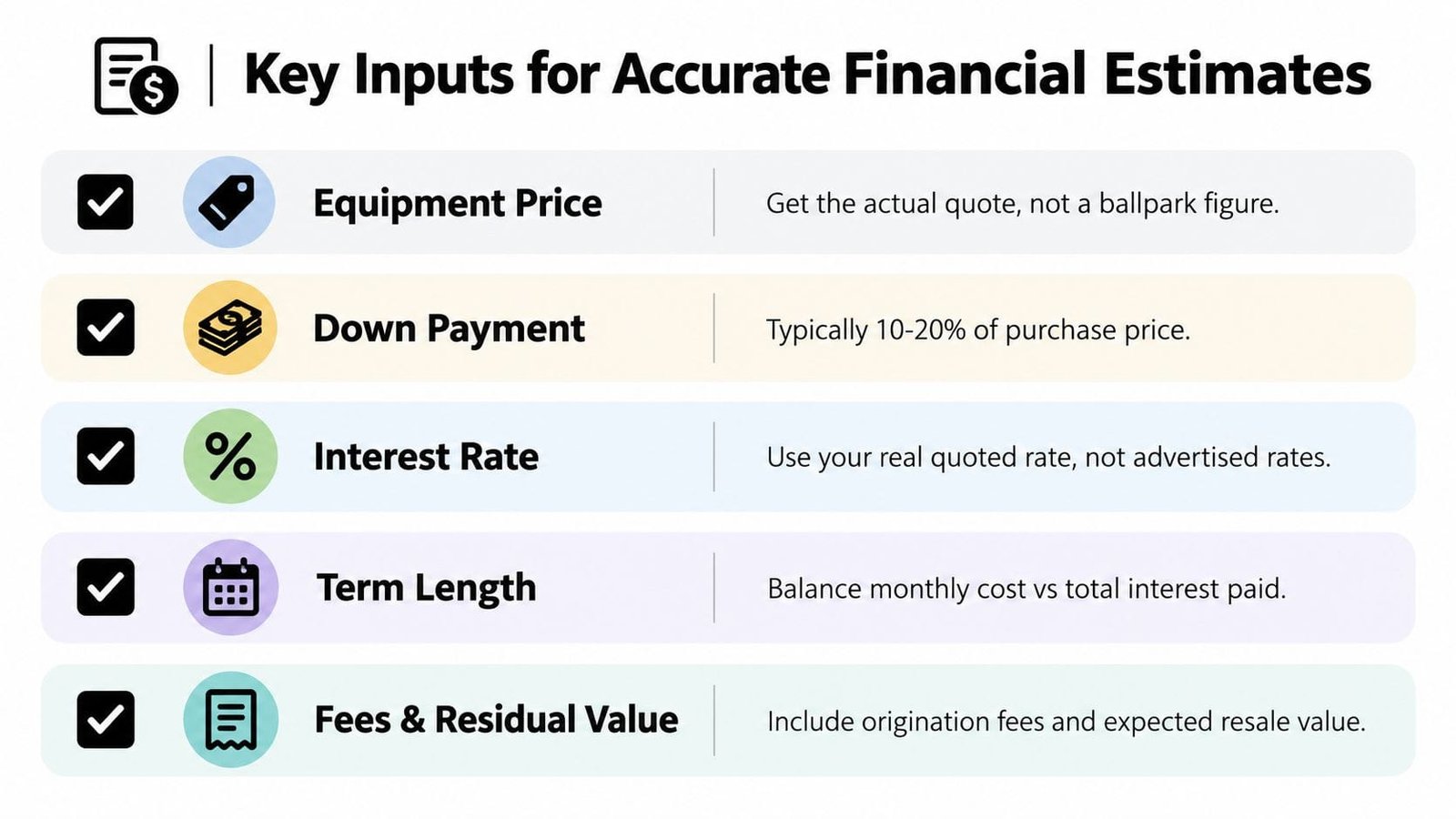
Use these fields deliberately:
- Equipment price: Enter the actual vendor quote. A ballpark figure produces a ballpark payment.
- Down payment: Model the cash contribution separately from working capital. More cash reduces the financed balance, but it can weaken liquidity if the business needs funds for payroll, inventory, or launch costs.
- Interest rate: Use a realistic quoted rate or a clearly labeled range. Don't use an advertised best-case rate as the base case.
- Term length: Match the repayment period to the asset's productive life and expected resale market. A long term should not just disguise an unaffordable acquisition.
- Fees and residual value: Include origination charges, documentation fees, broker fees, and any expected residual or resale value in the comparison.
Eligibility and pricing aren't determined by the calculator. They depend on the borrower's credit profile, time in business, financial performance, collateral quality, and the equipment itself. Rates generally vary with credit, time in business, and asset type, while newer equipment and stronger credit commonly receive the lowest pricing, as described in this equipment loan calculator discussion.
Stress-test the result
Run at least three scenarios, even if the calculator only offers one output:
- Base case: Your best evidence-based rate, quote, term, and expected use.
- Conservative case: A higher rate, delayed installation, lower utilization, or higher operating expense.
- Exit case: The result if the equipment is sold, traded, refinanced, or replaced before the scheduled maturity.
Don't report the outputs as predictions. Label them as planning assumptions. A calculator estimate is not an approval, and a lender can change the final offer after reviewing financial statements, tax returns, collateral, and the vendor documentation.
For leases, add the residual assumption and confirm who carries the risk if the equipment is worth less than expected. A payment that looks attractive because of an aggressive residual may be less attractive once you account for the end-of-term choice.
Comparing Common Equipment Financing Structures
Choose the structure by expected years of use, obsolescence risk, ownership goals, and balance-sheet capacity. A lower payment does not automatically mean a lower cost. Normalize every offer to total expected cash outflow, the asset's remaining value, and the cost per year of productive use.
| Feature | Equipment Term Loan | Capital Lease | Operating Lease |
|---|---|---|---|
| Primary purpose | Finance an asset the business expects to own and use | Finance use with ownership-like economics | Use equipment while preserving replacement flexibility |
| Payment design | Principal and interest amortize over the term | Payments reflect financed use and contract terms | Payments reflect the right to use the asset for the lease period |
| Ownership outcome | Business generally owns the equipment after repayment | Business may purchase or obtain ownership under the agreement | Equipment is generally returned or replaced, subject to contract terms |
| Residual risk | Owner carries resale and obsolescence risk | Depends on purchase option and contract structure | Often shared or transferred through return conditions |
| Best fit | Durable equipment with lasting productive value | Assets the business may ultimately retain | Technology or assets likely to become outdated quickly |
| Tax treatment | Interest may be deductible, and the asset may qualify for depreciation or Section 179 expensing | Treatment often follows ownership, so depreciation and interest rules may apply | Payments are frequently treated as operating expense |
| End-of-term choice | Continue using, sell, trade, or refinance | Purchase, return, or follow the contract's option | Return, renew, or replace according to the lease |
Your accountant must confirm tax treatment for the specific agreement, business structure, and equipment. Calculator labels are not tax advice.
Term loans build ownership
A term loan fits equipment with a long working life, a credible resale market, and a direct link to revenue or capacity. Construction machinery, manufacturing systems, and specialized commercial equipment can support this choice when the business expects to keep them productive for years.
The trade-off is concentrated ownership risk. The business remains responsible for maintenance, insurance, utilization, resale timing, and obsolescence. If the asset loses value faster than the loan balance declines, a sale may not repay the debt in full.
Model the asset's annual economic cost, not only the scheduled payment. Include the expected holding period and an informed estimate of resale value. A loan can produce the lowest long-run cost when the equipment stays productive, yet still strain cash flow during a slow ramp-up.
Capital leases split the difference
A capital lease, often called a finance lease, can resemble an acquisition financed through scheduled payments. The agreement may include a bargain purchase option, a fixed purchase option, or another route to ownership. Review the end-of-term language carefully, because the monthly payment does not show the final obligation.
This structure suits an asset the business expects to retain while using lease documentation. Compare the purchase option, remaining payments, and expected asset value at the decision point. The right choice depends on whether keeping the equipment creates more value than returning it and replacing it.
Operating leases prioritize flexibility
An operating lease suits equipment that changes quickly or loses value through technological obsolescence. It can help the business replace assets without committing to ownership, but usage limits, condition standards, insurance duties, and return requirements can raise the actual cost.
For location-based assets, the same ownership question applies beyond traditional machinery. This comparison of leasing versus buying mobile offices helps operators assess purchase price, use period, relocation needs, and residual value before choosing a structure.
Compare total expected cash outflow, remaining asset value, and productive years of use. The lowest monthly figure is only one input.
Real-World Scenarios for Different Business Profiles
A calculator becomes useful when the inputs reflect how the business operates. The same equipment price can justify different structures for a restaurant, a contractor, and a technology-led agency because each business faces a different utilization pattern, replacement cycle, and resale market.

A growing restaurant chain
A restaurant adding a location may need ovens, refrigeration, prep stations, point-of-sale hardware, and installation work. The owner shouldn't enter only the equipment invoice. The model should include freight, electrical work, plumbing, ventilation, commissioning, staff training, and the working capital required before the new location reaches normal operations.
A term loan or finance lease may fit durable kitchen assets that will remain useful across locations. The owner should test a shorter repayment period against a longer option, then compare the payment with the new location's conservative cash contribution. If the business needs to preserve liquidity for inventory and payroll, a larger down payment may be counterproductive even if it reduces interest.
The key question is operational: does the equipment create enough dependable capacity to cover debt service and its running costs during the ramp-up period?
A scaling construction firm
A contractor buying excavators, loaders, cranes, or other heavy equipment should focus on utilization, maintenance, transport, and resale. The calculator should use the full delivered and commissioned cost, then layer in insurance, servicing, attachments, storage, and periods when the asset may sit idle.
A term loan often fits equipment with a durable secondary market and a long productive life. The business builds equity as principal declines, but it also accepts residual risk. Model the asset's likely trade-in or sale value conservatively and compare that value with the remaining balance at the intended replacement date.
The contractor should also test whether the asset will be used across multiple jobs or depends on one contract. Financing a machine against uncertain utilization creates a fixed obligation without fixed revenue.
A technology-heavy marketing agency
An agency investing in servers, workstations, editing systems, or specialized production technology faces a different risk. The equipment may remain functional while becoming commercially outdated. A lease can make sense when predictable replacement and flexibility matter more than eventual ownership.
The model should include support, upgrades, cybersecurity requirements, energy use, and end-of-term return conditions. Compare the lease with a loan that leaves the agency responsible for resale and replacement. If the technology cycle is short, ownership may produce a low payment but an expensive disposal problem.
The right structure follows the asset's economics. Durable equipment with stable resale value can reward ownership. Fast-changing technology often rewards flexibility.
Hidden Costs Most Calculators Miss
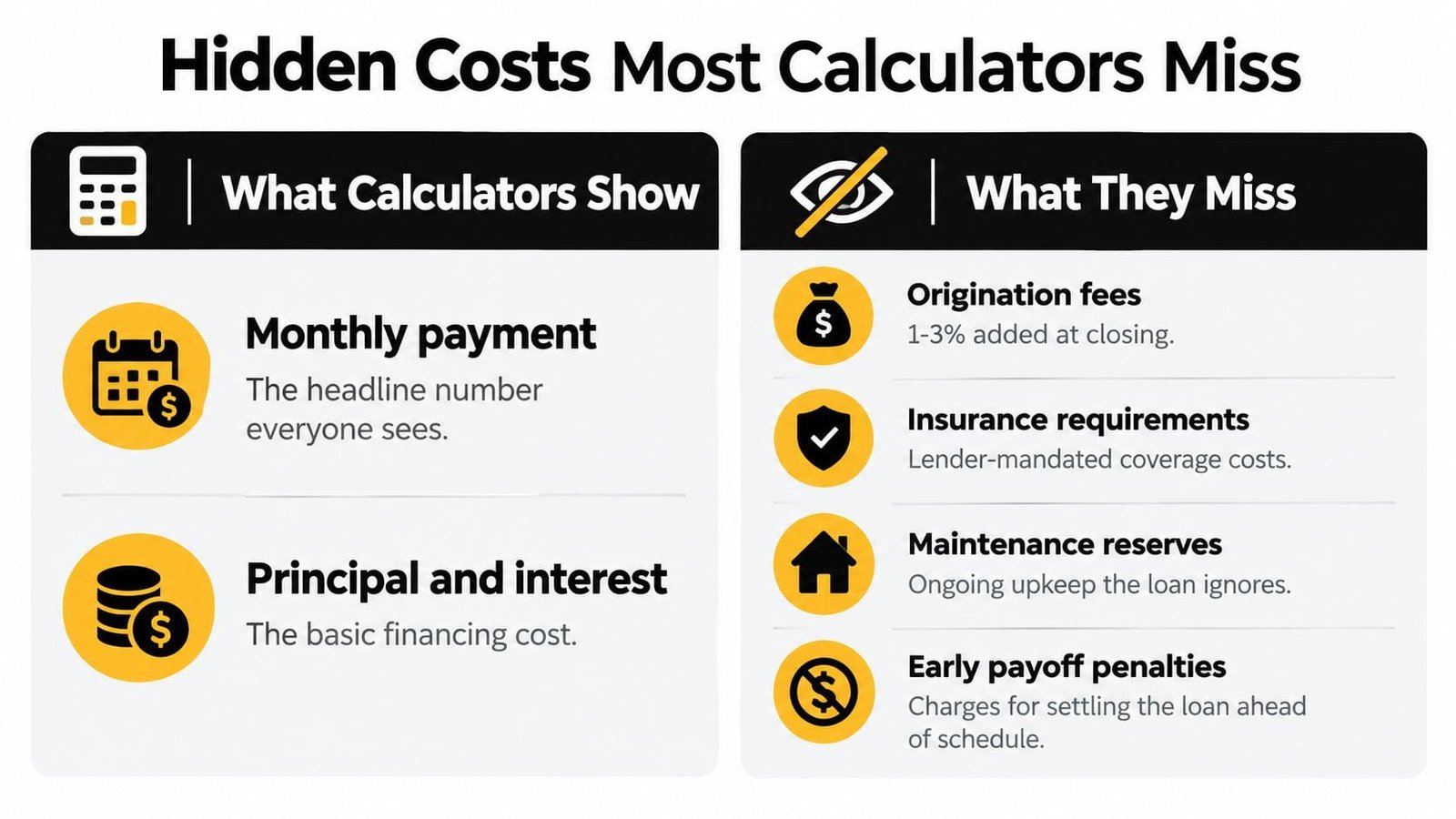
The most misleading number on a calculator is often the final total. It may include scheduled principal and interest while excluding the costs that determine whether the equipment improves the business.
Many calculators focus on monthly payment, total interest, and total repayment, but don't clearly model depreciation, residual value, trade-in value, installation, service contracts, and consumables, as explained in this equipment financing calculator guide. That omission is material when you compare ownership with leasing or compare two vendors offering different support packages.
Create a second cost model
Keep the financing calculator's debt-service output, then add an operating-cost schedule. Use monthly or annual estimates that you can support with vendor quotes, service histories, insurance proposals, and internal operating assumptions.
Include:
- Installation and commissioning: Freight, site preparation, electrical work, construction, configuration, and testing.
- Maintenance and repairs: Preventive service, replacement parts, labor, inspections, and maintenance reserves.
- Consumables: Fuel, filters, tooling, cartridges, chemicals, materials, and other inputs required to produce output.
- Insurance and compliance: Required coverage, inspections, certifications, permits, and safety work.
- Labor and training: Operator onboarding, specialist support, productivity loss during the transition, and overtime.
- Residual economics: Expected resale, trade-in value, disposal cost, lease return charges, and any remaining payoff.
Then divide the total expected ownership or lease cost by the useful years of operation, or by a meaningful operating unit such as billable hours, production units, or completed jobs. That produces a more useful measure: true cost per year of use or cost per unit of capacity.
A small-business owner should also understand the full borrowing burden beyond the displayed payment. This guide to calculating the real cost of a business loan provides a practical way to organize those financing costs.
Decision test: If two options have similar payments, choose the one with the stronger utilization, support, resale, and replacement economics.
The cheapest-to-finance equipment may be expensive to operate. Conversely, a higher payment can be rational if the asset delivers dependable capacity, lower maintenance, better resale, or a longer useful life. Your spreadsheet should make those trade-offs visible before you sign.
Next Steps to Secure Your Equipment Funding
A credible calculator result should lead to a lender-ready file, not a rushed application. Start by collecting the actual equipment quote, vendor contact details, delivery schedule, installation scope, and any warranty or service documents. Underwriters need to understand what the asset is, what it costs, and how the business will use it.
Prepare the financial evidence that supports repayment:
- Recent business financial statements
- Business tax returns
- Current balance sheet and debt schedule
- Bank statements or other cash-flow records
- A short explanation of the acquisition's expected operational impact
- Information about existing equipment, collateral, and ownership obligations
Use your model to explain the decision in business terms. Show the requested amount, down payment, selected term, expected monthly obligation, conservative revenue or savings contribution, operating costs, and exit plan. If the asset replaces an older machine, identify what happens to the old equipment and whether its sale proceeds reduce the funding need.
Pricing and eligibility can change after underwriting, so submit the assumptions that matter rather than presenting one optimistic calculator output. A clean package helps the lender evaluate the request against actual business capacity.
Don't let a headline payment make the decision for you. Compare the financing structure, complete ownership cost, operating contribution, and residual exposure, then move forward only when the asset strengthens the company's cash-flow position.
Business Loan Warrior offers equipment and construction financing through a single, no-fee application, with pre-approval checks that don't affect your credit and tools for connecting accounts and tracking progress. Visit Business Loan Warrior to turn your equipment financing calculator results into a customized funding request.