

A contractor can have a healthy backlog, profitable jobs, and signed contracts, yet still feel short of cash every Friday. The problem usually isn't the work. It's the timing. Crews need wages, suppliers expect payment, and subcontractors can't wait for a general contractor's approval process to finish while an invoice sits in accounts receivable.
That gap becomes harder to manage as projects grow. Progress billings, retainage, change orders, lien waivers, and joint-check arrangements can delay usable cash long after the work has been completed. Invoice factoring for contractors is designed to address that timing problem by converting eligible receivables into working capital before the project owner or general contractor pays.
Table of Contents
- The Construction Cash Flow Trap
- How Construction Factoring Actually Works
- Breaking Down the Real Cost of Speed
- Factoring Versus Alternative Funding Options
- Qualifying Criteria and Debtor Credit Quality
- The Step-by-Step Application and Funding Process
- When to Use Factoring and When to Walk Away
The Construction Cash Flow Trap
A specialty contractor finishes a certified phase of work on a commercial project. The payment application is submitted, the general contractor accepts the billing, and the invoice enters a long approval queue. The contractor's payroll is due Friday, the material supplier wants payment, and the next project requires mobilization cash. The receivable is real, but it isn't liquid yet.
That is the trap. Construction companies often spend cash before they collect revenue. They pay labor, fuel, materials, insurance, equipment costs, and subcontractors while waiting through progress-billing approvals and customer payment cycles. A project can look profitable on the job-cost report while the operating account remains uncomfortably thin.
Practical rule: Treat profit and liquidity as separate measurements. A profitable job can still create a cash emergency if billing and collection dates don't match expense dates.
Construction payment delays are especially difficult because the invoice may not represent a simple completed sale. The factor may need to review the contract, schedule of values, approved payment application, lien waivers, change orders, backcharges, and the general contractor's payment history. A disputed line item can affect the amount that is financeable.
Invoice factoring offers a bridge. The contractor assigns or sells an eligible receivable to a factoring company, which provides an advance before the account debtor pays. The factor then collects the receivable, deducts its fee, and releases the remaining reserve according to the agreement. This isn't the same as taking out a conventional term loan for general use. The transaction is tied to money the contractor has already earned and billed.
That distinction matters for a growing firm that hasn't built the balance sheet, collateral base, or borrowing history a bank expects. Industry data describes factoring as a major global financing channel, with construction among its most common user sectors. The same industry summary reports that 75% of U.S. factoring clients operate in construction, manufacturing, or transportation, while another finding places 82% of U.S. clients among small and medium-sized businesses with fewer than 50 employees. These figures are reported in the invoice factoring industry overview.
A bank line may still be the cheaper long-term tool once the contractor qualifies. It often doesn't solve an urgent receivables timing problem, though, particularly when approval depends on historical statements, collateral, or personal guarantees. Contractors assessing broader options can also review this guide to construction financing for contractors, then compare the cost of capital with the cost of missing payroll, delaying a project, or turning down work.
For a broader operating framework, EndureGo Tax's resource on working capital management is useful because factoring should sit inside a cash-planning process, not replace one.
How Construction Factoring Actually Works
Construction factoring starts with an eligible receivable, but the factor doesn't treat every invoice as equally financeable. A certified progress billing owed by a strong general contractor is usually easier to underwrite than a final invoice containing unresolved change orders, pending punch-list work, or a large retained portion.
Start with the non-retained billing
For contractors, the typical structure advances about 70% to 85% of an approved progress billing, with the remaining amount held in reserve. The exact advance depends on the debtor, documentation, contract terms, dispute exposure, and the factor's construction experience. Details on this structure and the treatment of retainage are outlined by Bay Street Lending's construction factoring guidance.
Retainage changes the calculation. Construction contracts commonly withhold 5% to 10% of each certified billing until substantial completion, as described in the same source. Since retained money may not yet be due, the factor generally finances the non-retained portion rather than treating the full face value as immediately collectible.
Consider the flow without assigning an invented invoice amount:
- You complete a documented phase of work.
- You submit the payment application and supporting paperwork.
- The factor verifies the billing with the general contractor or owner.
- The factor advances the agreed percentage of the eligible, non-retained amount.
- The account debtor pays according to the assigned payment instructions.
- The factor deducts its fee and releases the remaining reserve, subject to the agreement.
Documentation controls the advance
A schedule of values gives the factor a way to connect the billing to the contracted scope. Approved pay applications, signed change orders, lien waivers, delivery records, and inspection approvals help show that the receivable is earned and enforceable. Missing documentation doesn't always make an invoice impossible to factor, but it can slow verification or reduce the amount available.
Joint-check agreements require special attention. If the general contractor issues payment jointly to the contractor and a supplier, the factor must understand who controls the payment and whether the check can be deposited under the assignment arrangement. Lien waiver coordination can create a similar issue. A factor may require waivers, notices, or payment instructions to be handled in a specific order.
The strongest construction factoring process connects the billing file, payment rights, debtor quality, and cash-advance calculation before money moves. A factor that understands draw schedules and retainage will ask better questions upfront, which is usually preferable to discovering a funding problem after a payroll deadline.
Breaking Down the Real Cost of Speed
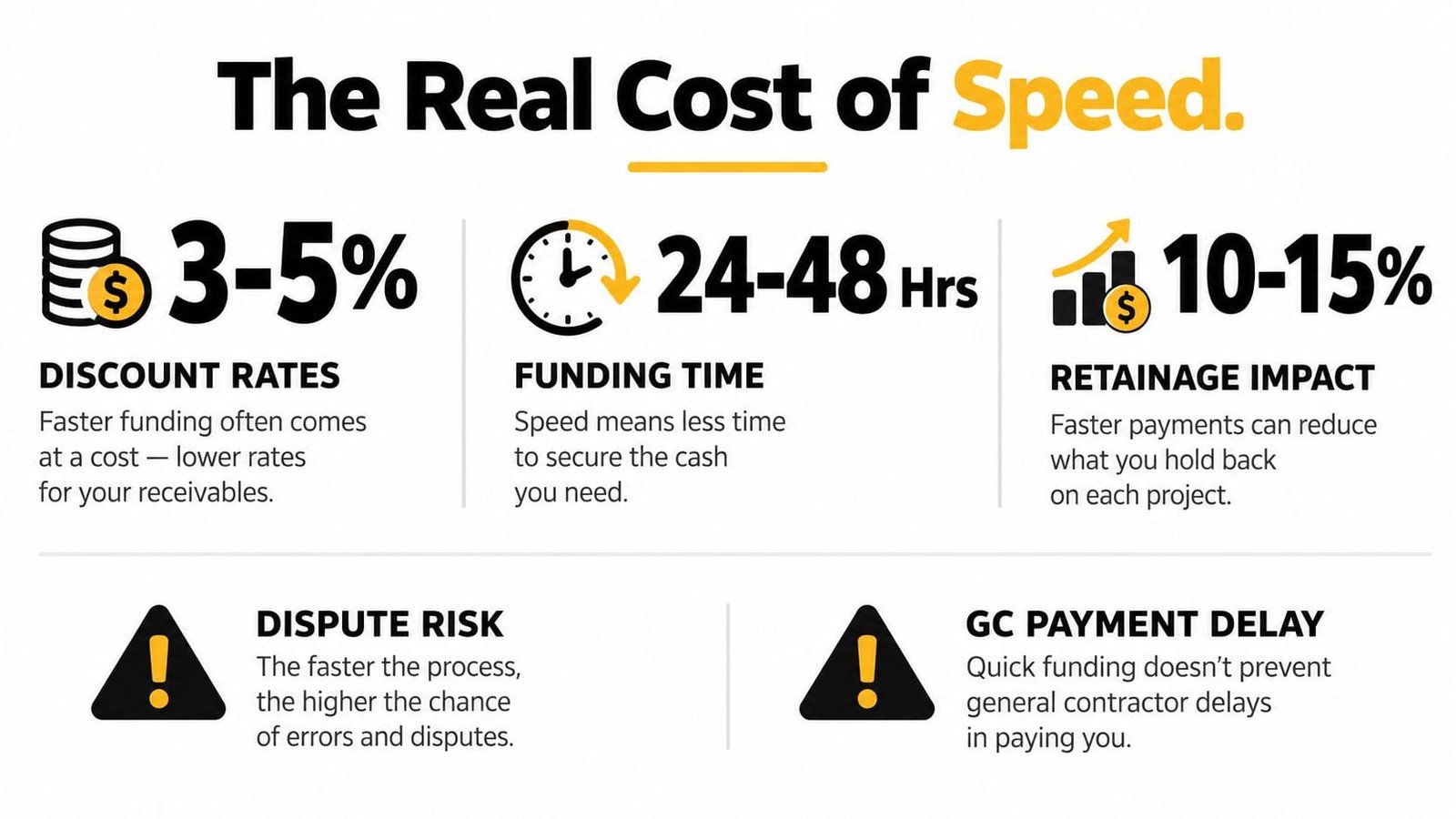
Factoring buys time, and time has a price. Contractor factoring usually costs more than uncomplicated commercial factoring because construction receivables carry added exposure to retainage, disputed work, backcharges, approval delays, and changing payment schedules.
The common fee range is roughly 1% to 5% of invoice value, depending on invoice size, debtor credit quality, and contract conditions. That range is documented in construction factoring cost guidance for contractors. Strong commercial accounts may receive pricing near the lower end, while smaller or riskier contractor books can fall closer to the higher end.
Calculate the cost against the collection period
The headline fee doesn't tell you the complete cost unless you connect it to time. A fee charged for a short, predictable payment cycle is different from the same fee applied repeatedly while an invoice remains unpaid through additional billing periods.
Use this calculation before signing:
- Eligible receivable: Determine which portion of the billing is financeable after retainage and exclusions.
- Advance amount: Multiply the eligible balance by the agreed advance rate.
- Factoring fee: Apply the fee to the invoice value or the funded amount, depending on the contract.
- Reserve timing: Find out when the reserve is released and what conditions can delay it.
- Additional charges: Ask about setup, minimum-volume, wire, audit, renewal, and termination charges.
- Dispute treatment: Confirm whether a disputed invoice becomes a repurchase obligation under recourse terms.
A 2% to 5% fee for a 30-day cycle can become expensive when the customer takes 60 or 90 days to pay, particularly if the agreement applies another charge for the extended period. The practical annualized cost can look much higher than the original percentage. That's why a contractor should evaluate the expected collection date, not just the advertised rate.
Speed is valuable only when the cash produces more value than the fee consumes.
The right question isn't whether factoring is expensive in isolation. Ask what the cash prevents or enables. It may protect payroll, keep a crew mobilized, allow a material purchase on better terms, or support a new contract that would otherwise be delayed. It may also merely cover a recurring deficit caused by underpriced work or chronically slow customers. Those are very different uses.
This overview of invoice factoring rates can help contractors build a rate-comparison checklist, but the contract's full fee schedule and reserve rules matter more than a single promotional percentage.
Use factoring as a short-term working-capital instrument, not as a substitute for job costing, collection discipline, or realistic payment terms. If every project needs factoring for its entire life, the financing cost may be masking a margin or contract problem that needs to be corrected at the source.
Factoring Versus Alternative Funding Options
No single funding product fits every construction cash cycle. A contractor waiting for a certified progress billing needs a different tool from a company buying a vehicle, funding a long mobilization period, or covering a seasonal dip.
| Funding Type | Speed to Cash | Primary Requirement | Best Use Case |
|---|---|---|---|
| Construction invoice factoring | Fast after verification | Eligible receivables owed by a creditworthy debtor | Bridging approved billings before customer payment |
| Business line of credit | Slower approval, then reusable access | Strong financial history and acceptable credit profile | Recurring cash gaps after the business qualifies |
| Invoice financing | Depends on underwriting and documentation | Receivables pledged as collateral | Retaining more control while borrowing against invoices |
| Term or working-capital loan | Varies by lender and file | Repayment capacity and underwriting support | A defined one-time operating or expansion need |
| Equipment financing | Tied to the purchase process | Financeable equipment and repayment capacity | Vehicles, machinery, and tools rather than payroll |
Factoring and invoice financing aren't identical
Factoring generally involves selling the receivable to the factor. Invoice financing usually means pledging the receivable as collateral for a loan. That distinction affects who collects, how the transaction is recorded, how the customer is notified, and what happens if payment is late or disputed.
A line of credit can be cheaper when the contractor has strong financials and needs a revolving reserve. It also creates debt and may involve collateral or personal guarantees. Factoring can be more accessible when the contractor's own credit profile is less persuasive but the general contractor or owner is financially sound. The trade-off is the transaction fee and the possibility that customer communication becomes part of the process.
Match the product to the problem
Choose factoring when the cash gap is directly tied to approved receivables and the debtor has a reliable payment capacity. Choose a line when the business needs flexible liquidity across expenses that aren't connected to a specific invoice. Consider invoice financing when preserving the borrowing structure and collection relationship matters more than the speed or simplicity of a receivables sale.
For a wider comparison of short-term products, these buy-and-hold lender insights offer useful context on how financing choices can serve different time horizons. Contractors can also compare factoring with other quick-capital products in this unsecured funding comparison.
Don't choose based only on the advance percentage. Review the effective cost, reserve release rules, recourse exposure, customer-notification requirements, and whether the facility fits the way the company bills.
Qualifying Criteria and Debtor Credit Quality
The factor is primarily evaluating the party that owes the money. That makes debtor quality central to construction factoring. A contractor with imperfect business credit may still qualify when the receivable comes from a public entity or an established, financially strong general contractor. A contractor with excellent internal records may struggle if the invoice is owed by an unproven developer or a homeowner with no reliable commercial payment history.
Read the receivable, not just the backlog
A backlog report shows potential revenue. It doesn't prove that a factor can fund the work today. Start with the accounts receivable aging report and separate invoices into practical categories:
- Approved and undisputed: These are the strongest candidates because the debtor has acknowledged the billing.
- Submitted but pending approval: These may require further verification and may not receive the same advance treatment.
- Subject to retainage: Only the eligible non-retained portion may be financeable.
- Affected by change orders or backcharges: These require evidence that the disputed items are resolved.
- Past due with a payment explanation: The factor will want to know whether the delay is administrative or signals a deeper credit problem.
- Owed by a weak or unfamiliar debtor: The invoice may be legally valid but commercially unsuitable for factoring.
Project documentation can improve the file, but it can't fully compensate for a questionable account debtor. Public projects and large investment-grade general contractors often support stronger pricing and advance terms because the payment risk is easier to assess. Smaller residential customers and unproven developers can create more uncertainty around payment, disputes, and collection authority.
Check assignment restrictions
Review the prime contract and subcontract for clauses that restrict assignment of receivables. Existing bank liens can also affect the transaction if they cover accounts receivable. A contractor should resolve those conflicts before submitting invoices, because the factor needs a clear right to collect or control the assigned receivable.
The best application package tells a coherent story. It identifies who owes the money, what work was completed, which amount is retained, what approvals exist, and what could still reduce the billing. Transparency helps the factor price the actual risk instead of discovering surprises during verification.
The Step-by-Step Application and Funding Process
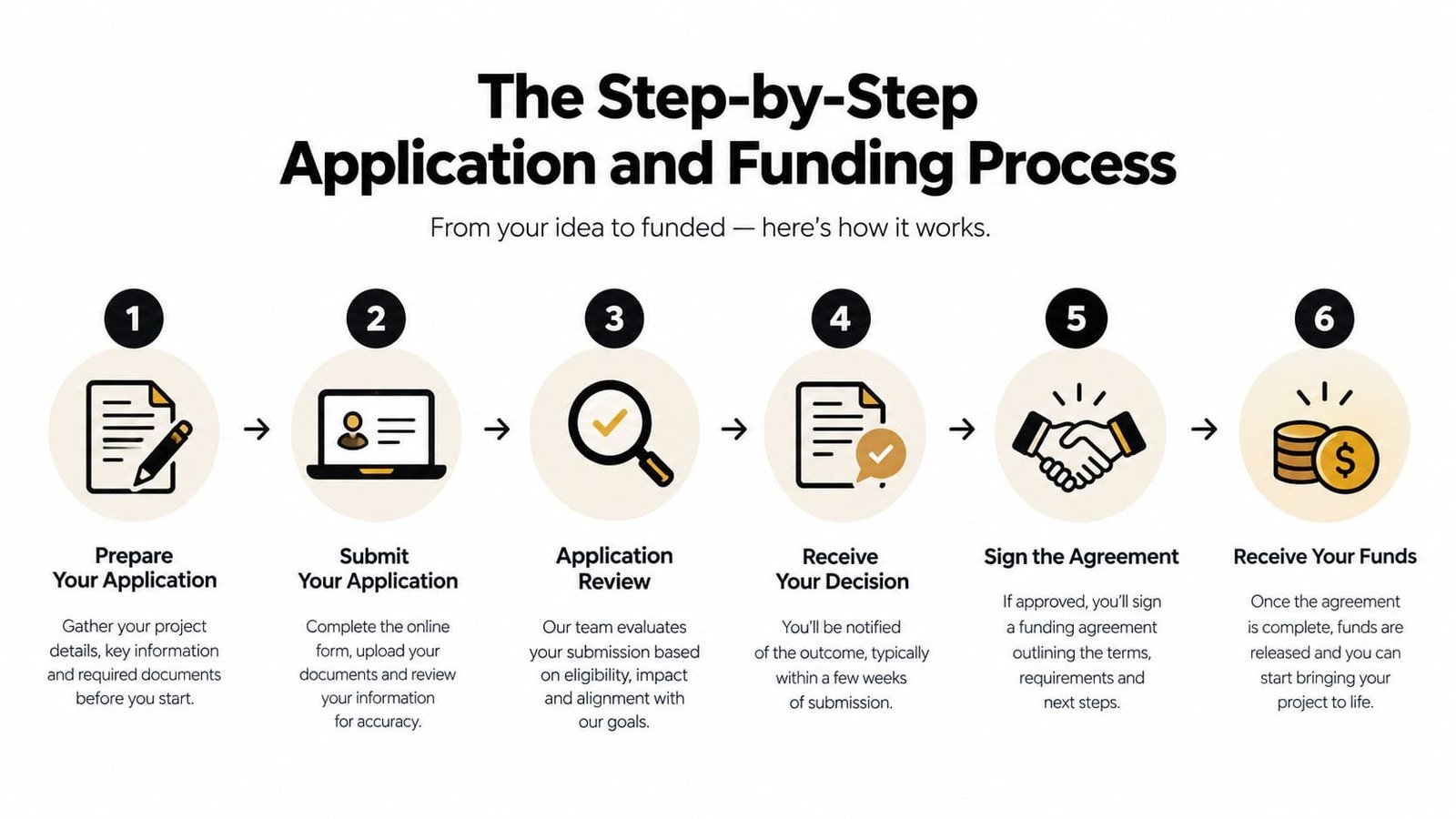
A prepared contractor can make the application much easier by assembling the construction file before contacting a factor. The goal isn't to present every document the company has. It's to show that the receivables are earned, documented, assignable, and likely to be paid.
Assemble the billing file
Start with the accounts receivable aging report, open invoices, underlying contracts, schedules of values, approved payment applications, and recent project correspondence. Add lien waivers, change-order approvals, inspection records, delivery confirmations, and any joint-check agreement that affects payment.
The factor may also request business formation documents, bank information, and evidence of ownership. If another lender has a blanket lien over receivables, provide the relevant payoff, subordination, or intercreditor information rather than waiting for the issue to surface later.
Expect debtor verification
After reviewing the contractor's file, the factor verifies the receivable with the general contractor or project owner. That call or written confirmation may address the invoice amount, work completion, approval status, payment terms, retainage, open disputes, and payment instructions.
Weak documentation gets exposed here. A payment application that the contractor considers approved may still be pending a formal review. A change order included in the invoice may not have been signed. A joint-check arrangement may require the factor to coordinate with another payee before funding.
Funding follows the setup
Once the facility is established and an invoice passes verification, the contractor submits the funding request under the agreed process. Ongoing funding can arrive within 24 to 48 hours after setup, according to the market research summary on invoice factoring market developments. The initial setup can take longer because the factor must underwrite the business, debtor, contracts, and payment controls.
Before signing, confirm the advance calculation, reserve release, fee trigger, recourse terms, notification language, minimum volume, termination rights, and treatment of disputes. Ask who communicates with the general contractor and whether the contractor remains responsible for collection activity.
A reliable process is boring in the best sense. The same documents are uploaded consistently, the factor knows the project contacts, and approved billings move through verification without repeated clarification.
When to Use Factoring and When to Walk Away
Factoring works best when a contractor has a temporary timing problem attached to a sound receivable. The customer is credible, the work is complete, the billing is approved, and the cash will support a clear operating purpose. In that situation, paying a fee can be rational if it protects the crew, keeps procurement moving, or lets the company accept work that fits its capabilities.
It becomes dangerous when the contractor uses it to finance invoices that are routinely disputed or consistently paid far beyond the expected cycle. Fees can accumulate while the reserve remains unavailable, and recourse terms may return the unpaid invoice to the contractor. A slow-paying customer can turn a short-term bridge into a permanent deduction from job profit.
Use a simple go or no-go test
Proceed only when the answer to most of these questions is clear:
- Is the account debtor financially credible and familiar to the factor?
- Has the work been completed and properly documented?
- Is the billing approved or readily verifiable?
- Does the fee fit the gross margin and expected collection period?
- Will the advance support a specific operational or growth objective?
- Do the payment instructions work with lien waivers and joint-check requirements?
- Can the business absorb a reserve delay or disputed-invoice obligation?
Walk away, renegotiate, or seek another product when the invoice depends on unresolved change orders, the customer disputes the work, or the funding would only cover recurring losses. Better contract terms, milestone billing, deposits, a draw-based facility, or a line of credit may solve the underlying problem more effectively.
The strongest contractors use factoring selectively. They factor clean receivables, monitor debtor concentration, forecast reserve releases, and measure the fee against the contribution margin of each job. They don't confuse fast cash with cheap cash, and they don't let a financing facility replace disciplined billing and collection.
Business Loan Warrior offers invoice factoring, invoice financing, construction loans, lines of credit, and other business funding options through a single application process. Review the available funding paths and compare the structure against your receivables, project schedule, and cash-flow needs by visiting Business Loan Warrior.