
A customer has placed a large order, but your current machine can't produce it on schedule. You could pay cash for an upgrade, yet that would leave less money for payroll, inventory, repairs, and the ordinary surprises that keep a business moving. The opportunity is real, but the timing creates a familiar growth wall.
Equipment financing for small businesses helps solve that tension by spreading the cost of a productive asset over time. Instead of treating the purchase as a single drain on cash, you match payments with the equipment's expected use and the revenue it helps generate. The right structure won't remove risk, but it can preserve liquidity while giving your company the tools to accept more work.
Table of Contents
- Why Equipment Finance Matters for Growth
- Loans, Leases, and Lines of Credit
- The SBA Advantage for Equipment Buyers
- Qualification Thresholds and Revenue Levels
- Risk Profiles and Default Statistics
- Making the Lease vs. Buy Decision
- Sourcing Lenders and Applying Smartly
Why Equipment Finance Matters for Growth
A landscaping company wins a contract that requires another commercial mower. A fabrication shop needs a larger machine to handle a new customer. A delivery business must replace a vehicle before breakdowns disrupt service. In each case, the owner isn't buying equipment merely because it would be convenient. The asset is connected directly to capacity, service quality, or revenue.
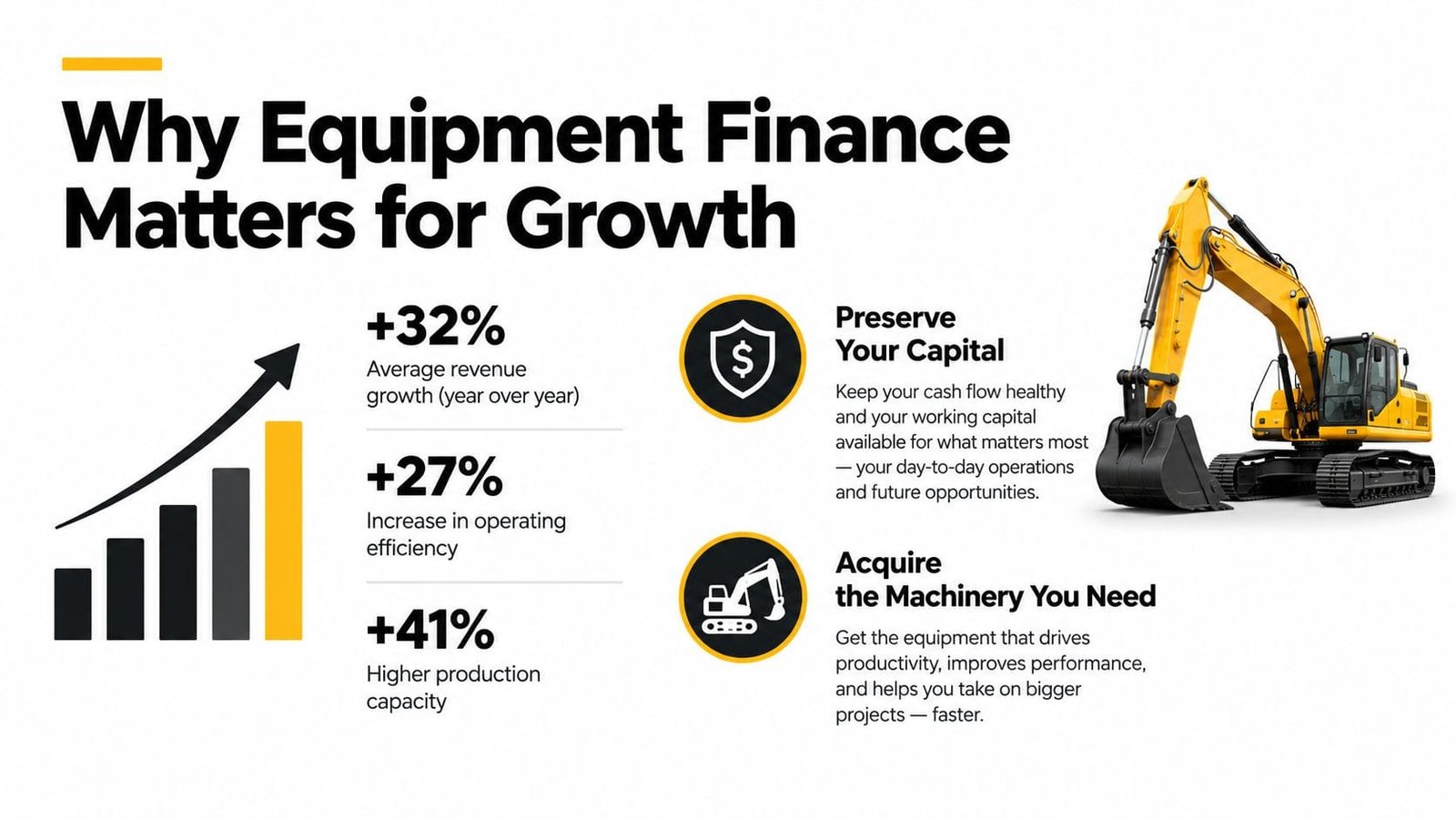
Paying cash may look cheaper because it avoids interest, but the decision can create a second problem. Money used for the machine can't also cover inventory arriving next month or a slow period in customer payments. Financing allows the owner to keep part of that working capital available while the equipment begins contributing to operations.
The asset changes the lending conversation
A general working capital loan gives the lender fewer direct safeguards. Equipment finance is different because the financed asset commonly serves as collateral. If the borrower defaults, the lender may be able to take possession of the equipment and recover some value, although resale depends on the asset's condition, demand, and specialization.
That structure explains why equipment finance is not just a smaller version of an unsecured loan. The lender evaluates the business, but also examines the machine, vehicle, invoice, useful life, resale market, and proposed payment schedule. A productive, broadly usable asset may support a different decision from a highly customized machine with little secondary-market demand.
Practical rule: Finance equipment because it supports a clear business need, not just because a lender offers an attractive monthly payment.
Equipment financing is already a mainstream acquisition tool. ELFA research reports that 82% of small businesses use at least one form of financing to acquire equipment, while the U.S. equipment finance market supports over $1 trillion in annual business investment and funds nearly two-thirds of capital equipment purchases. Those figures appear in the ELFA small-business equipment finance fact sheet.
The practical lesson is simple. If the equipment will generate revenue, reduce downtime, or protect delivery capacity, financing can turn a cash-flow obstacle into a manageable investment. You still need a realistic forecast, but you don't have to wait until every dollar is saved before acting.
Loans, Leases, and Lines of Credit
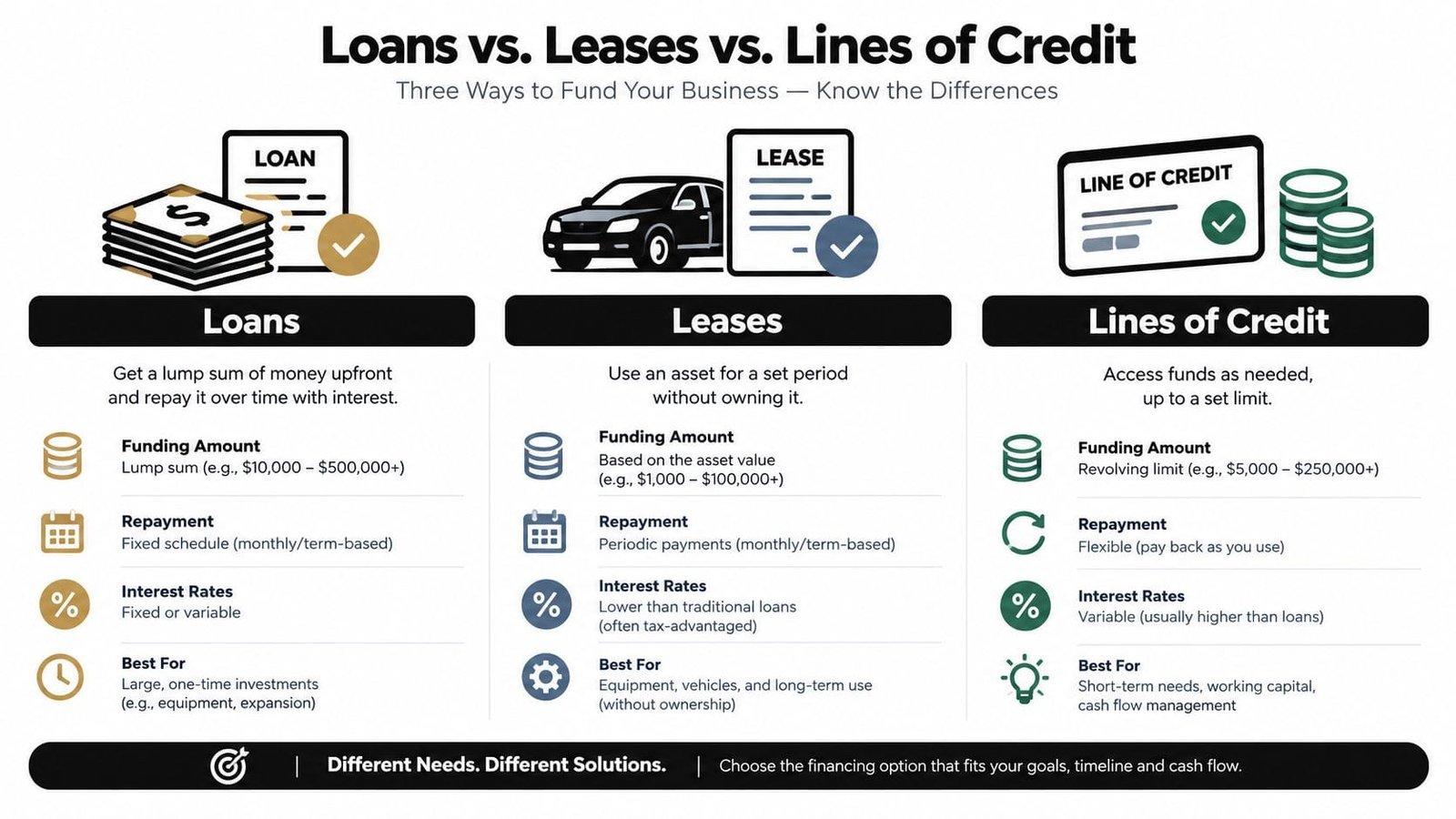
The word “financing” covers several different arrangements. Choosing among them starts with one question: Do you want to own the equipment, use it temporarily, or draw funds repeatedly as needs arise?
An equipment loan works much like a mortgage for a building. The lender advances money for a specified asset, your business makes scheduled payments, and ownership generally transfers to the company once the obligation is satisfied. The equipment secures the debt, and the lender may also require a personal guarantee or other collateral depending on the application.
A lease is closer to renting a car. The finance company owns the asset while your business pays for the right to use it during the lease term. At the end, you might return it, renew the agreement, or purchase it, depending on the contract. Maintenance, insurance, end-of-term conditions, residual value, and upgrade rights can materially change the economics.
Match the structure to the asset
A line of credit secured by equipment offers a different kind of flexibility. Rather than funding one machine with one fixed advance, the business can draw against an approved limit as eligible needs arise. That can help a company managing recurring purchases, but the terms, borrowing base, fees, and repayment rules require close attention.
Vendor financing can be convenient because the seller and finance provider are presented together. Convenience doesn't guarantee the best structure. Compare the vendor's proposal with an independent lender, especially when the contract includes bundled service charges, unusual purchase options, or restrictions on early repayment.
| Structure | Ownership during repayment | Best fit |
|---|---|---|
| Equipment loan | The business generally owns the asset subject to the lender's security interest | Durable equipment the company expects to keep |
| Equipment lease | The finance company owns the asset during the term | Technology or assets that may need replacement |
| Equipment-secured line | Ownership depends on the asset already pledged or purchased | Repeated, flexible equipment needs |
The transaction mix shows why there isn't one universal answer. In 2025, equipment loans represented 44% of U.S. equipment finance transactions by count, while leases represented 38%, and the average small-business equipment loan was $127,000, according to Crestmont Capital's equipment loan and lease statistics. Leasing was especially common among businesses with annual revenue below $1 million, where it accounted for 47% of transactions in that source's reporting.
Businesses tied to agriculture, vehicles, construction, or materials handling may also benefit from understanding specialized credit practices. For background on agricultural borrowing and related financing considerations, this guide to farm credit offers useful context.
Before signing, ask who owns the asset, who pays for maintenance, what happens if the equipment fails, and what the end-of-term purchase cost will be. A clear comparison is more valuable than a low advertised payment.
For a broader overview of structures and considerations, review this equipment financing and leasing resource.
The SBA Advantage for Equipment Buyers
SBA-backed financing can be useful when the equipment is durable, the business wants predictable repayment, and a conventional structure doesn't fit the required term. The SBA doesn't usually lend directly to the owner. Instead, an approved lender makes the loan and receives a government guarantee subject to program rules.
The two programs most relevant to equipment buyers serve different purposes.
7(a) for flexibility
An SBA 7(a) loan can fund machinery and equipment as part of a broader business need. Its equipment terms can extend up to 10 years, according to TD's overview of SBA equipment loans. That flexibility may suit a company purchasing several types of assets, combining equipment with eligible expenses, or seeking a structure that isn't limited to one major fixed-asset project.
The tradeoff is that the application can require substantial documentation. Lenders commonly review financial statements, tax returns, ownership information, debt obligations, the purchase quote, and the business explanation for the investment. Approval still depends on the lender's underwriting and SBA eligibility requirements.
504 for long-lived assets
An SBA 504 loan is designed for major fixed-asset purchases. Depending on the structure, terms can extend from 10 to 25 years, and eligible equipment generally should have a useful life of at least 10 years. That rule is important because it aligns the repayment period with the asset's expected economic life.
For example, a company buying durable production machinery may value a longer term because it reduces the size of each scheduled payment. A business replacing rapidly outdated computers may find that a 504 structure is less suitable, even if the purchase is important, because the asset may not meet the useful-life expectation.
A longer term isn't automatically cheaper. It can improve monthly cash flow, but the owner should compare total repayment, fees, equity requirements, and the equipment's expected contribution over time.
Leases and conventional equipment loans may offer more speed or simpler documentation. SBA programs may offer a more suitable tenor for durable assets, but owners should allow time for the application and confirm the lender's current terms. Tax treatment also depends on the agreement and the business's circumstances, so have a qualified tax professional review the proposed structure before relying on a deduction or ownership assumption.
Qualification Thresholds and Revenue Levels
Revenue matters, but it isn't a magic approval switch. A lender wants to know whether the business can make payments from dependable cash flow and whether the proposed equipment offers meaningful collateral value. A larger sales figure helps only when it is supported by healthy margins, organized records, and manageable existing debt.
Industry data shows a meaningful qualification gap. The smallest sales bracket financed equipment 46% of the time, compared with 56% to 67% in most other revenue brackets, according to the ELFA Horizon Report fact sheet. The same source reports that about 35% of small businesses under $5 million in revenue financed equipment during the prior 12 months.
Those figures don't mean a smaller company can't qualify. They show that lenders often see a thinner financial cushion at the smallest end of the market. An owner-operator may have strong demand but limited operating history, irregular customer payments, or too little retained cash to absorb a setback.
What the underwriter will test
Expect the lender to examine:
- Cash-flow consistency: Can operating receipts support the proposed payment after ordinary expenses and existing debt?
- Debt-service capacity: Does the business have enough recurring cash flow to handle the new obligation without depending on an optimistic sales forecast?
- Asset quality: Is the equipment identifiable, insurable, transferable, and likely to retain resale value?
- Purpose and payback: How will the asset increase capacity, reduce costs, or protect existing revenue?
- Owner commitment: Is the owner contributing equity, signing a guarantee, or providing a clear plan for managing the risk?
A company in the $20 million to $50 million revenue range may have more documentation and borrowing options than a micro-business, but it shouldn't assume every lender will treat it like a large corporation. The right question is not only whether the business is technically small. Ask whether the requested ticket, asset type, repayment period, and reporting package fit the lender's appetite.
SBA 7(a) can help when flexibility matters. SBA 504 may suit a qualifying, long-lived fixed asset. A specialized equipment lender may be more practical when speed and collateral expertise matter more than the broadest possible structure. Revenue helps you identify the likely lane, but the asset and cash flow determine whether the lane leads to approval.
Risk Profiles and Default Statistics
A lender doesn't price equipment finance by looking only at your credit score. The lender is also estimating what happens if the business stops paying. With unsecured debt, recovery may be limited. With equipment finance, the pledged asset can provide a recovery path, although repossession and resale aren't guaranteed to cover the balance.
That collateral is the structural reason an owner might receive consideration for equipment financing after struggling to obtain an unsecured line. The lender can assess the machine's condition, marketability, useful life, and location alongside the company's financial profile.
What the risk data means for borrowers
In normal economic environments, equipment-finance delinquency rates have typically stayed around 1.5% to 3.5%, while charge-off rates have been around 0.5% to 1.5%, according to Crestmont Capital's discussion of business loan default rates. These figures describe the financing category, not a promise about an individual application or lender.
Lower structural risk can support longer maturities and more workable monthly payments, but only when the equipment retains value. A specialized machine built for one customer may be difficult to sell. A widely used truck, forklift, or standard production asset may give the lender more confidence, subject to condition and market demand.
Ask the lender what happens after a default before you sign. Understand the collateral description, personal guarantee, insurance duties, late-payment remedies, and any deficiency balance that could remain after a sale.
Use a simple risk review before applying:
- Identify the pledged asset. Confirm exactly what secures the financing and whether other business assets or a personal guarantee are included.
- Estimate productive life. Compare the proposed term with the period in which the equipment should remain useful and revenue-producing.
- Test a slower month. Rework your cash-flow forecast with weaker sales or a delayed customer payment. If one difficult period makes the payment impossible, the structure is too aggressive.
- Check resale reality. Ask the vendor and lender how comparable used equipment is valued. Don't rely solely on the new purchase price.
- Separate equipment risk from operating risk. A machine may be valuable, but it won't solve a business model that can't consistently cover payroll, suppliers, rent, and debt.
The collateral protects the lender first. It may improve access or terms for the borrower, but it doesn't make an unaffordable purchase safe. A careful owner treats the asset's value as one part of repayment capacity, not a substitute for it.
Making the Lease vs. Buy Decision
Lease-versus-buy decisions become clearer when you stop comparing monthly payments alone. A lease may show a lighter initial burden, while a loan may create ownership value over time. The better choice depends on how long you need the asset, how quickly it becomes outdated, and what your business needs its cash to do.
Leasing often deserves serious consideration for technology-heavy equipment, vehicles with planned replacement cycles, or assets whose usefulness changes faster than their physical condition. The business preserves cash and may have more flexibility at renewal, but it must review end-of-term conditions, return obligations, upgrade rights, maintenance, and the total cost of repeated leasing.
Buying tends to make more sense when the equipment is durable, heavily used, difficult to replace, and likely to remain productive after the financing ends. Ownership can provide control over the asset and remove scheduled lease payments once the debt is repaid. It can also leave the business responsible for repairs, obsolescence, insurance, and resale risk.
Compare the whole decision
Ask these questions in order:
- Usage period: Will you keep the equipment for many years, or does the business expect a replacement soon?
- Cash priority: Would a large down payment limit inventory purchases, staffing, or emergency reserves?
- Technology risk: Could a newer version materially change productivity before the agreement ends?
- Residual value: Is there a realistic market for the used asset?
- Tax and accounting treatment: How will ownership, depreciation, lease payments, and deductions affect your records? Confirm the answer with a tax professional.
The market context supports careful comparison. Industry commentary reported that the equipment finance market exceeded $1.34 trillion in 2023, and that more than 80% of businesses used a loan or lease to acquire equipment. It also reported that 42% of surveyed businesses expected equipment acquisitions to increase in 2025, while inflation and rising equipment prices made cash purchases less attractive for some owners. These figures are discussed in Rok Financial's 2025 equipment finance report coverage.
A medical practice evaluating ownership and rental can also learn from this practical discussion of when to rent vs. buy medical equipment. The same principle applies across industries: choose the structure that matches the asset's useful life and your operating strategy, not the payment that looks smallest in isolation.
Sourcing Lenders and Applying Smartly
The first lender you contact may be convenient, but it may not be the right match for your equipment or revenue profile. Traditional banks can offer relationship-based underwriting and established SBA channels. Specialized equipment finance companies may understand asset values better. Fintech platforms can simplify applications and connect borrowers with multiple funding paths, though you still need to compare the actual terms.
Prepare a lender package before requesting quotes. Include the vendor proposal, equipment specifications, delivery timeline, ownership information, recent financial statements, tax records, current debt schedule, and a short explanation of how the asset will affect capacity or revenue. If the machine replaces an existing asset, explain why the replacement is necessary and what will happen to the old equipment.
Use a decision matrix
| Your situation | Financing path to investigate |
|---|---|
| Durable asset, long planned use, desire for ownership | Equipment loan |
| Fast-changing technology or uncertain replacement cycle | Lease |
| Major qualifying fixed asset with a long useful life | SBA 504 |
| General equipment need with broader business flexibility | SBA 7(a) |
| Repeated purchases or changing equipment needs | Equipment-secured line of credit |
| Urgent purchase with a clear vendor quote | Specialized equipment lender |
Request proposals that show more than the payment. Compare the total amount repaid, fees, down payment, prepayment terms, collateral, guarantee requirements, maintenance obligations, insurance rules, and end-of-term options. A proposal with a lower payment can still cost more if it extends repayment beyond the equipment's useful life.
You can also ask each lender the same questions. What percentage of the equipment value will be financed? How does the lender treat used equipment? Does the term reflect the asset's useful life? Will a personal guarantee be required? How quickly can the lender fund after receiving complete documentation?
For a broader starting point, review this directory of equipment financing lenders. The strongest application isn't the one with the most optimistic forecast. It's the one that connects a specific asset to realistic cash flow, presents complete records, and chooses a repayment structure the business can carry through an ordinary difficult month.
Business Loan Warrior helps small businesses compare funding paths for equipment purchases, SBA financing, lines of credit, and other capital needs through a single application and lender-matching process. If you're ready to evaluate your next machine, vehicle, or technology purchase, visit Business Loan Warrior and review the available financing options.