
A line of credit is a reusable borrowing facility with a set maximum limit, where your business draws only what it needs, repays, and borrows again, with interest generally applying to the outstanding balance rather than the full approved limit.
You might be looking at payroll coming due while a customer's payment is still somewhere between approved and deposited. Or your supplier needs payment for seasonal inventory before you've sold it. The practical question isn't just whether you can borrow. It's whether you can cover that gap without taking on more debt than the business needs.
Understanding line of credit meaning starts with separating permission to borrow from money you owe. From there, the important decisions become clearer: which structure fits, what access costs, and how today's borrowing could affect your next credit application.
Table of Contents
- What a Line of Credit Actually Means
- The Main Types of Lines of Credit
- How Much a Line of Credit Really Costs
- Line of Credit vs Term Loan vs Business Credit Card
- Eligibility and What Underwriters Actually Look At
- Real-World Examples of How Small Businesses Use a Line of Credit
- How to Apply, Manage, and Avoid Common Mistakes
- Key Takeaways and Frequently Asked Questions
What a Line of Credit Actually Means
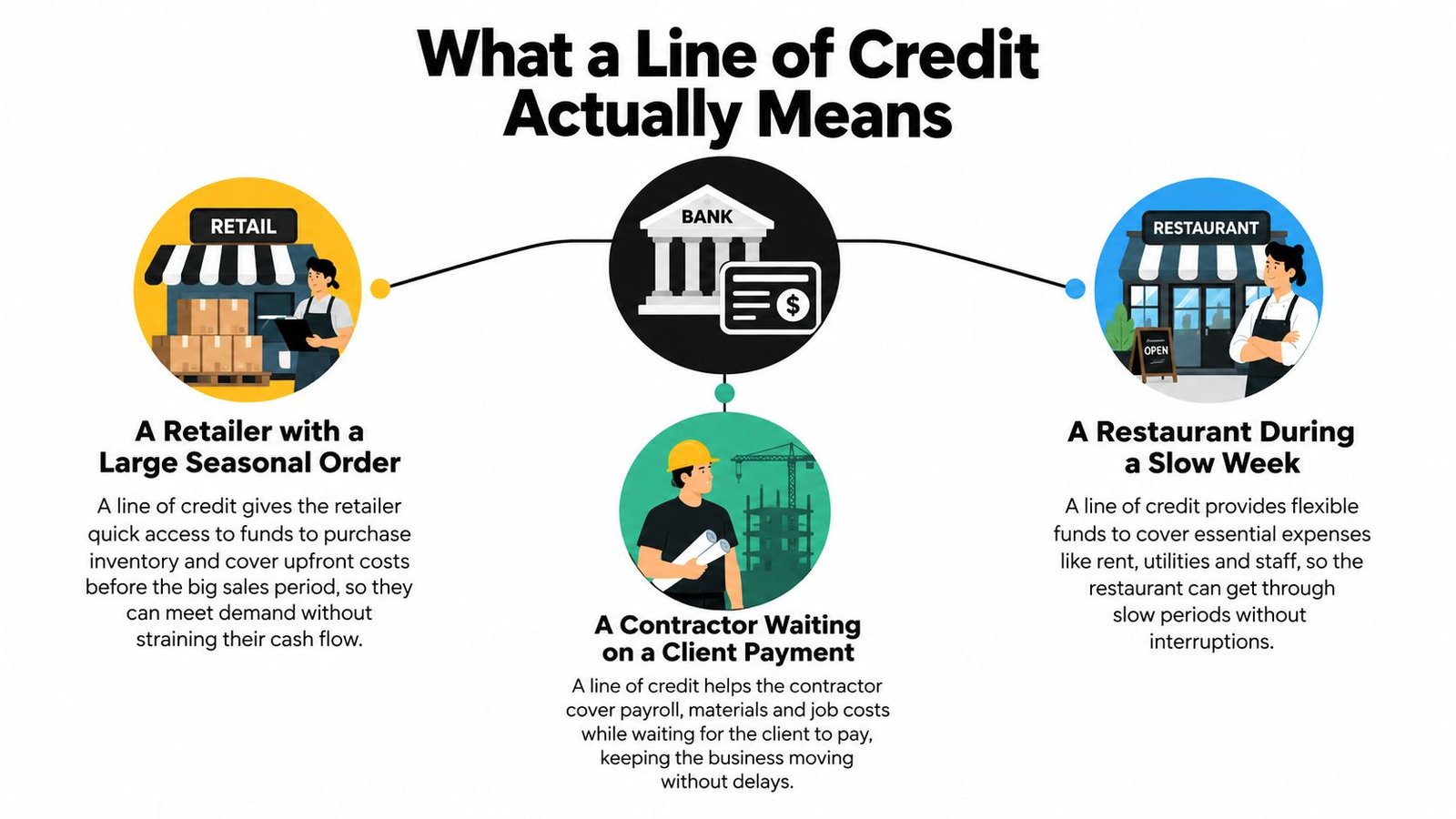
A retailer lands a promising seasonal order, but the inventory bill arrives before customer revenue does. A credit line can help bridge that timing mismatch. Approval establishes access to funding; it doesn't require the retailer to borrow the entire commitment.
Separate the limit from the debt
Keep these terms distinct when you review an offer or account statement:
- Approved limit: The maximum borrowing commitment, subject to the agreement's conditions.
- Amount drawn: Money you've taken from the facility. A draw describes a borrowing transaction, not necessarily what remains unpaid later.
- Outstanding balance: The amount still owed after borrowing and repayments.
- Available credit: The remaining capacity you can access under the lender's rules.
For example, a business with a $100,000 limit that draws $25,000 generally has approximately $75,000 available, subject to fees, repayment terms, and lender rules. This illustrates the changing balance described in the Consumer Financial Protection Bureau's explanation of revolving credit.
At the moment of that initial draw, the amount drawn and outstanding principal may match. After principal repayments, they no longer mean the same thing. When reviewing your account, look at the current balance rather than adding up historical withdrawals.
Follow the cash-flow cycle
The useful business question is: What incoming cash will repay this draw? For the retailer, it might be proceeds from selling the inventory. For a contractor, it might be payment against an outstanding customer invoice.
The illustration below connects that borrowing cycle to familiar operating situations.
Specialized inventory financing deserves its own review. If you're comparing funding for vehicle inventory with general working-capital borrowing, Solana EV's explanation of how floor plan credit lines work is a useful starting point for identifying questions about that particular structure.
Don't assume every facility restores borrowing capacity in exactly the same way. Ask when principal payments become available to redraw and whether other conditions can restrict access.
Your approved limit is borrowing capacity, not a spending target.
The Main Types of Lines of Credit
When someone offers you a business line, ask separate questions about reuse and security. Can you draw again after repayment? And what assets, if any, support the agreement?
Those questions address different features. A revolving facility can also be secured, so these labels aren't mutually exclusive choices.
Line of Credit Types at a Glance
| Type | How It Works | Typical Use | Key Trade-Off |
|---|---|---|---|
| Revolving | The agreement permits borrowing, principal repayment, and borrowing again within its conditions. | Recurring inventory or cash-flow needs. | Check the conditions governing continued access. |
| Non-revolving | Repayment doesn't replenish the amount available to borrow. | A defined spending period or project. | Don't mistake staged access for reusable capacity. |
| Secured | Specified business assets support the borrowing arrangement. | Financing connected to inventory, receivables, or other assets. | Understand which assets are covered and what obligations apply. |
| Unsecured | The facility isn't secured by specified collateral. | Working-capital borrowing where that structure fits the agreement. | Don't assume unsecured means no personal obligations. |
Treat the table as a vocabulary guide, not a substitute for reading the proposed contract. Product names alone won't tell you what happens after repayment or what the lender can require.
Match the structure to your operating pattern
For a retailer replenishing stock throughout the year, the key question is whether repaid principal becomes available for another purchasing cycle. For a business funding a defined project, repeated access might matter less than having an appropriate repayment schedule.
If a proposed facility relies on invoices, ask whether availability changes when customers pay, invoices age, or receivables become disputed. If inventory supports it, ask what records you must maintain and whether the lender can adjust availability.
Use a short set of questions when discussing any offer:
- Redraw rights: Does repayment restore access automatically, conditionally, or not at all?
- Access period: When can you request funds, and when does that permission end?
- Security obligations: Which assets or guarantees does the agreement cover?
- Repayment trigger: What could require you to reduce or repay the balance?
Be especially careful when the sales description and written terms sound different. If someone calls a product a line of credit but repayment doesn't restore capacity, evaluate it on those mechanics rather than the label.
How Much a Line of Credit Really Costs
Flexible doesn't mean free. The cost question isn't what interest rate appears on the offer. It's what your business would pay under the way you expect to use the facility.
Start with a realistic borrowing pattern: frequent inventory draws, occasional payroll support, or mostly unused emergency capacity. Different fee structures deserve different scrutiny depending on that pattern.
Identify what each charge pays for
The available product terms may include several distinct charges:
- Interest: The borrowing cost associated with the outstanding balance.
- Draw fees: Charges attached to withdrawing funds.
- Annual or maintenance fees: Charges for keeping or administering the facility.
- Unused-line fees: Charges associated with capacity you haven't drawn.
The statement review below is a reminder to look beyond the interest line.

Ask the lender to identify every applicable charge in writing, including what triggers it and the amount on which it's calculated. A fee based on the approved limit requires a different budgeting approach from one based on an individual withdrawal.
For additional terminology to use during those conversations, review this explanation of line of credit interest rates.
Compare the same borrowing behavior
Consider hypothetical offers without assuming any particular market rate. One has a lower advertised interest rate but an annual charge. Another has no annual charge but applies a fee each time you draw.
For a business that rarely borrows, the annual charge deserves attention even during quiet periods. For a business making frequent withdrawals, the draw charge deserves closer examination. Neither offer is automatically cheaper without applying the actual terms to the same borrowing pattern.
Request a written cost illustration using your expected draw dates, repayment dates, and average balance. Then ask for an alternative illustration where customers pay late and the balance remains outstanding longer.
Cost check: Compare what you'd pay for the same use of funds, not just the rate printed most prominently.
Ask about APR where provided, but also request the underlying fee schedule and payment calculation. Don't assume a quoted summary answers every question about an intermittently used facility. Your goal is a budget you can reconcile against the contract and, later, the account statement.
Line of Credit vs Term Loan vs Business Credit Card
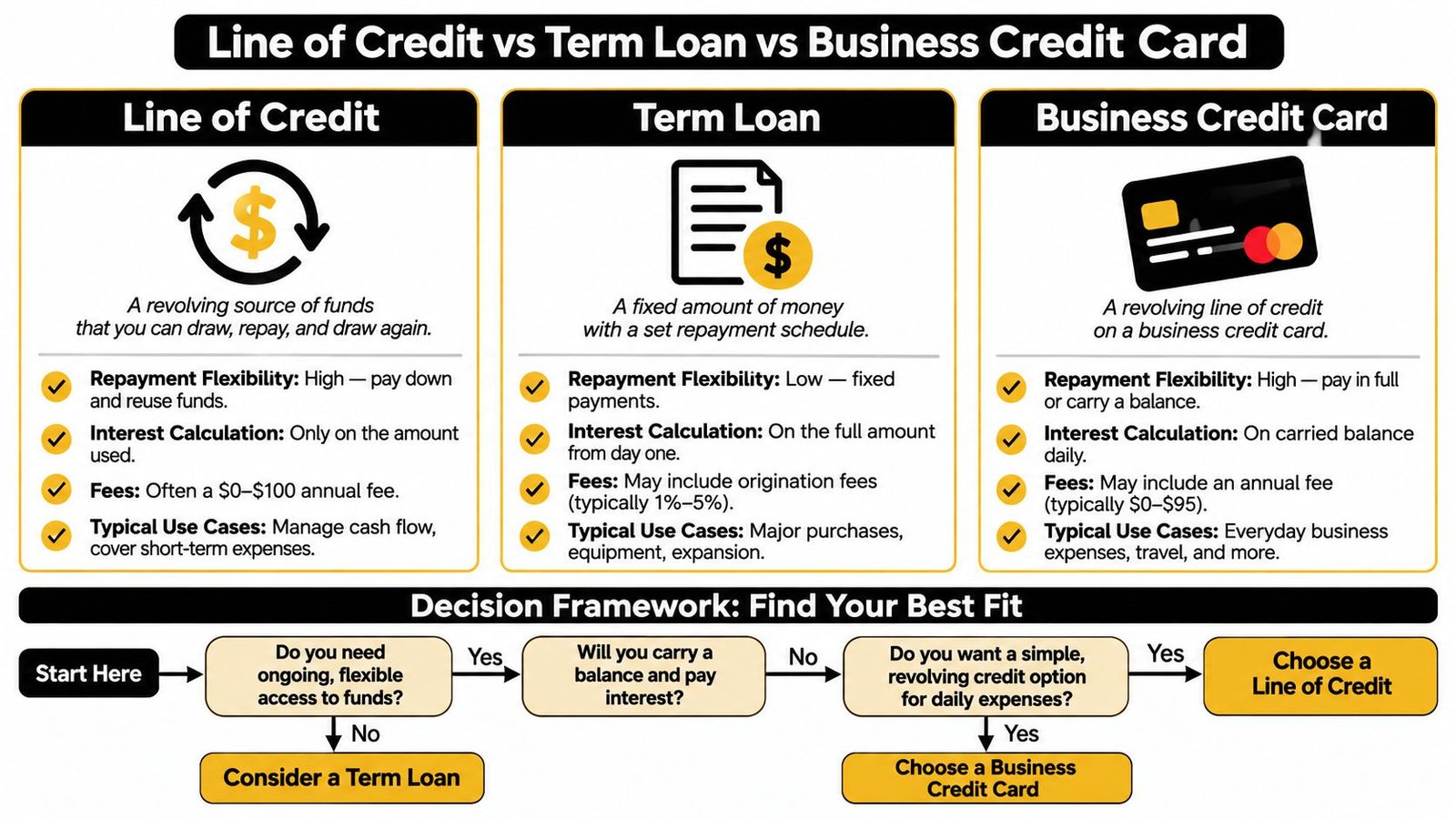
Choose financing by starting with the expense and its repayment source. A temporary timing gap, a long-lived purchase, and everyday purchasing activity don't necessarily call for the same tool.
Lines are already an established part of business financing: 34% of employer firms regularly used or carried a balance on lines of credit, compared with 53% for business loans, according to the Federal Reserve's discussion of the Small Business Credit Survey. Those figures describe usage, not which product your business should choose.
This comparison helps organize the decision.
Compare the proposed agreements
| Decision point | Line of credit | Term loan | Business credit card |
|---|---|---|---|
| Expense to evaluate | Recurring or unpredictable working-capital needs. | A defined, one-time funding requirement. | Routine purchases you can manage through a payment account. |
| Repayment question | What cash will reduce each draw? | Does the scheduled payment fit the business budget? | Can the business support the statement repayment plan? |
| Limit question | Is available capacity sufficient for the expected gap? | Is the funded amount appropriate for the purchase? | Does the offered spending limit suit the transactions? |
| Cost question | What will actual usage and access cost? | What is the total scheduled borrowing cost? | What do the actual interest and fee terms require? |
Don't assume one product always offers a larger approval or lower cost. Compare written offers against the same business need.
My practical rule of thumb is to consider a term loan for a defined purchase with a planned repayment horizon, a line for a temporary operating gap with an identifiable repayment source, and a card for routine purchasing that fits your payment controls.
For a video explanation alongside the comparison, use the player below.
If your real objective is managing existing obligations, separate that problem from new working-capital borrowing. You can find debt consolidation help for businesses through Morgan & Morgan Attorneys at Law P.C. while evaluating whether restructuring, rather than adding another facility, deserves consideration.
Eligibility and What Underwriters Actually Look At
Prepare to explain how your business will repay, not merely why it wants access to funds. A useful application package connects operating history, incoming cash, existing obligations, and the purpose of the proposed facility.
Requirements vary, so ask the prospective lender for its actual criteria rather than relying on a universal revenue or credit-score cutoff.
Prepare evidence, not just a sales figure
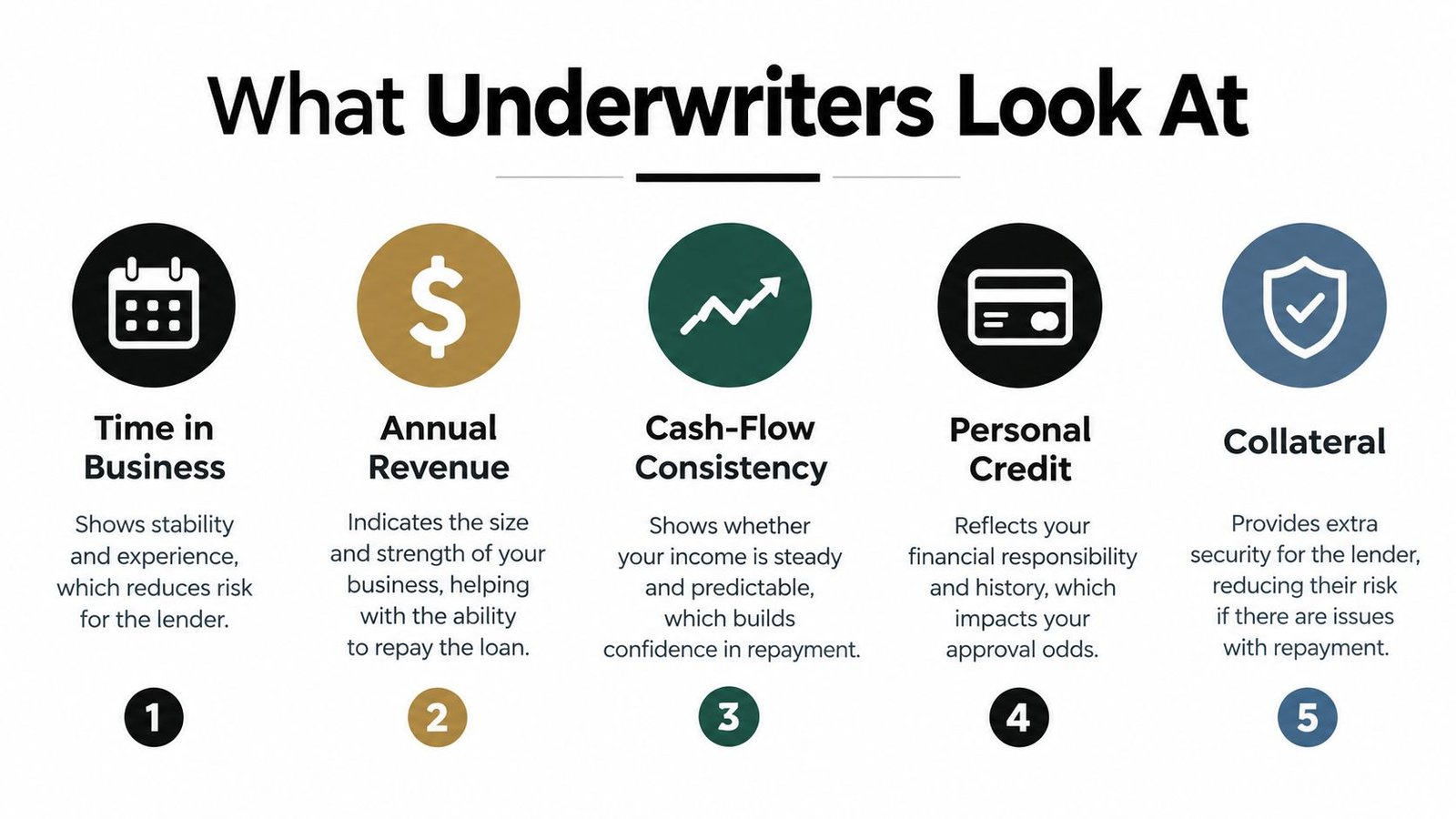
Use these categories to organize the conversation:
- Time in business: Provide a clear operating history and explain significant changes.
- Annual revenue: Reconcile the sales figures in your financial statements and application.
- Cash-flow consistency: Explain when customers pay relative to payroll, suppliers, and other obligations.
- Personal credit: Ask whether the lender will review it and what authorization it requires.
- Collateral and liens: Identify existing asset commitments and ask what security the new agreement would require.
The checklist below provides a visual prompt for assembling those materials.
Bank statements and financial statements answer different practical questions. Prepare to reconcile reported sales with actual deposits and explain unusual withdrawals or delayed collections. A large sales total alone doesn't explain how the next repayment will be funded.
For another way to organize your explanation, review the three Cs of credit.
Understand utilization before asking for more capacity
Utilization compares the outstanding balance with the committed limit. Median small-business credit-line utilization was 40.1% in Q4 2025, according to the Federal Reserve Bank of Kansas City's Small Business Lending Survey.
That's context, not a recommended target or an approval threshold. High utilization can increase repayment pressure and may affect future underwriting, but the reason for the balance matters.
A seasonal buildup followed by repayment tells a different story from a balance that stays high because operating cash never catches up. Before requesting more credit, prepare to explain that distinction with your own records.
Underwriting perspective: Don't just explain how much capacity you want. Show why the business needs it and how you expect the balance to come down.
Real-World Examples of How Small Businesses Use a Line of Credit
The following are illustrative operating scenarios, not reported customer results. Each starts with an expense that arrives before the cash expected to cover it.
A retailer buys ahead of seasonal demand
A retailer needs to pay a supplier before the selling season begins. The owner maps expected inventory purchases against projected customer receipts, then plans draws around supplier payment dates.
As merchandise sells, the owner directs an appropriate share of receipts toward principal rather than treating all deposits as available profit. The discipline is matching inventory funding to inventory conversion.
In this scenario, I'd evaluate a line because the purchasing need repeats and its timing changes. I wouldn't choose a long repayment schedule because it produces a comfortable-looking payment.
A restaurant keeps capacity available for payroll
A restaurant operator expects a slow trading period but still needs to meet payroll and supplier commitments. Instead of borrowing preemptively, the operator monitors expected deposits and keeps the facility available if a temporary gap develops.
The important distinction is standby capacity versus a standing balance. Keeping access available doesn't require leaving borrowed money in the operating account.
For this hypothetical restaurant, a line is worth considering when the gap is temporary and the repayment source is credible. If ordinary trading can't support ordinary expenses, I'd reassess the operating budget before relying on another draw.
A contractor bridges costs and collections
A contractor pays for labor and materials before receiving a client's payment. Before drawing, the contractor checks the invoice status, expected collection date, and whether the customer has raised any dispute.
When payment arrives, the contractor follows the planned repayment instruction rather than redirecting the entire receipt toward another project. That keeps project profitability separate from the availability of borrowed cash.
The lesson isn't that every contractor needs a line. It's that borrowing should connect to a specific collection cycle, with a plan for what happens if the customer pays late.
For a practical follow-up, use this guide on how to use a line of credit to frame your own draw-and-repayment process.
How to Apply, Manage, and Avoid Common Mistakes
Treat the application as a financial explanation, not just a form. Before approaching lenders, write down the intended use, the expected borrowing period, and the cash source you'll use for repayment.
Build a decision-ready application
Prepare current bank statements, a profit-and-loss statement, tax returns, and a list of existing borrowing obligations. Ask each prospective lender which documents and reporting periods it requires.
Clean up discrepancies before submitting. If your accounting records show sales that haven't yet reached the bank, explain the timing rather than leaving the reviewer to infer it.
When reviewing offers, request written answers about:
- Payment requirements: What must you pay, when, and under what circumstances could that change?
- Access conditions: What could suspend withdrawals or reduce availability?
- Ongoing obligations: Which reports, guarantees, collateral commitments, or renewal conditions apply?
- Negotiable terms: Ask about fees, payment timing, reporting requirements, and security provisions, not only the headline rate.
Establish operating controls
Assign someone responsibility for approving draws and someone responsibility for reconciling statements. In a small business, that may involve the owner and an outside bookkeeper rather than separate finance staff.
Maintain a simple draw register showing the business purpose, expected repayment source, actual repayment, and remaining capacity. Review it alongside your cash forecast so borrowing decisions reflect upcoming obligations.
Use these operating rules to avoid turning convenient access into an unmanaged liability:
- Do connect each draw to a purpose. Record what expense it funds and why borrowing is appropriate.
- Do review exceptions. Investigate missed repayment plans rather than automatically replacing them with new ones.
- Don't treat unused capacity as revenue. It's an option to borrow, not earned cash.
- Don't ignore a persistent balance. Revisit the financing structure if the business no longer has a credible path to reducing it.
A line should support the operating plan. It shouldn't become a reason to stop testing whether that plan works.
Key Takeaways and Frequently Asked Questions
The useful line of credit meaning is access you manage deliberately, not an amount you're expected to spend. Choose the structure around your cash cycle, compare the full contractual cost, and preserve a clear explanation of how borrowing supports repayment.
Will an application affect my personal credit?
Ask whether the specific application involves a personal credit inquiry, what kind, and when it occurs. Don't assume every prequalification or application process works alike.
How quickly can I access funds?
Request separate timelines for approval, account setup, and individual withdrawals. Don't commit to a supplier payment based solely on an advertised funding description.
Can my business have another line elsewhere?
Ask both lenders about additional-debt restrictions, existing liens, and disclosure requirements before signing. Have your adviser review potentially conflicting obligations.
Is approval a guarantee of permanent access?
Read the agreement's expiration, renewal, and suspension provisions. Budget against the access your contract provides.
Business Loan Warrior offers business lines of credit and other funding options through a single, no-fee application, with pre-approval checking that doesn't affect credit. Visit Business Loan Warrior with your cash-flow forecast and intended use of funds to explore options you can compare against your business's repayment plan.