
If you're waiting on a loan decision while a supplier quote expires, a contractor wants a deposit, or payroll is coming due, you already know the problem. The issue isn't just that the file is slow, it's that every extra handoff pushes funding farther away and makes the whole process feel unpredictable. For lenders serving $20M to $50M revenue businesses, that unpredictability is where deals stall, teams get overloaded, and “fast approval” stops meaning much.
Automated loan processing exists to remove that drag, but the marketing version often skips the hard part. A lender can automate the front end and still lose time in exception handling, compliance review, and post-decision cleanup. That's why the gap between a quick decision and actual funding matters so much for business lending.
Table of Contents
- The Moment a Slow Loan Decision Costs Real Money
- What Automated Loan Processing Actually Is
- The Four Layers Every Automation Stack Needs
- Who Actually Wins When Lending Goes Automated
- A Practical Implementation Roadmap for Fintech Lenders
- The Inclusion Question Most Coverage Skips
- After the Instant Decision What Really Changes
- Choosing a Vendor and Tracking the KPIs That Matter
The Moment a Slow Loan Decision Costs Real Money
A restaurant operator calls on Monday morning because a distributor will hold pricing only until Wednesday. The owner has the bank statements, the tax returns, and the story behind the seasonal dip, but the file still sits in a queue because three people need to review it in sequence. By the time the lender circles back, the deal is gone and the borrower has already moved on.
That's the part most lending teams recognize but don't always measure cleanly. A slow decision doesn't just frustrate the applicant, it changes the economics of the business loan itself. The borrower loses a commercial opportunity, and the lender loses a funded file that may never come back.
For lenders serving $20M to $50M revenue companies, this pressure shows up in a very specific way. These borrowers often have enough complexity to need judgment, but not so much time that they can wait for manual back-and-forth. They're often choosing between expansion, inventory, payroll, or equipment now, not after a committee meeting next week.
That's why automated loan processing became more than a back-office upgrade. In the market benchmark from Zest AI, roughly 8 in 10 institutions already generate automated underwriting decisions, but adoption depth still varies a lot, with nearly 3 in 10 auto-decisioning more than 40% of loans and 40% auto-decisioning 20% or fewer loans (Zest AI benchmark). The message is simple, automation is already mainstream, but how far it reaches inside the workflow still separates lenders that feel fast from lenders that merely sound fast.
Practical rule: If your borrower experience still depends on a human chasing documents across email threads, your funding speed is limited by the slowest review step, not the smartest model.
For a plain-English sense of how long approval can take in the world, this breakdown on how long approval takes is a useful companion read. The core point is that speed is not a cosmetic feature in lending. It's often the difference between capturing a qualified borrower and losing the deal before underwriting finishes.
What Automated Loan Processing Actually Is
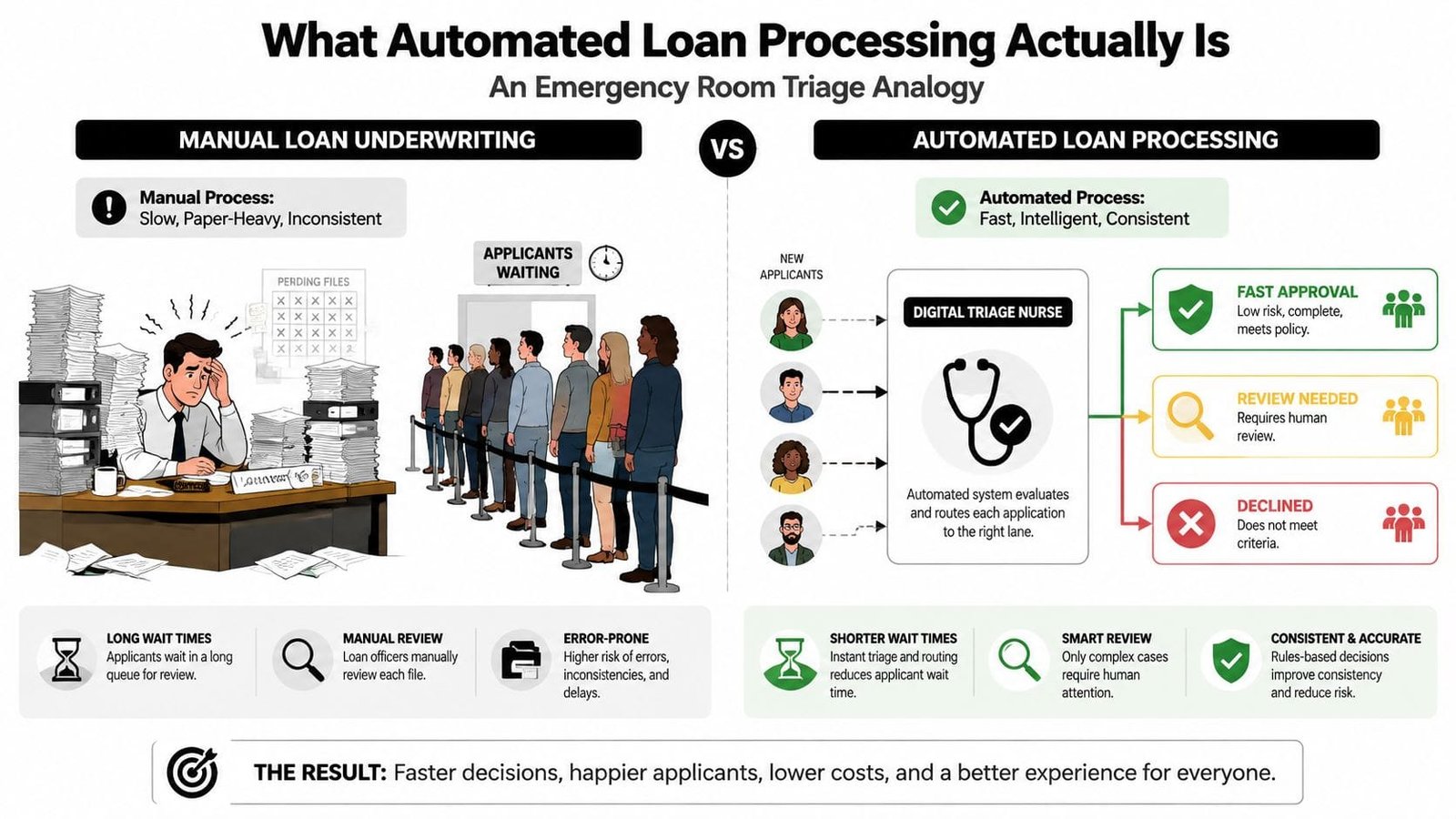
Think of automated loan processing like a triage desk in an emergency room. Not every case needs the same path, and not every file should sit in the same queue. Simple, clean applications move quickly, messy ones get routed to review, and only the cases that need human judgment consume that human time.
That's why automation is better understood as a workflow-orchestration pipeline, not a single AI model. A lender receives an application, checks identity and KYC, validates documents, makes a credit decision, generates an offer, funds the loan, and then monitors what happens after disbursement. The pipeline matters because each stage depends on the one before it, and speed only improves when the handoffs between stages stop leaking time.
A useful way to picture the stack is to break it into seven steps. First comes intake, where the application enters the system. Then identity and KYC checks confirm who the borrower is. After that, document validation compares the submitted files against the expected data. The system then runs credit decisioning, creates the offer generation, pushes the file into funding, and finally starts post-disbursement monitoring.
The important shift is mental as much as technical. Manual underwriting treats every file as a series of individual tasks performed by different people. Automated processing treats the whole journey as one coordinated flow with defined rules, logs, and exception paths. That's why lenders usually describe it as an operating model, not a feature bolt-on.
If you want a concise overview of how automation is changing the broader banking stack, edge through banking automation is a good contextual resource. It helps explain why workflow design matters as much as model quality.
The fastest lenders don't automate everything. They automate the parts that are repeatable, then preserve human attention for the files where judgment still matters.
The technical architecture from AWS's reference mortgage workflow shows the mechanics well. Uploaded files trigger event-driven extraction, agents verify documents, compute DTI ratios, assemble a summary, and generate a pre-approval letter with minimal human involvement (AWS reference workflow). That's the clearest example of how a structured pipeline turns scattered borrower inputs into a decision package that can move.
The Four Layers Every Automation Stack Needs
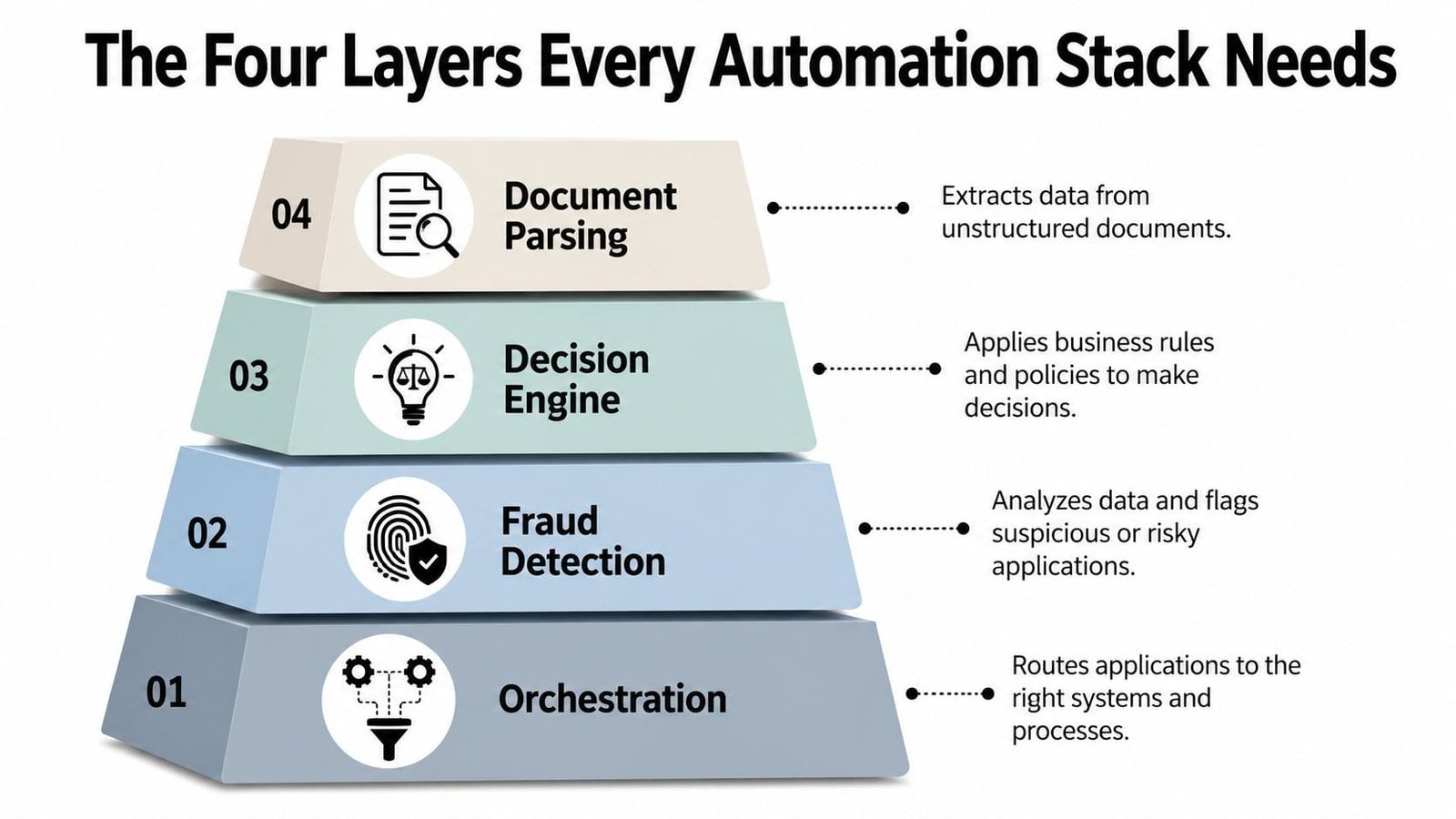
A lender can't safely automate lending with just a decision engine. The stack needs orchestration, fraud detection, compliance checkpoints, and exception handling working together. Remove one layer and the system either breaks operationally or creates regulatory exposure.
Orchestration keeps the file moving
Orchestration is the traffic controller. It decides what happens next, tracks SLA timing, and keeps the application from getting lost between intake, review, and funding. Without it, even a strong model can still produce a messy borrower experience because the file has no clean routing logic.
This is also why vendor demos can be misleading. A tool that says it uses AI but can't explain how it routes files, pauses incomplete cases, and resumes them later is not a complete automation stack. It's a prediction layer sitting on top of manual work.
Fraud, compliance, and exceptions are not optional extras
Fraud detection screens for synthetic identities, account takeover, and suspicious document patterns. Compliance checkpoints enforce the rules tied to HMDA, ECOA, FCRA, and AML-KYC controls, which means the system can't just approve what looks efficient, it has to prove it followed the right path. The exception layer is where borderline files get handed to a human underwriter instead of being forced into a rigid yes or no path.
Bottom line: If a vendor pitches “pure AI” and can't show how exceptions are routed, audited, and reviewed, you're looking at a risk transfer, not a process improvement.
The neutral technical guidance in the workflow-automation reference makes this point clearly, the core architecture should include an orchestration layer, a fraud-detection layer, a compliance checkpoint layer, and an exception-handling layer (workflow architecture guidance). The reason is practical. Each layer protects the lender from a different kind of failure.
For a hands-on example of how data quality affects this layer, the article on building a bank statement variance tracker is worth reading alongside this section. It shows why structured inputs matter before any model can do useful work.
A quick vendor checklist
- Routing clarity: Can the platform show exactly how a file moves from one stage to the next?
- Control visibility: Can compliance, fraud, and exception logic be audited without guessing?
- Human override path: Can underwriters intervene cleanly when the file doesn't fit the rules?
- System logs: Can the lender reconstruct what happened after the fact?
The architecture is only credible if all four layers are visible in the product, not just described in a slide deck.
Who Actually Wins When Lending Goes Automated
Borrowers and lenders gain from automation in different ways, and the trade-offs are not symmetrical. Borrowers usually feel the benefit first in the form of faster pre-qualification, less retyping, and fewer dead-end conversations. Lenders usually see the financial benefit later, through cleaner operations, lower manual load, and more capacity for files that need expertise.
Borrower benefits
A borrower wants fewer forms, fewer repeated requests, and clearer status updates. Automation can support that by pulling in data once, reusing it across stages, and letting applicants track progress in a dashboard instead of calling for status updates. It also makes reapplication easier when the system already knows the business and can reuse validated information.
The catch is that borrowers with messy records can hit friction. If bank data is incomplete, document formats are inconsistent, or ownership structures are layered, the automation layer may ask for more manual proof rather than less. That's not a bug, it's the system recognizing that some cases still need human attention.
Lender benefits
For lenders, the biggest wins are more operational than promotional. Automated workflows reduce repetitive data entry, free underwriters to focus on exceptions, and make portfolio oversight more consistent. The Federal Reserve Bank of New York's mortgage research found fintech lenders processed applications about 20% faster than other lenders, cutting application-to-closing time by roughly 10 days on average from 2010 to 2016 (NY Fed study). In one specification, fintech lenders were about 7.9 days faster, with estimated speed gains ranging from 7.5 to 9.4 days for purchase mortgages and 9.3 to 14.6 days for refinances.
That study matters because it shows the value of automation isn't theoretical. It shows that once the workflow is structured well, cycle time can compress in a measurable way.
| Stakeholder | Primary Benefits | Trade-Offs to Manage |
|---|---|---|
| Borrower | Faster pre-approval, fewer repeated inputs, clearer status visibility | More friction for messy data, document gaps, or non-standard structures |
| Lender | Lower manual load, quicker decisions, better staffing allocation, stronger oversight | Implementation cost, governance burden, model monitoring, exception design |
If you're evaluating automation through an ROI lens, small business automation metrics can help frame the operational side of the decision. The useful question isn't whether automation helps. It's which part of the loan journey gets faster, and which part still needs expert review.
A Practical Implementation Roadmap for Fintech Lenders
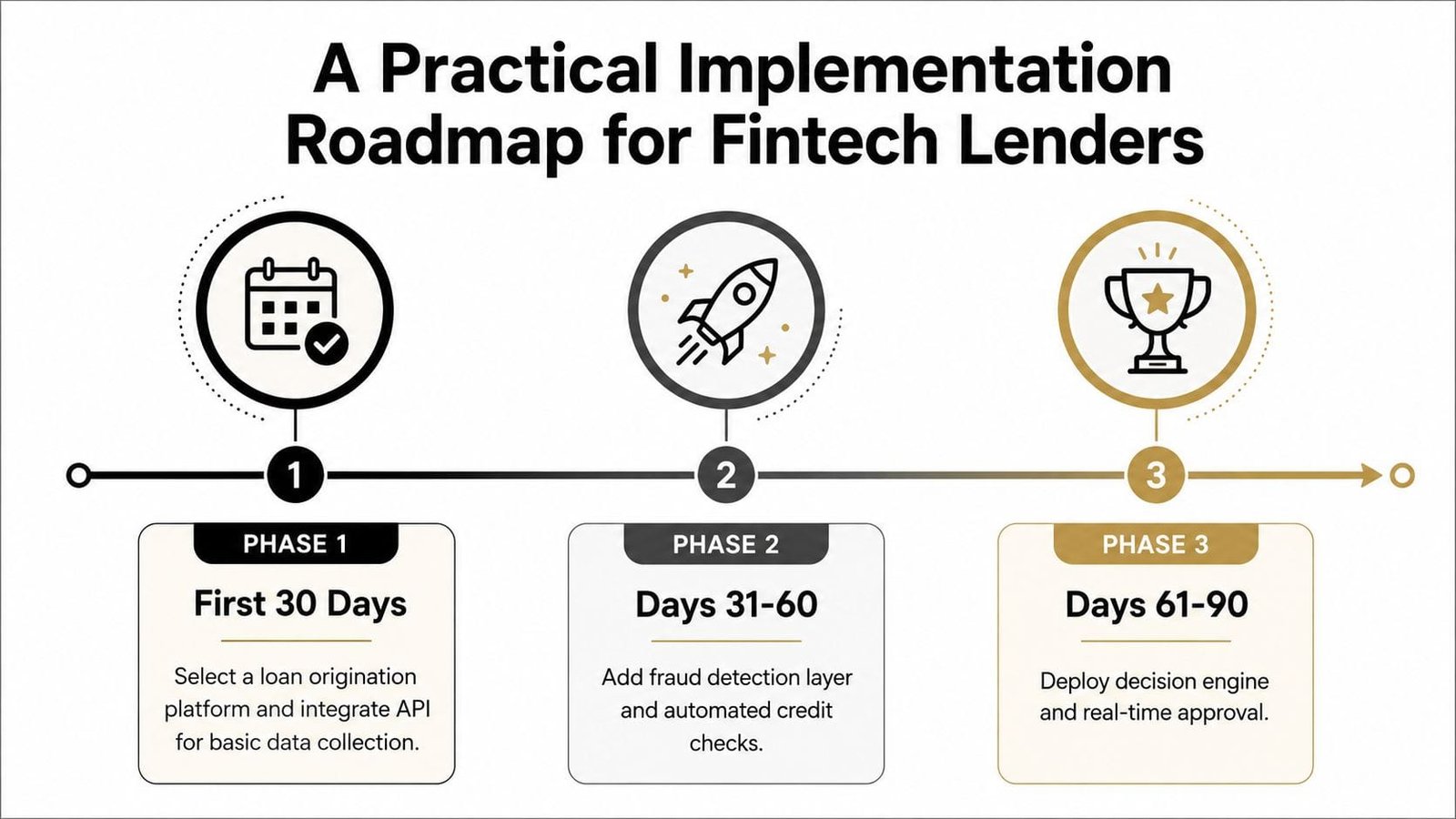
A lender doesn't need to rebuild the whole stack on day one. The better approach is to automate the high-volume, low-variance steps first, then add judgment-heavy layers after the data flow is stable. That sequence keeps the project from collapsing under its own scope.
First 30 days
Start by selecting a workflow-orchestration vendor and mapping the current intake flow from application to underwriting. Identify the product with the highest volume and the least complicated exceptions, because that's where the first automation win will show up fastest. The deliverable here is a clean process map with named owners for each step.
Days 31 to 60
Add bank-account connectivity, document automation, and a soft credit-pull pre-qualification layer. The point is not to automate the whole decision yet, it's to stop humans from re-keying the same information over and over. If the borrower can upload once and the system can classify, validate, and route the file, the team starts to feel the benefit immediately.
Days 61 to 90
Introduce credit-decisioning models, exception-routing rules, and compliance checkpoints mapped to ECOA, FCRA, and BSA obligations. This is the phase where a lender has to be disciplined about review logic. A good model with weak exception routing still creates bottlenecks, and weak compliance logic creates avoidable exposure.
After those core stages are stable, add post-disbursement monitoring and portfolio dashboards. That's where automation starts to help beyond origination, because operations teams can watch the book rather than just close the file. One useful reference point on the broader business case is Business Loan Warrior's automation and ROI discussion if you're comparing how lenders talk about workflow efficiency versus actual implementation.
The real test isn't whether a system can say yes quickly. It's whether the lender can fund clean files faster while keeping messy files visible, tracked, and reviewed.
Business Loan Warrior's lending platform includes automated offer generation and automated decisioning in its origination workflow, which makes it one example of how a lender can structure this kind of rollout. The important part is the sequence, because rushed automation usually creates hidden queues elsewhere.
The Inclusion Question Most Coverage Skips
A lot of sales content says automation improves inclusion, then stops there. The harder question is whether automated loan processing widens access for smaller businesses with non-traditional profiles, or just favors firms whose data is already easy for a machine to read. Those are not the same outcome.
Academic evidence from PPP-era lending found that automation reduced fixed origination costs and expanded capacity, which helped lenders serve smaller firms and areas with higher minority shares, especially where branch networks were thin (PPP lending research). That's a real inclusion gain at the portfolio level. More files could be handled, and more borrowers could be reached.
But the operational edge cuts both ways for the lender's target market. Many businesses in the $20M to $50M range have seasonal revenue swings, layered entities, or non-standard collateral that don't map neatly to rule-based logic. When a system depends on bank-account connectivity, structured cash-flow data, and automated document verification, those applicants can end up needing more manual help, not less.
That's the part marketing pages usually avoid. Automation can make a lender more inclusive overall while still excluding borrowers whose files are too messy for straight-through processing. The exception isn't a failure of the technology, it's evidence that the technology is optimized for structured input.
Practical takeaway: The borrowers most likely to benefit are the ones with clean digital records and repeatable cash flow. The borrowers most likely to need human review are the ones with layered ownership, variable revenue, or documents that don't fit a standard template.
For lenders, that means inclusion needs to be designed, not assumed. If the goal is to serve more small businesses, the automation stack has to recognize when to escalate instead of trying to force every file into the same model path. That's especially true in business lending, where an apparently “difficult” applicant may be a strong credit story hidden behind non-standard data.
After the Instant Decision What Really Changes
The headline version of automation stops at “instant approval,” but the operating reality starts after that. A decision is only useful if the lender can clear exceptions, finish compliance checks, and move the file to funding without creating a new backlog. That's where the true speed gains show up.
Industry research in non-bank mortgage lending reports that 44% of mortgage operations are already automated and that figure is expected to rise to 68% within two years (Cognizant HFS research). The signal there is not just “more automation.” It's that automation is moving beyond intake and underwriting into broader operational workflows.
That shift matters because the post-decision stage determines whether underwriter capacity is freed up. If routine files are automated but borderline cases still land in a manual review pile with no routing discipline, the team just moves the bottleneck. The lender may show a fast decision time, but funding still slows down.
What changes inside the team
Underwriters stop spending as much time on clean, repetitive files and start spending more time on exceptions, overrides, and complex judgment calls. That changes staffing design. Managers need fewer people doing entry-level processing and more people reviewing edge cases, monitoring quality, and handling escalations.
The best use of automation is not to erase human review. It's to make human review more valuable by giving it only the files that deserve it. That's how lenders improve both service speed and portfolio oversight without treating every application as a special case.
What to measure instead of just decision speed
- Exception resolution time tells you whether the hard files are still backing up.
- Override rate shows where the model's judgment is being challenged.
- Funding time reveals whether the borrower gets money faster.
- Exception aging exposes hidden queue problems before they become visible to customers.
The AWS mortgage workflow example is a good reminder that speed only works if the system also stays auditable and stable under load (AWS reference workflow). Faster decisioning is useful, but faster decisioning plus clean handoff logic is what changes the business.
Choosing a Vendor and Tracking the KPIs That Matter
Start vendor selection with the workflow, not the sales pitch. Ask how the platform routes files, how it handles exceptions, what compliance checkpoints are built in, and how much engineering work is needed to connect it to your LOS or core lending system. If those answers are vague, the implementation will be vague too.
A practical KPI set should include cycle time by stage, auto-decision rate, override rate, time-to-funding, exception-aging, and compliance-finding frequency. Those measures tell you whether automation is removing friction or just moving it to a less visible part of the workflow. For SMB lenders, the most useful first-quarter wins are usually pre-qualification automation, standardized document intake, and a real-time dashboard that shows where every file sits.
If your borrower profile includes working-capital requests, the guide on working capital scorecards is a practical fit with this topic. It reinforces the same core idea, clean inputs and visible workflow logic make faster lending possible.
Business Loan Warrior is one option in this space, and its platform uses automation, predictive algorithms, and a secure dashboard for pre-approval and tracking. Whatever vendor you choose, the right test is simple, can you see the file moving, the exceptions aging, and the funding time shrinking without losing control.
If you're building or buying automated loan processing for small business lending, Business Loan Warrior can help you compare workflow options and see where automation fits in a real lending stack. Visit Business Loan Warrior to explore how a fintech-enabled funding platform handles pre-approval, bank connectivity, and borrower tracking in one place.