
You've found a profitable business, agreed on a price, and received two financing offers. One lender quotes a lower rate, while the other offers a longer repayment period and a more flexible structure. The lower number looks attractive until you calculate the monthly payment, debt-service coverage, fees, refinance risk, and cash left inside the company after closing.
That's why business acquisition loan rates can't be judged like a mortgage quote. The right question isn't “Which lender has the lowest rate?” It's “Which capital structure gives this business enough room to repay debt and keep operating?”
Table of Contents
- The Two Buyers Paying Very Different Rates on the Same Deal
- What a Business Acquisition Loan Actually Is and How It Prices
- Comparing Acquisition Financing Options Side by Side
- What Actually Moves Your Acquisition Loan Rate
- Realistic Payment Scenarios at Different Rates and Terms
- How to Negotiate a Lower Acquisition Loan Rate
- Using a Fintech Platform to Shop Acquisition Loan Rates
- Choosing the Right Acquisition Loan Structure for Your Deal
The Two Buyers Paying Very Different Rates on the Same Deal
Maya and Devon are pursuing the same HVAC service business. The seller wants $1.4 million, and both buyers have strong personal credit, relevant management backgrounds, and 20% down. On paper, they look nearly identical to lenders.
Maya receives an SBA 7(a) offer at approximately 11.5% over 10 years. Devon receives a conventional bank offer at 10.25% over five years. Devon's quote looks better because the interest rate is lower. The repayment schedule tells a different story.
The bank's shorter amortization forces Devon to repay principal much faster. His monthly payment runs roughly $1,050 higher, leaving less cash for payroll, equipment repairs, inventory, and the working-capital swings common in field-service businesses. His DSCR falls below 1.20, which makes the loan harder to defend during underwriting and leaves little room if revenue softens.
Maya pays more interest on the headline rate, but the longer amortization preserves operating cash. Devon may also face a refinance problem when the five-year structure reaches maturity or when the business needs additional capital. If refinancing occurs under worse market conditions, his original rate advantage can disappear.
Practical rule: A lower coupon is not automatically a lower-cost acquisition loan. Measure the payment against dependable cash flow before comparing the rate.
| Financing structure | Quoted rate | Amortization | Primary pressure |
|---|---|---|---|
| SBA 7(a) | Approximately 11.5% | 10 years | Higher coupon, lower required payment |
| Conventional bank | 10.25% | 5 years | Lower coupon, heavier principal repayment |
The numbers above are a useful illustration, not a universal quote. Actual pricing depends on the lender, base index, transaction risk, collateral, borrower experience, and the quality of the target company's cash flow.
This guide takes a firm position: rate-shopping is structure-shopping. Compare the full payment schedule, fees, covenants, prepayment terms, guarantees, and refinancing exposure. A loan that costs slightly more in interest can be the safer and cheaper deal if it keeps the acquired company liquid.
What a Business Acquisition Loan Actually Is and How It Prices
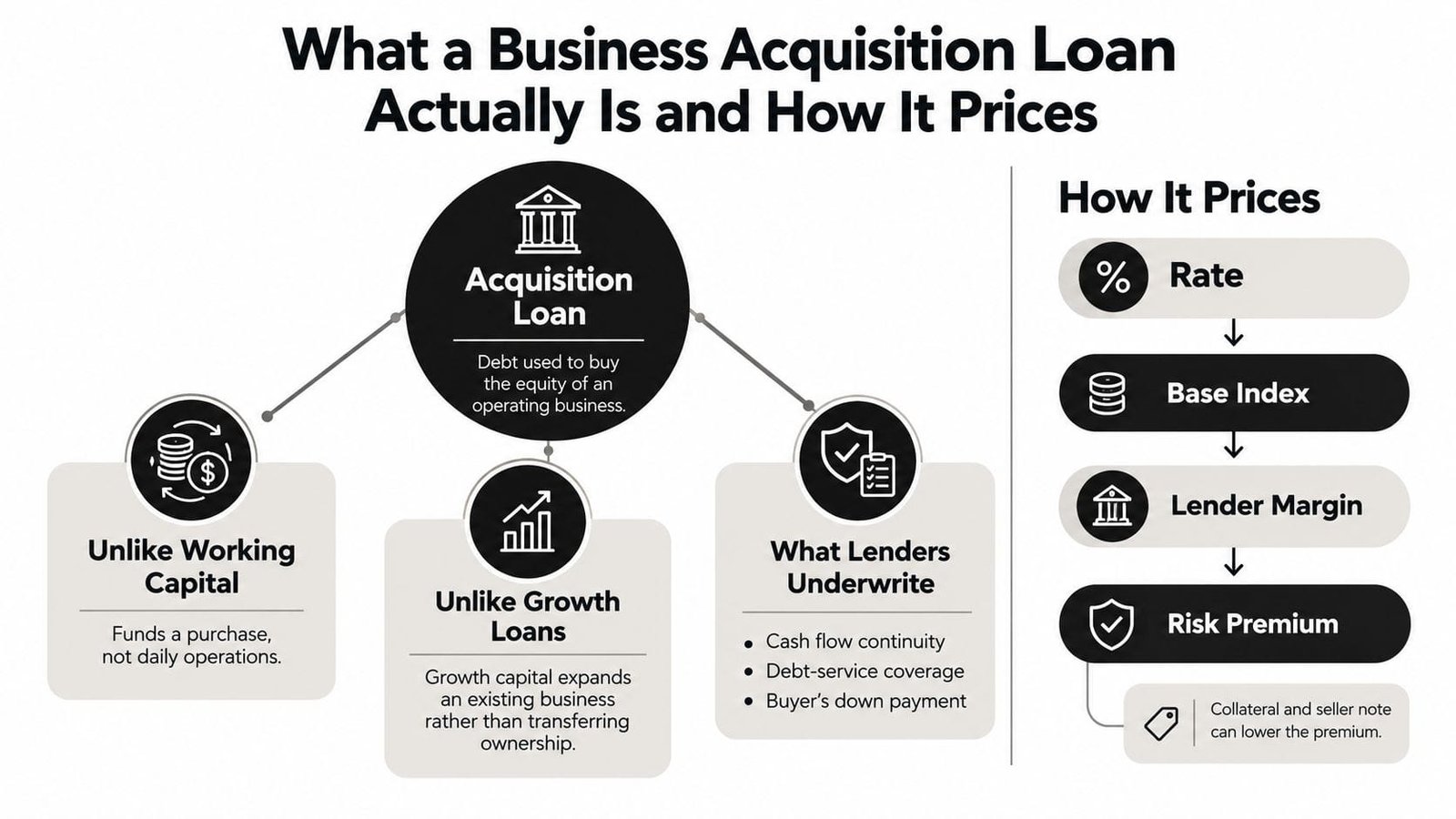
A business acquisition loan finances the purchase of an operating company, usually through an asset purchase, stock purchase, or change-of-control transaction. It's different from a working-capital line because the money funds ownership transfer rather than ordinary operating expenses. It's also different from a growth loan, which supports expansion after the borrower already owns the company.
The lender underwrites two risks at once. First, the buyer must repay the debt. Second, the business must continue producing cash flow after ownership changes. That second risk makes acquisition financing more demanding than many ordinary commercial loans.
The three layers in a loan quote
Most acquisition pricing starts with a base index. SBA and bank loans commonly reference Prime, while lower-middle-market facilities often use SOFR. The lender adds a margin or spread based on debt load, DSCR, collateral, business risk, and borrower quality.
The quoted rate is only one layer. Buyers should separate:
- Interest rate: The percentage applied to the outstanding principal.
- APR or all-in borrowing rate: The rate after eligible fees and financing costs are included.
- Fully loaded cost of capital: The broader economic cost, including required equity, seller-note payments, covenants, refinancing exposure, and lost operating flexibility.
A lender may advertise a 10% rate, but origination fees, packaging charges, guarantee costs, and a short amortization can make the financing materially more expensive than the headline suggests. A longer amortization may increase total interest while lowering monthly debt service and protecting the business from a liquidity squeeze.
SBA 7(a) pricing provides a clear benchmark in the United States. The SBA states that variable loans can charge up to base rate plus 6.5% for loans of $50,000 or less, base rate plus 6.0% for loans from $50,001 to $250,000, base rate plus 4.5% for loans from $250,001 to $350,000, and base rate plus 3.0% for loans above $350,000. See the SBA 7(a) loan rules for the governing structure.
That tiering matters. Larger acquisition loans generally receive tighter maximum spreads, while smaller loans carry a higher permitted margin. Independent 2026 coverage placed current SBA 7(a) rates roughly between 9.75% and 14.75%, depending on loan size and whether the rate is fixed or variable, as summarized by Crestmont Capital's acquisition-financing analysis.
Comparing Acquisition Financing Options Side by Side
The right financing choice depends on the deal's structure, not just the lowest advertised rate. SBA 7(a) financing suits buyers who can complete detailed underwriting and want long amortization. Conventional banks may offer lower pricing to stronger borrowers, but they typically require cleaner cash flow, more collateral, and tighter repayment terms. Private credit and alternative lenders solve speed or higher-debt problems, but that flexibility carries a higher cost.
SBA 504 financing fits transactions that include eligible fixed assets or real estate. It is not a universal substitute for 7(a) acquisition debt. Seller financing can fill a capital-stack gap, while mezzanine debt can provide funding beyond the amount a senior lender will approve.
| Financing option | Typical rate range | Max amortization | Time to close | Best for |
|---|---|---|---|---|
| SBA 7(a) | Approximately 9.75% to 14.75% | Long-term acquisition amortization | Slower than alternative lenders | Smaller-business acquisitions with strong cash flow |
| SBA 504 | Varies by project and lender | Long-term fixed-asset financing | Detailed approval process | Acquisitions involving eligible real estate or equipment |
| Conventional bank | Approximately 7% to 11% | Often shorter than SBA structures | Moderate to slow | Strong borrowers with dependable cash flow and collateral |
| Credit union | Varies by institution | Depends on policy | Moderate | Buyers with a strong local relationship |
| Alternative term lender | Approximately 12% to 25% | Usually shorter | Faster than bank financing | Buyers prioritizing speed or flexible underwriting |
| Revenue-based financing | Contract-specific | Repayment follows revenue | Often fast | Businesses with recurring or highly visible revenue |
| Seller financing | Negotiated | Flexible | Can accelerate closing | Deals where the seller supports the buyer and values flexibility |
| Mezzanine or private credit | Approximately 12% to 17% all-in for mezzanine | Structured around the transaction | Faster than traditional bank processes | Highly debt-dependent deals with a senior-debt shortfall |
| Equipment-led financing | Contract-specific | Linked to the asset | Depends on equipment and lender | Acquisitions with valuable, financeable machinery |
The published rate ranges support a clear pricing ladder. Conventional bank acquisition loans for well-qualified borrowers often fall around 7% to 11%, while alternative lender acquisition loans can range from 12% to 25%, depending on risk. A 2026 analysis of 8,678 funded SBA acquisition loans reported an average approved rate of 9.31%, a median of 9.50%, and an average loan size of $1,175,340. Those figures are reported in Crestmont Capital's business acquisition financing coverage.
Lower-middle-market deals show why the coupon alone is an incomplete comparison. Bank-led senior debt was described around SOFR plus 325 to 425 basis points, or approximately 7.60% to 8.60% using SOFR at 4.35%. Unitranche financing was placed around SOFR plus 500 to 700 basis points, or approximately 9.35% to 11.35%, while fees could bring all-in costs to approximately 9.35% to 14.5%, according to Business.org's acquisition-loan guide.
Compare the full structure before choosing. A lower-rate senior tranche with a shorter amortization can create greater monthly pressure than a higher-rate facility with longer repayment. A fast closing can also cost more through pricing, fees, or a larger equity requirement.
Use SBA or bank debt when the business can support the diligence process and the buyer values payment stability. Use private credit when speed or a higher advance rate is worth the extra yield. Add seller financing when it improves the senior lender's risk position rather than merely increasing total debt.
What Actually Moves Your Acquisition Loan Rate
Lenders don't price an acquisition from the buyer's credit score alone. They price the probability that the acquired company will generate enough dependable cash to service the new debt after the seller exits.
The borrower matters first. Personal credit history, liquidity, management experience, and relevant industry knowledge affect confidence in the transition. Business credit can help, but it rarely rescues a target with weak financial reporting or inconsistent cash flow.
The company matters just as much. A lender will examine the quality of EBITDA, customer concentration, recurring revenue, working-capital needs, supplier dependence, owner add-backs, and the durability of earnings. An aggressive add-back may increase adjusted EBITDA in a presentation but fail to receive full credit in underwriting.
Pricing factors lenders may not show in the rate
A lender can respond to risk without changing the quoted coupon. It may require more equity, tighten covenants, shorten the term, demand a broader guarantee, reduce advance rates, or insist on additional collateral.
| Factor | Typical rate impact | Practical lever |
|---|---|---|
| Personal credit and liquidity | Can move the offer from preferred to higher-risk pricing | Resolve reporting errors and document available liquidity |
| EBITDA quality | Weak or heavily adjusted earnings can widen pricing | Provide support for every add-back and commission adjustment |
| DSCR | Lower coverage reduces repayment comfort | Lower purchase debt or improve the cash-flow case |
| Industry risk | Cyclical or concentrated revenue can increase the premium | Use conservative projections and explain customer retention |
| Deal structure | Stock purchases, earn-outs, and rollover arrangements complicate underwriting | Align purchase terms with lender collateral and repayment requirements |
| Collateral coverage | Limited collateral can reduce lender flexibility | Separate financeable equipment and real-estate components |
| Requested term | Shorter amortization increases required monthly debt service | Request a term that matches the useful life of the cash flow |
| Variable-rate exposure | A rising index increases payment risk | Compare fixed-rate options, caps, and conversion rights |
The pricing impact can be material. On a $1 million acquisition loan, a 1 percentage-point rate increase over 7 years adds roughly $45,000 to $50,000 in interest, while an additional 24 months of amortization can change total interest by more than $80,000, based on the supplied acquisition-finance assumptions.
Index risk deserves its own line item
A SOFR-based loan is not a fixed rate. The borrower pays the index plus the lender's spread, so the payment can rise even when the lender hasn't changed its margin. Prime-linked SBA debt has the same practical issue because the base rate can move.
That's why a quote should show the starting index, spread, reset frequency, rate cap, floor, and conversion terms. A lower initial variable rate may be worse than a higher fixed rate if the business has limited cash-flow tolerance.
The best approach is usually not aggressive bargaining over the margin. It's improving the lender's view of repayment capacity through cleaner diligence, appropriate financing, a credible transition plan, and a term that matches the acquired company's cash-generation pattern.
Realistic Payment Scenarios at Different Rates and Terms
The same principal can produce very different cash requirements depending on amortization. Consider a $1 million acquisition loan under two structures.
Scenario A uses an SBA 7(a) loan at 11.25% over 10 years. Scenario B uses an alternative lender at 13.50% over 7 years. The alternative loan carries the higher rate, but it also repays principal faster. That creates an important distinction between total interest and operating pressure.
| Metric | Scenario A: SBA 7(a) at 11.25%, 10yr | Scenario B: Alt Lender at 13.50%, 7yr |
|---|---|---|
| Loan amount | $1,000,000 | $1,000,000 |
| Interest rate | 11.25% | 13.50% |
| Amortization | 10 years | 7 years |
| Approximate monthly payment | $13,830 | $18,150 |
| Approximate total interest | $660,000 | $525,000 |
| Assumed stabilized EBITDA | $250,000 | $250,000 |
| Illustrative annual debt service | Approximately $165,960 | Approximately $217,800 |
| Illustrative EBITDA-to-debt-service ratio | Approximately 1.51x | Approximately 1.15x |
The payment and interest figures above are the supplied scenario assumptions. The illustrative coverage calculation divides the stated EBITDA by annual principal and interest payments. It isn't a lender's final DSCR calculation, because lenders may adjust EBITDA for taxes, capital expenditures, working capital, owner compensation, and other obligations.
Scenario B generates less total interest because principal amortizes faster. It is still the more uncomfortable structure for a business producing $250,000 of stabilized EBITDA. The annual debt service consumes more of the company's cash flow, leaving less room for a weak quarter, a delayed customer payment, or an unexpected equipment replacement.
The cheaper interest bill can be the more dangerous loan if the payment leaves no room for the business to operate.
The uncomfortable threshold is also different. Scenario A starts to look strained once adjusted cash flow approaches its annual debt service, while Scenario B becomes uncomfortable much sooner because its required payment is substantially higher. A seller note can improve the structure if it is subordinated, deferred, or amortized after the senior debt has stabilized.
A rate buy-down can help, but only if the upfront cost is compared with the savings and the buyer has enough liquidity after closing. Don't spend scarce acquisition cash to reduce a rate while leaving the operating company undercapitalized.
How to Negotiate a Lower Acquisition Loan Rate
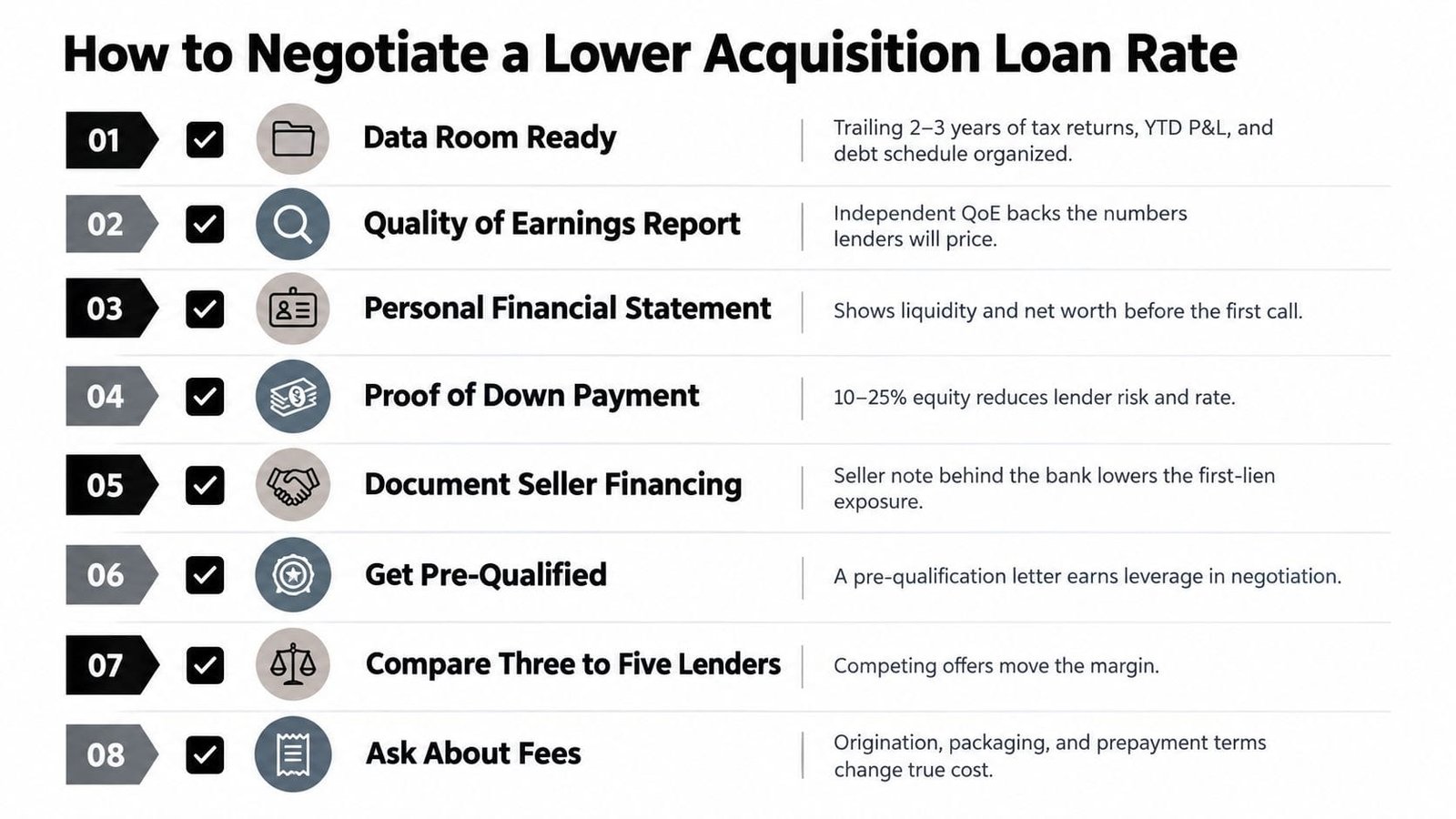
Rate negotiation starts before the first lender call. A clean file gives underwriters fewer reasons to add spread, shorten amortization, or impose protective conditions.
Prepare a lender-ready data room containing:
- Tax returns: Organize the trailing 2 to 3 years of business returns and supporting schedules.
- Current financials: Include the year-to-date P&L, balance sheet, and debt schedule.
- Quality of earnings: Use an independent QoE report when the valuation, add-backs, or customer concentration need validation.
- Transaction documents: Provide a clear CIM or offering memorandum, signed LOI, proposed purchase agreement, and use-of-funds schedule.
- Buyer profile: Include a personal financial statement, resume, industry history, and proof of equity.
Give lenders reasons to improve the structure
More equity can lower debt and improve the lender's loss position. A willing co-borrower or guarantor may strengthen the application, but don't offer a personal guarantee without understanding exactly which obligations and assets it covers.
Seller financing can also help. A subordinated seller note may reduce the senior lender's exposure, but it still creates a future payment obligation. Ask the lender to model the combined debt service rather than evaluating the senior loan in isolation.
Present a DSCR case that relies on defensible cash flow. Run-rate synergies can matter, but unsupported projections won't persuade a cautious credit committee. Show the timing, cost, owner, and evidence behind each improvement.
Shop 3 to 5 lenders within a defined window so the offers remain comparable. Ask every lender to provide the same information:
- Fixed or variable rate and the underlying index
- Amortization and maturity
- Origination, packaging, guarantee, and legal fees
- Prepayment penalties
- Collateral and guarantee requirements
- Financial covenants and reporting obligations
- Interest-only availability during the transition
Interest-only payments during a 6 to 9-month transition period can preserve cash while the buyer takes control, but they may increase later payments or total interest. Fixed-rate conversion rights can reduce index risk, while a narrower guarantee scope may protect personal assets.
The negotiation target isn't a lower margin. It's a structure that gives the business enough cash flow to meet obligations without forcing a refinance or emergency capital raise.
Using a Fintech Platform to Shop Acquisition Loan Rates
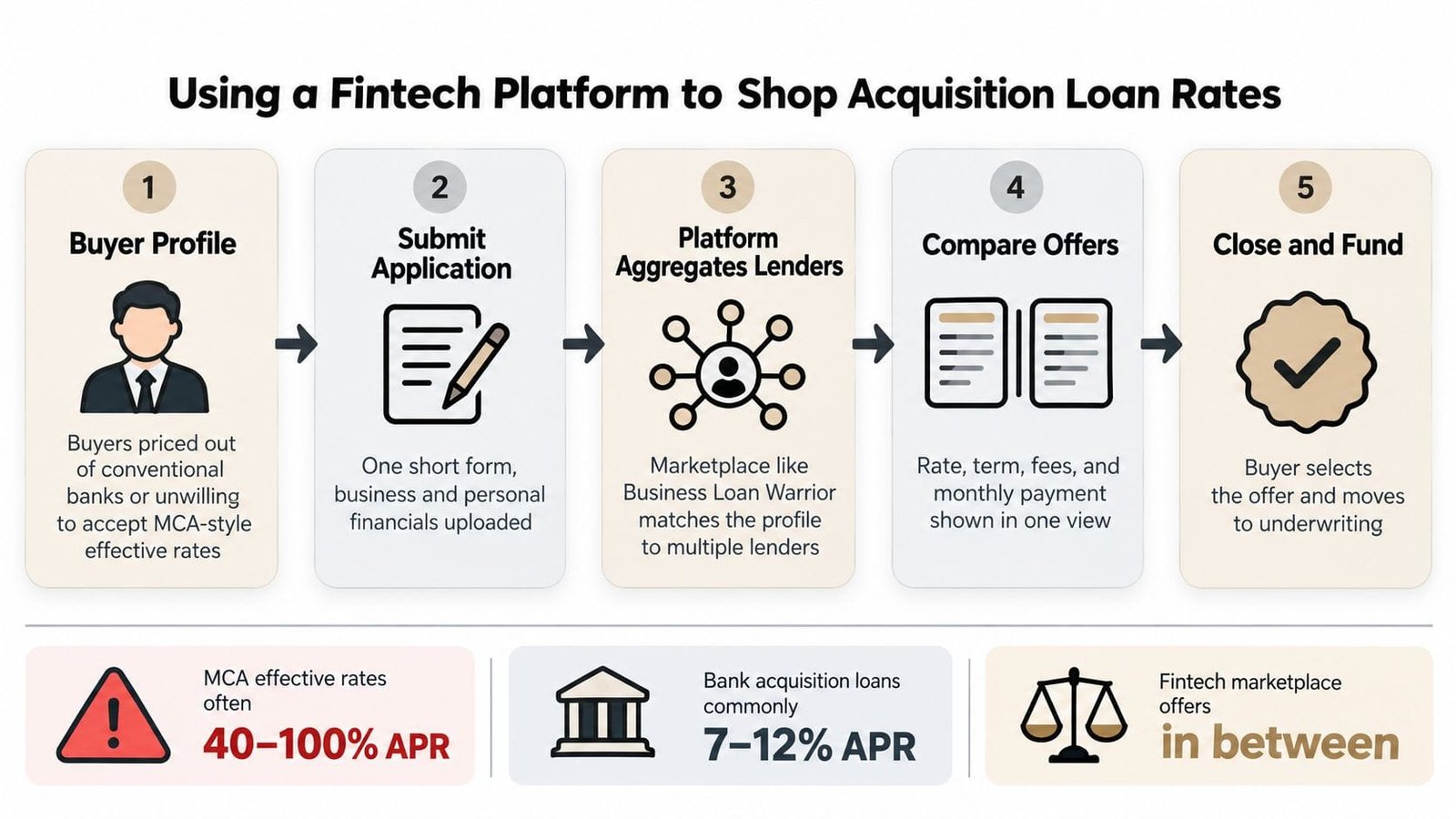
A fintech marketplace can help when a buyer doesn't fit a conventional bank's box but also doesn't want a costly merchant-cash-advance-style product. The useful role is not to replace underwriting. It's to make competing structures easier to find and compare.
A platform such as Business Loan Warrior can accept one application, support pre-qualification without a hard credit impact, connect financial accounts, and present funding options through a dashboard. For an acquisition, the buyer should care less about the number of lenders displayed and more about whether the platform can distinguish an acquisition from ordinary working capital.
Features that matter in an acquisition
Look for filtering by transaction type, deal size, industry, collateral, and repayment structure. A lender match is only useful if the offer shows amortization, payment, fees, DSCR implications, and whether the lender supports an ownership-transfer transaction.
A useful platform should also let the buyer download term sheets for a CPA, attorney, or acquisition adviser. That makes it easier to compare offers on the same basis instead of forwarding screenshots with incomplete pricing details.
Buyers should also ask whether the platform supports SBA packaging, whether a human advisor can discuss seller notes and earn-outs, and whether the displayed offer is indicative or fully underwritten. A marketplace quote is not a commitment letter.
If a marketplace produces 5 to 8 comparable quotes within days, it can reduce the time spent arranging individual lender meetings. The buyer still has to verify covenants, collateral, fees, and final approval conditions. Use digital lending platforms as a comparison channel, not as a substitute for transaction-level diligence.
Choosing the Right Acquisition Loan Structure for Your Deal
The best structure depends on the buyer, the target, and the cash flow left after closing.
| Buyer profile | Best-fit structure | Typical rate range |
|---|---|---|
| Strong credit, relevant experience, and meaningful equity | SBA 7(a) | Approximately 9.75% to 14.75% |
| Established cash flow and strong collateral | Conventional bank | Approximately 7% to 11% |
| Limited acquisition history or tight cash contribution | Seller financing combined with senior debt | Negotiated |
| Deal requiring additional leverage | Mezzanine or private credit | Approximately 12% to 17% all-in for mezzanine |
| Acquisition with financeable machinery or real estate | Equipment-led or asset-backed financing alongside senior debt | Contract-specific |
SBA 7(a) is usually the first structure to test for a smaller operating-business acquisition when the buyer has strong credit, relevant experience, and sufficient equity. A conventional bank can win when the company has clean cash flow and collateral. Seller financing is valuable when the buyer needs flexibility, but it shouldn't conceal an excessive debt load in the deal.
For a broader overview of financing a purchase, review this guide to a business loan to buy a business.
Questions buyers ask during underwriting
Are business acquisition loan rates negotiable? Yes, but lenders often negotiate through spread, amortization, fees, covenants, collateral, and guarantees rather than the coupon alone.
Is SBA always cheaper? No. SBA pricing can be competitive, but fees, variable-rate exposure, and processing time still matter.
Should I choose the lowest rate? Choose the offer that produces an acceptable payment, durable DSCR, manageable fees, and reasonable refinance risk.
What should I compare first? Compare annual debt service and fully loaded cost of capital before comparing the headline rate.
Business Loan Warrior offers a single application for business funding options, including SBA processing, acquisition financing, equipment loans, lines of credit, and alternative structures. Use the platform to compare acquisition loan rates, repayment terms, fees, and lender requirements, then visit Business Loan Warrior to start evaluating financing for your purchase.