
One industry compilation puts the combined global cost of out-of-stocks and overstocks at about US$1.77 trillion, with out-of-stocks alone at roughly US$1.2 trillion (Sci-Tech Today inventory control statistics). That’s why business inventory management isn’t a shelf-stocking task. It’s a cash-flow discipline, a service-level discipline, and, for many owners, a lender-readiness discipline.
When inventory is off, the damage doesn’t stay in the warehouse. Cash gets trapped in slow movers, emergency freight eats margin, and the team starts making bad decisions just to keep sales moving. The owners who treat inventory as working capital usually get cleaner operations, clearer financing conversations, and fewer ugly surprises at month-end.
Table of Contents
- Why Business Inventory Management Is a Cash-Flow Problem
- What Inventory Actually Is and How It Costs You Money
- The Metrics That Matter for SMB Owners
- Choosing the Right System, Counting Method, and Workflow Style
- Picking Software and Rolling It Out Without Disrupting Sales
- The Hidden Inventory Problem Most Guides Ignore
- Turning Inventory Discipline Into Lending Readiness
- Common Pitfalls and a 30-60-90 Day Action Plan
Why Business Inventory Management Is a Cash-Flow Problem
A shelf full of stock can hide a cash shortage fast. Every unit tied up in inventory is money that cannot cover payroll, rent, repairs, ads, or the next purchase order that could turn faster. Weak stock control usually shows up in cash before it shows up in the accounts.
Cash trapped in plain sight
The purchase price is only the starting point. Storage, handling, insurance, shrinkage, obsolescence, and the time spent cleaning up ordering mistakes all sit on top of it. Recent benchmark data puts carrying costs in the 20-30% of total inventory value annually range, according to Unleashed inventory management statistics. That is why a business can look asset-rich on paper and still feel short on liquidity.
Practical rule: if a SKU has not earned its space, it is probably borrowing cash from elsewhere in the business.
Overstock does more than tie up capital. It raises the odds of markdowns, dead stock, and rushed liquidation when demand misses the forecast. Understock creates a different drag, because the first lost sale is only part of the cost, the second is the customer who stops trusting your availability. For owners trying to keep money moving, working capital for businesses is the right lens, because stock decisions and cash decisions usually land in the same place.
The operational side matters too. If you are comparing software or trying to tighten control, inventory tools from Wistec can help you assess what kind of system fits your counting discipline and buying habits before more cash gets trapped in the wrong products.
What discipline actually buys you
Strong inventory management does more than keep counts tidy. It shortens the time between buying stock and turning it back into cash, which makes daily planning easier and makes financing conversations less stressful. Lenders look at inventory as part of working capital, so slow-moving stock and bloated buy plans can affect how your business reads from the outside.
That is why owners should watch inventory and working capital together, not as separate problems. The useful questions are simple: how much money is sitting in stock, how fast does it move, and how much pressure does that create during seasonal peaks or supply delays? A practical visual of the cash loop is shown below.
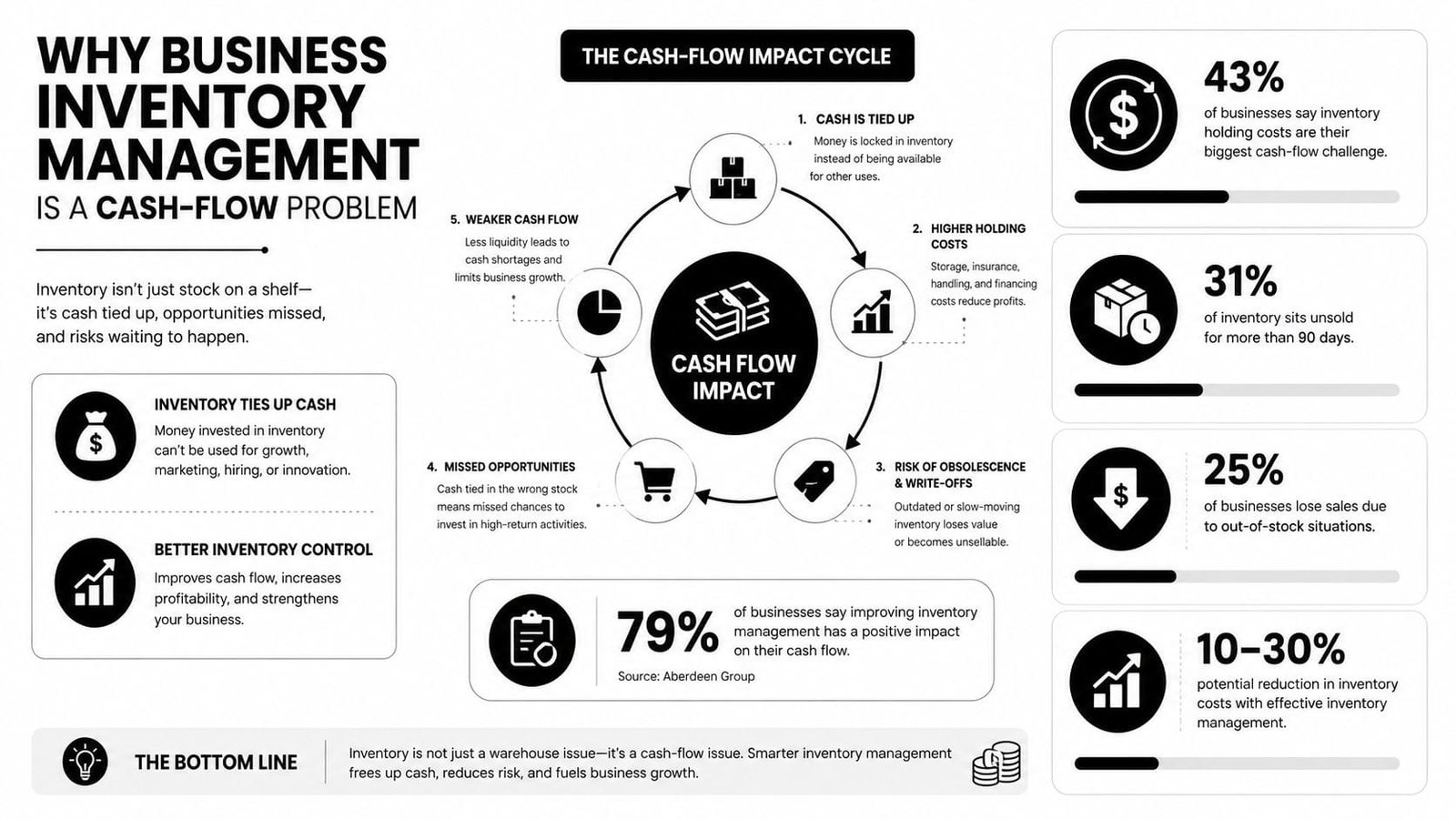
The best systems do not just count units. They protect cash, reduce scramble, and make financing less reactive. If inventory is drifting, the fix usually starts with discipline, not with buying more stock.
What Inventory Actually Is and How It Costs You Money
Inventory is any asset held for sale, use in production, or support of operations. In practice, that means raw materials, work-in-progress, and finished goods, plus the supplies that keep the business moving. A restaurant’s flour, dough in prep, and boxed takeout meals all sit in different stages, but they all represent money waiting to be converted.
The categories that matter
Raw materials are the inputs. A custom cabinet shop might hold lumber, hardware, and finishes. Work-in-progress is inventory already committed to labor but not yet ready to sell. Finished goods are the products ready to leave the shelf, the dock, or the POS.
A small apparel retailer shows the difference clearly. Fabric and trim are raw materials if the business makes private-label product, cut-and-sew pieces in process are WIP, and packed shirts on hangers are finished goods. Each stage creates different risks, which is why owners need to know where the stock sits, not just how much exists.
The three cost buckets
Inventory creates three cost buckets that hit differently:
- Holding costs cover storage, insurance, shrinkage, spoilage, and obsolescence.
- Ordering costs include purchasing admin, vendor follow-up, and inbound freight.
- Shortage costs show up as lost sales, rush replenishment, and customer churn.
The useful question isn’t “How much inventory do we have?” It’s “What does this inventory cost us while it waits?” If a slow-moving item needs a big shelf footprint and a lot of attention, it can be more expensive than it looks on paper.
Inventory only looks cheap when you ignore the time it spends sitting still.
The most practical discipline is to separate stock by behavior, not just by name. Fast movers deserve different ordering logic from seasonal or bulky items. Perishable or fashion-sensitive inventory needs tighter review cycles than commodity parts, because the cost of being wrong rises quickly.
That’s why good inventory management is partly vocabulary. Once the team can distinguish categories and cost buckets, it becomes easier to set reorder rules, assign ownership, and stop treating every SKU like it deserves the same policy.
The Metrics That Matter for SMB Owners
Dashboards fill up fast, but owners do not need a wall of charts. Five metrics carry most of the load: inventory turnover, fill rate, stockout rate, carrying cost percentage, and record accuracy. A strong inventory program uses these numbers to guide buying, replenishment, and cash decisions, not just to file a report.
The five KPIs in plain English
Inventory turnover shows how often stock is sold and replaced. It is calculated as cost of goods sold divided by average inventory. For owners, the point is not to chase a high number for its own sake. The question is whether money is sitting in stock longer than the business can afford. A widely cited benchmark from Unleashed inventory management statistics gives owners a rough comparison point, but your own category trend matters more than any broad average.
Fill rate shows how often demand can be satisfied from stock on hand. Stockout rate is the opposite signal, the share of demand missed because the shelf is empty. Carrying cost percentage measures what it costs to hold inventory relative to its value, and record accuracy shows whether the system matches physical reality.
The owner lens is straightforward. A café that keeps missing a critical ingredient on Saturday morning has a fill-rate problem. A hardware store that keeps too many slow-moving drill bits has a turnover problem. A brand with frequent count errors has an accuracy problem, and that error usually spreads into reorder decisions, purchasing, and lender conversations about how tightly the business is controlled.
A simple table for baseline thinking
| KPI | Formula | Healthy SMB Range | Warning Sign It Reveals |
|---|---|---|---|
| Inventory Turnover | COGS ÷ Average Inventory | Depends on category, but should be monitored against your own baseline | Cash is trapped too long |
| Fill Rate | Orders filled from stock ÷ Total orders | High enough to protect service levels | Demand is being missed |
| Stockout Rate | Stockouts ÷ Demand events | Low and trending down | Lost sales and emergency buying |
| Carrying Cost Percentage | Annual holding cost ÷ Average inventory | Kept under tight review | Inventory is expensive to hold |
| Record Accuracy | System count vs. physical count | Must stay close enough for reorder decisions | Reorder points are unreliable |
For ecommerce operators, a practical way to frame these metrics appears in Cosmy’s guide to eCommerce KPIs, especially if the business sells across channels and needs to connect stock behavior to order performance.
What weak numbers usually mean
Weak turnover usually means the buying team is over-ordering, or the assortment has too many slow movers. Weak accuracy means counts, receiving, or adjustments are not controlled tightly enough. Weak fill rate usually means the business is reacting to demand after the sale instead of planning for it.
Each metric affects the others. If record accuracy slips, reorder points become unreliable. If turnover falls and carrying costs rise, cash gets tied up in stock that does not help service levels or lending readiness. Owners should pick a baseline, document it, and track movement weekly instead of waiting for quarter-end to react.
Choosing the Right System, Counting Method, and Workflow Style
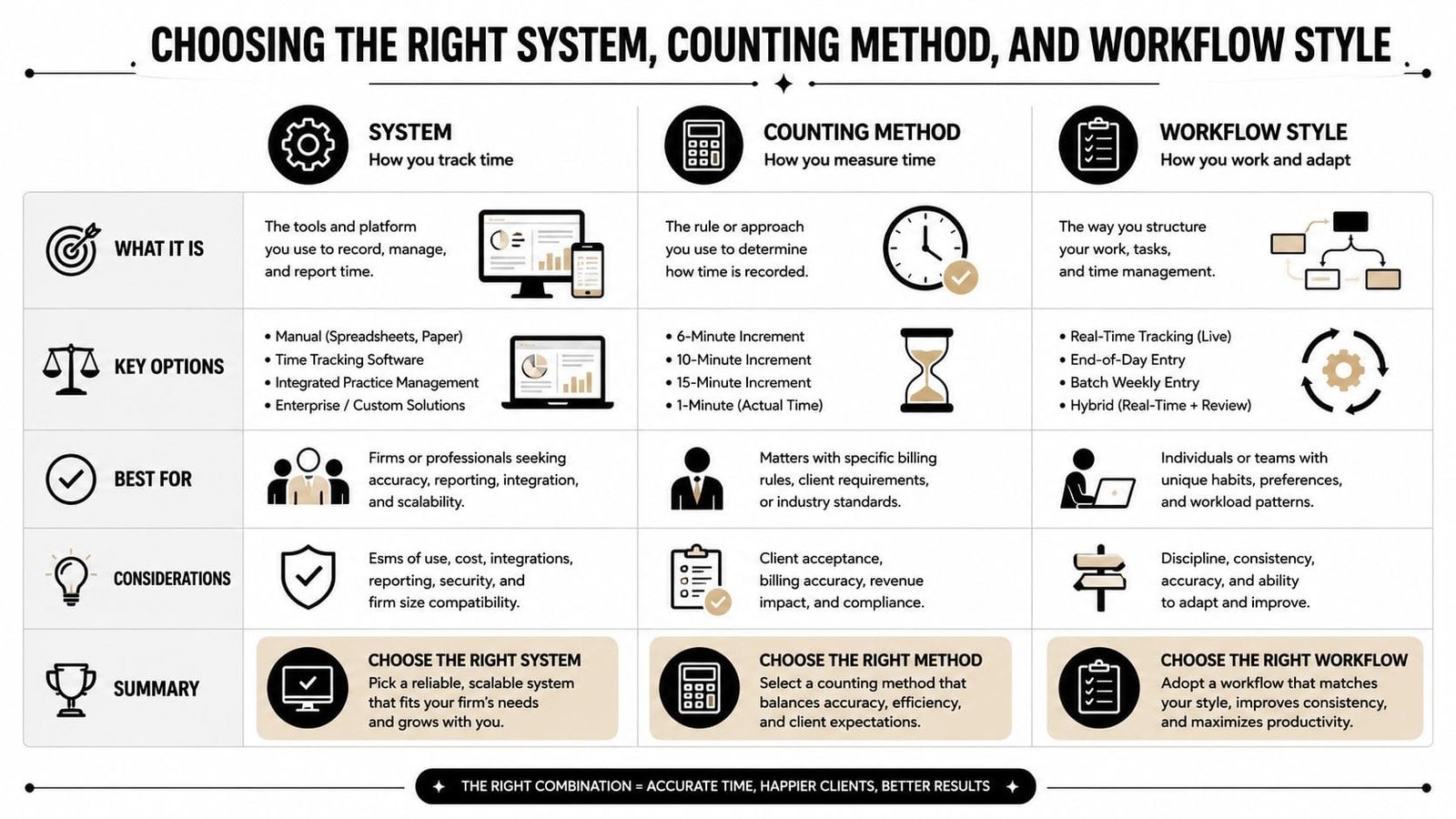
The right inventory setup depends on SKU count, transaction speed, lead-time variability, and labor budget. A multi-location boutique, a parts yard, and an ecommerce brand can all use “inventory software,” but they shouldn’t use the same operating model. The trick is to match the control method to the risk.
Perpetual vs. periodic
A perpetual system updates inventory after each transaction. That’s the better fit for businesses with fast-moving stock, multiple channels, or tight margins, because it gives near-real-time visibility. A periodic system updates on a schedule, which can work for smaller operations with simple assortments, but it leaves blind spots between counts.
Perpetual control is more demanding, but it’s also more honest. If the business can’t see stock movement as it happens, it often discovers problems only after a sale fails or a count is already off.
Manual, barcode, or RFID
Manual spreadsheets can still work for low-volume operations with disciplined staff, but they become fragile quickly. Barcode scanning is usually the best jump in accuracy for a growing SMB, because it reduces entry error and speeds receiving, transfers, and cycle counts. RFID is stronger in dense, high-volume environments, but it’s a more expensive and more complex leap.
FIFO, LIFO, and weighted average
FIFO suits goods that age, expire, or change fast. LIFO may fit certain accounting contexts, but many SMB owners never need it operationally. Weighted average cost can simplify valuation where individual unit cost differences are small and frequent.
The right answer depends on how the business behaves. A restaurant with date-sensitive inputs needs FIFO discipline. A contractor with mixed parts inventory may care more about availability and fewer count errors than about precise unit-level valuation. A growing ecommerce brand often needs barcode control first, then valuation consistency second.
Practical rule: don’t copy the system from a bigger business. Copy the control level that matches your real mess.
A short video walkthrough can help staff visualize the workflow changes and the counting cadence.
For daily operations, combine the system with a small set of rules. Reorder points, safety stock, and cycle counts should fit the lead time and variability of the item, not the preferences of the person ordering it. That’s what keeps the system practical instead of theoretical.
Picking Software and Rolling It Out Without Disrupting Sales
Software should reduce friction, not create a new job for the team. The best inventory platform for an SMB usually integrates cleanly with POS, ecommerce, and accounting, supports the way the business stores stock, and gives enough reporting depth to keep owners from exporting to spreadsheets every Friday. If a vendor can’t explain how the system handles multi-location stock, lot or serial tracking, and mobile scanning, keep looking.
What to check before you buy
The selection process gets easier when you test the software against daily work:
- Integration fit: Confirm it connects with your POS, ecommerce store, and accounting system without manual rekeying.
- SKU depth: Make sure it handles variants, bundles, lots, serials, and units of measure cleanly.
- Location logic: If the business has multiple sites, transfers and visibility need to work without workarounds.
- Reporting quality: Owners need dashboards for stockouts, aging, and accuracy, not just a prettier item list.
- Total cost: Ask about setup fees, support, training, add-ons, and user limits before committing.
For ecommerce teams, recommended inventory solutions from Reddog Consulting can be a useful comparison point when you’re sorting through tool categories and integration depth.
Rollout without breaking operations
Start by cleaning the master data. SKUs, units of measure, item costs, vendor names, and location labels need to be standardized before migration, or the new system just imports old confusion. Then pilot one store, one category, or one warehouse aisle before rolling out company-wide.
After that, train by task, not by feature list. Receivers should know how to receive stock, pickers should know how to confirm quantities, and managers should know how to resolve exceptions. Parallel reporting helps too, because it lets you compare the old process and the new system until the numbers line up.
Clean data beats fancy software every time.
A strong implementation also defines ownership early. Someone has to own count adjustments, someone has to approve item setup, and someone has to watch KPI drift after go-live. Without that, the platform becomes a passive database instead of a control system.
The goal is confidence. Staff should trust the numbers enough to act on them, and owners should trust the numbers enough to make buying decisions from them.
The Hidden Inventory Problem Most Guides Ignore
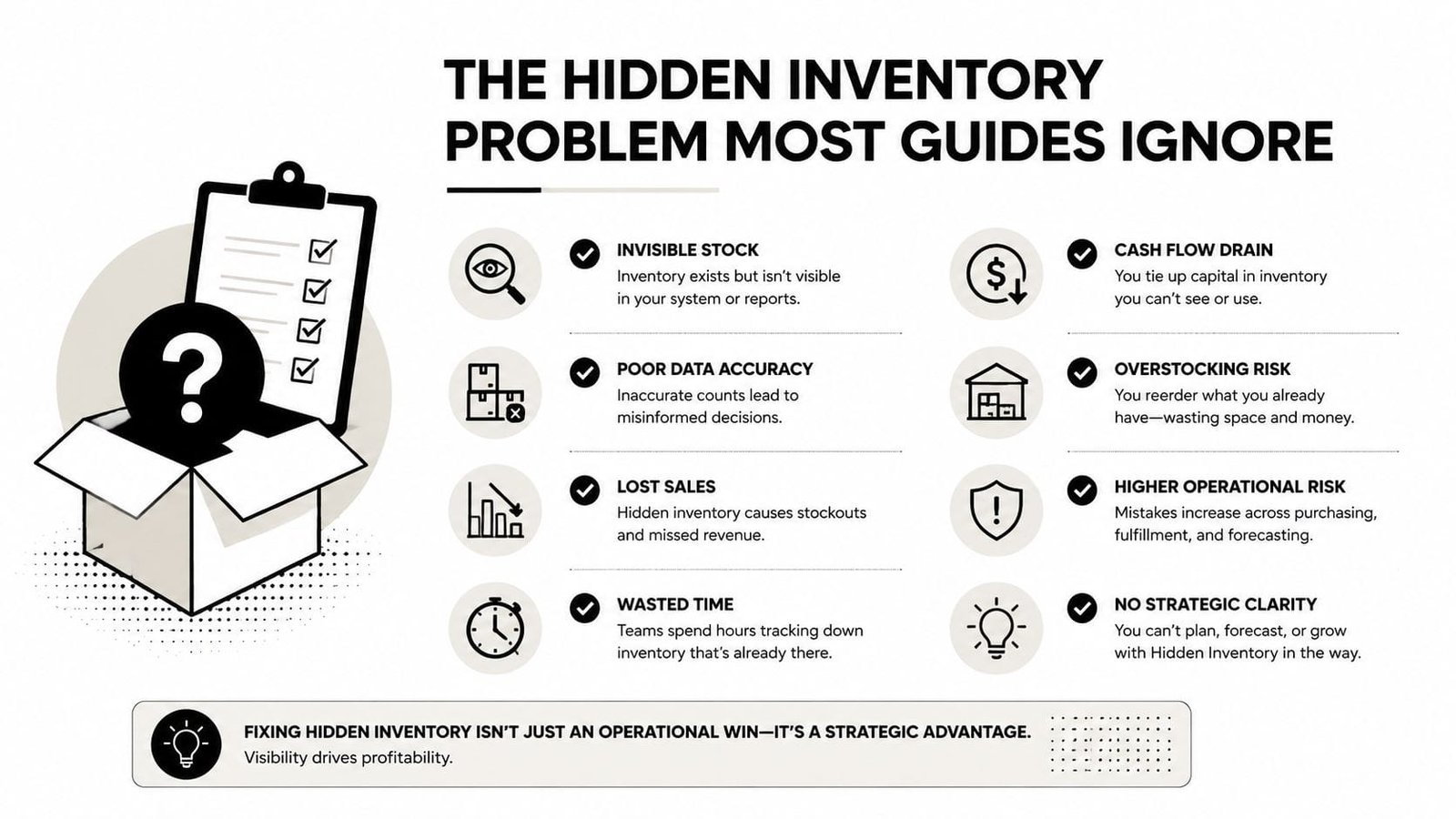
Some inventory is visible, but not sellable. The system says it exists, yet the team cannot ship it, pick it, or allocate it. That gap shows up as phantom availability, and it is one of the fastest ways to lose margin in an omnichannel business.
Where invisible inventory comes from
Miscounts are the obvious source, but they are only the start. Channel mismatch across stores and marketplaces creates duplicate availability. Returns in transit can sit in limbo, and shrinkage from damage or theft can distort the record. Promotional holds also create a false sense of availability if they are not released or reconciled fast enough.
The scale of the distortion matters. Industry reporting from Supply Chain Dive on out-of-stock and overstock costs points to a combined global cost in the trillions, with out-of-stocks carrying the larger share. That is not just a warehouse issue, because phantom stock can hit revenue, customer trust, and cash at the same time.
What works in real operations
The best control is centralized sync across every channel that can sell the same SKU. After that, exception-based reconciliation matters more than endless counting, because the team should focus on items that move fast, disappear often, or cause the most damage when they are wrong. Anomaly detection helps too, especially when shrinkage or adjustment patterns do not match normal activity.
For fast-growing omnichannel sellers, the priority order usually looks like this:
- Centralize availability: One stock record should drive stores, ecommerce, and marketplaces.
- Reconcile exceptions: Do not wait for month-end to find out a channel went out of sync.
- Track shrinkage separately: Damage, theft, and write-offs need their own review path.
- Release holds fast: Promotional or quarantine stock should not stay frozen after the reason ends.
If the business is selling on more than one channel, the risk is not just overselling. It is making pricing, buying, and marketing decisions on top of a false stock picture. That is how margin leaks through a system that looks healthy on paper.
For owners who want to connect inventory control with cash discipline, this guide on turning cash conversion cycle into a borrowing base advantage is a useful companion.
Turning Inventory Discipline Into Lending Readiness
Lenders don’t just ask whether inventory exists. They ask how quickly it turns, how much cash it absorbs, and how reliably the record can support the value you claim. That’s why clean inventory management can improve borrowing conversations long before a business applies for money.
How lenders read stock
Turnover tells a lender whether the business is converting inventory into sales efficiently. Days on hand shows how long cash is tied up before stock moves. Carrying cost gives the lender a sense of how expensive the asset is to keep on the books. Together, these measures show whether inventory is helping the business grow or constraining it.
A useful internal lens is to treat inventory like a financing asset with risk attached. If the records are messy, valuations are inconsistent, or counts don’t reconcile, underwriting slows down because someone has to trust the numbers before they can lend against them. Clean SKU-level data, aging reports, and regular count reconciliations make the asset easier to evaluate.
What to have ready before a funding conversation
A lender-ready inventory file doesn’t need to be complicated. It does need to be clean.
- Perpetual records: Keep item-level movement visible and current.
- Aging reports: Separate fresh stock from slow-moving stock.
- Count reconciliations: Show where physical counts agree with system records.
- Valuation logic: Make the costing method clear and consistent.
- Exception notes: Document shrinkage, write-offs, and unusual adjustments.
The fastest way to create confidence is to show that inventory discipline exists before anyone asks for it. A business that can explain turnover, stock age, and valuation clearly is easier to underwrite than one that only has a pile of reports.
If borrowing is part of the growth plan, the cash conversion cycle matters too, because stock, payables, and receivables move together. The financing angle is explored in more depth in this guide on turning the cash conversion cycle into a borrowing-base advantage.
When inventory and finance speak the same language, the owner gets better options. That can mean cleaner approvals, fewer back-and-forth questions, and a stronger position when terms are being discussed.
Common Pitfalls and a 30-60-90 Day Action Plan
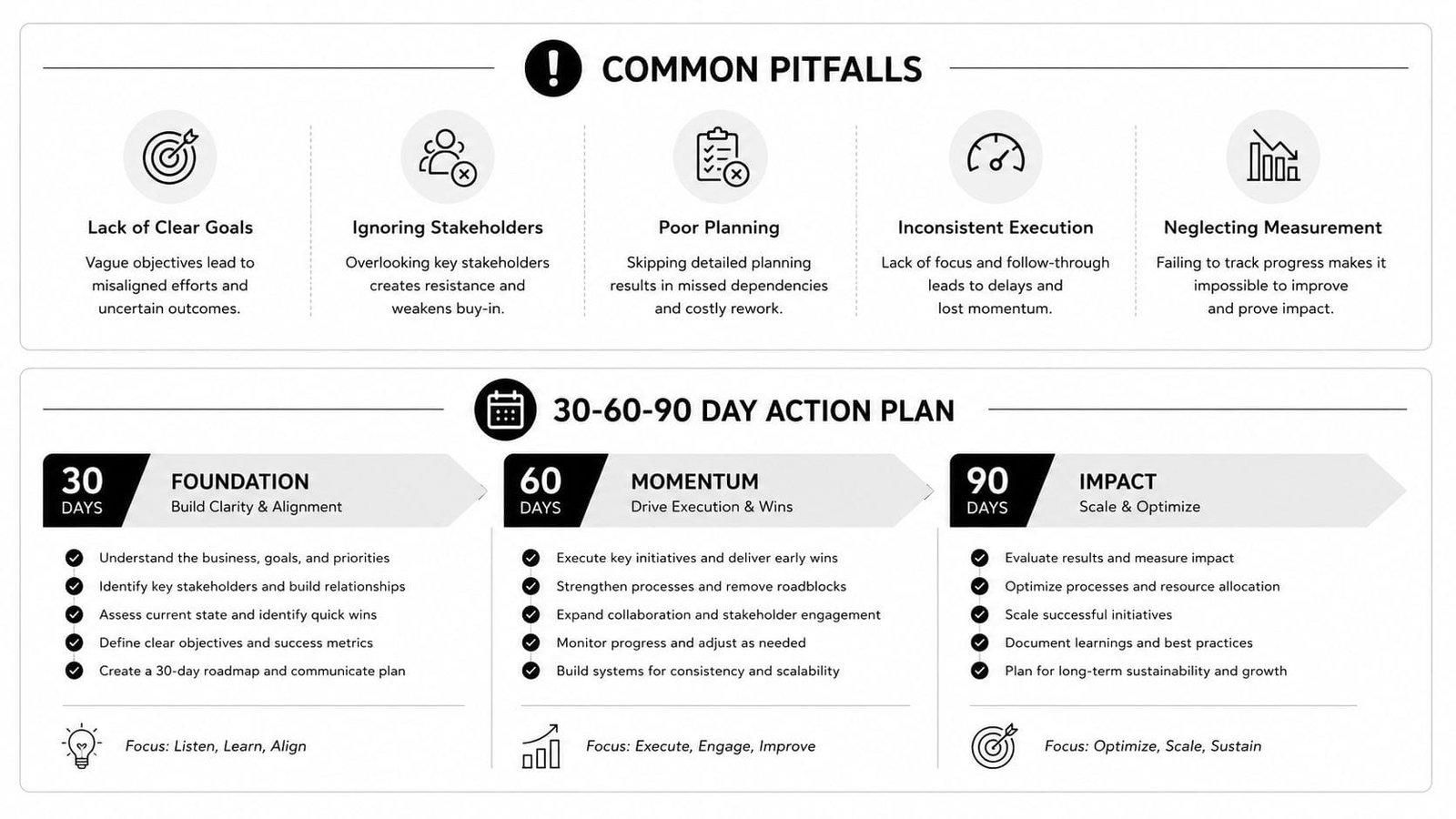
Most inventory problems come from a few predictable mistakes. Owners chase discounts into overstock, ignore lead-time variability, skip cycle counts, and assume software will solve a process problem on its own. Promotions also get launched before anyone checks on-hand stock, which is a fast way to create both stockouts and customer frustration.
The fixes that actually stick
- Chasing discounts into overstock: Buy to demand, not to emotion.
- Ignoring lead-time variability: Build reorder rules around the actual delivery window, not the ideal one.
- Skipping cycle counts: Count the high-risk items often enough to catch drift early.
- Treating software as set-and-forget: Assign an owner to keep data clean and exceptions closed.
- Running promos blind: Check available stock before marketing pushes inventory harder.
A practical guide on cash discipline can also help here, especially if inventory issues are pulling cash too hard in one direction. The owner-focused resource on how to improve cash flow is a good companion when inventory and liquidity problems are happening at the same time.
A realistic 30-60-90 day plan
Days 1 to 30: Baseline the five core KPIs, clean master data, and identify the top SKUs by risk or volume. Get one accurate physical count and compare it to the system.
Days 31 to 60: Roll out barcode scanning for the highest-impact items, define reorder points, and start cycle counting the fastest movers.
Days 61 to 90: Tune safety stock, align inventory targets with finance, and document the before-and-after numbers for lending conversations or internal review.
The best next move is simple. Pick the 20% of SKUs that drive most of the pain, clean those records first, and build the control system around them instead of trying to fix everything at once.