
You've found the equipment, signed the lease, and built a cash-flow forecast that supports expansion. Then the lender asks a question that changes the conversation: What can you pledge as business loan collateral? You may own machinery, inventory, receivables, or property, but that doesn't automatically mean every asset is available, valuable enough, or safe to offer.
Collateral can influence whether a lender approves an application, how much the lender is willing to advance, and how much operating freedom you'll retain afterward. It can also reach further than expected through blanket liens and personal guarantees. The right decision isn't “secured or unsecured.” It's about understanding exactly what a lender can claim, how the arrangement affects future borrowing, and whether the funding's business benefit justifies the risk.
Table of Contents
- Introduction Why Collateral Decides Your Loan Outcome
- What Business Loan Collateral Really Means
- Types of Collateral Lenders Accept for Business Loans
- How Lenders Value Collateral and Secure Their Interest
- The Hidden Reach of Blanket Liens and Personal Guarantees
- Risks Alternatives and When You Can Avoid Collateral
- Making a Confident Collateral Decision for Your Business
Introduction Why Collateral Decides Your Loan Outcome
A restaurant owner may apply for financing to renovate a second location. The business has steady sales, functioning equipment, and valuable inventory, but the owner's balance sheet is heavily committed to existing obligations. The lender doesn't just ask whether the restaurant can repay. It asks what happens if repayment stops and which assets could help recover the unpaid balance.
That question matters because collateral gives the lender a recovery route beyond the business's future cash flow. A secured loan connects repayment to identified property, such as equipment, accounts receivable, inventory, or real estate. An unsecured facility relies more heavily on credit history, financial performance, and the borrower's promise to pay.
Collateral is common because lenders use it to manage the potential severity of a loss. The importance of that practice is visible in the U.S. Census Bureau working paper on small business lending, which reports that over 88% of small business loans were backed by collateral in 2016. In Europe, the European Central Bank has found that 70% of credit amounts are collateralized on average, reinforcing that secured lending is a broad financial practice rather than an unusual condition.
Practical rule: Treat collateral as a strategic financing decision, not a box to check on an application.
This guide will help you understand what business loan collateral means, which assets lenders typically consider, how liens are created, and why a general lien can affect property you hoped to use later. You'll also see when an asset-light company may have alternatives, including underwriting based on verified banking and cash-flow data.
The most useful question isn't “Can I pledge something?” It's “What will I give up, and what will the financing let my business accomplish?”
What Business Loan Collateral Really Means
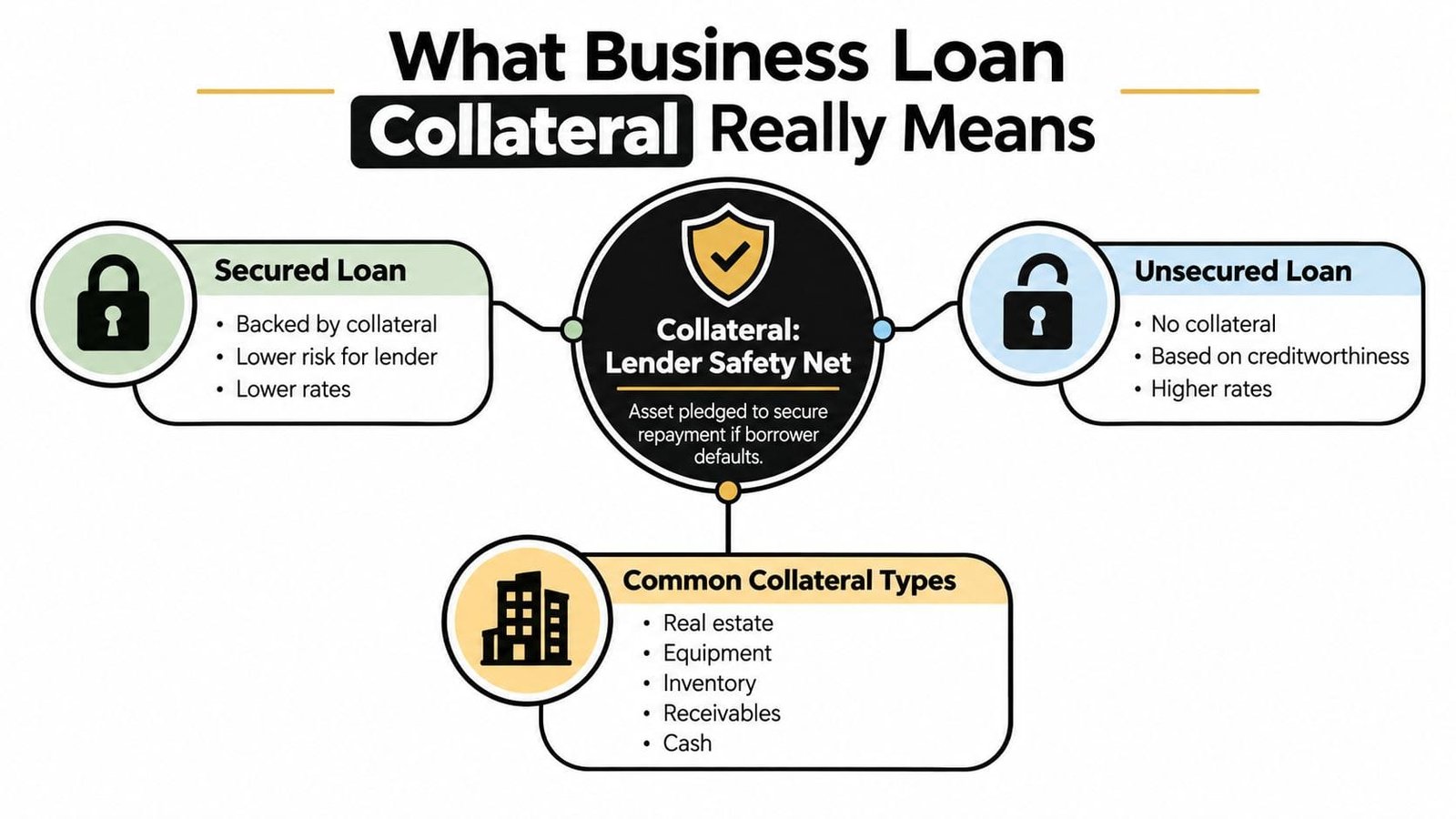
Think of collateral as a lender's safety net. If you borrow money to buy a delivery vehicle, the vehicle may support the loan because it has identifiable value and can potentially be sold if the business doesn't repay. The lender still expects payments from your business's cash flow, but the pledged asset provides another recovery path.
That distinction creates two broad structures:
- Secured financing: The lender has a legal claim connected to specific property or a wider pool of business assets.
- Unsecured financing: The lender doesn't take a conventional asset pledge and instead evaluates repayment capacity, creditworthiness, and other risk factors.
A secured loan doesn't mean the lender owns the asset while you're making payments. You generally continue using the property, subject to the agreement. The lender's rights become important if you breach the loan terms, default, or trigger another event described in the documents.
Why lenders ask for collateral
A lender faces uncertainty whenever it advances capital. A young company may have limited operating history. An established company may experience seasonal revenue, customer concentration, or volatile working capital. Collateral can reduce the amount the lender might lose if the business fails to repay.
That risk reduction can support a larger loan or more favorable pricing, although it doesn't guarantee approval or a particular rate. Lenders also consider whether an asset is easy to identify, maintain, value, and sell. A specialized machine with a narrow resale market may provide less comfort than a broadly useful piece of equipment or a well-documented receivable.
What happens after default
Default doesn't automatically mean that a lender immediately takes every item named in a conversation. The legal outcome depends on the loan documents, the type of collateral, the lender's perfected security interest, applicable law, and the borrower's actions after default.
The lender may enforce its rights against pledged property and apply proceeds toward the debt. If the collateral doesn't cover the full balance, the borrower may still owe the remaining amount, depending on the agreement and applicable law. A personal guarantee can also expose the guarantor personally, which is why the signature page deserves as much attention as the collateral schedule.
Types of Collateral Lenders Accept for Business Loans
Different assets create different levels of comfort for lenders. A property appraisal may provide a clearer reference point than the resale value of customized inventory. Receivables may be valuable, but their usefulness depends on whether customers pay, whether invoices are disputed, and whether another lender already claims them.
| Collateral Type | How Lenders View It | Best For |
|---|---|---|
| Real estate | Potentially substantial value, but subject to appraisal, priority, title, and sale considerations | Property purchases, expansion, and larger secured facilities |
| Equipment | Identifiable and tied to a specific financing purpose, with value affected by condition and resale demand | Machinery, vehicles, technology, and production assets |
| Inventory | Useful working-capital support, but value can change with age, demand, and obsolescence | Retailers, wholesalers, and product-based companies |
| Accounts receivable | Closely tied to customer quality, invoice eligibility, and collection history | Businesses waiting for commercial customers to pay |
| Cash and securities | Highly liquid and easier to value, but pledging them can reduce personal or corporate flexibility | Borrowers with liquid reserves or investment accounts |
| Blanket lien | Broad claim over categories of business property, often combined with a guarantee | Revolving credit, online lending, and general-purpose financing |
Matching the asset to the purpose
Equipment often fits a loan used to acquire that equipment because the lender can identify the financed property and connect its useful business purpose to repayment. A contractor might pledge a work vehicle or specialized machinery, while a manufacturer may use production equipment.
Inventory and receivables are more fluid. A retailer's inventory changes daily, and a service company's receivables may depend on contract terms and customer payment behavior. Lenders may monitor those assets rather than treating them as a one-time pledge.
Real estate can support substantial financing, but pledging a property involves more than estimating market value. Ownership, existing mortgages, title issues, priority, and the legal documents used to create the claim all matter. Borrowers reviewing property-secured financing may find a useful legal reference in 2026 California deeds of trust and notes, particularly when they need to understand how real estate security documents fit with the broader loan agreement.
The SBA threshold borrowers should know
The Small Business Administration's lender guidance states that loans of $50,000 or less don't require collateral. Loans from $50,001 to $500,000 are subject to a lender's written collateral policies, and lenders may not decline a loan solely because collateral is inadequate.
That framework doesn't mean every borrower receives funding without reviewing assets. It shows how collateral expectations can change with loan size and program rules. Before offering property, ask the lender whether it needs a specific asset, a category of assets, or a broader lien.
How Lenders Value Collateral and Secure Their Interest
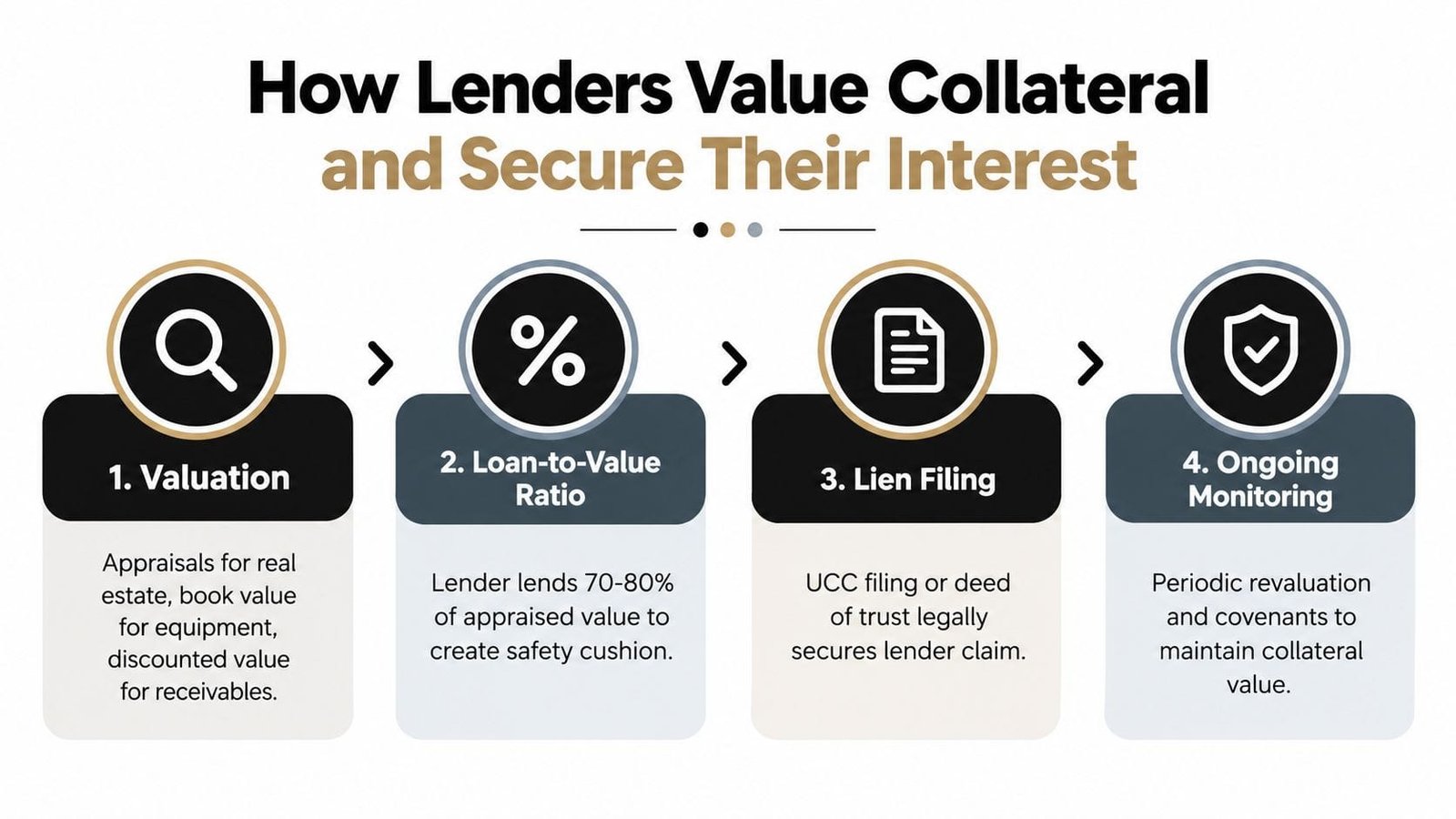
A lender rarely treats an asset's headline value as the amount it can safely lend. The lender cares about the asset's recoverable value, which accounts for uncertainty, selling costs, market conditions, and the time required to convert property into cash.
Real estate may require an appraisal and title review. Equipment may be assessed using purchase records, condition, age, and market demand. Inventory can be evaluated through accounting records and inspection, while receivables may receive a discount if customers have extended payment terms, dispute invoices, or have weak credit profiles.
Why valuation creates a cushion
Lenders commonly apply a loan-to-value approach. They lend against only part of an asset's assessed value, leaving a cushion between the loan balance and the estimated recovery value. The exact advance level depends on the asset, the lender, the borrower's finances, and the loan structure.
That cushion protects against a decline in value or an expensive liquidation process. A machine may sell for less than its accounting value. Inventory may become obsolete. An invoice may remain unpaid. The lender's calculation reflects those possibilities rather than assuming a perfect sale.
This is why your balance sheet may show enough assets to cover a requested loan while the lender still says the borrowing base is insufficient. Book value, market value, and lendable value are different concepts.
How the legal claim is established
The loan documents typically describe the collateral and grant the lender a security interest. In the United States, a lender may use a UCC filing for certain personal-property collateral. Real estate transactions may use a mortgage or deed of trust, depending on state law and the property involved.
The filing or recording gives notice of the lender's claim and helps establish priority against other creditors. Priority matters because another creditor may already have rights in the same equipment, receivables, inventory, or property.
For revolving facilities, lenders may also monitor the borrowing base over time. A business that wants a practical overview of this process can review the borrowing base monitoring playbook for keeping SMB lines accurate between audits. The central lesson is straightforward: collateral isn't assessed only at closing. Its value and eligibility may continue to affect available credit.
The Hidden Reach of Blanket Liens and Personal Guarantees
A borrower may hear “the loan is secured” and assume one specific asset is at risk. That assumption can be wrong. Some financing uses an asset-specific lien, such as a claim on a particular vehicle. Other agreements use a blanket lien, which can cover broad categories of present and future business property.
A personal guarantee creates a separate layer. It's a promise by an owner or another individual to repay the obligation if the business doesn't. The guarantee may not be collateral itself, but it can make the signer personally responsible for the debt and may lead to claims against personal assets under the agreement and applicable law.

Three operating scenarios
A retailer with a blanket lien may continue selling inventory in the ordinary course of business, but the agreement can still affect what happens outside normal operations. Selling major equipment, transferring assets, or taking another secured loan may require lender consent or coordination.
A contractor may finance a vehicle under an asset-specific lien, then discover that a separate working-capital facility has a broader claim over receivables and equipment. The business can use the truck, but refinancing or selling it may require a payoff, lien release, or permission from the lender with priority rights.
A service firm may own little physical property, so an online lender may rely on a general lien and personal guarantee. The absence of a neatly listed machine or building doesn't necessarily mean the owner has no exposure. The SoFi explanation of collateral and guarantees discusses how online lending can combine a general lien with a personal guarantee and how SBA-related borrowing may involve residential or investment real estate when business assets don't fully secure the debt.
Read the collateral description literally: “All business assets” can mean something very different from “the equipment purchased with loan proceeds.”
Questions to ask before signing
Review the security agreement, guarantee, lien authorization, and any collateral schedule together. Ask whether the lien covers after-acquired property, proceeds from asset sales, deposit accounts, intellectual property, or property already pledged elsewhere.
Also ask how the arrangement affects future borrowing. A later lender may refuse to lend against the same assets, require a subordination agreement, or demand that the first lender release part of its claim. That can make refinancing slower and reduce your choices during a cash-flow crunch.
The practical issue isn't just what you pledge today. It's whether the lien prevents you from using tomorrow's assets to finance the next stage of growth. For a focused explanation of this structure, see what a blanket lien means for a business borrower.
Risks Alternatives and When You Can Avoid Collateral
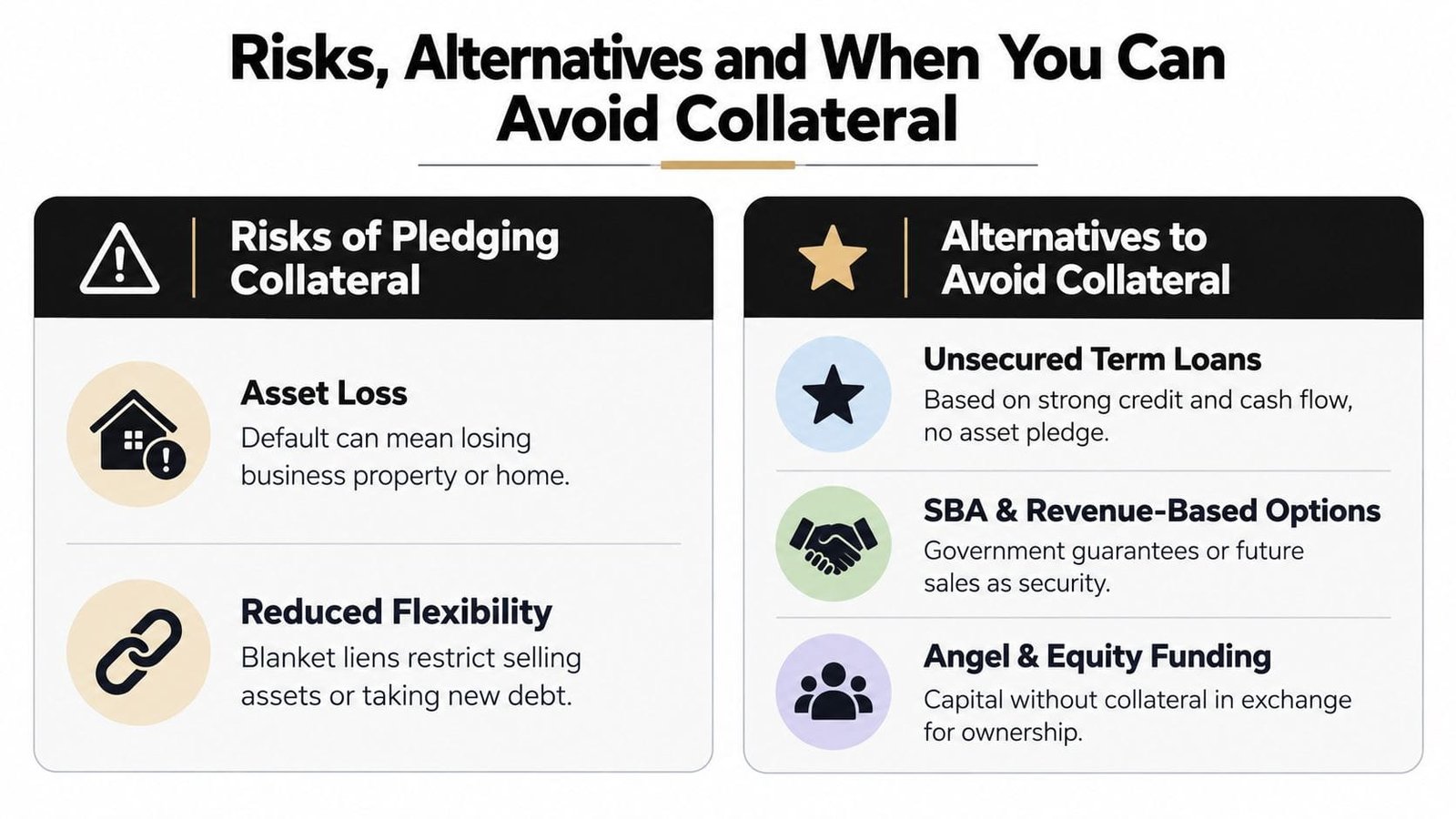
Collateral can improve a lender's recovery position, but it transfers meaningful risk to the borrower. If the business defaults, the lender may enforce its rights against pledged property. A personal guarantee can extend the consequences beyond the company, while a blanket lien can limit asset sales, refinancing, and additional secured borrowing.
That trade-off doesn't make secured financing wrong. It means the loan should fund something with a credible path to repayment. Pledging a building for a speculative project creates a different risk profile from pledging equipment that directly supports contracted revenue.
Options for asset-light companies
Unsecured term loans may suit a company with strong credit and dependable cash flow but limited physical assets. The lender may compensate for the added risk through pricing, tighter underwriting, or a personal guarantee.
Invoice financing can align funding with a specific receivable instead of requiring a broad pledge of business property. If unpaid customer invoices are causing a working-capital gap, a guide to unlock cash from unpaid invoices can help explain how factoring differs from a conventional collateralized loan.
Merchant cash advances exchange an advance for a portion of future sales. They may help businesses with consistent card or revenue activity, but owners should examine the repayment mechanics and total cost carefully.
Equity funding avoids a collateral claim, but it exchanges capital for ownership and may affect control, distributions, and future decision-making. It's not debt, so compare the strategic cost, not only the absence of a lien.
Data as a substitute for hard assets
Asset-light firms may increasingly benefit from underwriting based on verified banking activity, open-banking information, and firm-level administrative data. Recent research describes a shift toward using these inputs as collateral-like underwriting signals, particularly for small business lending, as discussed in this research paper on data-driven finance and collateral information.
That doesn't eliminate repayment risk or guarantee approval. It changes what the lender can evaluate. A software company with limited hard assets may demonstrate financial strength through verified cash flow, customer payments, and operating data instead of relying solely on property.
For a broader decision guide, review business loans without collateral. Compare the cost, speed, repayment pressure, ownership impact, and restrictions attached to each option.
Making a Confident Collateral Decision for Your Business
Start with an asset map. List the property your business owns, identify existing liens, separate personal assets from company assets, and note which items are essential to daily operations. Then match the proposed loan to the asset that creates the clearest repayment benefit.
Before signing, ask the lender:
- Scope: Is the lien limited to one asset, a defined class, or substantially all business property?
- Future property: Does the agreement cover assets acquired after closing?
- Personal exposure: Is a personal guarantee required, and what obligations does it cover?
- Control: Can you sell, replace, refinance, or move pledged assets without consent?
- Valuation: How will the lender determine eligibility and value over time?
- Release: What happens to the lien when you repay part or all of the balance?
- Priority: Are other lenders already claiming the same collateral?
Keep copies of every signed document, including the security agreement, guarantee, lien filings, and collateral schedules. If real estate or personal property is involved, qualified legal and accounting advice can help you understand consequences that a sales summary may not reveal.
Collateral can strengthen an application, but the best structure protects both repayment and future flexibility. If your business has reliable cash flow but few hard assets, ask whether verified financial data or an unsecured product can meet the need. If secured financing is the better fit, pledge only what the business can responsibly risk and understand the lender's rights before you commit.
Business Loan Warrior helps small businesses compare customized funding options, including secured loans, lines of credit, SBA financing, equipment loans, invoice financing, and alternatives that may not require traditional collateral. Visit Business Loan Warrior to review your options and take the next step with a clearer view of liens, guarantees, and borrowing flexibility.