
Most business loan applications require a coordinated package of financial statements, bank statements, tax returns, ownership and legal records, licenses, credit information, debt details, and collateral documents when applicable. For SBA and many other small-business loans, lenders commonly expect two to three years of business and personal tax returns, supported by current financial records and product-specific evidence.
Build Your Loan File Before the Application
A viable business can still face delays when its records are missing, inconsistent, or out of date. Lenders aren't only checking whether revenue exists. They're tracing repayment ability, legal authority, operating legitimacy, collateral, credit risk, and existing obligations through documents that should tell one consistent story.
The most reliable approach is to prepare a dated folder before you apply. Separate core records, such as tax returns, financial statements, ownership documents, and bank statements, from product-specific records, such as equipment quotes, accounts-receivable aging, or SBA forms. Reconcile figures across every file, then write short explanations for unusual deposits, large deductions, ownership changes, late payments, or recent borrowing.
The eight-part checklist below follows the way underwriters review a business loan file. A restaurant seeking an SBA-backed expansion loan won't submit exactly the same package as an established contractor seeking equipment financing or a retailer requesting a line of credit.
Practical rule: Document readiness is evidence of control, not merely paperwork.
Business Loan Warrior users can start with a single no-fee application, connect bank accounts, and manage documents through a secure dashboard. That can make it easier to present current financial information while exploring business loans, SBA processing, lines of credit, equipment financing, and other funding options.
Table of Contents
- 1. Business Plan and Executive Summary
- 2. Personal and Business Tax Returns
- 3. Financial Statements, Business Bank Statements, and Cash Flow Documentation
- 4. Ownership and Legal Documentation
- 5. Collateral Documentation and Asset Statements
- 6. Credit History and Personal Credit Reports
- 7. Business Licenses, Permits, and Industry-Specific Documentation
- 8. Debt Schedule and Liabilities Documentation
- Business Loan Documents: 8-Point Comparison
- Run the Final Lender-Ready Check
1. Business Plan and Executive Summary
A lender needs a clear answer to one question: How will this loan strengthen the business enough to support repayment? A concise executive summary should answer that question before the reviewer reaches the supporting detail.
Describe the company, customers, revenue model, competitive position, and reason for borrowing. Then connect each use of funds to an operating result. A restaurant adding a second location might explain expected seating capacity, staffing needs, food costs, launch timing, and the assumptions behind projected sales. A service company buying equipment should show how the asset supports additional jobs, faster delivery, or lower operating costs.
The plan doesn't need optimistic language. It needs assumptions that a lender can test.
Match the plan to the product
An SBA-backed expansion request usually benefits from a fuller narrative because the lender needs to understand the business model, management team, and long-term repayment plan. A short-term working-capital request may need a tighter explanation of the cash gap, the timing of receivables, and the specific expenses the funding will cover.
For every forecast, identify:
- Revenue assumptions: Explain the customers, contracts, pricing, volume, and timing behind projected income.
- Cost assumptions: Separate fixed expenses from variable costs, and identify any new payroll, rent, inventory, insurance, or maintenance.
- Repayment logic: Show how operating cash flow will cover the new payment alongside existing obligations.
- Downside plan: Explain what management will adjust if sales arrive later or costs rise.
Use industry benchmarks to support assumptions, but don't disguise a weak forecast with elaborate formatting. The borrower's budget and financial plan should agree with the P&L, bank deposits, and requested use of funds.
Update the plan after a major ownership, location, product, or financing change. An accountant can review the calculations, while the owner should confirm that the operating narrative reflects what the business does.

2. Personal and Business Tax Returns
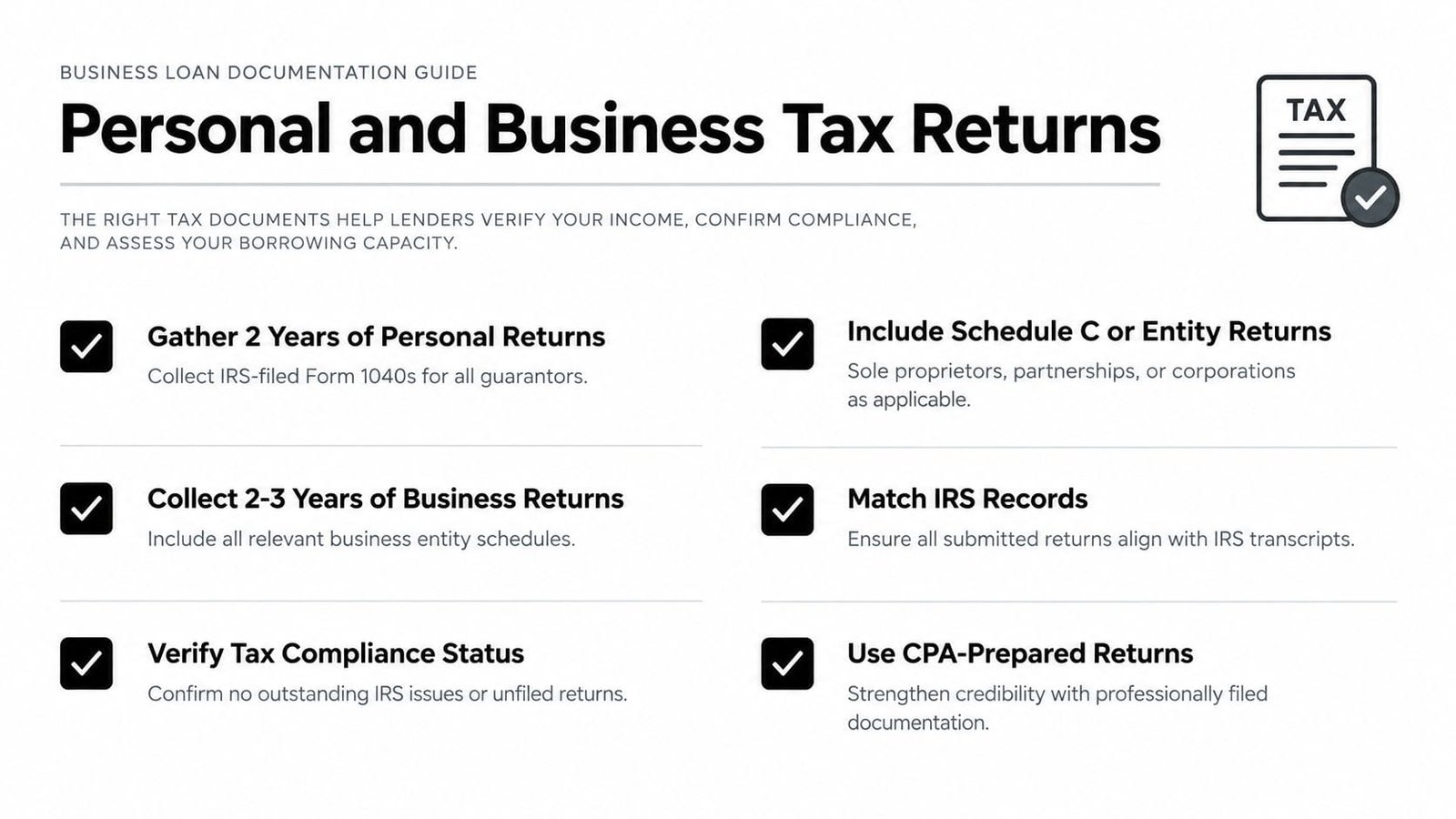
Tax returns give lenders a historical record that is harder to reshape for an application. They help underwriters compare reported income, deductions, ownership distributions, business profitability, and personal financial responsibility across multiple filing periods.
For many SBA and conventional small-business loans, prepare two to three years of business and personal returns when available. The U.S. Bank SBA loan guidance describes the broader documentation trail lenders commonly request, including tax returns and current financial statements. An SBA package also includes Form 1919 for every loan in the lender program, while personal financial disclosures may include Form 413 under SBA guidance available through the SBA lender resources.
Make the tax file easy to verify
Submit complete returns with schedules, signatures, and supporting business filings. If several entities feed income to the owner, explain the relationship and provide the records needed to connect them. A contractor operating through multiple entities, for example, should make it obvious which company earns revenue, which entity owns equipment, and where the proposed debt will sit.
Large deductions aren't automatically a problem. Unexplained deductions are. Prepare a short note for items such as accelerated depreciation, one-time losses, owner distributions, forgiven debt, unusual gains, or a sharp change in taxable income.
Newer businesses may not have a full tax history. In that case, current P&Ls, balance sheets, bank statements, signed contracts, and a realistic cash-flow forecast can help show how the company operates today. Those substitutes don't erase the lender's need to assess risk, but they give the reviewer a current evidence trail instead of an incomplete file.
Don't edit the story after filing: If the tax return, accounting ledger, and bank records disagree, explain the difference before the lender finds it.
Ask your CPA or tax preparer to confirm that every return is final and that amendments, extensions, payment arrangements, or tax liabilities are disclosed accurately. A clean tax file won't guarantee approval, but an incomplete one can create avoidable questions.
3. Financial Statements, Business Bank Statements, and Cash Flow Documentation
Tax returns are historical. Bank statements and interim financial statements show what the business is doing now. Together, they help the lender assess liquidity, deposit patterns, margins, working-capital pressure, and repayment capacity.
Prepare a balance sheet, profit-and-loss statement, and cash-flow statement or projection. The balance sheet shows assets, liabilities, and equity. The P&L explains revenue and expenses over a period. The cash-flow record shows when money enters and leaves the account, which matters when a profitable company still struggles with timing.
Lenders commonly request recent business bank statements, and Business Loan Warrior's application process asks applicants to upload at least the last three months of business bank statements, as described in its application materials. You can prepare more history when seasonality, project billing, or irregular deposits affects the picture.
Reconcile before uploading
Don't send a bank statement bundle without reviewing it. Mark unusual deposits, transfers between related accounts, owner contributions, refunds, cash deposits, and one-time payments. A construction company may have a large customer payment followed by a quiet period. A restaurant may experience strong seasonal deposits followed by a slower operating cycle. The explanation should identify the source, not merely label the transaction “miscellaneous.”
Use accounting software such as QuickBooks or Xero, then compare:
- Revenue: Do recorded sales align with deposits after considering card processors, transfers, and timing?
- Expenses: Are rent, payroll, inventory, and debt payments reflected consistently?
- Cash flow: Does the forecast show enough cash for the proposed payment during weaker periods?
- Account ownership: Are business and personal spending separated clearly?
The business bank statement guidance can help you understand why these records matter during a financing review. Standardized digital invoices can also improve verification for receivables-based funding because structured records make payment obligations and counterparties easier to validate, as explained by SUERF's analysis of digital invoices and credit markets.
A CPA review can add credibility, but accuracy matters more than presentation. If your business is seasonal or project-based, include a short monthly cash-flow explanation so the lender can distinguish a timing issue from a structural loss.
4. Ownership and Legal Documentation
Before evaluating repayment, a lender must know who owns the company and who can legally borrow on its behalf. Formation records establish the entity. Operating agreements, partnership agreements, stock records, and ownership certificates show how control is divided.
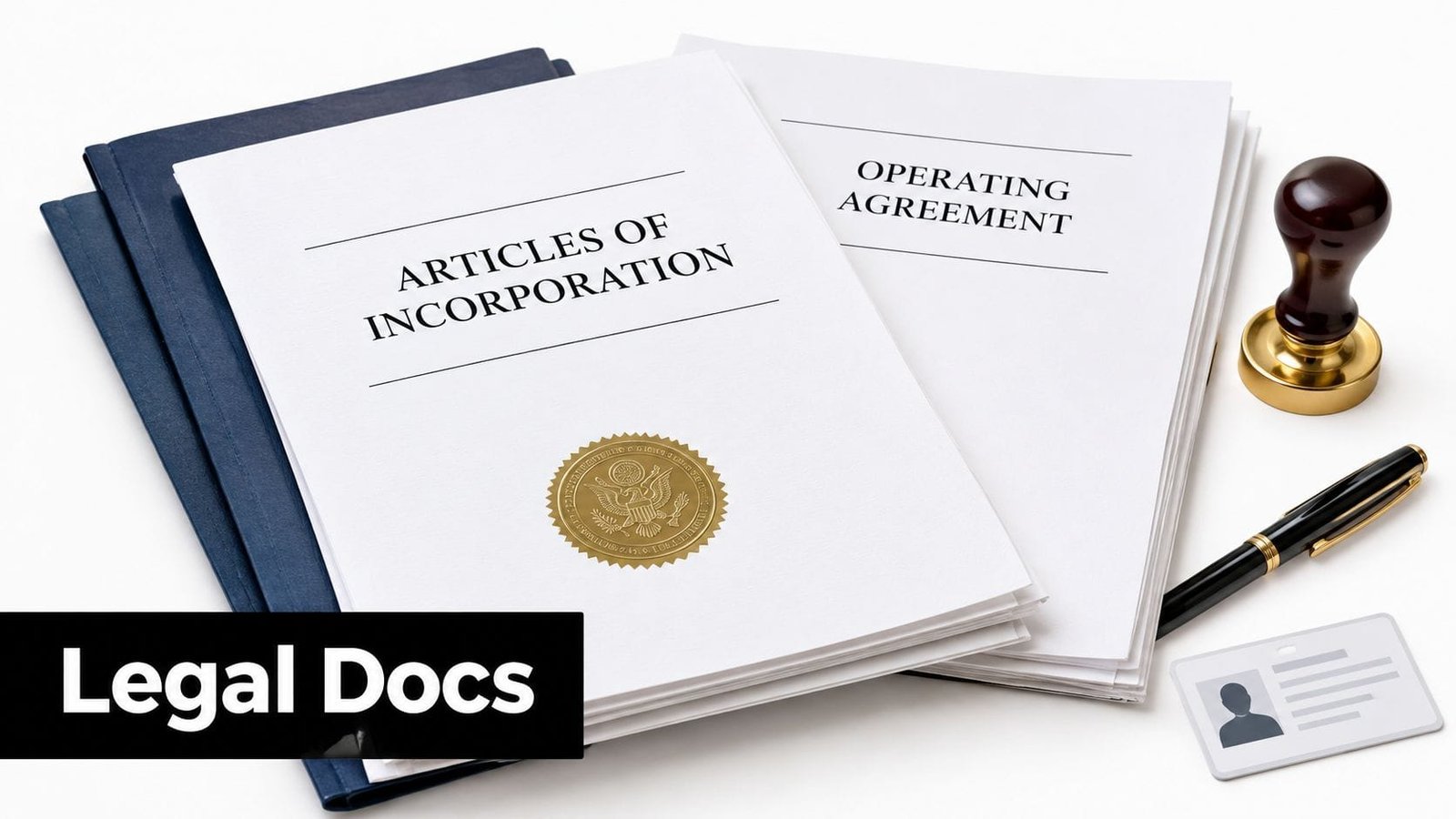
Gather the articles of organization or incorporation, current operating or partnership agreement, ownership schedule, employer identification details, identification for owners and signers, and any assumed-name registration. A corporation may also need a board resolution authorizing the borrowing and identifying the officer who can sign.
Confirm authority and guarantors
Ownership records should match the application, tax filings, state records, and internal books. If an owner recently joined, exited, or transferred shares, provide the amended agreement and a brief explanation. A mismatch can make a simple application look incomplete or raise questions about undisclosed control.
SBA guidance summarized by major lending references identifies 20% ownership as an important threshold for an unlimited personal guarantee. That means personal financial statements and related records can become relevant for each qualifying owner, not only the person completing the application.
A single-member LLC might provide its operating agreement, formation records, identification, and authorization to borrow. A partnership may need records for each partner and evidence that all required parties approve the transaction. A corporation may need resolutions, certificates of good standing, and proof that the signer has authority.
Keep originals in a secure location and upload clear copies. Don't rely on an outdated operating agreement that doesn't reflect current ownership.
Legal enforceability also depends on proper execution, authority, signatures, and applicable law. This overview of what makes a document legally binding is a useful reminder to review signing requirements before submitting agreements.
Underwriter's question: “Can this person bind the company, and does the lender have a clear path to the responsible owners if the business defaults?”
5. Collateral Documentation and Asset Statements
Collateral doesn't replace repayment ability. It gives the lender an additional recovery source and can shape the structure of a secured loan. Your documents should show what the asset is, who owns it, what it is worth, where it is located, and whether another creditor already claims it.
For equipment, prepare an asset list with descriptions, serial numbers, purchase invoices, current condition, location, and insurance information. For vehicles, include titles and registration records. For commercial property, provide deeds, ownership records, insurance, and an appraisal when requested. Inventory and accounts receivable require detailed records that show existence and quality, not just a total on a balance sheet.
Product fit changes the collateral file
Equipment financing often uses the purchased equipment as the primary security. A construction company may submit a supplier quote, specifications, delivery details, and an existing equipment schedule. A restaurant buying ovens, refrigeration, or point-of-sale equipment should identify the assets and explain how they support operations.
A working-capital line may use inventory or receivables, but the lender may ask for aging reports, customer details, invoices, and evidence that the collateral is collectible. An unsecured short-term product may not require pledged assets, while a conventional or SBA-backed facility may involve broader collateral review.
Don't assume an appraisal equals available borrowing capacity. Lenders apply their own valuation and advance rules, and condition, marketability, liens, insurance, and location can all affect the result. Avoid overstating values or listing assets the business doesn't own outright.
Maintain a current insurance certificate when required. If equipment is leased, identify the lessor and provide the lease, because leased equipment usually isn't available for the same collateral treatment as owned property.
6. Credit History and Personal Credit Reports
Small-business lending often connects the company's performance with the owner's financial history. A lender may review personal credit for owners and guarantors because the business may have a limited credit record, and a personal guarantee can make owner-level repayment behavior relevant.
Check personal credit reports before applying. Look for inaccurate accounts, duplicate debts, wrong addresses, identity issues, or accounts that should have been closed. Dispute errors with the reporting agency and preserve documentation of the dispute. Don't hide negative information. Prepare a concise explanation that states what happened, what changed, and what evidence supports the resolution.
Match the credit file to the product
Credit expectations vary by lender and product. A bank evaluating an SBA-backed loan may take a broad view of payment history, liabilities, management, cash flow, and guarantees. An equipment lender may focus on the asset, operating cash flow, and the guarantor's profile. A short-term working-capital provider may place more weight on recent deposits and transaction performance.
The FDIC's 2024 Small Business Lending Survey shows that banks continue to rely heavily on traditional financial statements and tax returns, while business credit scores rank among the less commonly evaluated inputs. That doesn't make credit irrelevant. It means you shouldn't treat one score as the entire application.
Review personal and business credit separately. Confirm that the business is listed under the correct legal name and identification details. Also list recent applications, existing revolving accounts, personal guarantees, and obligations that may not appear where you expect.
If credit weakness is recent, address it before requesting a major facility when timing allows. If funding is urgent, choose a product whose documentation and risk assessment fit the actual profile instead of submitting an incomplete conventional-bank package.
7. Business Licenses, Permits, and Industry-Specific Documentation
A lender needs confidence that the company is legally allowed to operate and generate the revenue shown in the application. A current license or permit can be a simple document, but an expired registration can create a serious question about operating continuity.
Requirements depend on the business, location, and activity. A restaurant may need health and food-service permits, plus a liquor license where applicable. A contractor may need a general contractor license, bonding records, safety documentation, and permits tied to specific work. A staffing company may need licensing, bonding, and employment-related compliance records.
Build a renewal-controlled file
Create a folder for every license and add the issuing authority, license number, covered activity, location, expiration date, and renewal status. Set reminders before expiration rather than discovering the issue during underwriting. Keep evidence of renewals, inspections, corrective actions, and current insurance where they support the business model.
The documents should align with the business plan. If a retailer is expanding into a regulated product category, the plan should explain the required approvals and whether they are already active or still pending. If a construction company is buying equipment for a new service line, include the license or permit pathway that supports the projected revenue.
Don't submit an old certificate just because it is easy to find. Download the current version from the issuing authority when possible. If a renewal is pending, disclose the status and provide the receipt or confirmation rather than allowing the lender to assume the business ignored the requirement.
This category can also expose operational risk. A license tied to one location won't necessarily authorize a second site, and a permit for one type of work may not cover a new service. Resolve those gaps before presenting expansion revenue as dependable repayment capacity.
8. Debt Schedule and Liabilities Documentation
A new loan payment must fit beside every existing obligation. Underwriters therefore need a complete debt schedule covering business loans, credit cards, lines of credit, equipment financing, vehicle loans, leases, merchant-related obligations, payment plans, and personally guaranteed debts connected to the company.
List the creditor, original balance if known, current balance, monthly payment, interest terms if available, maturity or payoff date, collateral, guarantor, and payment status. Attach recent statements or agreements that support each entry. Include leases and contracts that create recurring obligations, even when they aren't labeled as loans.
Explain how the new facility fits
A manufacturer requesting equipment financing may already have an equipment note, revolving line, and vehicle loans. The application should show how the proposed payment fits within operating cash flow after those commitments. A restaurant seeking expansion capital should include rent, equipment payments, leases, and seasonal cash needs, not just formal bank debt.
Lenders may discover obligations through statements, credit checks, lien searches, or transaction histories. An omitted debt can damage confidence more than the debt itself. If an account is paid off but still appears open, attach proof. If a balance is being refinanced, show the payoff amount and explain whether the new facility replaces or adds to the obligation.
The debt repayment strategies available to a business should reflect cash-flow reality, not just a lower headline payment. Consolidation can simplify obligations, but extending repayment may increase total cost or create new collateral requirements. Compare the payment schedule with the cash-flow forecast before requesting a larger amount.
Prepare this sentence: “After existing monthly obligations, the business expects cash flow of ___, and the proposed payment of ___ will be funded from ___.” Fill it with verified figures and explain any seasonal variation.
Undisclosed liens and existing advances deserve special attention. List them early, identify their priority, and ask the lender how they affect the proposed structure.
Business Loan Documents: 8-Point Comparison
| Item | Implementation Complexity 🔄 | Resource Requirements ⚡ | Expected Outcomes 📊 | Ideal Use Cases 💡 | Key Advantages ⭐ |
|---|---|---|---|---|---|
| Business Plan and Executive Summary | High 🔄, detailed research & financial modeling | High ⚡, market data, financial expertise, accountant | Strongly influences approval and terms; clarifies repayment & strategy 📊 | Major expansions, large loan requests, strategic financing 💡 | Demonstrates viability; improves terms; internal roadmap ⭐ |
| Personal and Business Tax Returns | Low–Medium 🔄, gather filed returns (2–3 years) | Moderate ⚡, past filings, CPA-prepared preferred | Verifies income, profitability, tax compliance; required by many lenders 📊 | SBA loans, traditional underwriting, income verification 💡 | IRS-verified credibility; shows multi‑year trends ⭐ |
| Financial Statements, Bank Statements & Cash Flow | Medium 🔄, recurring bookkeeping and reconciliations | High ⚡, accounting software, bank connections, CPA review | Provides current liquidity/cash‑flow view; speeds underwriting and negotiation 📊 | Working capital, seasonal cash needs, quick verifications 💡 | Real‑time verification; shows repayment capacity; reduces processing time ⭐ |
| Ownership and Legal Documentation | Low–Medium 🔄, collect formation docs and resolutions | Low ⚡, certified copies, IDs, signed agreements | Confirms authority to borrow and lender recourse; prevents fraud 📊 | Any loan requiring guarantees, multi‑owner structures, SBA 💡 | Establishes legal authority; secures guarantor recourse; required compliance ⭐ |
| Collateral Documentation and Asset Statements | Medium 🔄, inventories, appraisals, title checks | Medium–High ⚡, appraiser, insurance, title paperwork | Secures loan, improves rates and approval odds; affects LTV 📊 | Equipment financing, asset‑backed loans, larger secured loans 💡 | Better rates; enables weaker credit to qualify; lowers lender risk ⭐ |
| Credit History and Personal Credit Reports | Low 🔄, pull & review bureau reports | Low ⚡, access to credit reports; pre‑approval tools | Key underwriting factor; affects eligibility, rates, and guarantees 📊 | Startups with guarantors, unsecured lending, rate negotiation 💡 | Quick risk assessment; strong credit improves terms; pre‑approval options ⭐ |
| Business Licenses, Permits & Industry Documentation | Low–Medium 🔄, obtain and maintain permits | Moderate ⚡, fees, compliance processes, renewals | Verifies legal operation and regulatory compliance; may be mandatory 📊 | Regulated industries (restaurants, contractors, healthcare) 💡 | Demonstrates compliance; qualifies for industry‑specific products ⭐ |
| Debt Schedule and Liabilities Documentation | Medium 🔄, compile all obligations and schedules | Moderate ⚡, creditor statements, accounting time | Shows DSCR and debt capacity; directly impacts loan sizing/structure 📊 | Refinancing, expansion with existing debt, complex capital structures 💡 | Complete liability picture; informs structuring and approval; prevents surprises ⭐ |
Run the Final Lender-Ready Check
A strong application is consistent before it is persuasive. Review every file as if you were an underwriter who has no context beyond the documents. A revenue figure in the tax return should not conflict with the P&L or bank deposits without an explanation. Ownership in the application should match formation records. Debt in the schedule should match statements, leases, and credit information.
The final review should be product-specific. An SBA loan may require the standardized SBA forms, personal financial information, business history, and a broad legal and financial file. A line of credit should emphasize current deposits, working-capital cycles, receivables, inventory, and the repayment source. Equipment financing should include the supplier quote, asset specifications, ownership or purchase details, insurance, and the operating case for the equipment. Short-term funding may emphasize recent bank activity and use of funds, while invoice financing depends heavily on verifiable receivables and buyer obligations.
Business Loan Warrior pre-submission checklist
- Confirm file quality: Every requested document is current, readable, complete, and named clearly.
- Reconcile financials: Revenue, expenses, cash, ownership, liabilities, and debt payments agree across tax returns, statements, and bank records.
- Explain exceptions: Label unusual deposits, transfers, deductions, losses, ownership changes, late payments, tax matters, and recent borrowing.
- Verify legal authority: Identify every owner, guarantor, authorized signer, entity, trade name, and required resolution.
- Check operating legitimacy: Confirm licenses, permits, insurance, registrations, and industry documents are current.
- Validate collateral: Match asset descriptions, serial numbers, titles, invoices, appraisals, insurance, and existing liens.
- Align the request: Make sure the amount and use of funds match the cash-flow plan and the repayment explanation.
- Review debt capacity: Include every business and personally guaranteed obligation, including leases and existing advances.
A simple tracking sheet can keep the file under control:
Business Loan Warrior users can begin with a no-fee application, connect accounts securely, track approvals and repayments, review credit insights, and chat with underwriters. Those tools can help organize the evidence, but they don't replace your responsibility to verify the numbers and explain the business clearly.
Submit a complete, consistent package instead of sending documents piecemeal. Lenders may request additional records based on the business, loan product, ownership structure, collateral, and the issues raised during review. A well-organized file won't guarantee approval, but it gives the lender a reliable basis for evaluating repayment ability and reduces avoidable friction.
Business Loan Warrior offers a no-fee application, secure account connections, document uploads, funding options, and a dashboard for tracking approvals and repayments. Visit the platform to organize your business loan documents and explore funding that matches your company's cash flow, collateral, and intended use of funds.