
The loan closes, the equipment arrives, and the owner plans the next hire. Then the first automatic payment clears before a major customer pays an overdue invoice. The balance drops, payroll is still due, and the financing that was supposed to create breathing room suddenly competes with everyday operating costs.
That moment is the test of business loan repayment. The important question isn't whether the business can make the payment in a strong month. It's whether the payment still fits during the weakest stretch of its cash cycle, after payroll, taxes, inventory, and essential bills are covered.
Table of Contents
- The Real Moment That Decides Whether a Loan Helps or Hurts
- How Amortization Actually Works Under the Hood
- Fixed, Interest-Only, and Balloon Repayment Compared
- How Repayment Schedules Shape Your Cash Flow
- What Delinquency Data Reveals About Real Repayment Risk
- A Sample Amortization Schedule You Can Read in Five Minutes
- Repayment Strategies That Actually Protect Cash Flow
- When to Refinance, Restructure, or Hold Steady
The Real Moment That Decides Whether a Loan Helps or Hurts
An owner can sign a loan agreement focused on the rate and the approval amount, then discover the repayment mechanics only when the first automatic draft lands. Maybe payments begin before a renovation brings in new revenue. Maybe the loan requires frequent withdrawals while customers pay invoices on slower terms. In either case, the issue isn't that the business borrowed. It's that the payment schedule didn't match when cash arrives.
Repayment structure influences decisions well beyond the loan account. A large fixed payment can delay hiring, limit inventory purchases, or make an expansion harder to manage. A schedule that leaves room for slower periods can give the business more control, even if the advertised rate isn't the lowest.
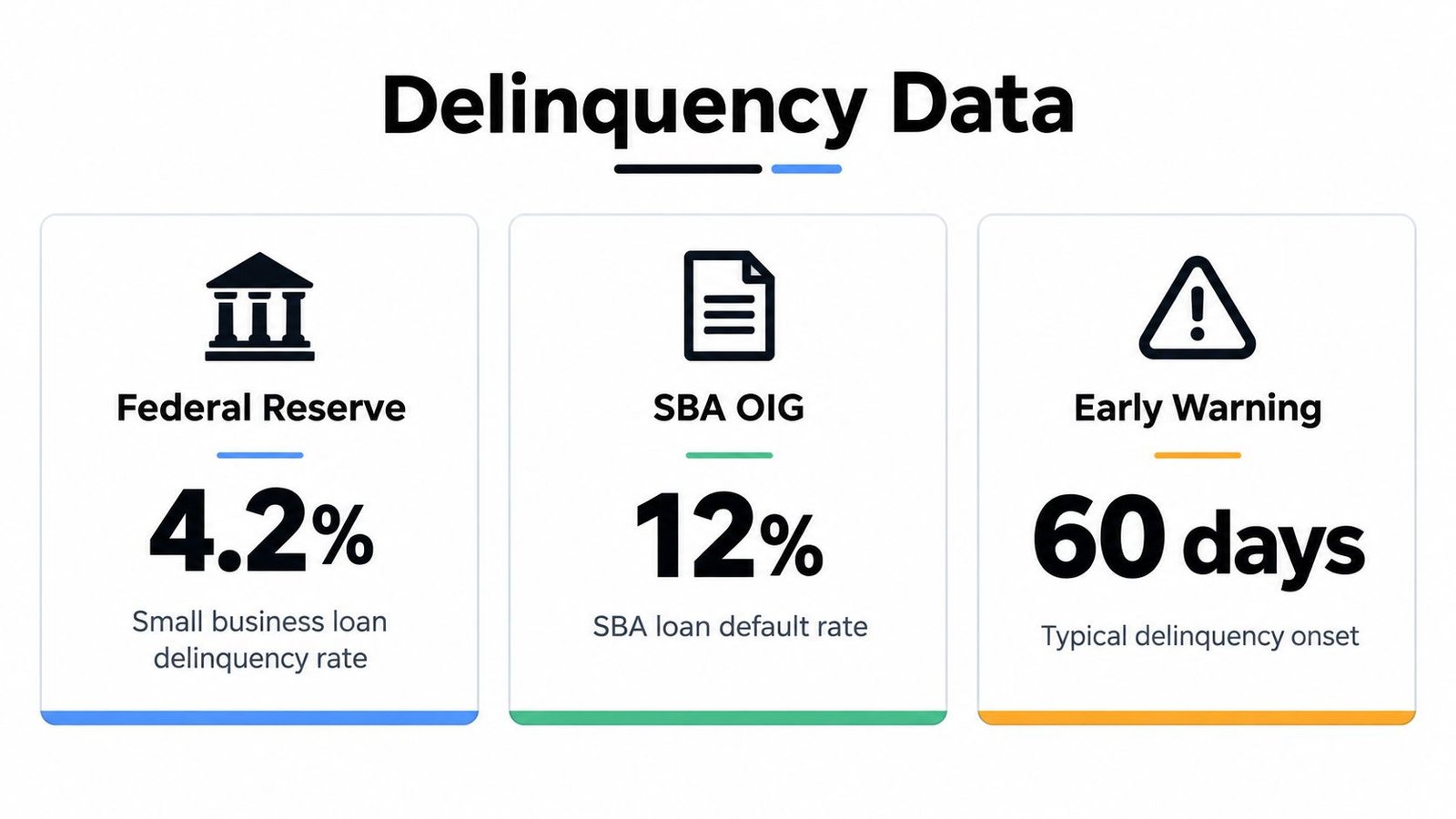
Federal Reserve data show that both short-term business-loan delinquencies, covering loans up to 90 days past due, and long-term delinquencies, covering loans more than 90 days past due, remained above pre-pandemic levels in 2026, even as short-term rates edged lower (Federal Reserve business-loan delinquency data). A missed payment is an early warning, not a useful moment to start planning. Business owners should compare scheduled debt service with cash available through weak revenue periods, not just with an average month's sales.
Start with the week cash gets tight
Before signing, map the payment date against customer receipts, payroll, taxes, and important supplier bills. An owner managing payroll obligations can also consult this guide to handling payroll tax obligations to keep tax responsibilities visible alongside debt service.
Approval answers whether a lender is prepared to fund the business. It doesn't answer whether the repayment terms suit the business's cash cycle. That judgment belongs to the owner, before funding arrives and after repayment begins.
How Amortization Actually Works Under the Hood
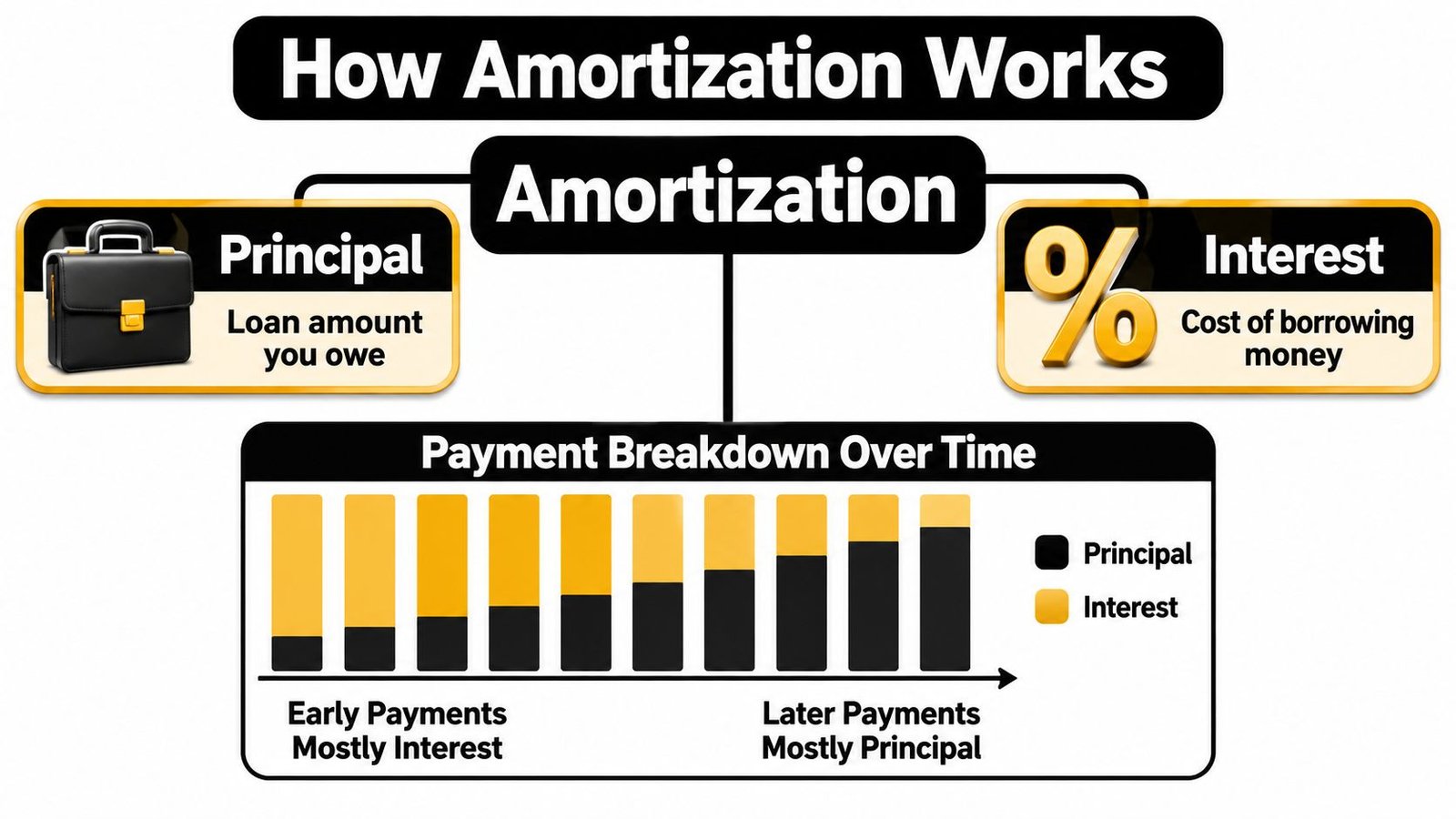
Amortization is the process of paying down a loan through scheduled installments. Each payment usually covers interest for the period and reduces some of the principal, the amount still owed. Think of it as paying both the cost of using the lender's money and a portion of the balance itself.
At the start of a typical amortizing loan, the outstanding balance is at its largest. That means interest takes up a relatively larger share of each payment, while less goes toward principal. As the balance falls, the interest portion shrinks and more of the scheduled payment goes toward reducing principal. The exact allocation depends on the contract's rate, payment frequency, and term.
Read the schedule, not just the payment
A lender's amortization schedule shows how each payment is divided between interest and principal, and how the remaining balance changes. Review the full schedule before signing. A payment that looks manageable can still produce a high overall borrowing cost if it stretches across a long period.
To compare offers, look past the monthly payment. Check the total amount payable over the term, whether the rate can change, whether fees are included in the quoted cost, and whether the lender charges for early payoff. Two loans with similar payment amounts may leave very different balances at a given point, particularly if their rates, fees, or structures differ.
For a plain-language explanation of the period over which scheduled payments repay principal and interest, see this guide to the amortization period. It's useful context, but the signed loan documents control the actual terms.
Extra payments can reduce principal faster, but only if the contract allows them without a charge and the business can spare the cash. Don't send extra money merely because the balance looks uncomfortable. First confirm that doing so won't leave the company short on operating funds.
Fixed, Interest-Only, and Balloon Repayment Compared
The right repayment structure depends on how reliably the business converts sales into cash. A restaurant paying for a buildout may need time for the new space to generate revenue. A contractor waiting on project milestones may have money coming in unevenly. A stable retailer refinancing existing debt may prefer predictable installments that fit its established sales pattern.
| Structure | Payment Profile | Best For | Key Risk |
|---|---|---|---|
| Fully amortizing fixed payments | Regular payments include interest and principal | Businesses with dependable cash flow and a clear operating budget | A fixed obligation can strain cash during a slow period |
| Interest-only period followed by amortization | Lower initial payments, then higher payments once principal repayment begins | Businesses waiting for a project, asset, or expansion to generate receipts | The later payment increase can arrive before expected revenue does |
| Balloon repayment | Scheduled payments may leave a large principal balance due at maturity | Borrowers with a credible plan to refinance, sell an asset, or receive a substantial payment | The business may not be able to refinance or produce the lump sum on time |
Match the structure to the receipts
Fully amortizing payments are easier to plan around when customer receipts are steady. They reduce principal throughout the repayment term, but the business has to make the full scheduled payment during slow spells too.
Interest-only terms can be useful when revenue is expected to arrive later, but they don't make the principal disappear. The owner should identify exactly when regular principal payments begin and model whether cash flow can support that change.
Balloon structures can appear comfortable because the recurring payment may be lower. That comfort can be misleading if the business hasn't secured a realistic source for the final principal balance. “We'll refinance later” isn't a repayment plan. Before agreeing, identify a practical backup if refinancing becomes unavailable or expensive.
A structure that looks cheaper in a strong month may put more pressure on the business when receipts slip. Choose by the cash pattern the company has, not the payment it hopes to afford after growth.
How Repayment Schedules Shape Your Cash Flow
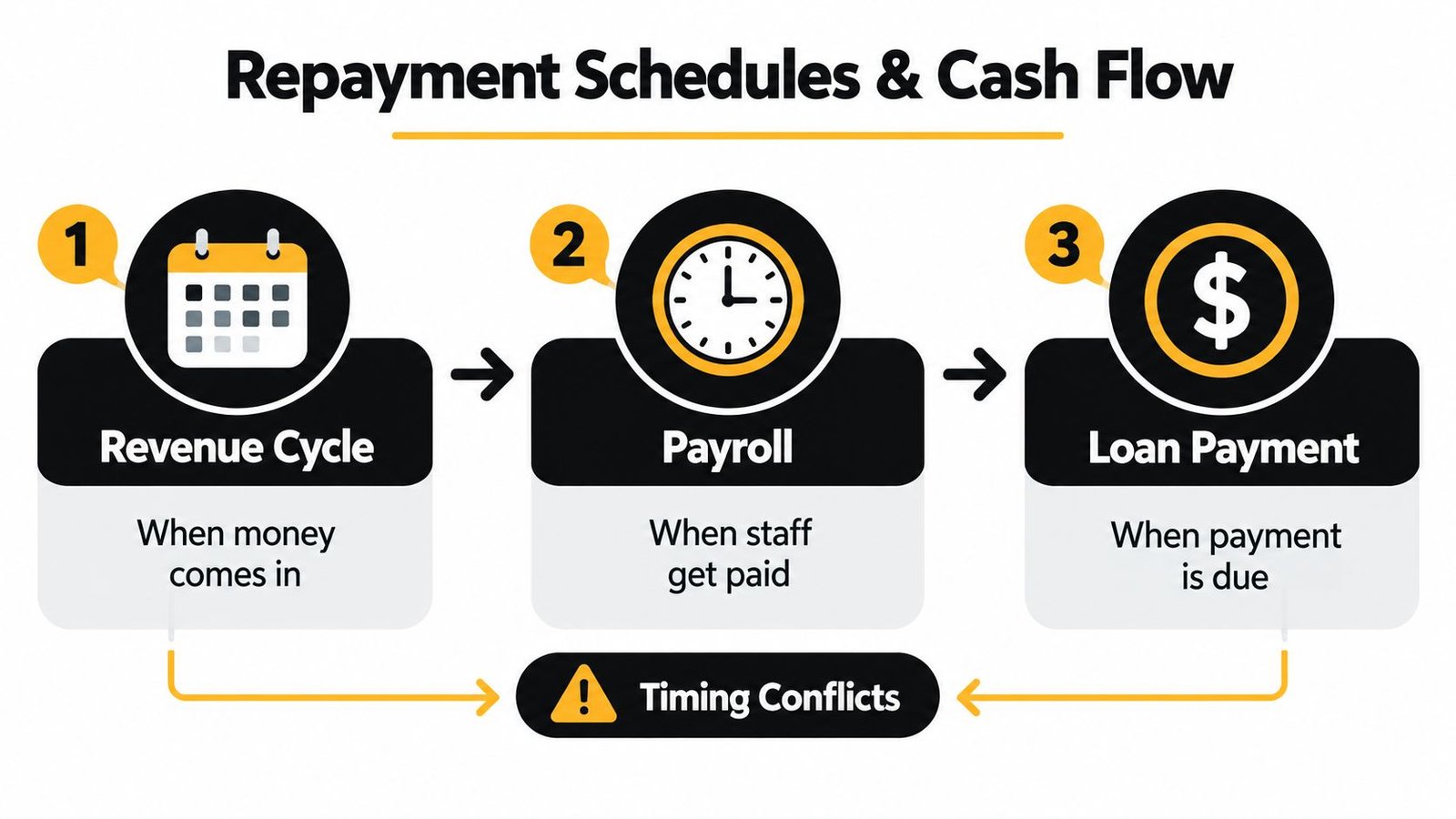
A due date can matter as much as the amount owed. A business that invoices customers on delayed terms may have completed the work without receiving the cash needed to cover an early-month loan draft. Meanwhile, payroll and suppliers still need payment on their own schedules.
Put debt service on the same calendar as cash
Start with the expected date money reaches the business, not when an invoice goes out. Then place payroll, taxes, inventory orders, rent, and debt payments on the same cash-flow calendar. A forecast that lists monthly totals but ignores dates can conceal a shortfall between incoming receipts.
Different financing products draw cash in different ways:
- Term loans usually follow an agreed repayment schedule, commonly with installments that cover interest and principal.
- Lines of credit let a business draw funds as needed. Repayment can restore available credit, but the owner should check the required payment calculation and any conditions for continued access.
- Invoice financing may deduct repayment from customer payments or direct those payments toward the balance. That can help release cash sooner, but it also affects the money available when the invoice is ultimately collected.
- Merchant cash advances can collect through frequent remittances tied to sales or another agreed method. Regular deductions may pull cash out of the business during the very periods when it needs to cover staff and suppliers.
Don't judge a product by the payment figure alone. Ask what gets debited, how often, whether the amount changes with sales, and what happens if receipts arrive late.
A useful cash-flow forecasting approach for planning loan strategy should include repayments as cash outflows, matched against the timing of projected inflows. If the forecast shows a crunch, ask the lender whether a different due date or repayment arrangement is available before accepting the funds.
What Delinquency Data Reveals About Real Repayment Risk
Loan performance depends on more than borrower discipline. The lender channel, the underwriting decision, how the loan is serviced, and the repayment terms can all affect how a borrower experiences debt. An owner evaluating offers should ask how the lender handles payment issues and what choices exist if cash flow deteriorates.
Look beyond the advertised rate
In an analysis of SBA 7(a) lending, the SBA Office of Inspector General found that, as of March 31, 2025, Small Business Lending Companies had a 14.97% portfolio default rate, compared with 9.79% for other lender types. Their 5.38% early-default rate was more than twice the comparable rate for other lenders (SBA OIG analysis of Small Business Lending Companies%20Loan%20Program%20and%20SBA%E2%80%99s%20Oversight.pdf)). Those findings don't predict the outcome for a particular borrower, but they make lender practices worth examining rather than treating every offer as interchangeable.
Ask about servicing contacts, reporting requirements, covenant terms, prepayment conditions, and the process for requesting a payment change. A low advertised rate isn't much comfort if the borrower can't get a useful answer when a payment problem first appears.
Federal Reserve data define business-loan delinquency to include loans that are past due or in nonaccrual status. That makes delinquency a broader repayment-risk measure than missed payments alone. For an individual business, falling receipts, overdue customer balances, reduced cash reserves, or trouble covering operating expenses should prompt a review before a scheduled payment is missed.
Practical rule: Contact the lender when the forecast first shows a likely payment shortfall, not after the account is already past due.
Keep the warning signs visible
Review scheduled debt service against operating cash flow regularly. If the business can't cover debt payments without delaying payroll, taxes, inventory, or essential bills, the repayment plan needs attention. Owners should also know whether a loan has a large principal payment due at maturity, rather than waiting until that obligation is near.
A Sample Amortization Schedule You Can Read in Five Minutes
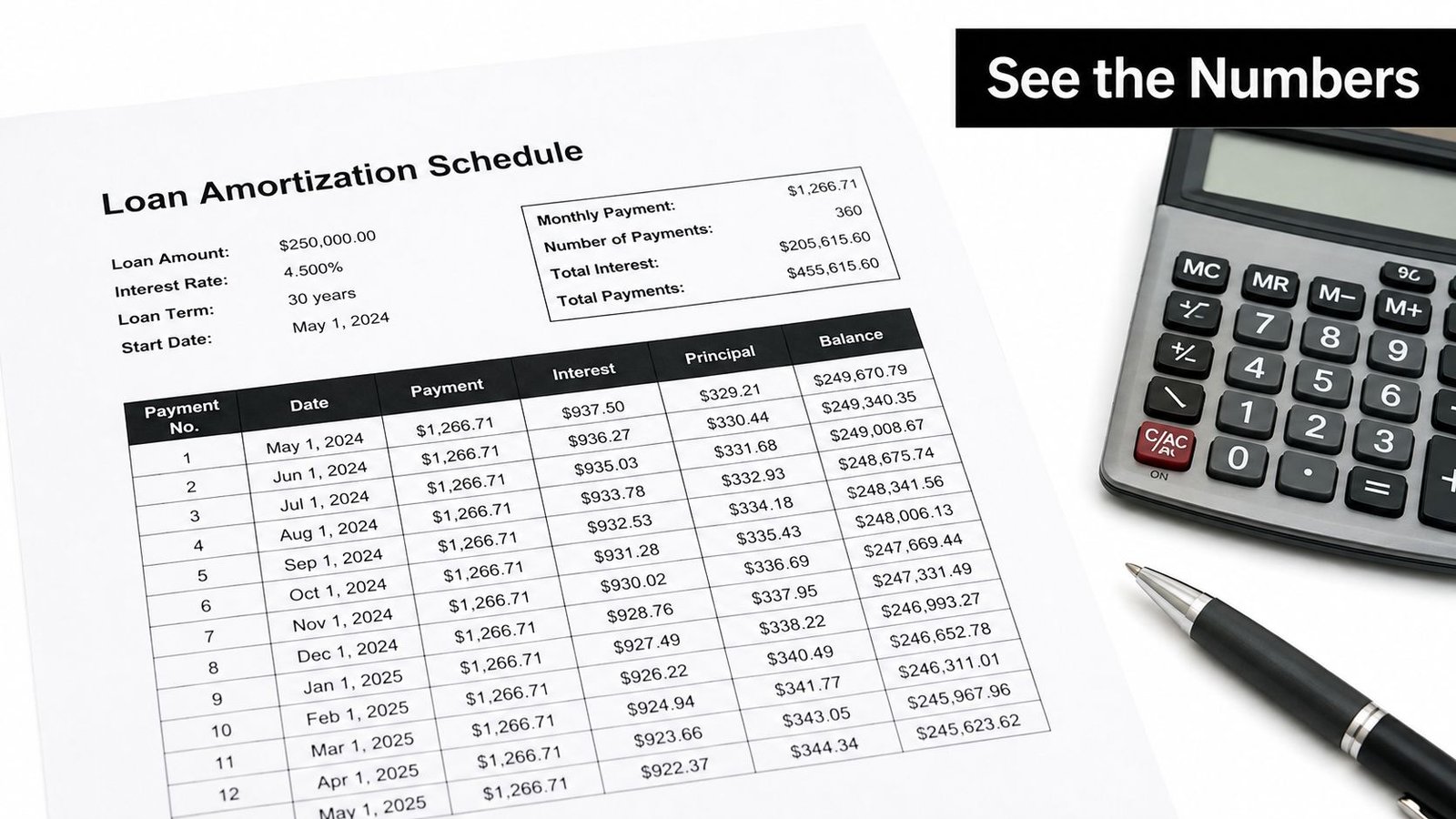
A sample loan can make the mechanics easier to see, but it shouldn't be mistaken for an actual offer. The following figures would depend on the lender's rate, payment frequency, fees, and contract. Don't rely on an estimated payment when deciding whether a business can afford a loan.
Follow the balance from one payment to the next
In a standard amortizing schedule, each row records a payment date, the amount paid, the interest portion, the principal portion, and the remaining balance. Read across the row to see how the payment is allocated. Read down the balance column to see whether principal is falling as expected.
Early in repayment, interest may account for a larger share of the installment because the balance is still high. Over time, as payments reduce the balance, the interest portion generally shrinks and more of each scheduled installment reduces principal. The precise crossover depends on the loan's terms, so ask the lender for a complete schedule instead of assuming when it happens.
For an overview of an actual government-backed loan portfolio, the Government Accountability Office reported that 850 of 1,830 Main Street Lending Program loans, roughly 46%, had been fully repaid by August 31, 2024. Those loans represented about $8.8 billion, or 51% of the program's total authorized loan amount (GAO review of the Main Street Lending Program). Portfolio outcomes provide context, but they don't replace a borrower's own repayment forecast.
Review this video explanation of reading a loan schedule alongside the schedule from your lender. Before making an extra principal payment, ask how the lender applies it, whether the payment reduces future installments or shortens the term, and whether any charge applies. Those details determine whether an extra payment helps the business or ties up cash it may need for operations.
Repayment Strategies That Actually Protect Cash Flow
Paying off debt early isn't automatically smart. A business can save interest and still make itself more vulnerable by draining the cash it needs for payroll, inventory, repairs, or a slow season. Liquidity has value because it gives the owner options when revenue doesn't arrive on schedule.
Recent Federal Reserve small-business credit findings report that firms faced increased costs, carried more debt, and experienced problems paying operating expenses and managing uneven cash flows (Federal Reserve small-business credit findings for the Third District). That's a strong reason to avoid treating spare cash as automatically available for early repayment.
Choose the order of repayment deliberately
First, preserve an operating reserve that fits the company's cash needs and revenue volatility. Don't define the reserve by what happens in an unusually strong month. Base it on the expenses the business must keep paying through a downturn or delayed customer receipts.
Next, review debt by its actual cost and restrictions. A high-cost balance or a facility with tight terms may deserve priority over a lower-cost fixed-rate loan, but check for prepayment charges and confirm the effect of paying it down. If the business carries multiple debts, list each balance, rate structure, payment date, collateral requirement, and payoff condition before choosing an order.
Then decide whether to accelerate repayment. Paying down a fixed-rate loan can reduce interest, but holding cash may be more useful before a seasonal dip or a period of heavy purchasing. Don't confuse interest savings with improved liquidity.
Before closing a revolving facility, ask the lender whether payoff ends access to the funds and whether closure changes the company's available borrowing capacity. Ask how repayments and account closure are reported, too. A payoff can support future lending discussions, but the business shouldn't assume that closing an account automatically improves its credit profile or its next underwriting outcome.
When to Refinance, Restructure, or Hold Steady
Refinancing can improve the fit between a loan and the business, but a lower quoted payment doesn't prove the new offer costs less. A longer term may ease immediate pressure while keeping debt outstanding longer. Fees, guarantees, collateral, changing rates, and restrictions can erase the apparent benefit.
The first check is the business's forward cash-flow forecast. Include expected receipts, operating costs, payroll, taxes, existing debt payments, and periods when sales typically slow. Stress-test the proposed payment against a temporary revenue decline of 20–30% and delayed customer receipts. Treat that decline as a planning scenario, not a prediction.
Federal Reserve data report an all-commercial-bank business-loan delinquency rate of 1.27% in Q2 2026, compared with 1.33% in Q1 2026 (Federal Reserve business-loan delinquency series). The change in the reported rate doesn't remove the need to assess the business's own repayment capacity. A national measure can't tell an owner whether their next weak sales period will overlap with a payment date.
Refinance when the full terms improve
Compare the current loan with the proposed one using the total cost over the period the business expects to keep the debt. Include fees, closing costs, any payoff charge, and the effect of a variable or resetting rate. If the new offer requires additional collateral or a personal guarantee, weigh that exposure as part of the cost.
Before signing, ask:
- Does the new arrangement reduce total borrowing cost after fees, or only lower the scheduled payment?
- Can the rate change, and what event or schedule triggers a reset?
- What collateral, guarantees, covenants, or reporting requirements will change?
- Does the new payment align with customer receipts and operating expenses?
- Can the business repay early without a penalty?
- What happens if revenue weakens or a major customer pays late?
If the existing loan is becoming difficult to manage, contact the lender before a payment breach. Ask about a modification, revised due date, temporary relief, or another permitted adjustment. Be clear about the size and timing of the cash-flow gap, and bring a forecast showing what the business can afford. Restructuring is a response to a problem, not proof that the owner has failed.
If a refinance includes an SBA loan, review the conditions and trade-offs with a qualified adviser and compare them against the current agreement. This guide to when and how to refinance an existing SBA loan can help you frame the questions before discussing an offer with a lender.
Hold steady when the change adds risk
Keep the current loan if the payment fits the business's cash cycle and a new agreement adds fees, weaker protections, or exposure to rate changes without a clear financial benefit. Don't refinance merely because another lender advertises a smaller payment. Confirm that the new terms still work when receipts are delayed and expenses remain due.
Match the repayment structure to cash-flow volatility, then test it against the weakest week of the year.
In the coming month, get the complete amortization schedule for every loan, place each payment date beside expected customer receipts and operating costs, and ask your lender how it handles early repayment or payment trouble. Then decide whether to refinance, request a change, or keep the current arrangement. The answer should be clear before the next slow period arrives.
Business Loan Warrior helps owners compare funding options, including term loans, SBA loans, lines of credit, equipment financing, and invoice financing. Review your repayment needs and explore available options with Business Loan Warrior before committing to terms that could strain cash flow.