
You've got three statements open, three different rates, and a lender on the phone asking what you're paying today. You don't have a clean answer. The SBA loan looks cheap, the card looks brutal, and the merchant cash advance doesn't even quote a rate the same way. Until you calculate blended interest rate correctly, you're negotiating blind.
Table of Contents
- Why a Small Business Needs One Number for All Its Debt
- The Balance-Weighted Formula in Plain English
- Adding Time to the Math With a Weighted-Average Borrowing Cost
- Excel and Google Sheets Shortcuts You Can Reuse
- Where the Blended Rate Misleads You on Real Decisions
- Turning the Numbers Into a Smarter Refinancing Call
Why a Small Business Needs One Number for All Its Debt
A restaurant owner I worked with carried an SBA loan from an expansion, a business credit card she used for produce when cash got tight, and a merchant cash advance taken during a slow winter. Each payment came out on a different schedule. She knew the individual quotes, but she couldn't tell a lender, or herself, what her debt cost as a portfolio.
That gap shows up fast in conversation. A refinancing lender quotes one new rate. An investor asks about your cost of capital. Your bookkeeper wants a single figure for reporting. If you average the quoted rates in your head, you'll get a number that feels plausible and is almost certainly wrong, because it treats a small, expensive balance as if it matters as much as a large, cheap one.
Two Questions Hide Inside One Number
Owners usually think they're asking one question. They're asking two, and the math differs for each.
What does my current debt cost on average? That's a portfolio reporting number. You want a snapshot of today's balances so you can track whether your mix is getting cheaper or more expensive over time, and so you can explain it clearly to a partner or lender.
Will this new loan save me money? That's a refinancing comparison number. It has to handle fees, payoff timing, and how long you'll carry the new debt. A snapshot average can't answer it on its own.
Confusing those two is where most bad decisions start. The first number is useful and quick. The second decides whether you sign.
If you can't state your current blended cost in one sentence, you can't tell whether a new offer improves it.
You also need the inputs organized before any formula helps. List every facility, its current outstanding principal, its rate, and how it's repaid in one place. If you don't have that inventory yet, build it with a clear debt schedule for tracking every balance and payment and update it as balances move. A blended rate built on stale balances or original loan amounts misleads you from the first cell.
Once that inventory exists, the single number earns its keep. It lets you compare offers on equal footing, spot when a small expensive balance is distorting your thinking, and walk into a lender conversation with a baseline you can defend. It doesn't replace a full cash flow analysis. It gives you the starting point that makes that analysis possible.
The Balance-Weighted Formula in Plain English
The standard method is a principal-weighted average, not a simple average. You don't add the rates and divide by the count of loans. You weight each rate by how much principal sits behind it, following the principal-weighted blended rate formula published by America's SBDC.
Blended rate = (Loan 1 principal × Loan 1 rate + Loan 2 principal × Loan 2 rate + …) ÷ total principal
In plain terms, you figure out the annual dollar cost of each balance, add those dollars together, then divide by total debt. Dollars first, percentage second. That order is what keeps a tiny balance from bossing the result around.
A Worked Example With Three Balances
Take an owner with a $100,000 SBA loan at 5%, a $5,000 business credit-card balance at 22.5%, and a $3,000 merchant-cash-advance balance at 30%. The annualized cost is $5,000 + $1,125 + $900 = $7,025. Divide $7,025 by total debt of $108,000 and you get a blended rate of approximately 6.50%.
That result surprises people who expected something in the teens. It shouldn't. The SBA loan is about 92.6% of total debt, so the blended figure gets pulled hard toward its rate. The expensive products raise the average, but they don't control it because there's so little principal behind them.
Worked Example: Inputs and Weighted Output
| Loan Type | Balance | Rate | Dollar Interest | Share of Debt |
|---|---|---|---|---|
| SBA loan | $100,000 | 5% | $5,000 | 92.6% |
| Business credit card | $5,000 | 22.5% | $1,125 | 4.6% |
| Merchant cash advance | $3,000 | 30% | $900 | 2.8% |
| Blended total | $108,000 | 6.50% | $7,025 | 100% |
Use current outstanding principal for every row, not what you originally borrowed. A loan you've paid halfway down shouldn't carry its old weight. Also keep the inputs comparable. Don't casually mix annual interest rates with factor rates, fees, or products whose cost isn't expressed as annualized interest. If a product doesn't quote an annual rate, convert its cost to dollars over a defined period first, or keep it separate until you can.
Run your own numbers through the same table layout. If your result lands near your largest loan's rate, that's normally a sign the weighting is working, not that you made an error.
Adding Time to the Math With a Weighted-Average Borrowing Cost
The snapshot above assumes every balance sat there for the same period. Real businesses don't borrow that neatly. You draw a line of credit in June, repay it after the holidays, and carry a term loan all year. A year-end snapshot treats those very different exposures as if they were identical.
The visual below maps how adding time as a second weight changes the calculation.
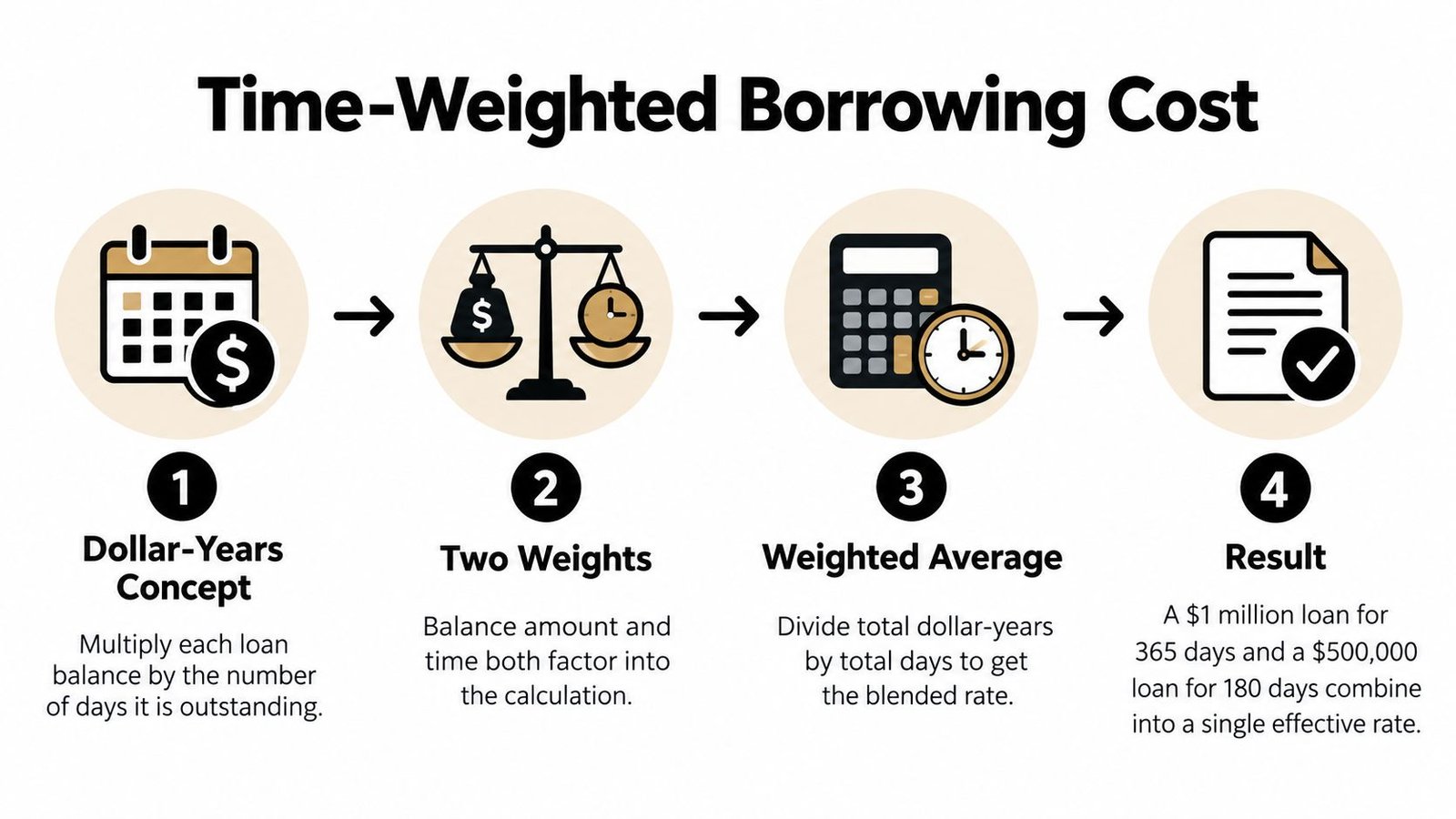
Dollar-Years Measure Real Exposure
U.S. regulations for small-business investment companies handle this by defining cost of capital through time-weighted borrowing, as set out in the SEC filing describing the weighted-average borrowing calculation. For each borrowing, you multiply ending principal net of unamortized fees by the number of days it was outstanding during the prior four fiscal quarters, then divide by 365. You add those results across borrowings to get a weighted-average borrowing amount. Then you divide corresponding interest expense by that amount and multiply by 100.
The intuition is dollar-years. A $1 million loan outstanding for 365 days plus a $500,000 loan outstanding for 182 days produces 1.274 million dollar-years of exposure, not $1.5 million for a full year. The second loan was only there for about half the period, so it earns about half the weight.
Follow four steps when timing varies:
- Qualify each borrowing: Confirm which facilities were outstanding during the period you're measuring.
- Net the principal: Use ending principal net of unamortized fees where that definition applies, so fees don't inflate the base.
- Weight by days: Multiply that principal by days outstanding, then divide by 365 for each borrowing.
- Divide interest by the weighted base: Total interest expense over the summed weighted amount gives the time-weighted rate.
This version matters most for revolving lines, seasonal borrowing, and any loan drawn or repaid mid-year. If you only use year-end balances, a line you carried heavily for eight months and paid down in December nearly disappears from your cost. That's not conservative math. That's missing math.
The short video below walks through the weighted-average logic in a different format if you prefer to see it worked aloud.
Auditors and underwriters lean toward this exposure-based view because it matches interest incurred to balances carried. For a stable stack of term loans that never changes, the snapshot and the time-weighted result will sit close together. For anything revolving or seasonal, trust the time-weighted one.
Excel and Google Sheets Shortcuts You Can Reuse
You don't need specialist software to calculate blended interest rate reliably. You need a clean layout and two formulas you'll reuse every quarter. Set up columns for Lender or Product, Current Balance, Annual Rate, Days Outstanding, Fees, and Net Principal. Keep rates as decimals in the sheet so you don't fight percentage formatting mid-calculation.
The screenshot below shows the kind of simple worksheet layout that keeps the inputs auditable.

The Two Core Formulas
For the balance-weighted snapshot, put balances in column B and rates in column C, then use SUMPRODUCT:
=SUMPRODUCT(B2:B10,C2:C10)/SUM(B2:B10)
SUMPRODUCT multiplies each balance by its rate, adds the results, and hands you total dollar interest in one move. Dividing by SUM of balances finishes the weighted average. It works identically in Excel and Google Sheets, which makes it easy to share with a bookkeeper who uses the other one.
For the time-weighted version, add days outstanding in column D and build a dollar-years column first. In column E, use =B2*D2/365 for each row, then divide total interest expense by SUM(E2:E10). Keeping dollar-years visible, rather than burying it inside one giant formula, lets you spot a wrong day count before it corrupts the result.
Add guardrails so the sheet fails loudly instead of quietly:
- Flag missing rates: Use conditional formatting or an IF check that highlights any row with a balance but a blank rate.
- Block zero-balance distortion: Wrap the main formula in IFERROR or check that SUM of balances is greater than zero before dividing.
- Separate unlike products: Put factor-rate facilities in their own block with a note, so nobody blends them into the APR rows by accident.
Practical rule: If another person can't trace your blended rate back to individual balances in under a minute, simplify the sheet until they can.
When the debt list grows, a pivot table grouped by product type gives you portfolio-level subtotals without rewriting formulas. Name your ranges, Balance, Rate, Days, so the formulas read like sentences. You'll thank yourself when you reopen the file six months later and need to explain the number to a lender.
Where the Blended Rate Misleads You on Real Decisions
A lower blended rate feels like a win. It isn't always one. The balance-weighted formula produces a nominal interest-rate average, and a neutral blended-rate calculator warning about omitted fees and compounding makes the limit explicit, blended calculations omit fees, terms, and compounding, while APR incorporates additional costs.
That omission list is long. Origination fees, servicing charges, prepayment penalties, repayment speed, amortization, and compounding all sit outside the simple average. Extend the repayment term on a consolidation loan and you can lower the rate while paying more total dollars, because you're paying that rate on a balance that declines more slowly for much longer. The rate improved. The deal got worse.
Factor Rates Don't Blend With APRs
The sharpest trap involves mixing pricing conventions. Bank business loans reported by the Federal Reserve range from 6.37% to 10.98%, quoted as annual interest. A merchant cash advance quoted with a factor rate is priced on the original amount over a short, fixed repayment, not as annualized interest on a declining balance. Dropping a factor rate into the same average as an APR is adding unlike units. The output looks precise and means very little.
Convert first. Turn each product into total dollars of cost over a defined time period, then annualize on a comparable basis, or keep factor-rate products as a separate line and compare total cash out. If the distinction between a quoted rate and an all-in annual cost is fuzzy, review how APR differs from the stated interest rate before you blend anything.
The same discipline applies outside business debt. Homeowners who compare mortgage rate options face a parallel problem, a lower headline rate on a different structure doesn't guarantee a lower total cost once term and variability enter the picture. Structure changes the answer in both markets.
Produce two outputs and label them clearly:
- Nominal blended rate: The balance-weighted average, for portfolio reporting and tracking your mix over time.
- Effective annualized cost: Built from actual cash flows, including fees and payoff timing, for deciding whether to refinance.
Negotiate around the second number. Report the first. If a lender only wants to discuss the first, ask why.
Turning the Numbers Into a Smarter Refinancing Call
You now have three tools, and the skill is knowing which one the decision in front of you needs. Use the balance-weighted blended rate when balances are stable, products are comparably priced, and you need a quick portfolio snapshot or a tracking metric. It's fast, explainable, and good enough for that job.
Switch to the time-weighted version when anything revolving, seasonal, or mid-year is in the mix. Lines of credit, draws you repay after a busy season, and loans you retired early all distort a snapshot. Exposure-based math is the honest answer there, and it's the version a careful underwriter will reconstruct anyway.
Move beyond both when you're signing something. For a consolidation or refinance decision, build a cash-flow comparison, ideally an XIRR-style analysis, that lays out every payment, fee, and payoff date for staying put versus switching. That's the only view that captures a longer term raising total cost while the rate falls. For a broader take on why shaving the rate matters when the structure is right, see Dealmaker Wealth Society on rate savings, then test that logic against your own cash flows.
Questions to Bring to the Lender
- What's the all-in cost? Ask for total dollars paid over the full term, including every fee, not just the quoted rate.
- What triggers extra cost? Confirm prepayment penalties on both the loans you're leaving and the loan you're taking.
- How does the balance decline? Get the amortization schedule and compare how fast principal falls under each option.
- What's my break-even point? Pin down how long you must hold the new loan before savings overtake closing costs.
If you're weighing a larger restructuring, work through the mechanics of refinancing a commercial loan step by step with those answers in hand.
Keep three guardrails after you decide. Re-run the math whenever your balance mix shifts materially, since last quarter's blended rate describes a portfolio you may no longer have. Keep factor-rate products on a separate line until you've converted them to comparable dollar and time-based costs. Document every fee in writing before you trust any quoted blended figure, including your own. The number is a tool. Your cash flow is the verdict.
Bring your current balances, rates, and fees together and get a clear read on what consolidation or new funding would really cost before you commit. Business Loan Warrior lets you check pre-approval through a single no-fee application without affecting your credit, then track approvals, repayments, and credit insights in a secure dashboard while you talk with underwriters. Visit today to compare options for business loans, SBA processing, lines of credit, and more against the blended cost you're paying now.