
You’ve built the business under one name, and now that name doesn’t fit the company you run. Maybe you expanded beyond the original service, maybe a lender keeps asking for a cleaner structure, or maybe the old name sounds too narrow for where you’re headed next. Changing business names can solve that problem, but only if the legal filing, banking records, loan documents, and public-facing brand all move together.
A rename is easy to underestimate. The paperwork may look like a branding decision, but the essential work sits in compliance, treasury, contracts, and customer communication. Done well, it signals a real strategic shift. Done sloppily, it creates avoidable friction in accounts, invoices, tax records, and lender files.
Table of Contents
- Beyond the Signage Why a Name Change Is a Strategic Move
- The Legal Roadmap Filing Your Name Change Correctly
- Updating Your Financial Identity IRS Banks and Lenders
- Operational Overhaul Aligning Contracts Website and SEO
- Communicating the Change Managing Perceptions and Preventing Confusion
- Your Name Change Checklist and Common Pitfalls to Avoid
Beyond the Signage Why a Name Change Is a Strategic Move
A business usually doesn’t outgrow its name in one dramatic moment. It happens when the original label starts to feel too small for the actual model, maybe the company added services, merged with another entity, or shifted from a local identity to a broader market position. At that point, the name is no longer just paint on the storefront, it’s part of the strategy.

The market often reads a name change as more than cosmetics. In one analysis, stock prices rose by an average of 4.4% relative to the NYSE Composite Index in the 30 days after a corporate name-change announcement, which suggests investors can see it as a credible signal of strategic repositioning, as reported in the Marketing Science study. That doesn’t mean the market rewards every rename, but it does show something important, the move can carry information when people believe the underlying business has changed too.
When a rename earns trust
The companies that benefit most are usually the ones making a real shift, not just trying to sound newer. If the business has a stronger product mix, a different buyer, a broader geography, or a better structure than the old name suggests, the rename can sharpen the signal. The opposite is also true, if the change looks decorative, customers and lenders may treat it as noise.
Practical rule: a name change should answer a business question first, and a branding question second.
This is why the process starts with strategy, not stationery. A new name can help investors, partners, and customers understand that the company has moved on from its original shape. It can also help internal teams align around the new direction, which matters when the business is making lending decisions, entering new markets, or reorganizing ownership.
For a useful way to pressure-test whether the new name matches the actual business, use these market research questionnaires before anyone orders signage or announces a launch date. A disciplined check at this stage is cheaper than a rebrand that has to be undone later.
The Legal Roadmap Filing Your Name Change Correctly
The legal side of a name change is straightforward only if you follow the sequence carefully. The first move is clearance, then filing, then follow-through. Skip the sequence and you can end up with a name that’s technically filed but unusable in practice.
Start with the three-layer clearance check
Experts recommend a three-layer clearance check, first verify state or entity availability, then run a trademark search, then confirm domain and social handles. That order matters because state registration alone doesn’t stop a conflict with another brand, and the filing only becomes official when the right amendment is accepted. For LLCs and corporations, that usually means filing Articles of Amendment with the formation state, as explained by Forbes.
If you’re a sole proprietor using a DBA, the process is usually simpler, but the same discipline still applies. Confirm that the new name isn’t already taken, check trademark exposure, and make sure the name can be used across the business’s real touchpoints. A filing that passes one test and fails the others is a half-finished change.
Build the filing around the business, not the form
The legal document is only the beginning. A well-run change also needs a live tracking list of every place the old name appears, because the surface area is much wider than the certificate itself. Bank accounts, licenses, tax records, contracts, websites, and vendor systems all need to move in sync, or the company ends up with mismatched records.
Use a simple sequence:
- Confirm the name is available at the state level.
- Check trademark risk before you commit to the name publicly.
- Reserve the domain and handles if they support the planned brand.
- File the amendment or the equivalent state form.
- Refresh internal records once the change is approved.
- Track acknowledgments from banks, vendors, and agencies until each system matches.
That order reduces rework. It also keeps the business from announcing a new identity before the legal backbone exists. If you need a cross-check on licensing and permit implications, this business license requirements guide is a useful companion while you map the filing obligations.
The most expensive mistake is not the form itself. It’s assuming the form solves everything else.
Updating Your Financial Identity IRS Banks and Lenders
This is the part that most generic guides gloss over, and it’s where a rename can become a cash-flow problem. Once the legal filing is done, every financial counterparty still needs to recognize the business under its new name. If they don’t, you can run into rejected payments, delayed postings, or lender questions that slow down day-to-day operations.
Start with the tax side, then move to cash access
A legal name change has to be coordinated with tax records and payroll records so the business name on file matches the business name in circulation. The EIN usually stays the same, but the IRS and state tax systems still need the name updated so filings, notices, and payments don’t drift out of sync. That matters because a mismatch can trigger administrative delays even when the underlying entity hasn’t changed.
Banks often want formal documentation before they update account records. Expect them to ask for the amended formation document, updated resolutions, and possibly new signature cards, because they need to verify that the person requesting the change is authorized to make it. Merchant account providers can be just as strict, especially if they need the legal name to match settlement and risk-review records.
Lenders need more than an announcement
For lenders, the issue is not just courtesy, it’s contract hygiene. Credit facilities and secured transactions can depend on the legal debtor name, and lenders may want advance notice, supporting paperwork, and amendments to guarantees or control agreements. If a loan document still reflects the old name while the operating company has moved on, someone eventually has to reconcile that mismatch.
A practical internal checklist for lender outreach usually includes:
- Amended formation documents so the lender can verify the official change.
- Written notice of the new legal name tied to the exact entity.
- Updated signatures or resolutions if the lender requests them.
- Review of loan agreements and collateral documents for name references.
- Confirmation that payment instructions still match the new records.
If you’re carrying debt, this is the point to look closely at timing. A name update that reaches the lender late can create unnecessary back-and-forth, and the wrong sequence can make an ordinary record change feel like a compliance event. If your capital structure is tied to an EIN-based application history, this business loan with EIN resource is worth reviewing alongside the lender’s document request list.
Keep a single source of truth
The cleanest approach is to assign one person or team to own the financial update log. That person should track who has been notified, what documents were sent, and which acknowledgments have come back. When the bank, lender, and payment processor all update at different speeds, that log becomes the difference between a smooth transition and a pile of contradictory records.
Best practice: don’t treat “sent the email” as completion. Completion is the point at which the bank, lender, or processor has actually updated its system.
Operational Overhaul Aligning Contracts Website and SEO
A legal rename isn’t finished until the company’s operating documents and digital presence match the new identity. If one vendor sees the old name, another sees the new one, and the website tells a third story, the business starts creating friction for itself. That friction shows up in billing, onboarding, and search visibility.
Update the paper trail that governs business relationships
Contracts, leases, vendor agreements, and client templates should all be reviewed for name references. In many cases, the underlying agreement stays valid, but the naming should still be cleaned up so billing instructions and correspondence don’t create avoidable confusion. The same logic applies to licenses and permits, because agencies and counterparties often want the name on record to match the current legal entity.
For businesses with a stronger digital footprint, the rename has another layer. Practitioners recommend keeping mentions of the old brand in homepage copy, title tags, and a dedicated transition page so Google and customers can connect the legacy and new names, as described in this SEO guidance. That approach helps preserve recognition instead of forcing people to relearn the company from scratch.
Treat the website as a transition asset
Your website shouldn’t just swap one logo for another. It should explain continuity, preserve brand equity, and guide visitors who know the old name. If the old name still carries search demand, a migration that removes every trace of it can make the company harder to find, not easier.
For a practical implementation framework, this website domain change best practices guide is a useful reference when you’re coordinating the move across pages, redirects, and customer-facing assets. Use that kind of checklist to make sure the domain, internal links, support pages, and navigation all tell the same story.
Build consistency across the operational stack
The biggest risk here is fragmentation. One team updates the homepage, another updates invoices, and a third leaves old templates in circulation. That’s how renamed companies end up with payment errors, customer confusion, and support tickets that shouldn’t exist.
A cleaner method is to update the company in layers:
- Legal records first, so the name is official.
- Financial systems next, so money can move without friction.
- Contracts and templates after that, so documents are consistent.
- Website and directories in the same window, so the public sees one brand.
- Search signals and transition pages last, so legacy demand still reaches the right place.
Communicating the Change Managing Perceptions and Preventing Confusion
A name change can sound like growth, or it can sound like trouble. The difference usually comes down to how the company tells the story. If customers, employees, and partners hear the news without context, they fill in the blanks themselves.
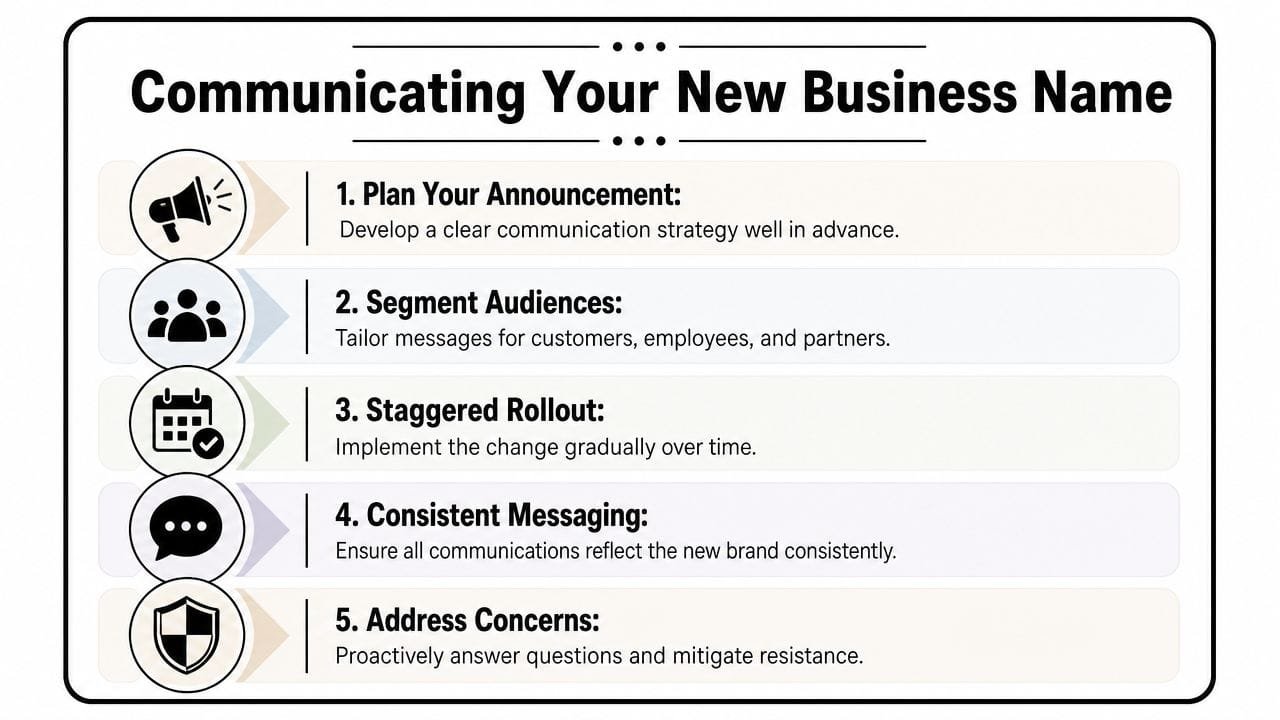
The strongest rollouts don’t rely on one blast announcement. They use a coordinated switch day, a clear explanation of the reason for the change, and channel-specific communication for the people who need to hear it first. That matters because a name change can look unsettling if it arrives without a narrative, even when the underlying business is stronger than before, as noted in this rollout guide.
Speak differently to each audience
Your team needs to know the rationale before the public does. Key clients need reassurance that contracts, service levels, and payment details won’t be disrupted. Partners need to understand what changes and what doesn’t, especially if the old name has lived in shared systems for years.
A practical rollout usually includes:
- Internal briefing first, so employees don’t hear it secondhand.
- Direct outreach to major customers, so they know what to expect.
- Public announcement, often through email, social channels, and a press release.
- Website and signature updates, timed to the launch.
- Follow-up reminders, so the new name sticks after the first wave.
Make the explanation simple and credible
The message should be direct. Say why the business is changing names, what stays the same, and how people should continue working with the company. Avoid overexplaining or sounding defensive. The goal is confidence, not a speech.
A clean rollout reduces the chance that people interpret the rename as instability.
That’s especially important for repeat buyers and referral partners, because they’re the ones most likely to notice a mismatch first. If they see consistency across email, website, and invoices, the change reads like a deliberate move. If they see a mix of old and new names, they start asking questions the business didn’t plan for.
Your Name Change Checklist and Common Pitfalls to Avoid
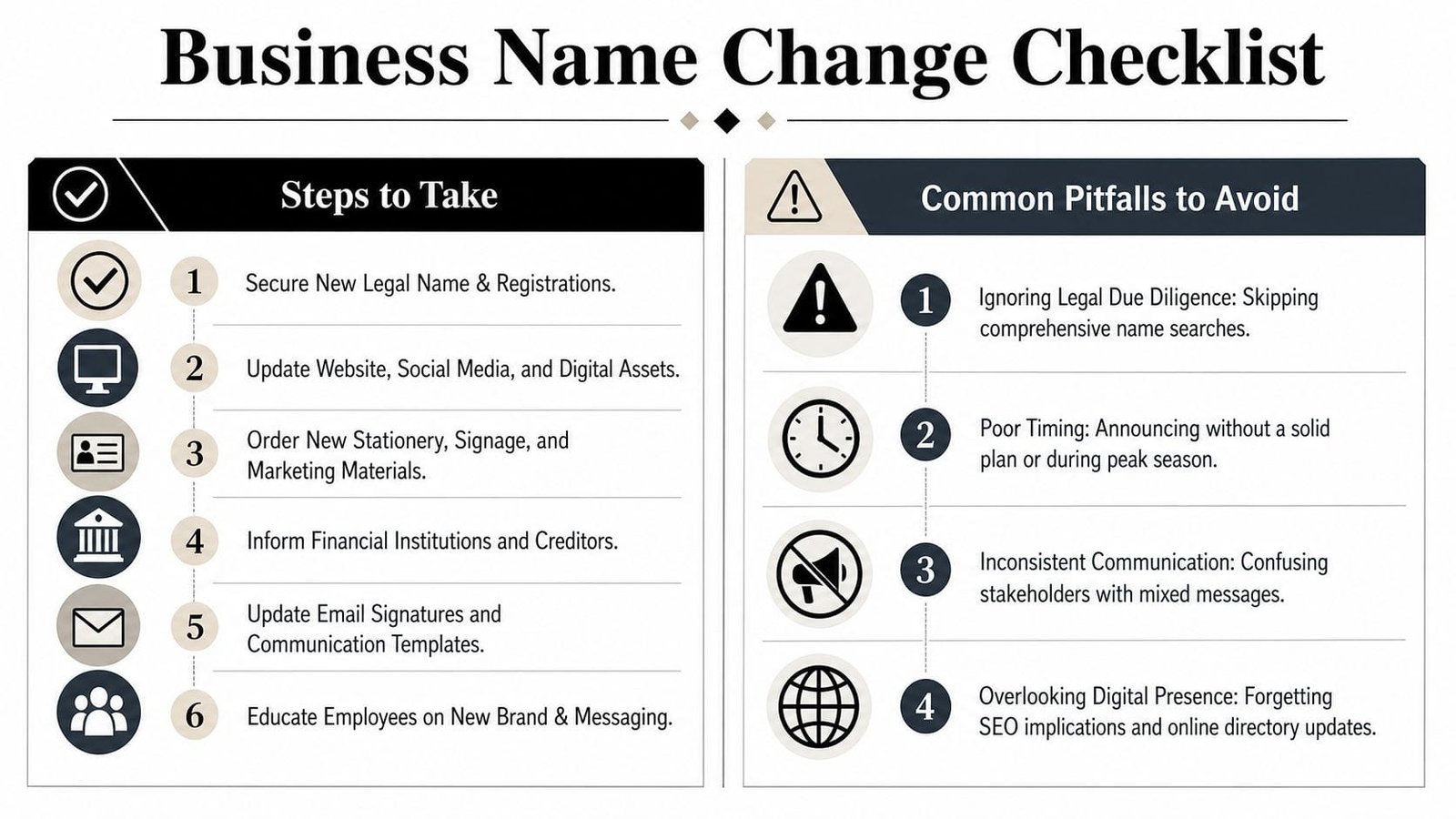
A name change works best when you treat it like an operating project, not a branding errand. The common mistake is to finish the filing and assume the job is done. In reality, the new name has to survive tax records, banking, contracts, customer communication, and search visibility.
Checklist to keep the rollout tight
- Secure the legal name and file the required amendment.
- Update financial institutions so accounts and payment records match.
- Revise contracts, licenses, and templates so the entity name is consistent.
- Refresh the website, emails, and directories so the public sees one brand.
- Brief employees and stakeholders so the message is consistent.
The traps that cause the most trouble
The biggest missed issue is cross-border complexity. For businesses operating in multiple states or internationally, a name change requires filings not only in the formation state but in every state where the business is foreign-qualified, and it can create friction across cross-border tax registrations and KYC/AML records, as Wolters Kluwer notes. That’s not a minor admin task, it’s a coordination problem.
Another trap is timing. If the announcement goes out before banks, lenders, and systems have been updated, the business creates work for itself. A third problem is inconsistency, where some records get updated and others don’t, leaving customers and vendors to guess which name is current.
If you’re changing names while also managing financing, vendor relationships, or growth plans, keep the project tied to one owner and one master checklist. That’s the difference between a clean transition and a messy one that lingers for months.
If you’re planning a business name change and want to protect cash flow, credit relationships, and operational continuity while you do it, start mapping the legal, banking, and lender steps together now. Visit Business Loan Warrior to compare funding options and keep your financial side organized while the new name goes live.