
Opening a mid-size coin laundry in the U.S. typically costs $200,000 to $500,000, and equipment plus build-out are usually the two biggest drivers of that total. If you’re pricing a realistic 2026 launch, the national average investment for a medium-scale facility is about $250,000, but the true all-in number often rises once you account for infrastructure, reserves, and security.
Most owners start this process the same way. They find a vacant retail space, run rough machine counts in their head, and assume the hard part is choosing washers and dryers. Then the actual budget shows up. Plumbing capacity, payment systems, water heating, insurance, security, permits, and working capital can turn a promising idea into a stressed financing package if they aren’t planned early.
That gap is where many laundromat budgets go sideways. The headline machine cost gets attention. The supporting systems don’t, even though they often decide whether the project opens cleanly or stalls in underwriting.
This guide treats coin laundry startup costs the way lenders and experienced operators do. Not as one big number, but as a stack of separate decisions, each with its own trade-offs.
Table of Contents
- Your Laundromat Dream and Its Price Tag
- The Complete Coin Laundry Startup Cost Breakdown
- Building Your Pro Forma and Finding Your Break-Even Point
- Financing Your Laundromat Startup From Application to Funding
- Smart Strategies to Reduce Your Initial Investment
- Your Laundromat Loan Application Checklist
- Planning Your Path to Profitability
Your Laundromat Dream and Its Price Tag
You find a vacant retail bay with strong parking, decent visibility, and rent that looks workable. On paper, the deal feels close. Then the complete financial picture starts to materialize. Utility upgrades, permits, security cameras, payment systems, insurance, and opening cash reserves can turn a promising site into a strained startup budget fast.
Published estimates from the U.S. Small Business Administration’s laundromat startup guide put laundromat startup costs in a wide range because the business is heavily site-dependent. That is the right way to read this industry. There is no single number that travels well from one location to another. A second-generation laundry with strong utilities is a different project from a raw retail shell, even if both stores end up with a similar machine count.
A common budgeting error is treating the machine package as the whole investment. It is not. The machine package is only one layer of the capital stack. The store also has to be safe, insurable, code-compliant, and able to operate for the first several months without choking on avoidable cash pressure.
Practical rule: Budget for the store you can open and stabilize, not the store you can barely sign for.
That distinction matters more in 2026 because many startup guides still focus on rent, equipment, and basic build-out. Owners now have to price in card and mobile payment hardware, remote monitoring, alarm systems, stronger cash-handling controls, camera coverage, and the labor setup required for wash-and-fold if that service is part of the model. These costs are easy to dismiss during early planning because they do not look as dramatic as a row of new washers. They still hit your bank account before the store is fully ramped.
Insurance belongs in that same conversation. A lender will care about coverage, and so should you. Water damage, slip-and-fall claims, equipment breakdown exposure, and liability tied to an unattended store can all affect your real startup budget. Before you finalize projections, find business insurance rates and treat that number as part of your opening math, not an afterthought.
The best operators review a laundromat site from two angles at the same time. First, can this location run efficiently without expensive rework after opening? Second, can the business carry debt service, early operating losses, and surprise repairs without running short on cash? If the answer to either question is no, the project is not ready yet.
The Complete Coin Laundry Startup Cost Breakdown
A first-time owner often prices a laundromat the same way someone prices a car. They focus on the sticker, then get blindsided by taxes, insurance, and the repair fund. Coin laundry projects work the same way. The machines get attention. The hidden operating and security costs decide whether the budget survives first contact with reality.
Equipment is the budget anchor
In nearly every new coin laundry, commercial-grade equipment is the largest cost category. It commonly absorbs 40% to 60% of the total startup budget, and a mid-sized store may need 40 to 100 washers and dryers costing roughly $150,000 to $300,000, based on Jim’s breakdown of coin laundry equipment costs.
That lines up with what I see in financing files. Machines set your earning capacity, vend pricing flexibility, utility profile, and repair exposure. If the package is too small, the store chokes during peak demand. If it is too expensive for the market, debt service starts eating cash before the location has time to stabilize.
The big decision is not just new versus used. It is matching machine mix to customer behavior. A neighborhood with family loads needs more large-capacity washers. A commuter-heavy trade area may need faster turns and easier payment options more than extra machine count.
What works:
- Buying for local demand: Capacity should follow household size, renter density, and turnover patterns in the trade area.
- Protecting uptime: Newer equipment often brings better parts access, warranty coverage, and fewer early service calls.
- Treating machine count as revenue capacity: Every removed washer is also removed income potential during busy hours.
What causes trouble:
- Buying on sticker price alone: A cheaper package can produce higher repair bills and more downtime.
- Ignoring payment compatibility: If your machines and payment system do not work well together, retrofits get expensive fast.
- Forcing the wrong mix into the room: A cramped layout slows customer flow and makes the store harder to clean and supervise.
Build-out can save or sink the deal
Build-out is where a promising project can go off budget. Laundromats are utility-heavy businesses, so the expensive work often sits behind finished walls, under the slab, or above the ceiling.
Industry cost guides from the Coin Laundry Association show why this category deserves close attention. Their laundromat startup guidance notes that build-out costs vary widely based on plumbing, electrical upgrades, gas service, venting, and local code requirements. That spread is exactly why two stores with similar square footage can have radically different opening budgets.
A practical way to review the numbers is to separate them by function:
| Cost Category | Low-End Estimate | High-End Estimate | Why It Moves |
|---|---|---|---|
| Equipment package | $150,000 | $300,000 | Machine count, capacity mix, new versus used |
| Build-out and renovation | $50,000 | $200,000 | Plumbing, drains, power, gas, venting, code work |
| Commercial space | $50,000 | $250,000 | Market rents, deposit structure, purchase versus lease |
| Installation and renovations | $20,000 | $100,000 | Delivery, hookups, concrete, finish work |
| Working capital reserves | $20,000 | $50,000 | Ramp-up time, early repairs, staffing, float |
When owners ask where real savings come from, I usually start with the site, not the machines. A second-generation laundry with usable utilities can save far more than a discount on equipment. A cheap vanilla shell can become an expensive mistake once trenching, transformer work, water heating upgrades, and permit revisions start piling up.
A bad site makes every other decision more expensive.
Before signing a lease, get hard answers on water pressure, sewer capacity, panel size, gas load, vent paths, roof condition, and landlord responsibility for utility upgrades. At the same stage, it helps to find business insurance rates so your startup budget includes the actual cost of opening, not a placeholder.
The hidden systems most first budgets miss
This is the part many startup articles gloss over. A laundromat budget is not finished when you price machines, paint, and permits.
Payment hardware is one example. The Speed Queen investment guide explains that modern laundromats often need integrated payment systems, card readers, or kiosk-based setups as part of the initial equipment and technology package. Owners who budget only for coin drops often end up rewriting their plan mid-project once they decide they need app payments, loyalty tools, or remote reporting.
Hot water infrastructure creates the same kind of surprise. The U.S. Department of Energy’s commercial water heating guidance at energy.gov makes the basic point clearly. Sizing, fuel choice, and efficiency standards have a direct effect on installation cost and monthly operating expense. In a laundry, undersized water heating is not a minor inconvenience. It can limit throughput, hurt customer experience, and force expensive corrections after opening.
Security is another line item that deserves more respect in 2026. Unattended and partially attended stores now rely on camera coverage, remote access controls, alarm systems, cash-handling procedures, and stronger network reliability for digital payments. Those costs do not make the storefront prettier. They reduce theft, chargebacks, vandalism, and after-hours confusion. They also matter to lenders and insurers because weak controls raise operating risk.
Owners adding wash-and-fold run into another hidden layer. The service sounds simple until the floor plan needs sorting tables, bag storage, employee work areas, sinks, POS setup, and extra utility use. Add labor scheduling and customer order tracking, and the startup budget changes shape. The store is no longer just self-service. It becomes a small processing operation.
If you are mapping those expenses, use a cash flow forecast that supports your loan strategy and build these systems into the opening budget instead of burying them in a later contingency line.
Startup cost summary table
A workable startup budget separates costs into four buckets:
-
Revenue-producing assets
Washers, dryers, customer payment systems, and any service equipment tied directly to sales. -
Site readiness costs
Plumbing, utility capacity, hookups, construction, installation, permits, and code compliance. -
Risk-control costs
Insurance, surveillance, alarm systems, cash-handling security, network reliability, and payment protection. -
Stability capital
Reserve cash for opening payroll, utilities, repairs, marketing, and a slower ramp than planned.
The deals that get into trouble usually do not fail because the owner forgot one giant expense. They fail because ten smaller costs were treated like afterthoughts. In laundromat lending, that pattern shows up constantly. The operator gets open, traffic builds slower than expected, one equipment issue hits early, and the reserve account is already thin.
A real all-in budget fixes that before the first dollar is spent.
Building Your Pro Forma and Finding Your Break-Even Point

A pro forma is the operating model that shows whether your laundromat can survive real startup conditions, not just a good opening month.
Picture a common early mistake. The owner budgets for rent, machines, and utilities, then assumes break-even arrives as soon as weekly turns start climbing. Three months later, the store is open, revenue is coming in, and cash is still tight because card processing holds, repairs, surveillance monitoring, internet outages, detergent inventory, and a slower ramp in wash-dry-fold all hit at once. That is why this part of the plan matters. It forces hidden operating and security costs into the math before they show up in your checking account.
A useful pro forma does two jobs. It shows profit potential, and it shows cash strain by month.
Build the model the way a lender reads it
Lenders want a model that matches how a laundromat opens and then stabilizes. That means monthly projections, not just annual totals, and assumptions you can explain in one sentence.
| Pro forma line | What to show |
|---|---|
| Revenue | Washer and dryer income, plus wash-dry-fold, vending, pickup and delivery, or ancillary sales if they are part of the model |
| Occupancy cost | Rent, CAM charges, property-related fees, and any required deposits |
| Utilities | Water, sewer, gas, electric, internet, and payment system connectivity |
| Payroll | Attended hours, wash-dry-fold labor, payroll taxes, and training if staffing is part of the plan |
| Repairs and maintenance | Routine service, early machine issues, drain cleaning, parts, and service calls |
| Security and loss control | Cameras, alarm monitoring, cash collection procedures, card system protection, and after-hours response costs |
| Administrative overhead | Insurance, licenses, software, bookkeeping, merchant fees, and office supplies |
| Debt service | Loan payments, equipment financing, and any landlord-required obligations |
| Net cash position | Whether the store can cover obligations each month without draining reserves |
That security line gets skipped too often. In a cash business with unattended hours, cameras, alarm monitoring, bill changers, smart payment systems, and network reliability are operating requirements, not nice extras. If your pro forma ignores them, your break-even point will look better than your bank balance.
Break-even is a line. Cash survival is a timeline
Owners often focus on the month the store covers its fixed costs. Lenders care about that, but they also want to know what happens in the months before customer habits are established.
A realistic break-even model usually tests at least three cases:
- Base case: traffic builds at the pace you expect
- Slow ramp case: customer volume builds later than planned
- Disruption case: one or two early repairs, a utility spike, or a payment system issue hits during the first six months
Weak projections quickly unravel. The paper profit is there, but the reserve account is too thin to absorb normal startup friction.
If you need a framework for laying this out month by month, use this guide to build a cash flow forecast that supports your loan strategy. It follows the same logic underwriters use when they test whether a new location can carry debt and still keep enough working cash on hand.
What a believable laundromat pro forma includes
Strong projections are specific about timing.
Rent may start before the first wash cycle. Utilities often run high early because owners are testing equipment, correcting settings, and training staff. Merchant fees, software subscriptions, camera storage, and alarm monitoring start immediately. Wash-dry-fold can improve revenue, but it also adds labor, packaging, customer service time, and rewash risk.
I tell borrowers to model the first six months like a store that is still finding its rhythm, because that is usually what happens. A grand opening weekend can look great and still tell you very little about month three.
Lender mindset: If the store only works when volume ramps fast, repairs stay low, and no security or payment issue shows up, the projection is not ready.
The best pro formas are not fancy. They are defensible. They show how the business handles ordinary startup pressure while covering the less obvious costs that many first-time owners miss. That is what turns a spreadsheet into a financing tool.
Financing Your Laundromat Startup From Application to Funding
A lot of first-time owners walk into financing conversations focused on the machine package. Then the lender starts asking about tenant improvements, utility capacity, security cameras, alarm monitoring, payment hardware, opening cash, and contingency reserves. That is usually the moment the budget stops looking clean.
Laundromat financing works best when each cost is matched to the right type of capital. Machines have resale value, so lenders often view them differently than plumbing upgrades or electrical work. Working capital sits in a third bucket. Hidden operating costs matter here too. If your opening budget ignores camera storage, remote monitoring, software subscriptions, merchant processing float, or early repair calls, the loan request can look underbuilt even if the machine count is right.
Owner cash still matters. Industry lenders commonly expect a meaningful equity injection on startup deals, especially for new operators, larger build-outs, or projects with heavier construction risk, as noted in Eastern Funding’s laundromat financing overview. The practical takeaway is simple. Approval does not remove the need for cash. It usually confirms how much cash the owner must bring in.
Match the loan to the cost category
The strongest financing plans treat a laundromat like a stack of separate needs, not one giant purchase order.
SBA financing usually fits full startup projects with several moving parts. It can cover build-out, equipment, soft costs, and working capital in one structure. The trade-off is paperwork and scrutiny. Lenders want a tighter pro forma, clearer personal financials, and a better explanation of how the store gets through the first uneven months.
Equipment financing fits machine-heavy deals where the site work is already funded or modest. It preserves cash, which matters because cash gets eaten up fast by deposits, permits, utility setup, surveillance, access control, and early operating expenses that do not produce revenue on day one.
Business lines of credit work better as backup liquidity than as primary startup funding. They can help absorb timing gaps, repair spikes, and small misses in the opening budget. They do not fix a project that is short on build-out cash.
If you want a practical view of timelines, underwriting, and document prep, review this step-by-step SBA loan application process for small business owners before you start sending applications.
What lenders look for before they say yes
A lender reviewing a coin laundry startup usually asks five questions:
- Has the owner put in enough cash? Equity shows commitment and gives the project breathing room if costs run high.
- Does the location support the model? Good demographics and visibility help, but lenders also look at parking, utility readiness, lease terms, and local competition.
- Is the budget complete? Missing line items hurt credibility fast. Security systems, network setup, card or app payment hardware, signage, permit fees, and reserve capital are common omissions.
- Can the store cover debt under normal pressure? A usable pro forma shows performance after utilities, payroll, repairs, payment processing, and the slow ramp most new stores experience.
- Does the borrower understand day-to-day operations? Experience helps. So does a clear plan for staffing, maintenance, shrink prevention, and handling vandalism or equipment downtime.
That last point gets underestimated. I have seen lenders get more comfortable with a first-time owner who built a realistic operating plan than with an overconfident buyer who only knew machine brands and revenue headlines.
Here’s a useful midpoint before you move deeper into loan shopping.
Why structure matters more than chasing one product
The financing mistake that causes the most stress is forcing one product to carry the whole deal.
A laundromat startup often includes leasehold improvements, utility work, machine acquisition, payment infrastructure, security systems, and reserve capital. Those costs age differently, carry different risk, and produce returns on different timelines. Equipment may justify one structure. Build-out may fit another. Reserve cash should usually stay flexible.
Good financing structure protects the store after closing, not just at approval. That matters because hidden costs show up early. A camera system may need cloud storage. Smart locks may need monthly service. Card systems may create settlement timing issues. A break-in, vandalism event, or drain problem can hit before the customer base is steady. Owners who preserve liquidity usually handle those hits better than owners who finance aggressively and open with no cushion.
Smart Strategies to Reduce Your Initial Investment
A lot of owners try to save money in the wrong place. They negotiate hard on machine pricing, then sign a lease for a room that needs expensive trenching, panel upgrades, new gas service, and a full security retrofit. That is how a “cheap” deal turns into an expensive opening.
The goal is to lower upfront cash without creating operating problems in the first six months. In laundromats, hidden costs usually show up in infrastructure, security, and service support, not in the brochure price.
-
Pick the utility-ready site first
Site selection drives more startup cost than almost any design choice. Industry guidance from the Coin Laundry Association points out that construction and build-out costs can vary widely based on plumbing, electrical capacity, venting, and code requirements, which is why a plain second-generation laundry space often beats a nicer site that needs heavy utility work. Review utility capacity before you get attached to the layout, finishes, or storefront potential. A site with the right water, gas, drainage, and power can save more than any vendor discount. -
Spend on throughput and risk control before appearance upgrades
Customers notice machine availability, store cleanliness, lighting, payment reliability, and whether the location feels safe. They do not pay extra because you installed decorative finishes. If cash is tight, put money into the items that protect revenue and reduce headaches. Good cameras, solid locks, bright exterior lighting, and remote monitoring often do more for real-world performance than upgraded wall treatments or custom millwork. -
Use financing as a cash-preservation tool
Smart owners keep cash available for deposits, opening reserves, early repairs, and the small operating hits that show up fast after launch. Equipment financing can help with that if the terms fit the store’s projected cash flow. If you are comparing structures, review this guide to zero-down equipment financing for laundromat startups before committing too much cash to machinery. -
Treat used equipment like a trade-off, not an automatic win
Used machines can reduce upfront cost, especially in smaller markets or partial retool projects. They can also bring more service calls, slower turns, higher utility use, and more downtime. I usually tell first-time owners to price the repair risk before they celebrate the purchase price. A machine that saves money at closing but creates repeated out-of-order periods can cost more where it hurts most, during customer acquisition. -
Delay add-on services until the core store works well
Wash-and-fold, pickup and delivery, and vending can all add revenue. They also add labor, software, supplies, theft exposure, and more day-to-day management. A clean self-service opening with strong machine uptime and good store controls is often the better first move. Add service layers after the base operation is stable.
The right target is a lower-cost opening that still protects uptime, safety, and cash reserves.
Disciplined owners usually win this stage by trimming complexity, not by stripping out the pieces that keep the store secure and operating.
Your Laundromat Loan Application Checklist
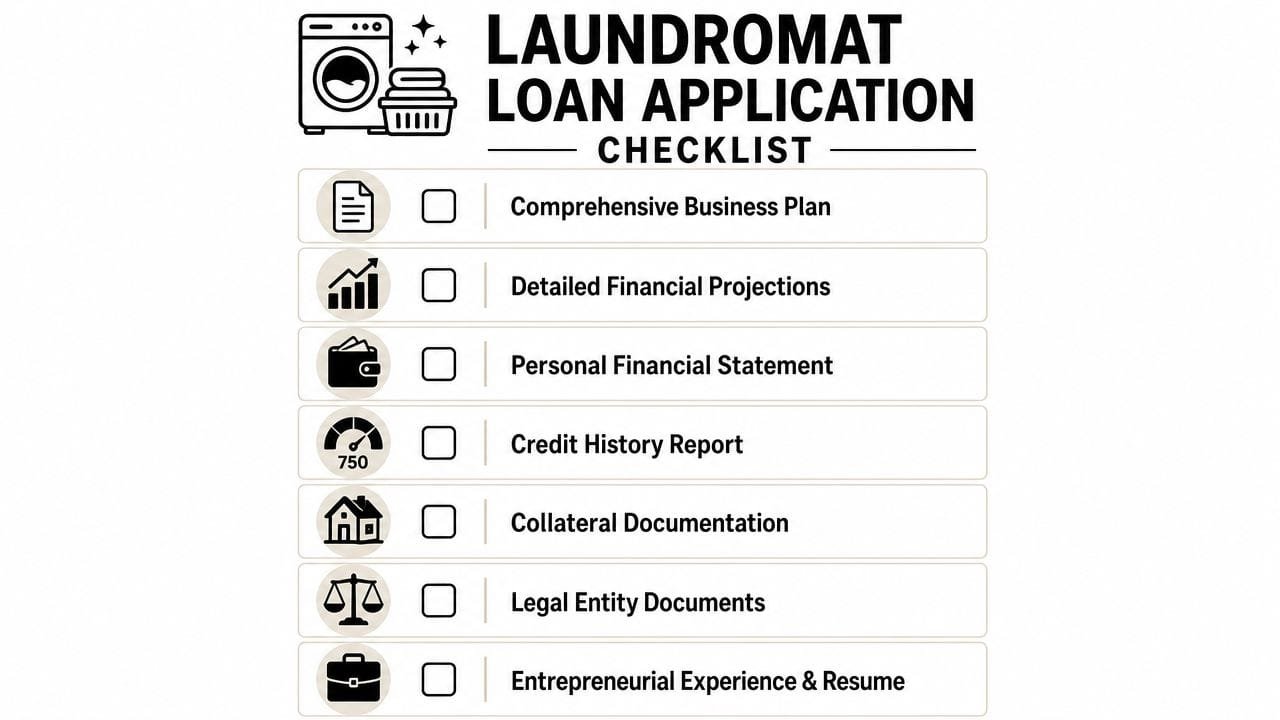
A strong loan package makes a laundromat project feel real. A weak one makes it feel speculative. Most lenders don’t reject owners because the concept is unfamiliar. They reject incomplete files, vague projections, and unsupported budgets.
Financial documents
- Personal financial statement with assets, liabilities, liquidity, and contingent obligations
- Personal and business tax returns if you already own other companies
- Bank statements that show available cash for down payment and reserves
- Detailed financial projections including startup uses of funds, revenue assumptions, and debt service
Business and project documents
- Business plan that explains the model, location logic, customer base, and management plan
- Equipment quotes from actual vendors so the machine budget isn’t a guess
- Lease terms or letter of intent for the proposed site
- Contractor or build-out estimates for plumbing, utility, and renovation scope
- Legal entity documents such as formation paperwork and ownership breakdown
Owner information
- Resume or operating background that shows transferable experience
- Credit history documentation if a lender requests support for specific items
- Collateral information when the structure requires it
Bring quotes, not guesses. Lenders can finance a project. They can’t finance a moving target.
The cleaner this package is, the faster underwriting usually moves.
Planning Your Path to Profitability
A laundromat is a capital-heavy business, but it isn’t a mystery business. The owners who succeed usually do a few things well. They budget thoroughly, choose sites carefully, protect working capital, and don’t treat hidden operating costs like afterthoughts.
The biggest lesson in coin laundry startup costs is simple. The machine package gets attention, but the supporting infrastructure decides whether the store opens smoothly and stays financially stable. Security systems, payment technology, water heating, labor setup for service models, and reserve capital all belong in the first draft of the budget, not the last.
That mindset changes the project. Instead of asking, “What’s the cheapest way to get open?” ask, “What’s the most durable version of this store I can responsibly fund?” That’s the question lenders respect, and it’s usually the question that leads to a more profitable business.
If you’re ready to turn your laundromat plan into a financeable project, Business Loan Warrior can help you explore funding options for equipment, build-out, working capital, and SBA-backed structures through one consolidated application.