
You're comparing two financing offers at the kitchen table. One advertises an 8% interest rate, but it includes an origination fee and a short repayment period. The other quotes 9% with no visible fee, yet the payment schedule looks more manageable. Which one is cheaper?
The answer isn't found in the headline rate alone. The cost of debt converts interest, fees, repayment terms, and tax effects into a more useful view of what borrowed money costs your business. That number can help you decide whether expansion is affordable, whether refinancing makes sense, and whether fast working capital is worth its convenience.
By the end, you'll be able to calculate the pre-tax and after-tax cost of debt, compare different loan types, and question offers that look inexpensive until the fine print appears. If you're also comparing APR with a lender's stated interest rate, this guide to APR versus interest rate will help clarify the difference.
Table of Contents
- Why Your Real Borrowing Cost Is More Than the Interest Rate
- What Cost of Debt Means in Plain English
- Calculating Cost of Debt Step by Step
- Cost of Debt vs Cost of Equity vs WACC
- Current Benchmarks and What Moves Your Rate
- Matching Loan Types to Real Business Scenarios
- Practical Ways to Lower Your Cost of Debt
- Your Next Steps to Smarter Borrowing
Why Your Real Borrowing Cost Is More Than the Interest Rate
The owner with those two offers has a common problem. An 8% rate sounds cheaper than 9%, but the first lender may collect fees upfront, calculate payments over a shorter term, or require faster repayment. The second lender may charge more interest but give the business longer to repay the balance and no origination charge.
A rate tells you the price attached to the loan balance. It doesn't always tell you how much cash leaves the business, when it leaves, or what obligations come with the financing. A lower rate can still produce a higher total cost if the loan carries substantial fees or forces large payments before the funded project generates revenue.
The practical question: “What will this money cost my business from funding date to final payment?”
That's why cost of debt matters. It gives you a common language for comparing a bank term loan, a business line of credit, equipment financing, and short-term working capital. Each product may quote its price differently, so comparing the visible rate alone can lead you toward the wrong offer.
The calculation also supports better operating decisions. A business may accept a higher borrowing cost for equipment that immediately produces revenue, while rejecting the same cost for a long-term expansion with uncertain timing. Refinancing decisions require the same discipline. A new loan can lower the rate while adding fees, resetting the repayment clock, or placing more collateral at risk.
You don't need an investment banker's spreadsheet to begin. You need the interest expense, debt balance, fees, repayment period, and tax rate that apply to your business. Once those pieces are visible, the loan offers on your desk become much easier to compare.
What Cost of Debt Means in Plain English
Think of debt as renting capital. When you rent office space, the advertised monthly rent isn't always the full occupancy cost. You may also pay a deposit, maintenance charges, and other required expenses. Borrowed money works similarly. Interest is the main rental charge, while fees, points, and repayment conditions affect the true price.
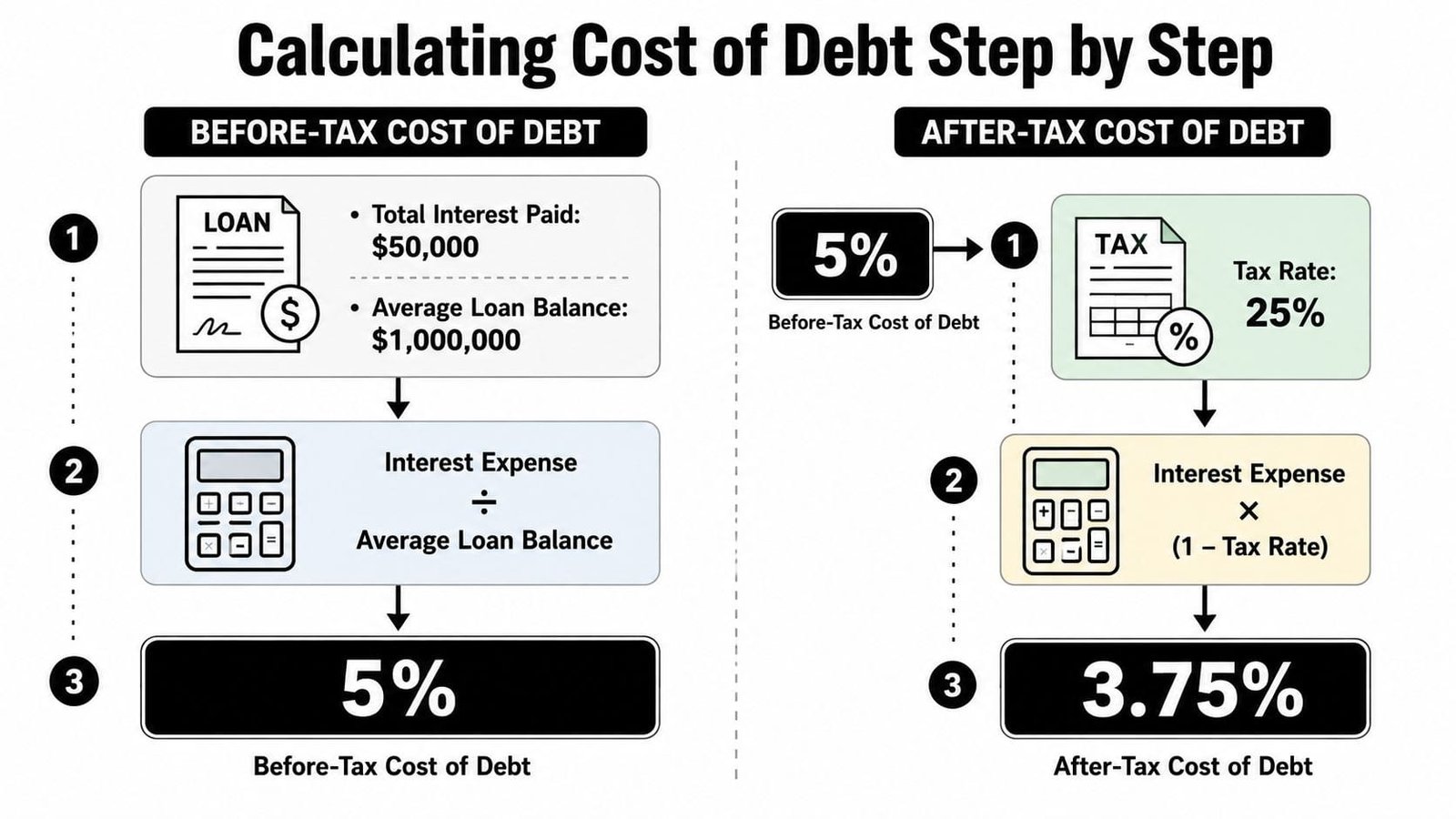
The pre-tax cost of debt measures the borrowing cost before considering the tax deduction for interest. In valuation practice, businesses often estimate it by dividing annual interest expense by total debt. For publicly traded debt, finance professionals commonly use yield to maturity, or YTM, because it reflects the return investors currently require if they hold the debt until maturity. The standard cost of debt framework explains why a historical nominal interest rate may not represent the debt's present market cost.
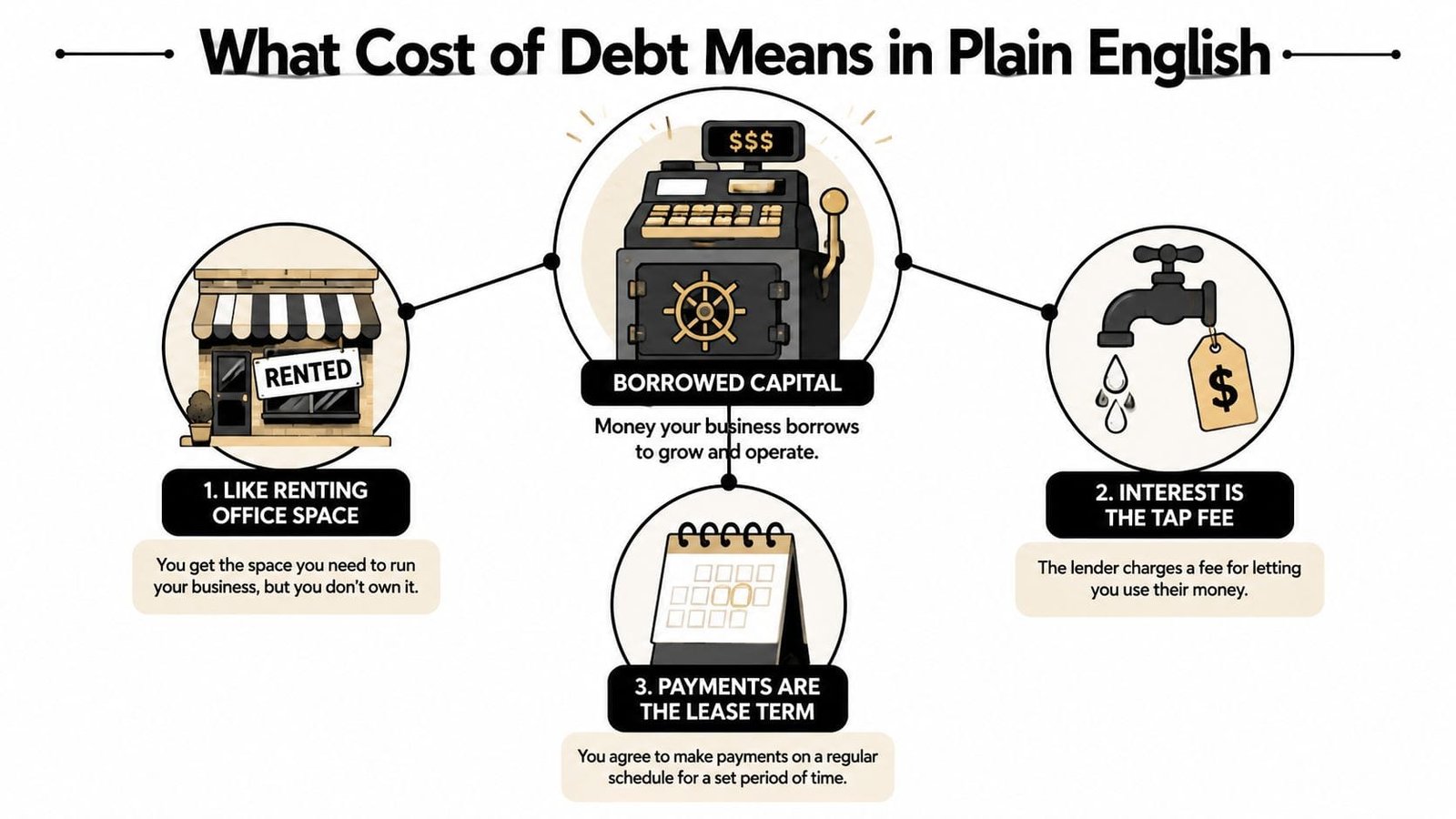
Before-tax and after-tax cost
The pre-tax figure is useful for comparing lender offers. The after-tax cost of debt asks what the borrowing costs after the business receives the tax benefit associated with deductible interest.
After-tax cost of debt = effective interest rate × (1 − tax rate)
The tax shield exists because eligible business interest expense can reduce taxable income. If the business can use that deduction, part of the interest burden is offset through lower taxes. The reduction isn't a cash rebate from the lender, and it shouldn't be assumed automatically. Tax treatment depends on the business's circumstances, applicable rules, and whether the company has taxable income against which to use the deduction.
Why market yield can matter
A loan's original coupon is the rate written into its agreement. Market yield reflects what that debt costs at current prices and current investor expectations. If market conditions change, the original coupon may remain unchanged while the debt's present economic cost changes.
The scale of this issue is visible in federal borrowing. U.S. federal interest costs reached an all-time high of $476 billion in 2022 and then rose to $970 billion in 2025, while the Congressional Budget Office projected $1.0 trillion in 2026. Those figures don't determine a small business's rate, but they illustrate how quickly higher borrowing costs can affect large borrowers and the benchmarks used throughout credit markets.
Calculating Cost of Debt Step by Step
Start with the numbers on the loan statement, not the marketing page. Separate interest from principal repayment, identify upfront fees, and use the relevant debt balance for the period you're measuring.
Example one with one term loan
Assume a business has a $150,000 fixed-rate term loan with an annual interest rate of 8%. For simplicity, treat the balance as stable during the measurement period and leave fees out of this first illustration.
Step 1, calculate annual interest expense.
$150,000 × 8% = $12,000
Step 2, calculate the pre-tax cost of debt.
$12,000 ÷ $150,000 = 8%
Step 3, apply an assumed tax rate.
Assume the business can use a 25% tax rate for this illustration.
Step 4, calculate the after-tax cost.
8% × (1 − 25%) = 8% × 75% = 6%
The result is a 6% after-tax cost, assuming the interest deduction is usable. If the loan includes an origination fee, that fee should be added to the financing cost and spread across the period being analyzed. A short loan term makes that fee more significant because the business has less time over which to distribute it.
For a fuller view of the payment balance, principal reduction, and interest schedule, create a debt schedule before making the comparison.
Example two with two loans
Now assume the business has:
- $100,000 at 7%
- $50,000 at 11%
Step 1, calculate interest on each loan.
$100,000 × 7% = $7,000
$50,000 × 11% = $5,500
Step 2, add the annual interest expense.
$7,000 + $5,500 = $12,500
Step 3, add the debt balances.
$100,000 + $50,000 = $150,000
Step 4, calculate the blended pre-tax cost.
$12,500 ÷ $150,000 = 8.33%, rounded
Step 5, apply the same 25% tax assumption.
8.33% × 75% = 6.25%, rounded
This weighted average is more informative than looking at either rate separately. For help estimating the broader cost of carrying debt, use a calculator that lets you account for the balances and payment obligations attached to each facility.
The video below offers another visual explanation of the calculation process.
Cost of Debt vs Cost of Equity vs WACC
A business can fund itself with borrowed money, owner capital, or a mixture of both. Each source has a different price.
Cost of debt is the effective return lenders require. The business must make scheduled payments, and interest may qualify for a tax deduction. Cost of equity is the return owners expect for investing their money and accepting business risk. Equity doesn't require scheduled repayment, but owners generally expect compensation for giving up the use of their capital and taking the possibility of loss.
That tax difference matters. Debt may receive a tax shield, while equity returns generally don't create the same interest deduction. As a result, debt can appear cheaper than equity on an after-tax basis, although the comparison changes when you include collateral, guarantees, default risk, and repayment pressure.
WACC as the financing seesaw
Weighted average cost of capital, or WACC, combines the cost of debt and cost of equity according to their shares in the company's financing mix. Think of a seesaw. Debt sits on one side, equity on the other, and the balance depends on both the amount of each source and its price.
Adding reasonably priced debt can lower the blended financing cost because the company uses capital that may be less expensive than equity. Add too much debt, however, and lenders may demand a higher return because the business has less room to absorb a weak quarter. Owners may also demand a higher return because their position becomes riskier. The seesaw can tip.
WACC matters when an owner evaluates an investment. A project should generate enough return to justify the capital committed to it, not merely cover the advertised loan rate. Buyers and lenders also use financing costs when assessing business value and repayment capacity.
The risk-free rate forms the starting point for much corporate debt pricing. Lenders commonly price debt as a spread above government securities, especially Treasury yields. The risk-free rate explanation shows why a company's cost of debt is more than its coupon. It includes the market's required return above that baseline. U.S. projected net interest totals $16.2 trillion over the next decade, which highlights why benchmark yields matter across the financing system.
Current Benchmarks and What Moves Your Rate
There isn't one universally good business loan rate. A rate that makes sense for equipment with a long useful life may be unsuitable for a restaurant covering a brief cash-flow gap. Product structure, repayment speed, collateral, and borrower risk all change the comparison.
Recent coverage provides these reference points:
| Loan Source | Typical Rate Range | Best For |
|---|---|---|
| Bank loans, Q3 2025 | 6.3% to 11.5% | Established businesses with stronger financial profiles |
| Online and alternative lenders | 14% to 99% APR | Businesses prioritizing access or speed |
| Short-maturity small business loans, January 2026 | 9.1% average | Short-term working-capital needs |
The figures in the table come from recent small-business financing coverage. They are benchmarks, not promises. A lender may price your application differently because your company, loan purpose, and repayment capacity differ from the businesses behind a broad market range.
What pushes the rate up or down
Lenders usually examine the quality and consistency of cash flow first. A business with dependable revenue and clean financial statements gives the lender more confidence that scheduled payments will arrive. Weak margins, irregular deposits, or incomplete records can lead to a higher price or a smaller approval.
Credit history affects the lender's view of repayment risk. Time in business can provide operating evidence, while collateral gives the lender an asset it may claim if the borrower defaults. A longer maturity can make each payment easier to manage, but it may increase total interest paid over the life of the loan.
Debt load also matters. Recent coverage says 39% of firms carry more than $100,000 in business debt, up from 31% in 2019, so owners should examine existing obligations before adding another payment. Before applying, write down current balances, monthly debt service, average monthly cash flow, collateral available, and the exact purpose of the new funds. That short review can reveal whether you need cheaper capital, a different product, or no new debt yet.
Matching Loan Types to Real Business Scenarios
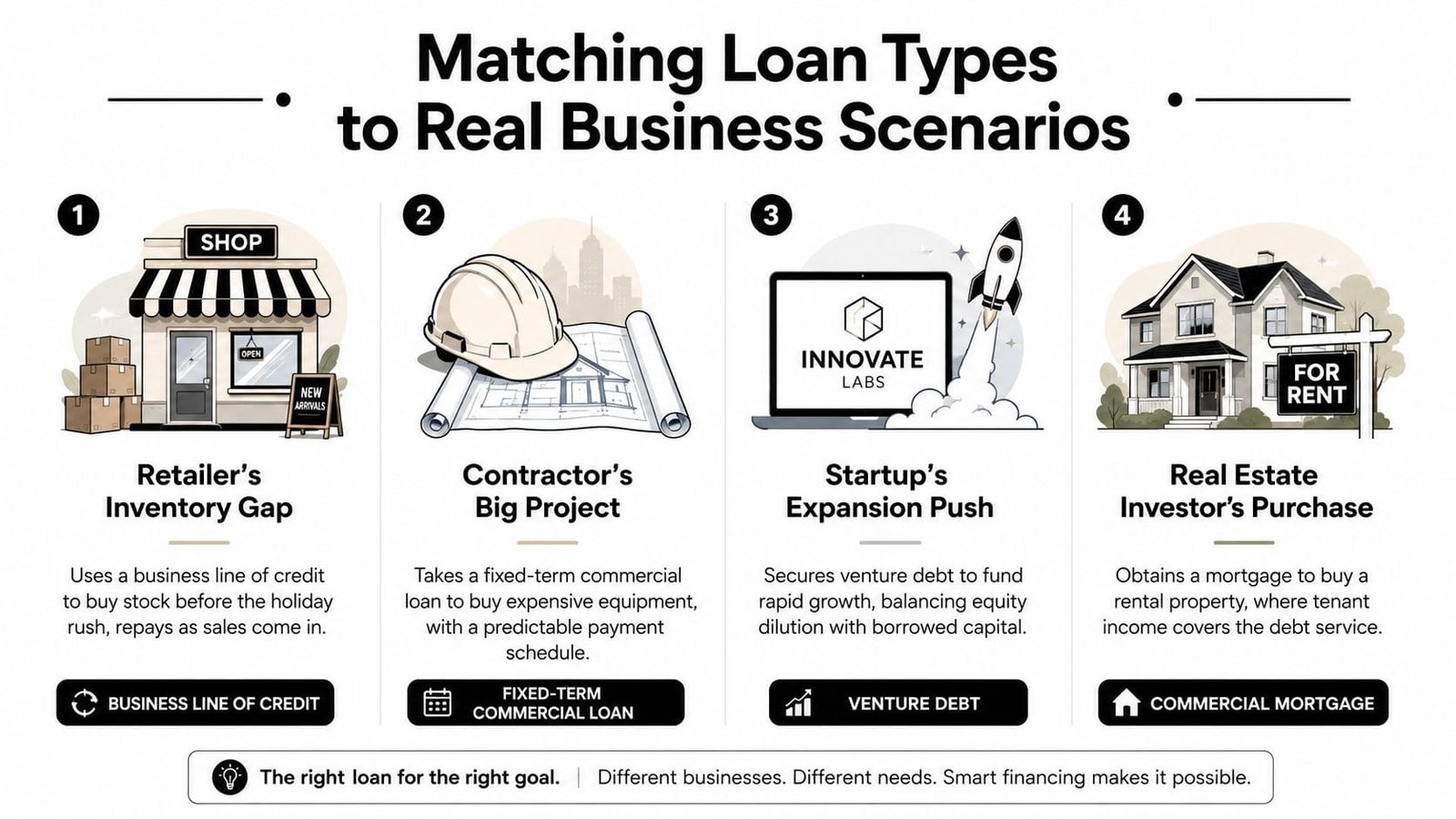
The best loan type follows the job the money must perform. A temporary inventory gap doesn't need the same structure as a machine that will produce revenue for years.
A retailer managing seasonal inventory
A retailer expects strong holiday demand but needs stock before customers arrive. A business line of credit can fit because the owner draws only what's needed, pays interest on the outstanding balance, and repays the draw as sales produce cash.
The visible rate isn't the whole decision. Check whether the lender charges an annual fee, draw fee, unused-line fee, renewal fee, or interest that changes during the borrowing period. A line that stays available may justify a somewhat higher price than a term loan, especially when the business needs flexibility rather than one large deposit.
A restaurant covering a slow quarter
A restaurant facing a slow period may choose short-term financing because the application and funding process can be faster. The danger appears when the repayment schedule is aggressive. A loan with manageable-looking periodic payments can consume cash that the restaurant needs for payroll, food, rent, and repairs.
Calculate the total dollars repaid, include every fee, and convert the obligation into an annualized comparison where possible. If the product uses a factor rate rather than an interest rate, review this explanation of factor rates before comparing offers.
A contractor buying an excavator
An excavator has a clear business purpose and may serve as collateral. An equipment loan can align the repayment period with the machine's productive life, while the equipment itself may reduce the lender's exposure. The contractor should still compare the down payment, filing costs, insurance requirements, maintenance assumptions, and consequences of missed payments.
A service firm considering an MCA
A service company with uneven invoices may be tempted by a merchant cash advance because approval can focus heavily on receivables and deposits. The factor rate can look simpler than an interest rate, but the repayment amount is fixed against the purchased receivables. Frequent remittances can drain operating cash, and a short collection period can make the effective annual cost very high.
Owners managing recurring-revenue businesses should also examine tools such as automated risk assessment for SaaS when evaluating how predictable subscription cash flow is. The broader lesson applies to every scenario: compare total repayment, fees, speed, term, payment frequency, collateral, and guarantees, not just the number printed beside “rate.”
Practical Ways to Lower Your Cost of Debt
The lowest borrowing cost often begins before you submit an application. A lender prices uncertainty, so clear records and a specific repayment plan can reduce the risk built into an offer.
Improve the file lenders review
Prepare accurate financial statements, current accounts receivable and payable details, bank statements, tax filings, and a concise explanation of how the funds will generate or protect cash flow. Reconcile accounts and separate personal from business transactions. Incomplete records make repayment capacity harder to assess.
Check personal and business credit reports for errors. Pay existing obligations on schedule, reduce unnecessary balances where possible, and avoid submitting several applications without a clear plan. A clean file cannot guarantee approval or a lower rate, but it gives the lender a clearer basis for pricing the loan.
Match structure to the asset
Use an equipment loan for equipment, a line of credit for recurring working-capital swings, and longer-term financing for durable investments. The right structure works like a container sized for its job. A short-term facility may fit a brief cash gap, while long-lived equipment usually needs payments spread across its productive life.
Collateral may reduce the lender's exposure, but it puts the owner's assets at risk. Do not pledge an essential operating asset for a small rate reduction until you have measured the effect of losing it. A personal guarantee carries a similar cost because repayment responsibility can extend beyond the company.
Federal Reserve survey data show that 59% of employer firms with debt used a personal guarantee, while 51% pledged business assets in 2025, according to the Federal Reserve report on employer firms. These commitments may not appear in the interest rate, but they belong in the borrowing-cost calculation because they shift risk to the owner.
Refinance and negotiate deliberately
Create a debt inventory with every balance, rate, maturity, fee, and payment. A replacement loan lowers costs only when its upfront charges and new repayment schedule leave genuine savings. Ask each lender to state total dollars repaid, required charges, prepayment terms, collateral requirements, guarantee terms, and whether the rate can change.
Private credit and direct-lending pricing remain high, even though global new-issue direct-loan median spreads fell to 544 basis points at year-end 2025, as reported in the Federal Reserve source above. Preparation matters more when lenders are charging more for uncertainty.
Take three actions this week:
- Build a debt inventory: Record every balance, payment, rate, fee, and maturity.
- Prepare a lender packet: Organize statements, tax records, and a concise use-of-funds explanation.
- Compare complete offers: Rank total repayment and risk terms before headline rates.
Your Next Steps to Smarter Borrowing
A useful borrowing decision fits on one page. Write down the loan's effective pre-tax cost, apply the after-tax formula if the business can use the deduction, and compare the result with the relevant product benchmark. Then ask whether the loan structure matches the work the money must do.
A line of credit may be appropriate for repeated inventory draws. Equipment financing may better suit a machine with a long productive life. Short-term capital can solve a timing problem, but only if the repayment schedule leaves enough operating cash. An attractive rate on the wrong product can create more pressure than a higher rate on the right one.
Review the entire obligation:
- Price: Interest, factor charges, origination fees, draw fees, and renewal costs.
- Timing: Payment frequency, maturity, amortization, and prepayment rules.
- Security: Personal guarantees, business collateral, and personal assets at risk.
- Purpose: The cash flow or asset that will repay the debt.
The most important principle is simple: true cost beats headline rate. A loan is cheap only when its total financial and operational burden fits the cash flow it supports.
Pull your loan statements tonight. Calculate annual interest divided by the relevant debt balance, apply the after-tax formula from this article, and compare the result with the benchmark table before signing a new offer. Keep that worksheet current as balances change. Smarter borrowing isn't a one-time trick. It's a repeatable habit that helps you fund growth without giving away more cash or control than necessary.
Business Loan Warrior helps small businesses compare funding options through a single, no-fee application, including business loans, lines of credit, equipment financing, SBA processing, and short-term financing. Visit Business Loan Warrior to explore funding choices and compare the total cost, repayment terms, and risk structure before you borrow.