
You’re trying to buy a business, the seller likes you, and the numbers almost work. The bank still wants more history, more collateral, or a cleaner file, and that leaves you staring at a deal you can’t quite close on your own. That’s where owner financing shows up, not as a magic shortcut, but as a practical way for a seller to help fund the purchase when conventional lending won’t cover the full price.
Table of Contents
- Why Owner Financing Matters for Small Businesses
- The Definition of Owner Financing and How It Differs
- How Owner Financing Works From Offer to Closing
- Typical Terms You Will See in an Owner Financing Deal
- Owner Financing Compared to SBA Loans and Bank Financing
- Advantages, Risks, and Legal Considerations for Both Sides
- Common Misconceptions That Trip Up First-Time Buyers
- Deciding If Owner Financing Is Right for Your Deal
Why Owner Financing Matters for Small Businesses
A buyer finds a profitable local company, maybe a landscaping firm, a specialty distributor, or a small manufacturing shop, and the seller is willing to stay flexible. The issue is rarely the business itself. It’s the gap between what the buyer can fund today and what the bank is willing to lend on this specific deal.
That gap matters because small-business acquisitions rarely close on one source of money alone. A bank may like the cash flow but still want more equity, stronger guarantees, or a cleaner debt profile. A seller can step into that gap by financing part of the price directly, which gives both sides a path forward without waiting for a perfect bank file.
Why deals stall without seller participation
Traditional underwriting can block a good acquisition for reasons that have nothing to do with the buyer’s intent or the seller’s confidence in the business. Maybe the buyer’s tax returns are uneven, maybe the business is concentrated in one customer, or maybe the lender wants more cash injected at closing. When that happens, owner financing can act like a bridge between the seller’s asking price and the buyer’s available capital.
Practical rule: If the bank can finance most, but not all, of the deal, seller financing often becomes the closing tool that makes the stack work.
That’s why this structure keeps showing up in real transactions. In residential finance, seller-financed deals remained a meaningful channel, even as overall home sales fell 0.7% in 2024, while seller-financed transactions rose 8% across 2,272 counties, with the average note at $271,655 and about 27% down according to Advanced Data Services as reported by AmeriSave’s consumer finance summary. The business takeaway is simple, the structure is established, not experimental.
The Definition of Owner Financing and How It Differs
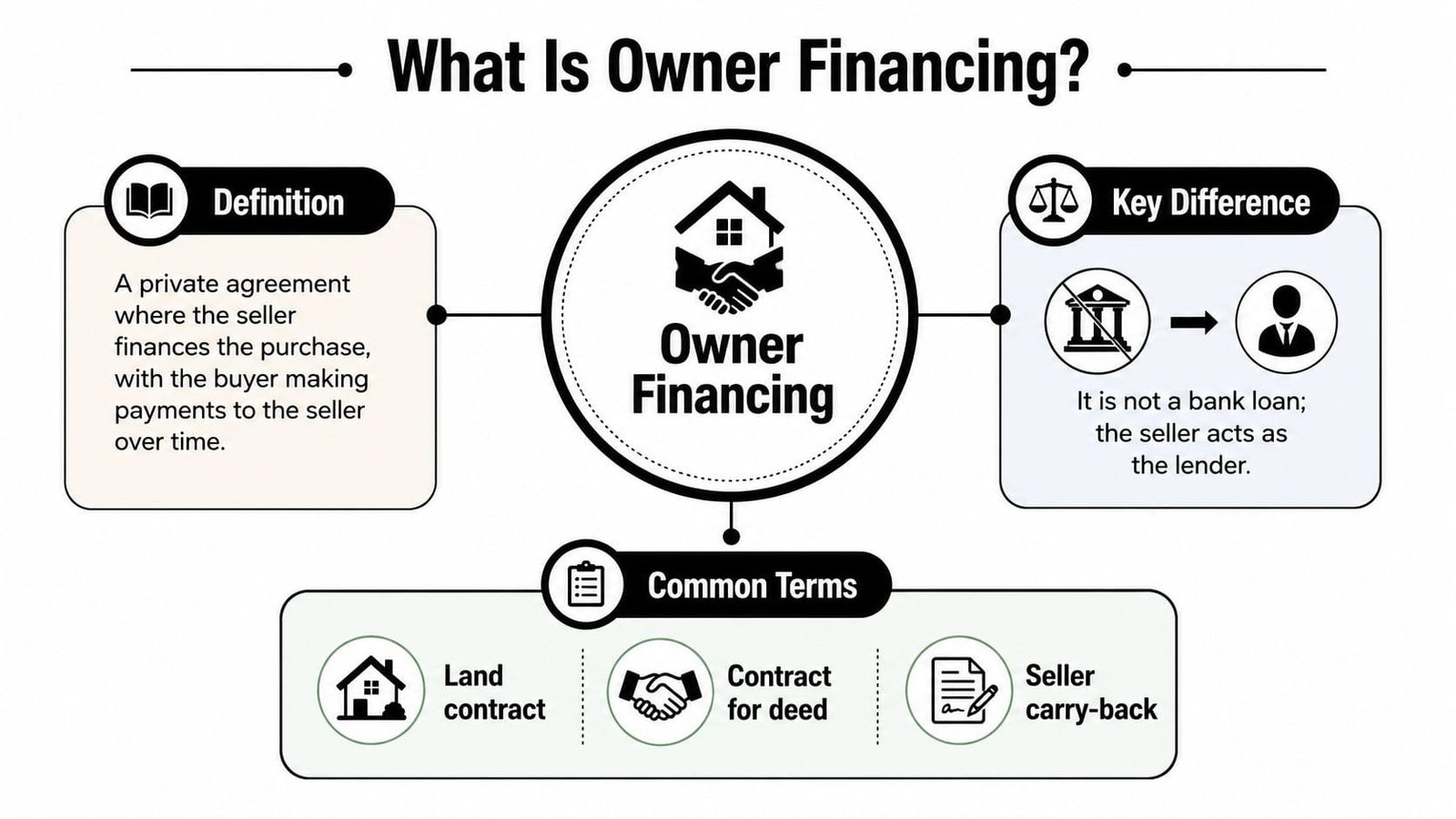
Owner financing is a private purchase structure where the seller, not a bank, lends part or all of the purchase money to the buyer. The buyer signs a promissory note and makes installment payments to the seller under agreed terms, which is why consumer finance sources describe it as a substitute for conventional mortgage lending.
The plain-English version
It’s a formal family loan where the paperwork is real, the terms are negotiated, and the property or business interest usually secures the debt. The seller sets the rate, the payment schedule, and the other core terms instead of handing the matter to a bank.
That’s also why people use a few overlapping phrases. Seller financing, seller carryback, and seller take-back usually point to the same basic idea, the seller is carrying part of the financing. In land deals, you may also hear land contract or contract for deed, which can describe related but not identical legal structures depending on the state and the document package.
The title on the listing matters less than the documents behind it.
How Owner Financing Works From Offer to Closing
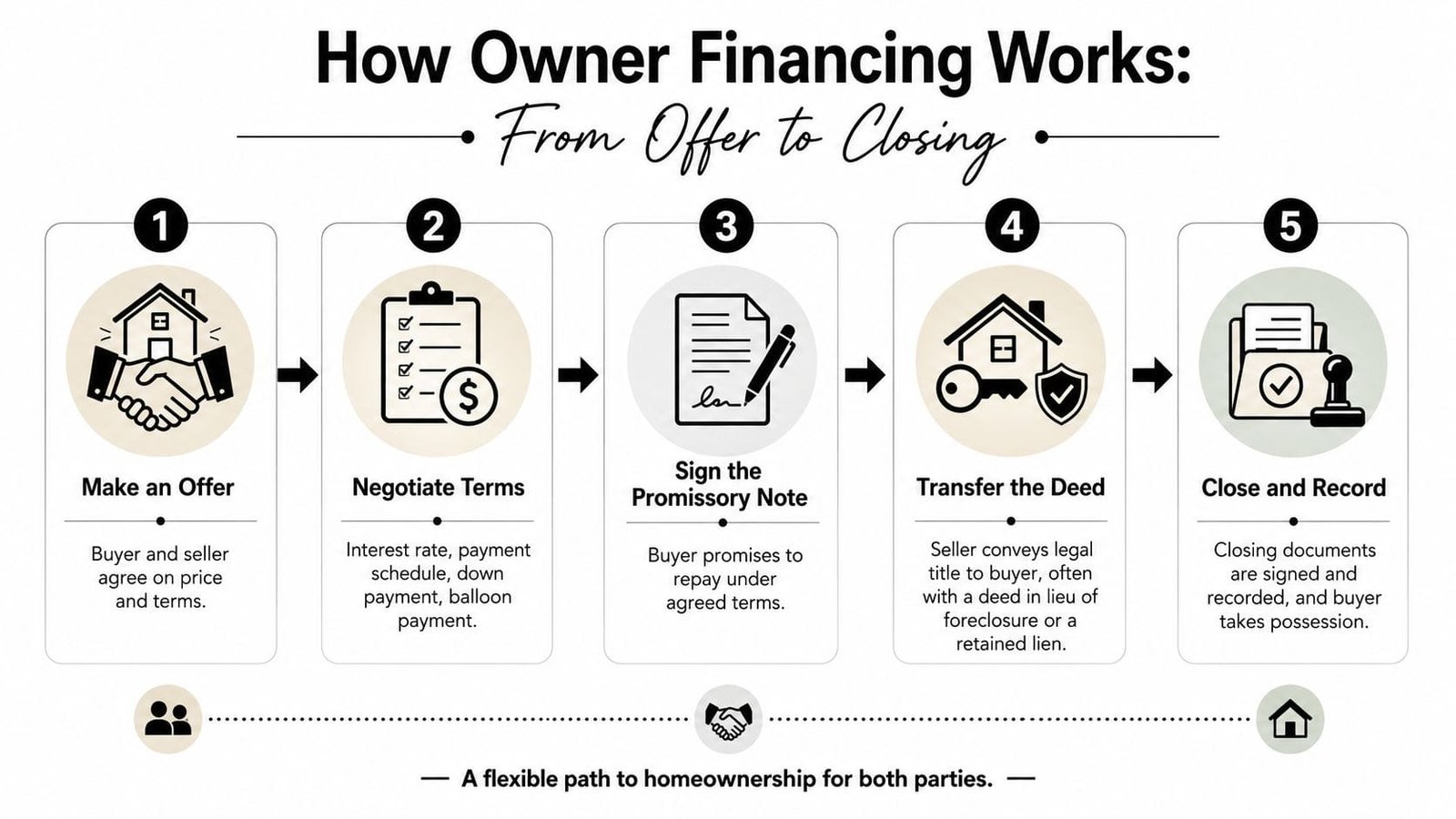
The mechanics are easier to follow when you break them into steps. The seller isn’t just “being flexible,” the seller is creating a loan, and loans need terms, documents, and a closing process.
Step 1, the offer sets the structure
The buyer names a price and proposes the financing mix. That usually includes a down payment, a seller-financed balance, and the broad shape of repayment.
Step 2, the parties negotiate the note
The hard questions come next, interest rate, payment schedule, amortization, and whether there will be a balloon payment later. If you want a deal structure example from the seller side, structuring seller financing offers is a useful reference point for how terms get packaged in the real world.
Step 3, the buyer signs the promissory note
The note is the buyer’s written promise to repay. In a business or property deal, it often sits beside the purchase agreement, not inside it, because the purchase and the debt are related but separate obligations.
Step 4, the seller’s position gets secured
The seller usually wants a mortgage, deed of trust, or another security instrument so the note isn’t just a handshake promise. That security is what gives the seller a legal path if payments stop.
Step 5, closing happens and payments begin
At closing, the documents are signed, the deed transfers, and the payment stream starts. A servicing company may collect and track the monthly payments, especially when the deal needs clean records or multiple parties want independent administration.
For buyers comparing acquisition capital options, a business acquisition loan often sits in the same conversation as seller financing, because many real deals use both. The seller may finance part of the price while a lender covers the rest.
Typical Terms You Will See in an Owner Financing Deal
The terms tell you whether a deal is workable or just dressed up to look flexible. Seller financing is less standardized than bank debt, so you’ll often see terms that reflect the seller’s risk tolerance rather than a template from a commercial lender.
The terms that usually move first
Because seller financing shifts default and servicing risk from the bank to the seller, terms are usually less standardized and may include a larger down payment, shorter amortization, and higher interest than bank financing (Investopedia on owner financing). In plain terms, the seller is taking on more risk than a bank would, so the seller often wants more protection in return.
A typical negotiation centers on these items:
- Down payment. The seller wants enough cash in the deal to know the buyer has real skin in the game.
- Interest rate. Higher risk usually means a higher rate than you’d hope to see in bank debt.
- Amortization. Shorter amortization means the balance comes down faster, but the monthly payment rises.
- Balloon payment. This gives the seller a payoff date instead of carrying the note forever.
- Prepayment terms. The buyer may want to refinance early, while the seller may want a minimum return.
- Default remedies. The documents spell out what happens if the buyer stops paying.
A simple example helps. Suppose a business sells for $500,000. The buyer might bring personal equity, a bank loan, and seller financing together so no single source has to cover the whole price. If the seller carries a piece of the deal, that can reduce the bank’s exposure and help the closing happen.
Practical rule: If a seller-financed deal looks too easy, read the balloon, the down payment, and the default clause again.
For buyers evaluating similar structures in a different market, hard money loans Texas can be useful context because it shows how higher-risk capital is typically priced and why short-term money often comes with tighter terms.
Owner Financing Compared to SBA Loans and Bank Financing
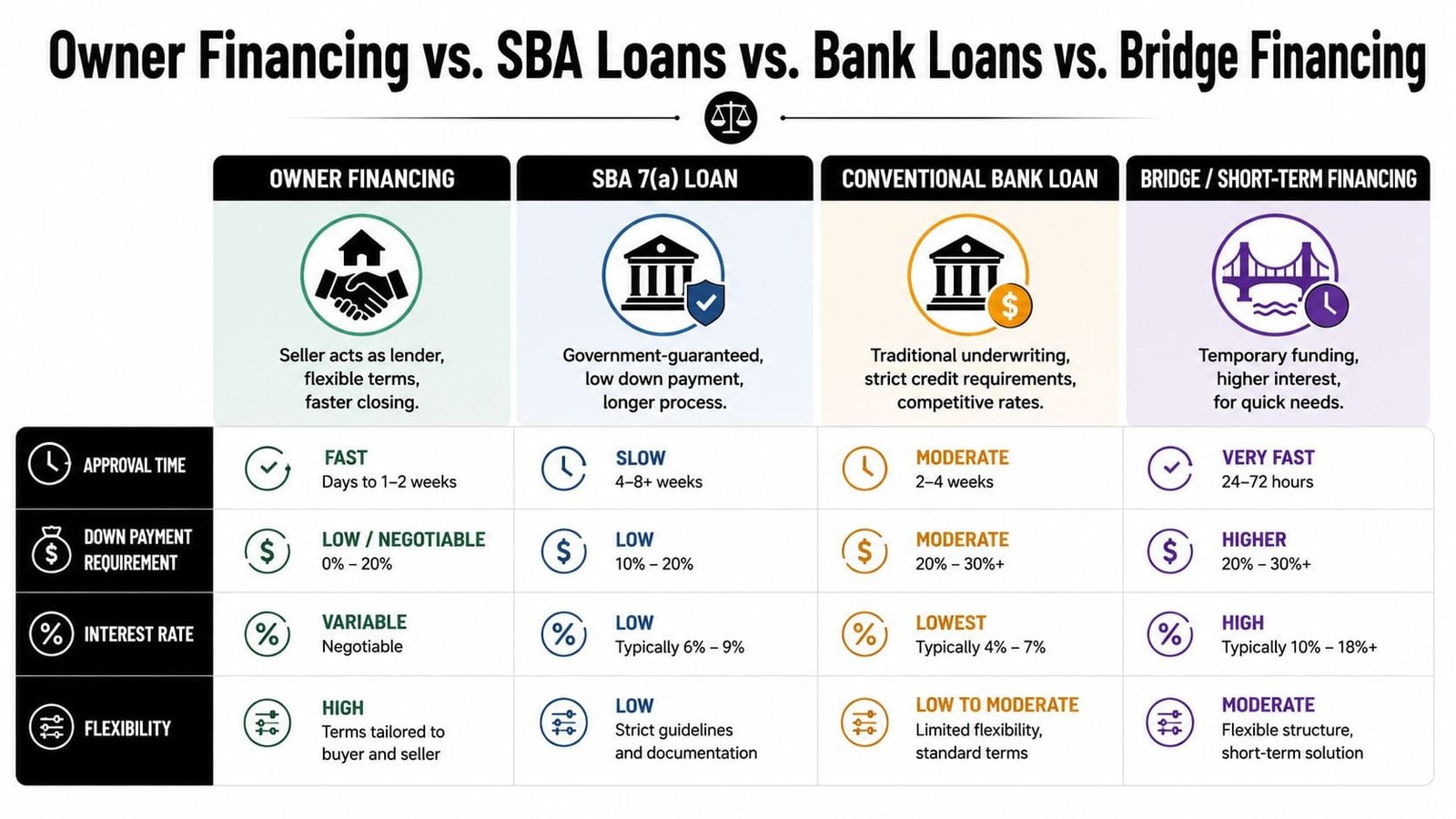
Owner financing rarely replaces bank financing in a serious acquisition stack. It usually fills a gap the bank doesn’t want to fill, or it helps bridge terms that would otherwise make the purchase impossible.
Side-by-side, what changes
| Factor | Owner Financing | SBA 7(a) Loan | Conventional Bank Loan |
|---|---|---|---|
| Approval style | Negotiated directly with the seller | Government-backed lender process | Traditional underwriting |
| Speed | Often faster | Usually slower and process-heavy | Usually faster than SBA, but still lender-driven |
| Flexibility | High, because terms are negotiable | Moderate, with program rules | Lower, because bank standards drive the terms |
| Funding role | Often part of the stack | Often the main senior loan | Often the main senior loan |
SBA loans and conventional bank loans still matter because they can provide the larger, cheaper layer of capital. Seller financing often becomes the second piece, not the first. That’s why a business deal can feel “partially financed by the seller” rather than “fully financed by the seller.”
That nuance matters, especially in business acquisitions. Neutral guidance on seller financing for a business notes that it typically still requires a down payment and often a second source of capital, so it’s usually a hybrid structure rather than a full substitute for bank financing.
For buyers comparing government-backed lending options, SBA loan types for small businesses is a practical companion piece. It helps you see when the seller note is the filler, and when the SBA loan is the backbone.
Advantages, Risks, and Legal Considerations for Both Sides
Owner financing can help a deal close, but the benefits and the risk land differently for each side. Buyers see flexibility. Sellers see a way to widen the buyer pool. Both sides also take on paperwork and legal responsibility that a bank would normally absorb.
Buyer and seller trade-offs
Buyer advantages usually include easier qualification, faster closing, and more room to negotiate terms. That can be a lifesaver when the business is strong but the buyer’s file isn’t bank-ready yet.
Buyer risks are just as real. The rate may be higher, the repayment term may be shorter, and a balloon can force a refinance that isn’t available later. A buyer who only looks at the monthly payment can miss the total cost.
Seller advantages include a faster sale, more pricing flexibility, and a steady stream of principal and interest. Sellers sometimes prefer that income stream to taking all cash at once, especially if they don’t need immediate liquidity.
Seller risks include buyer default, enforcement headaches, and the need for strong legal documents. The seller is acting like a lender, and that role carries legal and servicing responsibility.
The legal essentials are not optional. The promissory note, security instrument, recording requirements, default language, and local foreclosure rules all need to be handled correctly. If the deal is a business sale, tax treatment can also matter, because installment sale reporting may affect how the seller recognizes income. A qualified attorney and CPA should review the structure before signatures go on paper.
Don’t treat the note as a formality. It’s the deal.
For collateral-heavy structures, what is a blanket lien can help you understand how lenders and sellers protect themselves when multiple assets secure an obligation.
Common Misconceptions That Trip Up First-Time Buyers
The first mistake is assuming owner financing means no bank involvement at all. In real business deals, the seller note often sits alongside a lender loan, not instead of it, because many buyers still need a second source of capital.
The second mistake is assuming there’s no down payment. That’s rarely true. Even seller-financed business deals usually require some buyer cash, and the seller wants that because equity at risk changes how seriously the buyer approaches the purchase.
The third mistake is assuming approval is automatic. It isn’t. The seller may be more flexible than a bank, but the seller still needs to judge experience, cash flow, and the buyer’s ability to carry the note.
A simple example shows why this matters. A buyer takes on seller financing because it feels faster, then ignores the balloon date and the total payment burden. If refinance markets tighten or the business underperforms, the buyer can get trapped with a payoff date that’s harder to handle than the original bank process would’ve been.
Deciding If Owner Financing Is Right for Your Deal
Start with the structure, not the excitement. Ask whether the seller wants all cash, whether you still need a bank or SBA loan behind the note, and whether the business can support the combined debt after closing.
Then check the paperwork. You want a clear promissory note, a clean security instrument, a realistic balloon date, and written default terms you and the seller both understand. Bring in an attorney early, and add a CPA if the sale creates installment reporting questions.
If the deal only works because the terms are vague, the deal probably doesn’t work.
Owner financing makes the most sense when the buyer is qualified but not fully bankable, the seller wants flexibility, and both sides are willing to document the risk properly. It’s especially useful when it sits beside a bank or SBA loan instead of trying to replace one entirely.
If you’re sorting through a business purchase and need to know whether seller financing belongs in the funding stack, Business Loan Warrior can help you compare options and move faster with a clearer plan. Visit Business Loan Warrior to review funding paths, weigh acquisition loan options, and get practical guidance before you sit back down at the negotiating table.