
You've found the customer, signed the first contract, and discovered the uncomfortable part: you can't deliver the work without a van, kitchen system, medical device, machine, or technology platform. Paying cash would preserve ownership but drain the reserves needed for payroll, inventory, marketing, and unexpected delays. Borrowing too much, meanwhile, can leave a young company with an affordable asset payment and no room to operate.
That tension defines equipment financing for startups. The right facility can turn an essential asset into a productive source of revenue. The wrong one can leave you repaying a loan long after the equipment has become obsolete, unreliable, or difficult to sell. Approval matters, but the structure matters more.
Table of Contents
- The Equipment Gap in Early-Stage Growth
- Understanding Loan, Lease, and SBA Financing Options
- Navigating Startup Eligibility and Underwriting
- Securing Your Funding Step by Step
- Maximizing Tax and Accounting Benefits
- Recognizing the Hidden Risks of Asset Financing
The Equipment Gap in Early-Stage Growth
A new delivery company may have customers waiting but no vehicle. A restaurant owner may have a signed lease and a promising menu but no commercial refrigeration or cooking line. A contractor may know exactly which machine will open up profitable jobs but lack the retained earnings to buy it outright.
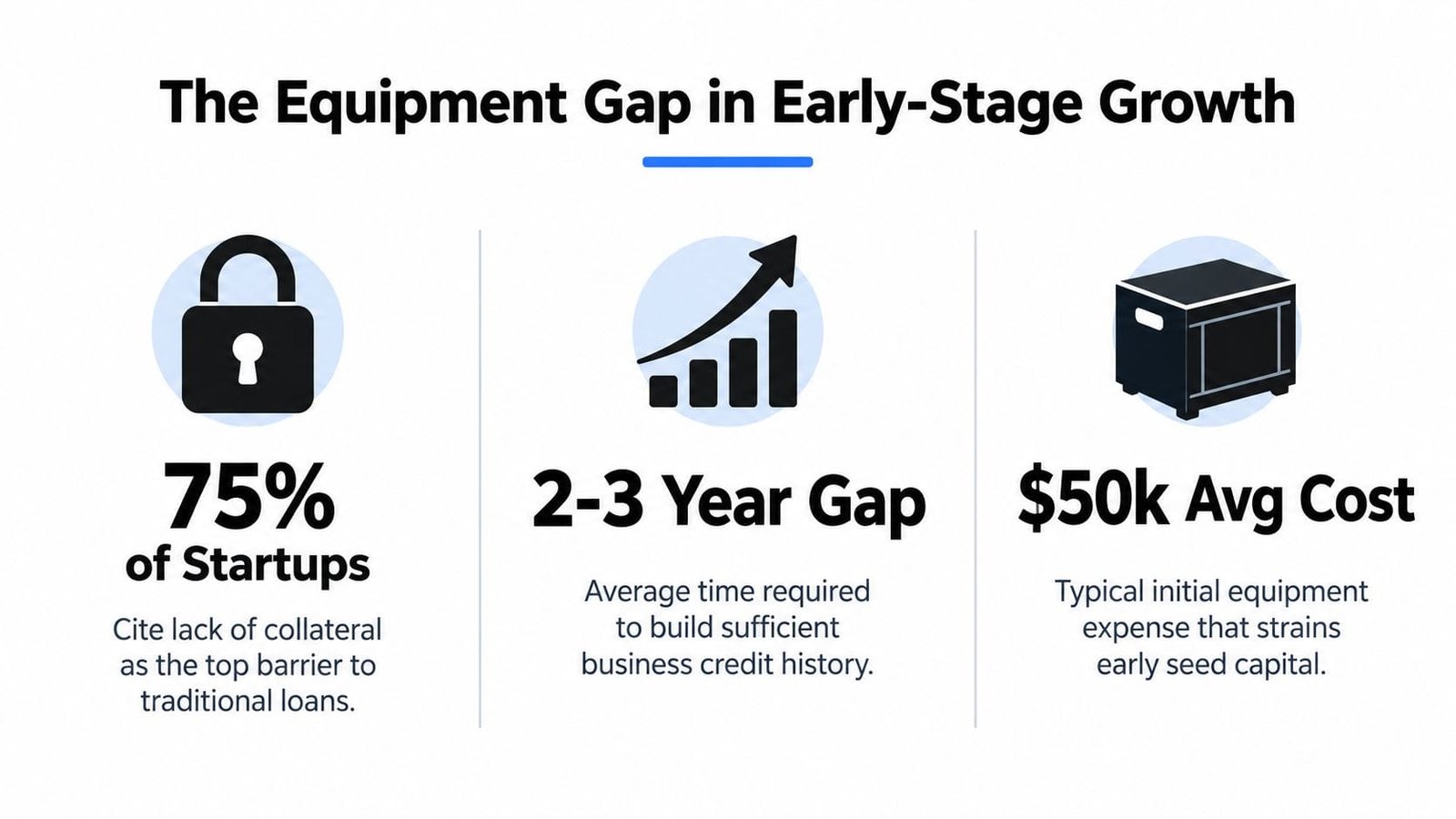
That's the startup equipment gap. The business needs productive assets before it has built the balance sheet that traditional lenders prefer. The founder must solve a chicken-and-egg problem: revenue depends on equipment, while lenders want evidence of revenue before approving credit.
Federal Reserve survey data reported in 2023 found that 59% of small businesses sought financing, while 46% sought funding to expand, pursue new opportunities, or acquire business assets. The same data indicated that 28% wanted financing to repair or replace capital assets, and for smaller term loans of approximately $25,000, equipment was the most commonly reported use, with 65% of borrowers using that credit for equipment, as summarized by small-business lending data from Credit Suite.
Why the asset changes the lending conversation
Equipment financing differs from an unsecured working-capital loan because the purchased asset can serve as collateral. That may reduce the lender's exposure and allow repayment to follow the equipment's useful life. It doesn't eliminate underwriting risk, but it gives the lender something tangible to evaluate and, if necessary, recover.
That distinction matters for founders who are still building business credit. A lender may care less about a blank business credit file when the application includes a reputable vehicle, a standard excavator, or a widely resold commercial appliance. Specialized technology, custom machinery, and assets with weak secondary markets receive more conservative treatment.
A startup also needs to protect the cash that keeps the asset productive. The delivery van requires fuel and insurance. The restaurant equipment requires ingredients, staff, maintenance, and opening inventory. Preserving working capital can be more valuable than owning equipment free and clear on the first day.
Practical rule: Finance the asset that directly creates revenue, but don't use equipment debt to disguise a broader operating shortfall.
Founders researching local technology businesses can also review the Atlanta technology ecosystem Reworx for context on how technology companies and supporting infrastructure develop together. For a straightforward overview of how equipment funding can support a new operation, see this guide to equipment financing for new businesses.
Understanding Loan, Lease, and SBA Financing Options
The financing product should follow the asset and the founder's priorities. An equipment loan prioritizes ownership. A lease prioritizes use and flexibility. An SBA-backed facility can provide a broader structure when the equipment purchase sits alongside expansion, working capital, or a large fixed-asset investment.
| Option | Who controls the asset | Where it fits | Main caution |
|---|---|---|---|
| Equipment loan | The business generally owns the equipment, subject to the lender's security interest | Durable assets with useful resale value | The borrower carries depreciation and resale risk |
| Finance lease | The lessor owns the asset during the lease, with possible purchase rights | Businesses seeking predictable use or lower upfront cash needs | Review the purchase option, end-of-term terms, and total cost |
| Operating lease | The lessor retains ownership and residual-value exposure | Assets likely to be upgraded or replaced | The business may not build ownership and may face usage restrictions |
| SBA 7(a) financing | The borrower owns financed assets under the loan structure | Equipment combined with working capital, expansion, or other eligible purposes | Documentation and lender underwriting remain substantial |
| SBA 504 financing | The borrower acquires long-lived fixed assets through a structured program | Large equipment and other fixed-asset investments | It's less suited to a small, rapidly obsolete purchase |
A loan works best when the equipment should remain useful after the debt is repaid. It also gives the owner more control over resale, modification, and long-term use. The drawback is that the startup bears the asset's residual-value risk, even if the equipment becomes difficult to sell.
A lease can be more appropriate for computers, specialized technology, or machinery that may need frequent replacement. With an operating lease, the lessor generally carries more of the residual-value risk. A finance lease may function more like ownership economically, so read the end-of-term purchase provision rather than judging the product by its monthly payment.
The U.S. Small Business Administration's 504 program provides a long-term fixed-asset framework for major equipment and other investments intended to support growth and job creation. The SBA's 7(a) program generally permits equipment financing alongside working capital, expansion, and other business purposes, while SBA-backed lending data summarized by Bankrate reports that individual 7(a) loans can reach $5 million and that the average loan amount is around $400,000 to $450,000, depending on the source and loan population, as described in SBA and small-business loan amount guidance.
A lower payment isn't automatically a lower cost. Compare ownership, tax treatment, maintenance, residual value, and exit terms before choosing the product.
Founders comparing structures should also review this discussion of funding options for asset acquisition. For a more detailed look at the distinction between borrowing and leasing, see equipment financing and leasing.
Navigating Startup Eligibility and Underwriting
Underwriters don't approve a startup because the idea sounds exciting. They approve a repayment plan supported by the founder, the asset, and the expected cash flow. With limited operating history, each part of the application has to compensate for what the business cannot yet prove through several years of financial statements.
The founder's personal credit profile usually receives close attention. Lenders may review repayment history, existing obligations, liquidity, and the owner's willingness to provide a personal guarantee. A strong personal profile doesn't make a weak business model acceptable, but a damaged profile can make a promising application harder to place.
What the equipment tells the lender
The asset invoice is more than a purchasing document. It tells the underwriter:
- Resale value: A standard commercial vehicle or recognized machine may have a clearer secondary market than custom-built equipment.
- Useful life: The lender wants the repayment period to make sense against the time the asset can produce income.
- Condition and origin: Used equipment may require inspection, maintenance records, an appraisal, or evidence of remaining productive life.
- Revenue connection: Explain which customer, contract, service line, or production capacity the equipment supports.
- Recovery risk: Specialized assets can be expensive to repossess, transport, repair, and resell.
The business plan should connect the asset to a measurable operating action without pretending that projections are guaranteed. Show the purchase price, installation costs, insurance, maintenance, staffing, and the time required before the equipment generates revenue. Then model a slower launch, not just the optimistic case.
What makes a file credible
A clean application usually includes formation documents, an ownership schedule, personal financial information, the equipment quote, bank statements where requested, tax returns if available, and a forecast that separates equipment-driven revenue from existing revenue. Signed contracts, purchase orders, or customer commitments can help establish commercial context, but they don't replace evidence that the company can handle debt service.
The lender may also ask how much cash remains after closing. A founder who contributes every available dollar to a down payment may appear committed while creating a more fragile company. Underwriting evaluates repayment capacity, not just the ability to complete the purchase.
For an SBA 7(a) loan, equipment repayment is generally limited to 10 years unless the equipment has a useful life exceeding 10 years. SBA guidance also permits a reasonable installation-related extension of up to 12 months when needed for equipment installation or leasehold improvements, as explained in SBA lender guidance. Build the application around that asset-life logic from the beginning.
Securing Your Funding Step by Step
The fastest applications aren't necessarily the ones with the shortest forms. They're the ones that answer the underwriter's questions before the underwriter has to ask them. Treat the process as a preparation exercise, not a search for a lender willing to overlook missing information.
Start with the purchase, not the application
Write down the exact asset, vendor, model, condition, delivery date, installation requirement, warranty, and total delivered cost. Separate the equipment price from shipping, setup, training, software, permits, and leasehold improvements. Some lenders finance soft costs, while others restrict proceeds to the equipment itself.
Next, prepare a short use-of-funds explanation. “Purchase equipment” is incomplete. “Acquire a refrigerated delivery vehicle for a contracted route, while preserving cash for fuel, insurance, and payroll during ramp-up” gives the lender a clearer repayment story.
Build the cash-flow case
Use a rolling 13-week cash-flow model that shows opening cash, expected collections, payroll, inventory, rent, taxes, maintenance, installation expenses, and proposed debt service. Add a delayed-revenue scenario. If the equipment arrives late or the first customer pays slowly, the model should show how many obligations the company can still meet.
Gather the supporting file in a logical order:
- Business identity: Formation records, tax identification details, ownership information, and a separate business bank account.
- Founder profile: Personal financial statement, credit authorization, resume, licenses, and relevant industry experience.
- Asset evidence: Vendor quote, specifications, serial information where applicable, delivery terms, and maintenance history for used equipment.
- Revenue support: Contracts, invoices, purchase orders, pricing assumptions, and a brief explanation of how the equipment creates or expands sales.
- Repayment plan: Forecasted cash flow, existing debt schedule, and a conservative explanation of the first payment period.
Ask every lender how it handles installation, prepayment, late delivery, insurance, maintenance, default, and early payoff. Ask whether the lender takes a security interest only in the equipment or requires additional collateral and a personal guarantee.
Modern digital platforms can reduce document friction by allowing owners to connect business accounts, submit a single application, review potential pre-approval, and communicate with underwriting through a dashboard. Business Loan Warrior is one option that includes equipment purchases among its use-of-funds categories and provides application and approval tracking tools.
The application itself should remain controlled. Don't send the same incomplete file to a long list of lenders. Start with a lender that understands your asset class, confirm its startup criteria, and track every inquiry, requested document, proposed term, and expiration date.
Use this video as a supplementary walkthrough while organizing the file:
A pre-approval isn't a funding commitment. Confirm the final equipment description, collateral terms, fees, insurance requirements, and closing conditions before signing a purchase order that cannot be cancelled.
Maximizing Tax and Accounting Benefits
Tax treatment can improve the economics of financed equipment, but it doesn't turn an unprofitable purchase into a sound one. The business still has to make the payments, maintain the asset, and generate enough operating cash to survive the ramp-up period.
For tax year 2025, qualifying equipment may generally be expensed under Section 179 up to $2.5 million, with the deduction beginning to phase out once total qualifying purchases exceed $4 million. The equipment must be placed in service during the relevant tax year and used more than 50% for business, according to Section 179 guidance from Investopedia.
The important point for startups is that financing the equipment may still allow the deduction. A company doesn't necessarily need to pay the full purchase price in cash before claiming eligible treatment. That can preserve liquidity while accelerating the tax deduction, subject to the applicable rules and the company's tax position.
The limitation founders miss
Section 179 generally can't exceed taxable income from active business operations. A pre-revenue startup or a company operating at a loss may receive limited immediate value. A deduction is not the same as a cash grant, and it won't cover a payment when the bank account is short.
Ask your tax professional to model at least three outcomes:
- Current-year deduction: Whether the company has enough qualifying taxable income to use the deduction now.
- Alternative depreciation: Whether another depreciation method better fits the company's expected income pattern.
- Business use and timing: Whether the asset meets the business-use requirement and when it is placed in service.
Accounting records should separate the equipment's original cost, accumulated depreciation, financing liability, interest, repairs, upgrades, and disposals. A fixed-asset register helps management see which assets are productive, which are nearing replacement, and which still support outstanding debt. Tools such as Lucentive QuickBooks asset management can help organize that information within an accounting workflow.
Match tax choices to operating reality
A large deduction may look attractive while the business is still consuming cash. Don't select a loan term based only on the tax benefit. Compare the payment schedule with expected revenue, maintenance cycles, insurance costs, and the point at which the equipment may need replacement.
The same discipline applies to depreciation. Review equipment depreciation considerations with your accountant, but keep the decision grounded in cash flow. Your books should explain what the company owns and owes. Your forecast should explain how the company will pay.
Recognizing the Hidden Risks of Asset Financing
Equipment as collateral sounds reassuring because the lender has something to recover. That protection is often weaker than founders assume. A piece of equipment can lose value faster than the loan balance declines, especially when technology changes quickly or the asset serves a narrow industry.
A laptop fleet, diagnostic system, restaurant technology package, or specialized production tool may remain essential to operations while becoming unattractive on the resale market. If the startup defaults, the lender may recover the asset but still face repair, transportation, auction, and resale costs. A personal guarantee can expose the owner to the remaining deficiency.
Stress-test the asset before signing
Run the purchase through four questions:
- Resale: What happens if the equipment's resale value is 30% lower, a downside scenario identified in recent small-business lending commentary from Equifax's Main Street Lending Report?
- Delay: Can the business make payments if delivery, installation, licensing, or customer onboarding takes longer than expected?
- Underperformance: What happens if the equipment generates less revenue than the forecast?
- Replacement: Will the company need a newer version before the loan is fully repaid?
Don't confuse a low monthly payment with a safe structure. Extending repayment can improve near-term liquidity while increasing the chance that the equipment becomes obsolete before the debt disappears. A shorter term may reduce total financing cost but create pressure during the startup's most fragile operating period.
The right question isn't “Can I qualify for this equipment?” It's “Will this asset still produce enough cash to justify the debt after the optimistic assumptions fail?”
Sequence equipment debt carefully against working capital. A large down payment may reduce the loan but leave no cash for payroll, inventory, maintenance, or customer acquisition. A separate equipment facility may preserve a revolving line for operations, while a blended facility may simplify administration. Compare both structures using the delayed-revenue forecast and the company's future borrowing needs.
Before closing, ask for the payoff amount, default remedies, insurance requirements, maintenance obligations, personal-guarantee language, and rules for selling or replacing the equipment. If the asset depreciates faster than the repayment schedule, negotiate a structure that acknowledges that risk or choose a lease where residual-value exposure better matches the business model.
Business Loan Warrior helps small businesses evaluate funding for equipment, working capital, SBA needs, and expansion through an efficient application and approval-tracking process. If you're weighing an asset purchase against cash preservation, visit Business Loan Warrior to review financing options and prepare a request around the equipment's useful life, cash-flow demands, and repayment risk.