
Your crew is booked, the phones are ringing, and the calendar looks healthy. Yet payroll is tight because the business plan was copied from a contractor with a different delivery method, customer base, and payment cycle. A remodeling company funding kitchen materials has different needs from a public-works contractor waiting on bonded progress payments.
That's why general contractor business plans must be built around the work you deliver. The operating model, capital needs, contract structure, labor capacity, and collection timing all have to fit together. The U.S. Bureau of Labor Statistics reports that only 34.7% of private-sector establishments born in March 2013 were still operating in March 2023, while construction had the steepest first-year decline among major industry groups, with survival falling 24.0 percentage points between the opening year and the following year. The BLS survival data makes the practical lesson clear: liquidity and execution belong in the plan from day one.
Below are eight contractor models, each mapped to its own operating approach, capital cycle, and contract structure. Use them to see where your business fits, then sharpen your financing and controls before you chase the next project. If lead generation is the weak spot, review these contractor advertising strategies alongside your operating plan.
Table of Contents
- 1. Residential Remodeling and Renovation Contractor
- 2. Custom and Spec Home Builder
- 3. Commercial Tenant Improvement General Contractor
- 4. Design-Build General Contractor
- 5. Construction Manager at Risk Model
- 6. Disaster Restoration and Insurance Repair General Contractor
- 7. Public Works and Government Contract General Contractor
- 8. Self-Perform Specialty General Contractor
- 8-Point General Contractor Business Plan Comparison
- Match Your Business Plan to the Model You Can Fund
1. Residential Remodeling and Renovation Contractor
Residential remodeling is often the most accessible general contracting model. The work ranges from kitchens and bathrooms to additions, basement finishes, and whole-home renovations. A local design-build remodeler with several crews may earn repeat business through referrals, while a franchise brand may rely on standardized estimating, sales scripts, and national marketing.
The operating model depends on disciplined estimating and customer communication. Homeowners want a clear scope, a realistic schedule, and fast answers when conditions change. Fixed-price contracts can make the buying decision easier, but they expose the contractor when the original scope is incomplete. Time-and-materials contracts protect against unknown conditions, but they require stronger documentation and can make homeowners nervous.
Build the cash cycle into the contract
The plan should show how deposits, progress payments, material purchases, payroll, and final collections line up. Deposit rules vary by state, so the contractor needs to verify local requirements before setting terms. A written milestone schedule is more useful than a vague promise to invoice “as work progresses.”
Use a written change-order process before extra work begins. The client should see the revised scope, price, and schedule impact, then approve it in writing. Verbal approvals create disputes precisely when the crew is already committed.
Practical rule: A signed change order is part of production control, not just paperwork.
The capital requirement is usually moderate compared with ground-up construction, but material-heavy projects can still create a cash gap. A revolving line of credit can bridge approved purchases and payroll between customer draws. Review job-level gross margin every week. Year-end profit won't reveal which active project is consuming the company's cash.
2. Custom and Spec Home Builder
A custom home builder and a spec builder may use similar crews, but their business plans differ completely. A custom builder works under a contract with a homeowner and can structure draws around construction milestones. A spec builder funds land, construction, carrying costs, and sales exposure before recovering capital at closing.
That distinction changes the risk profile. Custom work turns signed demand into a construction schedule. Spec work turns the balance sheet into the project's primary source of support. A small owner-operator building homes in infill neighborhoods may limit exposure by starting only when buyer interest is strong. A regional production builder may control land development and construction, but that also creates more capital tied up across the pipeline.
Separate construction cost from cost of waiting
Before acquiring land, model interest, property taxes, insurance, utilities, permits, and marketing. These costs continue when construction slows or the finished home takes longer to sell. A construction-to-permanent loan should be discussed early, not after the home is nearly complete and the take-out terms become urgent.
For a spec project, the plan should define the point at which the company will stop acquiring new lots. That trigger may depend on available equity, lender commitments, buyer demand, or the number of unfinished homes already in progress. Pre-selling or pre-qualifying buyers can reduce exposure, although it also limits flexibility if the buyer changes plans.
Keep contingency funding separate from the base estimate. The exact reserve should come from historical cost volatility, site conditions, and lender requirements, rather than a copied template. The plan should also state who can approve design upgrades, scope changes, and additional borrowing.
Builders comparing funding structures can review smart financing moves for construction growth before committing land or equipment. The right financing mix protects the project without forcing the company to pledge every available dollar.
3. Commercial Tenant Improvement General Contractor
Tenant improvement work is built around interior transformations. The contractor may convert an empty office suite, restaurant, medical office, retail storefront, or light industrial unit into an operating business. Projects are often shorter and more repeatable than ground-up construction, which can make estimating and crew scheduling more predictable.
The customer may be the tenant, landlord, property manager, or a combination of those parties. That creates a financing question before it creates a construction question. A tenant may have an allowance from the landlord but still request upgrades beyond that allowance. If the contractor starts without confirming who funds the overage, the job can become an unpaid credit facility for the client.
Make allowances and approvals visible
The plan should explain how the contractor verifies funding before mobilization. It should also show how the estimator handles permit timing, inspection delays, long-lead materials, and building access restrictions. A restaurant build-out, for example, can be delayed by equipment specifications or health-department requirements even when the field crew is ready.
Fixed-price contracts provide clarity when the drawings and finish schedule are complete. GMP contracts can work when the scope is still developing, but they require careful allowance tracking and disciplined cost reporting. The contractor needs a process for identifying when an allowance is nearly exhausted and obtaining approval before procurement moves forward.
Commercial TI operators often win by becoming easy for property managers to reuse. That means organized closeout packages, clean punch-list management, dependable subcontractors, and invoices that match the owner's approval process. A low bid that produces documentation problems can cost more than it saves.
The strongest TI plan treats permitting, tenant funding, and change approval as production dependencies. They aren't administrative details that can wait until the job is underway.
For larger projects, deposits, bonds, or other payment protections may help reduce exposure. The plan should show how much cash is needed for mobilization and how the company will respond if an owner delays approval of a change while the field team is already working.
4. Design-Build General Contractor
Design-build places design and construction under one contract. The contractor may employ design professionals, form a standing relationship with an architecture firm, or assemble a project-specific team. The customer gets one accountable party, while the contractor assumes more responsibility for coordination, budget control, and design decisions.
This model can reduce handoff problems because the people pricing the work participate in design development. It can also create professional liability and scope risk that a traditional builder may avoid. A regional contractor partnering with an architecture firm on a school project needs a plan for design reviews, owner decisions, code issues, and responsibility for errors. A large firm delivering healthcare or industrial facilities needs deeper systems for document control and technical coordination.
Price the design phase before pricing the build
Preconstruction should have its own scope and commercial terms. Early estimates, constructability reviews, value engineering, site investigation, and design coordination consume staff time before field revenue begins. If the contractor hides that effort inside a future construction fee, the company may carry months of unrecovered labor when the project changes direction.
The contract should define owner requirements and performance criteria clearly. It should also identify who approves substitutions, who carries design revisions, and how changes affect both fee and schedule. A single contract doesn't eliminate disputes. It changes where the dispute lands.
Design-build plans benefit from a stage-gate approach:
- Early feasibility: Confirm site conditions, budget range, approvals, and owner requirements.
- Design development: Update estimates as systems and finishes become more specific.
- Preconstruction release: Authorize procurement only after scope and responsibility are documented.
- Construction control: Track design decisions, submittals, field questions, and cost effects together.
The capital cycle may be less front-loaded than spec building, but the contractor still funds design staff, estimating, insurance, and early procurement. Professional liability coverage should match the services being offered. The plan should also explain how the company will protect margin when an owner asks for a premium design outcome without increasing the budget.
5. Construction Manager at Risk Model
Construction Manager at Risk, or CMAR, combines early contractor involvement with a later construction commitment. During design and preconstruction, the contractor provides estimating, scheduling, procurement advice, and constructability input. The contractor then delivers the project under a guaranteed maximum price, assuming financial responsibility for performance within that structure.
This model fits complex public, institutional, and healthcare work where early decisions can affect constructability and total cost. A contractor working on a university or hospital project may influence phasing, site logistics, trade packaging, and long-lead procurement before the final price is set. That influence is valuable, but it isn't free.
Keep preconstruction from becoming unpaid estimating
The business plan should price preconstruction services separately. Staff time spent reviewing drawings, developing schedules, and coordinating trade packages belongs in a defined fee or reimbursable structure. If it disappears inside the construction estimate, the contractor may win the relationship while losing money before the GMP is signed.
The GMP section needs unusually careful treatment. Define what belongs in the GMP, what remains an owner allowance, how savings are shared, and who carries the cost of scope growth. Closeout disputes often begin with unclear allocation language at the start.
Subcontractor buyout should be staged around design maturity and market conditions. Buying too early can lock the contractor into incomplete scope. Buying too late can expose the project to pricing movement and reduce schedule confidence. The plan should identify which packages must be secured early and which can wait.
Bonding capacity matters because a CMAR contractor carries substantial performance risk once the GMP is established. The company should show backlog, completed-project experience, management depth, and cash available for exposure. Strong demand alone isn't enough if the balance sheet can't support the contract structure.
6. Disaster Restoration and Insurance Repair General Contractor
Restoration work rewards speed, documentation, and availability. A contractor may respond to water, fire, storm, or mold damage, begin emergency mitigation, and then manage reconstruction. Referrals can come from adjusters, carriers, property managers, or restoration networks, so the sales process differs from a remodeling company's homeowner-driven approach.
The operating model has two distinct phases. Emergency work requires rapid dispatch, drying or stabilization equipment, photographs, readings, and careful records. Reconstruction requires estimating, trade coordination, permits, finish selections, and a closeout process that satisfies both the property owner and the claim administrator.
Treat documentation as a revenue control
A restoration plan should explain how the company documents conditions before demolition and after mitigation. Tools such as Xactimate may support estimating, but the estimate still depends on accurate photos, moisture readings, daily notes, and scope updates. Supplements need to be tied to evidence, not memory.
Insurer payment cycles should be modeled separately from homeowner payments. Holdbacks, disputed scope, approval delays, and supplement reviews can leave the contractor funding labor and materials long after the crew has completed the work. A 13-week cash forecast can show whether the company can maintain emergency capacity during a slow collection period.
Fast response wins the assignment. Complete documentation protects the margin.
Certifications in water damage and mold remediation can strengthen credibility, particularly when the contractor works with referral networks or property managers. The plan should also describe equipment ownership and rental decisions. Drying equipment that sits idle may be a poor purchase, while insufficient equipment can limit response capacity during a surge.
The company should diversify referral sources rather than depend on one carrier or network. A regional reconstruction contractor may combine adjuster relationships, property-management work, and direct property-owner referrals. That mix reduces concentration risk and gives the company more control over which work it accepts.
A technician may set up industrial drying equipment early in the response, while reconstruction follows only after the property and claim scope are documented.
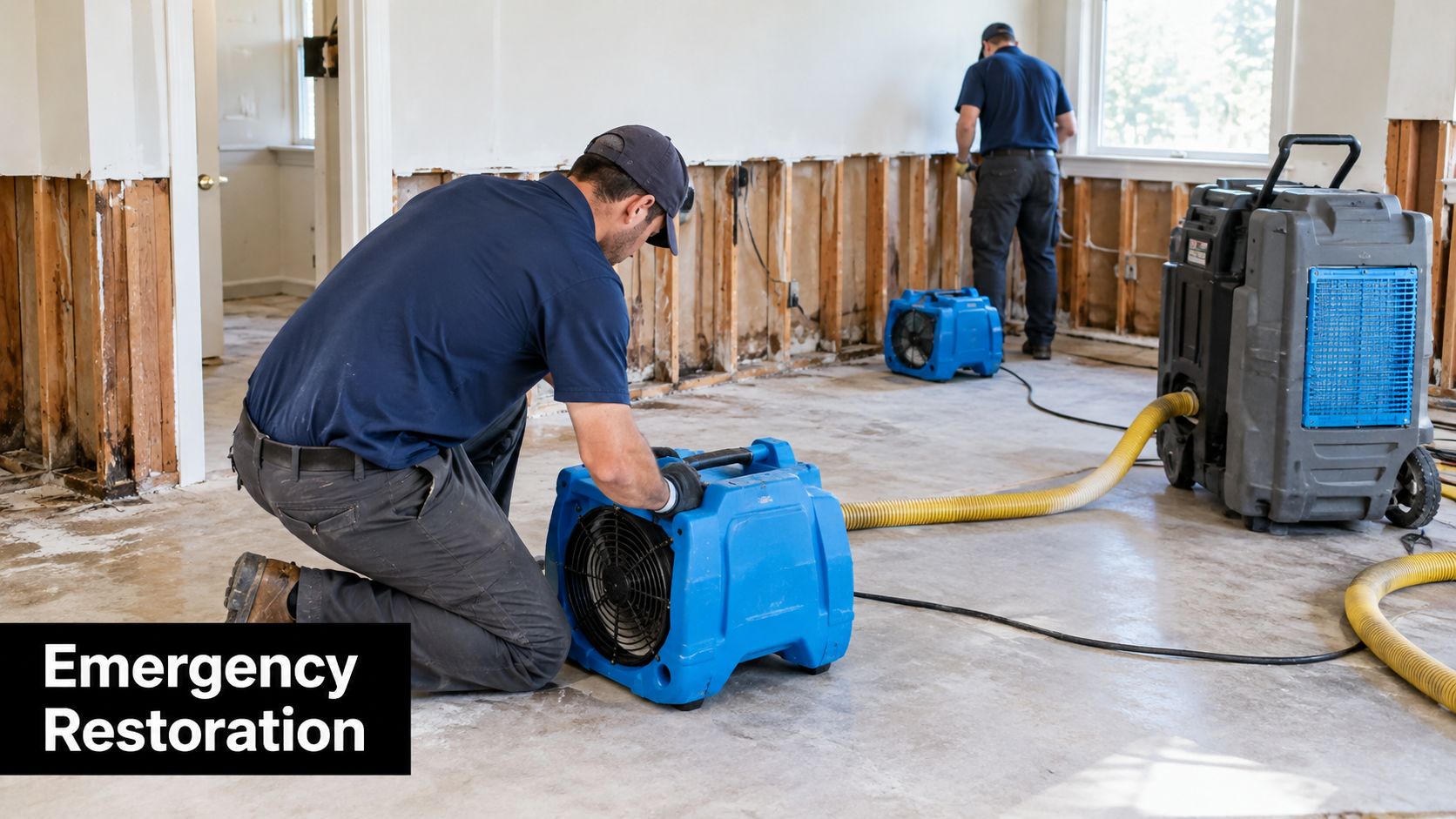
The customer experience still matters. Clear updates about access, drying progress, claim questions, and next steps can prevent the contractor from becoming the target of frustration caused by an insurer's approval process.
7. Public Works and Government Contract General Contractor
Public work is won through compliance as much as price. Federal, state, and municipal projects may require formal solicitations, prevailing-wage compliance, certified payroll, performance bonds, payment bonds, and extensive documentation. A regional contractor performing road or utility work needs a business plan that treats administration as a production function.
The customer is also different. A private owner may approve a change informally and resolve an issue over a meeting. A public agency usually needs a defined request, review path, authorization, and record. The contractor's project controls must support that process from the first bid.
Build the back office before chasing the award
Registration and certification can take time, so the plan should identify the relevant federal, state, and local programs early. Small and disadvantaged business certifications may create set-aside opportunities, but they don't replace bonding capacity, estimating discipline, or execution history.
A contractor should establish certified payroll, job-cost tracking, purchase-order controls, and document retention before the first public award. These systems protect payment and reduce the chance that a profitable project becomes an administrative failure. The plan should name the person responsible for compliance, not leave it as an owner task performed after hours.
Labor scarcity deserves specific treatment. Recent AGC and NCCER workforce data found that 57% of construction firms said available candidates lacked essential skills or the required license, while 45% reported project delays caused by shortages among their own workers or subcontractors. The same workforce analysis reported that 88% of contractors expected qualified craft-worker hiring to remain difficult or become harder, and 62% identified rising direct labor costs as a major concern. The AGC and NCCER workforce analysis supports a financing-oriented question: can the company service debt if labor shortages delay completion and billing?
Public contractors should also explore receivables funding carefully. Construction factoring options may help bridge eligible invoices, but the plan must account for assignment rules, agency payment procedures, fees, and the effect on customer relationships.
For opportunity research, contractors can review GovCon software, then filter prospects against bonding, staffing, geography, and cash capacity. A bid list is useful only when it reflects work the company can fund and complete.
8. Self-Perform Specialty General Contractor
Self-performing concrete, excavation, foundations, paving, or sitework gives a general contractor direct control over a critical portion of production. The company may subcontract electrical, plumbing, framing, or other trades while keeping the work where it has the strongest crews and cost data. Many firms reach this model after growing from a specialty trade into broader general contracting.
The advantage is control. A concrete contractor that self-performs foundations can coordinate its own crew, equipment, sequencing, and quality standards instead of waiting for an outside trade. The disadvantage is fixed overhead. Payroll, equipment, maintenance, insurance, and idle capacity remain with the company when the next project starts late.
Self-perform only where the data is repeatable
The plan should identify the work that the company can price from reliable production history. Track unit costs such as cubic yards, square feet, or linear feet by crew and project type. A crew that performs well on flatwork may not produce the same margin on complex foundations with difficult access.
Equipment decisions need the same discipline. A company can lease or finance machinery to preserve working capital, but the monthly payment still exists during idle periods. Construction equipment financing options can help fund productive assets, but the repayment schedule should be matched to expected utilization and project timing.
A useful operating dashboard includes:
- Crew productivity: Compare estimated units with actual installed units.
- Equipment utilization: Track operating time, idle time, maintenance, and rental substitution.
- Unit margin: Review revenue, direct labor, fuel, repairs, and equipment cost by unit.
- Safety performance: Record training, incidents, corrective actions, and site compliance.
- Subcontractor interface: Document handoffs so self-performed work doesn't create delays for other trades.
The strategy works best when the contractor can repeat the same production pattern across warehouses, multifamily projects, roads, or site packages. It works poorly when the company self-performs because it has an available crew, without proving that the crew is cheaper, faster, or more controllable than a qualified subcontractor.
Safety also affects the financing model. A strict OSHA-compliant training program protects workers and can support more stable insurance pricing, while poor controls can raise costs and restrict the work the company can pursue.
8-Point General Contractor Business Plan Comparison
| Business Type | Implementation Complexity 🔄 | Resource Needs ⚡ | Expected Outcomes ⭐📊 | Ideal Use Cases 💡 | Key Advantages ⭐ |
|---|---|---|---|---|---|
| Residential Remodeling & Renovation Contractor | 🔄 Low–Moderate: permits, estimating, change-order management | ⚡ Low–Moderate capital; mix of in-house crews + subs; line of credit useful | ⭐📊 Moderate revenue per job; steady referrals and repeat business; variable cash flow | 💡 Homeowner projects, kitchens/baths, additions, small design-build remodels | ⭐ Lower entry barrier; diversified project flow; strong referral potential |
| Custom and Spec Home Builder (New Residential Construction) | 🔄 High: land acquisition, permitting, long schedules, carry costs | ⚡ High capital needs: land, A&D and construction loans, long financing cycles | ⭐📊 High revenue per project; potential for developer margins on spec builds; inventory risk | 💡 Firms with access to capital; developers; custom luxury or production homes | ⭐ Higher per-project revenue; strong portfolio marketing potential |
| Commercial Tenant Improvement (TI) General Contractor | 🔄 Moderate: code compliance, landlord rules, tight deadlines | ⚡ Moderate working capital; short-cycle crews; specialty tools and bonds on larger jobs | ⭐📊 Shorter, repeatable projects with better cash conversion; tighter margins | 💡 Office, retail, restaurant, medical fit-outs; franchise build-outs | ⭐ Repeatable scope improves estimating; steady demand from leasing activity |
| Design-Build General Contractor | 🔄 High: integrated design + construction and added professional liability | ⚡ Requires design staff/partners, bonding, working capital for design fees | ⭐📊 Faster delivery, fewer change orders, earlier cost certainty | 💡 Owners wanting single-point responsibility; complex commercial/institutional projects | ⭐ One accountable team reduces disputes; schedule and cost efficiencies |
| Construction Manager at Risk (CMAR) Model | 🔄 High: two-phase preconstruction and GMP delivery; complex procurement | ⚡ Strong estimating, bonding, preconstruction staffing, lines of credit | ⭐📊 Improved budget accuracy and owner transparency; preconstruction fees | 💡 Large, complex public/institutional projects (hospitals, schools) | ⭐ Early contractor input reduces redesign; shared risk via GMP |
| Disaster Restoration & Insurance Repair General Contractor | 🔄 Moderate–High: emergency response, heavy documentation, insurer coordination | ⚡ Rapid-response crews, specialized equipment, receivables financing for claims | ⭐📊 Potential high-volume work after events; payments often insurance-backed but timing volatile | 💡 Flood/fire/mold mitigation, insurer referrals, restoration franchises | ⭐ Insurance-backed revenue source; strong demand during loss events |
| Public Works & Government Contract General Contractor | 🔄 High: formal bidding, compliance, prevailing wage, strict reporting | ⚡ High bonding capacity, certified payroll systems, heavy equipment financing | ⭐📊 Large multi-year pipelines with stable funding; long payment/retainage cycles | 💡 Federal/state/municipal infrastructure, DOT projects, set-aside programs | ⭐ Stable public funding and credential-building through past performance |
| Self-Perform Specialty General Contractor (Concrete & Sitework) | 🔄 Moderate–High: manage crews, equipment, safety, seasonal variability | ⚡ Significant equipment investment, trained crews, equipment loans/leases | ⭐📊 Higher margins on self-performed scopes; better schedule control; utilization risk | 💡 Contractors originating from specialty trades doing foundations, paving, sitework | ⭐ Higher margin capture, competitive differentiation, better critical-path control |
Match Your Business Plan to the Model You Can Fund
The right general contractor business plan isn't the one with the most pages. It's the one that explains how a specific type of work becomes collected cash. Start by choosing the model you can operate repeatedly, not the model with the largest theoretical revenue.
A residential remodeler needs a plan centered on deposits, milestone billing, change orders, lead conversion, and weekly project margin. A spec builder needs land discipline, construction-to-permanent financing, carrying-cost analysis, and a clear limit on unsold inventory. A CMAR contractor needs preconstruction pricing, GMP controls, subcontractor buyout, and bonding strength. A self-performing sitework contractor needs unit-cost history, crew capacity, equipment utilization, and a plan for idle periods.
The capital cycle should sit beside the operating model in the plan. Show when the company pays workers, suppliers, subcontractors, insurers, lenders, and equipment vendors. Then show when the company expects deposits, progress payments, retainage releases, owner payments, or sale proceeds. Annual revenue can look strong while the company still lacks the cash to mobilize the next project.
Payment-cycle volatility deserves its own page. Industry reporting found that payment cycles lengthened by an average of 8 to 12 days over the prior year, and nearly two-thirds of subcontractors identified cash-flow strain as their leading business challenge entering 2025. ENR's reporting on construction payment pressure illustrates why a plan should include a 13-week cash forecast, project-level collection dates, retainage assumptions, customer concentration, and delayed-draw scenarios.
Operational controls also belong beside financing projections. One construction case study reported a 10.6% improvement in labor drift, approximately $997,000 in savings, and an EBITDA increase of nearly $1.5 million after the contractor introduced productivity benchmarking, active management, material-storage controls, improved sequencing, and regular planning. The MNP construction case study shows how estimated versus actual labor hours can become lender-relevant evidence. A separate general-contractor case study recorded 5.2 RFIs per million units of project value for intervention projects versus 6.4 for control projects, along with lower PCI rates. The IGLC project-controls research offers a useful framework for tracking information flow, although fewer RFIs should never be treated as positive if teams are failing to report unresolved issues.
Before drafting the executive summary, list your top three financing needs for the chosen model. They might be a revolving line for payroll and materials, equipment financing, receivables support, acquisition capital, or bonding support. Match each need to a lender or product, then test the repayment schedule against a downside case with delayed payments, labor shortages, and a slower project start.
Keep the plan current as projects, crews, contract terms, and lenders change. Contractors seeking more business financial strategy insights should focus on the connection between operational decisions and cash generation. A plan is useful when it changes which jobs you accept, how you price them, and how much capital you reserve before mobilization.
Business Loan Warrior helps contractors compare funding for working capital, equipment, construction projects, invoice financing, and expansion through one no-fee application. Visit Business Loan Warrior to review financing options, check potential pre-approval without affecting credit, and connect your chosen contractor model to a practical capital plan.