

A supplier wants a deposit today. An equipment seller will hold a discount for two weeks. Payroll is approaching, and the cash gap is real, but your loan application is still sitting in underwriting. You don't need another generic checklist. You need to know what stops an underwriter from saying yes.
The fastest funding usually goes to the owner who prepares the file before applying, asks for an amount the business can repay, chooses a product that matches the need, and answers questions immediately. Speed isn't a lender promise you just purchase. It's a process you help create.
Table of Contents
- Why Fast Funding Usually Slows Down
- The Document Package That Unblocks Underwriting
- Diagnosing Your Eligibility Before a Lender Does
- Matching the Right Fast Lender to Your Need
- Using Pre-Approval and Underwriter Contact to Compress Timelines
- When the Fastest Loan Is the Most Expensive Delay
- Your Fast Funding Action Plan
Why Fast Funding Usually Slows Down
Most delayed applications don't begin with an unusually slow lender. They begin with a missing bank statement, a tax return that doesn't match the application, an unclear use of funds, or a request sized without regard to cash flow.
An underwriter can't approve what they can't verify. If your application says the money will purchase equipment, but the bank records show recurring payroll pressure and no purchase quote exists, the reviewer has to stop and investigate. If the debt schedule omits a lease, the lender can't confidently calculate your obligations. Each unanswered question creates another round of messages.
Underwriting reality: A complete application can move quickly. A nearly complete application often moves slowly because the final missing item is usually the one that changes the risk decision.
Plan backward from the date you need cash. Some SBA 7(a) reviews take approximately 2 to 10 business days, while broader SBA lender guidance lists roughly 5 to 10 business days for applicable processing stages, according to the U.S. Small Business Administration's lender guidance. Those figures generally describe lender or SBA review, not the entire journey from application to disbursement. Underwriting questions, closing documents, signatures, and funding still take time.
Other financing can move differently. An online lender may review an application quickly, while a bank or SBA-backed process may require more verification. Equipment financing can be more efficient when the asset, purchase quote, and collateral information are ready. A line of credit may suit a recurring cash gap better than a one-time term loan.
Your first task is to identify the funding deadline, then work backward through documentation, lender review, closing, and disbursement. Use this realistic funding timeline guide to pressure-test your schedule.
The rest of the process is straightforward. Build a file that answers the first underwriting questions, diagnose weaknesses before a lender finds them, match the financing to the business need, and calculate whether paying for speed makes financial sense.
The Document Package That Unblocks Underwriting
An underwriter should be able to verify your repayment story without chasing missing files. Each document answers a specific question: Can the business repay the debt, does the requested amount fit, and do the records support the application?
Create one application folder before submitting. Use current files and clear names such as Company_P&L_Current.pdf and Company_Debt_Schedule.xlsx. Send one organized package instead of scattering attachments across several emails. Every extra request adds delay, and incomplete submissions are a borrower-created bottleneck.
Build the core financial file
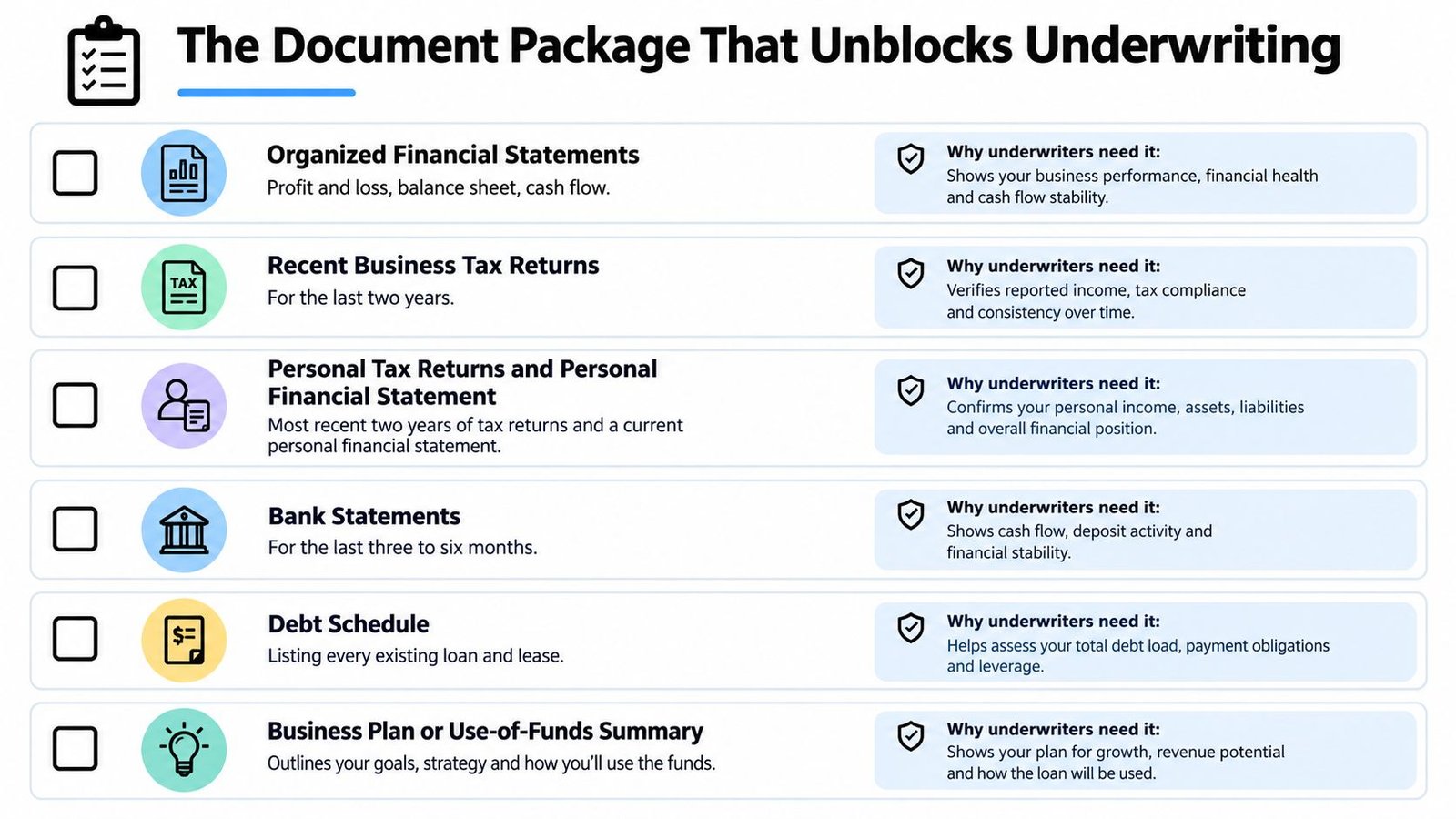
Include your profit and loss statement, balance sheet, and cash-flow information. The profit and loss statement shows operating performance. The balance sheet shows assets, liabilities, and owner equity. Cash-flow information lets the reviewer see whether reported profit becomes cash available for repayment.
Add recent business tax returns and personal returns when requested. Personal returns may matter when an owner provides a personal guarantee or the lender needs a broader view of repayment capacity. Review the statements before submission and prepare short explanations for unusual revenue, one-time expenses, owner draws, or seasonal declines. A clear explanation is faster than forcing the underwriter to investigate an unexplained variance.
Give the lender a complete obligation map
List every existing loan, line of credit, lease, equipment obligation, and payment. Include the lender, outstanding balance, recurring payment, maturity information, and collateral when known.
Omitting an obligation creates an avoidable delay. The debt may appear later in bank records or a credit report, prompting the underwriter to recalculate repayment capacity and question whether other information is missing. Transparency protects the timeline.
Ownership records should show the legal business structure, owners, ownership percentages, and relevant formation documents. Bank statements should cover the period requested and show activity that supports your revenue and cash-flow explanation.
Explain exactly what the money will do
Write a concise use-of-funds summary with the amount requested, purpose, timing, and expected business result. “Working capital” lacks detail. “Purchase inventory for confirmed seasonal orders” gives the reviewer a clearer repayment story.
For equipment or other asset-backed financing, attach purchase quotes, specifications, seller details, and collateral information. The Federal Reserve's 2024 Small Business Credit Survey found that applicants were more likely to receive approval for secured loans, including auto or equipment loans, than for unsecured business credit.
Practical rule: Submit one coherent story. Revenue in the application, statements, tax returns, and use-of-funds explanation should point in the same direction.
Digital delivery can reduce handoff friction between owners, accountants, brokers, and lenders. Use guidance on speeding up closing document handoffs to set up a cleaner file-transfer process.
Use this minimal documentation guide for fast funding to check the package before applying. A file built this way lets an underwriter verify your story in one pass, which is what compresses the timeline.
Diagnosing Your Eligibility Before a Lender Does
A profitable business can still be delayed or rejected when its debt, cash flow, or collateral position does not support the request. Before applying, ask the question an underwriter will ask: what in this file creates repayment risk?
Start with five screens:
- Revenue consistency: Check whether deposits arrive steadily or rely on a few customers, contracts, or seasonal periods.
- Profitability and available cash: Separate accounting profit from cash left after payroll, taxes, inventory, rent, and current debt payments.
- Existing obligations: List every loan, lease, credit card balance, and automatic withdrawal in one debt schedule.
- Credit history: Review business and personal credit where relevant, then correct reporting errors before submission.
- Collateral and lien position: Identify assets already pledged to another lender. A valuable asset may offer little borrowing capacity if a senior lien covers it.
Separate a fixable file from a weak structure
A missing statement, unclear ownership record, or absent purchase quote is a file problem. Correct it before submission. A structurally weak application requires a different decision, such as requesting less, offering collateral, choosing a line of credit, or allowing more preparation time.
Debt deserves close scrutiny. The Federal Reserve's 2025 employer firm report reports that 41% of firms denied financing in 2024 cited excessive existing debt, compared with 22% in 2021. It also shows full-approval rates below pre-pandemic levels at small banks, large banks, and online lenders. A fast digital application does not change the lender's assessment of your current obligations.
Run a simple debt-service screen. Compare recurring cash available for payments with existing required payments plus the proposed payment. Use conservative cash figures, include weak months, and test the payment against ordinary operations rather than your best month. If the result only works under ideal conditions, reduce the request or change the structure before applying.
Read your bank statements like a risk system
Review overdrafts, irregular deposits, tax-payment spikes, unexplained transfers, and automatic withdrawals clustered around payroll. Check customer concentration as well. If one customer supplies most deposits, prepare contracts, invoices, and a clear response to that dependency.
The Kansas City Federal Reserve found that 68% of surveyed lenders identified borrower financials as the most common reason for denying a loan, followed by credit history and collateral. Weak statements are not a reason to submit more applications. Diagnose the problem, correct what you can, and apply only where your debt load, cash flow, and lien position fit the lender's requirements.
Matching the Right Fast Lender to Your Need
Speed and fit are separate lender qualities, and the financing structure should follow how the money will create or preserve cash. Choose the product first, then compare lenders that regularly handle that type of request.
An equipment purchase has a defined asset and may support secured financing. Seasonal inventory can suit a line of credit because the business draws funds, sells products, collects revenue, and repays the balance. An urgent but temporary gap may justify short-term financing when the repayment schedule matches incoming cash. Long-term expansion needs a structure that gives the project time to produce revenue before demanding full repayment.
| Lender Type | Typical Speed | Cost Profile | Best Fit |
|---|---|---|---|
| Online lender | Often faster than traditional bank review | Can carry higher borrowing costs and tighter repayment schedules | Immediate working capital when the business can support frequent payments |
| Merchant cash advance | Very fast when revenue verification is straightforward | Factor-rate pricing can make the total repayment expensive | Businesses with strong card or receivables volume and a short, specific cash need |
| Short-term business loan | Quick review for a focused request | Higher cost or more frequent payments than longer-term credit may apply | Bridging a temporary gap with a clear repayment event |
| SBA Express or other SBA channel | Faster than some traditional SBA paths, but still documentation-heavy | Often more structured than emergency alternative financing | Owners who need a government-backed option and can tolerate review time |
| Business line of credit | Varies by lender and verification process | Pay for drawn funds or access according to the agreement | Recurring inventory, payroll, or seasonal cash-flow needs |
| Equipment financing | Efficient when the asset and quote are clear | Secured structure may improve approval fit, while terms depend on the asset and lender | Machinery, vehicles, and other identifiable business equipment |
Approval outcomes vary by channel, so use them to guide lender selection rather than to make a blanket choice. As noted earlier, full approval remains less common than partial approval or denial across many small-business financing applications. Online lenders may offer broader access and faster decisions, while banks can provide more structured terms when your financials and timeline fit their process. The right comparison is approval fit, total cost, payment frequency, and lien position.
Choose based on the cash cycle
Slow-paying customers with reliable invoices may make invoice financing more logical than a daily-payment product. Businesses that repeatedly buy inventory before collecting sales revenue may benefit from a line of credit, avoiding a new application for every cycle. If borrowed money buys a machine expected to generate revenue over a long useful life, the repayment schedule should leave room for the early operating months.
A payment mismatch can turn approved financing into a second cash-flow problem.
SBA financing can work well when the business qualifies and the investment benefits from a more patient structure. It does not suit a deadline that leaves no room for documentation and closing. Choose a faster product only when the cost of speed is justified by the consequence of waiting.
Before applying, shortlist lenders that already handle your need category. Ask how the product is priced, how often payments occur, whether a personal guarantee is required, which fees apply, and how early repayment changes the balance. Confirm the lien position and whether existing debt could block approval. Then calculate the break-even point: compare the cost of waiting with the added interest, fees, and cash-flow pressure created by faster funding. Pay for speed when the funding protects revenue or prevents a larger loss. Otherwise, use the structure that keeps the business solvent.
Using Pre-Approval and Underwriter Contact to Compress Timelines
The application process has two phases you control: screening before submission and responsiveness after submission. Treat them differently.
Start with pre-qualification tools that assess likely eligibility without creating a hard credit inquiry, where available. This helps you eliminate unsuitable lenders before sending a full application. Don't submit inconsistent applications to several lenders just because each form looks short. A multi-application spiral creates duplicated document requests and can complicate the credit review.
Electronic bank-account connections can replace manual statement hunting. With permission, the lender or platform can review transaction history directly, verify deposits, and identify cash-flow patterns. You still need to inspect the connected data yourself. If an old account contains relevant activity or a major transfer needs context, prepare that explanation before the underwriter asks.
Keep the file consistent after submission
Use the same revenue period, ownership details, loan amount, and use-of-funds explanation everywhere. If the application says the funds will buy equipment but the supporting message describes payroll support, the underwriter has to reconcile the difference. A short, consistent narrative removes friction.
Respond to questions the same day whenever possible. Give complete answers rather than sending one attachment at a time. If the lender asks for a debt schedule and clarification about a large deposit, answer both in one organized message.
Borrower-controlled variable: Once the file enters review, your availability often matters more than another round of lender shopping.
Keep your phone available and tell your accountant or bookkeeper that a funding review is active. Underwriting may need a clarification that only they can answer. A missed call can turn a simple verification into a waiting period.
Business Loan Warrior is one platform that combines a single no-fee application with matched financing options, bank-account connections, a dashboard for tracking approvals and repayments, credit insights, and underwriter chat. Its process can help an established owner keep lender communication and document status in one place, though the actual offer still depends on lender underwriting.
Don't confuse a fast interface with guaranteed approval. Pre-qualification narrows the field. Connected data improves verification. Prompt answers keep the file moving. None of these replaces sufficient cash flow, acceptable credit, or a request that fits the business.
When the Fastest Loan Is the Most Expensive Delay
Fast capital has a price. Before signing, compare the total repayment, not just the approval time or the payment amount shown in an advertisement.
Factor-rate products require special care because a factor rate isn't the same as an annual percentage rate. Ask for the total dollar repayment, how often withdrawals occur, whether the balance can be reduced through early payment, and whether origination fees are deducted before funding. Also review personal guarantees, confession-of-judgment language where applicable, collateral requirements, and automatic withdrawal terms.
Daily or weekly payments can look manageable until they collide with payroll, inventory purchases, taxes, or slow customer collections. A loan that improves the bank balance today may weaken operating liquidity tomorrow.
The Federal Reserve's recent small business credit survey insights report that 60% of businesses borrowing from online lenders said their borrowing costs were higher than expected. The same research identifies high interest rates as the most common financing challenge and unfavorable repayment terms as a particular concern among online-lender applicants.
Run a break-even test before signing
Estimate the revenue created or cost avoided by the financing. Then subtract the total repayment, fees, and the operating cost of the payment schedule. If the loan funds inventory, use a conservative estimate of gross cash generated after that inventory sells. If it covers a production bottleneck, calculate the cash contribution from the additional work, not the headline sales figure.
Compare that benefit with a slower bank or SBA process. If waiting produces a materially safer repayment structure and the business can survive the delay, slower funding may be the rational choice. The fastest approval is not a bargain when its repayment timing forces you to seek another loan.
For a practical framework, use this guide to calculate the real cost of a small business loan before accepting an offer.
Your Fast Funding Action Plan
You can begin this week with a disciplined sequence:
- Assemble the file: Gather financial statements, tax returns, ownership records, bank statements, debt schedules, and a specific use-of-funds summary.
- Audit eligibility: Review cash-flow volatility, existing obligations, credit history, customer concentration, and lien positions.
- Size the request: Ask for an amount the business can repay through weaker periods, not only its strongest month.
- Match the product: Use secured equipment financing for identifiable assets, a line of credit for recurring gaps, and short-term funding only when the repayment event is clear.
- Pre-qualify and submit: Compare suitable lenders without unnecessary hard inquiries, then send one complete, consistent application.
- Respond immediately: Treat every underwriting question as time-sensitive and answer with a complete package.
- Run the cost test: Compare total repayment and payment frequency with the revenue or savings the loan should create.
The fastest loan goes to the most prepared borrower, not necessarily the borrower who finds the loudest “instant approval” advertisement. Preparation, lender fit, clear sizing, and cost discipline are the parts of the timeline you control.
Business Loan Warrior can help you submit one application, compare matched funding options, connect business banking data, and communicate with lenders while you work through the underwriting process. Visit Business Loan Warrior to review your funding options and start with a prepared, lender-ready application.