
So you want to know how to get a product into stores? The single biggest mistake I see new brands make is pitching a retail buyer with nothing more than a great idea and a pretty package. That’s not a business proposal; it's a gamble, and buyers don't like to gamble.
The real answer starts long before you ever draft that first email. It begins with building a credible sales story that proves customers already want what you’re selling.
Table of Contents
- Building Your Sales Story Before the Pitch
- Making Your Product and Packaging Shelf-Ready
- Calculating Pricing That Protects Your Profit
- Crafting a Pitch That Gets a Buyer’s Attention
- From Purchase Order to Launch Day: Managing Your Retail Logistics
- Expanding Your Retail Footprint and Scaling Up
- Common Questions About Getting Your Product Into Stores
Building Your Sales Story Before the Pitch
Before you even think about approaching a retail buyer, you need undeniable proof that your product sells. A strong sales history is your most valuable asset. It transforms your pitch from a hopeful request into a data-backed business proposal that significantly lowers a buyer's perceived risk.
Think of this initial phase as a data-gathering mission just as much as a sales one.
Validate Your Product in the Real World
The first step isn’t walking into a big-box store; it’s proving your concept in smaller, more controlled environments. This is where you find out if real people will spend real money on your product, no theories allowed.
Here are a few ways to get that crucial early traction:
- Go Direct-to-Consumer (DTC): Your own online store is a goldmine. It gives you a direct line to your customers and a treasure trove of data on who is buying, where they live, and which marketing messages actually work.
- Hit the Pavement with Pop-ups: Selling at farmers' markets, craft fairs, or local events puts you face-to-face with your target audience. You get immediate, unfiltered feedback and can test everything from your price point to your packaging on the spot.
The goal here is simple: gather tangible evidence of demand. A buyer is far more likely to listen when you can say, "We sold 500 units in our first month online with a 25% reorder rate," versus, "I have a great idea I think your customers will love."
This simple framework breaks down how to get your product into stores by starting with a solid sales story.
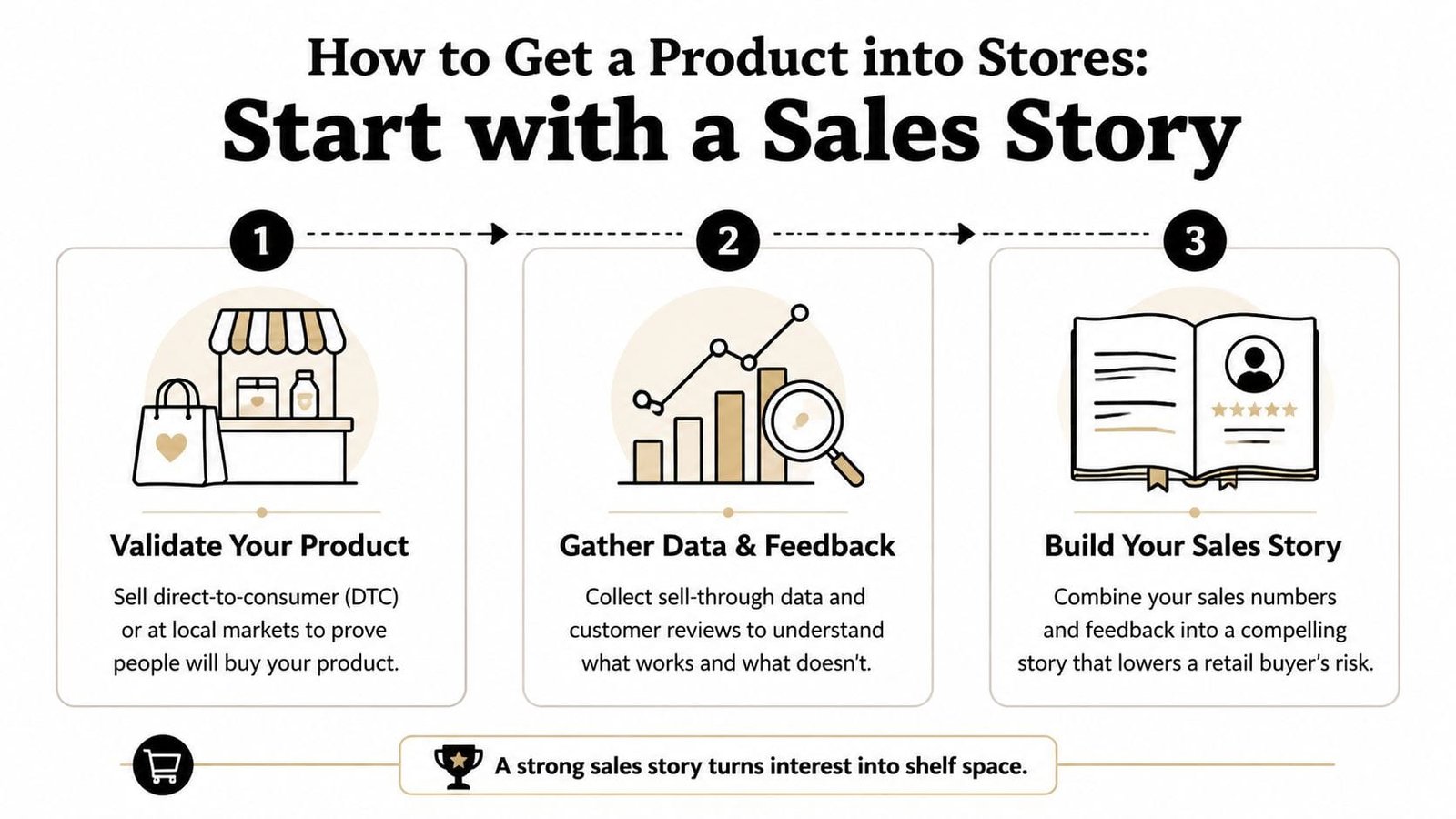
As you can see, the process starts with validating your product and gathering data before you ever try to craft the narrative that gets a buyer interested.
This whole approach is rooted in the fundamental logic of retail. Buyers are judged on performance. Every new item they bring in has to fight for limited shelf space against thousands of other products that are already proven sellers.
Before you begin outreach, make sure you have your foundational elements in order. This checklist covers the absolute must-haves.
Retail Readiness Checklist
| Element | Why It Matters | Action Item |
|---|---|---|
| Proven Sales Data | Buyers want proof, not promises. Data from DTC, markets, or local stores de-risks their decision. | Set up a basic Shopify store or book a spot at a local market to generate initial sales. |
| Customer Feedback | Positive reviews and testimonials show that people who buy your product actually love it. | Actively collect reviews through post-purchase emails and social media engagement. |
| Clear Target Audience | Knowing exactly who your customer is helps the buyer understand where you fit in their store. | Analyze your early sales data to build a detailed customer profile (demographics, interests). |
| Compelling Brand Story | Your story is your "why." It helps you stand out from a sea of soulless products on the shelf. | Write a one-paragraph origin story that explains why your brand exists and what makes it special. |
Once these pieces are in place, you're no longer just another hopeful founder with an idea. You're a business partner with a proven product.
By building a credible sales story with real sell-through data and glowing customer reviews, you show traction and make the buyer's decision easy. For more deep dives into retailer expectations and pitch strategies, the resources on Artisan.co are a great next step.
Making Your Product and Packaging Shelf-Ready
Your product could be the best on the market, but if it looks amateur on the shelf, it’s invisible. Before you even think about how to get a product into stores, you have to get it "shelf-ready." This is the critical jump from a farmers' market hero to a brand that can survive in the cutthroat retail world.
I see it all the time. A small-batch salsa maker, for instance, kills it at local markets with a simple mason jar and a computer-printed label. That works perfectly when you’re there to tell your story. But to land on a grocery store shelf, that same jar needs a total transformation. We’re talking a professionally designed, durable label, a proper nutrition facts panel, a scannable barcode, and packaging that can be stacked in a warehouse without falling apart.
The Retail Packaging Non-Negotiables
Think of your packaging as your 24/7 salesperson. It has just a few seconds to grab a shopper's attention, explain what you're about, and convince them you're worth the price. It's not just about looking pretty; it's about meeting the tough logistical demands of retail.
Here are the absolute must-haves. Getting these wrong is a non-starter.
Professional and Durable Packaging: Your product will be shipped, tossed into stock carts, and stacked on shelves. It needs to survive all that and still look great. Is it stackable? Is it easy for a stocker to handle? Does it catch the eye from five feet away?
A Scannable UPC Barcode: Retail is run by barcodes. A Universal Product Code (UPC) is essential for everything—inventory, sales tracking, and reordering. Without a scannable UPC, you’re dead in the water for almost every retailer.
Full Regulatory Compliance: Depending on your product, you’ll face a maze of regulations. For food, you need to follow FDA rules for things like nutrition labels. For kids' toys, it's CPSC standards. Don’t guess—know exactly what’s required for your category.
When a retail buyer sees a product with a proper UPC and compliant labeling, they don’t just see a nice package. They see a founder who understands the business of retail. They see a low-risk partner who's ready to play by the rules.
This is the big leap. You're moving from being a maker to being a brand. It takes a real investment of time and money, but this is the investment that unlocks wholesale accounts and gets you on shelves across the country.
Calculating Pricing That Protects Your Profit
Getting that retail contract feels like a massive win. But the celebration can be painfully short-lived if you realize you’re losing money on every single sale. This is a tough lesson many brands learn the hard way. Mastering the financial math behind retail pricing isn’t just a good idea; it’s absolutely essential for survival.
The whole process starts with your Cost of Goods Sold (COGS)—the real, hard cost to make one unit of your product. From there, you have to figure out a Manufacturer's Suggested Retail Price (MSRP), which is the price a customer will see on the shelf. The real trick, though, is working backward from that MSRP to find a wholesale price that lets everyone in the chain make a profit, especially you.
Why Your Profit Margin Disappears So Fast
The first slice of your profit goes to the retailer. Their margin is the biggest cut you’ll give away, and it’s not small—expect it to be anywhere from 30% to 50%. If a distributor is also in the picture, they’ll take another 15% to 20% off the top. All of a sudden, your piece of the pie starts looking dangerously thin.
Let's break it down with a real-world example:
- MSRP: $25.00 (what the customer pays)
- Retailer Margin (40%): $10.00
- Price to Retailer: $15.00
- Distributor Margin (20%): $3.00
- Price to Distributor (Your Wholesale Price): $12.00
Now, let’s say your COGS is $7.00. Your gross profit is a mere $5.00 per unit. And that’s before you even think about marketing costs, shipping, and the inevitable chargebacks for damaged goods or returns. To make sure you’re profitably placed in stores, getting these numbers straight from the start is non-negotiable. For a more detailed breakdown, check out these TPR Brands' wholesale pricing insights.
The most overlooked killer for new brands is cash flow. Retailers often operate on Net 60 or even Net 90 payment terms. This means you won’t see a dime for two to three months after you’ve already shipped the product. You are funding their inventory long before you get paid.
This delay can absolutely cripple a growing business. You have to plan for that cash flow gap just as carefully as you plan your pricing. To learn how to manage this gap, take a look at our guide on how to improve cash flow.
Crafting a Pitch That Gets a Buyer’s Attention
Let's be honest, you've got about 30 seconds—maybe a minute if you're lucky—to get a retail buyer's attention. These folks are busy, looking at hundreds of products. Your pitch has to do more than just introduce your product; it has to make their job easier.
This means thinking like a buyer and giving them everything they need to say "yes" without having to ask. A killer pitch isn't just about your brand story; it's about showing you understand their business. A polished presentation is the first step in learning how to get products into retail stores and is your ticket to being taken seriously. It proves you're ready to navigate CPG retail negotiations like a pro.
What Every Buyer Wants to See
Your goal here is to create a complete sales toolkit. This usually consists of a sharp-looking pitch deck and a concise, one-page sell sheet. These documents need to tell your brand's story, but back it up with cold, hard numbers.
Here’s what every buyer I’ve ever worked with looks for immediately:
- Stunning Product Photos: Don’t skimp here. You need high-resolution, professional shots of your product, the packaging, and lifestyle images of it in use. Make it look like it already belongs on their shelves.
- Your Brand Story in a Nutshell: Give them a compelling, one-paragraph summary. Who are you? Why does this product exist? And most importantly, who is your ideal customer?
- Proof of Sales: Buyers want winners. Show them your sell-through rates, which SKUs are your best performers, and any sales data you have from your website or local market sales. Data removes the guesswork.
- The Wholesale Numbers: Be upfront and clear. Provide your wholesale pricing, MSRP, case-pack sizes, and any minimum order quantities (MOQs).
Once your materials are ready, it's time to start the outreach. I use tools like LinkedIn and industry directories to track down the correct category buyer’s contact details.
Keep your first email short and to the point. Personalize it, mention their store specifically, and attach your sell sheet. You want to make it incredibly easy for them to grasp your value in a single glance.
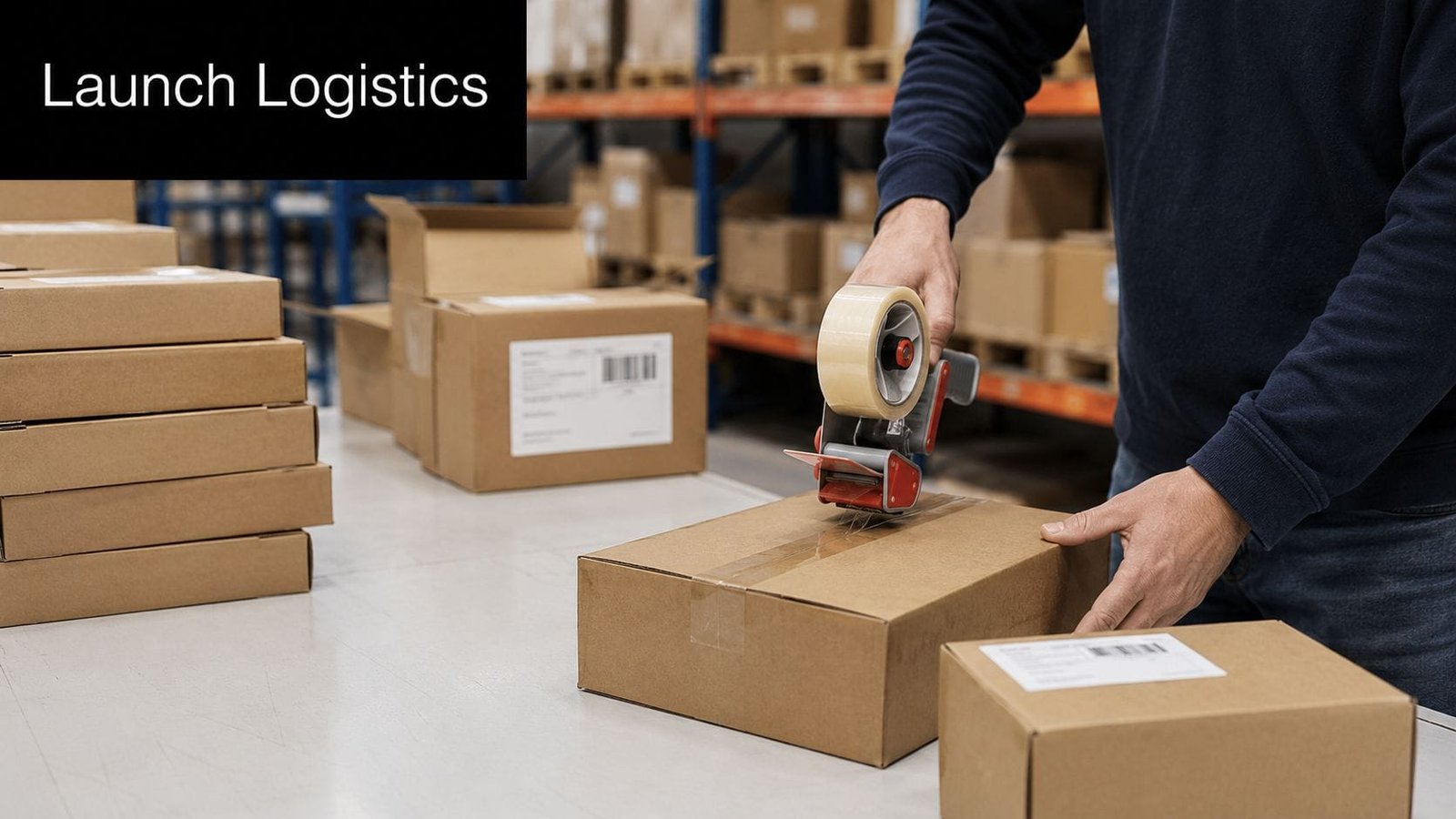
From Purchase Order to Launch Day: Managing Your Retail Logistics
That first purchase order feels like the finish line, but it’s actually the starting gun. Getting a "yes" from a retail buyer is a huge win, but now you have to prove you can deliver on your promises—literally. This is the moment your business switches from pitching an idea to running a complex logistical machine.
The operational demands of serving a major retailer can be a shock. Many big players won't be sending you purchase orders as email attachments. They'll require you to communicate through Electronic Data Interchange (EDI), a system that automates everything from orders and invoices to shipping notices. It’s a direct, system-to-system integration, and it's non-negotiable.
Building Your Fulfillment Engine
With orders coming in, you need a bulletproof plan for getting them out the door. This is a critical fork in the road for new brands. Do you keep everything in-house, or do you outsource to a third-party logistics (3PL) provider?
A 3PL can be a lifesaver. They handle the warehousing, picking, packing, and shipping, and they’re experts at hitting the strict delivery windows and following the complex labeling rules retailers demand. While their fees eat into your margins, they free you up to focus on what you do best. On the other hand, in-house fulfillment gives you total control but can become a massive bottleneck as you grow. A sudden spike in orders could cripple your operation, which is why having flexible funding is so important. For more on that, check out our guide on working capital for businesses.
Your product’s success isn't just the buyer’s problem—it’s a partnership. A stockout isn’t just a missed sale; it’s a broken promise to both the retailer and the customer. It puts your shelf space at risk of being given to a more reliable competitor.
This partnership is about much more than just shipping that first box. Driving sales once the product is in the store is a shared responsibility, but the best brands always take the lead.
Your job isn't over when the pallet is delivered. To get those crucial reorders and forge a strong relationship, you need to actively help your retail partners sell the product.
- Coordinate In-Store Demos: There's no better way to sell than letting a customer experience your product firsthand. Demos create energy and move units off the shelf immediately.
- Provide Marketing Materials: Make it easy for them. Supply shelf talkers, informational flyers, and digital assets that their team can use in their own marketing campaigns.
- Run Launch Promotions: A temporary price drop or a BOGO offer can create that initial sales velocity that gets the buyer just as excited as you are.
Success in retail is a simple cycle: deliver on time, support the launch, drive sales, and earn the reorder. Nail this, and you’re well on your way.
Expanding Your Retail Footprint and Scaling Up
That first "yes" from a retailer is an incredible feeling. But what comes next? Moving from that first independent shop to a regional or even national chain is what separates a local favorite from a household name. This is where you turn your initial success into a launchpad for much bigger things.
Your first retail partner isn't just a win—it's your most powerful sales tool. When you walk into a meeting with a buyer for a 20-store chain, you’re not selling an unproven idea anymore. You're presenting hard data from a real-world test, showing them the sell-through numbers and proving your product already has fans.
Preparing for High-Volume Production
Landing that big account creates a whole new kind of problem: keeping up. The setup that worked for a few boutique stores simply won't cut it when you need to supply a distribution center. You have to get your supply chain ready for a massive jump in volume, all without sacrificing the quality that got you here.
This kind of operational leap almost always requires a significant cash investment. To figure out how to finance this growth spurt, looking into business expansion loans can give you a clear picture of your funding options.
Big-box retail contracts are a different beast entirely. Get ready to negotiate terms far beyond just the wholesale price. You'll likely run into slotting fees (a fee just to get on the shelf) or Marketing Development Funds (MDF), where you're expected to chip in for the retailer's marketing efforts.
Working with Distributors and Brokers
As you grow, trying to manage relationships with dozens of individual stores becomes a full-time job. This is the moment when bringing on a distributor or a sales broker becomes a game-changer. These partners have the keys to the kingdom—established relationships with buyers that can get you into more doors than you could ever knock on yourself.
Of course, this access isn't free. Brokers and distributors take a cut of sales, which will put more pressure on your margins. The trade-off is their logistical power and market reach, which can put your growth on the fast track. The trick is making sure your pricing can handle another layer of costs while still leaving a healthy profit for you at the end of the day.
Common Questions About Getting Your Product Into Stores
When you're trying to break into retail for the first time, the same questions pop up again and again. I’ve heard them from hundreds of founders, so let's get you the straight answers you need to move forward without the guesswork.
What Is the First Thing I Should Do?
Before you even think about calling a retail buyer, you need proof. The single most important first step is to prove that real people will actually buy your product.
Don't start by pitching stores. Instead, go prove your concept. Sell directly to customers online, hustle at local farmers' markets, or get a booth at a community fair. Your goal isn't just to make a few sales; it's to gather hard data that shows a buyer your product already has an audience.
Do I Need a Distributor to Get Into Stores?
No, not right away. In fact, for your first few accounts with local shops or independent retailers, you absolutely should handle it yourself. Going direct lets you build a personal relationship with the buyer, learn the ropes of retail fulfillment firsthand, and—critically—keep more of your profit margin.
You'll only start thinking about a distributor much later on, once you're scaling up and managing dozens of individual store accounts becomes impossible to do on your own.
How Much Inventory Should I Have Ready?
This is always a tough balancing act. You don't want to sink all your cash into a mountain of inventory, but running out of stock right after you land a big purchase order is a disaster.
A solid rule of thumb is to have enough product on hand to cover the first full purchase order, plus a safety buffer of 20-30%. This buffer is your insurance against surprisingly strong launch sales or a quick reorder from the buyer.
The most common mistake new brands make is underestimating their lead times. If it takes you four weeks to manufacture more product, you have to build that into your inventory plan from day one. Buyers have zero patience for suppliers who can't keep the shelves stocked.
Funding that first big inventory run, scaling production, and managing cash flow are the biggest hurdles to retail growth. Business Loan Warrior provides flexible funding solutions—from working capital loans to lines of credit—that help you confidently say "yes" to those big purchase orders. See what you qualify for at https://businessloanwarrior.com.