
A five-person HVAC contractor can be profitable on paper and still miss payroll. The commercial customer may take 60 days to pay, while wages, fuel, and materials are due this week. A properly sized line of credit for business can bridge that gap. A poorly structured line can leave the owner with a partial approval, an expensive draw, and no capacity when the next invoice runs late.
That distinction matters more than the approval headline. In 2023, 37% of small employer firms applied for a loan, line of credit, or merchant cash advance, and 34% used lines of credit regularly, according to the Federal Reserve's Small Business Credit Survey. The practical question isn't, “Can I get a line?” It's, “Will I receive the full amount, at a workable price, with draw and repayment terms that match my cash cycle?”
Table of Contents
- What a Business Line of Credit Actually Is
- Types of Business Lines of Credit and How They Differ
- How APR, Fees, and Rate Moves Hit Your Bottom Line
- What Underwriters Actually Look At on Your File
- Getting Ready and Applying for Your Line of Credit
- Three Real Scenarios Where a Line of Credit Pays Off
- Lines of Credit vs Term Loans, SBA Loans, and Cash Advances
- Decision Framework and Smart Questions to Ask Before You Sign
What a Business Line of Credit Actually Is
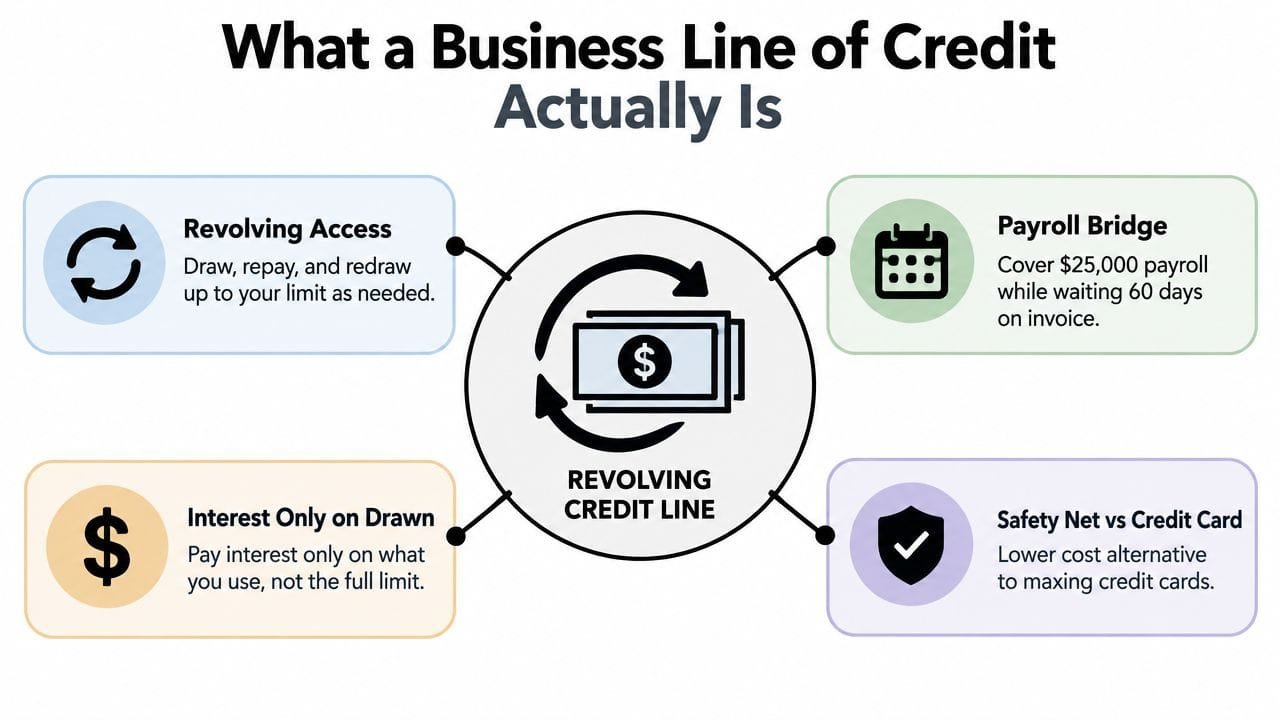
The HVAC contractor has an existing revolving facility with a $50,000 limit. The company draws $25,000 to cover payroll while waiting for the commercial invoice. Once the customer pays, the contractor repays the balance, and that borrowing capacity becomes available again.
That's the operating logic of a business line of credit. The lender approves a maximum amount, but the company doesn't receive the entire limit as a lump sum. It draws funds when needed, repays principal, and can generally draw again under the agreement. Interest applies to the amount outstanding, not automatically to the unused availability.
Think of the line as a credit limit at a bank, not a pile of cash sitting in your account. Approval gives you access to a defined borrowing capacity. It doesn't eliminate underwriting conditions, renewal requirements, borrowing-base tests, or the possibility that a lender reduces availability later.
How it differs from other revolving credit
A true commercial line is underwritten around the business. The lender may review revenue, bank-account activity, owner credit, existing obligations, and business assets. The facility may also involve a UCC filing, a personal guarantee, or collateral tied to receivables, inventory, equipment, or cash.
A business credit card is also revolving credit, but it often relies more heavily on personal-style underwriting and can create personal liability for the owner. It may be useful for expenses and vendor acceptance, but it shouldn't automatically replace a dedicated operating line.
The line's value comes from alignment. A contractor with predictable receivables, a retailer with seasonal inventory needs, or a service firm with uneven collections may benefit from reusable access. A company using debt to cover recurring losses has a different problem. Revolving credit can delay that problem, but it won't solve it.
Underwriting rule: Size the request around the documented cash-flow gap, then build a repayment plan before the first draw.
Types of Business Lines of Credit and How They Differ
Not every line has the same risk profile or operating mechanics. Secured facilities give the lender a claim on specified collateral, such as receivables, inventory, equipment, or a certificate of deposit. That support can produce a larger limit or lower pricing when the assets are liquid, well documented, and easy to monitor.
Unsecured lines remove the collateral requirement, but the lender takes more repayment risk. The trade-off is usually a tighter limit, stronger emphasis on cash flow and credit, or a higher rate. Faster online underwriting can be convenient, but convenience often carries a price.
Revolving versus non-revolving
A revolving line is the standard working-capital structure. Draws reduce availability, repayments restore it, and the borrower manages usage against the approved limit. This fits recurring needs tied to payroll, receivables, inventory, or seasonal purchasing.
A non-revolving facility is more specialized. The lender may approve a defined project or draw period, but repaid principal doesn't necessarily become available again. That structure can make sense for a one-time project, but it's a poor fit when the owner expects repeated access throughout the year.
Traditional bank lines usually offer deeper relationship underwriting and may work well for established companies with collateral and clean financial reporting. Online lines can move faster and may use connected bank data, but owners should scrutinize the repayment schedule, draw fees, renewal terms, and personal guarantee.
| Borrower Profile | Best Structure | Typical Use Case |
|---|---|---|
| Startup under two years | Smaller unsecured or closely monitored revolving facility | Early operating gaps, provided deposits and repayment capacity are documented |
| Established SMB with collateral | Secured revolving line | Receivables, inventory, equipment-backed working capital |
| Cash-flow-heavy services firm | Revolving line sized to collection timing | Payroll and vendor payments during invoice delays |
| One-time project borrower | Non-revolving facility or term loan | A defined contract, installation, or project expense |
The right structure isn't the one with the largest advertised limit. It's the one that gives the business enough usable capacity without forcing the owner to pledge assets unnecessarily or accept repayment mechanics that conflict with revenue timing.
How APR, Fees, and Rate Moves Hit Your Bottom Line
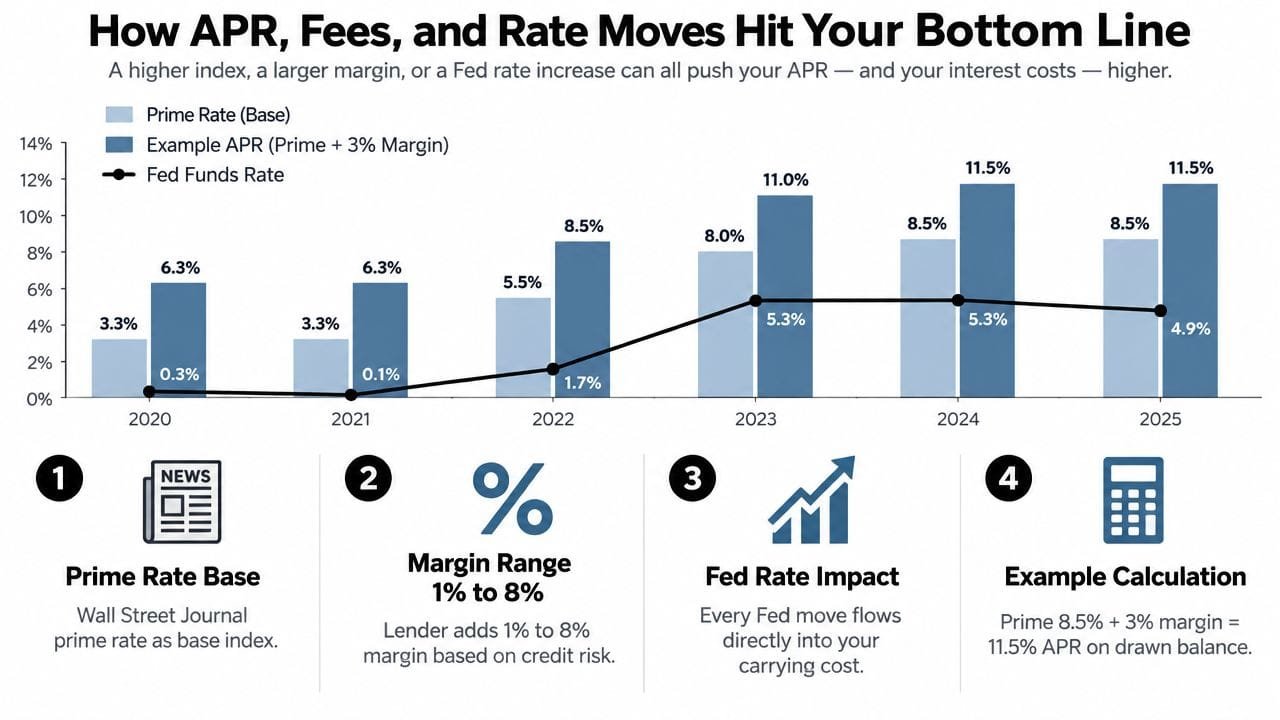
A variable business line usually combines a benchmark with a lender margin. The margin reflects the lender's view of credit quality, collateral, cash flow, and operational risk. A fixed-rate line offers more payment certainty, but the borrower gives up some flexibility if market pricing later falls.
Neutral market data for new business lines in Q3 2025 showed average fixed-rate pricing of 6.99% to 7.38% and variable-rate pricing of 7.63% to 7.91%, according to Bankrate's business line of credit rate data. Stronger credit, longer operating history, stable cash flow, and collateral can support better pricing, while faster underwriting may cost more.
Price the facility you'll actually use
Ask for the index, margin, floor, reset timing, and whether the rate applies only to drawn funds. Then add every fee that affects availability or repayment:
- Origination or draw fees: These can make small, frequent draws more expensive than the headline APR suggests.
- Annual or maintenance fees: A mostly unused line may still generate a fixed carrying cost.
- Unused-availability fees: Some facilities charge for committed capacity that remains undrawn.
- Prepayment terms: These matter more for non-revolving products and structured facilities than for ordinary revolving access.
A Federal Reserve-linked study of revolving credit found that a 1 percentage point increase in interest rates was associated with about an 8.2 percentage point decline in utilization. The result is a useful warning for owners. Higher pricing doesn't merely increase interest expense. It can also change whether the business draws at all. See this explanation of APR versus interest rate before comparing offers.
Run the math under more than one rate scenario. A line with a lower starting APR but a draw fee may cost more for a borrower who draws repeatedly. A fixed facility may be preferable when the owner expects a persistent balance and needs predictable payments. The cheapest offer is the one with the lowest all-in cost for the actual draw pattern, not the lowest number in an advertisement.
What Underwriters Actually Look At on Your File
Underwriters aren't grading your application as a simple yes-or-no test. They're deciding how much exposure the business can support, how quickly the lender can be repaid, and what protections belong in the structure.
The review usually starts with time in business. Operating history gives the lender evidence that the company has survived different billing cycles, customer problems, and expense pressures. A newer company may still qualify, but the file has less performance history to support a large revolving request.
Next comes recurring revenue and bank-account cash flow. Tax returns can show reported performance, but bank statements show how money moves. An underwriter watches deposit consistency, average balances, overdrafts, returned payments, debt withdrawals, and whether the requested line is proportionate to operating activity.
The signals that change the offer
Owner credit remains important, particularly for smaller businesses and facilities supported by a personal guarantee. Collateral can improve structure, but only when the lender can verify ownership, value, priority, and liquidation potential. A valuable asset that is already pledged may not provide meaningful additional support.
| Factor | What Underwriter Measures | Typical Threshold | Impact on File |
|---|---|---|---|
| Time in business | Operating history and continuity | Varies by lender and product | Affects eligibility and confidence in repayment |
| Revenue | Recurring deposits and business scale | Must support requested exposure | Influences limit size and repayment capacity |
| Bank cash flow | Balances, NSFs, volatility, and debt activity | Clean recent statements are preferred | Can reduce, condition, or stop approval |
| Owner credit | Personal repayment history and current obligations | Product-specific | Affects pricing, guarantee, and structure |
| Collateral | Eligible assets, lien position, and documentation | Depends on secured facility | Can support larger capacity or better terms |
High NSFs, volatile deposits, tax liens, recent credit inquiries, undisclosed affiliates, and mismatches between stated revenue and bank deposits all create friction. Fix reconciliation issues, explain unusual deposits before submission, disclose related entities, and avoid applying for an oversized limit without evidence that the business can use and repay it.
For a more detailed qualification checklist, review line of credit eligibility and qualification guidance.
The lender's question is not “Does this owner want capital?” It's “What exposure can this cash flow repay under stress?”
Getting Ready and Applying for Your Line of Credit
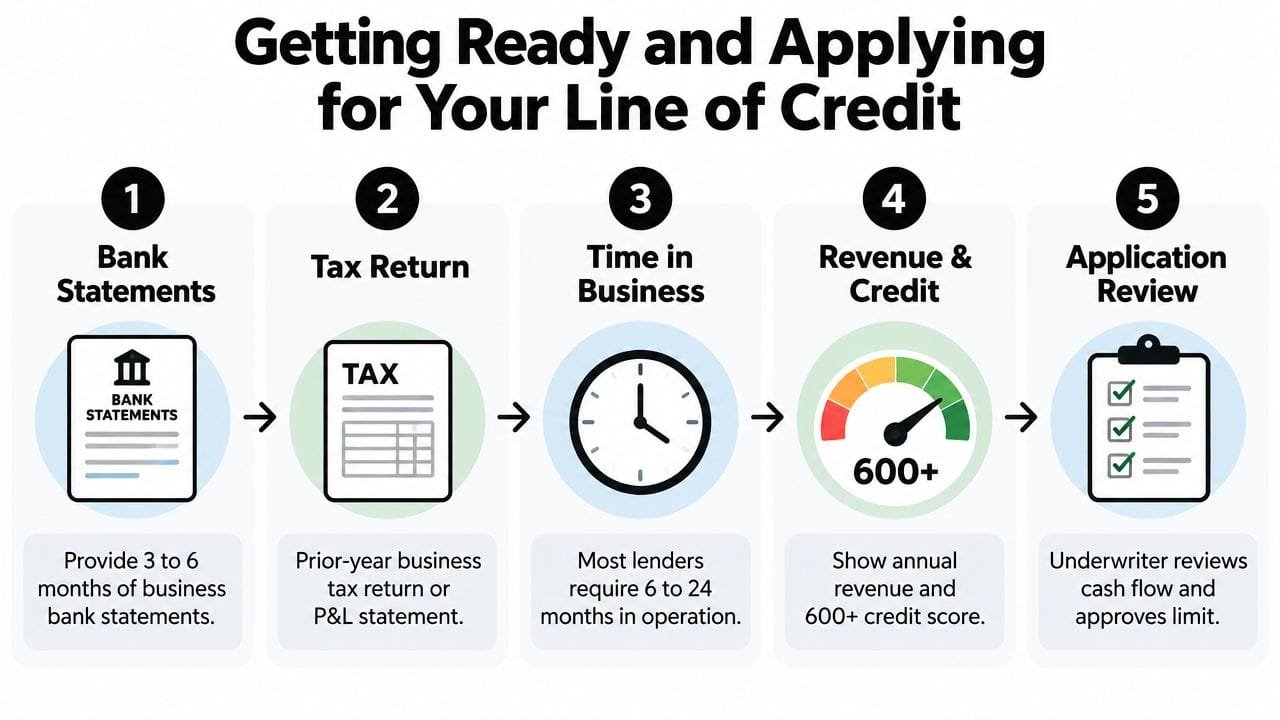
A clean application starts before the form. Gather the material that lets an underwriter reconcile your story with the bank data.
Prepare:
- Business bank statements: Have the recent operating statements available in the format the lender requests.
- Financial information: Provide the prior-year business tax return or a current profit-and-loss statement.
- Entity documents: Keep the EIN, formation records, and operating agreement accessible.
- Identity and funding details: Expect a government-issued ID and a voided check or equivalent account verification.
- Collateral records: For a secured line, assemble ownership documents, receivables aging, inventory records, or equipment details.
A cleaner application sequence
Start with pre-qualification where available, especially if the lender uses a soft credit inquiry. Then connect the business bank account through the provider's secure data process, upload financial documents, and review the proposed amount before accepting a term sheet.
The lender may return a condition list rather than an immediate decision. Respond with explanations that tie directly to the file. If the line is secured, expect collateral verification and lien review before final documents. Funding commonly arrives through ACH after approval and agreement execution, but the draw process itself may differ by lender.
The most common avoidable problem is inconsistency. A stated revenue figure that doesn't match deposits, stale financial statements, missing affiliate information, or unexplained transfers can cause the lender to reduce the request even when the business is sound.
Application discipline: Request the amount your records can defend, not the amount you hope a lender might approve.
A smaller, fully usable line can be more valuable than a larger facility with restrictive borrowing-base tests or insufficient availability after conditions. Build the request from a cash-flow forecast, identify the largest expected gap, and show the repayment event, such as a customer payment, inventory conversion, or contracted project receipt.
Three Real Scenarios Where a Line of Credit Pays Off
A revolving facility earns its keep when the draw has a clear purpose and a visible repayment trigger. The same product can support very different businesses, but the underwriting story must connect the amount borrowed to the timing of cash coming back in.
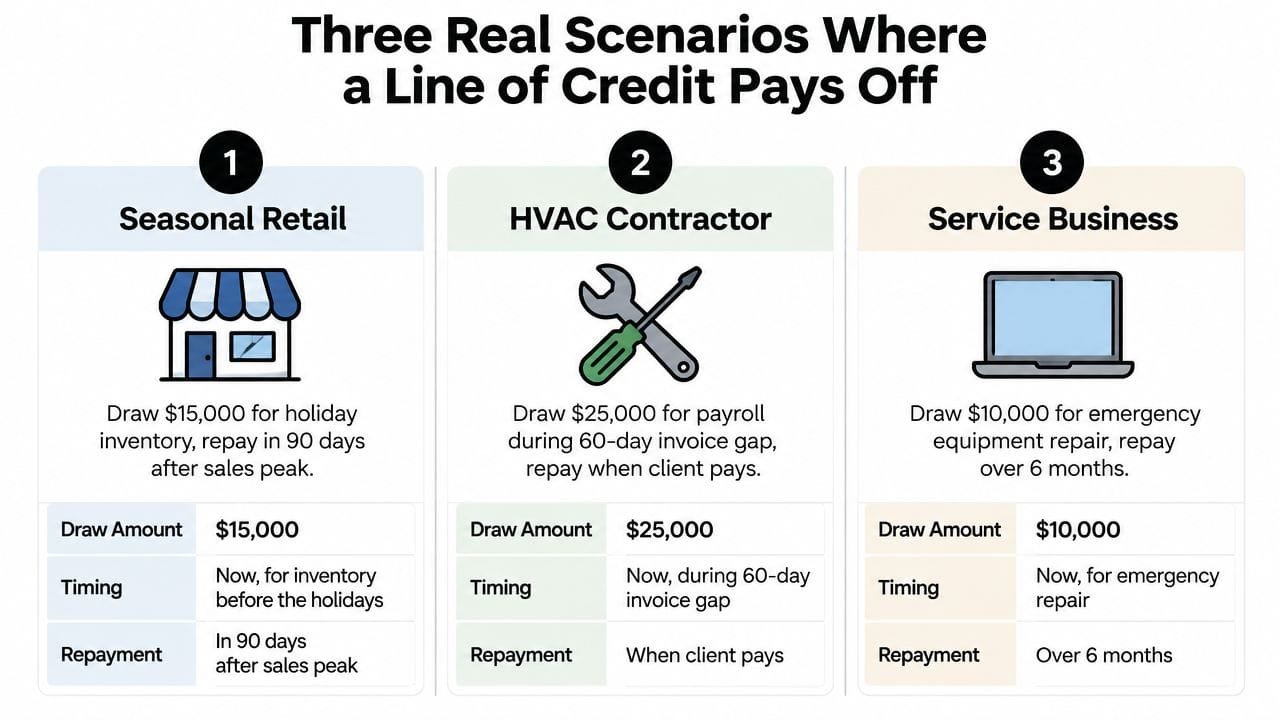
Seasonal retail
A retailer may draw $15,000 for holiday inventory and plan to repay it within 90 days as sales peak. The repayment trigger isn't a vague promise to “pay it down later.” It's the conversion of inventory into cash, monitored through sales deposits and inventory movement.
The owner should preserve unused availability for a supplier opportunity or an unexpected repair. Drawing the full limit because it exists creates unnecessary interest cost and removes flexibility at the moment it matters.
HVAC or B2B services
An HVAC contractor can draw $25,000 during a 60-day commercial invoice gap to cover payroll and job-related expenses. The repayment trigger is the customer's payment, not the next credit application. If the same gap repeats, the owner can evaluate whether the line is appropriately sized or whether invoice financing better matches the receivable.
Owners who need stronger cash-flow routines can also use a resource such as Accountant She Ltd.’s self-paced Calm Cashflow programme to build more consistent forecasting and payment planning.
Service business or manufacturer
A service business might draw $10,000 for emergency equipment repair and repay it over 6 months. That use can work if the repair restores billable capacity and monthly cash flow supports the scheduled paydown.
A manufacturer could instead use a secured facility for a $40,000 equipment upgrade and short-term component purchases, while keeping the outstanding balance below the available limit. The operating principle is the same: borrow against a defined business need, then restore capacity as cash returns.
The bad use case is open-ended operating loss. If every repayment depends on another draw, the line has become a substitute for viable margins. That's when an owner needs a restructuring conversation, cost correction, or longer-term capital plan.
Lines of Credit vs Term Loans, SBA Loans, and Cash Advances
A line is built for repeated, short-cycle access. A term loan is built for a defined amount and scheduled repayment. SBA-backed facilities can offer structured working-capital support for qualified borrowers, while merchant cash advances trade speed for expensive repayment mechanics. Invoice financing ties funding to receivables rather than general availability.
| Product | Speed to Fund | Typical Cost Range | Flexibility | Best-Fit Use |
|---|---|---|---|---|
| Revolving business line | Varies by lender and file | Depends on benchmark, margin, fees, and risk | Draw, repay, and potentially redraw | Short-cycle working capital |
| Term loan | Varies by lender and documentation | Fixed or variable, based on risk and structure | Limited after initial funding | Defined project or durable asset |
| SBA-style facility | More structured review | Often favorable for stronger files, with program terms | Can support monitored working capital | Larger, documented operating needs |
| Merchant cash advance | Often fast | Factor-based and potentially very expensive | Frequent repayment, limited reuse | Last-resort liquidity when alternatives fail |
| Invoice financing | Tied to receivables | Based on invoice quality, timing, and fees | Advances against eligible invoices | B2B collection gaps |
A line is the wrong tool for long-tenor equipment financing, an acquisition, or a project whose return arrives over several years. Use term debt for a durable asset when fixed payments match the asset's useful life. A borrower with weak credit who is being priced into a costly cash advance should not mistake speed for affordability.
The SBA 7(a) Working Capital Pilot is a notable structured alternative. It offers asset- or transaction-based revolving lines up to $5 million with a 75% guaranty, according to the Federal Reserve series describing business financing purposes. That type of facility may involve monitoring, collateral rules, and use restrictions that a generic line doesn't.
Owners selling through marketplaces should compare more than a generic LOC. A practical guide to funding options for Amazon sellers can help frame inventory, receivables, and platform-specific alternatives. For a secured-versus-term-loan comparison, see when to choose a secured line of credit over a term loan.
Rule of thumb: Use a line for a short cash conversion cycle, term debt for a long-lived asset, and revenue-based products only after you understand their true repayment cost.
Decision Framework and Smart Questions to Ask Before You Sign
Approve the line only when three conditions hold. First, the need is short-cycle working capital. Second, the business can cover interest and principal reduction at the highest expected draw without relying on another advance. Third, the all-in cost still works after fees, benchmark changes, and the possibility of a partial approval.
Ask the lender these questions before signing:
- How do I request a draw, and how quickly will funds arrive?
- Is interest calculated daily or under another method?
- Does repayment restore availability immediately?
- Is there a minimum payment, mandatory amortization, or clean-down requirement?
- What happens if the balance exceeds the borrowing base or approved limit?
- Can collateral values, receivables eligibility, or advance rates be changed during the facility?
- What documents will you review at renewal?
- Can the lender reduce or suspend availability if deposits decline?
- Are there annual, unused-availability, origination, draw, or renewal fees?
- Does the agreement include a personal guarantee or broad UCC filing?
Brief answers to the questions owners ask most
Can approval still result in underfunding? Yes. Only 48% of small businesses that applied for a line received the full amount, while 21% received part of the requested amount and 31% were denied, according to the Federal Reserve's 2026 report on employer firms. Submit a request supported by deposits, receivables, and a documented repayment path. Then plan for a shortfall so payroll and critical vendors aren't dependent on the maximum approval.
When should I choose secured over unsecured? Choose secured when the larger capacity or lower pricing justifies pledging assets and complying with monitoring requirements. Choose unsecured when speed, simplicity, and asset protection matter more and the business can operate within a smaller limit.
What should I expect from rates in 2026? Don't build the budget around a single rate forecast. Benchmark-linked pricing moves with the base rate, and higher pricing can reduce actual utilization. Model the line at the offered margin plus a higher benchmark scenario, then decide whether the business can still repay comfortably.
A pre-qualification process that uses a soft pull can help you compare likely structure and capacity before committing to a hard inquiry. Business Loan Warrior offers a single application for business funding options, including lines of credit, with bank-account connection and an approval dashboard.
Use Business Loan Warrior to pre-qualify and compare a line structure against your real cash-flow gap, not just an advertised limit. Prepare your bank statements, financials, and target draw schedule first, then submit one complete application so the lender can evaluate the amount and terms you need.