
A customer's payment is late, payroll is due, and a supplier won't release the next order without cash. The business may be profitable on paper, yet the owner is still deciding which bill can wait. That's the working-capital problem a business line of credit can solve, but only when the lender, pricing model, and repayment structure match the company's cash-flow pattern.
The wrong offer can create a more expensive version of the same squeeze. A low quoted rate may hide draw fees, unused-line charges, or variable pricing. A fast approval may come with a repayment schedule that drains cash before receivables arrive. The right comparison is not which lender advertises the lowest APR. It's which lender advances enough usable capital, at a tolerable all-in cost, with terms that fit how revenue arrives.
Table of Contents
- The Working Capital Squeeze Most Owners Know Too Well
- What a Business Line of Credit Actually Is
- Types of Line of Credit Lenders and How They Differ
- Reading the True Cost of a Credit Line Offer
- Preparing to Apply and What Underwriters Look For
- Comparing Offers and Tracking Pre-Approvals
- Managing a Credit Line So It Grows With You
- Choosing the Right Line of Credit Lender for Your Business
The Working Capital Squeeze Most Owners Know Too Well
A commercial cleaning company has completed several large contracts, but its customers pay on normal invoice terms. Meanwhile, payroll lands this week, equipment supplies need restocking, and a seasonal order has to be placed before demand peaks. The owner doesn't need a permanent lump sum. The owner needs cash for a short gap, then wants the borrowing capacity available again after customer payments arrive.
That gap between receivables and payables is the classic working-capital squeeze. It appears in service companies waiting on invoices, retailers buying inventory ahead of busy periods, contractors funding materials before milestone payments, and manufacturers managing uneven purchase orders. The business can be healthy while its bank balance looks temporarily strained.
A term loan often mismatches this pattern. The borrower receives the full amount upfront, pays interest on the entire balance, and follows a fixed repayment schedule even if only part of the money was needed. That structure makes sense for a defined purchase, such as equipment or an acquisition. It's less efficient when cash needs come in irregular bursts.
Advisor's view: Borrow for a known asset with a known price. Use revolving credit for recurring gaps that open and close with the operating cycle.
Owners who want a stronger foundation should first document how money moves through the company. A practical guide to managing business cash flow can help identify collection delays, supplier timing, and recurring shortfalls before a funding application begins.
The question behind the application
The important question isn't “Which lender will approve me?” It's “Which facility will behave properly when revenue is uneven?” That answer depends on several factors:
- Draw pattern: Will the business make occasional draws, or carry a balance continuously?
- Funding urgency: Can the owner wait for bank underwriting, or does a supplier deadline require a faster decision?
- Cost tolerance: Is the business prepared to pay more for speed, or is minimizing annualized cost the priority?
- Repayment rhythm: Will receivables replenish cash quickly, or will the balance remain outstanding for months?
A line of credit can provide flexibility, but flexibility has a price when the lender charges for every draw or reprices the balance. Owners should judge the product by the cash it makes usable after fees and by the payment burden created during slower months.
What a Business Line of Credit Actually Is
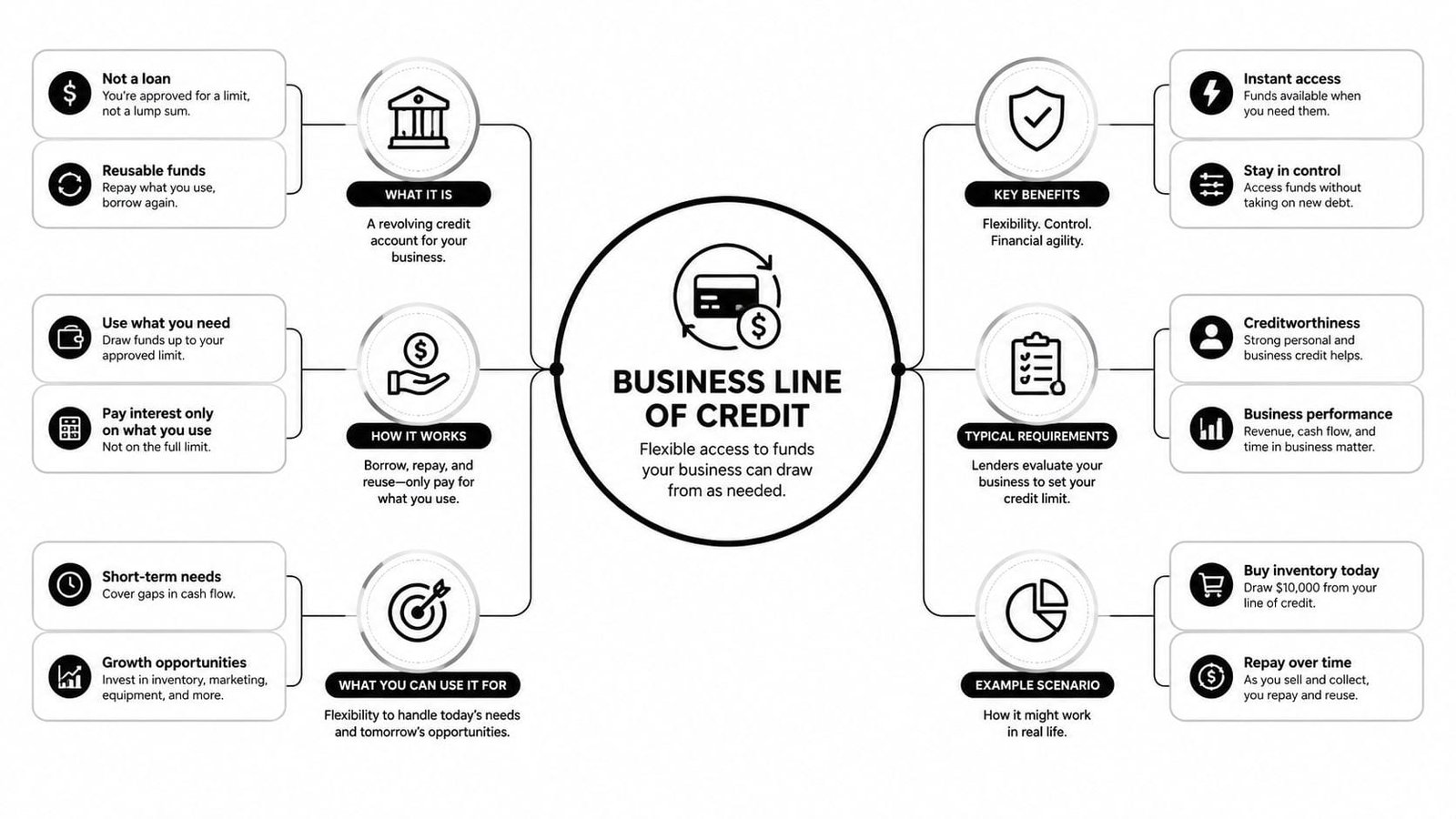
Think of a revolving business line as a water tap. The approved credit limit is the size of the pipe. A draw turns the tap on, a repayment restores available capacity, and the business can access that capacity again under the agreement's rules.
A term loan works differently. The lender advances a lump sum, and the borrower repays that balance over a set schedule. With a revolving line, interest generally accrues on the amount drawn rather than on the unused ceiling. That distinction matters when a company needs emergency liquidity but doesn't want to pay borrowing costs on capital sitting idle.
The components that determine flexibility
The approved limit tells you how much the lender is willing to make available, not necessarily how much the business should draw. The draw period defines when the borrower can access funds, while repayment terms determine how quickly the available balance returns.
Pricing may be fixed or variable. Bank and credit-union lines commonly use prime-based pricing. Recent U.S. bank benchmarks clustered around 7.0% to 7.3% for fixed-rate lines and 7.6% to 7.9% for variable-rate lines, while online and fintech lines can reach 15% to 60% or more in APR because shorter terms and fee-based pricing increase the effective annualized cost, as detailed by Lendio's business line of credit rate guide.
Read the agreement for more than the rate:
- Draw fees: A charge may apply each time the business accesses funds.
- Maintenance fees: Some lenders charge for keeping the facility open or for unused capacity.
- Minimum payments: The payment may include interest, principal, or both.
- Security: A secured line may require business assets, receivables, or another form of collateral. An unsecured line typically relies more heavily on cash flow and personal credit.
- Rate resets: A variable line may change as its index changes, raising the payment without a new draw.
A line is useful only when the tap works under pressure. Confirm how quickly funds arrive, whether draws require approval, and whether repayments automatically restore availability.
Types of Line of Credit Lenders and How They Differ
Line of credit lenders price different risks, so the right choice depends on your revenue pattern and funding speed. A bank usually fits an established company with predictable cash flow and time to provide full documentation. An online lender fits an owner who needs access quickly and accepts a higher all-in cost. Credit unions can reward an existing member relationship, while SBA-backed facilities suit owners planning around longer repayment horizons.
| Lender Type | Typical Approval Speed | Underwriting Focus | Typical Limit Range | Pricing Profile |
|---|---|---|---|---|
| Traditional bank | Slower, with formal review | Cash flow, financial statements, collateral, business history, personal credit | May support substantial working-capital needs for established firms | Often prime or index based, with recent U.S. bank benchmarks around 7.0% to 7.3% for fixed-rate lines and 7.6% to 7.9% for variable lines (Lendio) |
| Credit union | Relationship dependent | Cash flow, member relationship, collateral, owner profile | Varies by institution and borrower strength | Commonly relationship and prime based |
| Online lender | Faster, with a digital application | Bank deposits, revenue consistency, time in business, personal credit | Varies widely, with some products designed for smaller or moderate facilities | Can reach 15% to 60% or more in APR because of fee-based pricing and shorter terms |
| SBA-backed working-capital line | More involved than a basic online application | Financial history, repayment ability, guarantors, eligibility, lender requirements | Structure and lender dependent | SBA working-capital lines are capped around 9.75% to 14.75%, depending on structure and lender type (ByzFunder) |
| Fintech marketplace or broker platform | Initial comparison can be faster | Digital application data, bank connection, lender-specific rules | Depends on matched lender | Not one pricing model. The platform may present bank, fintech, or other nonbank offers |
Choose a bank when the lower quoted rate justifies slower approval and heavier review. Choose an online lender when a short cash gap threatens payroll, inventory, or an immediate opportunity, and calculate the cost of draw fees, variable pricing, and unused capacity before accepting the speed premium. A marketplace can widen your options, but compare the actual funding provider, not only the platform's initial offer.
Credit unions depend on membership and local coverage. Their underwriting may account for the owner's relationship with the institution, which can help a financially sound business that does not fit a rigid bank process. SBA-backed lines involve approved lenders, guarantors, eligibility rules, and more documentation. A longer repayment horizon may ease monthly pressure, but it does not erase fees or make the facility inexpensive.
The lender's name matters less than how the facility behaves when revenue fluctuates. Seasonal businesses should prioritize a line that can be drawn during slow collection periods and repaid after customer receipts arrive. Businesses with uneven deposits need an underwriting model that can interpret volatility instead of treating every weak month as a permanent decline.
Owners comparing collateral requirements should review this practical guide to secured versus unsecured business lines of credit. Headline APR does not select the lender. Cash-flow fit, speed, draw costs, and total utilization cost do.
Reading the True Cost of a Credit Line Offer
A rate sticker can hide the economics that matter most. Suppose a lender quotes a 9% APR on a $50,000 line, charges a 2% draw fee on each withdrawal, and applies a 1% monthly maintenance charge on unused capacity. If the business draws the full line and repays it over eight months, the draw fee alone is $1,000 if the 2% charge applies once to the full withdrawal.
At a simple annualized view, 9% APR on $50,000 for eight months produces about $3,000 in interest before the lender's other charges. The draw fee raises the stated cost to about $4,000, before considering the variable-rate reset or payment timing. If the business repays the balance gradually, the average outstanding balance may be lower, but an unused-balance fee could still apply to the portion that remains available.
That's why two offers with the same APR can produce different net costs. One lender may charge only interest on the outstanding balance. Another may add a fee at every draw, a monthly account charge, or a minimum charge during inactive periods.
Build an all-in cost worksheet
Before accepting an offer, write the economics on one page:
- Requested limit and planned draw: Record the amount you expect to use, not only the approved ceiling.
- Interest calculation: Identify whether interest accrues daily or through another method, and whether the rate is fixed or tied to an index.
- Draw charges: Ask whether the fee is deducted from the advance or added to the balance.
- Unused-line charges: Confirm whether maintenance fees apply when there's no activity.
- Repayment mechanics: Note the minimum payment, principal requirements, and the date funds leave the operating account.
- Early payoff rules: Check for restrictions or charges if receivables arrive sooner than expected.
Ask each lender three direct questions: Does the draw fee come out of the cash advance? Does the maintenance charge apply during zero-draw months? When does interest begin accruing?
The worksheet should compare the cost of the same intended draw across lenders. It should also model a slower repayment scenario, because a line that looks affordable during a strong month may become expensive when collections slip.
Preparing to Apply and What Underwriters Look For
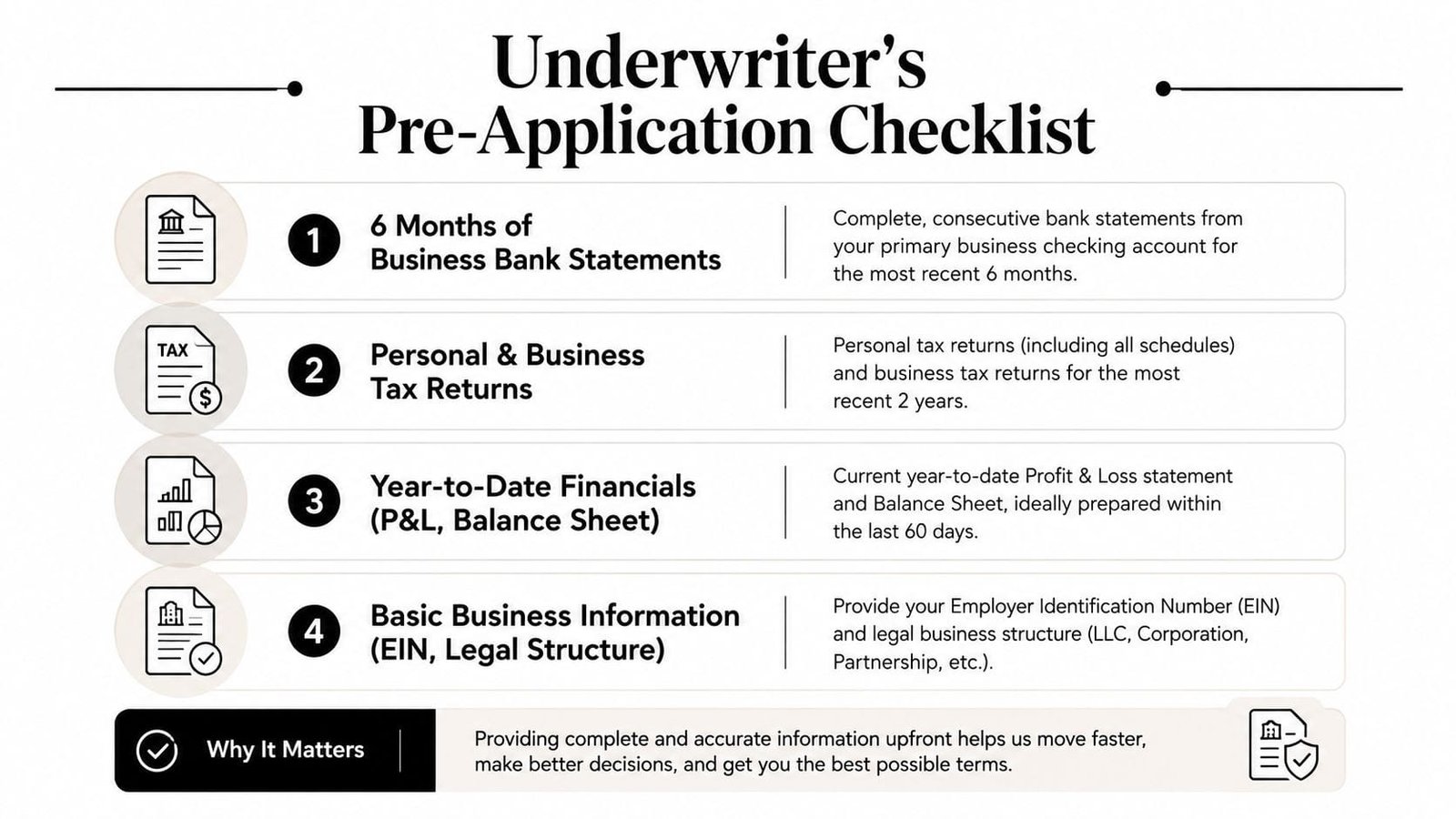
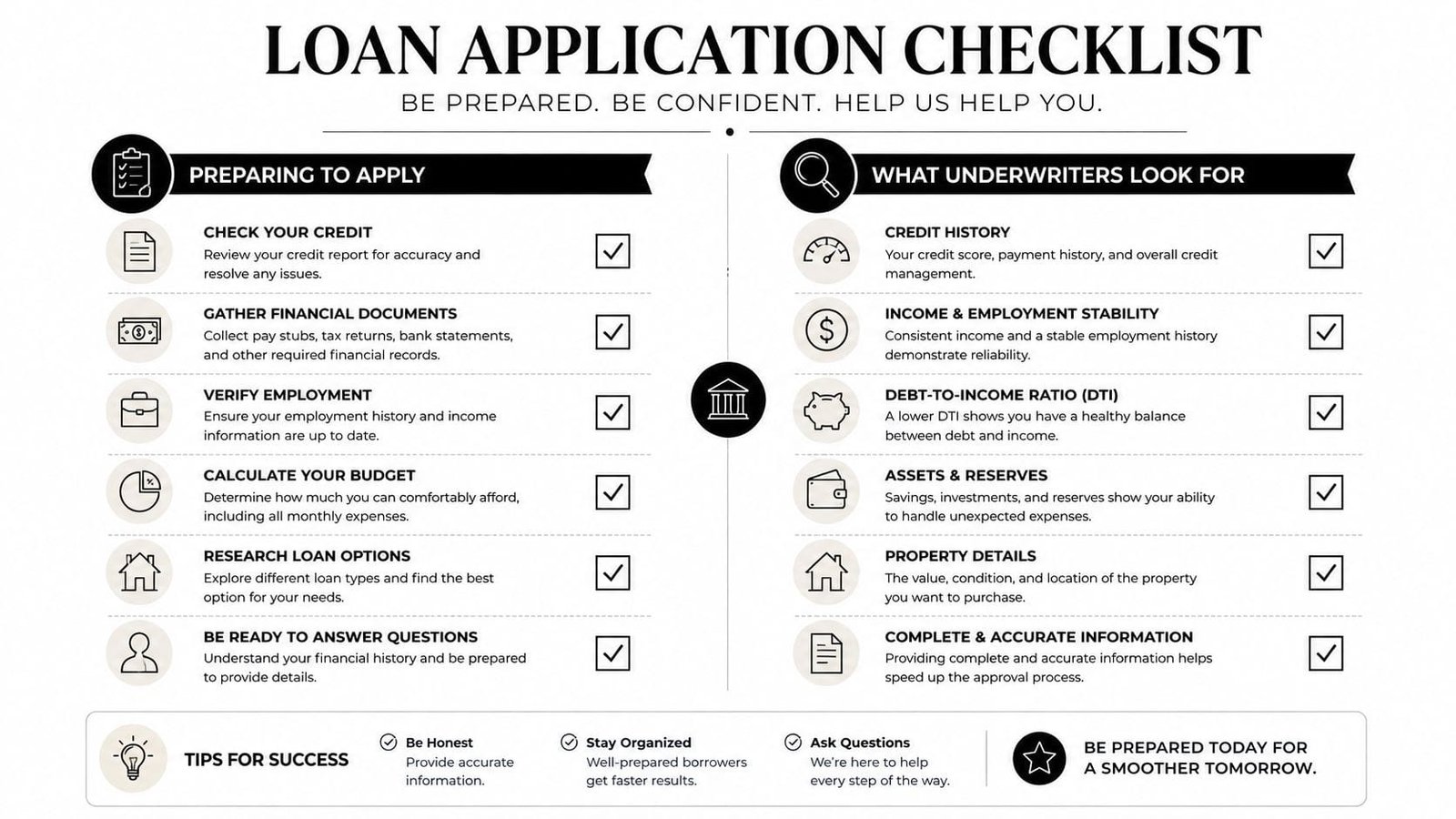
Underwriters want evidence that the business generates enough cash to repay the line while continuing to operate. Prepare the core file before submitting an application, because missing documents create delays and can trigger repeated reviews.
Start with:
- Bank statements: Gather the most recent three to six months of business statements, with every page included.
- Tax returns: Established businesses should prepare two years of business and personal returns when requested.
- Financial statements: Keep a current profit and loss statement and balance sheet ready.
- Entity records: Confirm the legal name, ownership, entity type, tax identification details, and authorized signer.
- Receivables information: If customer invoices drive repayment, prepare an aging schedule and explain concentration among major customers.
The lender will examine more than total revenue. Average daily balances, deposit consistency, revenue volatility, recent nonsufficient-funds events, tax liens, industry classification, and the principal's personal credit can all shape the decision. A business application may focus on company health, but the owner's financial profile can still influence approval, pricing, guarantee requirements, and the available limit.
Sequence the file instead of sending fragments
First reconcile the bank statements to the accounting records. Then update the profit and loss statement and balance sheet. After that, write a short explanation for unusual deposits, seasonal dips, customer concentration, or recent overdrafts.
Online lenders often place more weight on current banking activity and may accept a thinner operating history than a bank. Banks typically expect a longer, cleaner record and more formal financial reporting. The exact threshold varies by lender, so owners should avoid applying randomly and instead match the file to the underwriting model.
This guide to line-of-credit eligibility offers another useful lens for businesses that are new, asset-light, or less conventional.
The application process also benefits from preparation around credit inquiries. Ask whether the initial review uses a soft or hard credit pull, when a hard inquiry occurs, and which documents are required before final approval.
Comparing Offers and Tracking Pre-Approvals
A pre-approval letter is not a final answer. It's an invitation to inspect the facility's mechanics before the business commits to a lender.
Submit one complete application through a comparison platform, connect the relevant business banking information if required, and read each pre-approval inside the dashboard. A single application can reduce duplicate data entry, but it doesn't eliminate the need to verify the final agreement.
Turn offers into a decision sheet
For every offer, record the same fields:
- Approved limit: Separate the maximum facility from the amount the lender will initially make available.
- Draw mechanics: Note whether draws are automatic, manually requested, or subject to additional review.
- Fee structure: Capture draw fees, maintenance charges, origination fees, and any other stated costs.
- Payment terms: Record the minimum payment, repayment period, frequency, and whether principal is required immediately.
- Rate behavior: Identify the index, margin, reset frequency, and any floor or cap.
- Funding speed: Compare the lender's stated timing with the business deadline, not with a generic promise of fast funding.
- Documentation gaps: Resolve missing bank statements, tax returns, or ownership records before final underwriting.
The dashboard signals can be as useful as the offer itself. Look for which lenders matched the company's stated revenue band, which offers relaxed collateral requirements, and whether missing documents are flagged before a hard credit pull. Those details reveal lender fit. An approval that requires collateral the owner won't pledge isn't a practical approval.
Compare before urgency takes over
Put at least two offers side by side, and preferably three when the business has enough time. Calculate the cost of the same intended draw under the same repayment assumption, then rank each offer by total cost, funding speed, limit adequacy, and repayment flexibility.
Don't accept a larger limit just because it appears available. A high ceiling can encourage unnecessary borrowing and create a payment burden that outlasts the original cash-flow gap. The best offer is the one the business can use responsibly and repay without starving payroll, taxes, or suppliers.
Managing a Credit Line So It Grows With You
A credit line becomes a useful long-term asset when the owner treats it as operating infrastructure, not emergency spending money. Draw for a defined purpose, record the expected repayment source, and pay according to the agreement even when customer collections arrive later than planned.
Utilization is one of the clearest signals in revolving credit. Business credit reporting generally evaluates utilization as the outstanding balance divided by the total limit, often measured monthly and averaged quarterly. The SBFE material describes utilization as a core metric across revolving credit types, and keeping utilization below about 50% is commonly recommended to reduce deterioration in the credit profile, as discussed in the SBFE revolving-credit reporting publication.
Use a monthly operating rhythm
- Review the balance: Confirm current principal, available capacity, accrued interest, and upcoming payment.
- Log the purpose: Tie every draw to inventory, payroll timing, receivables bridging, or another identifiable need.
- Pay down deliberately: Reduce the balance when cash arrives instead of allowing the line to become permanent debt.
- Refresh the file: Keep bank statements, revenue records, and financial statements current for renewal conversations.
- Check utilization: Watch the balance relative to the approved limit, especially before requesting more capacity.
A lender may view clean repayment behavior, consistent reporting, and disciplined utilization favorably during renewal. Those habits can support a stronger negotiating position, but owners shouldn't assume they guarantee an automatic increase or rate reduction.
The practical playbook in how to use a business line of credit reinforces the central discipline: draw with a purpose, repay from a defined source, and preserve capacity for the next genuine operating need.
Choosing the Right Line of Credit Lender for Your Business
A predictable business with time to plan should start with a bank or credit union. Their underwriting may take longer, but lower pricing can outweigh the delay when the line will stay active for months. If payroll or inventory creates a short gap that must close quickly, an online lender can fit. Make that choice only after calculating draw fees, variable pricing, and the cash required for repayment.
SBA-backed working-capital lines suit owners who can provide more documentation and want a structured facility for broader operating needs. A fintech marketplace or broker platform can help thin-file, asset-light, or comparison-focused borrowers find possible matches. The agreement still comes from the underlying lender, so review its repayment terms, fees, renewal conditions, and security requirements.
| Lender Type | Best Cash-Flow Pattern | Speed | Typical Cost | Ceiling |
|---|---|---|---|---|
| Traditional bank | Slow, predictable cycles with strong financial reporting | Slower | Often lower, prime or index based | Can support larger established needs |
| Credit union | Stable operations with a relationship-oriented borrowing approach | Moderate to slower | Often relationship and index based | Institution and borrower dependent |
| Online lender | Urgent, short-duration gaps with reliable deposits | Faster | Higher, with online products reaching 15% to 60% or more in APR as noted earlier | Product dependent |
| SBA-backed line | Planned working capital with tolerance for documentation | More involved | SBA-working-capital pricing as noted earlier | Structure and lender dependent |
| Fintech marketplace or broker platform | Borrowers needing comparison across lender models | Initial comparison can be faster | Depends on matched offer | Depends on matched lender |
Score each offer on speed to fund, total annualized cost, ceiling size, and reporting flexibility. Then model the line against your revenue pattern. Estimate how long each draw remains outstanding, include every draw fee, and test the payment against a weak collection month. A lower quoted rate can lose its advantage if variable pricing rises or repeated utilization keeps cash tied up. A line that repeatedly consumes operating cash is not flexible in practice.
Business Loan Warrior provides a single, no-fee application that can surface pre-approval options, support bank-account connections, and organize lender responses in a secure dashboard without affecting credit during the initial check. Visit Business Loan Warrior to compare offers against your draw pattern, funding deadline, and all-in borrowing cost before signing.