
A restaurant can post strong quarterly revenue and still feel squeezed between holiday rushes. A contractor can have profitable jobs underway while payroll is due before a client pays the next invoice. In both cases, the problem isn't demand or profitability. It's timing.
That's where the right line of credit options earn their place. A revolving facility gives the business access to an approved limit, allows draws as needed, and restores borrowing capacity as the balance is repaid. A term loan delivers a lump sum and follows a fixed repayment schedule. The distinction matters because working capital gaps rarely arrive in neat, predictable amounts.
Table of Contents
- Why Line of Credit Options Matter for Growing Businesses
- The Main Types of Business Line of Credit Options
- How Eligibility and Pricing Are Decided
- What Happens During the Application and Underwriting Process
- When to Choose a Line of Credit Over Other Financing
- Building a Line of Credit That Supports Growth
Why Line of Credit Options Matter for Growing Businesses
A line of credit works best when the business knows why cash is temporarily tight and has a realistic path to repayment. The restaurant owner may draw before purchasing inventory for a busy period, then repay the balance as sales arrive. The contractor may cover payroll and materials while waiting for an approved receivable. Neither owner necessarily needs permanent debt. They need controlled access to liquidity.
The Federal Reserve's 2023 Small Business Credit Survey found that 34% of employer firms used lines of credit regularly, while 53% regularly used or carried a balance on business loans. The same survey found that 37% of small employer firms applied for a loan, line of credit, or merchant cash advance during the prior 12 months. Those findings put revolving credit in context. It isn't an exotic product reserved for distressed companies. It's a mainstream financing tool for businesses managing uneven cash flow.

Flexibility versus committed debt
A line of credit gives you control over the timing and size of each draw. You pay interest on the amount outstanding, not automatically on the full approved limit. That can make the facility efficient for short-lived needs, provided you don't allow temporary borrowing to become a permanent balance.
A term loan is usually cleaner when you know the exact project cost and expect the asset or expansion to produce returns over a defined period. Borrowing a lump sum through a revolving facility can create unnecessary interest expense and expose the business to renewal or rate risk after the original need has passed.
Practical rule: Use a line of credit for a timing problem. Use a term loan for a known investment with a longer useful life.
For an owner in the $20 million to $50 million revenue range, the decision often involves more than approval. A larger company may have multiple operating accounts, seasonal divisions, outstanding receivables, inventory commitments, and existing debt maturities. The useful question is not “How much can I borrow?” It's “Which financing structure matches the way cash moves through this business?”
A revolving line can be a strong fit when borrowing needs recur but amounts vary. It becomes a weaker fit when the business carries most of the balance continuously, relies on refinancing to make payments, or uses short-term credit to fund fixed assets.
The Main Types of Business Line of Credit Options
The product name does not tell you whether a facility fits the business. A bank line, unsecured online facility, and receivable-backed product may all be called lines of credit, yet differ materially in underwriting, collateral, repayment mechanics, rate structure, and total cost. For an owner in the $20 million to $50 million revenue range, the practical question is which structure handles recurring cash timing without turning short-term borrowing into permanent debt.
Comparing the main structures
| Option | Typical Access Speed | Cost Range | Collateral | Best Fit |
|---|---|---|---|---|
| Traditional bank line | Slower, with detailed financial review | Often lower for stronger borrowers | May be required | Established businesses with stable financials |
| Online or unsecured line | Faster, with reduced documentation and automated bank-data review | Moderate to higher | Usually none, though a personal guarantee may apply | Businesses prioritizing speed and flexibility |
| Secured business line | Varies by collateral and lender | Often lower than comparable unsecured credit | Accounts receivable, inventory, equipment, or other assets | Asset-backed businesses seeking better pricing |
| SBA-backed revolving facility | Slower and more documentation-heavy | Negotiated within SBA program limits | Depends on lender and program | Businesses that need structured revolving capital |
| Merchant or receivable-backed line | Often responsive to sales or invoice data | Moderate to higher, depending on risk | Future receipts or eligible receivables | Businesses with strong payment flows but limited hard assets |
Traditional bank lines often provide the lowest borrowing cost for qualified companies, but approval requires clean financial statements, dependable deposits, satisfactory credit history, and evidence that the business can manage weaker periods. The lender may also require collateral or a personal guarantee. Variable pricing can make the facility affordable when benchmark rates fall, but it raises interest expense when rates increase.
Online and unsecured lines shorten the path to an initial decision and reduce paperwork. That convenience usually comes with higher rates, fees, more frequent repayment, or less favorable renewal terms. A lender relying heavily on recent bank activity may offer speed without giving the business the broader relationship pricing available from a bank.
Secured lines deserve close attention when a company holds substantial receivables or inventory. Pledged assets can increase borrowing capacity or improve pricing, but the lender receives rights to those assets after default. Review advance rates, eligibility rules, borrowing-base certificates, reporting duties, and the treatment of overdue invoices before signing.
SBA-backed revolving options, including CAPLines and express lines, add program requirements to the lender's underwriting. SBA lender guidance on revolving programs explains that the lender and borrower negotiate the rate, subject to SBA maximums. Some structures include a revolving period followed by a term-out phase for unpaid balances. That change can turn flexible draws into scheduled amortization, so repayment planning matters from the start.
Merchant and receivable-backed facilities can suit businesses with strong payment flows but limited hard assets. They may respond to sales or invoice data rather than traditional collateral, though cost and repayment mechanics require careful comparison. The MCA Pay factoring line of credit provides context on how receivable-based financing differs from a conventional revolving facility. For collateral decisions, this comparison of secured and unsecured business lines outlines the main trade-offs.
How Eligibility and Pricing Are Decided
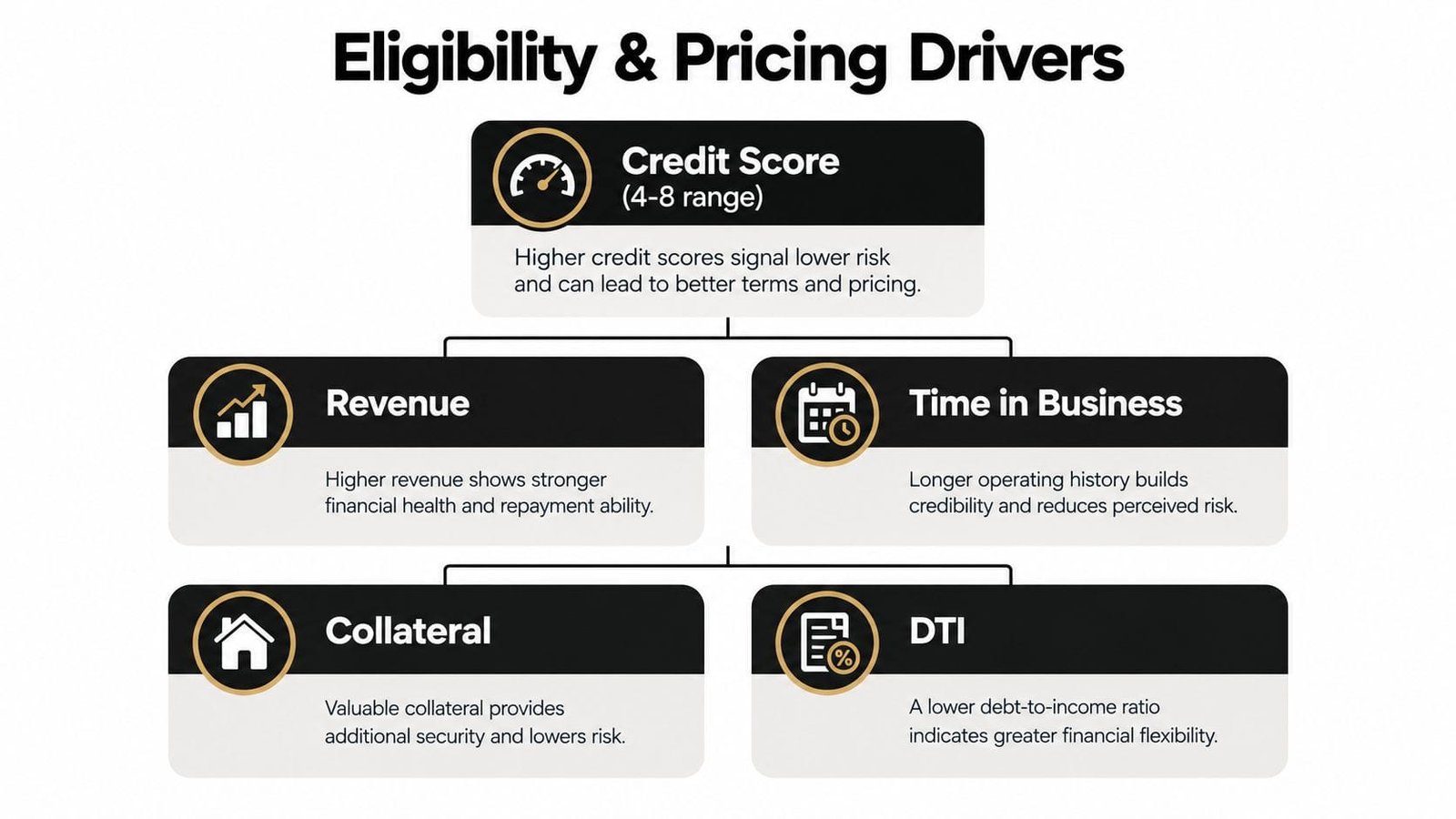
Lenders don't approve a line based on revenue alone. They evaluate whether the business generates enough dependable cash flow to service existing obligations, repay new draws, and withstand ordinary volatility. Credit history, time in business, industry conditions, deposit activity, profitability, debt levels, collateral, and the requested limit all influence the decision.
A borrower with strong sales but erratic deposits may receive tougher terms than a smaller company with predictable collections. A company in a cyclical industry may need to explain its seasonal pattern clearly. A business carrying substantial existing debt may qualify for a lower line than its revenue suggests because the lender is measuring repayment capacity after current obligations.
The signals underwriters examine
- Credit profile: Personal and business credit history can affect approval, required guarantees, limit size, and margin over the benchmark rate.
- Revenue quality: Lenders want to understand how much revenue is recurring, how quickly customers pay, and whether a few customers account for most collections.
- Time and operating history: A longer record gives the lender more evidence about margins, seasonality, and management's response to difficult periods.
- Debt service capacity: Existing loans, leases, credit cards, and other obligations reduce the cash available for a new facility.
- Collateral and industry risk: Assets can support a secured request, while industry volatility may lead the lender to apply tighter limits or monitoring.
Why the rate structure changes the economics
Business lines are generally priced as a benchmark rate plus a lender margin. The borrower pays interest on the drawn balance, which makes utilization central to the economics. A higher outstanding balance increases interest expense immediately, even if the committed limit stays unchanged.
Published survey-based benchmarks for new bank lines have recently clustered around roughly 7% to 8% for fixed or variable bank lines, while broader market quotes can range much higher depending on credit quality and lender type, as described in this business line of credit rate overview. Treat that range as market context, not a quote for your company.
Variable pricing can be efficient when the balance turns quickly and market rates remain manageable. It becomes more difficult to budget when the balance stays high or the benchmark rises. A fixed-rate structure offers greater payment predictability, but it may cost more initially or limit the flexibility associated with a traditional revolving facility.
Owners should compare the margin, benchmark, adjustment frequency, floor, ceiling, annual fee, draw fee, unused-line fee, renewal conditions, and any conversion provision. A low opening rate doesn't necessarily produce low total cost if the business keeps the line heavily utilized.
For a more detailed review of qualification factors, see this guide to business line of credit eligibility.
What Happens During the Application and Underwriting Process
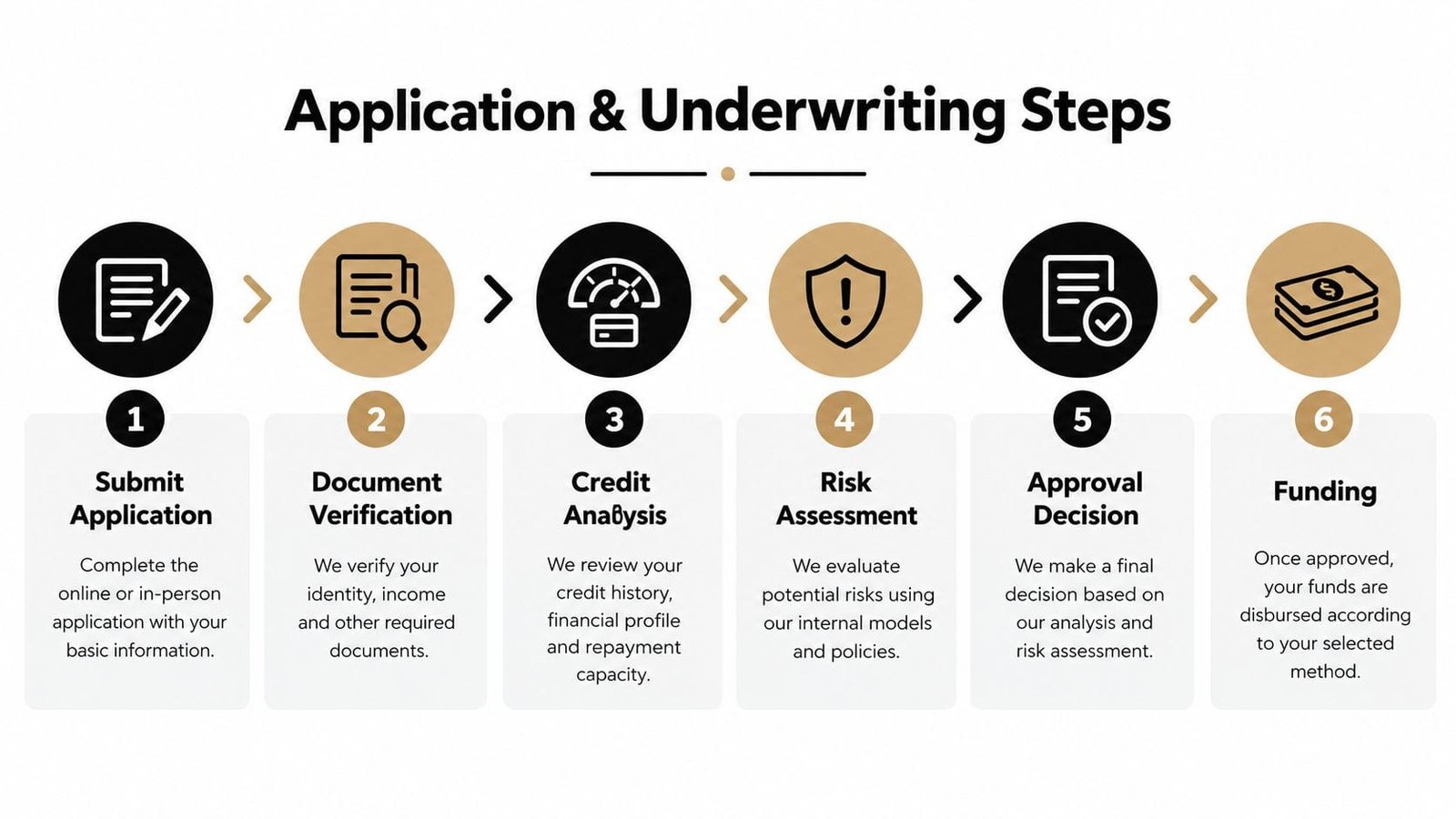
A line of credit application is a cash-flow investigation, not just a credit-score check. The lender is trying to answer a practical question: if the business draws today, what operating receipts will repay that draw, and how reliable are those receipts?
The first review
The initial application usually captures ownership, requested amount, revenue, industry, existing debt, and the intended use of funds. Some lenders can review linked bank activity or other operating data early. That helps them identify whether deposits are consistent, whether balances frequently fall too low, and whether the requested facility matches the business's scale.
Prequalification can be useful, but it isn't a final commitment. The lender may still request tax returns, financial statements, accounts receivable aging, debt schedules, ownership documents, and proof of operating accounts.
Documentation tells the operating story
Financial statements show profitability and use of debt. Bank statements show the timing and quality of actual cash movement. Receivables reports help the lender assess whether reported sales are likely to convert into cash soon. Inventory records can matter when the business needs a line to purchase or carry stock.
Prepare the file before applying:
- Reconcile statements: Make sure the income statement, balance sheet, and bank activity don't tell contradictory stories.
- Explain unusual items: Document one-time expenses, owner distributions, litigation, major customer losses, or unusual deposits.
- Map the borrowing cycle: Show when the business draws, what the funds pay for, and when collections should reduce the balance.
- List every obligation: Include equipment leases, credit cards, existing lines, merchant advances, and guarantees.
- Request a usable limit: A facility that is too small may force repeated applications, while an oversized request can create unnecessary underwriting concern.
Credit analysis and risk assessment
The underwriter reviews payment history, debt load, cash-flow coverage, industry exposure, customer concentration, collateral, and management experience. A profitable company can still face friction if customers pay slowly, deposits are irregular, or the business has multiple daily or weekly repayment obligations.
Approval may include covenants, borrowing-base reporting, personal guarantees, minimum payment rules, or restrictions on how the funds can be used. Funding can also wait if the lender needs to verify ownership, resolve a discrepancy, obtain collateral documents, or complete a final compliance review.
The experience of other borrowers is uneven. A 2026 SMB financing survey from Bluevine reported that 37% of SMB owners experienced a problem in their most recent financing application, while 65% had applied for a business line of credit or term loan during the prior 12 months. The same source highlights that access conditions vary across business and owner characteristics. Approval isn't the end of the process either. Ask how renewals work, what triggers a review, and whether the lender can reduce or suspend availability if performance changes.
Owners who want a practical timeline can review this guide to how long business line of credit approval can take.
When to Choose a Line of Credit Over Other Financing
A $20M–$50M business can have strong revenue and still choose the wrong financing structure. The decision turns on how often cash is needed, how quickly it returns, and whether the company can absorb rate movement while the balance remains outstanding.
A revolving line works best when the business faces recurring, short-term timing gaps. A commercial service company may invoice customers regularly, wait for collections, and still need payroll funding between billing and payment. Drawing only what is required, then repaying from receivables, keeps financing aligned with the operating cycle.
A term loan fits a different need. A distributor making a committed equipment purchase knows the amount, expects the asset to serve the business for years, and may not generate returns during a short cash cycle. Receiving the full amount and repaying it on a defined schedule can provide better structure than carrying a large revolving balance.
Apply a simple decision filter
Choose a line of credit when most of these conditions apply:
- The need repeats: Seasonal inventory purchases, payroll timing gaps, or receivable delays occur as part of normal operations.
- The draw amount varies: The company does not need the entire facility on day one.
- Repayment comes from operations: Customer collections or ordinary sales should reduce the balance.
- You can tolerate rate movement: Cash flow can handle a variable benchmark, or the lender offers a fixed structure that fits the budget.
- You can monitor utilization: Management reviews outstanding debt, unused capacity, and renewal requirements rather than treating the limit as permanent capital.
For a one-time investment, a term loan is generally more suitable. That includes equipment, construction, acquisition costs, a location buildout, or another project with a defined budget. A revolving line used for those purposes can leave the company with a high balance and no clear repayment event.
The practical test is simple: match the repayment source to the financing structure. Short-term working capital should turn back into cash. Long-lived assets should be paid down over a schedule that reflects their useful life.
Rate risk deserves a separate decision
A variable-rate line charges interest only on the amount drawn, which can lower the cost when utilization is modest. The advantage narrows when the business carries a large balance for an extended period. A benchmark change then affects the outstanding debt, raises the cost of capital, and makes forecasting harder.
A fixed-rate line or fixed-rate loan provides more predictable budgeting, but that certainty may reduce flexibility or carry a higher price. Compare the expected balance over the complete borrowing cycle, not only the opening rate. Test the effect of a higher benchmark and slower collections before selecting the facility.
SBA-backed revolving facilities may suit a company that wants a formal working-capital structure and can manage additional documentation and program rules. SBA program materials describe negotiated rates subject to program maximums, including structures in which a revolving period is followed by term repayment. That transition can reduce refinancing uncertainty, while also creating a higher scheduled payment after the revolver ends.
Recent lending data provides useful context. The Kansas City Fed lending survey reported that total new loan balances rose 9.9% year over year in the first quarter of 2026, with new credit lines up 31.1% while term loans fell 0.9%. Median credit line usage moved from 40.3% to 40.7% quarter over quarter, and 20% of respondents reported a change in usage. Those figures do not determine the right product for an individual borrower. They reinforce the need to manage utilization actively, especially when a large company is deciding whether a line should remain a backup facility or become a regular funding source.
Building a Line of Credit That Supports Growth
A line becomes a growth tool when the business connects each draw to a defined operating event. For example, a growing manufacturer might use revolving credit to purchase inputs for confirmed orders, use receivables to repay the balance, and finance a long-lived machine separately with an equipment loan. That structure keeps short-term working capital from competing with long-term investment for the same repayment capacity.
The approved limit matters less than the operating discipline behind it. Track utilization, interest expense, upcoming maturities, customer collections, and the date when the lender will review the facility. Start renewal discussions before the line becomes essential. A business that waits until liquidity is tight has less negotiating power and fewer alternatives.
Lender's perspective: Consistent repayment behavior and transparent reporting build more confidence than a large unused limit.
Avoid using a revolving line to cover recurring losses without a turnaround plan. Don't let minimum payments disguise a balance that the business can't realistically clear. If the company needs permanent capital, refinance into a structure with a repayment schedule that matches the underlying need.
The best line of credit option isn't the one with the largest headline limit. It's the facility whose rate structure, collateral terms, renewal process, and repayment pattern fit the way your business earns and spends money.
Business Loan Warrior helps owners compare working-capital products, including revolving business lines of credit, through a single no-fee application and a secure dashboard for tracking approvals and repayments. Visit Business Loan Warrior to review funding options and connect your cash-flow needs with a financing structure that can support the next stage of growth.