
A customer invoice is due next month, but payroll is due Friday. Your supplier wants payment before releasing inventory, and a seasonal sales opportunity won't wait for the cash to arrive. A business line of credit can help cover that timing gap by giving you reusable access to funds without a new application for every draw. You pay for what you use, then available credit can replenish as you repay.
That flexibility doesn't make every line a good deal. The actual value depends on the interest-rate structure, draw and maintenance fees, repayment mechanics, collateral, personal guarantees, financial covenants, and renewal terms. Approval also isn't automatic. Federal Reserve data shows that 37% of small employer firms applied for a loan, line of credit, or merchant cash advance in 2023, while earlier reporting showed strong demand for lines of credit during other market conditions, as summarized by Federal Reserve small-business credit data.
The eight line of credit pros and cons below focus on business decisions, not sales promises. You'll see when revolving access solves a working-capital problem, when flexibility turns into expensive debt, and how secured and unsecured lines compare with term loans, merchant cash advances, and business credit cards.
Table of Contents
- 1. Flexible Access to Capital Without Fixed Loan Amounts
- 2. Interest Rate Characteristics and Variable Market Risk
- 3. Quick Approval and Funding Timelines
- 4. Collateral Requirements and Personal Guarantee Obligations
- 5. Borrowing Discipline and Risk of Over-Leverage
- 6. Ideal for Cash Flow Management and Working Capital Optimization
- 7. Impact on Credit Score and Credit History Building
- 8. Compliance, Renewal Terms, and Long-Term Relationship Management
- Line of Credit: 8-Point Pros & Cons
- Turn a Line of Credit Into a Controlled Financing Tool
1. Flexible Access to Capital Without Fixed Loan Amounts
A line of credit gives your business access to a predetermined borrowing limit. You can draw part of that limit for a specific need, repay it, and potentially use the available credit again. That differs from a term loan, which usually deposits a lump sum and then follows a fixed repayment schedule whether you needed all the money immediately or not.
This structure works best when the timing or amount of your expenses changes. A service company might draw funds to cover payroll while waiting for a client invoice. A retailer could use the line for inventory before a busy period, then pay it down as sales produce cash. A restaurant may need repeated smaller purchases rather than one large project payment.
The important distinction is that available credit isn't the same as affordable capital. A lender may approve a limit that looks generous, but every draw creates a repayment obligation. Read how a business line of credit works before treating the limit as part of your operating budget.

Use access to solve timing, not permanent losses
A line is a strong fit when you can identify the cash inflow that will repay each draw. It becomes a weak fit when you use new borrowing to cover recurring losses, delayed collections with no reliable payment date, or expenses that don't produce enough gross profit.
Use these controls:
- Set a purpose for every draw: Record whether the money funds payroll, inventory, receivables, or an identifiable short-term opportunity.
- Track utilization daily or weekly: A dashboard can show the outstanding balance, available credit, interest charges, and upcoming payment dates.
- Automate required payments: Automatic payments reduce the risk of avoidable late fees and credit damage.
- Keep a separate paydown plan: Decide how incoming cash will reduce principal instead of allowing the balance to remain outstanding indefinitely.
A revolving line should function like a controlled liquidity reserve. If the business repeatedly draws without meaningful paydowns, the product has stopped solving a timing gap and started financing the operating model.
2. Interest Rate Characteristics and Variable Market Risk
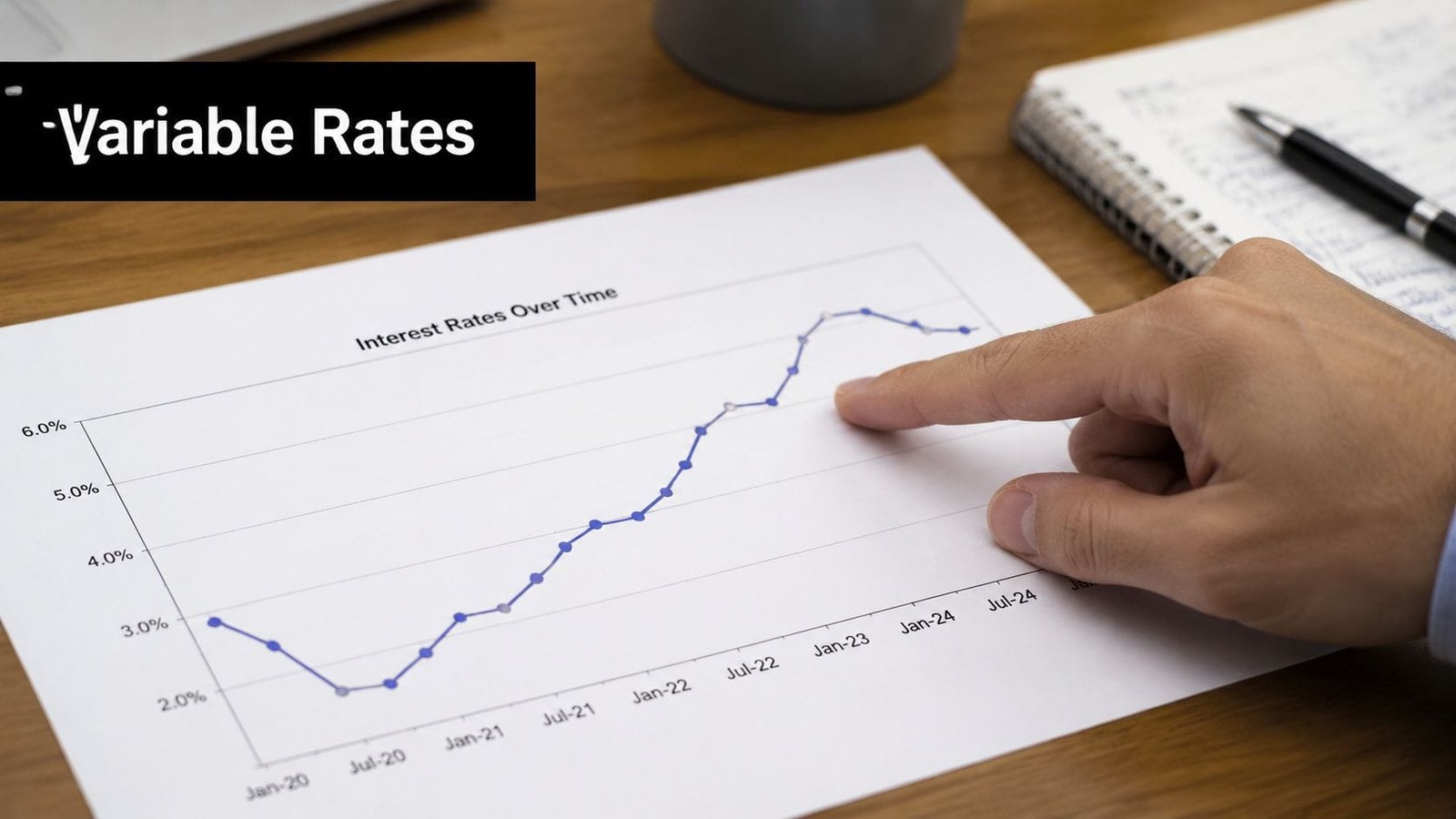
A line of credit may cost less than a credit card or merchant cash advance for a qualified borrower, but the offer depends on the lender, credit profile, collateral, and repayment structure. Recent U.S. lending data shows that fixed-rate and variable-rate business lines can be priced differently. The reported ranges were 6.99% to 7.38% for new fixed-rate lines and 7.63% to 7.91% for variable-rate lines in the third quarter of 2025, according to recent small-business line-of-credit rate data.
Those figures describe market pricing, not the rate your company will receive. A bank may tie a variable line to a benchmark such as prime, while another lender may offer a fixed rate with different fees or a shorter repayment period. A lower starting rate can become expensive if frequent resets push payments beyond what your margins can support.
Practical rule: Compare the cost of carrying a balance, not only the advertised starting rate.
Ask how the lender calculates the rate, how often it can change, what margin is added to the benchmark, and whether a cap applies. Request a full cost summary covering interest, origination charges, annual maintenance fees, draw fees, late fees, account charges, and payoff fees. These details show whether flexibility solves a short cash-flow gap or creates costly debt.
Choose the rate structure that matches your cash cycle
A variable line can suit a business that draws for a brief period and repays quickly. If the company expects to carry the balance across several reporting periods, rate variability requires closer review. A fixed-rate alternative may make budgeting easier, though it can offer less flexibility or use a different fee structure.
Do not refinance expensive debt automatically with a line. Confirm that the new lender permits the intended use, calculate the total cost after fees, and establish a payoff plan that prevents the old balance from returning. The savings come from a lower-cost repayment strategy, not from transferring debt between accounts.
3. Quick Approval and Funding Timelines
Speed can be a genuine advantage when a business has a short window to act. Online and fintech-enabled lenders may use connected banking data and digital financial records to review an application faster than a traditional bank. That can help when an equipment repair, supplier requirement, or receivables delay threatens normal operations.
A fast process doesn't remove underwriting. The lender still needs evidence that your company can repay, and a quick approval may come with a smaller limit, higher pricing, more frequent payments, or a personal guarantee. Speed is useful only if the structure remains workable after you read the agreement.
A manufacturer that needs materials for a confirmed order may benefit from rapid working capital. A retailer that has already committed to inventory may value an available line before a seasonal rush. By contrast, using emergency financing for an untested expansion plan can turn urgency into avoidable debt.
For a practical overview of the timeline, see how long business line-of-credit approval can take.
Prepare before the cash becomes urgent
The best time to arrange a backup line is usually before the business faces a cash crisis. Lenders may ask for business bank statements, tax returns, licenses, financial statements, ownership information, and permission to verify account activity. Keeping those records current can reduce friction when you need funding.
Before applying, define the amount and purpose of the requested line. A lender is more likely to understand a specific receivables gap or inventory cycle than a vague request for “extra cash.” You should also confirm whether a pre-approval check uses a soft inquiry, and ask when a hard credit inquiry occurs.
Fast funding should support a documented repayment source. It shouldn't replace financial preparation.
4. Collateral Requirements and Personal Guarantee Obligations
The easiest line to manage from a risk perspective is often the one that doesn't place essential personal or business assets at stake. In practice, lenders may ask for collateral, a personal guarantee, or both, especially when the requested limit is large or the business has limited credit history.
A secured line may use equipment, inventory, accounts receivable, or real estate. Collateral can improve approval prospects or pricing, but it gives the lender rights in specified assets if the business defaults. A personal guarantee creates another layer of exposure. Depending on the agreement, the owner may become personally responsible even when the borrower is a separate legal entity.
Review secured versus unsecured business lines of credit before choosing based only on the interest rate. A cheaper secured line can carry a much greater downside if the pledged asset is central to operations.
Separate the borrowing decision from the asset decision
Don't pledge a property, vehicle, or piece of equipment without asking what happens if the line is reduced, frozen, or called for repayment. Consider whether losing that asset would prevent the company from generating revenue. If it would, the collateral may be too important for the proposed financing.
Read the guarantee language carefully. Look for whether liability is limited or unlimited, whether it applies to future increases, whether multiple owners must sign, and whether the lender can pursue personal assets after business collateral is exhausted. A business attorney can explain provisions that aren't obvious from the rate sheet.
A line that protects cash flow but puts the owner's home or core revenue-producing equipment at risk may not be flexible financing. It may be a transfer of business risk to the household.
Build business credit, maintain clean tax records, and demonstrate consistent repayment over time. Those steps may improve future access, but they won't eliminate the need to evaluate today's guarantee and collateral terms.
5. Borrowing Discipline and Risk of Over-Leverage
A revolving limit creates a psychological trap. Because the money remains available, an owner can treat it as normal working capital instead of debt. Small draws accumulate, principal paydowns get postponed, and the business eventually depends on the line to meet expenses that should be funded by operating cash.
This risk is especially serious when the business has thin margins or uneven revenue. A slow sales period can arrive just as interest rates rise or a lender reviews the account. If the company has no cash reserve and no alternative lender, a reduced limit can create an immediate operating problem.
Kansas City Fed data shows how heavily variable-rate lines are used in the market. In the third quarter of 2025, median usage was 53.4% for fixed-rate credit lines and 37.5% for variable-rate lines, while variable-rate lines represented about 91% of total credit line usage issued by banks, according to the Kansas City Fed small-business lending survey. The figures don't predict your company's outcome, but they highlight why utilization and rate exposure deserve regular review.
Set rules below the lender's limit
Your approved limit should be an upper boundary, not a spending target. Create an internal ceiling below the maximum, require an owner or finance manager to approve draws, and connect each draw to a written repayment source.
Watch for these warning signs:
- Borrowing pays old borrowing: New draws cover prior interest or principal instead of producing revenue.
- Paydowns disappear: Receipts arrive, but the balance never falls because cash gets redirected to unrelated expenses.
- Utilization rises during weak sales: The business draws more as margins and collections deteriorate.
- The line funds permanent expenses: Recurring payroll, rent, or losses remain dependent on revolving debt.
If debt pressure begins affecting payroll, suppliers, taxes, or personal finances, seek professional advice early. Owners should understand the potential financial distress for business owners before a lender default forces a rushed decision.
6. Ideal for Cash Flow Management and Working Capital Optimization
Working capital timing is where a line of credit often makes the most sense. A business may pay employees and suppliers today, deliver work this week, and collect customer invoices later. When the repayment source is reliable, a revolving line can bridge that gap without requiring the owner to borrow a new lump sum for every operating cycle.
The product also fits seasonal businesses when the draw period and paydown period are clear. A lawn care professional may need labor and supplies before the busy season produces cash. A wholesale company may purchase inventory before customers pay. A business-to-business services firm may fund a contract while waiting for an approved invoice.
Brookings, in material cited by the Federal Reserve, identifies lines of credit as the second-most-used financing tool after credit cards among firms that regularly use financing, while Federal Reserve survey data found that 34% of employer firms used lines of credit regularly. These facts appear in the Federal Reserve's consumer and community context publication. The practical lesson is that owners use lines for recurring liquidity, not only emergencies.
Link the line to the cash conversion cycle
Start with your actual operating calendar. Identify when you pay suppliers, when payroll leaves the account, when inventory converts into sales, and when customers pay. Then compare the largest expected cash gap with the proposed credit limit and repayment schedule.
A useful operating plan should answer:
- What triggers a draw? For example, a receivables delay or a documented inventory purchase.
- What repays it? Name the customer receipts, seasonal sales, or contract payments.
- How quickly will principal fall? Set dates and amounts instead of relying on a minimum payment.
- What happens if collections are late? Keep a backup plan that doesn't require maxing the line.
Use accounting software or a cash-flow model to connect each draw with its purpose and repayment. A 13-week cash-flow model for short-term liquidity planning can help management see upcoming gaps before they become urgent.
7. Impact on Credit Score and Credit History Building
A line of credit can help establish a business credit record when the lender reports payment activity and the company pays as agreed. That history may support future financing discussions, but it isn't automatic. The result depends on the lender's reporting practices, payment history, account age, and utilization.
High utilization can work against the business even when payments arrive on time. A company that repeatedly operates near its limit may appear dependent on borrowed cash. Missed payments can create a more direct problem, particularly if the owner signed a personal guarantee or the lender reports to consumer credit bureaus.
Ask before signing:
- Who receives payment information? Confirm whether the lender reports to business bureaus, consumer bureaus, both, or neither.
- How is utilization calculated? Understand whether reporting occurs at a statement date, a monthly snapshot, or another point.
- When does a late payment become reportable? Don't assume the grace period protects your credit record.
- Does a guarantee change personal exposure? Review how default could affect the owner's personal profile.
Use the account to demonstrate control
Draw only when the purpose and repayment source are clear. Pay more than the minimum when cash permits, and make sure automatic payments pull from an account with sufficient funds. Separate bookkeeping also helps show that the line is supporting business activity rather than mixing personal and company spending.
Don't open several accounts to collect available limits. Multiple applications, overlapping fees, and unused facilities can complicate cash management. Compare offers first, then select a structure that fits your operating cycle.
Credit building is a secondary benefit, not a reason to borrow unnecessarily. If the business has no near-term need for funds, a line that carries maintenance fees or renewal obligations may cost more than the future credit advantage is worth.
8. Compliance, Renewal Terms, and Long-Term Relationship Management
A line of credit isn't always permanent capital. Lenders may set a defined term, require periodic financial reporting, impose covenants, and review the relationship before renewal. They may also change the limit or decline to renew if the business's financial condition, tax status, collateral value, or repayment behavior changes.
That creates renewal risk for companies that use the line as their only liquidity source. A business can appear stable while the account is open, then face a funding gap if the lender reduces the limit at renewal. The risk increases when management doesn't understand reporting deadlines or allows tax filings, insurance, licenses, or financial statements to fall behind.
Read every covenant before accepting the offer. A minimum liquidity requirement, debt-to-equity test, debt-service condition, or restriction on additional borrowing can affect decisions far beyond the line itself. An acquisition, owner distribution, new equipment purchase, or weak quarter may change compliance.
Manage the lender relationship before renewal
Treat renewal as a process that starts well before the stated expiration date. Maintain clean monthly financials, reconcile bank accounts, track covenant calculations, and keep explanations ready for unusual changes in revenue or expenses.
Contact the lender proactively when performance changes. A lender may respond better to an owner who reports a problem early than to one who misses a covenant and waits for a formal notice. You should also maintain a backup plan, such as another banking relationship, a term-loan option for permanent assets, or an invoice-financing facility where appropriate.
A line of credit is strongest when the lender relationship is stable and the borrower has alternatives. It becomes dangerous when the business depends on one renewal decision to fund payroll or supplier payments.
Line of Credit: 8-Point Pros & Cons
| Item | 🔄 Complexity | ⚡ Speed / Resource Needs | 📊 Expected Outcomes | ⭐ Key Advantages | 💡 Ideal Use Cases |
|---|---|---|---|---|---|
| Flexible Access to Capital Without Fixed Loan Amounts | Medium, standard underwriting, ongoing draw/repay management | Fast availability once approved; modest ongoing admin; may be unsecured | Improves cash-flow flexibility; pay interest only on used funds | Reusable liquidity; lower cost than cards; on-demand access ⭐⭐⭐⭐ | Small businesses with seasonal/irregular cash flows; emergency working capital |
| Interest Rate Characteristics: Lower Rates vs. Variable Market Risk | Medium, requires rate option selection and negotiation | No special speed impact; needs credit profile and possible collateral | Lower APR vs cards/MCAs but variable-rate risk affects budgeting | Lower ongoing financing cost when credit is strong ⭐⭐⭐⭐ | Businesses replacing high-cost short-term debt; borrowers comfortable with variable rates |
| Quick Approval and Funding Timelines | Low, streamlined fintech underwriting, digital docs | Very fast, decisions 24–48h, funding in 3–5 business days; needs digital verification | Rapid liquidity to seize time-sensitive opportunities | Fast access; online process reduces friction ⭐⭐⭐⭐⭐ | Time-sensitive purchases, seasonal inventory buys, urgent payroll gaps |
| Collateral Requirements and Personal Guarantee Obligations | High, legal docs, appraisals, lien placement, guarantee terms | Slower funding when collateral/paperwork required; higher legal/valuation needs | Access to larger limits and lower rates but adds owner liability risk | Larger limits and cheaper rates when secured ⭐⭐⭐ | Established firms with assets willing to pledge; owners able to guarantee |
| Borrowing Discipline and Risk of Over-Leverage | Medium, requires policy, monitoring and repayment plans | Ongoing oversight needed; dashboards and forecasting recommended | High risk of debt accumulation if unmanaged; flexibility if disciplined | Flexible matching of capital to needs but discipline required ⭐⭐⭐ | Disciplined owners with strong financial controls and forecasting |
| Ideal for Cash Flow Management and Working Capital Optimization | Medium, sizing and integration with accounting systems | Ongoing use; requires regular cash-flow forecasting and accounting inputs | Stabilizes operations, avoids high-cost financing; supports vendor discounts | Aligns funding to operational cycles; preserves reserves ⭐⭐⭐⭐ | B2B firms, seasonal businesses, companies with predictable receivable cycles |
| Impact on Credit Score and Credit History Building | Low, routine reporting and utilization monitoring | Requires active monitoring; soft pre-approval can limit hard pulls | Can build business credit if utilization and payments are managed; damage if misused | Improves future financing options when managed well ⭐⭐⭐⭐ | New businesses building credit; firms aiming to separate business/personal credit |
| Compliance, Renewal Terms, and Long-Term Relationship Management | High, covenants, periodic reviews, renewal negotiations | Significant ongoing reporting and lender communication | Stable access if covenants met; risk of sudden reductions at renewal | Predictable renewal windows and negotiation leverage with strong relationships ⭐⭐⭐⭐ | Disciplined companies with stable financials and tolerance for reporting obligations |
Turn a Line of Credit Into a Controlled Financing Tool
The best line of credit decision starts with the repayment source. If your business has recurring receivables, seasonal working-capital needs, or a predictable gap between paying costs and collecting revenue, revolving access can match the way cash moves through the company. You draw when the gap appears, use the funds for a defined purpose, and reduce the balance when the expected cash arrives.
A term loan may fit better when you know the exact amount needed for a one-time purchase, expansion project, or long-lived asset. Fixed payments can make that debt easier to budget, and the loan doesn't depend on repeated borrowing decisions. Equipment financing may be more appropriate when the asset itself provides collateral. A business credit card can handle smaller everyday purchases, though carrying a balance may be expensive. Merchant cash advances and other high-cost products require especially careful comparison because repayment can consume cash flow quickly.
Current data reinforces the need to separate access from affordability. In the third quarter of 2025, average new fixed-rate business lines were priced between 6.99% and 7.38%, while variable-rate lines were between 7.63% and 7.91%, based on reported U.S. business line-of-credit rates. The same source cites approval outcomes in which about 48% of applicants received the full amount requested, roughly 21% received part of the amount, and 31% were denied. An approval for less than you requested may not solve the original cash-flow problem, and a line you can qualify for may still be too expensive for your margins.
Before accepting an offer, compare the full structure:
- APR or factor cost: Identify the actual borrowing cost and how it changes.
- Rate variability: Ask what benchmark applies, how often the rate resets, and whether a cap exists.
- Fees: Review origination, draw, maintenance, annual, late-payment, and payoff charges.
- Repayment mechanics: Confirm minimum payments, principal paydown requirements, and whether interest-only periods apply.
- Collateral and guarantees: Determine which assets are pledged and whether personal liability is limited.
- Utilization rules: Check whether the lender requires periodic paydowns or restricts certain uses.
- Covenants: Understand financial tests, reporting duties, and consequences for noncompliance.
- Renewal rights: Find the maturity date, review process, possible limit changes, and notice requirements.
- Lender access: Confirm how quickly you can draw, how funds are delivered, and who handles servicing questions.
Model a higher variable rate before borrowing. Test a late customer payment, a slower sales period, and a lender reduction at renewal. If the business can't keep payroll, taxes, suppliers, and debt payments current under those conditions, reduce the proposed line or consider a different financing structure.
Business Loan Warrior's no-fee application and pre-approval process can help owners review customized funding options without affecting credit, subject to the platform's process and lender requirements. Owners can connect bank accounts, review funding options, and use a secure dashboard to track applications and repayments. Compare the resulting terms with your bank and other lenders rather than assuming the first offer is the right one.
Business Loan Warrior offers a no-fee application and pre-approval process for reviewing business funding options, including lines of credit and alternatives for working capital. Visit Business Loan Warrior to compare financing possibilities and evaluate a structure that matches your cash-flow cycle, repayment capacity, and risk tolerance.