
You're staring at a funding gap and making a decision that's bigger than the rate sheet. The question isn't just whether a line of credit is cheaper than a HELOC, it's whether you want your business debt tied to business performance, or your house tied to the outcome.
For a lot of owners, this comes up when cash is decent but uneven. Payroll lands before receivables clear, inventory has to be ordered before the next sales cycle, or a project needs materials now and payment later. That's when people start comparing line of credit vs HELOC, and the wrong answer usually comes from focusing on APR first instead of risk, utilization, and payment behavior.
| Feature | Business Line of Credit | HELOC |
|---|---|---|
| Collateral | Often unsecured or lightly collateralized, usually backed by a personal guarantee | Secured by owner-occupied home equity |
| Approval focus | Business revenue, cash flow consistency, time in business, and personal credit | Home equity, credit profile, income, and debt-to-income |
| How money is used | Working capital, payroll, inventory, seasonal gaps, growth spending | Flexible revolving funds, often for larger one-time or phased needs |
| Payment behavior | Usually designed for active business use and paydown discipline | Can stay open for years, with draw-period flexibility and later amortization |
| Main risk | Personal guarantee and business cash-flow strain | Home lien risk and payment shock if balances linger |
| Best fit | Ongoing operating needs with repeat draws | One-time or known funding needs when home equity is the right collateral |
Table of Contents
- The Real Decision Behind Line of Credit vs HELOC
- What Each Product Is and How It Works
- Rates, Fees, and Repayment Compared
- Eligibility and What Underwriters Look At
- Personal Risk and Tax Implications Most Comparisons Skip
- Which Option Fits Which Business Situation
- Your Decision Framework and Next Steps
The Real Decision Behind Line of Credit vs HELOC
A contractor is staring at a six-figure materials gap. She can open a business line of credit and keep the house out of it, or she can draw against home equity and get the money secured by the property where she lives. That's not a pricing question. It's a decision about which balance sheet should carry the stress.
Ask the right two questions first
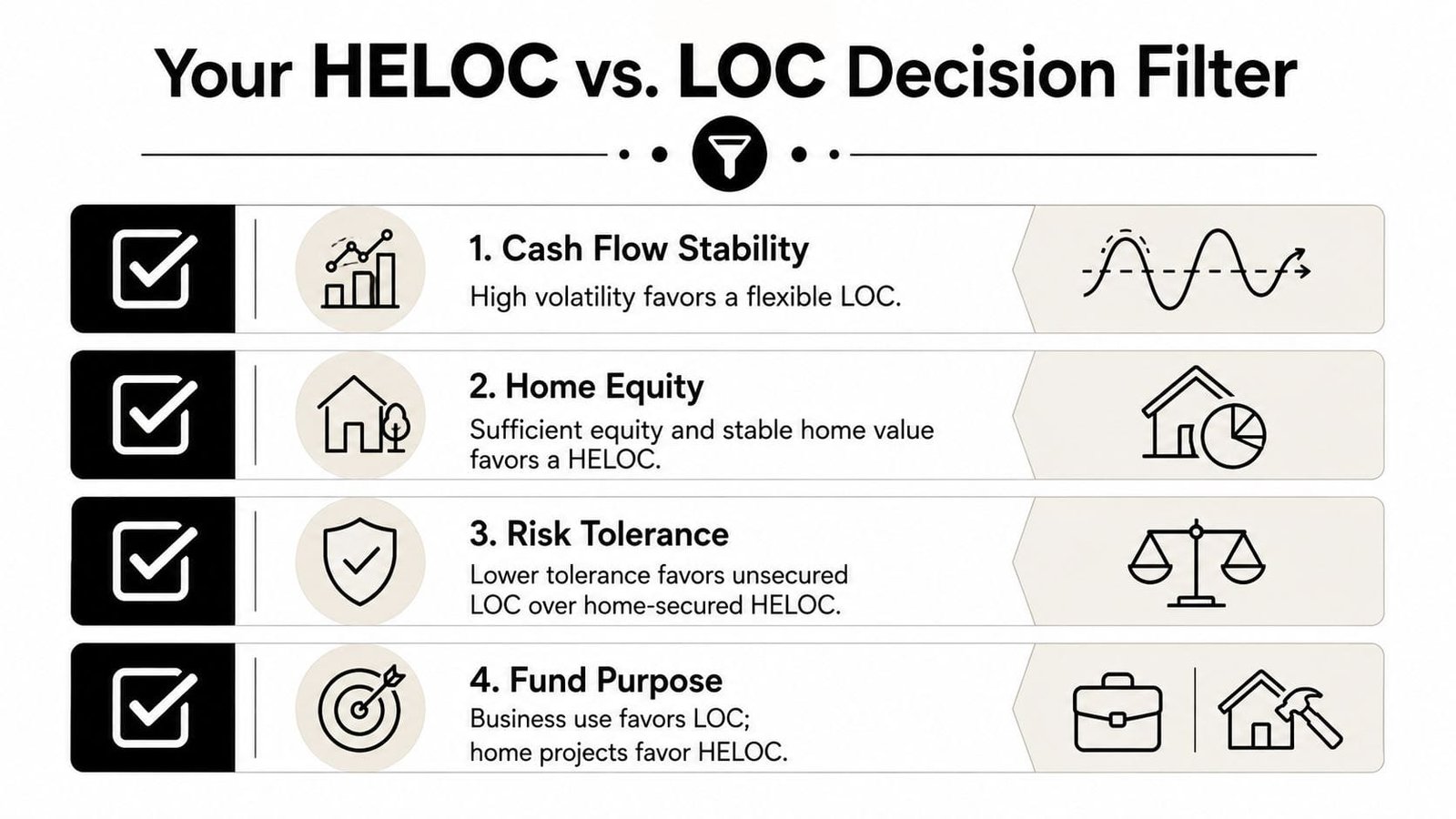
The first question is whether the business can support a revolving draw without blowing up monthly cash flow. If receivables are steady and the owner can pay the balance down fast, a business line of credit can work the way it's supposed to work. If cash comes in lumpy, repeated draws can turn a flexible line into a long-running liability.
The second question is personal, not financial. Is the owner willing to pledge the house? If the answer is no, the HELOC is off the table no matter how clean the rate looks. If the answer is yes, then the next filter is whether the money is for a project with a defined payoff path, or for recurring operating pressure that belongs on the business side.
Practical rule: if you need revolving capital to bridge timing gaps, keep the debt with the business. If you need a known lump sum and you're comfortable tying repayment to your home, a HELOC can be the cleaner tool.
That's the frame I use with owners. The product choice follows the use pattern, not the marketing pitch. When people get trapped, it's usually because they borrowed for an operating problem with a home-secured product, then left the balance open too long.
What Each Product Is and How It Works
A business line of credit is revolving business debt. The lender approves a limit, the owner draws cash as needed, and interest applies only to what is used. Most lenders judge the business first, then the owner, so the file usually centers on revenue, bank activity, and consistency. For a plain-English breakdown of how that structure works, this guide on how a business line of credit works is a useful companion.
A HELOC is revolving consumer debt tied to residential equity. The home secures the borrowing, so the lender looks at the property, personal credit, and personal income. That collateral change is the whole story.
Collateral drives the lender's posture
A business line of credit is usually underwritten around the company's repayment ability, even when the owner signs a personal guarantee. A HELOC puts the home directly on the hook, which gives the lender a claim on the property if repayment falls apart.
Approval logic follows that difference. Business lines care about business age, cash flow, and repeatable deposits. HELOC underwriting cares much more about equity position, debt-to-income, and personal repayment strength. Two owners with the same credit score can get very different answers depending on whether they apply as a business borrower or a homeowner.
How the money behaves after approval
A business line of credit works best as operating capital. Draw, repay, draw again, and keep it tied to timing gaps. A HELOC can start the same way, but if the owner uses it like a spare checking account, the balance can linger far too long.
A revolving limit is most effective when the borrower treats paydown as part of the plan, rather than an afterthought.
That behavior matters more than the label on the loan. A business line belongs with business cash flow. A HELOC belongs with home equity and the personal risk that comes with it. If the owner is not willing to put the house in play, the choice is already made.
Rates, Fees, and Repayment Compared
Rate talk dominates these comparisons, but the issue is what the payment does over time. HELOC balances are large and active in the market, with $426.2 billion in outstanding balances across 8.23 million accounts by January 2026, and utilization at 42.64%, up from 39.85% a year earlier, according to Experian's market summary of HELOC data Experian HELOC study. That tells you people are using these lines as revolving credit, not as occasional emergency money.
| Feature | Business Line of Credit | HELOC |
|---|---|---|
| Typical pricing | Variable, usually tied to prime plus a spread | Variable, often tied to a benchmark like prime |
| Fees | Often an annual fee, plus possible maintenance or draw-related fees | Often lower upfront fees, though closing costs can still apply |
| Repayment during use | Usually interest-only or minimum payment on drawn balance | Often interest-only during draw period |
| Repayment after draw | Depends on lender structure and renewal terms | Balance amortizes after draw period ends |
| Tax treatment | Interest is generally deductible when used for business purposes | Interest is only deductible when used to buy, build, or substantially improve the home |
| Best cost behavior | Works well when balances are repaid quickly and reused | Works best when the draw is intentional and the payoff plan is short |
The trap with both products is the variable rate. A HELOC from Bank of America, for example, showed a 5.95% to 10.85% APR range in 2026, plus an annual fee and an early closure fee in certain cases Bank of America HELOC terms. That kind of structure means the cost of borrowing can change while the balance is still sitting there.
The repayment shape matters too. A HELOC usually looks light during the draw period, then the payment rises when the balance starts amortizing. That's where owners get surprised. A line of credit used for business should feel more like working capital, but only if the borrower keeps turning it over rather than letting it become permanent debt.
If you're running month-end reporting, that payment volatility gets messy fast. Teams that want tighter cash visibility often use automation tools to keep the books clean, and streamline month-end with Zynthoro is a practical example of how businesses reduce reporting drag when debt service starts moving around.
Eligibility and What Underwriters Look At
A business owner can be approved for one product and rejected for the other on the same day, and that's not a mistake. The lender is judging a different borrower each time.
| Criterion | Business Line of Credit | HELOC |
|---|---|---|
| Primary borrower lens | The business and its cash flow | The homeowner and the property |
| Core approval factors | Revenue, deposits, time in business, bank balance, credit | Equity, credit profile, income, DTI |
| Personal guarantee | Common | Not the same structure, because the home is the collateral |
| Better fit for newer entities | Sometimes possible, but harder | Possible if the owner has equity and income |
| Better fit for strong W-2 earners | Sometimes, but business strength still matters | Often strong, if equity is there |
Three owner profiles, three different outcomes
A two-year-old LLC with $40K monthly revenue and a 680 FICO may have a shot at a business line if the deposits are consistent and the cash balance doesn't swing wildly. The same owner might still struggle if the lender wants more operating history or tighter bank averages. The issue isn't the personal score alone, it's whether the company looks stable enough to service a revolving business debt.
A sole proprietor with strong W-2 income and 65% LTV may fit a HELOC profile better than a business line profile. The home equity and personal income tell the underwriter what they need to know, even if the business itself is small or irregular. That's why many owners who feel “too early” for business credit still qualify on the homeowner side.
A newer shop owner with thin business revenue but substantial home equity often gets the most dangerous temptation of all. The HELOC may be easier to get than the business line, but easier does not mean smarter. If the cash flow problem is real and ongoing, home-secured borrowing is a risk transfer, not a solution.
If the business can't support the debt on its own, the house should not be the backup plan by default.
For a deeper look at qualification patterns, this guide on line of credit eligibility helps frame why newer or asset-light companies often face a different underwriting path than homeowners.
Personal Risk and Tax Implications Most Comparisons Skip
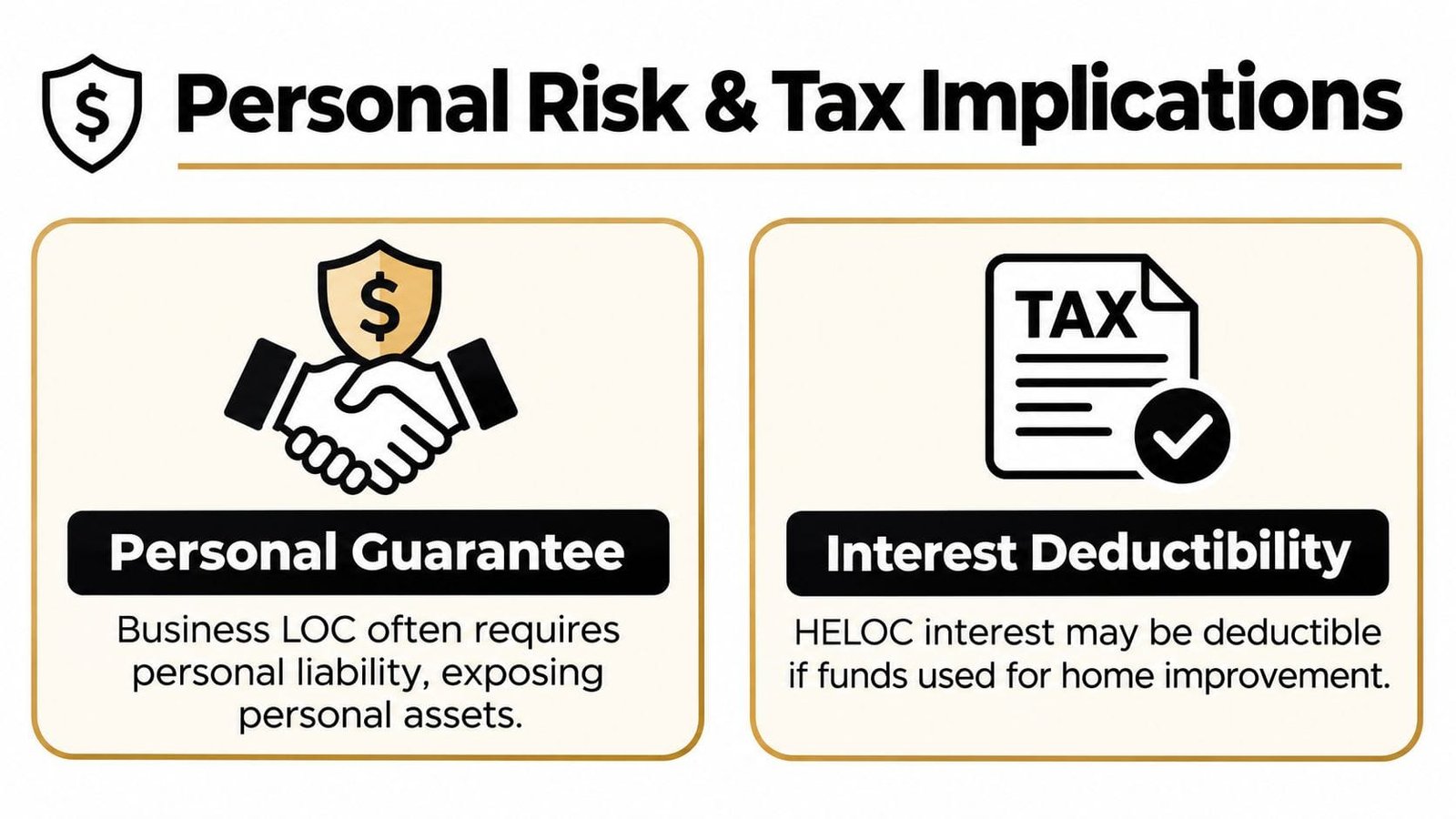
The decision stops being abstract here. A business line of credit can still come with a personal guarantee, but the home is usually not the pledged asset. A HELOC puts the residence directly on the hook. If the business turns down hard and the owner can't keep up, the lien is sitting on the house.
The home is a different kind of collateral
People often say they're “using equity” like it's a spreadsheet entry. It isn't. The emotional cost of putting your home on the line is real, especially when revenue is already volatile. If the business hits a rough patch, a HELOC can turn a cash-flow problem into a housing problem.
That risk gets worse when borrowers treat a low initial payment as a sign that the balance is harmless. It isn't harmless if the draw stays open and the amortizing payment later jumps into the budget. Payment shock matters because household owners often plan around today's payment, not the payment after the draw period ends.
The tax treatment is not symmetrical
Interest on a business line of credit is generally deductible as a business expense when the proceeds are used for business purposes. HELOC interest is only deductible when the funds are used to buy, build, or substantially improve the home securing the line. Borrowing against home equity to fund payroll or inventory does not qualify for that treatment.
That's the tax mistake I see most often. Owners assume any interest tied to a home-secured loan must be deductible. That's not how the rule works, and it changes the after-tax math in a hurry.
Divorce, lien disputes, and property tax problems make this choice even more sensitive because the HELOC sits on the residence itself. If the owner wants a broader tax and structure view, this resource on tax-savvy business financing is worth reviewing before any draw happens.
Which Option Fits Which Business Situation
A contractor with uneven receivables and payroll due on Friday should not reach for a HELOC first. A business line of credit fits that kind of operating strain because the balance can be used, repaid, and used again as cash comes in. That matches working capital behavior, and it keeps the house out of the collateral stack.
Use a HELOC for a defined, one-time need when the owner is fully comfortable pledging the residence. A buildout, equipment purchase, or other contained project fits that structure better than recurring operating gaps. It also fits owners who want to clear the balance on a clear schedule instead of carrying it through repeated draw cycles.
Two mini-examples with a $75K need
| Scenario | Product | Assumed Rate | Monthly Payment | Total Cost Over 24 Months | Collateral |
|---|---|---|---|---|---|
| Ongoing inventory and payroll gap | Business line of credit | Variable, rate not fixed in this example | Depends on draw balance and lender terms | Depends on usage and paydown speed | Personal guarantee, business assets |
| One-time equipment or buildout project | HELOC | Variable, rate not fixed in this example | Depends on draw timing and amortization | Depends on draw period and repayment timing | Primary residence |
The first setup belongs on the business side because the need keeps returning. Repayments free up room for the next cycle, which is exactly how operating capital should behave. A home-secured loan does not add anything there.
The second setup can justify a HELOC if the owner knows the amount, the timing, and the payoff path. The true test is not the rate. It is whether the owner is willing to have the home attached to a balance that might linger longer than expected. If that answer is no, the business line is the cleaner choice even when it costs more upfront.
Your Decision Framework and Next Steps
Take the next 30 days seriously.
Pull your personal and business credit reports first. Gather three months of bank statements, recent tax returns, and any records that show steady inflows. If you are considering a HELOC, get a payoff estimate and read the draw period and repayment phase carefully so the payment shift does not catch you off guard.
Then prequalify with two lenders in parallel, one business lender and one home-equity lender if both options are still on the table. Compare offers only when the funding need and repayment timeline are the same. Otherwise, you are comparing two different problems.
Business Loan Warrior fits in the middle of that process when you want a faster path to a business line of credit or another working-capital option and you do not want to pledge the house. It is the right place to check financing options when business revenue can support debt, but home equity, personal credit, or collateral comfort is the limiting factor.
If your owner stance is simple, use it. If you are not willing to put your home behind the balance, stop there and stay on the business side. If you are willing to do that, then the job shifts to execution. Get the documents tight, pressure-test the payment plan, and make sure the borrowing structure matches how the cash will move.
If you want a funding decision grounded in cash flow, collateral, and real repayment behavior, start with Business Loan Warrior. It helps small businesses compare working-capital options without forcing a home-secured answer, and that is the discipline this choice requires.