
If your daily deposits are being swept before lunch, your payroll is wobbling, and every merchant cash advance funder sounds more aggressive than the last, you're not dealing with a simple cash-flow problem anymore. You're dealing with a structure problem, and that changes the fix.
For a lot of owners, the first instinct is to chase the loudest lender, ask for a pause, or hope one more week of sales will calm everything down. That rarely works when the business is already stacked. The right move is to treat MCA debt relief like a recovery plan, not a panic response.
Table of Contents
- Why MCA Debt Relief Demands a Playbook
- Assess Your MCA Contracts and True Costs
- Prioritize Payback and Map Pressure Points
- Negotiate Settlements and Holdbacks with Funders
- Refinance or Consolidate with SBA and Credit Lines
- When to Hire Attorneys or Consider Insolvency
- Your MCA Debt Relief Action Plan and Risk Checklist
Why MCA Debt Relief Demands a Playbook
A restaurant owner calls after lunch service because the weekend deposits hit and vanished almost at once. Two MCAs are already taking their slices, the third funder is threatening default language, and the owner is still trying to make payroll on Friday. That is the point where “just negotiate harder” stops being advice and starts being fantasy.
The better response is a playbook. State enforcement has already shown how wide MCA relief can reach, with the New York Attorney General winning a $1.065 billion judgment against Yellowstone Capital and canceling $534.5 million in small-business MCA debt for more than 18,000 merchants nationwide. The size of that action matters because the U.S. MCA market still isn't overseen by a federal regulator, so state enforcement has become one of the strongest forces shaping outcomes in MCA debt relief. Annual originations in the U.S. are estimated at about $15 billion to $20 billion, according to merchant cash advance statistics.
What the owner in crisis needs first
The first mistake is confusing a temporary breath with real relief. A holdback reduction can ease cash flow, but if the principal still sits there and the guaranty still stands, the business may be buying time, not recovery. If you're trying to decide whether the debt is severe enough to require formal triage, resources that discuss hard-stop personal debt situations, such as gambling debt bankruptcy options, can help show how attorneys think about escalation when payment pressure becomes unmanageable.
Practical rule: If the funding structure is already affecting payroll, vendor terms, or tax deposits, don't ask whether you “can survive the week.” Ask whether the current structure can ever return the company to conventional fundability.
That is the test for larger small businesses. If a solution only stops the bleeding for a month and leaves the company locked out of normal credit later, it is not a finish line. It is a detour. The playbook below is built around that distinction.
Measure payment pressure and cash flow strain
The question is not whether the business feels squeezed. The question is whether the current payment stack leaves enough clean cash flow to keep banking relationships, taxes, and vendor terms intact. If the answers are shaky, the owner needs more than a payment pause, because the core issue is whether the company can still present as fundable to banks, SBA lenders, or other mainstream capital sources.
That is why owners should compare MCA pressure against cleaner funding options before they accept a quick fix. A practical comparison of short-term loans, MCA, and invoice factoring is laid out in this funding comparison guide, and it helps frame the trade-off clearly. MCA relief that only lowers today's withdrawal can still leave tomorrow's underwriting problems untouched, especially if the business needs larger credit later.
For larger small businesses, the question is not just how to stop collections. It is whether the relief path restores the paper trail, cash flow profile, and bankability needed for the next round of financing. If the answer is no, the owner should treat the deal as temporary damage control, not a lasting reset.
Assess Your MCA Contracts and True Costs
Before anyone calls a funder, the business needs a complete paper trail. The contract language matters more than the sales pitch, and the payment history matters more than the emotion in the room. I've seen owners walk into negotiations too early and give away advantages they didn't know they had.
Gather the documents before you negotiate
Start with every MCA agreement, including add-ons, renewals, and amendments. Add the personal guaranty, the payment ledger, bank statements that show withdrawals, and every default notice. If there are multiple funders, collect each one separately so the stacking picture is clear.
That document set lets you see whether the funder is following the contract. Reconciliation clauses, UCC lien positions, and notice requirements can all create pressure points. If a funder is over-withdrawing relative to actual receivables, or if the paper trail shows a compliance issue, that changes the negotiation before settlement starts.
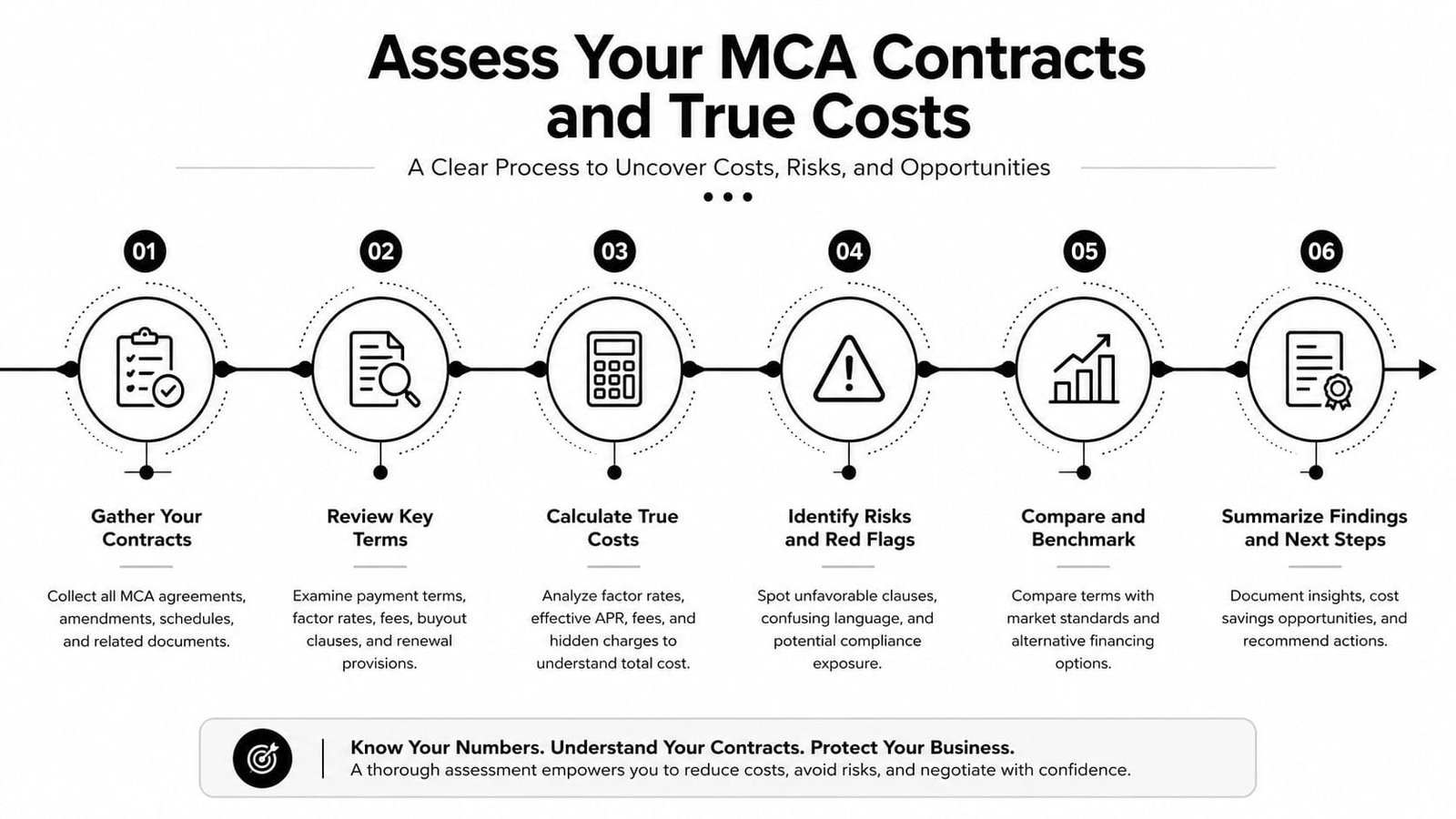
A useful way to think about the audit is this:
- Contract stack: List every MCA and note who funded first, who filed liens, and who is still pulling.
- Guaranty exposure: Mark every personal guarantee, because that changes the cost of delay.
- Bank activity: Match deposits and withdrawals so the actual cash drain is visible.
- Default triggers: Read the notices against the contract, not just against fear.
- Compliance gaps: Check reconciliation language and whether the funder followed it.
- Restructuring room: Decide whether the business can support a revised plan or needs settlement.
The best internal comparison point for this kind of financing pressure is a broader look at short-term capital types, which is why many owners also study the unsecured funding comparison between short-term loans, MCA, and invoice factoring. That helps separate a temporary liquidity issue from a structurally bad product fit.
Measure leverage and payment strain
Now translate the paperwork into economics. Specialists model debt-service coverage ratio, or DSCR, by comparing gross monthly deposits against MCA remittances and core operating costs. If the business can't absorb the remittances without starving operations, a restructuring may be possible only in theory.
Rule of thumb: Negotiate from numbers, not from hardship. Funders respond to legal risk, payment history, and guaranty strength more than to general distress.
Also look for recharacterization or usury issues if the structure resembles something other than a true receivables purchase. That doesn't mean every contract is challengeable, but it does mean the owner should know where the advantages sit before picking up the phone. A contract audit turns panic into a list.
Prioritize Payback and Map Pressure Points
The first signal is usually practical, not theoretical. A business owner sees deposits arrive, remittances leave the account, and then the operating balance gets thin enough that payroll, rent, or inventory starts to wobble. At that point, the question is no longer which funder is most annoying. It is which obligation has to be addressed first so the company can keep functioning and remain fundable for a larger lender later.
Rank the stack by what it does to the company's future. A fast settlement that frees cash and clears a blocking lien can be more valuable than a smaller concession on a quieter account. A deal that stops short-term bleeding but leaves the business unable to show stable cash flow to a bank does not really solve the problem.
Build a priority list
Start with the contract that creates the most immediate pressure on operations. In practice, that usually means the funder with the strongest enforcement posture, especially if default notices have already gone out or lien activity has started. The next item is the advance draining the most usable cash each day, because that is the one most likely to keep the business trapped in survival mode.
After that, check whether any filing could block the next source of capital. A UCC filing sitting in front of a refinance, bank line, or equipment loan carries real weight even if the balance itself is not the largest on the table. The last item is the contract most likely to settle cleanly, which may be the one with a smaller remaining balance, weaker documentation, or a funder that wants to avoid delay.
A priority list works best when it reflects advantage with the next lender, not just the size of the debt. If one remittance has to stop before the company can stabilize, that obligation should be handled before the easier call. A larger small business that wants to regain conventional fundability has to protect operating liquidity and remove barriers to new credit at the same time.
Separate nuisance debt from strategic debt
A small balance can still be the most important account in the stack if it sits on top of a lien that scares off the next financing source. A larger balance can be less urgent if the funder is quiet and the paperwork leaves room to work. The settlement list should reflect the company's financing path, not just the amount still owed.
Ask three direct questions. Which obligation is making the account brittle right now. Which one is most likely to block a bank, SBA lender, or asset-based lender. Which one can be resolved in a way that improves the business's story on the next underwriting review. Those answers usually create the order of operations.
For owners trying to get back to ordinary credit, the test is simple. If a proposed fix does not improve cash flow, clear a filing, or make the company easier to underwrite, it is only a pause. A real plan reduces strain today and improves the odds of funding tomorrow.
Negotiate Settlements and Holdbacks with Funders
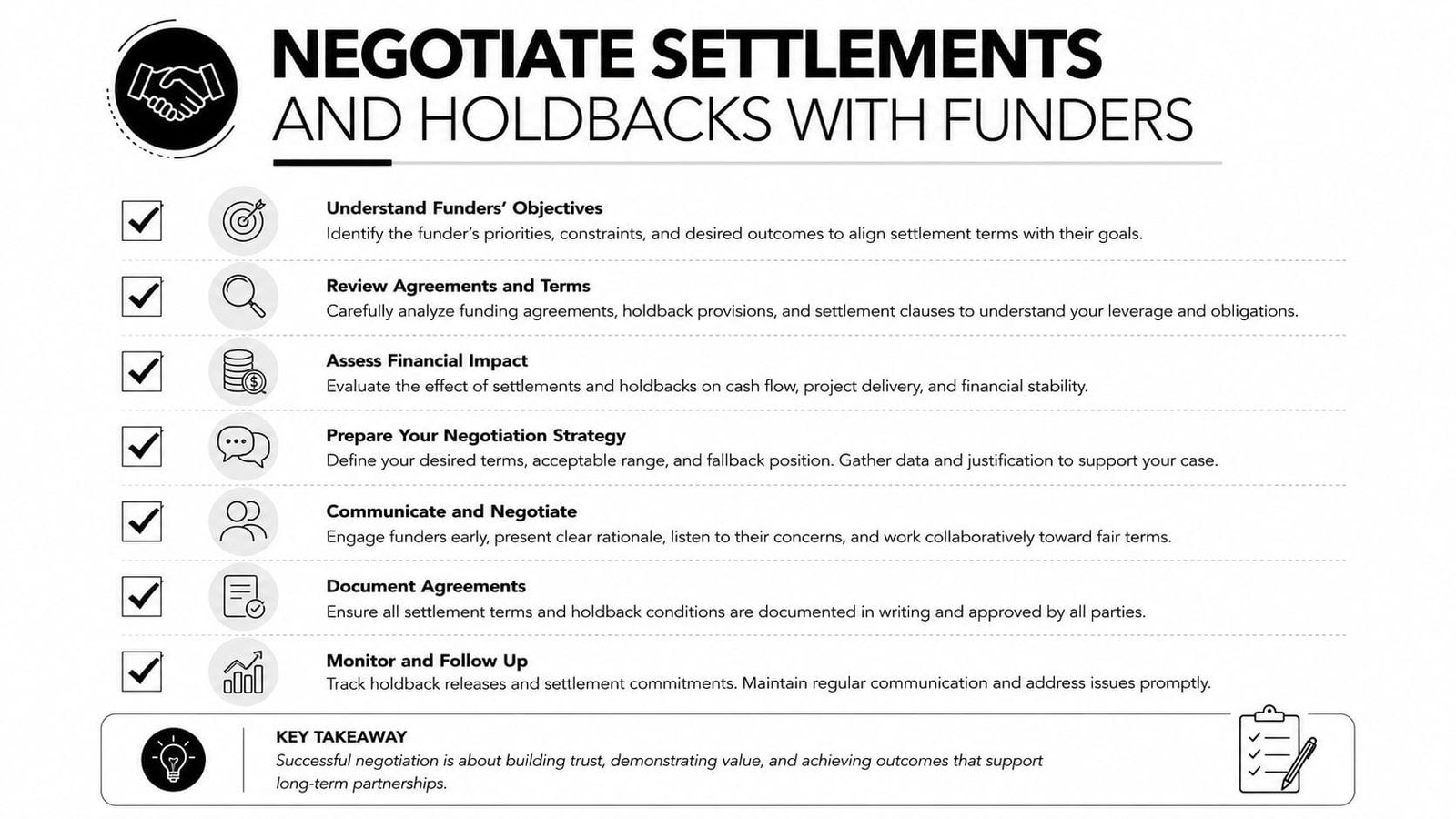
The strongest settlement conversations start before the call, not during it. Owners do better when they already know their ceiling, have a dedicated place to park funds, and can speak in exact terms. That's how MCA debt relief moves from desperation to execution.
Use a written-offer script, not a phone-only approach
The most consistently reported settlement range across independent guides is about 30% to 60% of the remaining balance, with many cases clustering around 40% to 70% depending on how far enforcement has gone. Open low, stay calm, and document hardship without oversharing. Keep the tone businesslike.
A script can sound like this:
We're reviewing all obligations and can't support the current daily remittance without damaging operations. We're prepared to discuss a lump-sum resolution if the account can be closed in writing, the remaining balance released, and the lien terminated.
That language does three things. It signals seriousness, it keeps the discussion focused on a lump-sum settlement, and it avoids promising more cash than the company has. Put the offer in writing, then keep all responses.
Preserve settlement money in a separate account rather than commingling it with operating cash. That way, if the funder agrees, the money is ready. If the funder doesn't, the business hasn't spent it accidentally.
Holdback reductions deserve caution. They can relieve cash-flow pressure, but they don't erase principal. A true settlement ends the debt. A modified holdback just slows the drain.
Close only with paper that ends the claim
Never treat a verbal “we're good” as closure. Insist on written terms, a UCC-3 termination or satisfaction filing, and a satisfaction letter that states the obligation is resolved. If the paperwork doesn't explicitly close the account, the risk can linger even after money changes hands.
Keep the settlement sequence disciplined:
- Start with a low written offer and let the funder counter.
- Confirm the final amount in writing before sending funds.
- Verify the lien release language is included or scheduled.
- Collect the satisfaction letter at closing, not later.
- Save every email and PDF in one folder in case a dispute resurfaces.
If the company has stacked MCAs, a holdback tweak on one account may not be enough. In those cases, the business may need either a lump-sum settlement, a refinancing product, or a legal challenge where contract defects exist. The point is to replace daily bleeding with a finishable path, not a cosmetic fix.
Refinance or Consolidate with SBA and Credit Lines
Not every damaged capital structure should be settled and left behind. Some businesses need to reset the debt stack into a normal borrowing pattern so they can operate, grow, and eventually refinance again. The test isn't just whether the payment is smaller. It's whether the new structure restores conventional fundability.
For contractor-heavy businesses that need cash to keep crews paid, a practical comparison point is the guide on payroll funding for contractors. That kind of resource is useful when cash timing, not just debt size, is the main issue.
Compare the paths by future flexibility
An SBA loan, a business line of credit, and a term consolidation loan each solve different problems. An SBA-style refinance can replace a chaotic daily withdrawal pattern with a fixed repayment structure, which is a major improvement for operators trying to stabilize. A business line of credit can offer ongoing flexibility, but only if the company qualifies cleanly and can use it without recreating the same pressure. A term consolidation can simplify payments, but it only helps if the new cost of capital is meaningfully better than the old one.
The key question is simple. Does the new product move the borrower closer to bankable financing later, or does it just rename the same stress?
Use the internal guide on SBA loan refinancing and lowering existing small business debt payments when you're evaluating whether the business can qualify for a more durable structure. That matters more for larger small businesses than it does for tiny ones, because growth-stage companies often need another round of financing after the current crisis is over.
Judge each option by the reset it creates
A good refinance should do more than slow collections. It should reduce daily friction, remove damaging liens where possible, and leave the company with a borrowing profile that a bank can understand. That's the right standard for businesses that plan to keep operating and borrowing.
If a lender offers a “solution” that still behaves like an MCA, keep looking. Reverse consolidations and layered rollups can disguise the same burden under a different label. The better answer is the one that supports a clean exit from daily remittances and points the company back toward normal credit.
When to Hire Attorneys or Consider Insolvency
A lot of owners are told to stop paying, save the cash, and wait for a settlement call. That can work in narrow situations, but it can also trigger collections, lawsuits, or frozen accounts before the company has enough influence to settle. Recent debt-settlement guidance also warns that some firms overpromise relief while using deceptive marketing, so the advice itself needs scrutiny.
That's why legal escalation should be a risk-based decision, not a fear-based one. If you've received multiple default notices, if the personal guaranty is in play, or if a funder is threatening UCC lien enforcement, counsel starts to make sense quickly. At that point, the question isn't whether the owner wants to fight. It's whether the business can survive a fight without help.

What formal relief changes
Bankruptcy or assignment can halt withdrawals and reset financial obligations, but they also create credit consequences the owner should understand before filing. Formal insolvency isn't a casual step. It's the move you make when the current structure is already failing and the business needs a legal pause to survive.
If the guaranty exposure is real and the funder is already escalating, a lawyer's job is often to slow the damage long enough to preserve options.
For a practical view of broader restructuring choices, the smart debt solutions for Cumming businesses resource is worth reading alongside counsel conversations. It helps frame the decision as a spectrum of remedies, not a single dramatic leap.
Use the blanket-lien issue as a trigger
A blanket lien can complicate almost every rescue path, because it gives the lender a wider claim on business assets and financing options. The internal overview on what a blanket lien is is useful when a borrower needs to understand why one lien filing can block another deal.
Attorney involvement becomes rational when the paper trail suggests the company is past simple negotiation. It's also rational when the owner needs someone to manage communication, preserve evidence, and prepare for the next creditor move instead of reacting to it.
Your MCA Debt Relief Action Plan and Risk Checklist
The cleanest MCA debt relief plans follow the same order. Audit the contracts, rank the pressure points, negotiate with written offers, test refinance options, and bring in counsel when the legal risk starts to outrun the owner's ability to manage it. The goal is not only to stop today's withdrawals. It's to restore a fundable business that can survive the next capital need.
Use this 30-day reset:
- Days 1 to 3: Gather every agreement, guaranty, ledger, bank statement, and default notice.
- Days 4 to 7: Map daily withdrawals, calculate cash strain, and rank funders by enforcement risk.
- Days 8 to 14: Send written settlement or holdback proposals and keep every reply.
- Days 15 to 21: Review refinance or consolidation options that improve future fundability.
- Days 22 to 30: Escalate to counsel if notices stack up, liens tighten, or settlement talks stall.
Keep this risk checklist in front of you:
- Multiple active MCAs with daily withdrawals.
- Personal guaranty exposure that makes delay expensive.
- Default notices that escalate beyond routine servicing.
- UCC filing pressure that could block future borrowing.
- No written settlement terms before funds are sent.
- A “solution” that only lowers the holdback without ending the principal.
The right outcome is not just breathing room. It's a debt structure the business can grow around. When the plan restores access to conventional capital, protects the operating account, and leaves a clear paper trail, it's doing its job.
If you're trying to work through MCA pressure and you want a clearer path than guessing at the next call, visit Business Loan Warrior. They help owners compare funding and debt options with an eye toward the goal here, getting the business stable enough to qualify for better capital instead of repeating the same trap.