
You've hit the point where the bank likes your story, but not your balance sheet. The business is healthy, the next move is real, maybe an acquisition, a second location, a buildout, and the senior lender has already told you the uncomfortable part: they'll lend, but not enough. That gap is where mezzanine financing comes in, and if you understand what you're giving up, it can be a smart tool instead of an expensive surprise.
Table of Contents
- When Traditional Loans Hit a Wall
- Understanding the Mezzanine Capital Stack Position
- Breaking Down the Cost Structure and Returns
- Comparing Mezzanine Against Senior Debt and Equity
- What Lenders Look For in Underwriting
- Your Readiness Checklist and Next Steps
- Making the Right Capital Structure Decision
When Traditional Loans Hit a Wall
The moment is familiar. Your company is profitable, the bank knows your name, and a growth move finally makes sense. Then the lender says the line is tapped, the collateral is already tied up, and they will not extend the balance sheet any further.
That is not a weak business. It is a capital structure problem.
Mezzanine financing means bringing in a layer of capital that sits above equity and below senior debt, so you can close a funding gap without giving away as much ownership as you would in a straight equity raise. The OECD describes mezzanine as a financing technique that combines debt and equity features in one investment vehicle, and in practice it shows up in deals where senior lenders will not provide more capacity, especially acquisitions, growth financings, and buyouts. For owners who have already used up conventional lending, that middle layer can be the difference between closing the deal and turning it down.
Owners make a mistake when they treat mezzanine like a panic move. It is a choice, and a specific one.
Use it when the business can support more capital, but the bank will not underwrite the deal in a plain-vanilla way. That is why mezzanine appears so often in sponsor-led acquisitions, expansion plans, and buyouts. The borrower wants speed and flexibility. The lender wants compensation for taking a subordinate position. If you want a plain-language primer on that structure, this explanation of what a subordinated loan is is a useful starting point.
Practical rule: If senior debt gets you most of the way there and the remaining gap is blocking a strong deal, mezzanine is worth evaluating. If the deal only works with optimistic assumptions, it is not.
The trade-off is control and collateral, not just the interest cost. Mezzanine can keep you from issuing more equity, but it also usually brings tighter terms, more lender influence, and a claim that sits ahead of owners if the business stumbles. Used well, it preserves optionality. Used badly, it becomes an expensive fix for a weak transaction.
Understanding the Mezzanine Capital Stack Position
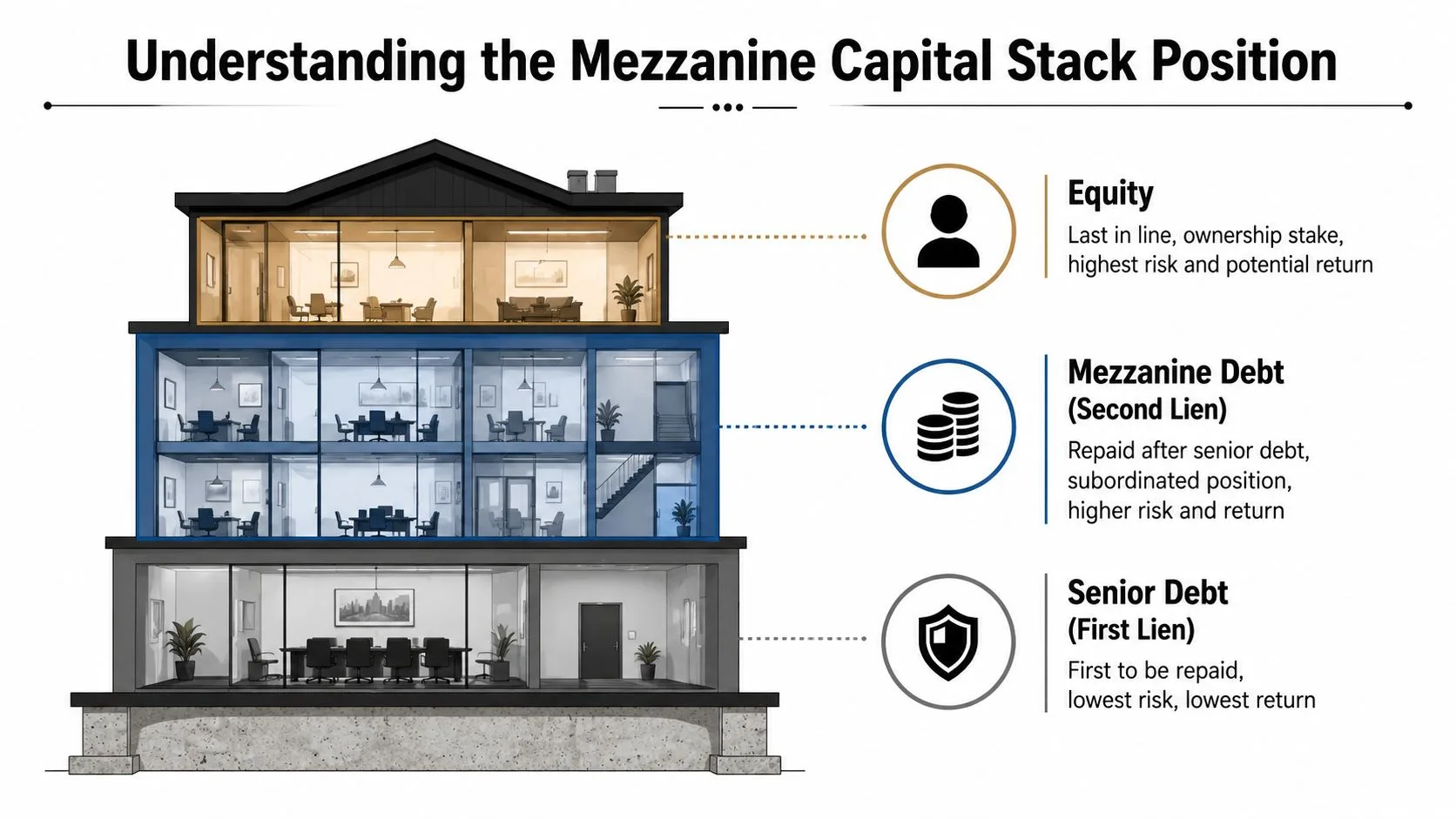
In the capital stack, senior debt sits at the bottom with first claim on assets, mezzanine debt occupies the middle tier, and equity rests at the top. Each layer absorbs risk in sequence, and that order drives who gets paid first if the deal goes sideways.
That ranking is the key story. Mezzanine is typically subordinated and often unsecured, so it stands behind senior lenders in the repayment waterfall and ahead of owners when recovery money is split, as explained in Investopedia's overview of mezzanine financing. The borrower is paying for capital that comes after the bank but before the owners, which is why the return sits above senior debt while still avoiding the full dilution of issuing more equity.
The structure is hybrid by design. It has a borrowing agreement, a coupon, and a maturity, so it behaves like debt. It also gives lenders upside through warrants or conversion features, so it borrows some of the economics of equity. In practice, that mix gives the lender more ways to get paid and gives the borrower more ways to keep the deal moving, with academic and industry references describing typical maturities around 5 to 10 years, and repayment that is usually more cash-flow friendly than heavily amortizing bank debt, as summarized in this mezzanine debt reference.
The trade-off is control and collateral. You are not only paying interest. You are bringing in a lender with a negotiated claim on the business if performance weakens, and that claim may rest on ownership pledges or other control rights instead of a first lien on hard assets. That changes default from a simple payment problem to a power problem. Read the plain-language primer on what a subordinated loan is if you want the structure stripped to basics.
Bottom line: Mezzanine gives you capital without giving up the keys today, but the lender gets a seat close enough to the equity line that control rights and collateral terms matter as much as price.
Breaking Down the Cost Structure and Returns
The headline rate is only the starting point. Stop there, and you will misread the deal and regret it later.
A typical mezzanine package can include a cash coupon, PIK accretion, equity warrants, and origination fees. Market guides on alternative financing for smaller firms describe the usual return mix as a cash coupon, payment-in-kind accrual, warrant upside, and upfront fees, because mezzanine sits below senior lenders and therefore has to pay for that extra risk. The practical lesson is simple. Model the all-in cost, not just the stated coupon.
What each cost component really does
- Cash coupon: This is the regular interest payment, the part you pay in cash.
- PIK accretion: This is interest that accrues to principal instead of being paid now. It preserves cash in the short term but raises the balance later.
- Equity warrants: This is the upside piece. The lender gets a shot at ownership value if the business performs.
- Origination fees: This is the upfront cost of getting the money closed.
Owners usually focus on the coupon because it is the easiest number to quote. That is the wrong metric. A deal with a lower stated rate can still cost more if fees stack up, PIK accumulates, and warrant value is part of the lender's return. If you want a clean way to separate what you pay in cash from what builds over time, use the same discipline you would apply to APR versus interest rate.
The control issue matters just as much as the math. Mezzanine lenders are paid not only through current cash flow, but also through claims that may affect ownership economics if the business stumbles. That means the true cost is not just interest expense. It is the combination of cash outflow, future balance growth, and the slice of upside you have agreed to share.
Mezzanine Financing Cost Components
| Component | Typical Range | Payment Method |
|---|---|---|
| Cash Coupon | 8% to 12% | Paid in cash during the term |
| PIK Accretion | 2% to 4% | Added to principal, paid later |
| Equity Warrant Upside | 2% to 8% | Value realized through ownership participation |
| Origination Fees | 1% to 3% | Paid upfront at closing |
The lender wants that return because the claim is junior to senior debt. That is the trade-off. You get capital without giving up a first lien on the business, but you also accept a pricier stack position and tighter pressure on future value. If the company cannot carry that burden, the answer is a different structure, not a harder negotiation.
Comparing Mezzanine Against Senior Debt and Equity
Mezzanine makes sense only when you compare it to the other two options. If you don't need the middle layer, don't use it. If you need more funding capacity but hate dilution, that's where it earns its place.
The fastest way to think about it is this. Senior debt is cheapest, but it comes with the tightest collateral expectations and the least flexibility. Pure equity costs the most in ownership terms, but it puts less pressure on cash flow. Mezzanine sits in between, more expensive than bank debt, less dilutive than selling another chunk of the company.
The comparison infographic below captures the trade-offs cleanly.
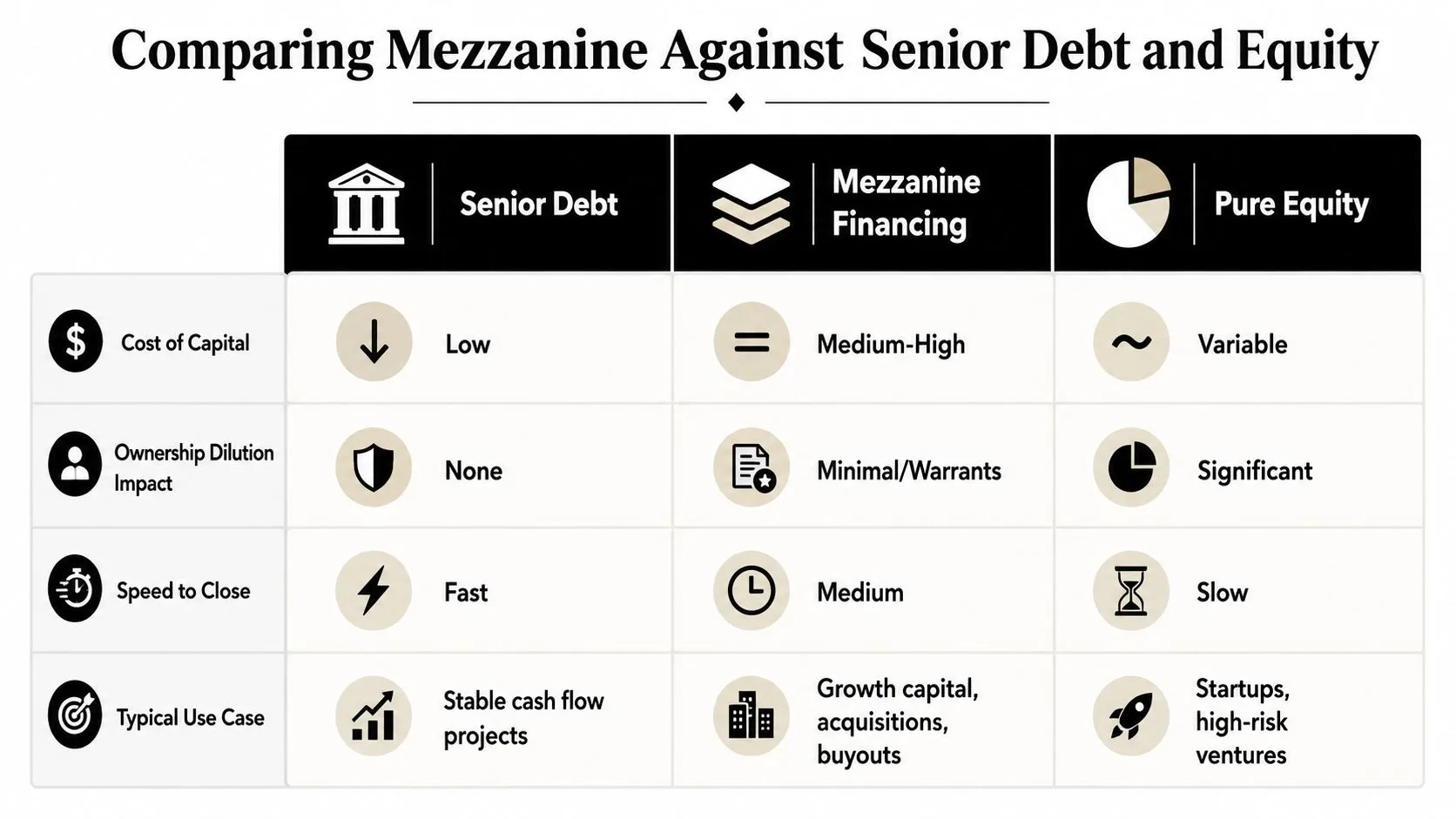
| Dimension | Senior Debt | Mezzanine Financing | Pure Equity |
|---|---|---|---|
| Cost of Capital | Low | Medium-High | Variable |
| Ownership Dilution Impact | None | Minimal, often with warrants | Significant |
| Speed to Close | Fast | Medium | Slow |
| Typical Use Case | Stable cash flow projects | Growth capital, acquisitions, buyouts | Startups, high-risk ventures |
The right choice depends on what you're protecting.
If preserving ownership is the priority and the business has cash flow to carry more debt, mezzanine is a strong candidate. If you're buying a volatile asset or a turnaround story with weak visibility, senior debt may be too tight and mezzanine may still be too expensive. In that case, equity might be the more rational answer because it reduces refinancing pressure and protects the company from taking on too much debt.
Mezzanine also changes control in subtle ways. You're usually not giving away day-to-day ownership, but you are letting a lender negotiate for warrants, tighter covenants, and stronger remedies if performance slips. That's a better deal than outright dilution, but it's not free.
The practical question is simple. Do you want to pay more in financing cost now, or give up more upside forever? That answer tells you whether mezzanine belongs on the table.
What Lenders Look For in Underwriting
Mezzanine lenders care far more about cash generation than about a pile of hard assets. They want proof that the business can service the debt, keep operating through a normal slowdown, and reach an exit or refinancing on schedule.
The borrower profile is usually an established business with predictable cash flow, a clear growth path, and management that can execute. That is why mezzanine shows up more often in mature operating companies than in speculative ventures. The lender is underwriting the borrower's ability to keep paying, not the resale value of equipment or real estate.
The underwriting lens
- Cash flow stability: Lenders want a business whose operating results do not swing wildly from month to month.
- Management credibility: A capable leadership team reduces execution risk, especially in acquisitions or expansion plays.
- Exit clarity: The lender wants a credible refinancing, sale, or repayment path at maturity.
- Documentation quality: Clean financial statements and a defensible forecast matter more than pitch-deck polish.
Collateral changes the conversation too. In many mezzanine structures, the lender is looking at pledged ownership interests, not a first lien on physical assets. That matters because the lender's remedies can reach control of the entity if performance slips, instead of the straightforward asset foreclosure a senior mortgage lender would use.
Practical rule: If your financials are messy, your projections are aspirational, or your exit path is vague, mezzanine lenders will spot the weakness fast.
Business owners should also prepare for the same kind of document scrutiny lenders use in the underwriting phase for self-employed borrowers. Different product, same discipline. Proof, consistency, and risk control matter more than a polished story.
The owners who get this right do not pitch mezzanine as a rescue plan. They present it as part of a capital structure with a real repayment story and a clear view of what they are giving up in control and collateral terms. That is the posture that gets attention.
Your Readiness Checklist and Next Steps
The right time to shop mezzanine is after you've done the boring work. If your books are a mess, your forecasts are hand-written, or your management bench is thin, fix that first. Mezzanine lenders are buying confidence as much as they're buying yield.
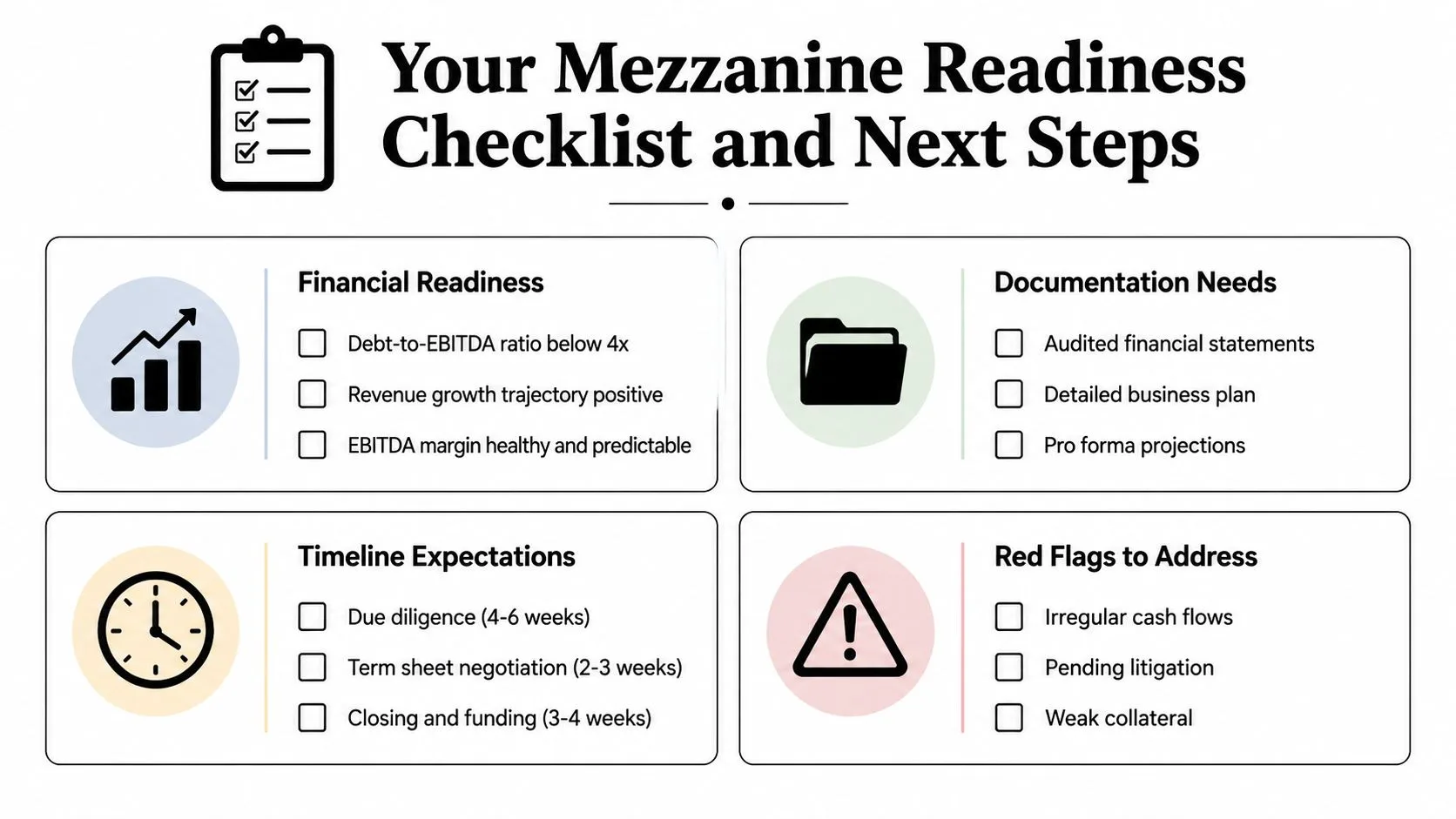
Readiness checklist
- Financial readiness: Make sure the business has stable operating performance, a believable growth path, and enough coverage to support another layer of debt.
- Documentation needs: Have clean statements, a detailed business plan, and projections that are tied to actual operating assumptions.
- Timeline expectations: Expect diligence to take time, because lenders will verify the story, not just read it.
- Red flags to address: Irregular cash flows, pending litigation, and weak collateral need to be cleaned up before you approach the market.
The process usually moves in a straight line. First comes outreach and initial screening. Then the lender issues a term sheet, due diligence starts, documents get pulled apart, and closing follows if nothing ugly appears. In practice, that can take 60 to 90 days, especially when legal review or financial cleanup slows the file.
The biggest deal killers are almost always self-inflicted. Bad bookkeeping, vague projections, unresolved tax issues, or a sponsor who can't explain the exit plan will stall momentum fast. If you can't answer how the debt gets repaid, the lender will assume you don't know either.
Clean numbers beat optimistic narratives every time.
For a broader view of how this layer fits into a total funding plan, the capital stacking and funding guide is a useful companion. The point is to match the right layer to the right use case, not to force a one-size-fits-all solution.
If you're not ready, don't fake readiness. Clean up the model, tighten the covenants you can influence, and talk to lenders only after you can defend the numbers with confidence.
Making the Right Capital Structure Decision
Mezzanine is worth considering when three things are true. The business can carry the debt, the use of funds is strong enough to justify the cost, and preserving ownership matters more than minimizing all-in financing expense. If any one of those is missing, the deal needs another look.
A good decision starts with the cash flow question. Not “Can we probably make this work?” but “Can we pay this without betting the company on perfect execution?” If the answer depends on heroic growth, mezzanine is too expensive for that risk profile. If the answer is yes under reasonable assumptions, then the structure may be a good fit.
The other issue is strategic flexibility. Mezzanine can protect ownership today, but it also adds another claimant to future cash flow and can complicate later financing. That's fine if the transaction creates enough value to justify it. It's a problem if you're using it just to avoid making a harder capital decision now.
For owners evaluating broader financing paths, LendingXpress commercial financing options is a useful place to compare alternatives before locking into a subordinate structure. The key is to compare the full capital stack, not just the rate sheet in front of you.
If you need a blunt rule, use this one. Choose mezzanine when it helps you do a better deal with acceptable control risk. Walk away when it's the only way to make a weak deal look financeable. That's the line that matters.
Business Loan Warrior helps owners compare funding options without guessing their way through the process. If mezzanine financing is on your radar, start by understanding where it fits in your capital stack and what it really costs. Visit Business Loan Warrior to explore funding options and make your next move with a clearer view of the trade-offs.