
You've got a line of vendors asking for deposits, your walk-in hasn't arrived yet, payroll is coming up, and opening week sales still haven't settled into a pattern. That's the moment when restaurant financing options stop being abstract and become a survival decision. The wrong structure can leave you short on cash at exactly the time you need breathing room, while the right one buys you time to open cleanly, ramp sales, and keep the kitchen moving.
Restaurant owners usually don't need just one kind of money. They need a plan that fits the project, the timing, and the risk. A build-out needs different capital than a seasonal cash squeeze, and a second location needs something different again. That's why the smartest funding decisions usually come down to fit, speed, collateral, and cash-flow flexibility, not just the headline rate.
This guide walks through the main funding paths in plain language, then shows how to stack them for real projects instead of treating every loan like a one-size-fits-all answer. You'll see which products tend to work for startups, expansions, equipment purchases, and emergency working capital, plus how to judge true cost when the clock is ticking. If you want a simple place to compare options as you read, Business Loan Warrior sits in that decision path as one of the places owners use to sort through offers.
Table of Contents
- Introduction to Restaurant Financing Today
- Why Restaurant Financing Works Differently Than Other Business Loans
- Understanding the Main Restaurant Financing Options
- True Cost Versus Speed When You Need Cash Fast
- How to Build a Smart Capital Stack for Your Restaurant Project
- How to Evaluate Offers and Prepare to Apply With Confidence
- Real World Examples and Choosing Your Best Next Step
Introduction to Restaurant Financing Today
The first cash crunch in a restaurant rarely feels dramatic on paper. It usually starts with something ordinary, like a food delivery arriving before sales stabilize, or a payroll run landing before the dining room has full momentum. That's when owners learn that funding isn't only about paying for the startup, it's also about buying time for the business to breathe.
That timing problem is why restaurant financing options deserve more than a quick rate comparison. A lender can quote a low cost, but if the approval takes too long, the money doesn't solve the problem you have. A faster loan can solve the timing issue, but if the structure is too expensive, it can create a second problem that lasts for months.
The right answer depends on what you're funding. A kitchen build-out, a line for inventory, a cash bridge for labor, and a second-unit expansion all call for different tools. Some owners need a lender that values collateral and repayment flexibility. Others need a funding source tied to equipment or to the project itself.
Practical rule: In restaurants, the best loan is often the one that arrives in time and leaves enough cash in the bank for the next two weeks.
For owners in the middle of a launch or expansion, that usually means looking at the funding mix before looking at the rate sheet. If you can map the project into parts, equipment, build-out, and working capital, the decision gets easier and much less emotional. If you try to force everything into one loan, you usually pay for the convenience somewhere else.
This guide moves from why restaurants are financed differently, to the main loan types, to cost versus speed, then into capital stacking and application prep. By the end, you should be able to look at a funding offer and ask the right question, not just “Can I get it?”, but “Does this fit the job?”
Why Restaurant Financing Works Differently Than Other Business Loans
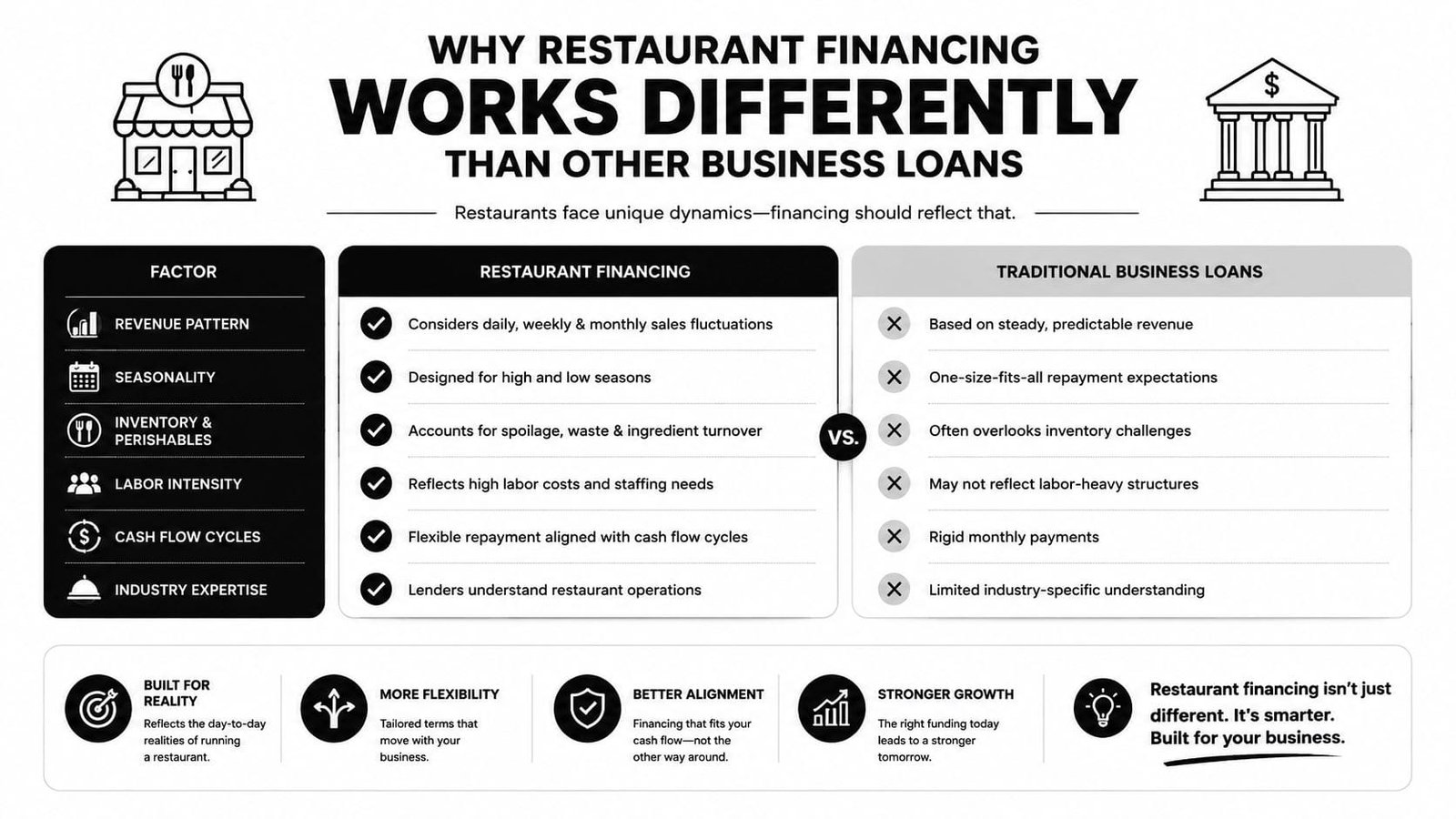
A restaurant can look healthy on paper and still feel tight on cash in real life. Rent, payroll, food costs, equipment upkeep, and slow weekdays all pull on the same account at once. That is why restaurant lenders read the business through a different lens than they use for many other small businesses. A restaurant financing guide citing Bureau of Labor Statistics data reports a 17%–30% first-year closure rate for restaurants and says about 50% close within five years. Those figures help explain why lenders pay close attention to speed, collateral, and whether repayment leaves enough breathing room for the owner.
Stage matters more than most owners expect
A lender does not assess a food truck the same way it assesses a multi-unit group. The project stage changes the size of the check, the documents required, and how much history the lender expects to see. Aggregated lending data shows that food trucks usually need $25,000 to $100,000, while independent casual dining restaurants typically borrow $75,000 to $200,000, fine dining establishments often borrow $150,000 to $500,000, and multi-unit franchise groups may access $300,000 to $2,000,000+. The same market data also shows that an SBA 7(a) loan can reach up to $5 million, while equipment financing commonly ranges from $5,000 to $500,000. Restaurant financing data
That spread shows how segmented restaurant financing really is. A newer operator often has to rely on collateral-based or government-backed structures because the business itself has not built a long track record yet. A seasoned operator can sometimes qualify for larger and less expensive facilities because the lender can read the financial history with more confidence. The underlying question stays the same, can this restaurant produce enough steady cash to cover the debt without starving the operation.
What lenders are really trying to measure
Lenders want to know whether the restaurant can keep making payments during normal sales swings. They look at repayment capacity, ownership equity, and how the money will be used. If the monthly payment is so large that one slow week creates a problem, the deal becomes harder to support.
That is why a loan for ovens and refrigeration often gets treated differently from a loan for payroll smoothing. The first is tied to hard assets that still have value if the lender needs protection. The second depends much more on cash flow discipline and the owner's ability to manage working capital. In restaurant funding, the use of funds is part of the credit story, not a side note.
A kitchen upgrade, a leasehold build-out, and a short-term inventory gap each carry a different kind of risk. The right structure follows the need, the way a sharp knife is used for prep and a ladle is used for service. When the funding matches the job, the lender can underwrite the deal more clearly, and the owner is less likely to end up with a payment schedule that fits the wrong phase of the business.
Understanding the Main Restaurant Financing Options
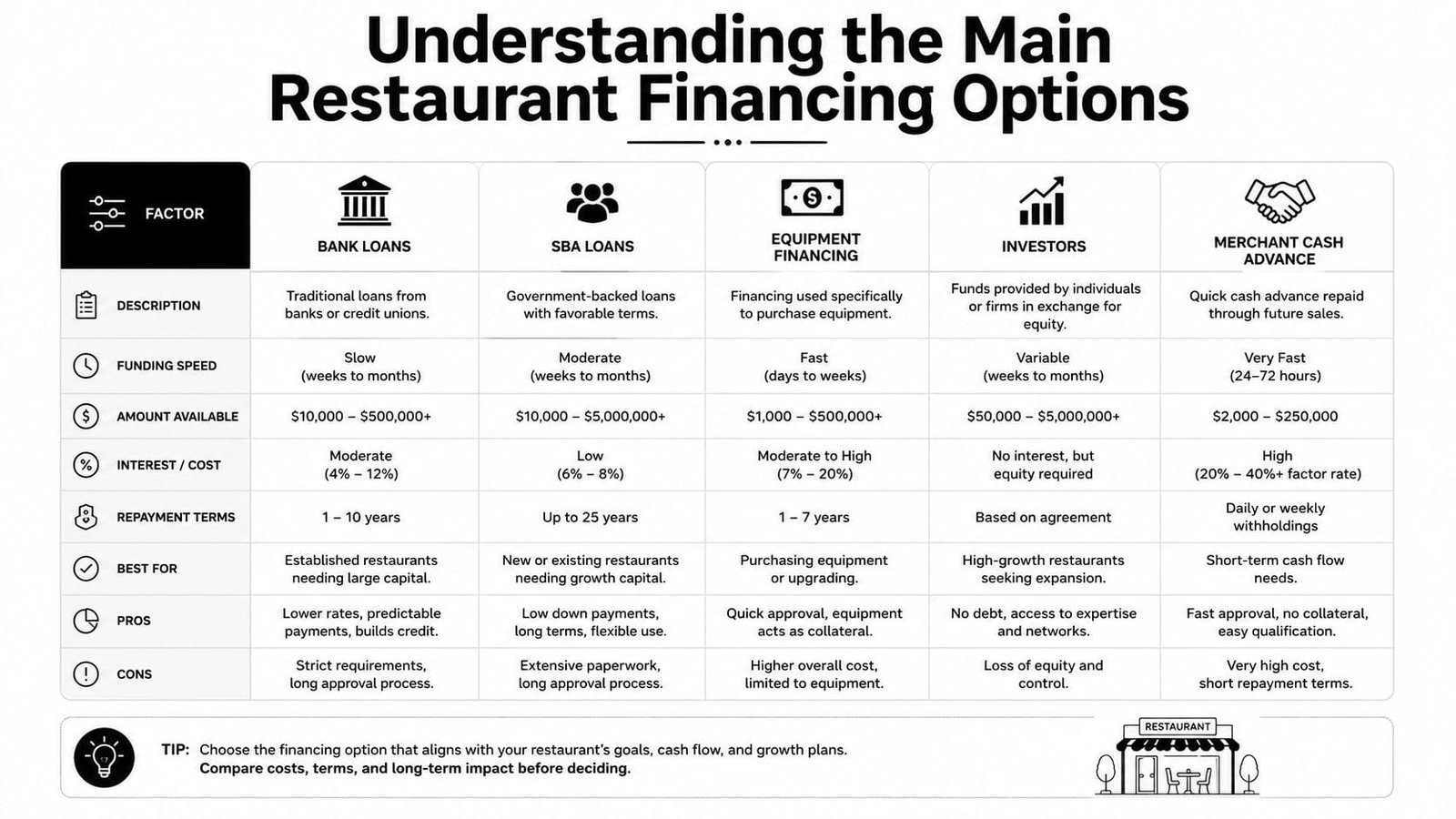
A restaurant owner can make better choices when the funding is matched to the job it has to do. A line for a fryer replacement should not be treated the same way as money for a patio build-out, and a short cash gap should not be financed like a long-lived renovation. The cleanest way to sort the main restaurant financing options is by purpose, repayment shape, and how much pressure each product puts on monthly cash flow.
The core products in plain English
SBA 7(a) and SBA Express sit in the middle ground between speed and cost. They are often used for larger projects that can support paperwork, lender review, and a longer wait before funding. For owners who can plan ahead, that slower approval can buy a more affordable structure for build-outs, buyouts, refinancing, and expansion. A broader overview of how these loans fit into a restaurant plan is laid out in the Ultimate Guide to Restaurant Small Business Loans from Startup to Expansion.
Equipment financing is tied to the asset itself, which is why it often makes sense for items with a clear useful life, such as ovens, refrigeration, hoods, walk-ins, and POS systems. The equipment helps secure the deal, and the payments spread the cost over time instead of pulling a large amount out of working capital at once. That structure fits a machine or fixture better than a general operating expense.
Business lines of credit work best when the need repeats but the timing is uncertain. Inventory swings, payroll timing, and seasonal slowdowns are common examples. You draw funds only when needed, repay them, and use the line again if the lender keeps it open. That flexibility matters when the size of the gap changes from week to week.
Term loans are straightforward lump-sum loans with a fixed repayment schedule. They fit a clearly defined project, especially one that should produce revenue over several years. When the work has a beginning and an end, a term structure usually makes more sense than a short-term cash product that forces faster repayment.
When the product fit changes
Merchant cash advances and other short-term working-capital products can solve an urgent gap, but they are expensive compared with bank-style borrowing. They belong in a narrow lane, usually where the need is short-lived and the payoff is visible soon. If the money is used for a problem that keeps going, the repayment strain can become part of the problem instead of the solution.
Invoice financing is more specialized in restaurant settings, but it can help operations that wait on receivables. It turns unpaid invoices into usable cash sooner, which can ease pressure when a customer, caterer, or partner payment is slow to arrive. For businesses with catering or contract work, the Monopack ltd catering finance tag gives a useful look at that kind of funding source.
Tenant improvement allowances are different again, because the landlord, not the lender, is helping cover part of the build-out. That reduces the amount the restaurant has to borrow in the first place, which can make the rest of the capital plan easier to carry. In practice, this can be the piece that keeps a leasehold project from becoming too debt-heavy.
| Restaurant Financing Options at a Glance | Typical Amount and Term | Best Use Case |
|---|---|---|
| SBA 7(a) | Larger project funding, longer term for bigger needs | Build-outs, buyouts, refinancing expensive debt |
| SBA Express | Faster SBA structure, shorter approval window | Projects that need SBA pricing with quicker funding |
| Equipment financing | About $5,000 to $500,000, tied to the equipment | Ovens, refrigeration, POS, hoods, walk-ins |
| Line of credit | Revolving access, used as needed | Inventory swings, payroll smoothing, seasonal gaps |
| Term loan | Fixed lump sum and schedule | Defined growth projects or renovations |
| Merchant cash advance | Fast access, short repayment cycle | Short-lived emergency cash needs |
| Invoice financing | Based on unpaid invoices | Waiting on receivables |
| Tenant improvement allowance | Project-based landlord support | Leasehold build-outs |
A useful way to read the table is to ask one question first, what is this money doing. If the answer is "buying something that lasts," the best fit is usually a structure with a longer payback. If the answer is "covering a temporary gap," a revolving or fast-access product may fit better, even if the price is higher. For more context on how these funding types are grouped, the Restaurant financing options guide is a helpful reference, and a closer look at funding behavior appears in Restaurant financing data.
If you want a broader restaurant-loan overview, the Ultimate Guide to Restaurant Small Business Loans from Startup to Expansion is a useful companion because it frames the same products by business stage instead of by label.
True Cost Versus Speed When You Need Cash Fast
Restaurant owners usually compare rates first, then timelines. In a cash emergency, that order can be backwards. If payroll is due tomorrow and your approved money arrives in six weeks, the cheapest loan in the world doesn't fix the immediate problem. The key question is whether the money is both affordable and available soon enough to matter.
Read the offer the way a lender does
One recent restaurant-financing guide reports SBA 7(a) loans at about 6–8% APR with 60–90 day approval windows, alternative lenders at 15–40%+ APR with 1–3 day approvals, and merchant cash advances at 40–200%+ APR with 1–2 day approvals. That spread is the core tradeoff for restaurants under pressure. Restaurant financing guide
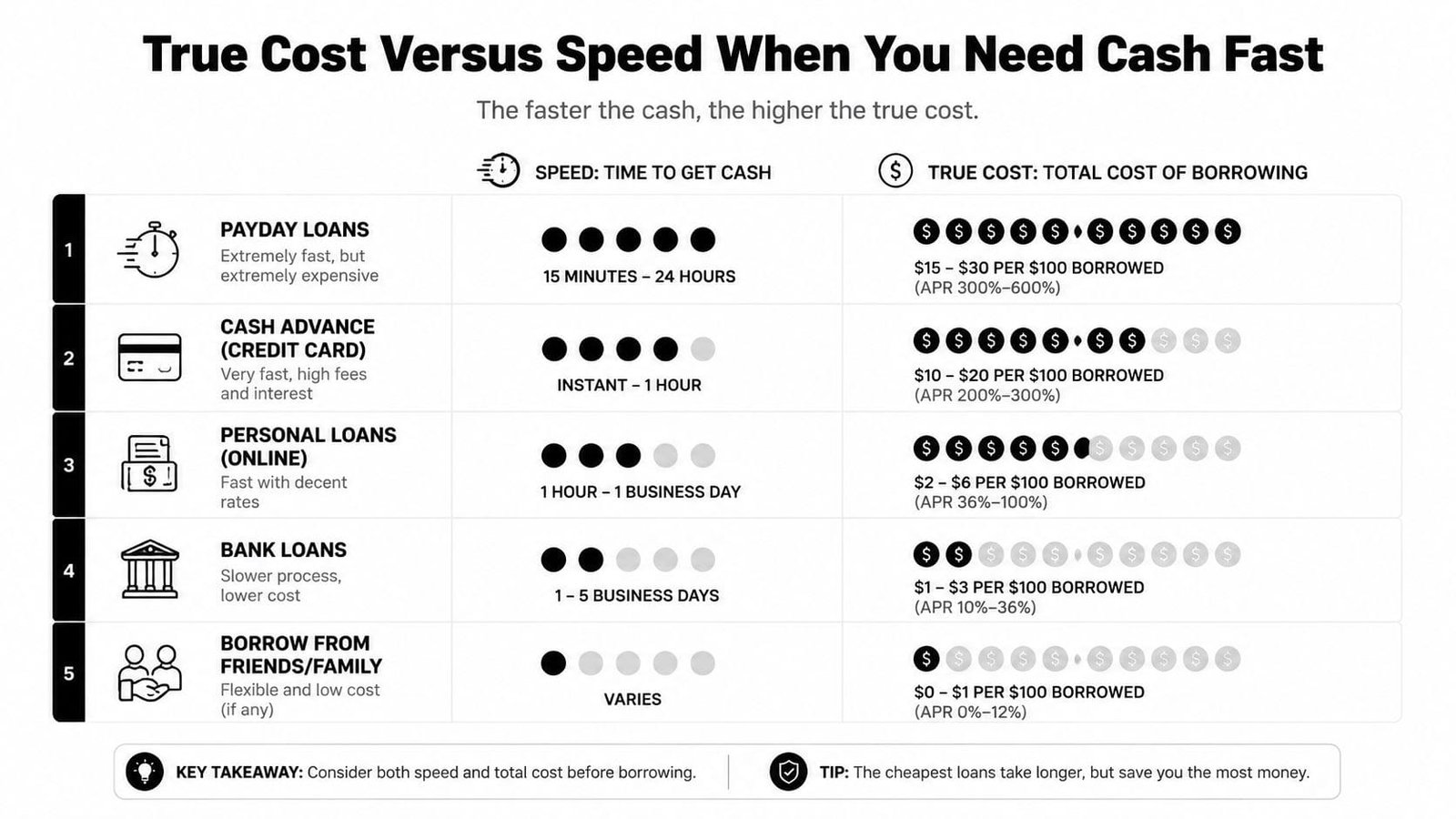
An SBA loan may be the cheaper structure, but it's not the right answer if the business needs relief this week. A faster alternative lender can make sense if the problem is short-lived and the payoff is visible quickly, like bridging a delayed opening or covering a temporary inventory crunch. Merchant cash advances belong in a much narrower lane, because the speed comes with a very steep cost.
Watch the payment shape, not just the headline price
APR matters, but so does the way the lender collects money. Daily payments can create more strain than the rate number suggests, especially if sales are already volatile. Factor rates and fee-heavy structures can make the true cost harder to see, so owners should translate every offer into total payback before signing.
Rule of thumb: If the debt outlives the problem it was meant to solve, the structure is probably wrong.
That's why short-term borrowing should be reserved for short-term needs. A payroll bridge, an inventory gap, or a supplier timing issue can justify speed. A kitchen build, a dining-room remodel, or a second location usually shouldn't be funded with money that expects to come back immediately.
For owners comparing emergency options, the Short-Term Business Financing page can help frame the category, but the decision still comes back to one simple test. If the business can't reasonably absorb the payment rhythm, the loan is too aggressive, even if it lands fast.
Match urgency to the product tier
When the pressure is high and the fix is temporary, speed matters most. When the project is larger and more durable, price should matter more. That single distinction prevents a lot of bad debt.
How to Build a Smart Capital Stack for Your Restaurant Project
Real restaurant projects rarely get funded by one source alone. Owners often mix landlord support, asset-backed lending, and working capital so the pieces line up with how the project unfolds. A non-SBA capital stack for restaurants often combines tenant improvement allowances, equipment financing, and working-capital financing together, with tenant improvement allowances called one of the most underutilized restaurant funding sources. Capital stack article
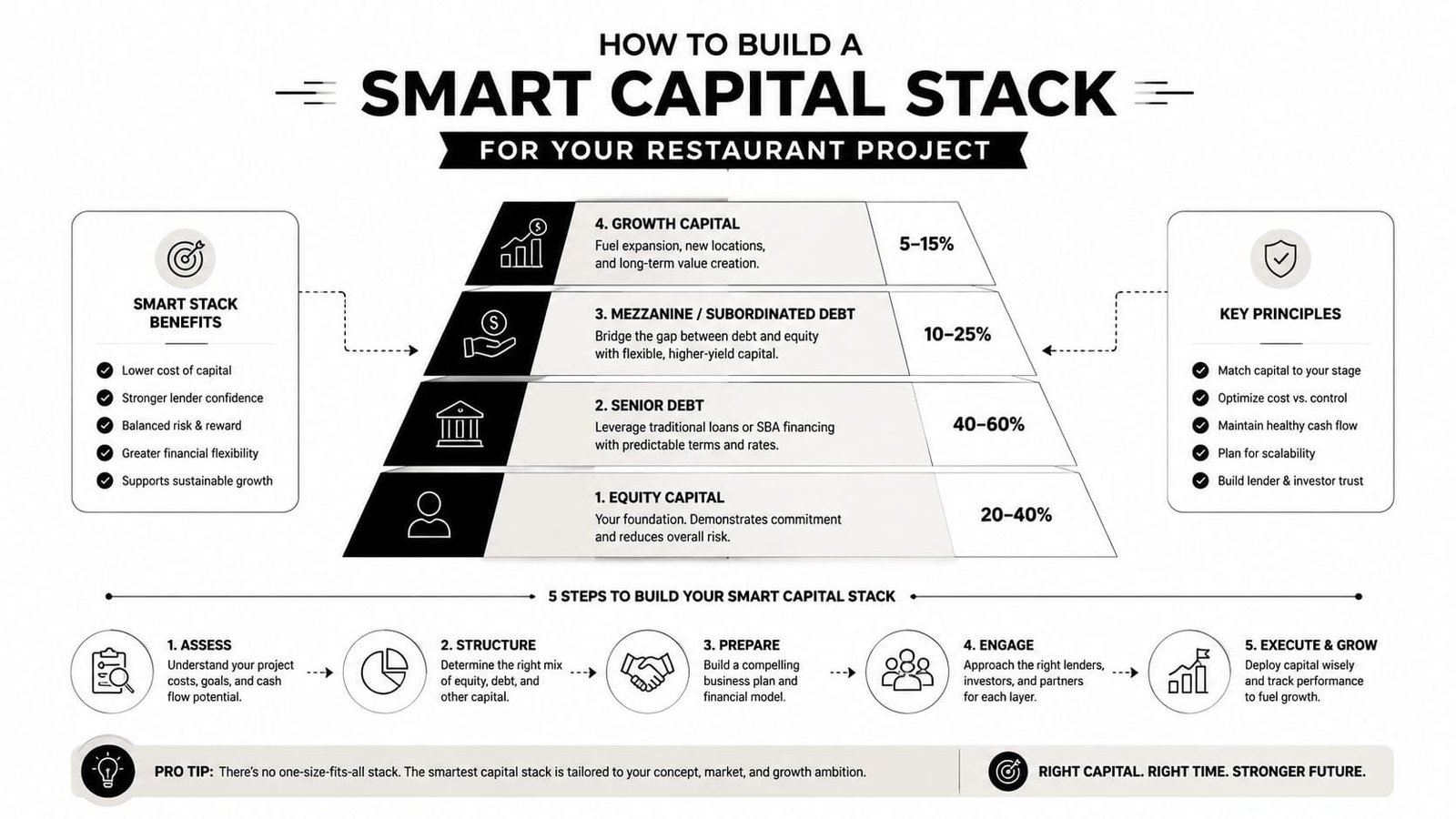
Think in layers, not in one loan
A capital stack starts with the question, “What piece of this project can pay for itself the easiest?” Equipment financing is often a good fit for ovens, hoods, refrigeration, and POS systems because those items are concrete and separable. Tenant improvement allowances can reduce the amount you need to borrow for the build-out itself. Working capital then covers the awkward gap between opening costs and stable sales.
That structure matters because different dollars should do different jobs. If a landlord is willing to support the space, that support should usually lower your borrowing need before you reach for a more expensive funding source. If the equipment has its own collateral value, it usually doesn't make sense to bury it inside a general-purpose loan.
A simple stack for two common projects
For a single-unit build-out, the logic often looks like this. Use landlord support for part of the space work, finance the kitchen equipment separately, then keep a working-capital layer for payroll, inventory, and the first ramp period. That keeps the long-life assets on longer terms and the short-life cash need in a more flexible bucket.
For a second-location expansion, the stack often shifts. A larger facility such as SBA 7(a) can anchor the project, while equipment financing handles the physical tools and a line of credit helps with the opening ramp. The key is sequencing, not just sourcing.
The guide at UK manager guide to net and gross is useful here because owners often confuse gross sales thinking with cash available for debt service. Knowing the difference keeps the stack grounded in actual operating money, not just top-line optimism.
Don't use long-term debt to fund every short-term need. Separate the building, the equipment, and the cash cushion whenever you can.
If you're mapping your own project, the Capital Stacking Funding page is a practical reference point for combining sources without trying to force one loan to do everything.
How to Evaluate Offers and Prepare to Apply With Confidence
A loan offer only works if it fits the restaurant's cash flow after the excitement wears off. The monthly payment matters, but so does the room left over for payroll, food, rent, and the small surprises that show up in every operating cycle. A low-cost loan can still strain the business if the payment is too large, and a fast loan with extra fees can create the same problem in a different form.
Start with the money purpose
Write down exactly what the funds will cover. Equipment, build-out, payroll, inventory, or a bridge between opening dates all point to different funding needs. Once the purpose is clear, comparing offers gets easier because you are measuring each one against the same job.
Next, estimate the payment the business can support from ongoing cash flow. That number should leave room for food cost, labor, rent, and the repairs that always seem to arrive at the wrong time. If the payment leaves no breathing room, the financing is too tight for the business to carry.
Compare structure, not just rate
APR helps, but it does not tell the full story. Some offers use factor rates, some fold fees into the upfront cost, and some rely on daily debits that look manageable until you add them up across the month. Ask for total payback, repayment frequency, prepayment terms, and renewal language before you choose.
SBA structures are often the lower-cost mainstream option for larger projects, but they usually trade price for speed. As noted earlier, SBA 7(a) and SBA Express sit in different lanes, and that difference matters when timing is tight.
Practical rule: The better offer is the one you can carry through a slow week, not the one that looks fine on a spreadsheet in a good week.
Organize the file before you apply
Lenders usually move faster when the paperwork is ready. For restaurant financing, that usually means recent bank statements, P&L data, lease terms, equipment quotes, and a clear list of existing obligations. Business Loan Warrior's single application flow is built around that kind of document review, with pre-approval checks that do not affect credit and a dashboard to track the process.
The faster you can show the lender what the money is for, the less friction you create. When the project is tied to specific quotes or a lease, that organization also helps the underwriter see the deal as concrete instead of theoretical.
Real World Examples and Choosing Your Best Next Step
A new operator opening a compact kitchen might use equipment financing for the ovens, refrigeration, and POS systems, then pair that with landlord support for the space itself. That keeps the hard assets in a structure built for assets and avoids draining cash before service starts. The main thing to watch is whether the payment stays comfortable once the first wave of opening expenses hits.
A second owner I'd worry less about is the one facing a short seasonal dip with a clear rebound coming. In that case, a line of credit or short-term working capital can make sense if the gap is temporary and the repayment can stay aligned with the business cycle. The mistake is using a daily-pay advance to cover a problem that won't disappear quickly.
A third example is the multi-unit operator planning another location. That project often needs a larger anchor facility, then equipment and working capital layered around it. The project looks cleaner when each piece of the stack does one job instead of making one loan carry the whole burden.
The simplest decision checklist is this. First, define the use of funds. Second, estimate the payment the restaurant can live with during a slow stretch. Third, compare total payback and timing. If the offer fails any one of those tests, keep looking.
If you're ready to compare options without starting from scratch, Business Loan Warrior can help you sort funding paths for equipment, working capital, SBA-style borrowing, and expansion planning in one place. It's often easier to choose well when the options are organized before the pressure turns urgent.
If you want help narrowing the right funding path for a build-out, equipment purchase, or cash-flow bridge, visit Business Loan Warrior to compare restaurant funding options and move from guesswork to a cleaner application plan.