
A holiday order arrives, the supplier wants payment, payroll is due, and your shelves still haven't converted yesterday's sales into cash. The store may be profitable on paper, yet the owner is staring at a bank balance that can't comfortably cover inventory, rent, wages, and marketing at the same time. That is the central problem retail store financing must solve.
The right facility isn't just the one with the lowest advertised rate or the largest approval. It's the one whose repayment schedule fits the time between paying for stock and collecting revenue. A financing product that works during a strong selling week can become a serious burden when foot traffic slows, markdowns rise, or a supplier shortens terms.
Table of Contents
- Why Retail Stores Need a Different Financing Playbook
- The Five Core Retail Store Financing Products Explained
- Comparing Cost, Speed, and Best-Fit Scenarios
- What Lenders Actually Underwrite for a Retail Store
- Why the Cheapest Product Can Still Be the Wrong One
- How the Application and Funding Process Actually Works
- Matching the Right Product to Your Store's Situation
Why Retail Stores Need a Different Financing Playbook
A retailer pays first and collects later. You purchase merchandise, pay employees to receive and sell it, keep the lights and systems running, and wait for customers to buy enough stock to recover those costs. A service business may invoice after work is completed. A store often commits cash before demand has been proven.
That timing creates a financing need that changes throughout the year. A boutique may need capital to buy seasonal clothing before the season begins. A specialty grocer may need more inventory ahead of a holiday period. A growing omnichannel retailer may need warehouse capacity, point-of-sale technology, delivery infrastructure, or improvements that connect its physical and online channels.
The scale is substantial. The U.S. Census Bureau reported that total U.S. retail sales rose from $6,519.8 billion in 2021 to $7,041.0 billion in 2022, an increase of 8.0%. That operating volume helps explain why retailers use several forms of borrowing rather than relying on one conventional term loan. U.S. Census Bureau retail data tracks sales alongside inventories, gross margins, operating expenses, sales taxes, and e-commerce, the financial environment in which retailers make funding decisions.
The cash squeeze is usually predictable
Consider an established home-goods store preparing for its busiest selling period. The owner has a strong sales history and a good relationship with suppliers, but the purchase order must be paid before the new merchandise reaches the showroom. A long-term loan could provide the money, but its fixed payments would continue after the seasonal rush. A revolving facility may fit better because the owner can draw for inventory, repay as sales arrive, and preserve unused capacity for the next need.
The opposite problem occurs during a slow mid-quarter stretch. Sales soften, inventory sits longer, and the owner still owes rent, payroll, processor fees, and loan payments. Borrowing more can keep the doors open, but it can also postpone the core issue if the store is carrying stock customers don't want.
Practical rule: Borrow against a clearly defined cash gap, not against an optimistic sales forecast.
Match repayment to the cash conversion cycle
Start with four questions:
- What gets funded? Inventory, fixtures, technology, renovation, marketing, or general working capital each points toward a different structure.
- When does cash return? Fast-turning stock can support a shorter facility than seasonal or imported merchandise.
- What happens if sales slow? A fixed payment, daily debit, and percentage-of-sales repayment behave very differently in a weak month.
- What remains after repayment? Gross margin must cover operating costs and debt service, not just the purchase price of the stock.
This is why a product catalog isn't enough. Retail store financing should be judged by what happens when inventory takes longer to sell, not only by how quickly the lender says yes.
The Five Core Retail Store Financing Products Explained
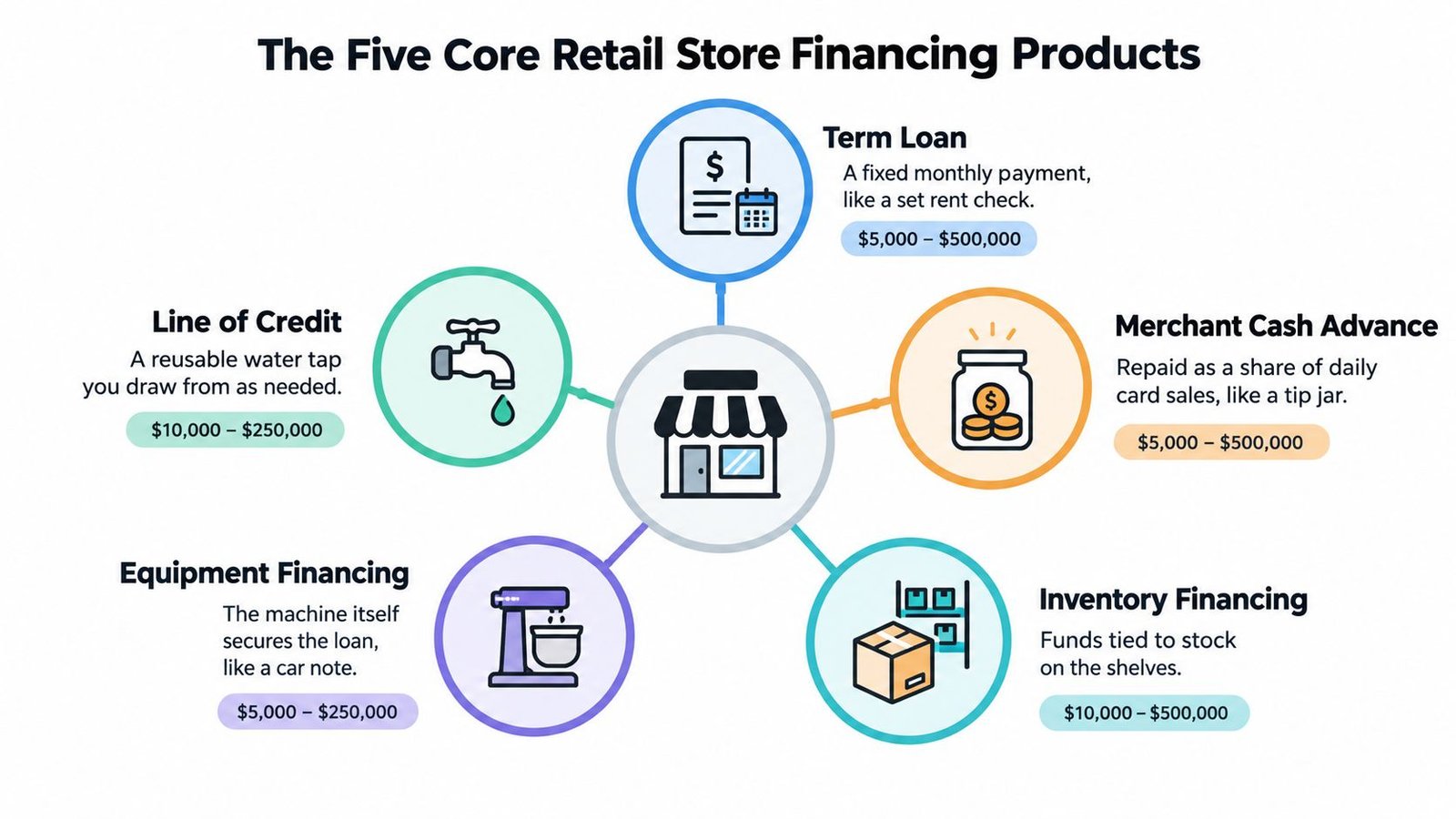
Retail owners usually encounter five broad categories. They overlap in purpose, but their repayment mechanics are different enough that confusing them can damage cash flow.
Term loans provide a defined project budget
A term loan delivers a lump sum and requires scheduled payments over an agreed period. Think of it as a second fixed obligation alongside rent. It fits a planned store buildout, renovation, acquisition, or expansion where you know the total project cost and expect the investment to produce cash over time.
It's a poor match for uncertain inventory demand. Once the money is drawn, payments continue whether the merchandise sells quickly or ends up discounted.
Lines of credit create reusable working capital
A business line of credit works more like a replenishable bucket. You draw what you need, repay principal, and regain access to available capacity. That flexibility makes it useful for purchase orders, short-term payroll gaps, repairs, and seasonal buying.
The discipline matters. A line should support a recurring operating cycle, not become a permanent patch for losses. If the balance never falls because inventory isn't converting, the facility is revealing a merchandising problem rather than solving one.
Equipment financing follows the asset
Equipment financing is tied to a specific purchase, such as a point-of-sale system, refrigeration unit, display fixtures, security equipment, or warehouse machinery. The asset often supports the lender's security interest, and the repayment period is connected to its useful business life.
This structure is cleaner than using expensive short-term money for equipment that will serve the store for years. Keep the proceeds tied to the invoice. Don't use equipment financing to fund unrelated stock or payroll.
Merchant cash advances sell future receipts
A merchant cash advance, or MCA, provides an upfront amount in exchange for a contracted portion of future revenue. Repayment may occur through daily or frequent withdrawals, sometimes linked to card sales.
That speed can appeal to an owner facing an urgent supplier demand or cash shortage. The trade-off is often a high total cost and a repayment burden that can arrive every selling day. An MCA shouldn't be the default answer for normal inventory planning.
SBA loans offer longer-duration capital
SBA-backed financing can support established retailers pursuing expansion, real estate, acquisition, or substantial improvements. The process is usually more document-heavy and slower than fast online products, but the structure can be better suited to investments that need time to produce returns.
For a broader overview of funding structures and retailer-specific borrowing, review business loans for retailers. Retail technology and customer experience can also affect how a store turns financed investment into sales, so resources such as Helbling Digital Media for retailers can help owners evaluate the operational side of an expansion.
Comparing Cost, Speed, and Best-Fit Scenarios
No product wins every comparison. Speed, total cost, payment behavior, and use case must be evaluated together.
| Product | Typical Funding Speed | Repayment Structure | Best Retail Use Case |
|---|---|---|---|
| Term loan | Generally slower than revolving or short-term products | Scheduled payments over a defined term | Planned buildout, renovation, or expansion |
| Line of credit | Often faster than a traditional term facility | Interest and principal apply to drawn funds | Seasonal working capital and recurring cash gaps |
| Equipment financing | Can move efficiently when an invoice and asset are clear | Scheduled payments tied to the financed equipment | POS systems, fixtures, refrigeration, or machinery |
| Merchant cash advance | Often among the fastest options | Frequent repayment from future sales or deposits | Urgent, short-term liquidity needs |
| SBA loan | Usually requires the most documentation and time | Longer-duration scheduled repayment | Major expansion, acquisition, or durable investment |
A line of credit is usually the most natural fit for sales that rise and fall during the year. You aren't paying interest on unused capacity, and the balance can decline as inventory sells. The danger is assuming availability equals affordability. A large limit can tempt an owner to carry slow stock longer than the economics justify.
Equipment financing works differently. If a new POS system improves checkout, reporting, or inventory control, the asset can support the repayment case. That's more defensible than placing a durable purchase on a daily-debit product designed for short-term cash flow.
Fast money has a specific job
An MCA may fund quickly, but speed doesn't make it cheap. Frequent withdrawals can reduce the cash available for replenishment, payroll, and supplier payments. If your sales are volatile, the product's repayment design matters more than the application experience.
Term loans and SBA loans generally require more preparation, but they can be better suited to investments with a longer payback period. Don't use long-duration debt for stock that should sell within a short buying cycle, and don't use expensive emergency capital for a predictable seasonal need.
Card acceptance also affects the cost picture. Before relying heavily on card-funded working capital, review practical guidance on credit card fees for businesses, because processing costs reduce the cash available to service every financing product.
The right comparison is not “Which lender offers the lowest rate?” Ask instead: Which payment can this store still make after a weak sales week, a markdown event, and the next inventory order?
What Lenders Actually Underwrite for a Retail Store
A strong personal credit score helps, but it won't rescue weak retail cash flow. Lenders want evidence that the store generates dependable deposits and can repay after ordinary operating expenses.
Revenue quality matters more than a single strong month
Underwriters review bank statements, sales records, deposit patterns, and time in business. They're looking for consistency, not one unusually successful promotion. Unexplained transfers, irregular deposits, or a mismatch between processor activity and bank statements can slow approval or weaken the offer.
Gross margin matters because revenue alone doesn't show repayment capacity. A store selling high-volume, low-margin products may have less debt capacity than a smaller retailer with healthier margins and faster inventory movement.
Inventory tells the lender what supports the borrowing
Lenders may examine how quickly stock sells, whether the products are seasonal, and how much value remains if the merchandise must be discounted. Fast-moving everyday goods are easier to understand than trend-sensitive or obsolete stock.
Existing debt is another major concern. Several advances with overlapping withdrawals can leave a retailer appearing profitable while cash is already committed elsewhere. Prepare a complete debt schedule before applying, including balances, payment frequency, remaining obligations, and any personal guarantees.
The business loan underwriting process becomes easier to understand when the owner presents clean records and a specific use of proceeds.
Banks do serve smaller commercial borrowers
The FDIC's 2024 Small Business Lending Survey reported that 94% of small banks and 90% of large banks made at least some small-business loans. It also reported that 95% of banks had at least some commercial-and-industrial loans with original amounts of $1 million or less at the end of 2021. FDIC small-business lending data shows lender participation, not a guarantee for any individual store.
Before applying, assemble:
- Recent financial records: Keep statements, tax filings, profit-and-loss reports, and balance sheets consistent.
- A borrowing purpose: Tie the request to inventory, equipment, renovation, or a defined operating gap.
- A debt inventory: List every existing payment so the lender can evaluate the full obligation.
- A repayment explanation: Show how the funded asset or inventory becomes cash.
Why the Cheapest Product Can Still Be the Wrong One
Retail owners often filter offers by headline APR. That's a mistake when the repayment schedule doesn't match the store's cash cycle.
A lower-cost loan with rigid payments may be more dangerous than a higher-cost facility with a payment pattern that gives the store room during weak periods. Conversely, flexible repayment doesn't automatically make a product affordable. The actual test is how much cash leaves the business before the next sales cycle replenishes it.
Inventory can absorb more cash than the owner expects
Retail working-capital data shows inventory days increased from 108.7 to 112.8 in FY2025, while average inventory holdings rose 5%. Suppliers were stretched from 49.1 to 53.2 payment days, which can temporarily preserve cash but may also hide excess stock or weaken supplier relationships. McGrathNicol's retail working-capital report connects those movements to the cash conversion cycle.
The important conclusion is not that delayed supplier payment is always bad. It's that liquidity can look healthier while inventory risk is growing. If stock takes longer to sell, the retailer may face markdowns, lost supplier discounts, tighter future terms, or all three.
A repayment stress test should examine:
- A 20% sales slowdown: Can the store cover scheduled debt service and essential operating costs?
- A 10% markdown: Does the reduced gross profit still leave enough cash to repay the facility?
- A supplier delay: What happens if replenishment arrives late or payment terms tighten?
- A slower inventory turn: Can the store avoid drawing again before the previous stock converts?
Those scenarios should guide the facility choice. A revolving line may suit inventory that turns predictably. Asset financing may suit a POS system. A fixed term loan may fit a buildout. An MCA can become hazardous if it removes cash every day while the store is discounting merchandise.
The safest facility is the one that remains serviceable when cash inflows weaken, not the one with the prettiest rate sheet.
How the Application and Funding Process Actually Works
The process is straightforward when the owner prepares before submitting an application. It becomes expensive when urgency forces a decision before the repayment terms are understood.
Start with a clean funding file
Prepare bank statements, tax returns where required, financial statements, processor reports, ownership information, existing debt details, and supplier or equipment invoices. State exactly how much you need and what it will fund. “Working capital” is less persuasive than a documented inventory purchase, equipment invoice, or renovation budget.
A pre-qualification step can help you compare potential options before committing to a full credit review, although the exact effect depends on the lender and application process. Bank and SBA requests usually involve more documentation and deeper review. Equipment financing can move more efficiently when the asset, invoice, and business purpose are clear. Fast short-term products may approve quickly, but speed leaves less room for correcting a poor structure.
Compare the offer, not just the approval
Read the full agreement for:
- Total repayment: A factor rate is not the same as an annual interest rate. Convert the offer into total dollars and expected payment frequency.
- Payment timing: Daily debits can strain a store before card deposits and supplier cycles replenish cash.
- Prepayment terms: Confirm whether early repayment reduces the cost or leaves the full charge in place.
- Additional obligations: Check personal guarantees, blanket liens, confession-of-judgment language where applicable, and restrictions on other borrowing.
- Renewal pressure: A follow-on offer may encourage the owner to refinance before the first balance is comfortably paid down.
Business owners are actively shopping for financing. In a 2025 survey of U.S. business leaders, 86% were considering some form of financing over the following 12 months, while 48% expected to use a business credit card. The survey covered businesses with annual revenue from $100,000 to $20 million. Chase's business financing survey illustrates why owners need a comparison process rather than an impulse decision.
For a practical view of the sequence from application to disbursement, review realistic timelines for small-business funding. The fastest offer isn't useful if its repayment schedule forces another borrowing decision before the inventory has sold.
Matching the Right Product to Your Store's Situation
Choose financing by tracing the cash cycle from payment to supplier through sale and collection.
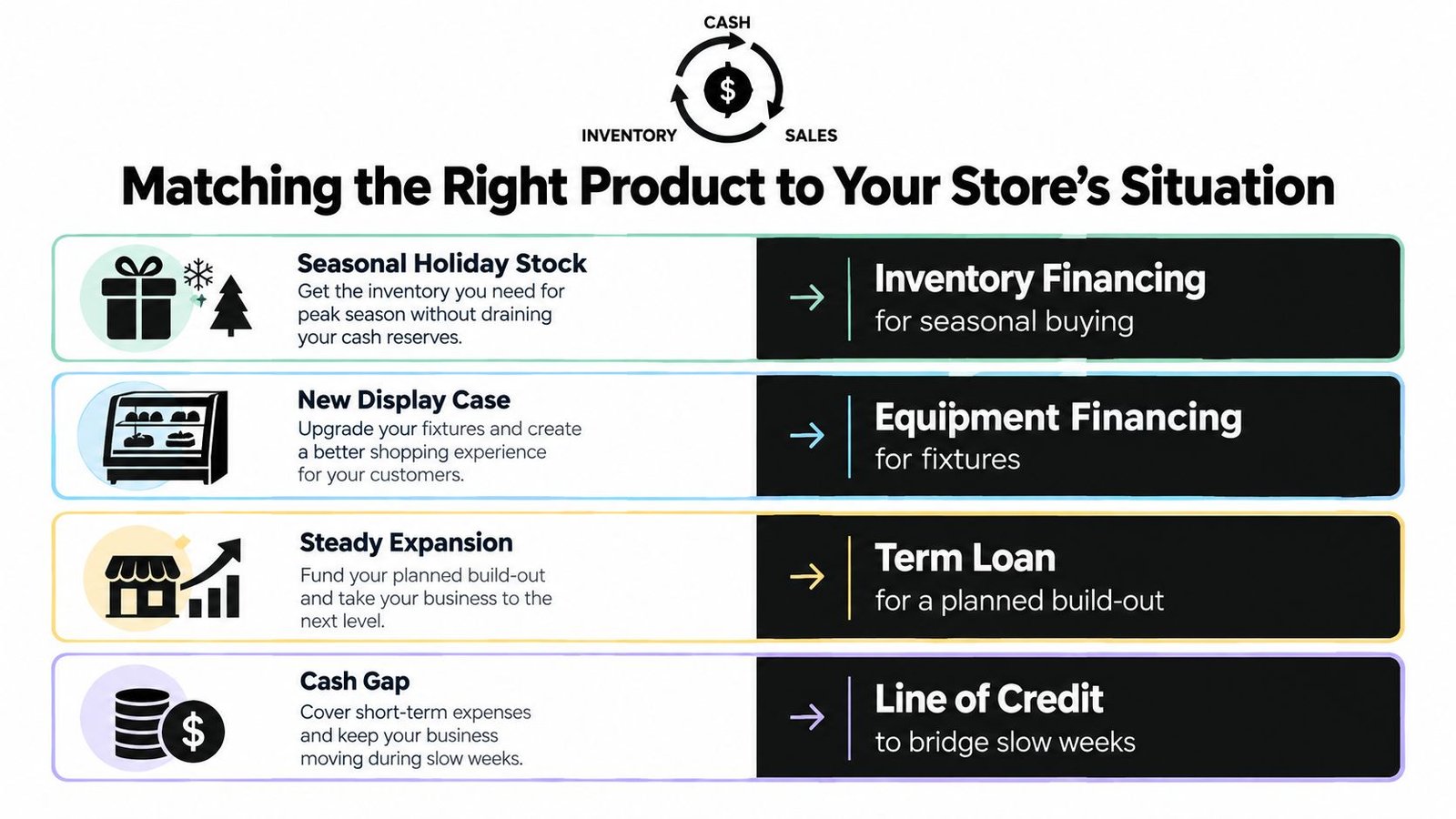
- Seasonal inventory: Use a line of credit or inventory-focused facility when stock should convert within a known selling period.
- Store fixtures or POS equipment: Use equipment financing so the repayment follows the useful life of the asset.
- Planned buildout or second location: Consider a term loan or SBA-backed structure when the investment needs time to produce revenue.
- Short-term cash gap: Use a line of credit when the gap is temporary and the store has a credible repayment event.
- Emergency liquidity: Treat an MCA as a last-resort tool, and stress-test daily or frequent withdrawals before signing.
Business Loan Warrior offers a single application through which owners can explore matched business funding options, including lines of credit, SBA financing, equipment loans, short-term financing, and merchant cash advances. That can help a retailer compare structures, but the owner still needs to verify total repayment, payment frequency, collateral, and the effect of a slow sales period.
Use the cash-conversion test before accepting any offer: identify when the money leaves, when the inventory or investment produces cash, and what repayment looks like if sales weaken. Then visit Business Loan Warrior to review retail-relevant funding options through one application and compare a facility that fits the store's actual operating cycle.