
You've made it through underwriting, answered the lender's final questions, and finally received an SBA loan approval. Then you review the term sheet and see a line labeled SBA guarantee fee. The amount may feel like a last-minute charge, especially when you've already planned every dollar of the project.
It isn't an arbitrary add-on. The fee is part of the cost of using the SBA 7(a) program, and understanding it before closing can help you protect working capital, compare loan structures, and avoid surprises in your net proceeds. This guide explains how the fee works, how lenders calculate it, and what it can do to your long-term borrowing cost. For broader context on the program itself, review this simple guide to SBA loans for small business owners.
Table of Contents
- You Got the SBA Loan Approval Now What Is This Fee
- What the SBA Guarantee Fee Is and Why It Exists
- How the SBA Guarantee Fee Is Calculated in 2026
- The Real Impact on Your Total Loan Cost and APR
- Fee Waivers and Exceptions You Should Know
- Navigating SBA Fees with Business Loan Warrior
You Got the SBA Loan Approval Now What Is This Fee
Consider a business owner who has negotiated a loan for new equipment and expansion. The approved principal looks sufficient, the interest rate appears manageable, and the repayment schedule fits the operating budget. During the closing review, the lender explains that the SBA guarantee fee applies to the portion of the loan backed by the agency.
The first reaction is often, “Wasn't this included in the approval?” Sometimes the fee is disclosed earlier, but it can receive less attention than the interest rate, collateral requirements, or monthly payment. By the time the closing package arrives, the fee suddenly feels like money coming out of the project.
The practical distinction is important. The fee is generally tied to the SBA-guaranteed portion, not automatically to every dollar of the total loan principal. The exact amount depends on the loan size, the applicable fiscal-year rules, the guarantee structure, and whether an exception applies.
What you should ask before closing
Ask the lender to show the calculation in writing. A clear explanation should identify:
- The total loan amount, meaning the principal approved by the lender.
- The guaranteed portion, which is the base used to calculate the fee.
- The applicable fee tier, based on the program rules and loan size.
- Whether the fee is paid from cash or financed, which changes the amount you receive and the interest you pay.
- Any waiver or exception, particularly if your business is veteran-owned or operates in qualifying manufacturing.
That review turns a vague closing charge into a traceable line item. You can then decide whether preserving cash is more valuable than minimizing the total cost of the debt.
Practical rule: Never evaluate an SBA offer from the interest rate alone. Review the fee, financing method, closing costs, repayment term, and net proceeds together.
The fee can be inconvenient, but it also supports the structure that makes SBA-backed lending available through approved lenders. The right question isn't just whether the fee exists. It's whether the guarantee gives your business access to useful repayment terms and a manageable payment after every cost is included.
What the SBA Guarantee Fee Is and Why It Exists
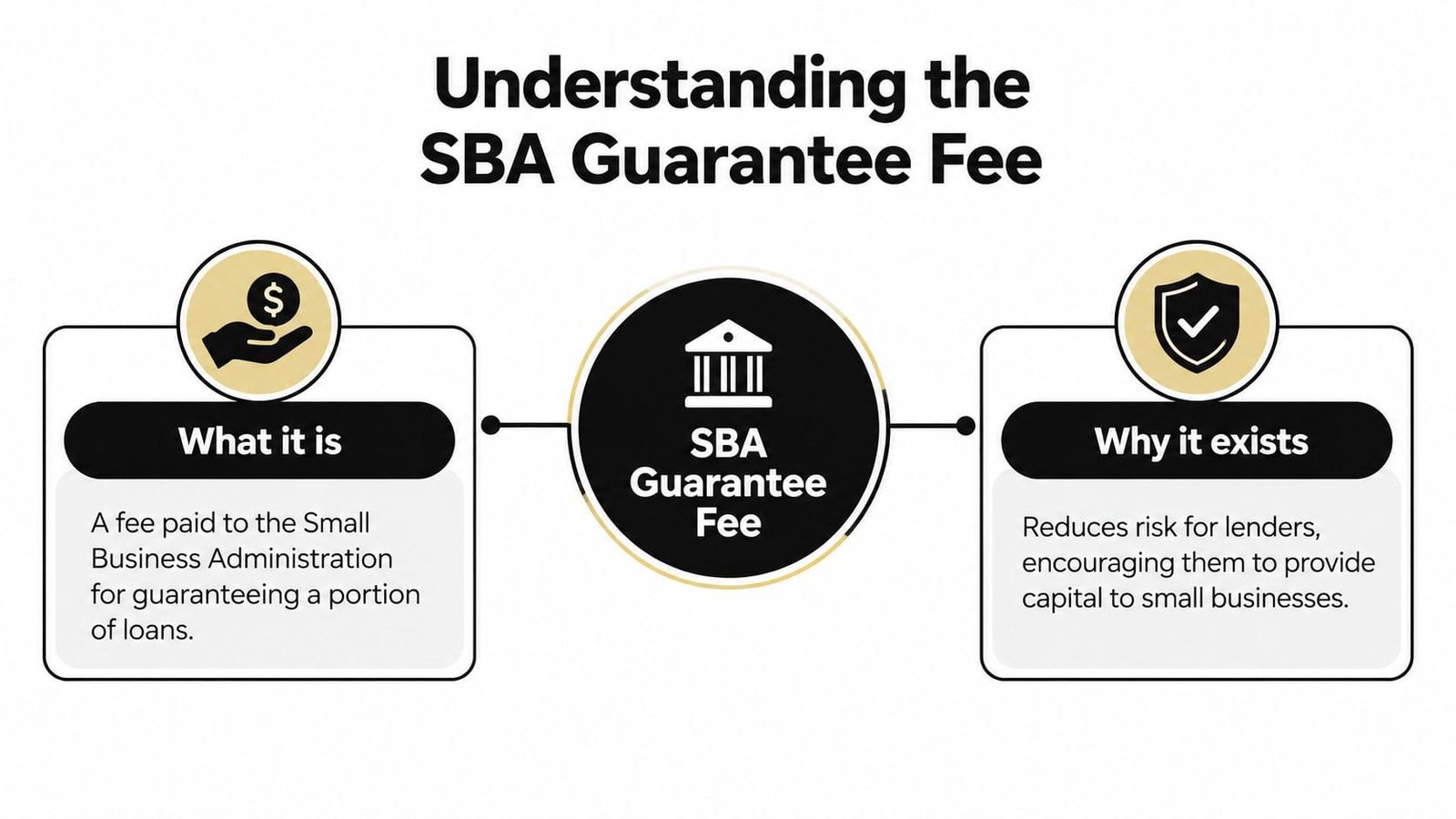
The SBA guarantee fee is a charge associated with the Small Business Administration's guarantee of a portion of an eligible loan. The SBA doesn't function like a conventional lender collecting interest directly from the borrower. Instead, an approved lender makes the loan, while the SBA guarantees an agreed portion under the program's rules.
A useful analogy is private mortgage insurance, or PMI. PMI protects the lender against part of the loss if a borrower defaults. The borrower pays for access to that protection, even though the protection primarily reduces the lender's risk. The SBA guarantee fee works in a similar economic direction. It helps support the government-backed guarantee, which can encourage lenders to consider small-business borrowers and uses of capital that might receive less favorable treatment without that support.
The Congressional Budget Office describes the 7(a) guaranty fee as a long-standing pricing mechanism. Historically, loans with terms of less than one year were charged 0.25% of the guaranteed amount, while longer-term loans used a tiered schedule based on loan size rather than one flat rate. See the Congressional Budget Office discussion of SBA fees for historical context.
What the fee is not
The guarantee fee isn't the same as every other charge in an SBA closing package. Depending on the transaction, a lender may also discuss packaging, appraisal, environmental review, legal, filing, or other third-party expenses. Those costs serve different purposes and may be charged under separate rules.
The guarantee fee specifically relates to the SBA-backed portion of the credit. That distinction matters because a headline percentage applied to the guaranteed share can produce a different dollar amount than the same percentage applied to the full loan.
Why lenders care about the guarantee
A lender evaluates repayment risk, collateral, cash flow, management, and the purpose of the loan. The SBA guarantee doesn't remove the borrower's obligation to repay, and it doesn't turn an unsafe project into a safe one. It does provide the lender with a government-backed layer of protection under the program's requirements.
That protection can influence whether the lender is willing to offer financing, how the transaction is structured, and whether the repayment period fits the business's projected cash flow. The trade-off is that the borrower must follow program requirements and absorb the costs associated with the guarantee.
If you want a broader explanation of how intermediaries can earn money through financial products, a separate 2026 insurance broker payment guide offers useful background. The comparison is helpful because it reinforces a basic principle: understand who receives a fee, what service or protection it supports, and whether the charge is passed through directly or reflected in pricing.
How the SBA Guarantee Fee Is Calculated in 2026
For FY 2026, the 7(a) upfront guaranty fee is tiered by loan size and calculated on the guaranteed portion. The official SBA fee calculator lists 2% for loans of $150,000 or less, 3% for loans from $150,001 to $700,000, and, for loans from $700,001 to $5 million, 3.5% on the first $1 million of guaranteed dollars plus 3.75% above that threshold. Review the SBA 7(a) loan guaranty fee calculator when checking a live transaction.
| Total Loan Amount | Fee on Guaranteed Portion | Sample Calculation ($500,000 Loan w/ 75% Guarantee) |
|---|---|---|
| $150,000 or less | 2% | A $500,000 example doesn't fall in this tier |
| $150,001 to $700,000 | 3% | $500,000 × 75% = $375,000 guaranteed portion. $375,000 × 3% = $11,250 |
| $700,001 to $5 million | 3.5% on the first $1 million of guaranteed dollars, plus 3.75% above $1 million | The applicable calculation depends on the guaranteed amount and whether it exceeds $1 million |
The table uses the loan amount and guarantee percentage separately. That's the part many borrowers miss. A $500,000 loan with a 75% guarantee has a guaranteed portion of $375,000, so the fee calculation uses $375,000, not the full $500,000.
Three ways to read the calculation
Small loan example. Suppose a loan is $150,000 or less and the lender identifies the guaranteed portion as $112,500. The applicable rate is 2%, so the illustrative fee on that guaranteed portion would be $2,250. The exact guarantee percentage and final closing treatment must come from the lender.
Mid-sized loan example. The required table example uses a $500,000 loan with a 75% guarantee. The guaranteed portion is $375,000, and the 3% tier produces an illustrative fee of $11,250. If the lender finances that charge, the borrower's debt balance increases compared with paying the fee from available cash.
Larger loan example. Consider a loan above $1 million where the guaranteed portion exceeds $1 million. The first $1 million of guaranteed dollars receives the 3.5% rate, while the guaranteed dollars above that level receive 3.75%. That split means you shouldn't multiply the entire guaranteed amount by 3.75%.
The fee behaves like a staircase, not a ramp. Crossing a threshold can change the marginal treatment of the next portion of guaranteed dollars, so loan sizing and structure deserve careful review.
The FY 2026 schedule creates important cutoff effects at $150,000, $700,000, and $1 million of guaranteed dollars, with the last threshold affecting the higher tier. A lender may need to compare the requested amount, the guarantee percentage, and the use of proceeds before recommending a structure.
For a second perspective on borrowing math, this guide to calculating the real cost of a small-business loan can help you organize fees, interest, and repayment effects in one analysis. Don't rely on a rough percentage applied to the face amount. Request the lender's actual fee worksheet and confirm whether the quoted amount includes only the guaranty fee or other closing costs as well.
The Real Impact on Your Total Loan Cost and APR
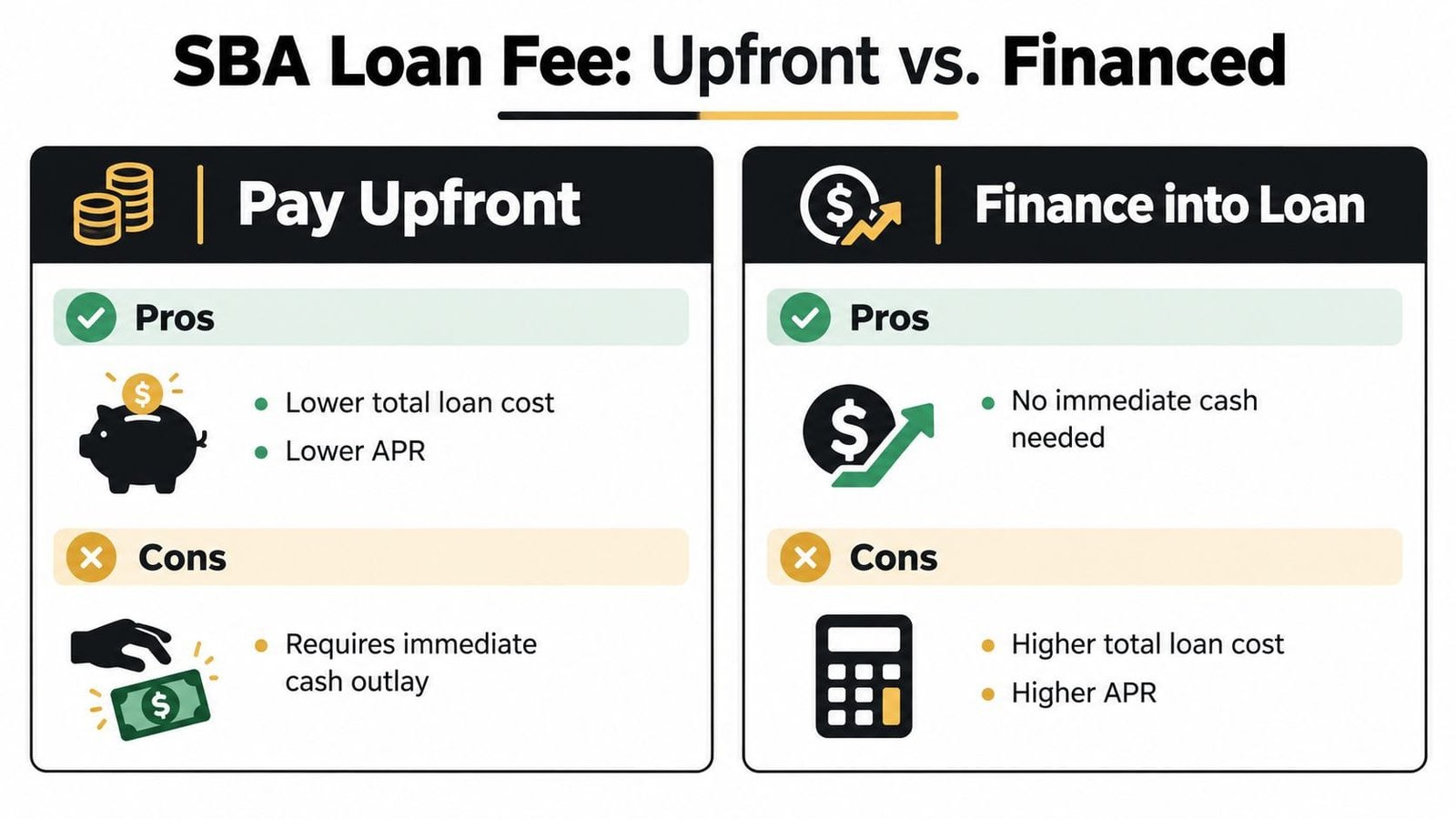
The fee's most important effect often appears after closing. You usually face a choice: pay the fee from cash or finance it as part of the loan.
Paying upfront uses liquidity immediately, but it keeps the financed principal lower. Financing the fee preserves cash for inventory, payroll, equipment installation, or another business need, but it adds the fee to the debt balance. The borrower then pays interest on that financed amount under the loan's repayment terms.
The cash-versus-debt trade-off
Assume the lender calculates a fee of $11,250 on a transaction. If the borrower pays that fee at closing, the loan principal remains tied to the approved financing amount. If the borrower finances it, the balance includes the additional $11,250, subject to the lender's documentation and program rules.
The extra interest can be described precisely only when the interest rate, payment frequency, amortization method, repayment term, and prepayment behavior are known. A 10-year comparison, for example, requires those inputs. Without them, claiming a specific total-interest difference would create false precision.
Use this framework instead:
| Choice | Immediate cash effect | Long-term effect |
|---|---|---|
| Pay upfront | Requires cash at closing | Avoids interest on the financed fee |
| Finance the fee | Preserves cash initially | Increases principal, interest, and total repayment |
| Compare both | Shows the liquidity trade-off | Helps identify the true all-in cost |
The fee can also affect APR, because APR is intended to reflect more than the nominal interest rate. A loan with the same stated rate can have a higher effective borrowing cost when the borrower finances an upfront charge. For a practical explanation of the distinction, review this guide to APR versus interest rate.
When preserving cash makes sense
Financing may be rational when the retained cash protects the business from a near-term liquidity problem or supports an investment that should generate operating value. Paying upfront may be stronger when the business has a reliable cash reserve and wants to reduce total debt cost.
The right answer isn't automatically “always pay cash.” A business with thin working capital can suffer more from losing liquidity than from carrying a modestly larger balance. Conversely, a business with substantial reserves may not benefit from paying interest on a charge it could have settled at closing.
The SBA's 2025 fee notice also identifies a 0.55% annual service fee on the guaranteed portion of the outstanding balance, paid by lenders but capable of influencing lender pricing and appetite in practice. Read the official SBA fee revision notice%20Fees%20(including%20the%207(a).pdf) when reviewing how current fee policy may affect a lender's offer.
Fee Waivers and Exceptions You Should Know
The standard fee schedule isn't universal in every practical situation. The SBA has used waivers and reductions as policy tools, and eligibility can depend on the borrower type, product, loan size, and fiscal-year guidance.
Veteran-owned businesses deserve particular attention. Congress and SBA records show that the agency waived the upfront guaranty fee for veteran-owned businesses using the 7(a) SBAExpress program on loans up to $350,000 from January 1, 2014, through the end of FY2015. That historical example doesn't guarantee the same treatment today, but it proves why borrowers should ask about current veteran-specific relief instead of assuming the standard table applies.

Borrower categories that need a closer review
Recent fee guidance and industry coverage identify potential zero-fee exceptions for some qualifying manufacturers with 7(a) loans of $950,000 or less and for veteran-owned businesses using SBA Express loans. Because these exceptions depend on current eligibility rules and documentation, the lender should confirm qualification before the borrower relies on the savings in a budget.
The thresholds can influence planning. A request near a cutoff may produce a different fee result if the final approved amount, guaranteed portion, or borrower classification changes. That doesn't mean a business should distort its financing need to chase a threshold. It does mean the borrower should understand the consequences before finalizing the request.
Ask the lender these questions:
- Does my ownership qualify for a current veteran-related waiver?
- Does my manufacturing activity meet the current definition and documentation standard?
- Is the threshold measured by total loan amount or guaranteed dollars?
- Does the waiver apply to my specific 7(a) product?
- Will a change in loan size remove the exception?
A waiver should appear in the lender's written calculation, not only in a verbal explanation. Keep the supporting ownership, industry, and loan-purpose documents with the closing file.
For visual guidance on reviewing financing paperwork, the following video can complement your lender's explanation:
Policy changes can occur between fiscal years, so treat online summaries as starting points rather than final approval documents. Confirm the current rule with the lender and the applicable SBA notice before signing.
Navigating SBA Fees with Business Loan Warrior
The SBA guarantee fee is easier to manage when you treat it as part of the financing decision rather than a surprise closing expense. Start with the guaranteed portion, apply the correct FY 2026 tier, and then compare the result under two funding choices: paying the fee from cash or financing it.
The lender's worksheet should answer the central questions:
- What is the guaranteed portion?
- Which fee tier applies?
- Does a waiver or exception reduce the fee?
- Will the fee lower net proceeds if paid upfront?
- What is the projected payment if the fee is financed?
- How does each option affect total repayment and effective borrowing cost?
A strong review also considers the business purpose. A company borrowing for equipment may value preserving cash for installation and operating reserves. A company refinancing debt may focus more heavily on reducing the total cost of the new obligation. A seasonal business may prefer liquidity during its busy period, even if financing the fee creates a higher balance.
What good fee analysis looks like
Good analysis doesn't stop at the percentage. It connects the charge to net proceeds, monthly affordability, total interest, APR, lender pricing, and waiver eligibility. It also tests whether the proposed loan amount is appropriately sized instead of assuming that a larger approval is automatically better.
What doesn't work is accepting a quoted fee without checking the base. Applying the rate to the full principal when the rules call for the guaranteed portion can overstate the estimate. The opposite mistake, ignoring a financed fee when comparing offers, can understate the actual debt burden.
Business Loan Warrior can help business owners examine financing options with a clearer view of the complete cost structure. Its platform supports SBA loan processing and other funding options, allowing borrowers to compare the role of fees, repayment terms, cash flow needs, and loan purpose rather than focusing on one number.
The practical objective is simple. You want enough capital to complete the project, enough liquidity to operate after closing, and a repayment structure the business can carry. Understanding the guarantee fee helps you make that decision with fewer assumptions and better questions for the lender.
Business Loan Warrior helps small-business owners review funding options, including SBA financing, with greater transparency around fees, repayment structure, and net proceeds. Visit Business Loan Warrior to explore your options and start a clear financing conversation before you commit to a loan.