
You've had the encouraging bank conversation. The lender likes your revenue, understands the expansion plan, and says the request looks reasonable. Then the SBA application arrives, followed by requests for ownership records, tax returns, debt schedules, personal financial statements, and explanations for every gap between your books and your bank statements.
That reaction is normal. SBA loan requirements are not difficult because the program is mysterious. They're difficult because eligibility, repayment capacity, ownership, use of funds, and federal compliance are reviewed together. The most important change for 2025 and 2026 is ownership certification. A business that appears eligible at first glance can still fail when the lender verifies every direct and indirect owner, guarantor, and key employee.
Table of Contents
- Why SBA Loan Requirements Feel Harder Than a Bank Loan
- How the SBA and Your Lender Actually Work Together
- The Four Legal SBA Eligibility Pillars
- Credit Score, Cash Flow, and Time in Business
- Collateral and the SBA Guaranty Structure
- The 2025 Ownership Rule Change Most Borrowers Miss
- Documents, Underwriting, and the Realistic Timeline
- Your Pre-Application Checklist and Next Steps
Why SBA Loan Requirements Feel Harder Than a Bank Loan
A conventional bank loan may begin with a short conversation about revenue, collateral, and the amount you want to borrow. An SBA-backed loan adds another layer because the lender is seeking a federal guaranty. The SBA usually doesn't fund the loan directly. Instead, it establishes program rules that the participating lender must follow before relying on that guaranty.
That changes the file immediately. The lender reviews the business under its own credit policy, while also documenting whether the borrower meets federal eligibility standards. Ownership, business size, industry, use of proceeds, repayment ability, and the credit-elsewhere test can all affect the file at the same time. The SBA's lender guidance describes these requirements as core program conditions, not optional preferences. SBA lender guidance explains the framework lenders use when making SBA-backed loans.
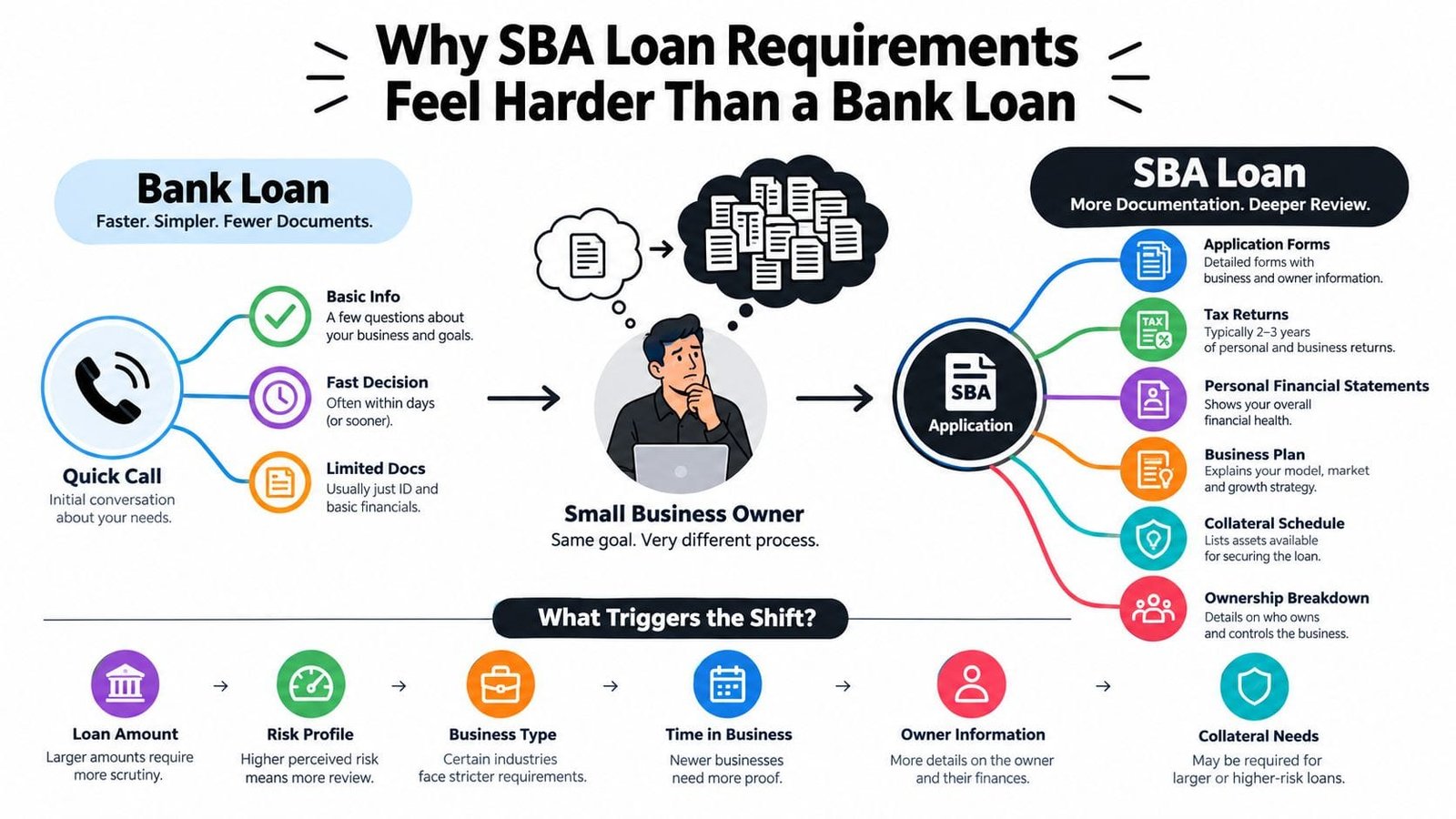
I tell owners to sort the application into four practical buckets before submitting anything:
- Legal eligibility: Is the business for profit, operating in the United States, small under SBA standards, and outside an ineligible industry?
- Financial readiness: Can the business demonstrate a reasonable ability to repay the requested debt?
- Collateral and guaranty positioning: What assets and guarantees support the structure, and how much lender risk remains?
- Documentation: Can the borrower prove every important statement with consistent records?
The paperwork itself isn't the main problem. The problem is submitting documents that conflict. A tax return showing one level of income, bank statements showing another, and an ownership agreement that doesn't match the application will force the lender to pause.
Clean financial administration helps before the application begins. For example, an owner who uses automated expense management can create a clearer record of business spending and reduce the manual work involved in organizing transaction history. That won't replace underwriting, but it can make the financial story easier to verify.
The SBA process rewards preparation, not optimism. If you identify the four buckets early, you'll know whether you need a different program, a cleaner ownership structure, more evidence of repayment capacity, or a better-organized file.
How the SBA and Your Lender Actually Work Together
The SBA is a federal guarantor, not the lender handing you the proceeds. A participating bank, credit union, Community Development Financial Institution, or non-bank SBA lender evaluates the business, structures the loan, closes the transaction, and services the debt. The SBA's role is to establish eligibility rules and guarantee a stated portion of an eligible loan.
That distinction matters when questions arise. Ask the lender about its credit policy, required financial strength, collateral preferences, pricing, and approval process. Ask whether the proposed use of funds fits the chosen SBA program. The lender must also document why the transaction qualifies for the guaranty.
SBA 7(a) is the flexible, general-purpose option. It can support eligible working capital and other business purposes, subject to the program's rules and the lender's underwriting. SBA 504 is structured around fixed assets and uses a Certified Development Company, or CDC, alongside a third-party lender. The SBA's 504 loan guidance describes its distinct capital structure and owner-occupancy requirements.
| Feature | SBA 7(a) | SBA 504 |
|---|---|---|
| Primary role | Flexible business financing | Long-term fixed-asset financing |
| Funding partners | Participating SBA lender | Third-party lender and CDC |
| Common fit | Working capital, eligible business needs, and broader-purpose financing | Owner-occupied commercial real estate or major fixed assets |
| SBA guaranty structure | SBA guarantees a defined portion of the lender's loan | CDC debenture structure supports the fixed-asset project |
| Main screening issue | Eligibility, repayment capacity, credit gap, and use of proceeds | Fixed-asset purpose, project structure, equity, and occupancy |
The lender performs the commercial underwriting. SBA procedures govern how the lender documents eligibility and seeks guaranty authorization. That's why two lenders can reach different decisions on the same borrower. The SBA sets the program floor, but the lender decides how much risk it's willing to accept above that floor.
For a practical comparison of government-backed and conventional financing, review this guide to SBA loans versus bank loans. The right question isn't whether SBA financing is always better. It's whether the SBA structure solves a financing problem that a conventional lender won't solve on reasonable terms.
The Four Legal SBA Eligibility Pillars
A business can have strong revenue and still fail the SBA's legal screening before the lender evaluates repayment capacity. The modern SBA 7(a) program requires an operating, for-profit business in the United States, compliance with SBA size standards, an eligible industry, a reasonable ability to repay, and proof that credit is unavailable elsewhere on reasonable terms. The SBA's 7(a) requirements make clear that calling a company “small” does not satisfy the program.
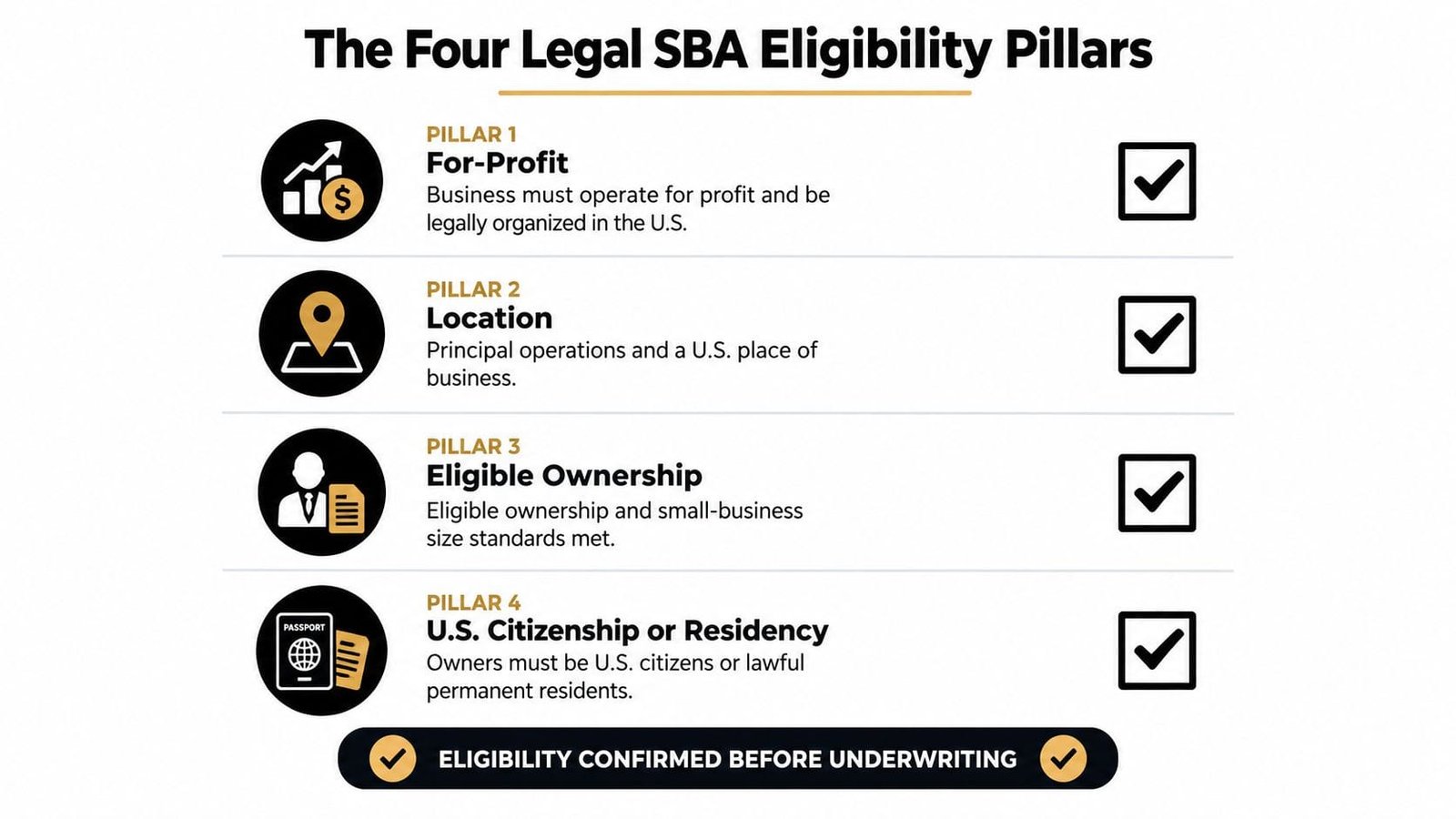
1. Operating and for-profit status
The applicant must be an active, for-profit business legally organized to operate in the United States. Expect the lender to verify the legal entity, formation records, licenses, tax identification details, and the activity reported under the business's NAICS classification.
A nonprofit, an overseas operation, or a company whose primary activity falls within an ineligible category can fail before credit strength enters the discussion. Describe the business by what it does, how it earns money, and where it operates. The label you prefer is less useful than clear documentation.
2. Size and ownership
The company must meet the SBA size standard for its industry. The standard may depend on employee count or receipts, and the lender may need information about affiliated businesses as well as the applicant.
Ownership requires early attention. Under the rule change effective June 1, 2025, the SBA framework requires 100% of direct and indirect owners, guarantors, and key employees to be U.S. citizens, U.S. nationals, or lawful permanent residents. Congressional Research Service coverage of the change explains why mixed ownership structures now receive more detailed review. Confirm this structure before submitting an application, not after underwriting begins.
3. The credit-elsewhere test
The lender must establish that the business cannot obtain the requested credit on reasonable terms from non-federal, non-state, or non-local sources. A profitable restaurant group may still need to explain why a conventional lender will not fund its expansion. A self-employed consultant may have strong income but lack the collateral or financing structure a conventional lender requires.
The credit-elsewhere test supports the SBA guaranty. It is not a reward for weak finances. Strong revenue without a documented financing gap can leave the lender unable to justify the request.
4. Repayment and business purpose
The borrower must show a reasonable ability to repay and identify a legitimate business purpose. The lender will connect the requested proceeds to operating needs, acquisition costs, equipment, property, inventory, or another eligible use.
“Growth capital” is too vague on its own. State what the money will purchase, why the purchase supports the business, and how the resulting cash flow will cover the debt.
Practical rule: If you cannot explain the business purpose, repayment source, and credit gap in plain language, do not submit the application yet.
A lender-friendly file clears all four pillars before credit analysis begins. Review the ownership rule in the dedicated later section, then assemble documents that support each requirement.
Credit Score, Cash Flow, and Time in Business
There is no single universal credit-score threshold in the verified SBA framework. Lenders set their own standards, and they evaluate personal credit alongside repayment capacity, debt obligations, management experience, and the quality of the financial records.
That means owners should stop treating a score as the entire application. A strong personal credit profile won't rescue a business with inconsistent cash flow or unexplained losses. Conversely, a credit blemish may be manageable when the borrower can document what happened, show that the issue is resolved, and present a repayment plan that makes sense.
What the underwriter actually tests
The underwriter is looking for evidence that the business can carry the proposed payment while continuing to operate. That review generally includes:
- Personal credit history: The lender examines how owners have handled obligations, not just the current score.
- Business cash flow: Historical performance and current results need to support the proposed debt.
- Existing liabilities: The new loan is added to current obligations, so the lender needs a complete debt picture.
- Operating history: A mature operating record usually gives the lender more evidence than a projection alone.
- Management capacity: The lender evaluates whether the people running the business can execute the plan.
A newer company isn't automatically impossible, but it must compensate with a stronger overall file. That may mean owner experience, a well-supported acquisition, a clear source of equity, or a lender whose policy fits the business. Don't present a young company as established. Explain what the owners have done, what the business has already proven, and what the requested financing changes.
Underwriting benchmarks in context
The table below uses qualitative guidance because the SBA doesn't publish one universal score, revenue, debt-to-income, or DSCR cutoff for every lender and program.
| Metric | 7(a) typical review | 504 typical review | Microloan typical review |
|---|---|---|---|
| Personal credit | Lender-specific review of repayment history and score | Lender and CDC review of personal credit and repayment behavior | Intermediary review of personal credit, character, and capacity |
| Cash flow | Must support a reasonable ability to repay | Must support the project and resulting obligations | Business readiness and repayment capacity remain central |
| Time in business | Operating history helps, but lender policy controls | Operating history and project strength are important | Newer businesses may receive a more individualized review |
| Revenue | Consistency and quality matter more than a generic minimum | Cash flow must support the fixed-asset structure | Business viability and management capacity receive close attention |
| Debt load | Existing obligations are analyzed with the new request | Existing debt affects project affordability | The intermediary assesses total repayment burden |
Owners who need better strategic financing for small business decisions should also review cash-flow management guidance from Blue Sage Tax & Accounting Inc.. The useful question is not “What score gets approved?” It's “What evidence makes repayment believable to this lender?”
Collateral and the SBA Guaranty Structure
Collateral and the SBA guaranty address different lender concerns. Collateral provides a recovery source after default. The guaranty covers the lender's eligible exposure. Neither removes the owner's responsibility for repayment.
For 7(a) loans, the SBA maximum guaranty is 85% for loans of $150,000 or less, 75% for loans above $150,000, and 50% for SBA Express loans. Separate export-related programs can receive 90% guarantees. These percentages come from the SBA program framework described in SBA lender guidance, not from a lender's informal preference.
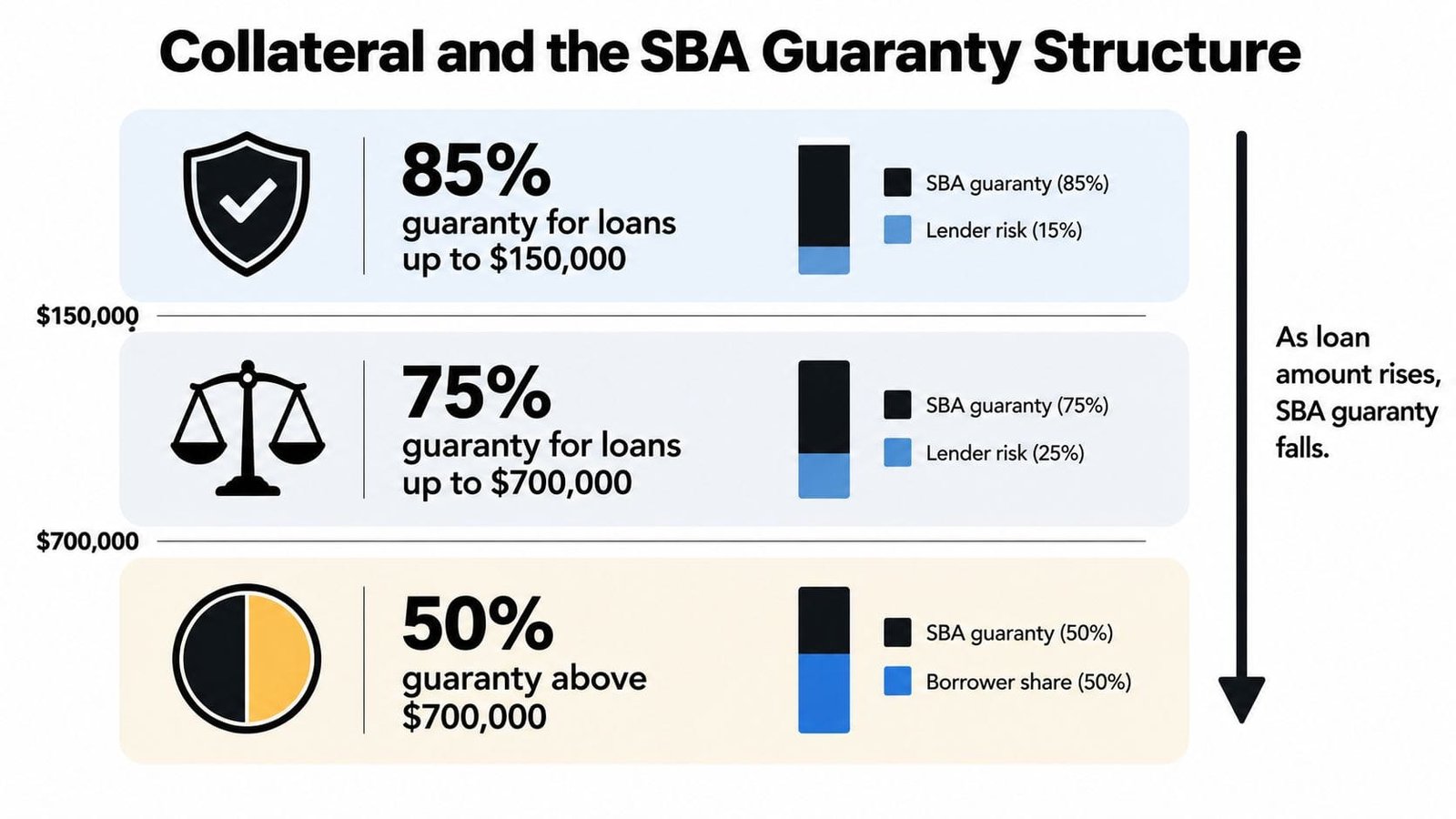
A higher guaranty lowers the lender's potential loss, but it does not secure approval. Underwriting still tests repayment ability, available collateral, equity, business purpose, and the lender's risk standards. A service company with few hard assets can qualify when cash flow supports the debt. A real-estate-heavy acquisition can still fail when projected income does not cover the new obligation.
For a 504 project, the typical structure is 10% borrower contribution, 50% third-party lender funding, and 40% CDC funding. The equity injection rises to 15% for startups or special-purpose property, and to 20% when both conditions apply. Owner occupancy generally must reach 51% for existing buildings and 60% for new construction. The SBA 504 loan requirements explain the program framework.
Expect the lender to take available business collateral and request appropriate personal guarantees. Existing liens may require subordination or an intercreditor agreement. For 2025 and 2026 applications, add ownership certification to this same eligibility check before underwriting begins. The practical question is not whether collateral is technically required. Ask what collateral, guarantees, and ownership documentation this lender expects for the proposed structure.
The 2025 Ownership Rule Change Most Borrowers Miss
An application can show strong revenue, clean financials, and an experienced operator, then fail at ownership review. For applications submitted in 2025 or 2026, lenders must examine more than the person who controls the company. Under the updated framework, 100% of direct and indirect owners, guarantors, and key employees must be U.S. citizens, U.S. nationals, or lawful permanent residents. The rule took effect June 1, 2025. The Congressional Research Service summary explains the change and its effect on SBA ownership screening.
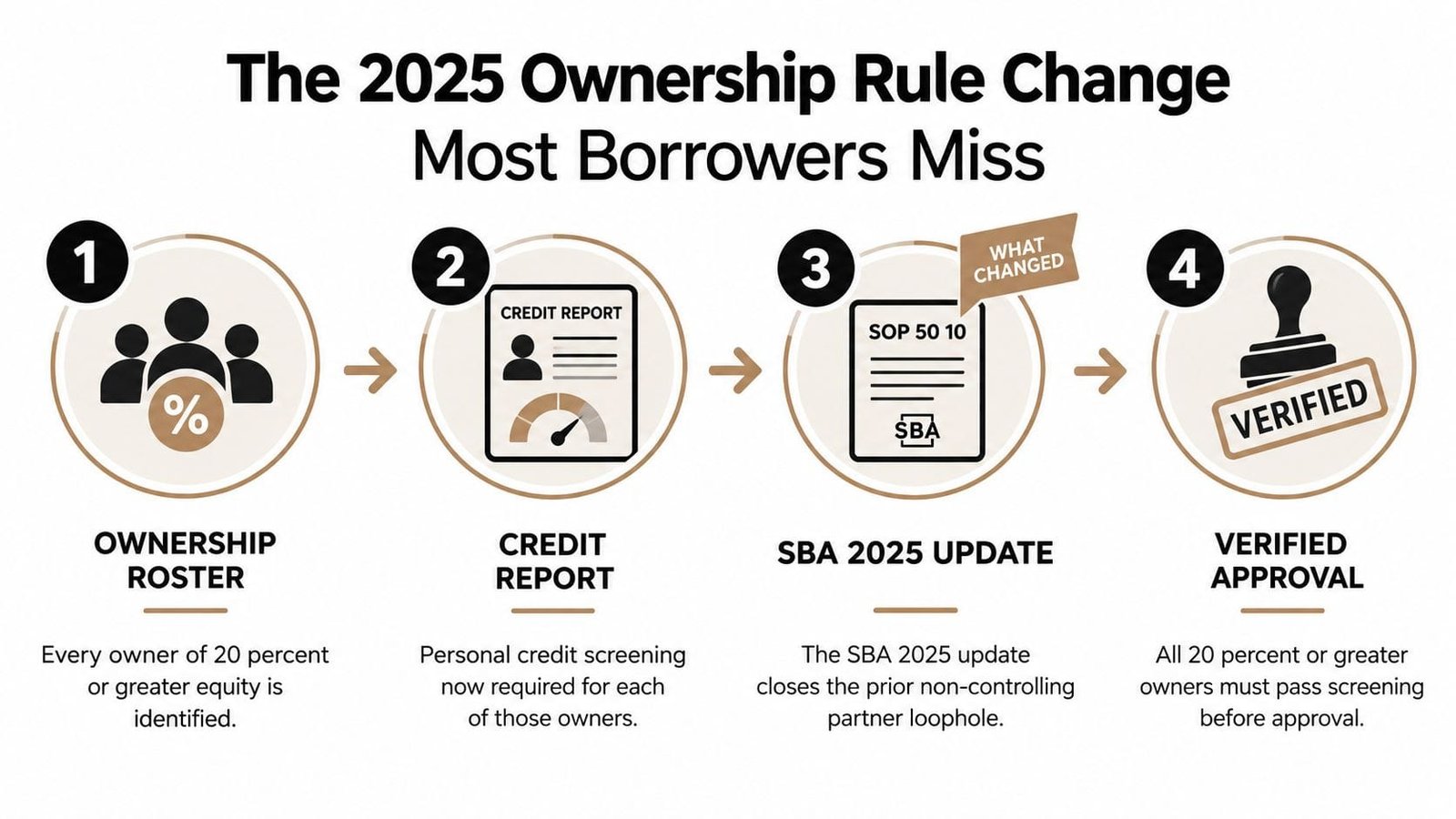
Start with the ownership chain, not the loan application. Direct ownership is only the first layer. A parent company, holding company, trust, or other entity can conceal additional owners who still fall within the review. Family businesses with several entities, acquisitions involving partial owners, and immigrant-founded companies should map every connection before the lender prepares its eligibility certification.
Acquisitions create a frequent problem. A partial owner entering through the transaction may need to become a co-borrower and complete the same review. Majority control does not make that person invisible.
Prepare the ownership file before the credit file
Build a lender-ready schedule covering:
- Direct owners: Every person and entity holding an interest in the operating company.
- Indirect owners: The people behind parent companies, holding companies, trusts, or other ownership layers.
- Guarantors and key employees: Individuals whose roles place them within the certification review.
- Acquisition participants: Any partial owner joining the company through the transaction.
- Status documentation: Evidence of citizenship, nationality, or lawful permanent residence.
Refugees, undocumented owners, foreign nationals, and partial acquirers should raise the issue before submitting financial documents. U.S. revenue does not resolve an ownership eligibility problem. The lender must confirm that the people and entities connected to the applicant satisfy the certification requirements.
The candid answer: A clean profit-and-loss statement cannot repair an ownership structure that fails the SBA eligibility test. Get the ownership chart and status documents reviewed first.
Documents, Underwriting, and the Realistic Timeline
An SBA file moves when the documents tell one consistent story. The lender wants to understand how the business operates, who owns it, what it owes, what it owns, how the loan will be used, and how repayment will occur.
Start with the core package:
- Business tax returns: Provide the historical filings the lender requests.
- Interim financials: Include a current profit-and-loss statement and balance sheet.
- Bank statements: Give the lender a current view of deposits, withdrawals, and cash management.
- Debt schedule: List every existing obligation, payment, maturity, and balance.
- Accounts receivable and payable aging: Explain collection timing and outstanding vendor obligations.
- Personal financials: Prepare SBA Form 413 and the supporting personal tax information.
- Legal records: Gather formation documents, operating agreements, ownership records, licenses, leases, and purchase agreements where applicable.
The 7(a) package may include forms such as SBA Form 1919, Form 1920, Form 159D, and Form 601. A 504 transaction adds the CDC and project documentation, including the relevant borrower and lender packages. The exact request varies by lender and transaction, so don't assume a checklist from one institution applies everywhere.
What happens after intake
The lender first reviews completeness, eligibility, business purpose, and repayment capacity. It may then seek additional support for collateral, ownership, equity, or the credit-elsewhere determination. The SBA review concerns guaranty eligibility, while the lender remains responsible for its credit decision and closing process.
A realistic process can take roughly 60 to 90 days, but that is a planning range rather than a promise. Delays usually come from missing records, inconsistent financials, unclear ownership, unresolved liens, or a late request for evidence supporting the credit gap.
For a fuller explanation of the lender's sequence, review the SBA loan underwriting process. Treat every follow-up request as a question about risk, not as busywork. If the lender asks why deposits fluctuate, explain the seasonality. If it asks about a related entity, provide the ownership connection. Silence creates more risk than an unfavorable fact that you explain clearly.
Your Pre-Application Checklist and Next Steps
Run this checklist before asking for a term sheet. If an item is missing, fix it before the lender discovers it.
Legal and ownership readiness
- Entity records: Confirm the EIN, formation documents, operating agreement, licenses, and current registrations.
- Ownership map: Show every direct and indirect owner, including ownership through other entities or trusts.
- 2025 certification packet: Prepare identity and status documents for owners, guarantors, key employees, and any partial acquirer.
- Business purpose: State exactly what the proceeds will fund and why the request benefits the operating business.
- Industry review: Confirm that the company's actual activity and NAICS classification fit SBA eligibility.
Financial readiness
- Tax returns: Assemble complete business and personal filings and reconcile them to current results.
- Current statements: Prepare an interim profit-and-loss statement, balance sheet, bank statements, and aging reports.
- Debt schedule: Include every business and personally guaranteed obligation.
- Repayment explanation: Show how existing operations will support the proposed payment.
- Equity and collateral: Document the source of any equity contribution and identify available collateral.
Credit readiness
- Pull reports early: Review personal and business credit before the lender does.
- Resolve errors: Dispute inaccurate information and document resolved delinquencies.
- Explain exceptions: Prepare a short, factual explanation for judgments, late payments, tax problems, or unusual debt.
- Avoid new surprises: Don't take on unnecessary obligations while the application is under review.
Common questions
Does a U.S. business automatically qualify? No. The business must also meet size, industry, repayment, credit-elsewhere, ownership, and use-of-funds requirements.
Can a strong owner compensate for a weak business? Sometimes the owner's experience and financial strength help, but the operating business still needs a credible repayment story.
Does a lawful permanent resident face the same ownership review as a citizen? Lawful permanent residents are included in the eligible status categories described in the 2025 framework, but the lender still needs complete documentation.
Can a partial acquisition owner stay outside the application? Not necessarily. A partial owner may need to become a co-borrower and participate in the certification process.
Is collateral the deciding factor? No. Collateral matters, but the lender also needs legal eligibility, a defensible credit gap, a legitimate use of proceeds, and reasonable repayment ability.
Start with the ownership map and the financial reconciliation. Those two exercises expose the problems that most often delay an otherwise promising SBA application.
Business Loan Warrior offers SBA loan processing, lender matching, and pre-qualification support for owners who want to test their readiness before submitting a full application. Visit Business Loan Warrior to review your financing options, organize the next step, and connect with a lender suited to your business purpose and eligibility profile.