
A distributor lands a large purchase order, but the cash arrives long after the supplier deposits, payroll, freight, and inventory bills come due. The revenue is real. The timing is the problem. That's the moment owners start searching for an SBA loan vs a line of credit, usually with pressure building by the week.
The choice isn't about finding the universally cheaper product. It's about matching repayment behavior to the way your business uses cash. An SBA term loan puts a defined amount into the business and starts amortizing immediately. A conventional line of credit gives you a ceiling, lets you draw as needed, and charges interest on the balance you use.
There's also a third option many comparisons miss. SBA-backed revolving products, including CAPLines, can support certain working-capital cycles, but they aren't interchangeable with a standard bank line. The right answer depends first on whether you're funding a one-time capital event or recurring cash-flow movement.
Table of Contents
- The Moment Most Owners Hit This Crossroads
- What Each Product Is and How It Works
- Side-by-Side Comparison Across the Decision Criteria
- The Hidden Cost Story Behind Headline Rates
- Three Real Scenarios That Show Which One Wins
- Can You Actually Get an SBA Line of Credit
- Your Decision Checklist and Application Path
The Moment Most Owners Hit This Crossroads
The owner of a regional distributor receives a purchase order that should produce substantial revenue, but fulfillment requires cash before the customer pays. Supplier deposits are due. Employees still need to be paid. Freight and storage costs don't wait for the receivable to clear. The company has enough cash to cover ordinary operations, but not enough to fund the order and protect its normal runway at the same time.
A term loan looks attractive because it creates a predictable payment and can support a large planned investment. An SBA 7(a) loan can reach $5 million, with maximum variable-rate formulas tied to the base rate and loan size, according to the SBA's 7(a) program guidance. That structure is useful when the business knows exactly how much it needs and can repay the debt over a defined period.
But the distributor may not need a permanent lump sum. It may need to draw for inventory, repay after customer collections, and draw again during the next order cycle. A line of credit fits that behavior better. The trade-off is that conventional lines can carry much wider pricing, from traditional bank rates to considerably higher alternative-lender APRs, as documented in current business financing rate comparisons.
The timing test
Ask one question before discussing rates: Will the same dollars be needed repeatedly, or only once?
A machine purchase, acquisition, buildout, or permanent expansion usually creates a one-time capital need. A line used for that purpose can leave you with a floating balance and no clean repayment endpoint.
Inventory purchases, payroll timing, receivables gaps, and seasonal orders behave differently. They rise and fall with operations. A revolving facility can prevent the business from borrowing, repaying, and refinancing a new term loan every time the cash cycle changes.
Practical rule: Use term debt for an asset or project with a clear payback period. Use revolving credit for a cash cycle that repeats.
An SBA loan is often cheaper and more stable, but it can't solve a funding emergency if the lender's process takes longer than your supplier's deadline. A conventional line can be faster and more elastic, but carrying it for months can turn convenience into expensive permanent debt. The product should follow the cash pattern, not the owner's preference for a familiar lender.
What Each Product Is and How It Works
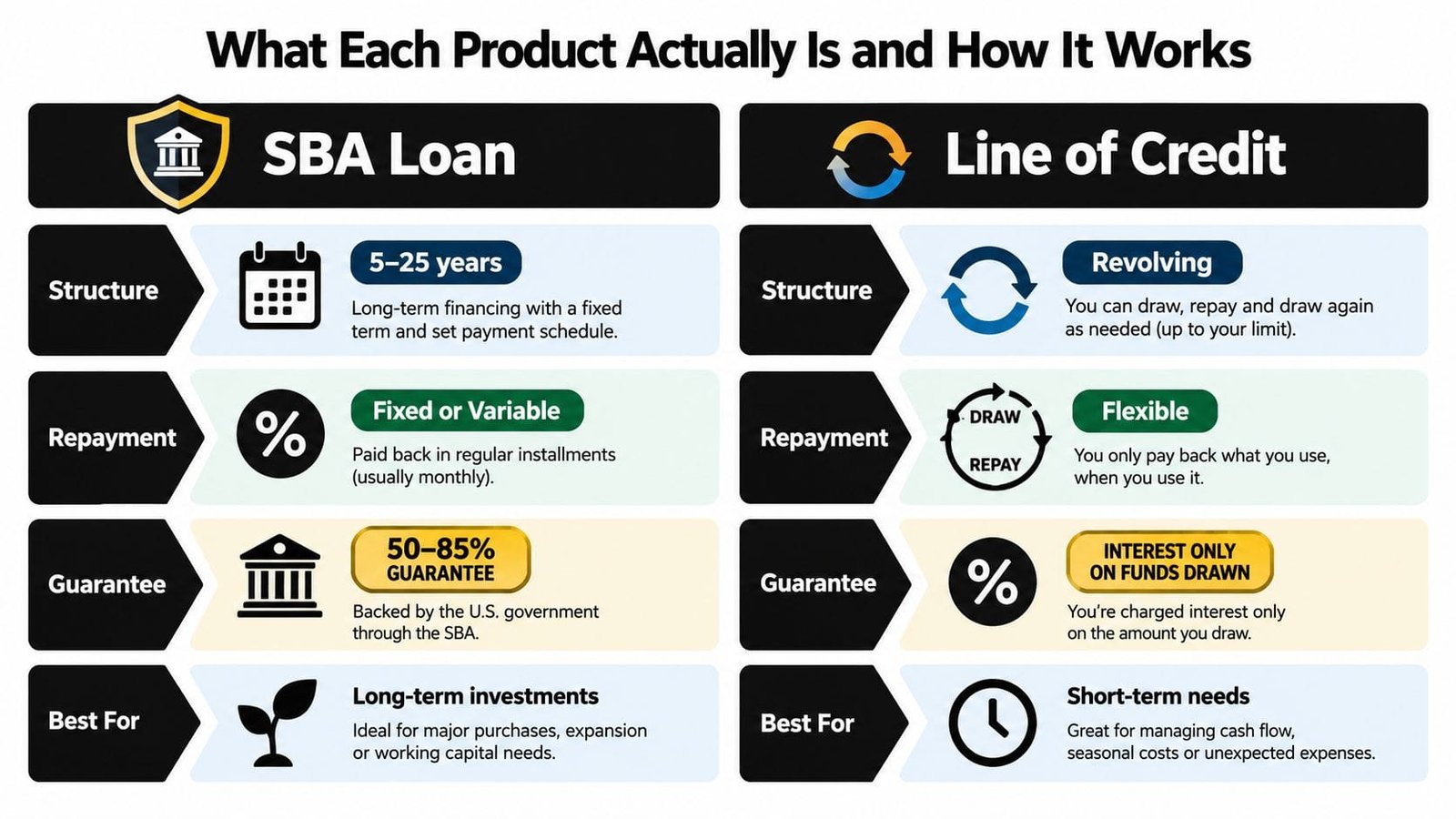
An SBA loan is not issued directly by the government. A bank or other participating lender originates the debt, while the Small Business Administration guarantees part of it under program rules. That guarantee lowers lender risk and can help qualified businesses finance growth, equipment, working capital, acquisitions, and other eligible uses.
A standard SBA term loan delivers a lump sum at closing. You then make scheduled principal-and-interest payments, and amortization steadily reduces the balance. The program permits loan amounts up to $5 million and applies rate ceilings tied to the base rate and loan size. Core maturity can reach 60 months, while certain eligible uses may receive longer treatment under applicable program rules.
A conventional business line of credit gives you a maximum commitment rather than one full disbursement. You draw only what the business needs, pay according to the facility's terms, and regain availability as principal is repaid. Renewal requirements, covenants, lender approval, and continued eligibility can still limit access.
The vocabulary that affects your decision
- Draw period: The time you can access an approved revolving facility.
- Amortization: The scheduled repayment of principal and interest over time.
- Variable rate: Pricing that changes when the lender's benchmark changes.
- Guarantee fee: An SBA-related charge tied to the guaranteed portion and loan structure.
- Unused-line fee: A charge some lenders apply to undrawn availability.
- Covenant: A condition requiring the borrower to maintain financial or reporting standards.
SBA-backed revolving products blur the usual categories. CAPLines operate within the SBA framework and support defined working-capital purposes, rather than unrestricted borrowing. A walkthrough of how a business line of credit works from Business Loan Warrior explains ordinary revolving credit mechanics. An SBA CAPLine adds program eligibility, use-of-proceeds restrictions, lender underwriting, and guarantee requirements.
The practical test is straightforward. A term loan funds a known amount and amortizes. A conventional line supports repeated draws and repayments. An SBA revolving structure can fund recurring working capital, but only when the business, cash cycle, and stated use fit the specific SBA program. For unrestricted, rapidly changing access, a conventional line is usually the practical route.
Side-by-Side Comparison Across the Decision Criteria
The right choice depends on the cash need, not the product label. SBA term financing fits a defined investment with a repayment plan. A conventional line fits recurring access to working capital. SBA-backed revolving products, including CAPLines, can serve some working-capital cycles, but their approved purpose and eligibility rules make them less flexible than a conventional line.
| Criterion | SBA Term Loan | Business Line of Credit |
|---|---|---|
| Primary use | Equipment, expansion, acquisition, real estate, or defined working capital | Inventory, payroll timing, receivables gaps, and recurring operating needs |
| Funding method | Lump-sum disbursement | Draw, repay, and redraw within the commitment |
| Pricing | Fixed or variable, with SBA rate ceilings tied to program rules | Usually variable, based on lender policy and borrower risk |
| Maximum size | SBA 7(a) financing supports larger projects, subject to program and lender limits | Commitment depends on lender, collateral, cash flow, and credit profile |
| Repayment | Scheduled principal and interest | Interest on the utilized balance, with principal repayment governed by the facility |
| Speed | More documentation and slower underwriting | Often faster, especially through an existing bank or alternative lender |
| Collateral | May require business assets, real estate, equipment, and a personal guarantee | Often secured by receivables, inventory, cash flow, or a personal guarantee |
| Rate protection | SBA maximum-rate formulas apply to eligible structures | Conventional lines generally float according to lender pricing |
| Best fit | A one-time investment with a measurable payback | A recurring cash cycle that rises and falls |
| Main risk | Borrowing the full amount when the need is uncertain | Carrying a variable balance longer than intended |
Eligibility and documentation
SBA underwriting requires a detailed view of business performance, ownership, repayment ability, use of proceeds, and collateral. The lender may also require a personal guarantee. For an SBA revolving product, the stated working-capital purpose and cash cycle must fit the applicable program.
A conventional line can be more straightforward when the business already banks with the lender and maintains clean financial reporting. The lender may still review borrowing-base certificates, receivables aging, inventory, and account activity. If you need unrestricted draws that change quickly with sales, payroll, or supplier timing, the conventional line is usually the more practical option.
Cost and rate behavior
Nav's 2026 business financing rate comparison places SBA pricing around 9.75% to 14.75%, conventional bank lines around 6.99% to 8.10%, and alternative-market APRs above 60%. Those figures provide context, not a quote. Your rate, fees, collateral terms, and repayment structure will determine the actual cost.
A lower line rate does not help if the lender limits availability, charges renewal fees, or reduces the commitment when sales soften. A higher SBA rate can still produce the better outcome when the debt funds a durable asset and amortizes predictably. Compare the cost under your expected usage pattern, including how much of a line you will draw and how long the balance will remain outstanding.
Speed is a hard constraint
If missing a supplier deadline threatens an order, an SBA process may be the wrong tool regardless of its long-term economics. A conventional line is usually the practical answer for an immediate liquidity problem, provided the business qualifies and can repay the balance. Choose an SBA structure when the use is defined, the documentation burden is manageable, and predictable repayment matters more than rapid access.
The Hidden Cost Story Behind Headline Rates
Headline APR comparisons fail because the products charge for different patterns of use. A term loan begins accruing interest on the full funded amount. A line charges interest on the amount drawn, but the borrower may pay renewal costs, unused-availability charges, and a higher variable rate if the balance remains outstanding.
The requested examples illustrate the principle, but the available verified data doesn't provide the precise Prime rate, lender fees, guarantee-fee amount, packaging fee, unused-line fee, or renewal charge needed to calculate a defensible dollar total. It would be misleading to manufacture those inputs. Use the table as a decision model, then replace each blank with the actual term sheet figures.
| Cost Component | SBA 7(a) Loan, Fully Drawn | Conventional LOC, Heavy Use, 55% Average | Conventional LOC, Light Use, $40K Total |
|---|---|---|---|
| Interest base | Full outstanding principal | Average utilized balance | Low utilized balance |
| Rate behavior | Fixed or variable, subject to SBA ceilings | Usually variable and lender-specific | Usually variable and lender-specific |
| Origination or guarantee charge | Review the lender's SBA fee disclosure | Review the lender's line fee schedule | Review the lender's line fee schedule |
| Unused availability | Not the defining cost feature of a term loan | May apply | May matter more because more capacity remains idle |
| Renewal cost | Not normally structured as an annual revolving renewal | Check annual renewal terms | Check annual renewal terms |
| Repayment pattern | Scheduled amortization | Draw and repay | Draw only when needed |
| Main economic risk | Paying interest on funds you don't need | Carrying a balance after the cash gap ends | Paying for committed capacity that stays unused |
Heavy-use pattern
A line becomes less compelling when the business draws most of the commitment and keeps the balance outstanding. At that point, the owner is paying variable interest while giving up the main benefit of revolving credit, which is the ability to borrow only when needed.
The real-cost loan calculation guide offers a useful framework: separate interest from fees, then compare the total against the cash generated by the funded activity. Don't compare a line's starting rate with an SBA loan's maximum rate and stop there.
Light-use pattern
A lightly used line can win even when its nominal rate is higher. If the business draws a modest amount for a short receivables gap, repays quickly, and avoids substantial commitment charges, it may pay less total interest than a fully funded term loan.
That advantage disappears if the owner keeps drawing for unrelated expenses. Repeated small draws can create a permanent balance that obscures the original purpose. The right test is not “Which rate is lower?” It's “How much will be outstanding, for how long, and what fees apply while the facility remains available?”
A line of credit is economical when usage is intermittent. It becomes term debt with floating pricing when the balance never comes down.
Three Real Scenarios That Show Which One Wins
The product decision becomes clearer when the financing follows the asset or cash cycle.
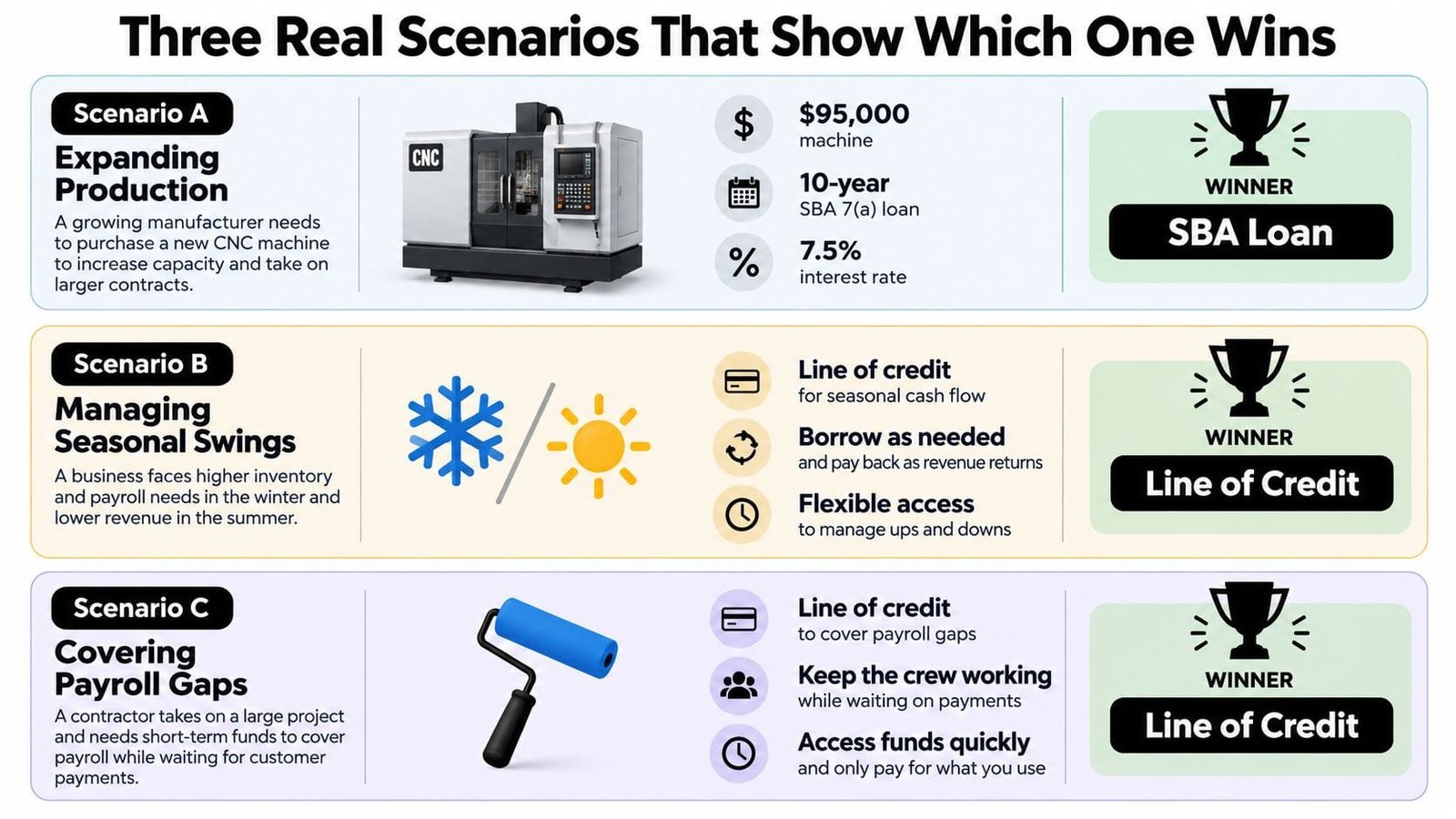
Profile A, the machining shop
A machining company needs $95,000 for a CNC machine. The equipment should produce value over a long useful life, so financing it with a short revolving facility creates a mismatch. The specified example uses a 10-year SBA 7(a) loan at approximately 7.5%, but that rate and structure are not included in the verified source data, so they should be treated as an illustrative scenario rather than a current quote.
The SBA loan wins conceptually because the shop receives the full amount once, makes scheduled payments, and aligns repayment with the machine's productive life. The owner also avoids relying on a line that may be reduced or renewed while the equipment remains essential to operations.
Profile B, the wholesale distributor
A distributor experiences a seasonal inventory swing of $250,000 for 90 days. That is a classic revolving need. The business draws as inventory arrives, repays as customers pay, and doesn't need permanent debt after the cycle closes.
The specified scenario assumes a conventional line at Prime plus 4.5%, but that pricing isn't verified in the provided sources. The recommendation still stands: a line is the better structure because the distributor shouldn't pay long-term interest on inventory financing that exists only for a defined seasonal window.
Profile C, the second-location operator
A franchisee needs $180,000 for buildout and $60,000 as a working-capital cushion. Those uses should not be blended casually. The buildout is a defined capital project, while the cushion protects the operating cycle after opening.
An SBA 504 or 7(a) structure may fit the buildout, subject to eligibility and lender underwriting. A separate smaller line can cover payroll timing, supplies, and receivables gaps. Splitting the facilities gives each dollar a job and prevents the owner from using expensive revolving debt to finance a long-lived improvement.
The accompanying video provides another visual introduction to the comparison:
The common thread is more important than the product labels. Long-life assets deserve amortizing debt. Repeating operating cycles deserve revolving access. A mixed need deserves a mixed structure.
Can You Actually Get an SBA Line of Credit
Yes, but an SBA-backed revolving facility isn't a generic substitute for a bank line. SBA CAPLines are designed for defined working-capital purposes, including cyclical, recurring, contract-related, construction, and asset-based needs. The SBA's working-capital program information describes the Working CAPLine as an asset-based revolving facility that converts short-term assets into cash.
That makes the structure useful for businesses with identifiable receivables, inventory, contracts, or recurring production cycles. It doesn't mean every established company can obtain an SBA line for general liquidity.
What makes the SBA route different
The SBA framework can help a lender support a revolving facility where conventional underwriting alone would leave too much risk. The borrower still has to demonstrate repayment ability, clean reporting, an eligible purpose, and sufficient collateral or borrowing support under the chosen program.
The distinction is especially important for a company with significant sales volume. A business may need a facility sized around receivables and inventory rather than a general-purpose term loan. However, the documentation burden can be substantial, and the lender will scrutinize the cycle rather than accept the owner's estimate of future demand.
When a conventional line is more realistic
A conventional bank line is usually the better path when the business has:
- A short deadline: The company needs access before a full SBA process can reasonably finish.
- A simple borrowing purpose: The owner needs flexible operating liquidity, not a specialized SBA working-capital structure.
- Strong existing banking history: Deposit activity and prior repayment performance may make underwriting more efficient.
- Clean collateral reporting: Receivables and inventory can support a borrowing base the lender understands.
- A need for repeated draws: The business can show how it will draw, collect, and repay.
Recent credit demand reinforces the practical point. 38% of employer firms applied for a loan, line of credit, or merchant cash advance in the prior 12 months, nearly unchanged from 2024, according to NerdWallet's SBA line-of-credit discussion. Owners are actively looking for liquidity, but demand doesn't make every revolving structure suitable.
For most borrowers, an SBA revolving line is a specialized option, not the default choice. Pursue it when the business has a defensible working-capital cycle and enough documentation to justify the process. Otherwise, compare conventional bank lines first.
Your Decision Checklist and Application Path
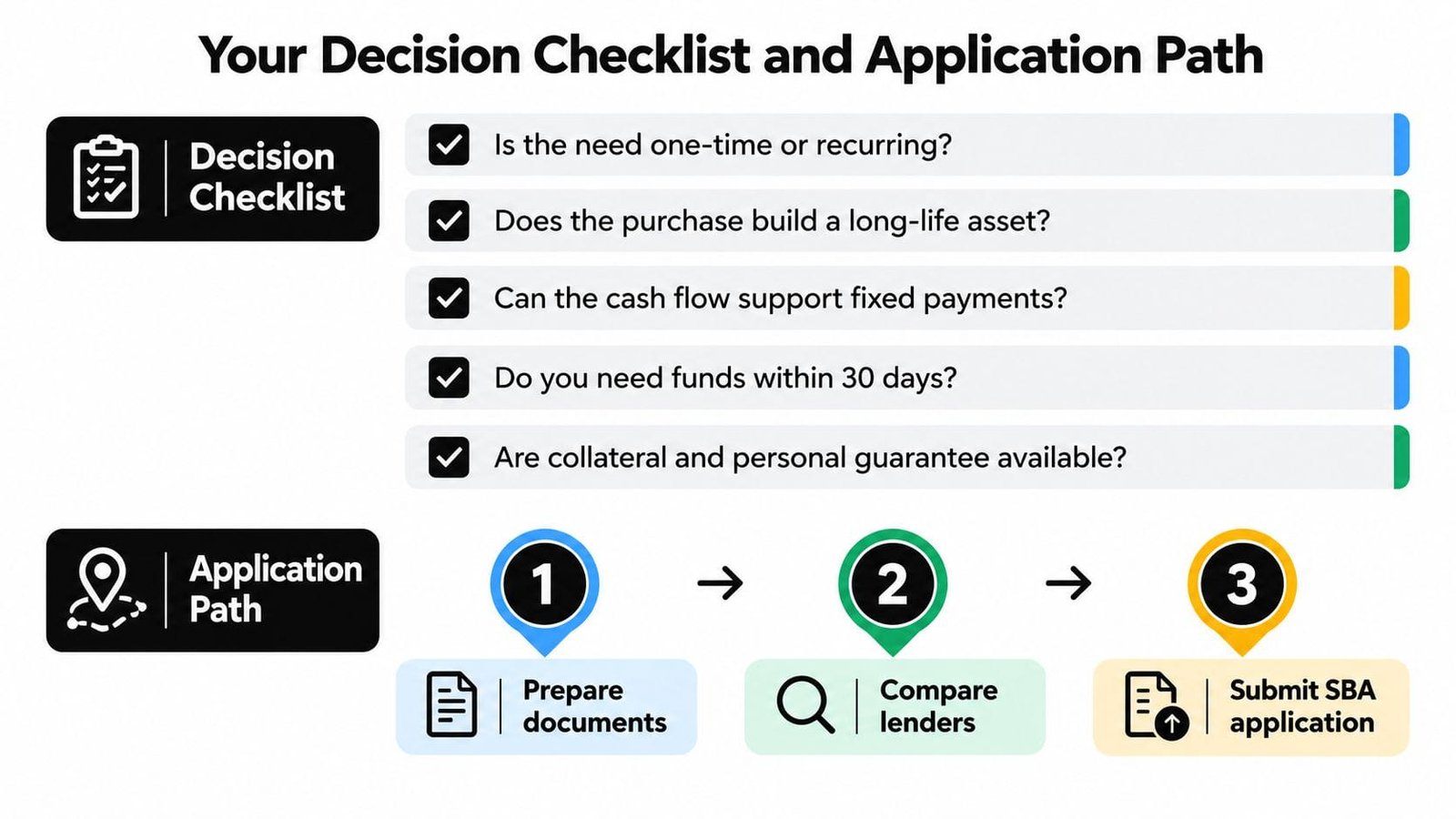
Start with the cash need, not the lender's product menu. Run these questions before requesting a quote:
- One-time or recurring: Is the money funding one project, or will the business draw and repay repeatedly?
- Asset life: Does the purchase create a long-life asset that should be paid for over time?
- Payment capacity: Can current cash flow support fixed payments even during a weaker operating period?
- Timing: Do you need funds before an SBA process can reasonably conclude?
- Security: Can the business provide acceptable collateral and a personal guarantee if required?
Prepare the lender package
Organize business financial statements, business tax returns, personal tax returns, an accounts-receivable aging report, an existing debt schedule, ownership information, and a clear use-of-proceeds narrative. For a revolving request, add inventory detail, customer concentration information, contract documentation, and a cash-flow forecast showing when draws and repayments should occur.
The application route depends on the answer to the checklist:
- Choose SBA term financing for a defined investment with predictable repayment.
- Choose a conventional line for recurring working-capital gaps and urgent access.
- Explore an SBA-backed revolving product only when the cycle, collateral, and documentation justify the extra structure.
The SBA application process guide can help you organize the sequence before approaching lenders. A lender may also recommend a different structure after reviewing the financials. That isn't a failure of the application. It's often the point of underwriting.
For an owner comparing an SBA loan vs a line of credit, my recommendation is direct: choose the SBA loan for term capital and predictable payback, a conventional line for ongoing cash-flow timing, and an SBA-backed revolving facility only when the business has a clear qualifying cycle and the expected benefit outweighs the added paperwork.
Business Loan Warrior helps owners compare SBA financing, conventional lines of credit, equipment loans, and other business funding through a single application and lender-matching process. Visit Business Loan Warrior to organize your funding request, review available options, and match the structure to the way your business uses cash.