
Small Business Saturday 2025 is Saturday, November 29, 2025. If you're planning holiday revenue now, treat that date as a real operating deadline, not just a marketing holiday, because this event now sits in a shopping window that has produced tens of billions of dollars in annual consumer spending.
Right now, a lot of owners are in the same spot. Q4 is coming fast, cash is already spoken for, payroll doesn't pause, vendors want commitments early, and every promotional idea sounds good until you price out inventory, ad spend, and overtime. That's exactly why Small Business Saturday works best when you plan for profitability, not just traffic.
Handled well, this day can do three jobs at once. It can create immediate sales, pull new customer data into your pipeline, and give you a controlled reason to invest in inventory, staffing, and outreach at a moment when buyers are already primed to spend. Handled poorly, it becomes a one-day discount binge that leaves you tired, overstaffed, and wondering where the margin went.
This guide takes the practical route. You'll get a clear countdown, tactics that work for retail and non-retail businesses, and a financing lens that helps you decide where a short-term capital push makes sense and where it doesn't.
Table of Contents
- Why Small Business Saturday 2025 Is a Massive Opportunity
- Your 12-Week Countdown to a Profitable SBS
- Crafting Your Unforgettable Marketing Campaign
- Preparing Your Operations for the Customer Rush
- Funding Your Campaign for Maximum Profitability
- Measuring Success Beyond the Day's Sales Tally
- FAQ Your Small Business Saturday Questions Answered
Why Small Business Saturday 2025 Is a Massive Opportunity
Small Business Saturday 2025 lands on November 29, 2025, right between Black Friday and Cyber Monday. That's not just calendar trivia. It means you get a chance to sell when shoppers are already in decision mode and already comparing offers.
The scale behind the day is real. Historical spending summaries show Small Business Saturday has generated hundreds of billions of dollars since launching in 2010, with one compiled industry summary reporting about $17 billion in consumer spending in 2023, about $22 billion in 2024, and roughly $201 billion in total spending since launch, according to AltLINE's Small Business Saturday statistics roundup.
That matters for one simple reason. If consumers are already prepared to spend at scale, your challenge isn't persuading the market that the day matters. Your challenge is making your business visible, prepared, and operationally strong enough to convert demand without giving away all the margin.
Why this matters for established small businesses
A lot of owners think of this as a Main Street foot-traffic event for tiny gift shops. That's too narrow. Small Business Saturday works for restaurants, service firms, specialty contractors, health and wellness providers, online brands, and local B2B companies that want to use the day for bookings, deposits, gift cards, and relationship marketing.
Practical rule: Don't ask, "Should I participate?" Ask, "What offer can I put in market that creates immediate cash flow and future revenue?"
The businesses that win usually don't have the biggest discount. They have the clearest offer, the cleanest execution, and a follow-up plan that keeps the momentum going after the day ends.
The opportunity is bigger than one day
For many companies, Small Business Saturday is the first clean signal of how the rest of the holiday stretch may perform. If your offer converts, your checkout holds up, and your team handles the pace, you can carry that same structure into the remainder of the season.
Used that way, Small Business Saturday becomes less of a one-day promotion and more of a controlled stress test for your entire Q4 growth plan.
Your 12-Week Countdown to a Profitable SBS
Most owners don't lose Small Business Saturday because of weak ideas. They lose it because they start too late. November compresses everything. Vendors slow down, ad costs rise, schedules get tight, and rushed decisions get expensive.
For context, this date matters across a very large share of the market. The U.S. Chamber notes that Small Business Saturday 2025 falls on November 29, 2025, and highlights 7,152,312 U.S. businesses with 19 or fewer employees out of 8,361,342 total business establishments recorded in 2023 in its Small Business Saturday overview.
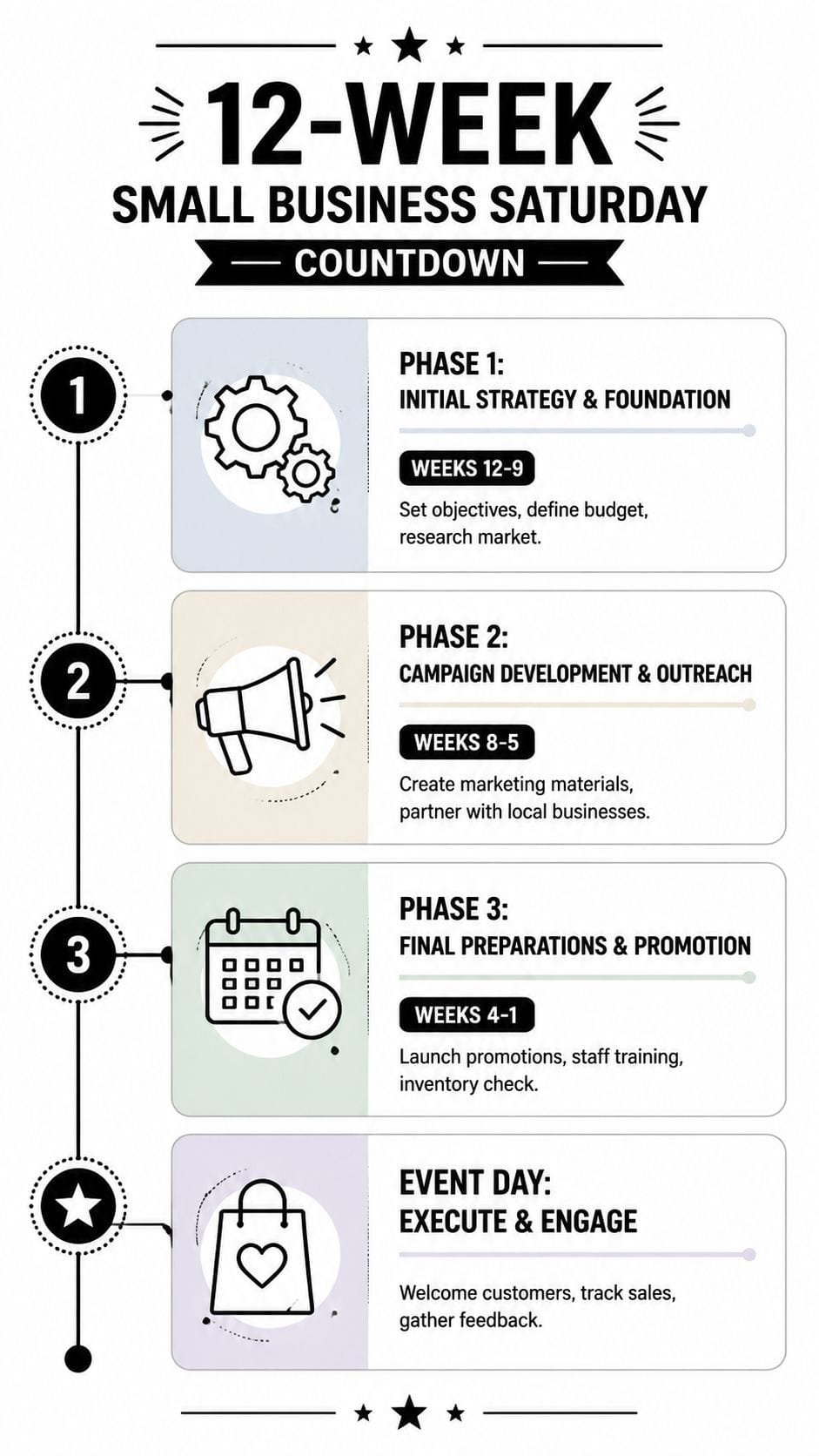
Weeks 12 to 9 lock the plan and funding
Start with math, not creative.
Pick one primary outcome. That could be same-day revenue, appointment deposits, gift card sales, new email captures, or reactivation of dormant customers. If you try to optimize for everything, your campaign gets muddy fast.
Then build the budget around capacity:
- Inventory-heavy businesses: Decide what you can reorder confidently, what can be bundled, and what should not be discounted.
- Service businesses: Block appointment availability, map staffing constraints, and decide whether you're selling consults, retainers, prepaid packages, or gift certificates.
- B2B firms: Choose a concrete action, such as a strategy session, paid diagnostic, deposit for January work, or a year-end planning package.
This is also the moment to decide whether outside funding improves execution. If extra capital lets you buy smarter, advertise earlier, or add labor without squeezing payroll, it may be a tool. If you don't have a measured use for the funds, don't force it.
Weeks 8 to 5 build demand before the noise peaks
This phase is where strong campaigns separate from reactive ones. You're not trying to shout louder than every other business in late November. You're trying to be familiar before shoppers hit the peak weekend.
Use this stretch to prepare assets and partnerships:
- Create one core offer: Make it easy to explain in one sentence.
- Build channel-ready creative: Email, Instagram, Facebook, Google Business Profile posts, in-store signage, and homepage banners should all match.
- Line up local partners: Neighboring stores, coffee shops, gyms, salons, and business associations can all help cross-promote if the offer benefits both sides.
- Clarify redemption rules: Expiration dates, exclusions, pickup windows, and booking instructions need to be obvious.
The best SBS promotions are easy for a customer to understand in five seconds and easy for a staff member to explain during a rush.
If you're using financing, commit funds here only after you know exactly where they go. Good uses include ad creative, inventory deposits, temporary labor, packaging, and point-of-sale readiness. Bad uses include broad "brand awareness" spending with no offer attached.
Weeks 4 to 1 pressure-test execution
This is not the time to brainstorm new campaigns. It's the time to remove friction.
Review every point where customers can drop off:
- Can they find you easily? Update holiday hours, contact details, and offer language everywhere customers search.
- Can they buy fast? Test checkout, coupon codes, appointment links, mobile pages, and gift card flows.
- Can your team explain the offer? Give staff a short script with examples and exclusions.
- Can you handle volume? Confirm stock, backup coverage, and fulfillment expectations.
For week-by-week control, use this simple sequence:
- Week 4: Finalize creative, scripts, landing pages, and signage.
- Week 3: Soft-launch awareness content and partner mentions.
- Week 2: Begin active promotion and audience reminders.
- Week 1: Increase frequency, confirm staff schedules, and test every operational handoff.
- Day before: Send the clearest reminder of all. Hours, offer, and what to do next.
Event day and the week after capture the real value
The day itself is about speed and visibility. Put your highest-converting offer front and center. Reduce decision fatigue. Ask for customer contact information at checkout or booking confirmation, and tie it to a clear benefit such as a follow-up offer, giveaway entry, or loyalty perk.
After the event, move quickly:
- Thank buyers promptly: A short thank-you email or text keeps the interaction warm.
- Segment new versus existing customers: That tells you whether the campaign reached fresh demand or mostly discounted habitual buyers.
- Push one follow-up action: Book again, redeem a bounce-back offer, join loyalty, or purchase a related service.
The businesses that get the most from Small Business Saturday don't stop on Saturday. They turn one day of attention into a repeat-customer pipeline.
Crafting Your Unforgettable Marketing Campaign
At 9:30 a.m. on Small Business Saturday, two businesses can have the same foot traffic and end up with very different results. One is busy, discounted, and drained by the end of the day. The other turns that traffic into larger tickets, repeat bookings, and enough margin to justify the extra spend on ads, staffing, and inventory. The difference usually starts with the campaign design.
Marketing for Small Business Saturday works best when it feels specific and financially disciplined. Generic "shop local" messaging can support your brand, but it rarely gives customers a strong reason to act now. A profitable campaign ties one clear offer to one clear audience, then funds the push early enough to create demand without choking cash flow. If seasonal spending is tight, map your promotion and your budget together using a holiday surge financing plan for small businesses before you commit to ad spend, inventory buys, or extra labor.

A practical playbook for 2025 is a three-step campaign. Build awareness in the two weeks before. Increase specificity one week before. Send a sharp final reminder the day before. That timing works because shoppers are already filtering gift ideas, service appointments, and holiday spending decisions between Black Friday and Cyber Monday.
Retail, restaurant, and e-commerce offers that hold up
The best offer is not always the biggest discount. It is the one that raises average order value, protects margin, and keeps fulfillment under control.
A local retailer usually gets better results from bundles, free gifts with purchase, or limited featured products than from a storewide markdown. Storewide discounts create traffic, but they also train customers to wait for lower prices and can bury your best-margin items in unnecessary cuts.
Restaurants face a different constraint. Capacity is fixed. A packed room with slow turns can hurt service and reduce the guest experience. For SBS, controlled offers usually work better, such as a prix fixe menu, holiday catering pre-orders, gift card bonuses, or take-home meal packages that create revenue without jamming the dining room.
An e-commerce brand needs a cleaner path. A homepage takeover, short email sequence, short-form video, and a landing page built around one featured collection usually outperform a site-wide promotion with too many competing messages.
Offer formats that consistently hold up include:
- Bundled value: Pair products or services customers already buy together.
- Free gift threshold: Encourage a higher cart value without cutting price across the board.
- Limited-time window: Use a defined time block to create urgency and pace demand.
- Loyalty enrollment perk: Trade a one-time incentive for future access through email or SMS.
- Giftable packages: Strong for salons, spas, fitness studios, tutoring, and specialty services.
How non-retail and B2B businesses should use the day
Small Business Saturday is not just for storefront retail. Service providers, trades, consultants, clinics, and B2B firms can use the day effectively if they stop copying retail tactics and sell a defined commitment instead.
For service businesses, broad discounting usually creates the wrong kind of demand. It attracts price shoppers, compresses margin, and fills the schedule with lower-value work. A better move is to package access, priority, convenience, or a scoped outcome.
Examples that work:
- Professional services: Year-end planning sessions, compliance reviews, tax prep kickoffs, or paid strategy intensives.
- Home services and trades: Priority-booking deposits, seasonal inspection packages, maintenance plans, or giftable service credits.
- Health and wellness: Intro packages, prepaid treatment bundles, or member-only add-ons.
- B2B firms: January onboarding deposits, paid audits, planning workshops, or limited consulting blocks.
That structure does two things. It makes the offer easy to explain, and it brings cash in before the work is delivered. For many non-retail businesses, that is the main SBS advantage.
Match the message to the buying window
The timing matters as much as the creative, but each phase needs a different job.
Early messaging should create awareness without overexplaining. Tease the category, the problem you solve, or the limited availability. A boutique can preview gift bundles. A consultant can announce a small number of December or January strategy slots. A contractor can open interest for a winter service package.
The next phase should get specific. Name the offer. State who it is for. Tell people exactly how to claim it. If you already use email, SMS, and paid retargeting, this is the point to align them around one message instead of running separate promotions in each channel.
The final reminder should be short and direct. Hours. Offer. Deadline. Link.
A short video can help sharpen that final message and give customers something easy to share:
Keep the campaign tight. One offer, one audience, one next step. That is how you turn attention into profitable demand instead of a busy day with thin margins.
Preparing Your Operations for the Customer Rush
Saturday opens strong. By 11 a.m., the line is building, two staff members are answering the same question three different ways, one featured item is running low, and online orders are coming in faster than expected. Sales look good on paper. Margin starts slipping because the team is reacting instead of executing.
Operations decide whether Small Business Saturday pays off.
A strong offer can create demand in a few hours. Your systems still have to handle that demand without missed orders, overtime surprises, stockouts, or a service experience that hurts repeat business. For non-retail companies, the risk is different but just as real. A consultant can oversell calendar capacity. A salon can create booking bottlenecks. A contractor can collect deposits for work that cannot be scheduled cleanly.
Inventory and fulfillment checklist
Start with the exact offer you plan to push, then work backward into fulfillment. That keeps buying tight and protects cash.
For retailers, that usually means featured SKUs, bundle components, packaging, gift cards, receipt paper, shipping materials, and backup checkout supplies. For service businesses, the equivalent is capacity. Open appointment slots, onboarding bandwidth, technician hours, intake forms, proposal templates, and any materials tied to prepaid work all count as inventory for SBS.
Run this check before launch:
- Confirm featured inventory: Put your highest-priority products or service slots in one view so you can see real availability.
- Protect margin: Keep your best-margin items out of broad discounting unless they are pulling profitable add-on sales.
- Stress-test fulfillment: Test pickup, local delivery, shipping labels, online checkout, booking confirmations, and payment links before the day starts.
- Prepare substitutions: Give staff approved alternatives if a product, time slot, or package sells out.
- Set a reorder line: Decide in advance when you will reorder and when you will stop, so a busy weekend does not turn into dead inventory in December.
That last point matters more than owners expect. Short-term financing can help you buy ahead, but only for inventory or materials tied directly to the SBS offer and the follow-up demand you can reasonably fulfill. If you need a sharper framework for that decision, this guide on holiday-ready financial planning for seasonal surges is useful.
Staffing and service checklist
Staffing plans fail when they cover headcount but not flow.
Set clear roles for the rush. One person greets and directs traffic. One owns checkout or payment collection. One handles fulfillment questions, substitutions, or booking issues. One restocks, resets, or watches for bottlenecks. In a service business, assign one person to sales conversations and another to scheduling, intake, or follow-up. If the same employee is trying to sell, explain the offer, fix calendar issues, and answer the phone, conversion drops fast.
Train for the exceptions, not just the happy path. Staff should know the offer terms, exclusions, upsell options, refund rules, and what to say when a package is sold out or a preferred time is gone. Write the script down. Good teams still get sloppy under pressure.
Capture customer information while the transaction is happening. Use checkout prompts, booking forms, SMS opt-ins, or a QR code tied to a real benefit such as a bounce-back offer or early access to December appointments. Small Business Saturday should produce repeat customers, not just a crowded register.
A busy day can still be an unprofitable day. A controlled day usually wins.
Budget template for SBS execution
Use a simple operating budget before you approve final spending. Doing so protects profitability.
| Category | Budget Allocation | Example Use Case |
|---|---|---|
| Inventory or materials | Core campaign spend | Featured products, bundle inputs, packaging |
| Paid marketing | Variable | Local social ads, boosted posts, email creative |
| Staffing | Core campaign spend | Overtime, temp support, weekend coverage |
| Technology | As needed | POS setup, online checkout testing, SMS tool |
| Customer incentives | Controlled | Free gift, loyalty perk, giveaway item |
| Contingency | Reserved | Rush reorder, same-day troubleshooting, backup labor |
Keep the budget lean and tied to execution. If a cost does not help customers buy, book, or come back, question it.
One more practical rule. Do not use financing to cover operational gaps you have not priced out. Use it for specific inputs that help you deliver the offer well, preserve service quality, and convert demand into repeatable profit.
Funding Your Campaign for Maximum Profitability
Owners usually ask the financing question too late. They wait until inventory is tight, ad opportunities are more expensive, and payroll pressure is already visible. By then, money is being used to patch problems instead of foster growth.
The better question is simple. Will additional working capital improve your profitability, or will it just enlarge an unproven campaign?
Where financing helps and where it hurts
Financing helps when demand is likely and the use of funds is specific.
Good examples include buying inventory tied to a featured offer, covering labor so service quality doesn't collapse, prepaying for creative assets, or funding a short burst of local advertising with a defined conversion goal. In each case, the spend has a job.
Financing hurts when it's vague. If the plan is "we'll spend more on marketing and hope traffic shows up," that's not strategy. That's pressure wearing a strategy costume.
Ask these questions before borrowing for Small Business Saturday:
- What exactly will the funds buy?
- What customer action should that spend produce?
- Can the business fulfill the added demand without chaos?
- Will the promotion protect margin, or only inflate top-line sales?
The smartest uses of short-term capital before SBS
In practice, the strongest uses of short-term financing fall into three buckets.
First, inventory and packaging. If your best offer depends on having enough product, enough bundle components, or enough giftable presentation, underbuying can cost more than the financing itself. Running out early doesn't create excitement if you have nothing credible to substitute.
Second, marketing concentration. A modest but focused push before SBS often works better than spreading the same dollars thinly across the entire quarter. If you already know your audience, front-loading spend into the awareness and reminder windows can sharpen performance.
Third, capacity protection. Extra labor, temporary support, fulfillment help, and extended service coverage don't feel glamorous, but they're often where profitability gets saved. A customer who has a smooth first experience is easier to retain than one who got stuck in line or never received a callback.
For a more detailed framework on using capital to support promotions without wrecking margin, this piece on profit-smart promotion financing is worth reviewing.
A disciplined funding plan for Small Business Saturday should feel narrow, not expansive. The money should remove bottlenecks, not encourage random spending.
Measuring Success Beyond the Day's Sales Tally
A lot of SBS postmortems are too shallow. Owners look at sales, compare the number to a normal Saturday, and call it a win or a miss. That leaves the most important question unanswered. Did the event create incremental profit after discounts, staffing, and processing costs?
That measurement gap is one of the biggest weaknesses in current guidance. OneHub POS notes that the core issue isn't awareness but measurement, especially which promotions convert best and whether the lift comes from new or existing customers, in its discussion of Small Business Saturday profitability questions.
The numbers that actually matter
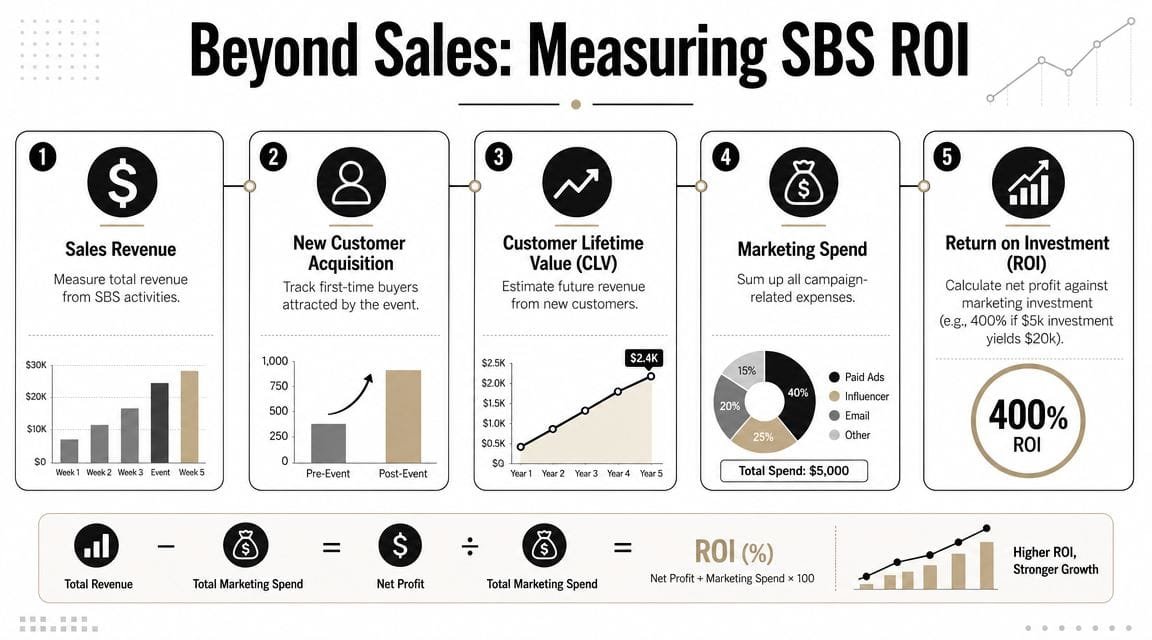
Start with gross sales, but don't stop there.
Look at:
- Promotion-level profit: Which offer produced healthy dollars after discounting and fulfillment?
- New versus existing customers: Did you acquire fresh buyers or mostly subsidize regulars?
- Customer capture rate: How many transactions produced usable contact data?
- Follow-up behavior: Did customers redeem bounce-back offers, book again, or buy complementary services?
- Channel performance: Which email, social, partner, or in-store prompt moved people to act?
For simple review math, use plain formulas:
- Campaign profit = SBS revenue tied to the campaign minus campaign costs
- Customer acquisition cost = campaign spend divided by new customers acquired
- Return on investment = net profit divided by campaign spend
You don't need fancy software to start. Your POS, booking platform, e-commerce dashboard, and email platform can usually tell you enough if you tag the offer correctly before launch.
A simple post-event review process
Hold the review while details are still fresh. Pull transaction data, staff notes, inventory issues, and customer responses into one working document.
Then answer these questions in order:
- Which offer generated the healthiest margin?
- Which offer generated the most first-time buyers?
- Where did the customer experience break down?
- What should be repeated in the rest of holiday season marketing?
- Which costs were justified, and which should be cut next time?
Revenue is the headline. Repeatable profit is the story.
If you want to connect this analysis to a broader borrowing strategy, build it into a forward-looking model. This guide on cash flow forecasting for smarter loan decisions is useful for turning one promotional event into a better capital plan.
FAQ Your Small Business Saturday Questions Answered
Can a B2B or service business participate meaningfully?
Yes. Service and B2B companies often have more control over margin than retailers do, which can make Small Business Saturday more profitable if the offer is structured well.
The key is to sell commitment, not just attention. A CPA firm can offer a paid year-end tax review with a credit toward a larger engagement. A marketing agency can sell a fixed-scope audit with limited booking slots. A salon can package prepaid services or giftable memberships. A home services company can push maintenance plans, inspection packages, or priority scheduling for winter work.
Cash flow matters here. Deposit-based offers bring in revenue now and spread delivery over the next few weeks or months. If demand is likely to spike, short-term financing can also help cover temporary labor, software, or materials before the booked work is fulfilled. That approach gives you room to grow without forcing a discount that eats your profit.
What's the best way to handle returns, exchanges, or post-event service issues?
Set the policy before the promotion launches. Then put it on the landing page, receipts, email confirmations, and any in-store signage.
Clear beats generous. If you sell services, spell out cancellation windows, expiration dates, transfer rules, and refund eligibility in plain language. If you sell products, decide in advance whether promotional bundles, limited-run items, and gift cards follow the standard return policy or a separate one.
This is also a staffing issue. Frontline employees need one script and one escalation path. If one person makes exceptions on the fly while another sticks to policy, the team spends the next week dealing with avoidable complaints.
How should I use the customer data I collect without sounding spammy?
Use it based on what the customer did.
Someone who bought a gift card should get redemption reminders and a relevant add-on. Someone who booked a service should get onboarding or prep details, then a well-timed follow-up offer. Someone who entered a giveaway but never purchased should get a lighter sequence with a clear opt-out, not a flood of sales emails.
A practical follow-up cadence works like this:
- Thank-you first
- Helpful reminder second
- Targeted offer third
Keep the list clean and the message specific. Relevance does more for repeat sales than frequency.
Should I discount heavily to compete with Black Friday offers?
Usually no. Heavy discounting creates a fast sales bump, but it often leaves owners frustrated once payroll, card fees, rush shipping, and fulfillment time are counted.
Margin-friendly offers usually perform better. Use bundles, threshold gifts, prepaid packages, loyalty perks, priority booking, or added service levels that cost less than a broad price cut. For non-retail businesses, a deposit-based package or annual plan can outperform a one-time discount because it brings in cash and sets up future revenue.
Run the math before you launch. If the offer will strain inventory, require extra staff, or delay cash collection, funding part of the campaign may be smarter than cutting price just to drive volume.
If you're planning a strong Small Business Saturday and need capital to support inventory, staffing, or a focused marketing push, Business Loan Warrior can help you explore funding options built for real operating timelines. Their platform lets business owners check pre-approval through a single no-fee application without affecting credit, compare relevant options, and move quickly when timing matters most.