
A loan priced at 6.75% can still sit far above the 3.63% effective federal funds rate, because lenders add spreads, fees, and contract terms that determine what your business pays. Understanding that gap matters more than watching the headline Fed rate alone.
Why do two businesses see similar benchmark conditions yet receive loans that behave completely differently? A restaurant owner may request working capital after a slow season, see an advertised rate that appears manageable, and focus on the percentage in large type. The trouble begins when repayment frequency, origination fees, collateral requirements, and a variable reset turn that apparently reasonable offer into a monthly obligation that consumes cash needed for payroll, inventory, and rent.
The central lesson in understanding interest rates is simple: the policy rate is a starting reference, not your final borrowing cost. The Federal Reserve's H.15 data showed an effective federal funds rate of 3.63% and a bank prime loan rate of 6.75% in mid-August 2026, illustrating the distance between a central-bank benchmark and borrower-facing pricing. Federal Reserve H.15 data provides the underlying rate history and benchmark context.
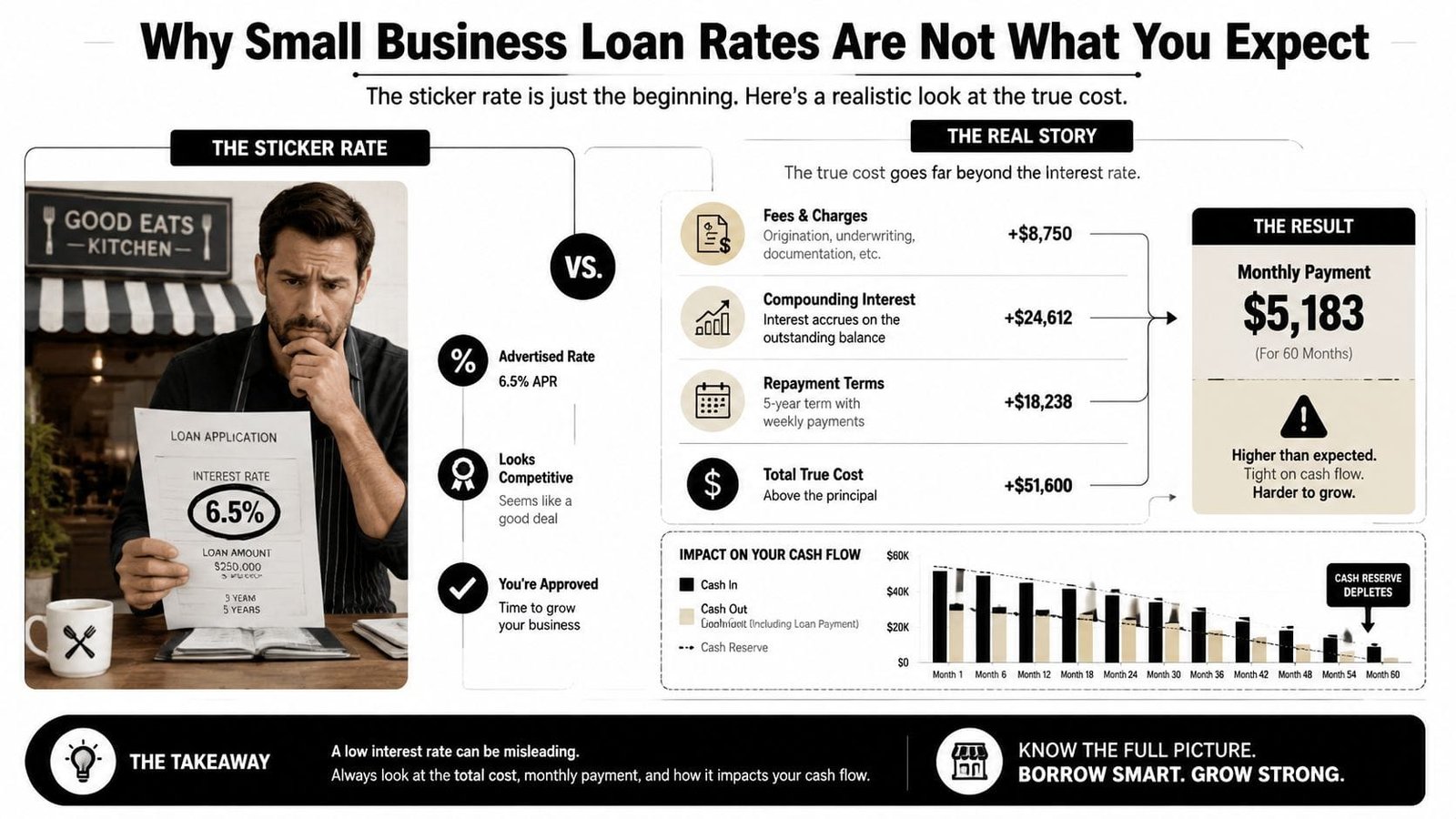
Table of Contents
- Why Small Business Loan Rates Are Not What You Expect
- Interest Versus APR Versus Factor Rates
- Fixed Versus Variable Rate Structures
- How Lenders Set Your Borrowing Rate
- Historical and Market Context for Rate Changes
- Real-World Impact on Cash Flow and Repayments
- Strategies to Reduce Your Borrowing Costs
- Making the Right Financing Decision for Your Business
Why Small Business Loan Rates Are Not What You Expect
The benchmark is only the first layer
Why can two businesses face the same market rates yet carry loans with very different costs? Lenders usually price business financing as a benchmark plus a spread. The benchmark may track a policy rate or another market reference. The spread reflects borrower risk, loan structure, operating costs, and the possibility of loss. The Federal Reserve lending-rate definitions describe a loan interest-rate spread as the origination rate above a benchmark market rate, such as the 10-year Treasury.
A restaurant with uneven seasonal revenue may receive a wider spread than an established company with stable deposits and stronger collateral. Both owners may apply during the same rate environment, but their repayment risk is different. Contract terms can also change the cash-flow effect through daily, weekly, monthly, quarterly, or annual payment schedules.
Before comparing offers, check these details in order:
- Benchmark and spread: Ask which reference rate the lender uses and what margin is added.
- Reset terms: Confirm whether the rate can change, how often it resets, and what limits apply.
- Fees: Include origination, closing, servicing, and reserve requirements in the cost.
- Payment schedule: Match payment timing to when customer receipts arrive.
Why headline comparisons fail
A lower opening rate may still create a heavier burden. A variable loan can reset upward while revenue is under pressure. A fixed loan with a higher starting rate may preserve the predictability needed for payroll, inventory, and rent. Repayment length matters too. A shorter term can produce larger payments, while a longer term may cost more interest overall.
Review the offer as a cash-flow contract:
- What is the all-in cost? Include interest, origination charges, closing costs, servicing fees, and any required reserve.
- When can the price change? Identify the index, margin, reset interval, caps, floors, and notice requirements.
- How often must I pay? Frequency can matter as much as the annual rate when receipts are uneven.
- What happens if revenue falls? Test the payment against a weak operating month, not only the forecast.
The headline percentage is only one input. The benchmark, spread, fees, reset rules, and payment timing determine whether the financing supports operations or strains them.
Interest Versus APR Versus Factor Rates
A basic interest rate tells you the percentage charged on the outstanding balance. APR, or Annual Percentage Rate, attempts to present a broader annualized cost by incorporating eligible fees alongside the interest charge. A factor rate uses a multiplier, often in alternative lending, to express the total payback without functioning like a conventional amortizing interest rate.
Suppose a lender offers two hypothetical structures for the same principal. One quotes a stated interest rate and amortizes the balance, so the interest portion declines as principal is repaid. Another quotes a factor rate, meaning the principal is multiplied by the stated factor to determine total repayment. Those offers can't be compared by placing the two headline figures side by side. You need the repayment amount, payment frequency, term, and fees.
Read the metric before you read the number
| Metric | What It Measures | Typical Use Case |
|---|---|---|
| Interest rate | The charge applied to the outstanding balance | Bank loans, lines of credit, and amortizing financing |
| APR | An annualized cost that includes the stated rate and eligible fees | Comparing loans with different fee structures |
| Factor rate | A multiplier used to calculate a predetermined payback amount | Merchant cash advances and some alternative financing |
APR gives a fuller comparison when the calculation includes the relevant fees, but it still doesn't eliminate the need to inspect the contract. A factor rate can look simple because it produces a clear payback figure, yet the effective annual cost depends heavily on how quickly you repay. If the lender collects payments frequently, the business may surrender cash much faster than the headline factor suggests.
Ask for a written amortization schedule or payback schedule. For a broader explanation of annual percentage rates and how they differ from basic interest, browse CreditCardCult's APR coverage for additional terminology and comparison context.
A useful reading sequence
Start with total dollars repaid, then examine the term and payment frequency. Next, identify whether the balance amortizes, whether fees are withheld from the proceeds, and whether early repayment changes the cost. Only after that should you compare the stated rate or factor with another offer.
The practical mistake is calling every borrowing price an interest rate. Use the lender's own metric accurately, then translate it into the cash your business receives, the cash it sends out, and the time required to finish repayment.
Fixed Versus Variable Rate Structures
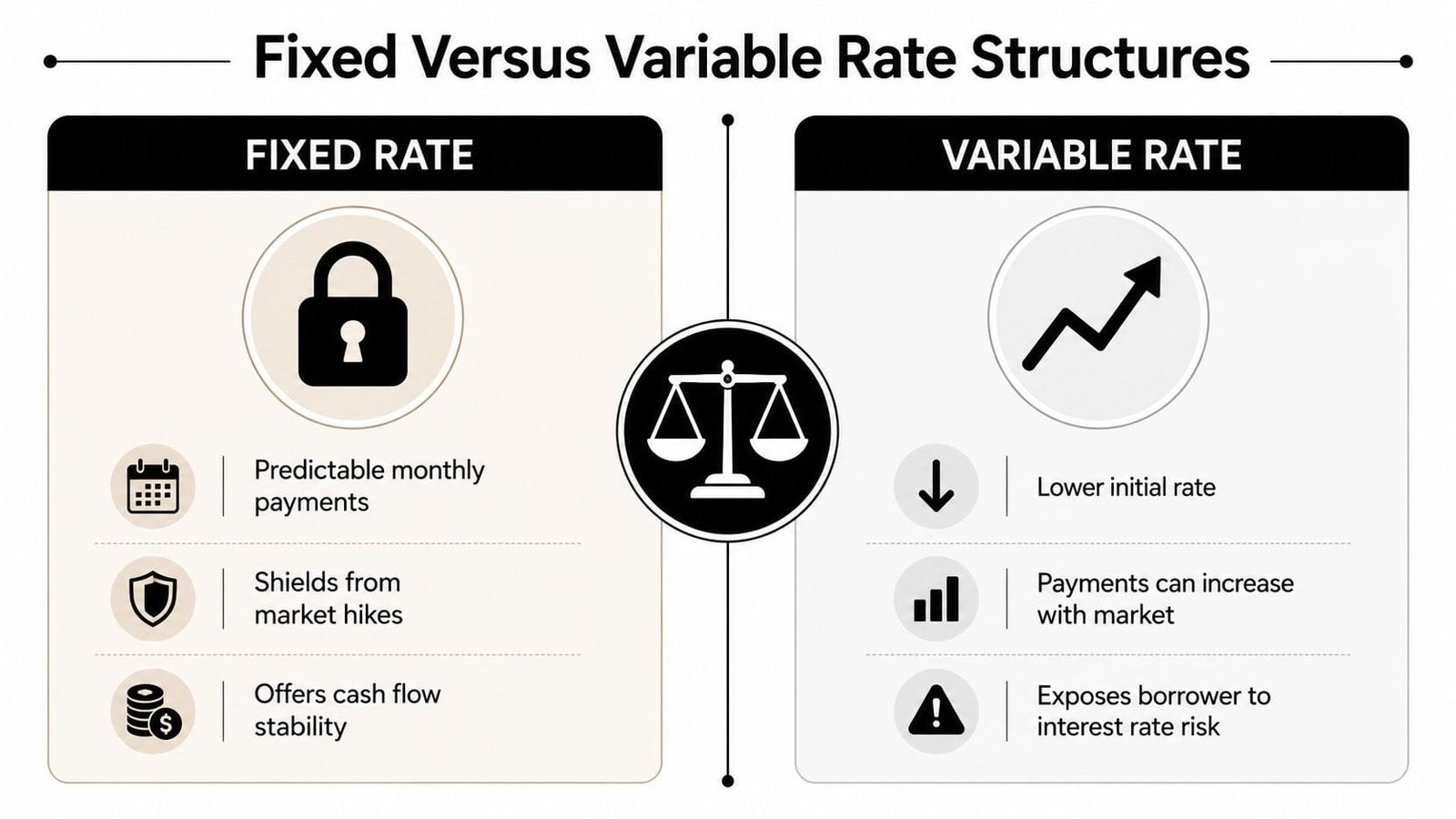
A fixed-rate loan exchanges possible future savings for payment certainty. The rate remains unchanged under the contract, so the owner can build a dependable debt-service line into the operating budget. A variable-rate loan may begin at a lower price, but the payment can change when its benchmark resets.
Recent easing has not moved every market together. Reuters reported that major central banks delivered 850 basis points of easing across 32 rate reductions in 2025, described as the biggest number of cuts since 2008 and the biggest scale of easing since 2009. Reuters' report on the 2025 easing cycle illustrates why a global headline doesn't automatically tell a U.S. small business what its own loan will do.
Choose based on cash-flow tolerance
| Structure | Main advantage | Main risk |
|---|---|---|
| Fixed rate | Stable payment and easier forecasting | You may miss future savings if market rates decline |
| Variable rate | Potentially lower initial pricing | Payments can rise after a benchmark reset |
A fixed structure often fits a business with stable but tightly managed margins, a long equipment life, or a project whose success depends on predictable debt service. It can also suit an owner who values certainty more than the possibility of a lower future rate.
Variable financing can make sense when revenue can absorb payment changes, the borrowing period is short, or the contract provides a transparent benchmark and manageable reset rules. It becomes more dangerous when the business uses working capital for recurring expenses and has little room between revenue and required payments.
A lower starting payment is useful only if the business can still carry the loan after the rate resets.
Before signing, write down the exact reset interval and calculate the payment under a higher benchmark. In India's EBLR framework, new floating-rate MSME and retail loans were tied to transparent external benchmarks, with resets shortened to at least once every three months. That structure shows why variable-rate borrowers should model quarterly changes when their agreement permits similar repricing. Research on EBLR transmission explains the practical sensitivity of benchmark-linked business borrowing.
How Lenders Set Your Borrowing Rate
A lender doesn't start with the policy rate and mechanically pass it through. The lender evaluates the chance of repayment, the value of the collateral, the time capital remains outstanding, and the conditions in the credit market. Your rate is the result of those inputs assembled into a benchmark-plus-spread price.
Four pricing inputs to examine
Credit profile. Lenders review repayment history, existing obligations, business cash flow, and the quality of financial records. Clean reporting and consistent deposits can support a stronger application because they help the lender assess repayment capacity.
Loan term. A longer term may reduce the required payment but keeps the lender exposed for more time. A shorter term can reduce total interest but may strain monthly liquidity. The best term matches the useful life of the asset or the period in which the financing should generate cash.
Collateral quality. Real estate, equipment, receivables, or other pledged assets can reduce loss severity if the borrower defaults. Collateral doesn't erase operating risk, and offering it can expose the owner to asset loss, but it may improve the lender's willingness to extend credit or adjust the spread.
Market conditions. Lenders update funding costs and risk appetite as benchmark rates, liquidity, and economic expectations change. They may also widen spreads when they see greater risk in a sector or borrower category.
Why rate cuts don't pass through evenly
NBER research found that when interest rates fell by 1 percentage point, loan rates fell by only about 75 basis points because spreads widened by 25 basis points. The same research reported spread increases of 35 basis points for speculative-grade loans compared with 14 basis points for investment-grade loans. The NBER analysis of loan-rate spreads shows why a policy cut doesn't guarantee an equal reduction in your loan price.
Your negotiating power is strongest before closing. Present current financial statements, explain unusual revenue swings, reduce avoidable outstanding debt, offer suitable collateral, and request competing term sheets. You can't control the benchmark or force a lender to ignore risk, but you can make your repayment story easier to verify.
For a practical explanation of the lender's review process, see this guide to the business loan underwriting process. The goal isn't to chase the lowest advertised rate. It's to understand which part of the price reflects the market and which part reflects your application.
Historical and Market Context for Rate Changes
Could a loan priced during a low-rate period still strain your cash flow? Yes. The federal funds rate sets a market reference, not the amount a small business ultimately pays. Funding costs, lender spreads, fees, repayment frequency, and reset terms can make two loans with the same stated rate behave very differently.
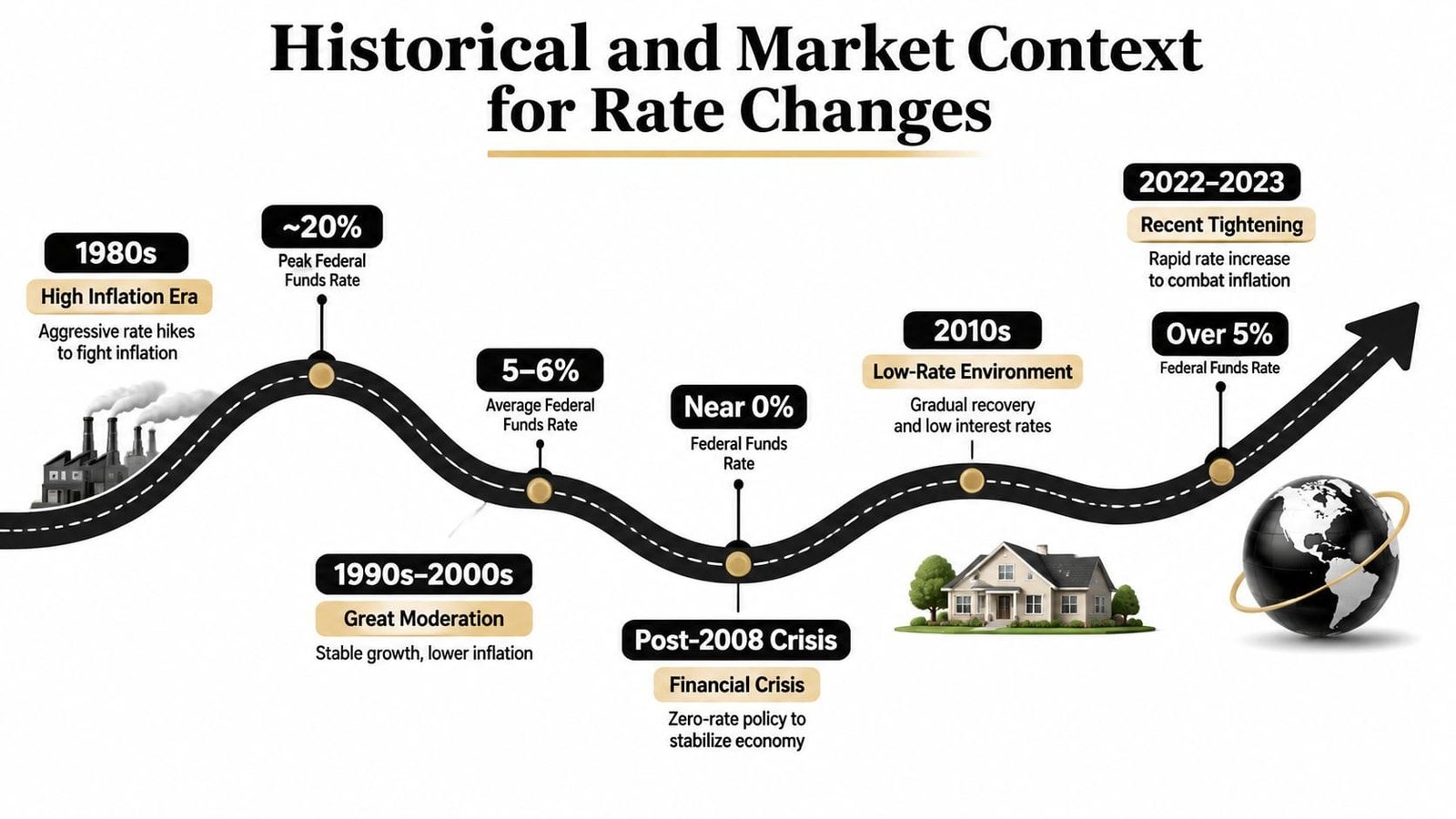
Long-run history shows why today's quote needs context. The federal funds rate averaged 5.39% from 1971 to 2026, reached a record low of 0.25% in December 2008, and had a recent reading of 3.75% in 2026. The Federal Reserve's historical H.15 series places current conditions within a much wider range.
The early 1980s also show how quickly borrowing conditions can change. The Federal Reserve raised the federal funds rate to around 19% in January 1981. The effective rate later peaked at 21.71% in June 1981, while monthly averages reached 22.36% in July 1981. The Richmond Fed's historical account documents that aggressive anti-inflation campaign.
Separate the cycle from the baseline
Policy cycles affect variable loans, new credit offers, and lender funding conditions. A fixed-rate loan may not change when the benchmark moves, while a floating-rate contract can reset according to its index, spread, and timing rules. The headline rate matters, but the agreement determines how that change reaches your bank account.
Long-term history provides perspective rather than a forecast. International comparisons require care because central banks respond to different inflation, currency, and growth conditions. Current small business lending trends in repayment terms and interest rates also show why repayment structure deserves attention alongside the advertised rate.
Before signing, check whether the rate is fixed or floating, how often the benchmark resets, whether the lender can change the margin, and how payments are collected. A historical view should help you set a realistic repayment buffer, not wait indefinitely for a supposedly perfect rate.
Real-World Impact on Cash Flow and Repayments
The same principal can create very different pressure on a business bank account. A merchant cash advance may use frequent collections and a fixed payback amount, a traditional SBA loan may amortize over a longer period, and a variable-rate term loan may change when its benchmark resets. Without the actual principal, fees, term, and payment schedule, no honest comparison can produce a precise monthly payment or total cost.
Compare structure before price
| Loan Type | Monthly Payment | Total Cost |
|---|---|---|
| Short-term merchant cash advance | May not have a true monthly payment, because collections can occur daily or weekly | Fixed payback plus disclosed fees, calculated from the contract |
| Traditional SBA loan | Determined by principal, rate, amortization, and term | Scheduled principal and interest, plus eligible fees |
| Variable-rate term loan | Changes when the benchmark and spread change | Depends on the starting rate, reset rules, and remaining balance |
Consider a restaurant receiving working capital through a merchant cash advance. If collections are tied to card receipts, the business may send more cash during strong sales periods and less during weak periods, but it still loses operating cash frequently. That can be useful for a short, identifiable need, yet it can trap the business if the advance funds recurring losses.
A traditional SBA loan generally offers a more structured repayment pattern, but the owner must qualify and accept the documentation and timing requirements. A variable-rate term loan may provide flexibility, but the owner needs a reserve and a written stress test for every reset date.
Build your own repayment test
Use this sequence before accepting an offer:
- Record net proceeds. Subtract origination fees and any amount withheld from the approved principal.
- List every required payment. Include daily, weekly, monthly, or quarterly obligations.
- Calculate total repayment. Add all scheduled payments, fees, and mandatory charges.
- Map the cash calendar. Compare repayment dates with customer receipts, payroll, rent, taxes, and inventory purchases.
- Stress the contract. For variable debt, model a higher benchmark. For fixed debt, model a revenue decline without assuming refinancing.
- Check the exit. Review prepayment terms, renewal conditions, and whether early repayment reduces the cost.
A loan can be affordable on an annual income statement and still be dangerous on a weekly cash ledger. For a deeper repayment-focused framework, use this guide to choosing business loan repayment terms without sinking cash flow.
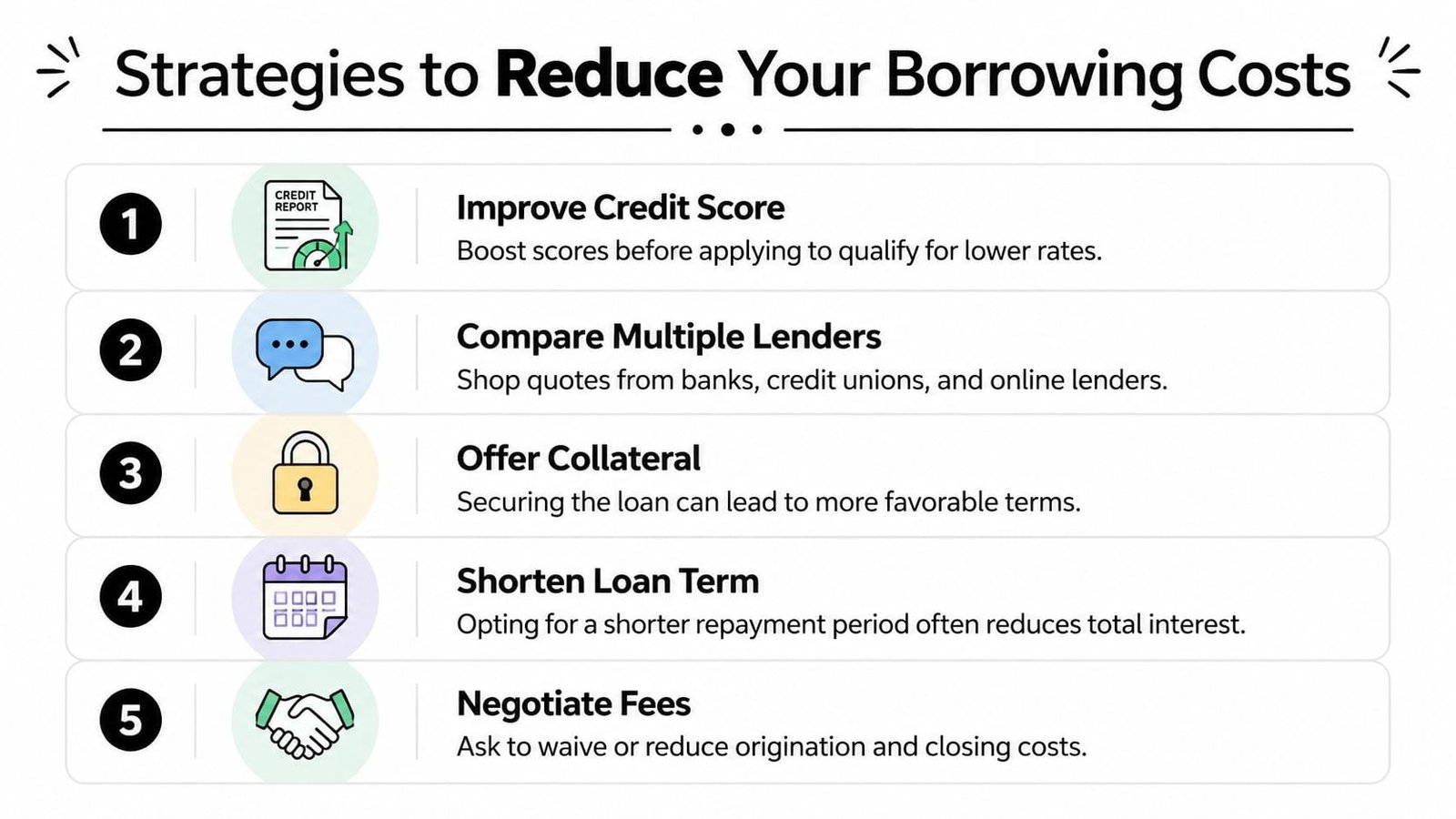
Strategies to Reduce Your Borrowing Costs
Lowering the borrowing cost usually comes from improving the lender's view of risk, selecting a structure that fits the cash cycle, and comparing the full contract. Rate watching alone rarely accomplishes much.
Five actions that produce better comparisons
- Improve the file before applying. Organize financial statements, explain anomalies, reduce unnecessary balances, and show how the requested capital will produce repayment cash.
- Match term to purpose. Don't finance a long-lived piece of equipment with a repayment schedule that drains working capital too quickly. Don't stretch a short-lived need so far that total cost becomes excessive.
- Offer appropriate collateral. Security may improve terms, but weigh the potential asset loss against the pricing benefit and preserve flexibility for future borrowing.
- Shop multiple lenders. Compare banks, credit unions, SBA channels, and alternative lenders by benchmark, spread, fees, reset rules, and payment frequency.
- Negotiate the complete package. Ask about origination charges, covenants, prepayment provisions, renewal fees, and whether the lender can adjust the margin after stronger performance.
The most effective timing strategy is often preparation. If rates fall but your records are weak, you may not capture the benefit. If your credit profile improves after the original loan closed, refinancing can become a second chance, provided the new payment reduction exceeds all refinancing costs and the business can manage the new term.
Don't refinance for a lower rate alone. Recalculate the total remaining cost, every fee, and the point at which savings recover those fees.
Making the Right Financing Decision for Your Business
Start with the purpose of the money, then test the structure against the business's cash cycle. A fixed rate may suit an owner who needs predictable payments and has stable cash flow. A variable rate may be reasonable when the business can absorb volatility, the benchmark is transparent, and the financing period is short enough to limit exposure.
Before signing, confirm:
- Metric: Is the quote an interest rate, APR, or factor rate?
- Benchmark: What index controls the price, and what spread does the lender add?
- Reset: Can the rate change, and how often?
- Payment: How frequently does cash leave the business account?
- Total cost: What will the business repay after fees?
- Exit: What happens if you refinance, prepay, renew, or miss a payment?
- Stress test: Can the business carry the obligation during a weak revenue period?
The best financing choice isn't necessarily the loan with the lowest starting percentage. It's the contract whose repayment demands remain compatible with the business's operating reality. Understanding interest rates becomes valuable when it changes the way you compare offers, forecast cash, and negotiate with lenders.
If the decision involves expansion, equipment, inventory, or refinancing, have a lending professional review the benchmark, spread, fees, and repayment schedule together. A second set of eyes can identify a payment risk that a headline rate hides.
Business Loan Warrior helps small businesses compare funding options, including business loans, SBA financing, lines of credit, equipment loans, merchant cash advances, and refinancing strategies. Visit Business Loan Warrior to explore financing that fits your cash flow, review repayment structures, and connect with lending specialists before you commit.