
An operating line of credit is a revolving financing tool that lets a business draw, repay, and reuse funds up to a preset limit for day-to-day expenses such as payroll, rent, and inventory. In Federal Reserve small-business survey data, 40% of employer firms with financing needs used a business line of credit in one survey year, rising to 42% in another, which shows how central flexible working capital has become. Crestmont Capital's operating line of credit overview explains the product's role in managing expenses that arrive before customer payments.
The need is easy to recognize. It's the middle of the month, payroll is due, rent is scheduled, and your biggest client still hasn't paid a net-30 invoice. Your business may be profitable on paper, but the cash isn't in the bank when the bills arrive.
That mismatch is where an operating line of credit earns its place. It gives you access to a borrowing reserve without forcing you to accept a lump sum and pay interest on money sitting unused. The catch is approval. Lenders don't treat a line as automatic access to cash, and renewal terms can matter as much as the initial approval.
Table of Contents
- The Cash Flow Gap Every Business Owner Knows
- How Draw, Repay, and Reuse Works
- Operating Line of Credit vs Term Loans and Credit Cards
- Real Approval Odds and What Lenders Charge
- How to Qualify and Strengthen Your Application
- When an Operating Line of Credit Is the Right Choice
- Your Next Steps to Secure Flexible Business Funding
The Cash Flow Gap Every Business Owner Knows
Why profitable businesses still run short
A landscaping company can purchase materials before finishing a project. A restaurant may stock inventory before a busy weekend. A consulting firm can deliver work today while waiting weeks for payment. The business owes money now, but its revenue arrives later.
That timing gap is the practical reason to consider an operating line of credit. The lender sets a borrowing limit, and you draw only what the business needs for payroll, rent, inventory, utilities, marketing, repairs, and other ordinary operating expenses. As customers pay, you reduce the balance and restore available credit.
A term loan handles a different problem. It provides one lump sum followed by scheduled principal and interest payments, even if part of the money remains unused. A revolving line fits short-term cash-flow interruptions more closely. Use it when receivables are delayed, not when the company needs permanent funding.
Practical rule: Use revolving credit for timing problems, not for expenses that will remain permanently embedded in the business.
The product exists because timing rarely cooperates
Revenue and expenses rarely arrive together. Wages, supplier invoices, and facility costs remain due while customer invoices sit unpaid. An operating line can cover that temporary mismatch without forcing the owner to seek a new loan each time collections run late.
Approval and renewal deserve as much attention as the initial limit. Lenders review whether the business generates enough cash to repay draws, whether owners manage collections responsibly, and whether the account still fits the lender's rules at renewal. A line that stays near its maximum can signal that the business needs more than a short-term buffer.
Treat the facility as a tool, not as a permanent substitute for working capital. Constant dependence on the full limit points to weak margins, slow collections, excess inventory, or an operating model that needs restructuring. Owners reviewing those underlying processes can seek compliance help from Bookkeeping and Accounting of Florida Inc. as part of a broader working-capital review.
The product remains common because flexible external funding matches uneven business cash flow. The Federal Reserve reported that 37% of firms applied for a loan, line of credit, or merchant cash advance in the prior 12 months, unchanged from 2023 and consistent with pre-pandemic levels. The Federal Reserve employer-firm report places lines of credit within the broader funding choices available to businesses.
How Draw, Repay, and Reuse Works
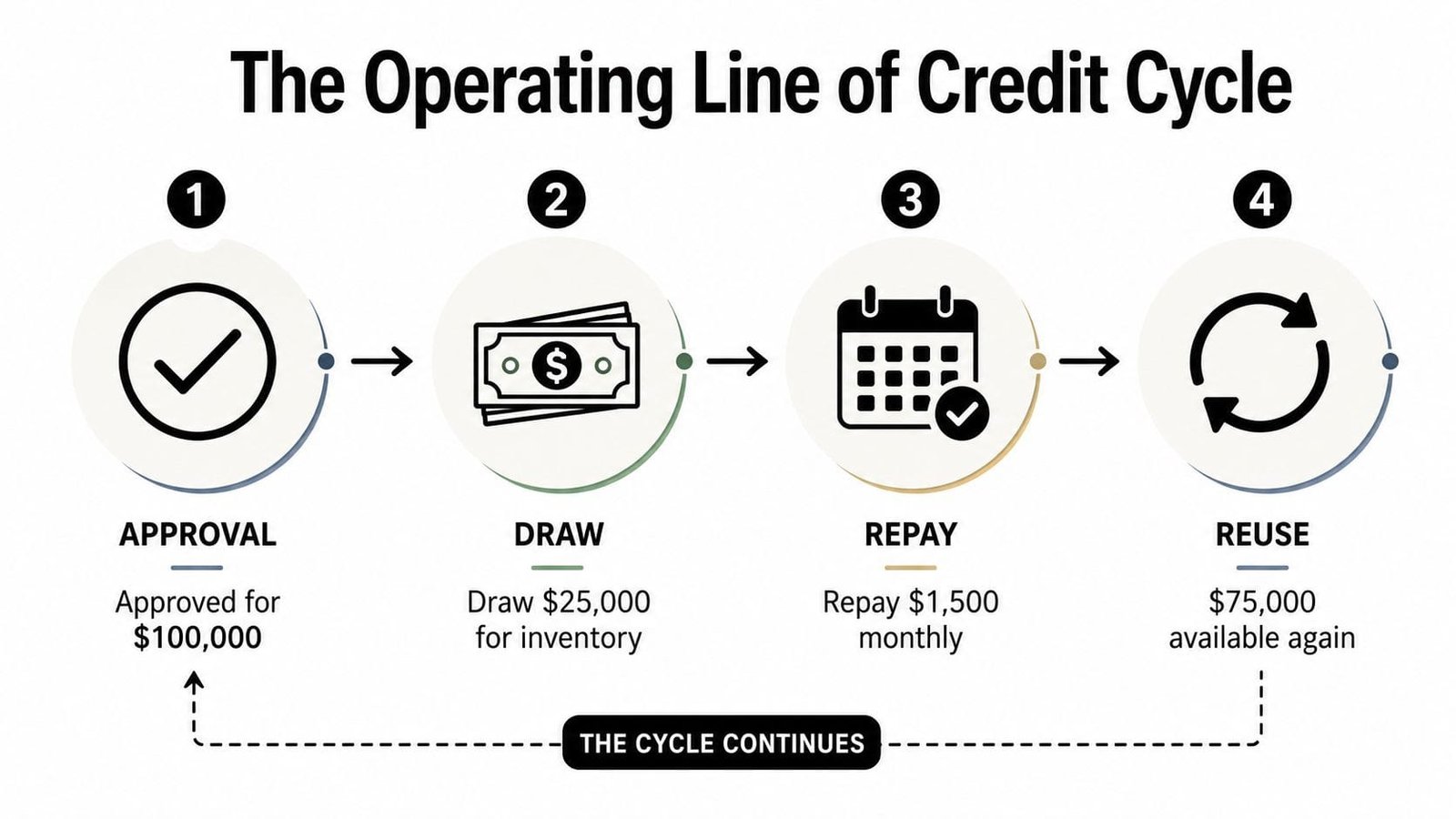
An approved operating line sets your maximum exposure, while interest is calculated on the balance you carry. For example, a lender may approve a $100,000 limit. Drawing $25,000 for payroll or inventory leaves a $25,000 balance and $75,000 available for later use.
The cost advantage comes from matching borrowing to the timing of your cash need. Interest generally applies to the outstanding balance rather than credit left untouched. Your agreement controls the calculation, including the rate structure, billing method, and fees.
The monthly borrowing rhythm
Approval: The lender establishes the credit limit, pricing, collateral requirements, reporting obligations, and renewal terms.
Draw: You access part of the line through the lender's portal, business checking account, transfer process, or another approved method. A $25,000 draw leaves $75,000 available.
Repay: When receivables arrive, you pay down the balance. Paying back the full $25,000 generally restores availability to $100,000, subject to the agreement and account status.
Reuse: You can draw again without submitting a new application for every transaction, provided the facility remains open and you follow its terms.
Costs owners miss during the sales pitch
Variable pricing often follows a benchmark such as prime. Your approved limit can remain unchanged while the cost of carrying a balance rises or falls. The lender may also charge a draw fee, annual maintenance fee, unused-line fee, wire fee, or another administrative charge.
Read the agreement beyond the headline interest rate. Confirm the minimum monthly payment, whether the line is demand-based, whether the lender can reduce availability, and whether annual financial statements are required. SBA describes lines of credit as useful for cyclical growth and recurring needs, while its Working Capital Pilot supports monitored lines up to $5 million with a maximum maturity of 60 months. The SBA lender guidance explains the program context.
A line works best when each draw has a defined purpose and a clear repayment source. Repeated draws without meaningful paydown indicate that the business is carrying long-term debt through a facility priced and reviewed as revolving working capital. At renewal, that pattern can weaken the lender's view of the account and reduce future availability.
Operating Line of Credit vs Term Loans and Credit Cards
The right product depends on the shape of the expense. A line of credit is not automatically cheaper or better just because it's flexible. Match the repayment structure to the way the funded asset or expense produces cash.
| Feature | Operating Line of Credit | Term Loan | Business Credit Card | Merchant Cash Advance |
|---|---|---|---|---|
| Cost of capital | Usually variable pricing, plus possible account fees | Fixed or variable pricing set at origination | Interest and card fees, with rewards sometimes available | Often expensive factor-based pricing and frequent repayment |
| Flexibility of access | Draw, repay, and reuse within the limit | Lump sum, then scheduled repayment | Reusable revolving access for purchases | Usually a lump advance tied to future revenue |
| Repayment structure | Payments depend on the balance and contract | Regular principal and interest payments | Minimum payments or full statement payment | Repayment commonly linked to card or bank receipts |
| Best use case | Uneven cash flow, inventory timing, payroll gaps, and receivables lag | Equipment, real estate, renovations, or another defined purchase | Smaller recurring expenses and controlled vendor purchases | Immediate cash needs when traditional approval is unavailable |
| Speed to funding | Moderate, depending on underwriting and documentation | Moderate to slow for larger secured requests | Often fast once approved | Often fast, with a higher financing cost |
When each alternative makes sense
Choose a term loan when you know the exact amount and purpose. Equipment, a property improvement, or a major expansion project should generally have a repayment schedule that matches the useful life of the purchase. Using a revolving line for a permanent asset can create renewal risk because the lender may expect short-term borrowing to turn over.
A business credit card can suit smaller, repeat purchases, particularly when the owner pays balances promptly and values purchase controls or rewards. It's a poor substitute for a large payroll gap if the balance will linger and the interest rate is high.
A merchant cash advance can provide speed for a business that can't qualify for conventional credit, but the convenience comes with a financing structure that can pressure daily or frequent cash flow. Treat it as a last-resort bridge, not a default working-capital strategy.
For a focused comparison of revolving access and card-based spending, review business line of credit vs. credit card guidance. My recommendation is direct: use a line when cash timing is the problem, a term loan when a specific asset is the problem, a card for controlled small purchases, and an MCA only when the cost is justified by an urgent opportunity or necessity.
Real Approval Odds and What Lenders Charge
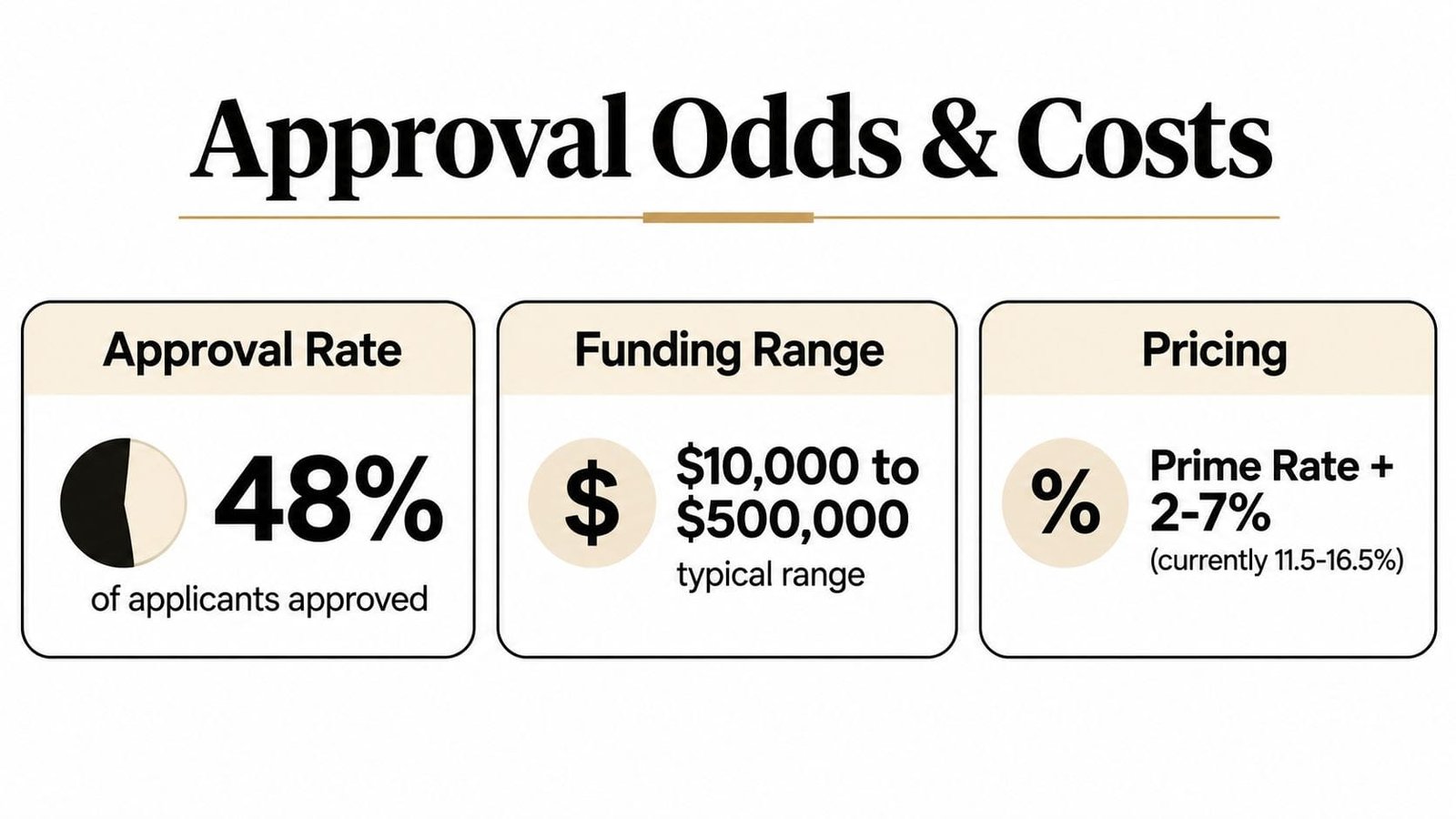
A line of credit is widely used, yet many applicants receive less than requested or leave the process without an offer. Federal Reserve small-business credit survey reporting found that 48% of applicants received the full amount requested, while 21% received only part and 31% were denied. Those figures support a practical approach: request an amount your cash flow can defend, and prepare for a smaller counteroffer. The cited Federal Reserve survey report
About 33% of small businesses currently have an active line of credit, making it the most commonly held financing product in the cited industry reporting. Usage alone does not satisfy underwriting. Lenders review repayment capacity, account activity, revenue quality, existing obligations, and how reliably cash moves through the business cycle.
Pricing moves with the market
Reported U.S. pricing for new lines in the third quarter of 2025 was around 6.99% to 7.38% for fixed-rate lines and 7.63% to 7.91% for variable-rate lines. Those figures are a market reference; your actual rate will reflect credit strength, collateral, revenue, lender type, facility size, and other contract terms.
Variable pricing deserves close attention. Recent coverage cited prime at 7.50% as of September 2, 2025, so the cost of an outstanding balance can change while the credit limit stays the same. The 2025 business line of credit analysis also highlights tighter lending standards and the need to compare total cost, including fees and renewal provisions.
Access varies by business scale. A 2025 SMB cash-flow survey reported that 38% of businesses with $250,000 or less in annual revenue had emergency access to a business line, compared with 63.4% of firms above that threshold. The Bluevine small-business cash-flow survey illustrates the practical point: smaller revenue does not automatically disqualify an applicant, but it can narrow lender appetite and reduce the facility size offered.
Renewal deserves equal attention. A lender may reassess revenue, balances, collateral, and repayment history before extending the facility. Choose a line whose limit and cost remain manageable if the lender reduces availability or declines renewal.
How to Qualify and Strengthen Your Application
Lenders want evidence that your business can draw, repay, and draw again. A polished application can't compensate for chronically negative cash flow, unexplained deposits, or financial statements that don't reconcile. It can, however, prevent avoidable delays and make your request easier to underwrite.
The lender's first-pass checklist
Prepare these items before you apply:
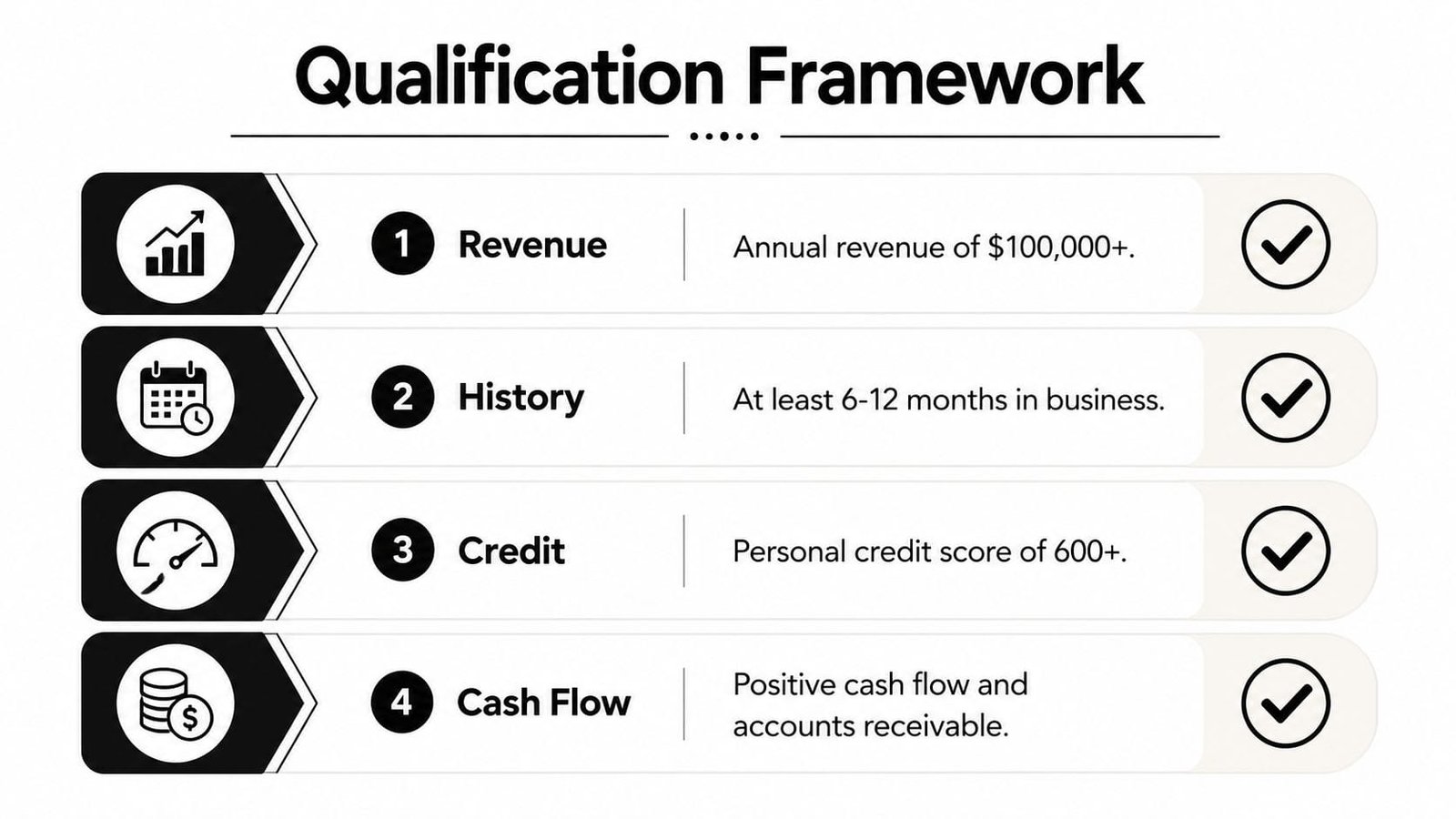
- Revenue history: Show consistent business deposits and explain meaningful fluctuations. Lenders care about the quality and stability of revenue, not just the top-line figure.
- Time in business: A longer operating history gives the lender more bank activity and repayment evidence to review. Newer businesses usually face fewer options or may need collateral and a personal guarantee.
- Credit profile: Review both personal and business credit reports for late payments, high utilization, errors, and unresolved collection accounts.
- Cash-flow support: Connect the requested limit to receivables, inventory turns, seasonal sales, or another identifiable operating cycle.
- Documentation quality: Have tax returns, bank statements, profit-and-loss statements, balance sheets, debt schedules, and ownership information ready in a consistent format.
Don't request an arbitrary maximum. Build the amount from your actual cash-flow gap, then explain how and when repayment will occur. A smaller facility that you can manage successfully may create a stronger record than an oversized request that strains the business.
Renewal is another underwriting event
Many owners focus on getting approved and ignore what happens at review. Lenders can examine utilization patterns, payment history, revenue trends, covenant compliance, account turnover, and whether the business still fits the facility's intended use. A line that was available during a strong period may be reduced, repriced, or declined at renewal if the business's performance or the lender's risk appetite changes.
Banks reported tighter standards and weaker demand for business loans in the 2025 lending environment, which makes preparation more important. Keep financial statements current, reduce unnecessary debt utilization, maintain clean operating accounts, and store tax filings and bank statements where you can retrieve them quickly.
Owners looking for a practical review of eligibility factors can use this guide to line-of-credit eligibility before submitting applications. The goal isn't to make your business look perfect. It's to give the lender a coherent, verifiable explanation of how the facility will be used and repaid.
When an Operating Line of Credit Is the Right Choice
An operating line is the right choice when the need repeats but the amount changes. Seasonal companies often draw to buy inventory before demand arrives, then repay after sales convert that inventory into cash. A service business may use the line while net-30 or net-60 invoices remain outstanding. A growing company might fund hiring or supplier deposits before the related revenue lands.
Unexpected repairs are another reasonable use. If a delivery vehicle, refrigeration system, or essential machine fails, a line can protect operations without forcing the owner to take a large loan unrelated to the immediate repair. The key is that the business has a credible source of repayment.

Four situations that favor a revolving facility
- Seasonal inventory: Draw before the sales period, then pay the balance down as customers purchase the goods.
- Receivables lag: Cover payroll and suppliers while invoices remain unpaid.
- Controlled expansion: Fund variable hiring, materials, or marketing tied to visible demand rather than financing an entire expansion upfront.
- Operating surprises: Handle a necessary repair or short-term disruption without draining every cash reserve.
A line is usually the wrong tool for a one-time building project, property purchase, or equipment acquisition. Use a term loan when the expense has a defined amount and useful life. A credit card may be more appropriate for smaller recurring purchases that you can pay promptly. An MCA may be available for emergency same-day funding when traditional credit isn't accessible, but the repayment pressure and total cost require careful scrutiny.
The warning signs
The line becomes expensive when you carry balances for long periods, ignore unused-line or standby charges, draw without a repayment plan, or assume renewal is guaranteed. It also creates risk when the lender can demand repayment or reduce the limit while your business still depends on it.
Review the trade-offs in this line-of-credit pros and cons guide before signing. My position is simple: if you can identify the cash coming in to repay each draw, a line can be disciplined working capital. If you can't, it's covering a structural deficit and deserves a different solution.
Your Next Steps to Secure Flexible Business Funding
Start with your own bank activity. Review cash inflows and bill dates across several operating cycles. Mark recurring shortfalls, then decide whether each gap is temporary or signals a profitability problem.
Prepare the application around evidence:
- Gather recent bank statements, tax returns, and current financial statements.
- Check personal and business credit for errors and high utilization.
- Set the requested limit against the largest recurring cash-flow gap, not an optimistic sales forecast.
- Compare pricing, draw rules, fees, collateral, personal guarantees, and renewal terms.
- Apply only to lenders whose requirements fit your business profile.
Approval is more realistic when revenue is reliable, the working-capital cycle is clear, and operating history lets the lender verify performance. Choose a term loan for a permanent asset with a defined cost and useful life. Choose a business card for smaller purchases you can repay quickly. Businesses paid through delivery marketplaces can also review financial services for delivery platforms to organize banking and cash-flow access.
Before accepting an offer, ask how often the line is reviewed, what can reduce the limit, and whether repayment can be demanded early. Renewal is a fresh underwriting decision, not a promise. Keep records current, borrow modestly, and match every draw to a documented repayment source.
Business Loan Warrior offers a no-fee application that may allow owners to check pre-approval without affecting credit, connect bank accounts, and track approvals and credit insights through a secure dashboard. Its lender-matching process can help compare lines of credit and other funding options. Visit Business Loan Warrior to prepare a request based on actual cash-flow needs.